Complete acetabular dissociation from axial skeleton - the 'floating acetabulum'
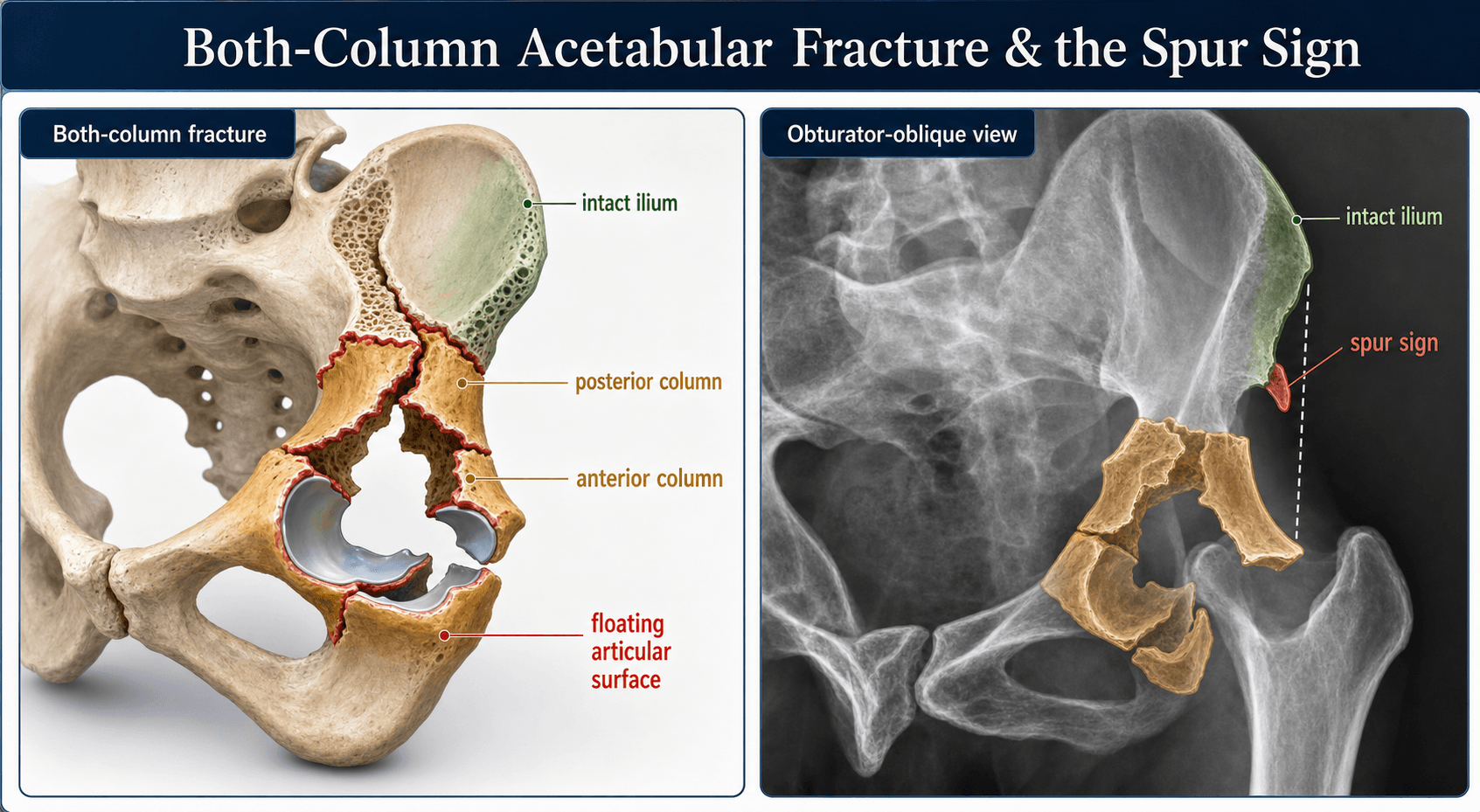
- SPUR SIGN is PATHOGNOMONIC - intact ilium above detached columns
- Entire articular surface is FLOATING (not attached to spine)
- Most common associated pattern in Letournel classification
- Secondary congruence may allow conservative treatment in elderly
- Young patients with displaced fractures need ORIF
- “Spur sign = both column (on obturator oblique view)
- “Distinguishing from transverse: transverse maintains some dome attachment
- “Iliopectineal AND ilioischial lines both disrupted
- “Secondary congruence: femoral head pushes fragments into alignment
- “Combined approaches often needed (ilioinguinal + Kocher-Langenbeck)
Overview and Epidemiology
One pattern within a family. Both-column is the commonest of Letournel's associated patterns, and it only means anything against the others - the full classification, the two Judet views and the operative approaches are on acetabular fractures. What makes this pattern distinct is that no part of the articular surface stays attached to the intact ilium, which is why it alone can show secondary congruence and be treated non-operatively in a patient who could not survive the alternative. The injury it travels with is hip dislocation, it sits within the wider spectrum of pelvic ring injuries, the nerve at risk posteriorly is the sciatic, the complication that most often spoils an otherwise good reduction is heterotopic ossification, and when the acetabulum is ultimately reconstructed the defect is graded by Paprosky.
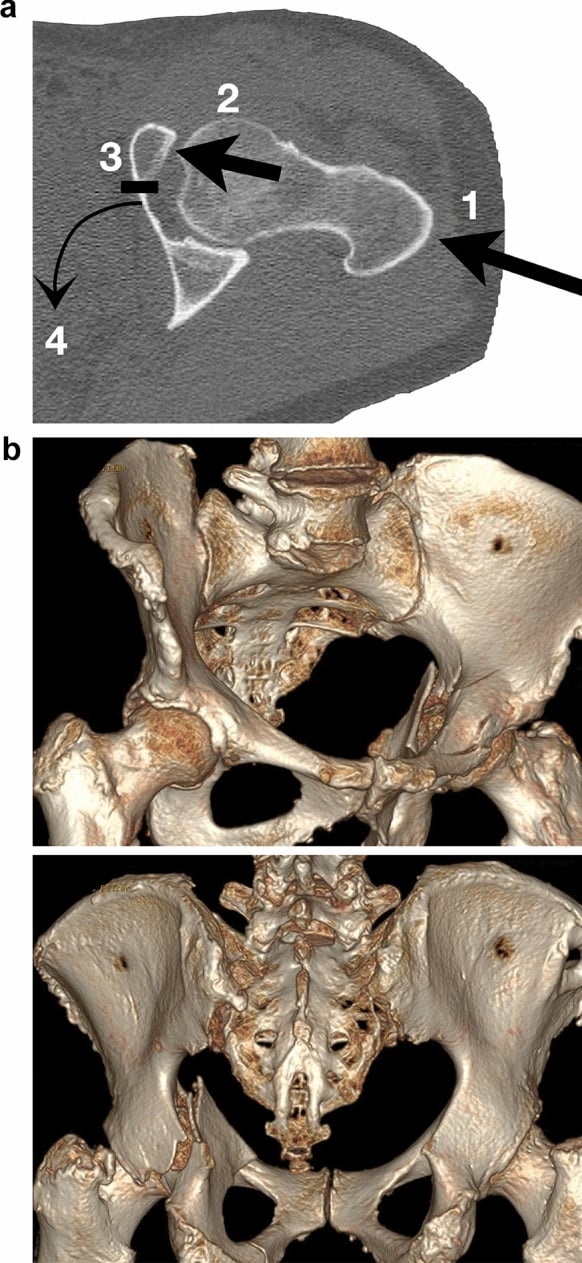
The definition. Both the anterior and the posterior column are completely fractured and the fracture lines run out above the dome, so no fragment of articular surface is left attached to the intact ilium. The whole acetabulum floats below an ilium that is still joined to the sacrum, and that intact ilium sitting above the detached columns is the bone that throws the spur sign. A transverse fracture keeps some of the dome attached above its fracture line, and has no spur.
How common. Both-column accounts for 20-25% of all acetabular fractures. It is a complex injury and needs expert management.
Mechanism. High-energy trauma driving an axial load through the femoral head, which transmits the force to both columns.
Who. The age distribution is bimodal. Young patients, with a male predominance, break the acetabulum in high-energy trauma; older patients break the same bone in lower-energy injuries through osteoporotic bone.
Anatomy and Biomechanics
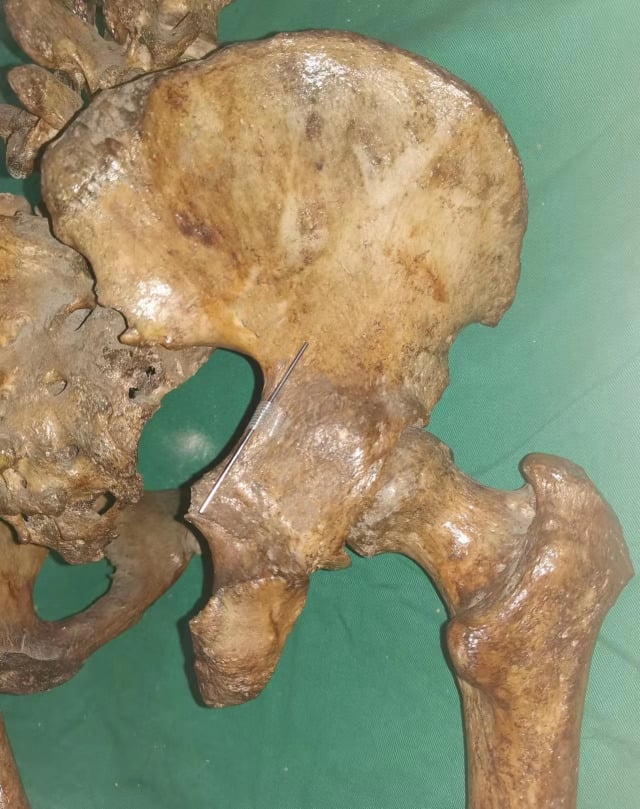
The two-column model. The acetabulum is suspended between two columns of bone, and the classification of every acetabular fracture is built on which of them is broken.
The anterior (iliopubic) column extends from the iliac crest to the symphysis and takes in the anterior part of the iliac wing, the anterior wall and the pubic ramus. It forms the anterior half of the acetabular dome.
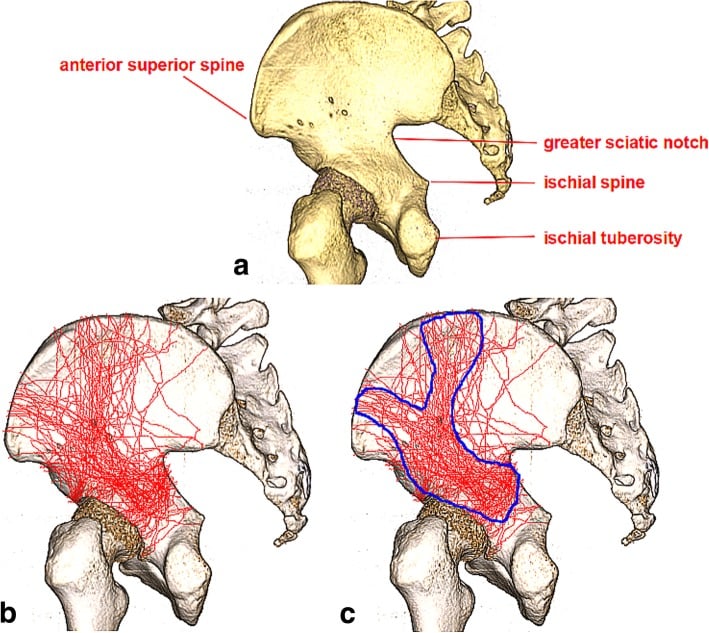
The posterior (ilioischial) column extends from the greater sciatic notch to the ischial tuberosity and takes in the notch, the posterior wall and the tuberosity. It forms the posterior half of the dome.
Each column has a line on the radiograph. The iliopectineal line runs from the iliac crest to the pubis and represents the anterior column; the ilioischial line runs from the greater sciatic notch to the ischium and represents the posterior column. Break a column and its line breaks with it.
Classification Systems
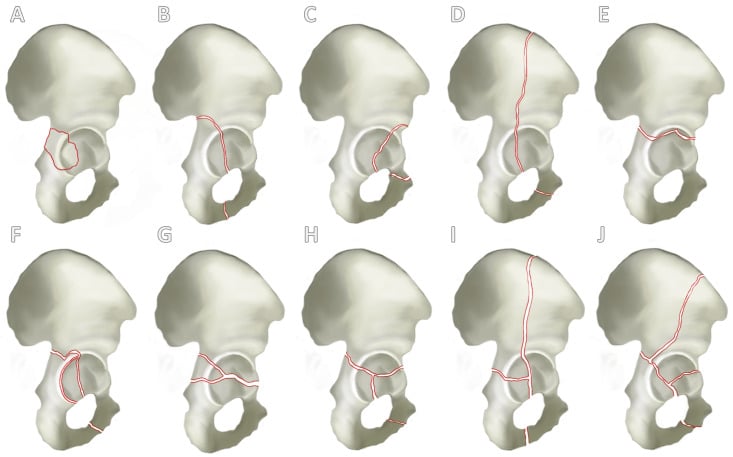
Where it sits in Letournel. The classification has ten patterns: five elementary and five associated. The elementary five are the anterior wall, the anterior column (running from iliac crest to pubis), the posterior wall (the most common elementary pattern), the posterior column (the ilioischial line), and the transverse fracture, which divides the acetabulum into superior and inferior halves. The associated five combine them:
- T-shaped - a transverse fracture with a vertical component
- Posterior column plus posterior wall - a common combination
- Transverse plus posterior wall - additional instability
- Anterior column or wall plus posterior hemitransverse - a complex associated pattern
- Both column - the pattern this topic covers
Subtypes worth naming. Where the fracture exits the ilium decides which approach reaches it:
- High both column - the fracture exits through the iliac crest
- Low both column - it exits through the sciatic notch
- With a posterior wall component - additional instability, and it must be looked for
Telling it from its neighbours. Four other patterns are mistaken for it, and each is separated by one finding.
- Discriminating feature
- NO articular fragment attached to axial skeleton (floating acetabulum)
- Lines / sign
- Spur sign on obturator oblique; both lines disrupted
- Why it matters
- Only pattern with secondary congruence; anterior/combined access
- Discriminating feature
- Roof segment remains attached to intact ilium
- Lines / sign
- No spur sign; both lines broken at one level
- Why it matters
- No secondary congruence; level dictates approach
- Discriminating feature
- Posterior column broken only below (hemitransverse); part of roof stays attached
- Lines / sign
- Iliopectineal line broken; partial ilioischial break
- Why it matters
- Mimics both column but NOT floating - no true spur
- Discriminating feature
- Transverse plus vertical (stem) split of the inferior fragment
- Lines / sign
- Both lines plus obturator ring disruption
- Why it matters
- Quadrilateral plate displacement; harder reduction
- Discriminating feature
- Marginal impaction / posterior instability dominates
- Lines / sign
- Posterior wall fragment on obturator oblique
- Why it matters
- Hip instability and AVN risk dominate
Clinical Assessment
How they arrive. The mechanism is high-energy and the patient is a trauma patient first, so the assessment is an ATLS one: polytrauma is common, an associated pelvic ring injury is possible, and the same leg may carry other injuries. The mechanisms that produce this fracture:
- Motor vehicle accident, classically a dashboard injury
- Motorcycle accident
- Fall from height
- Pedestrian struck
- Sports - skiing, equestrian
Force transmission. The load passes axially through the femoral head into both columns, and the position of the hip at impact determines which pattern results.
The hip itself. If the head has dislocated the limb lies shortened and externally rotated. Otherwise the findings are pain on hip motion, inability to bear weight, and tenderness over the hip and pelvis.
Sciatic nerve injury occurs in 10-15% of acetabular fractures, especially posterior patterns. Document detailed L5 (great toe extension) and S1 (ankle plantarflexion) function BEFORE any intervention. Peroneal division is more vulnerable - foot drop is the classic presentation.
The examination that has to be written down. Motor function by root level:
- Hip flexion (L1-2)
- Knee extension (L3-4)
- Ankle dorsiflexion (L4-5)
- Great toe extension (L5) - most vulnerable
- Ankle plantarflexion (S1)
Sensation by dermatome: lateral thigh (L2), medial leg (L4), dorsum of the foot (L5) and lateral foot (S1).
Injuries that travel with it. Femoral head fracture (Pipkin), femoral neck fracture, hip dislocation, ipsilateral knee injuries from the dashboard, and contralateral injuries.
Investigations
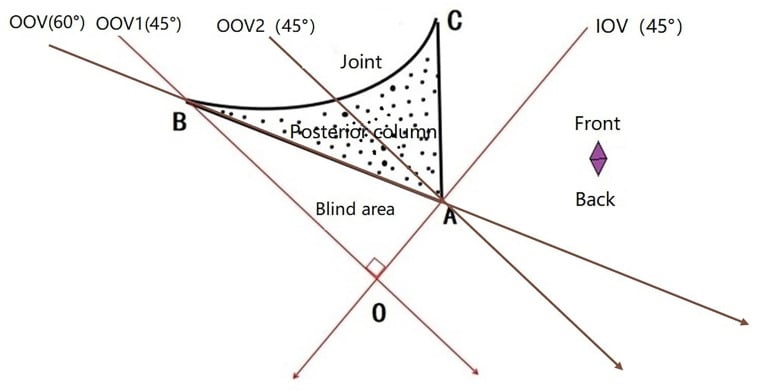
The Judet series. Three films: an AP pelvis and the two 45 degree obliques. Each answers a different question, and the pattern is not called from one of them alone.
- AP pelvis - both the iliopectineal and the ilioischial line are disrupted; assess roof involvement and the position of the femoral head
- Obturator oblique (45 degrees) - the key view. The spur sign is visible here and nowhere else, with the anterior column in profile and the posterior wall en face
- Iliac oblique (45 degrees) - the posterior column in profile, the anterior wall en face, and the greater sciatic notch
CT. Essential for surgical planning, taken as 2mm axial cuts through the acetabulum with coronal and sagittal reformats. It is read for the extent of the fracture in each column, articular congruence, the integrity of the femoral head, intra-articular fragments and marginal impaction.
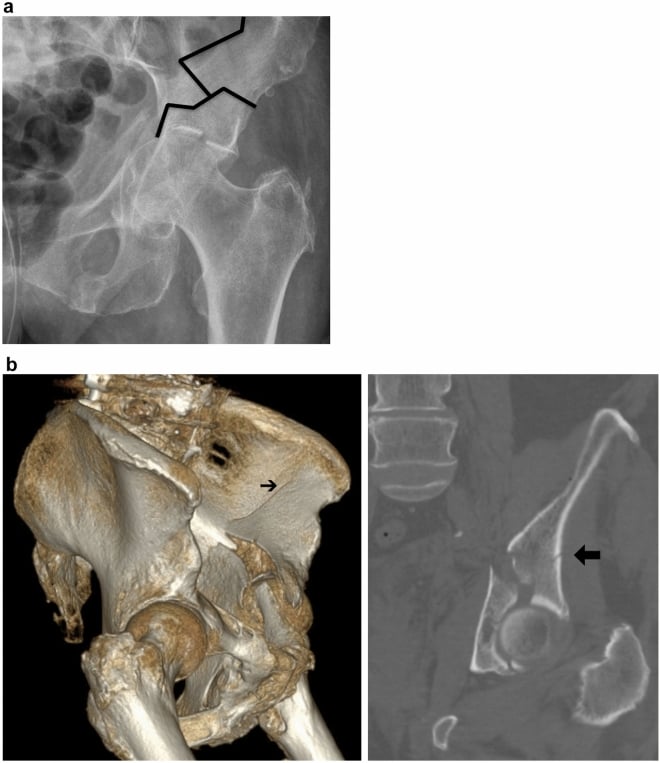
The 3D reconstruction demonstrates the disruption of both columns and makes the floating acetabulum obvious. It is the study the operation is planned from, and the one the patient and the team can be shown.
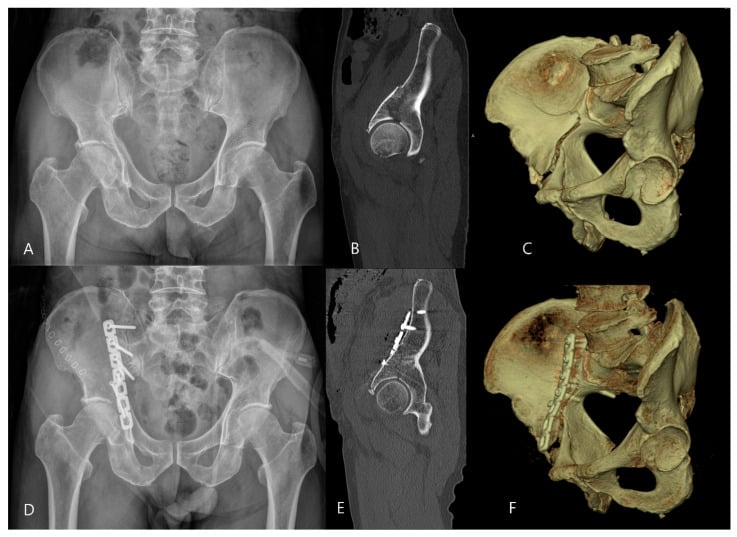
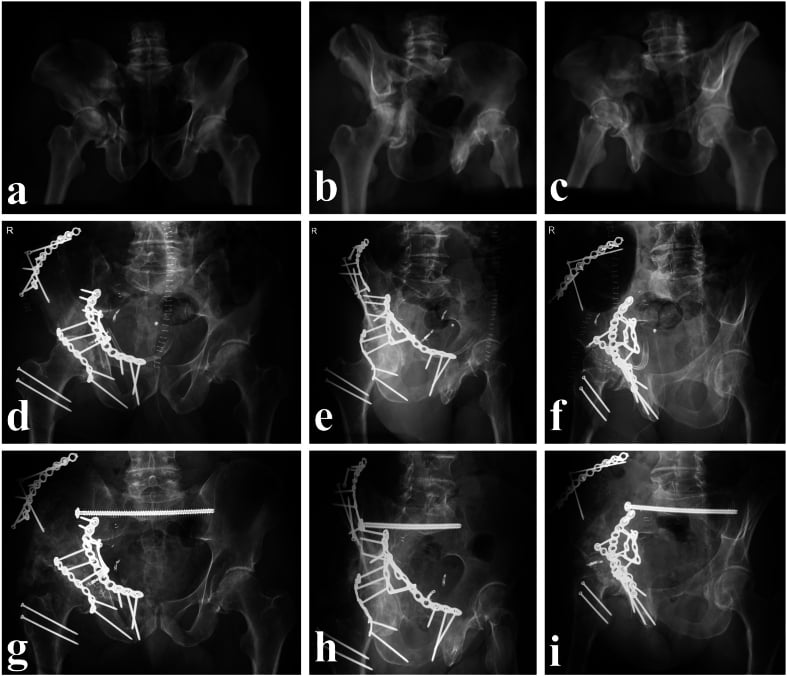
Medialisation. When the quadrilateral plate is pushed medially the femoral head follows it, and medialisation of the head is the finding that turns an argument about surgery into a decision.
Assessing secondary congruence on CT. The measurements that decide whether the floating fragments have come to lie acceptably are the roof arc measurements, the articular step-off, the size of any gap, and the overall congruence of the surface against the head.
Roof arc angles (Matta) and the CT subchondral arc. The roof arc angles quantify whether the weight-bearing dome is intact. Each is measured from the geometric centre of the acetabulum between a vertical line and a line to the fracture exit through the roof, on the three plain views:
- Medial roof arc - on the AP view
- Anterior roof arc - on the obturator oblique view
- Posterior roof arc - on the iliac oblique view
If all three arcs exceed ~45 degrees, the superior weight-bearing dome is intact and the fracture may be managed non-operatively. The CT equivalent is the subchondral (10 mm) arc rule: if the fracture spares the cranial 10 mm of subchondral bone on the top axial cuts, the dome is preserved.
Roof arc angles are validated for transverse and column (anterior/posterior) patterns - they cannot be applied to posterior wall fractures (the dome is intact but the hip is unstable) and they are not meaningful in a both-column fracture, because no roof remains attached to the axial skeleton. In the both-column fracture the analogous question is whether secondary congruence has restored a functional articular surface.
Management
Secondary congruence. Because the entire acetabulum is detached, the femoral head can act as a mould and push the fragments into acceptable alignment during weight-bearing, creating a functional weight-bearing surface despite the fracture. That is why the phenomenon belongs to this pattern alone, and it is more common in elderly patients with comminuted fractures.
The decision turns on two questions: whether secondary congruence is present on CT, and what this patient needs from the hip. A displaced fracture in a young patient is reconstructed; an elderly patient with a congruent joint and comorbidities may be better served by never being anaesthetised.
- Finding
- Pathognomonic for both column
- Action
- CT scan for surgical planning
- Finding
- Femoral head reduces fragments
- Action
- Consider non-operative in elderly
- Finding
- Displaced fragments, incongruent
- Action
- ORIF indicated
- Finding
- Any displacement beyond 2mm
- Action
- Surgical fixation required
- Finding
- Femoral head centered under roof
- Action
- May tolerate some displacement
Who is treated without an operation. The candidate has a congruent joint or cannot survive the alternative:
- Secondary congruence present, with the femoral head moulding the fragments into alignment
- Elderly, low-demand patient with an acceptable articular surface
- Medical comorbidities precluding major surgery
- Roof arc measurements greater than 45 degrees in all planes
- Minimal displacement with acceptable articular congruence
A note on the roof arcs. They appear in these criteria and in the algorithm because they are the general acetabular rule, but in a both-column fracture no roof stays attached to the axial skeleton for them to measure. Secondary congruence is the assessment that actually decides.
The protocol. Skeletal traction for 2-4 weeks, then progressive mobilisation, with weight-bearing restrictions maintained for 6-12 weeks. Serial radiographs monitor the alignment, and losing it converts the plan to surgery.
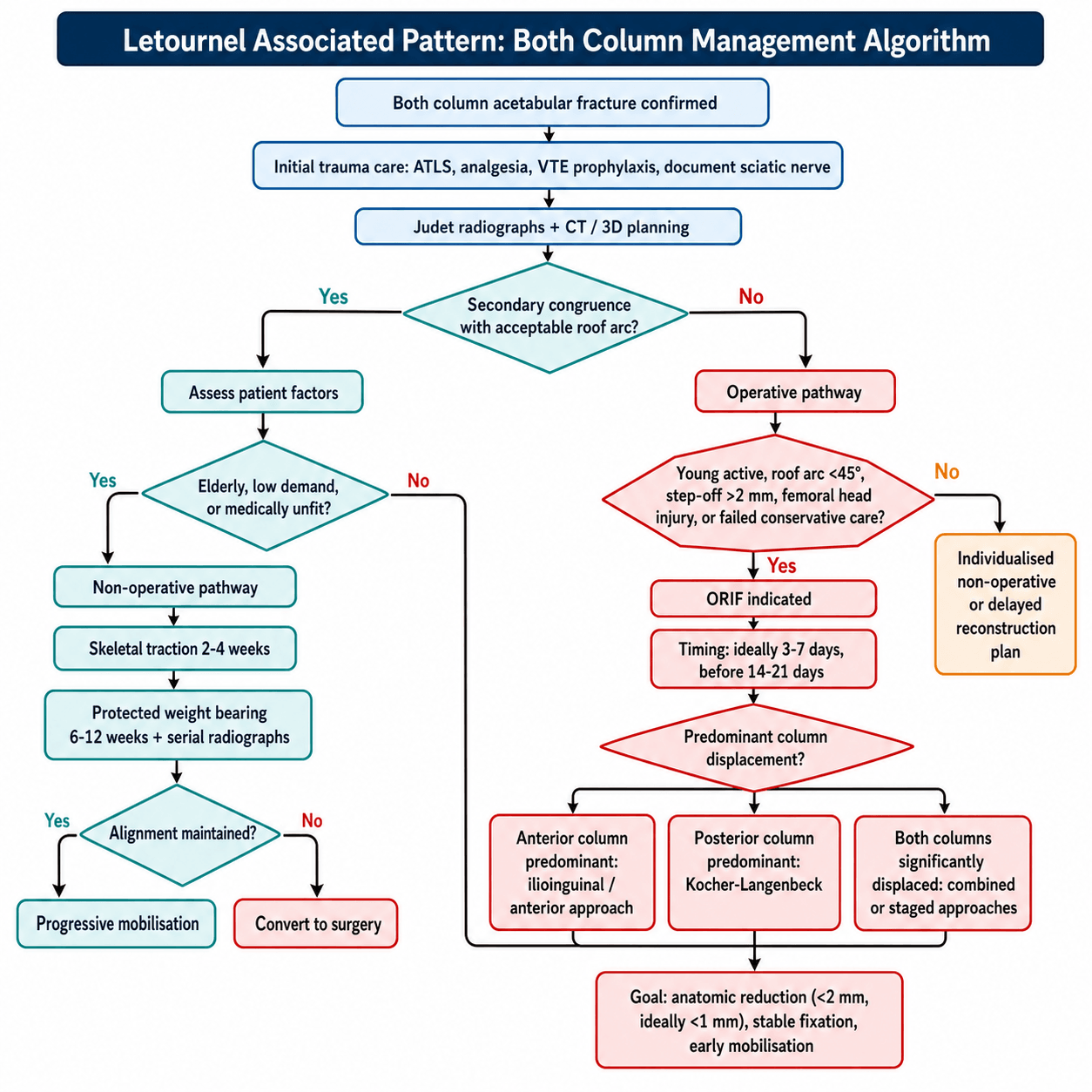
A young patient with a displaced both-column fracture needs ORIF whether or not the femoral head has moulded the fragments - secondary congruence buys a low-demand hip a reasonable result, not a young one.
Surgical Technique
What it gives you. The anterior column from the iliac crest to the pubic symphysis, the quadrilateral surface and inner table of the ilium, and the superior pubic ramus with the pelvic brim.
When to use it. Anterior-column-predominant both-column fractures, and high both-column variants exiting through the iliac crest.
Structures at risk. The external iliac vessels in the middle window, the femoral nerve lateral to them, the lateral femoral cutaneous nerve over the ASIS, and the corona mortis behind the superior pubic ramus.
The technique. Three windows are created - lateral, middle and medial. The lateral femoral cutaneous nerve is identified and protected, and the iliac vessels and femoral nerve are protected within the middle window.
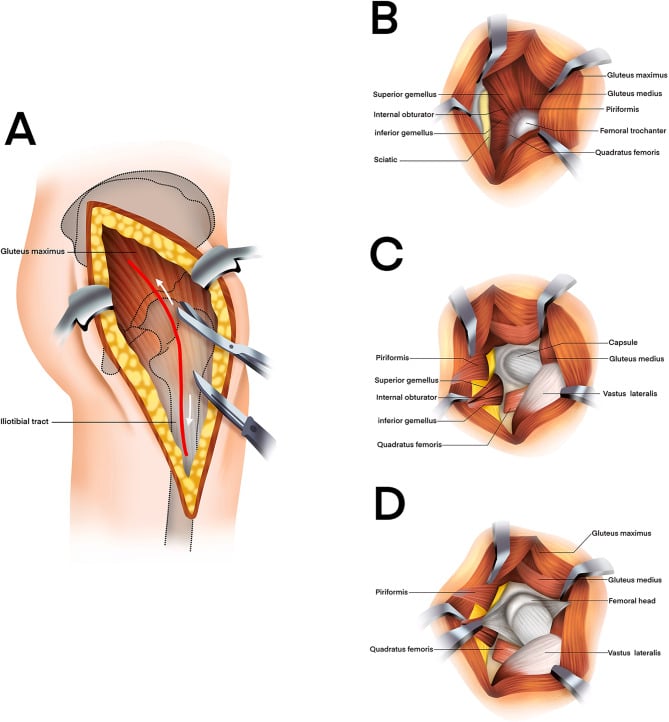
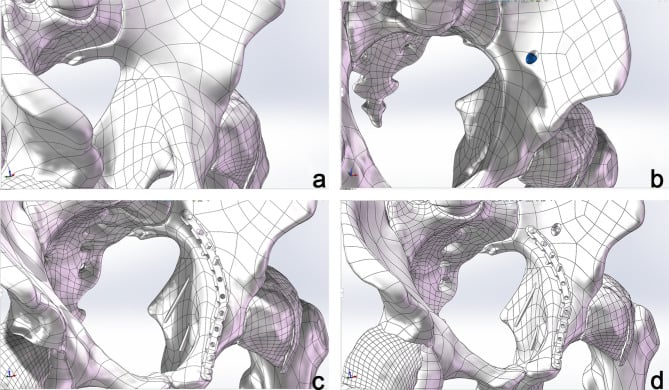
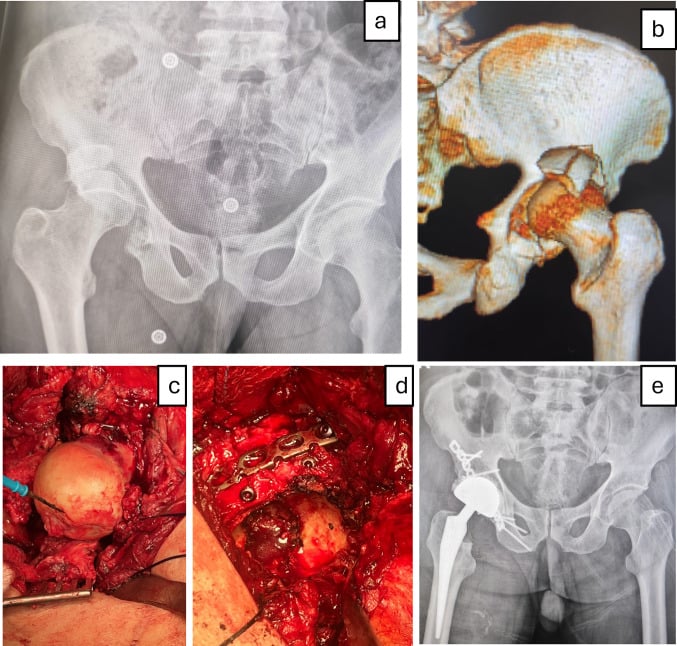
Anterior approach: Corona mortis - a retropubic anastomosis between the obturator and external iliac systems - is present as some variant in most hemipelvises (an arterial variant in the classic 15-30%). Identify and ligate before division. External iliac vessels protected in middle window. Posterior approach: Sciatic nerve must be identified and protected throughout, with the knee flexed. Avoid excessive retraction which damages medial femoral circumflex artery.
Complications
Nerve injury. The sciatic nerve is at risk from the injury and from the exposure, which is why the deficit is documented before anyone operates.
Vascular injury. The corona mortis with the ilioinguinal approach, the superior gluteal artery with the posterior approach, and the external iliac vessels in the middle window.
Thromboembolism. DVT risk is very high and pulmonary embolism is a significant concern, so prophylaxis is essential.
Infection. Surgical site infection is more common with the extensive approaches these fractures require, and careful handling of the skin matters.
Post-traumatic arthritis is the most common long-term complication and its likelihood follows the quality of the reduction. A hip replacement may be needed.
Heterotopic ossification is common after extensive approaches and may limit range of motion. Prophylaxis is indometacin or radiation.
Avascular necrosis of the femoral head follows an associated posterior dislocation, particularly where reduction was delayed, and carries a poor prognosis.
Postoperative Care
The first 48-72 hours. Monitor for compartment syndrome and check neurovascular status. DVT prophylaxis is mandatory given the risk, the wound is cared for with drains out at 24-48 hours, and pain is managed to allow early mobilisation as tolerated.
Weight-bearing. Touch weight-bearing to begin with, using crutches or a frame, progressed according to the fracture pattern and the stability of the fixation. Protected weight-bearing typically continues for 8-12 weeks.
Outcomes/Prognosis
Reduction quality decides the result. It is the strongest predictor of outcome there is, and an anatomic reduction of less than 1mm achieves good to excellent results in 80-90%. Combined approaches allow adequate access for most patterns.
What makes it worse. An articular step-off greater than 3mm strongly predicts post-traumatic arthritis, an associated femoral head injury worsens the prognosis, and a reduction compromised by delay carries its penalty into the result.
- Step-off
- Less than 1mm
- Good/Excellent Outcome
- 80-90%
- Step-off
- 1-3mm
- Good/Excellent Outcome
- 60-70%
- Step-off
- Greater than 3mm
- Good/Excellent Outcome
- Less than 30%
Guidelines, Registries & Global Practice
Global Epidemiology
According to large registry data, the epidemiology of acetabular fractures is shifting worldwide from high-energy injuries in young men towards low-energy falls in older adults. In the German Pelvic Multicentre registry of 2,853 unilateral acetabular fractures, the mean age was 61.5 years and rising, with a parallel shift from simple patterns to complex fractures involving the anterior column. Both-column fractures are the single most common associated pattern, accounting for roughly a third of operatively treated acetabular fractures in the Matta series.
National Registry: Epidemiologic & Treatment Trends
- German Pelvic Multicentre registry: 2,853 acetabular fractures over 10 years; mean age 61.5 years and rising, with a shift from simple patterns towards complex anterior-column-involving fractures.
- Operative treatment in 62.5%; anterior intrapelvic approaches progressively replaced the extrapelvic ilioinguinal approach. Anatomical reduction in only 47.4% (31.7% imperfect, 20.9% poor); high-volume centres achieved significantly better reductions. In-hospital mortality stable at 3.3%.
Guideline & Society Positions (Side by Side)
- Position
- Restore congruent, stable joint; anatomical reduction of articular surface; anterior intrapelvic / ilioinguinal for anterior-dominant both-column
- Evidence basis
- Expert consensus + observational series
- Position
- Suspected acetabular fractures referred early to a specialist pelvic & acetabular unit; CT for all; definitive surgery by a specialist team
- Evidence basis
- Standard of care / consensus
- Position
- Centralisation to high-volume centres improves reduction quality and outcome
- Evidence basis
- Registry & observational
- Position
- Consider fix-and-replace or acute total hip arthroplasty when articular surface is non-reconstructable
- Evidence basis
- Level IV (Mears)
The "Gull Sign" in Geriatric Acetabular Fractures
In older patients (typically an anterior-column / anterior-column-posterior-hemitransverse pattern), superomedial dome impaction produces a characteristic radiographic "gull sign" (a seagull-wing appearance of the impacted roof). It is an important predictor of poor ORIF outcome — the impacted, osteoporotic articular surface is difficult to reconstruct durably — and is one of the features (alongside femoral-head impaction, marginal/articular comminution and large-area dome impaction) that favours acute total hip arthroplasty / fix-and-replace over attempted reconstruction in the frail elderly.
Registry Evidence
Joint and trauma registries (the German Pelvic Registry, and for the arthroplasty endpoint the NJR of England and Wales, AOANJRR in Australia, AJRR in the USA and the Swedish/Nordic registries) consistently show two themes: reduction quality and outcome improve with surgeon and centre volume, and a growing proportion of older patients are managed with primary or salvage total hip arthroplasty rather than ORIF.
Global Practice Variation
- High-resource settings: routine CT with 3D reconstruction, anterior intrapelvic (Stoppa-type) approaches, and increasing fix-and-replace/acute THA in the elderly.
- Limited-resource settings: greater reliance on traction and non-operative management exploiting secondary congruence, and on single-approach plating where combined exposures or arthroplasty are not feasible.
- Universal principles: early specialist referral, meticulous documentation of sciatic nerve function, thromboprophylaxis, and heterotopic ossification prophylaxis (indometacin or single-dose radiotherapy) after extensile posterior exposures.
Viva Scenarios
Clinical Decision Scenarios
Practise clinical reasoning and management decisions out loud
“A 35-year-old woman is in a high-speed MVA. X-rays show disruption of both iliopectineal and ilioischial lines, with a spur sign on obturator oblique. CT confirms both column acetabular fracture with 5mm articular step-off. Describe your management approach.”
“Explain the spur sign and how it distinguishes both column fractures from transverse fractures.”
“An 80-year-old woman with multiple comorbidities has a both column acetabular fracture from a low-energy fall. CT shows secondary congruence with acceptable articular alignment. How would you manage this patient?”
MCQ Practice Points
Q: Which radiographic sign is pathognomonic for both column acetabular fractures?
A: SPUR sign on obturator oblique view. The spur represents intact superior ilium above the completely detached anterior and posterior columns. This sign confirms that NO articular surface remains attached to the axial skeleton.
Q: How do you differentiate both column fracture from transverse fracture?
A: Spur sign is present only in both column fractures. In transverse fractures, some dome remains attached to the axial skeleton above the fracture line. In both column, NO articular surface has any attachment to the spine - the entire acetabulum floats.
Q: Which radiographic lines are disrupted in both column acetabular fractures?
A: BOTH iliopectineal AND ilioischial lines are disrupted. Iliopectineal represents anterior column, ilioischial represents posterior column. Disruption of both confirms involvement of both columns.
Q: What is secondary congruence and when does it allow conservative treatment?
A: Secondary congruence occurs when the femoral head molds the floating acetabular fragments into acceptable alignment. It is unique to both column fractures and may allow conservative treatment in elderly, low-demand patients with acceptable roof arc measurements.
Q: What is the most important prognostic factor after acetabular fracture surgery?
A: Reduction quality. Anatomic reduction (less than 1mm step-off) achieves 80-90% good outcomes. Greater than 3mm step-off is strongly predictive of post-traumatic arthritis.
Key Features
- 20-25% of acetabular fractures (most common associated)
- NO articular segment attached to axial skeleton
- BOTH iliopectineal AND ilioischial lines disrupted
- SPUR sign on obturator oblique is pathognomonic
Radiographic Findings
- Obturator oblique shows SPUR sign
- Both column lines disrupted
- CT with 3D for surgical planning
- Assess for secondary congruence
Management
- Young patient displaced: ORIF (combined approaches)
- Elderly with secondary congruence: conservative
- Timing: within 2 weeks for best outcomes
- Reduction goal: less than 2mm step-off
Surgical Approaches
- Ilioinguinal for anterior column
- Kocher-Langenbeck for posterior column
- Combined approaches often needed
- Sciatic nerve injury risk 10-15%
Key Pitfalls
- Missing spur sign (only on obturator oblique)
- Confusing with transverse (transverse has dome attached)
- Not documenting sciatic nerve preoperatively
- Delaying surgery beyond 2 weeks
Evidence Base
Letournel Classification & Congruence (Founding Paper)
- Letournel's founding paper codified the ten-pattern column classification and the principle that outcome is governed by congruence between the femoral head and acetabular roof.
- Defined total, partial and apparent (secondary) incongruence; in nine fractures, displaced fragments regrouped around the femoral head to give apparent congruence, with seven achieving very good clinical results despite overall displacement.
Both-Column Outcomes & Secondary Congruence Biomechanics
- In a cohort of both-column fractures treated with anterior and posterior (bicolumnar) plating, 80% achieved excellent-to-good results with a mean modified Harris Hip Score of 85.7.
- Highlights that biomechanical data show non-operative reliance on secondary congruence raises peak supra-acetabular contact pressures, with a risk of post-traumatic osteoarthritis, supporting operative reconstruction in fit patients.
Operative Series: Both-Column Most Common Associated Pattern
- In 262 displaced acetabular fractures operated within 21 days, associated patterns accounted for 79%, with both-column the single most common type (92 hips, 35%).
- The vast majority were managed through a single approach (Kocher-Langenbeck, ilioinguinal or extended iliofemoral); only 4 hips required a combined ilioinguinal plus Kocher-Langenbeck exposure.
Acute Total Hip Arthroplasty for Selected Fractures
- In 57 patients (mean age 69) with displaced acetabular fractures and features predicting poor ORIF outcome (articular comminution, full-thickness cartilage loss, femoral head impaction, acetabular impaction of more than 40% of the joint surface), acute THA gave 79% excellent or good results at a mean of 8.1 years.
- No cup or stem developed late loosening, establishing acute arthroplasty as a viable primary option in the elderly with non-reconstructable joint surfaces.
Corona Mortis Anatomy: Surgical Hazard
- In 62 hemipelvises dissected via the anterior intrapelvic approach, a corona mortis anastomosis between the obturator and external iliac systems was present in 50 (80.6%).
- The venous variant (40.3%) was more frequent than the arterial variant (16.1%); venous bleeding behind the superior pubic ramus is harder to control.
Reduction Quality Predicts Outcome (Matta Series)
- Across 262 displaced acetabular fractures, anatomical reduction was achieved in 71% and correlated closely with the clinical result; the overall outcome was excellent or good in 76% of hips.
- The rate of anatomical reduction fell with increasing fracture complexity, older age and longer injury-to-surgery interval; outcome was worsened by femoral head injury and operative complications.