Most Common | Internal Rotation | Rami + Sacrum | LC-I Stable | LC-III Unstable
- LC is most common pelvic ring injury pattern (50-60%)
- Internal rotation deformity - pelvis narrows (vs APC which opens)
- Anterior ring: Ipsilateral pubic rami fractures
- Posterior ring: Sacral impaction (LC-I), crescent fracture (LC-II)
- LC-III = windswept pelvis: Contralateral APC component = unstable
- “LC injuries tend to have LESS hemorrhage than APC (pelvis closes, tamponades)
- “Head injuries common with LC (lateral impact same as head impact)
- “Morel-Lavallee lesion = closed degloving over trochanter
- “LC-I often missed initially - look for sacral impaction line
- “LC-III is rotationally unstable - don't miss contralateral injury
Overview/Epidemiology
Lateral compression (LC) injuries are the most common pelvic ring injury pattern, accounting for 50-60% of all pelvic fractures. A laterally directed force rotates the hemipelvis inwards, and the damage ranges from stable rami fractures with a sacral impaction (LC-I) to a rotationally and vertically unstable pelvis (LC-III). LC-I is by far the most common subtype, 70% of all LC injuries.
Who. All age groups are affected and there is no significant gender predilection. The distribution is bimodal: the young in high-energy motor vehicle accidents and the elderly in low-energy falls. Incidence is higher where traffic volume is higher.
How. Motor vehicle accidents, classically the T-bone collision, and pedestrian strikes account for most of these injuries:
- Motor vehicle accidents: 60-70%
- Pedestrian versus vehicle: 15-20%
- Falls from height: 10-15%
- Other mechanisms: 5%
What comes with it. Associated injuries are common:
- Head injuries: 40-50%
- Long bone fractures: 30-40%
- Acetabular fractures: 20-30%
- Thoracic injuries: 20-30%
- Neurological injuries: 10-20%, with sacral fractures
Anatomy and Pathophysiology
The ring. The anterior ring is the pubic symphysis with the superior and inferior pubic rami; the posterior ring is the sacrum, the sacroiliac joints and the posterior ilium. A ring cannot break in one place: an anterior injury means there is a posterior injury, and vice versa, so always search for the second break.
What holds it together. About 60% of pelvic stability comes from the posterior structures: the sacroiliac ligament complex (anterior, posterior and interosseous) and the posterior tension band of the iliolumbar, lumbosacral, sacrospinous and sacrotuberous ligaments. That is why the posterior lesion, not the visible rami fractures, decides stability in an LC injury:
- LC-I: posterior ligaments intact, sacral impaction only - stable
- LC-II: partial posterior disruption through a crescent fracture - variable stability
- LC-III: both sacroiliac joints disrupted, ipsilateral LC and contralateral APC - unstable
Mechanism. The force arrives from the side: a T-bone collision, a pedestrian struck, a fall from height landing on the side. It drives the hemipelvis into internal rotation, so the pelvis narrows, the opposite of the APC injury which widens it, and there is compression both anteriorly and posteriorly.
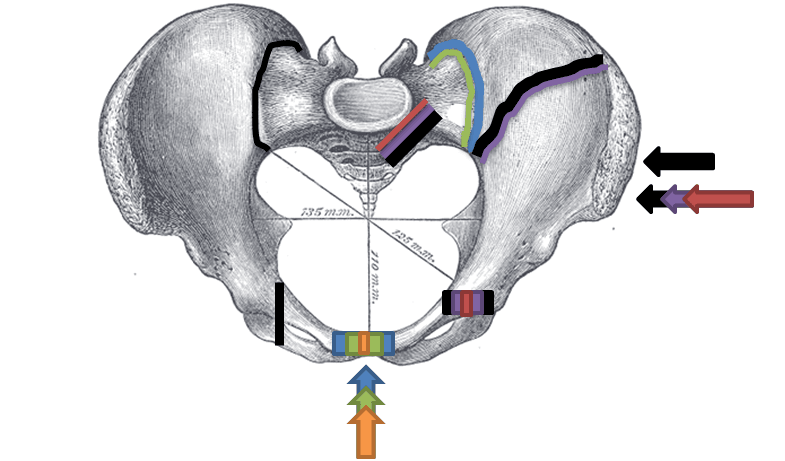
Why LC bleeds less. Internal rotation closes the pelvic volume, leaving less space for haemorrhage and tamponading bleeding to some extent, so LC injuries are generally less haemodynamically unstable than APC injuries. Do not be complacent: severe LC can still bleed significantly, LC-III can have substantial bleeding, associated injuries may contribute, and haemodynamic status needs assessing and reassessing.
Head injury. Very common with the LC mechanism, because the same lateral force that hits the pelvis also hits the head. Assess neurological status in every patient.
The Morel-Lavallée lesion. A closed internal degloving injury: the same lateral force shears the skin and subcutaneous fat off the underlying fascia, typically over the greater trochanter, and the cavity can fill to form a large fluid collection that may become infected. There need be no external wound, and presentation may be delayed. Identify it before any surgical incision; MRI is diagnostic, showing the fluid collection between fat and fascia.
Classification Systems
Young-Burgess classifies by the direction of the injuring force, and grades the LC injury by its posterior lesion and by whether the opposite hemipelvis is involved. The type tells you where to look on the CT and how stable the ring is likely to be.
LC-I is the most common subtype. Anteriorly the ipsilateral superior and/or inferior pubic rami fracture; posteriorly the ipsilateral sacrum is impacted, usually in Denis Zone 1. The sacral impaction is often subtle on radiographs, which is why CT is needed to find it.
Stability. The posterior ligaments are intact, so LC-I is generally stable both rotationally and vertically and is usually treated conservatively. The exception is the LC-I with a complete sacral fracture: Tosounidis found this pattern rotationally unstable on manipulation in every case, so stress-test it rather than assume a good outcome.
- LC-I
- Ipsilateral rami fractures
- LC-II
- Ipsilateral rami fractures
- LC-III
- Bilateral rami or symphysis
- LC-I
- Sacral impaction (Zone 1)
- LC-II
- Crescent fracture (iliac wing)
- LC-III
- Ipsi LC + Contra APC
- LC-I
- Stable
- LC-II
- Variable
- LC-III
- UNSTABLE
- LC-I
- Stable
- LC-II
- Stable
- LC-III
- Potentially unstable
- LC-I
- Low
- LC-II
- Moderate
- LC-III
- High
- LC-I
- Conservative
- LC-II
- Consider fixation
- LC-III
- Surgical fixation
Tile correlation. Tile grades by the posterior lesion and stability rather than by force vector, so the mapping between the two systems is a convenience rather than an equivalence:
- Tile
- B2.1
- Description
- Stable internal rotation
- Tile
- B2.2
- Description
- Partially unstable (crescent)
- Tile
- C
- Description
- Completely unstable
Clinical Assessment
History. The mechanism is a lateral impact, and the answers that shape the assessment are few:
- Level of consciousness, because an associated head injury is common
- Ability to walk
- Where the pain is
Primary survey. ABC, haemodynamic status, a single gentle test of pelvic stability and a search for associated injuries.
Test pelvic stability once, gently, during the primary survey: gentle anteroposterior and lateral compression at the iliac crests. Do not test repeatedly, because it can disrupt clot and worsen haemorrhage. If the pelvis is unstable, apply a binder immediately, and document the findings clearly.
Examination. Look for leg length discrepancy, rotational deformity, ecchymosis over the pelvis and perineum, open wounds (including the perineum, vagina and rectum) and the bruising or fluctuance over the trochanter of a Morel-Lavallée lesion. Palpate the symphysis, the sacroiliac joints and the iliac crests for tenderness; crepitus may indicate unstable fragments.
Associated injuries. The lateral mechanism injures more than the ring, and each system needs a deliberate check:
- Urogenital: blood at the urethral meatus means urethral injury (do not catheterise), haematuria, a high-riding prostate on rectal examination, vaginal or scrotal haematoma
- Neurological: the lumbosacral plexus and the L4-S1 nerve roots with sacral fractures; assess motor and sensory function
- Head injury, abdominal injuries, long bone fractures and acetabular fractures from the same mechanism
"Do not catheterise" is the headline, but the examinable substance is the work-up and the rupture type, because a displaced rami fragment in an LC injury can spear the bladder or shear the urethra:
- Suspect a urethral injury (blood at the meatus, high-riding/boggy prostate, scrotal or perineal haematoma, inability to void) - perform a retrograde urethrogram (RUG) before any catheter. A urethral disruption is managed by suprapubic catheter / delayed repair, not by forcing a urethral catheter that can convert a partial tear into a complete one.
- Bladder rupture is classified by location relative to the peritoneal reflection, and this dictates treatment:
- Extraperitoneal rupture - much the commoner pattern with anterior-ring (rami/symphyseal) pelvic fractures; contrast tracks in a flame/molar-tooth pattern around the bladder base. Managed non-operatively with catheter drainage, UNLESS the bladder neck is involved or pelvic hardware will be placed at that site (then repair to avoid hardware contamination).
- Intraperitoneal rupture - contrast outlines bowel loops/paracolic gutters; needs operative repair because urine leaks into the peritoneal cavity.
- CT cystogram with the bladder actively distended (passive bladder filling from IV contrast alone misses ruptures) is the test of choice once a urethral injury is excluded.
Differential diagnosis. When an AP pelvis shows rami fractures or there is pelvic pain after a fall or collision, distinguish lateral compression from its main mimics. The discriminating features are the direction of the deforming force, the posterior ring lesion on CT, and the patient's bone quality.
- Mechanism / Force
- Lateral force, internal rotation
- Key Discriminator
- Ipsilateral rami plus sacral impaction; pelvis narrows
- Stability / Action
- LC-I usually stable; stress test if complete sacral fracture
- Mechanism / Force
- AP force, external rotation
- Key Discriminator
- Symphyseal widening or diastasis; pelvis opens; high transfusion
- Stability / Action
- Often unstable; binder effective; higher haemorrhage risk
- Mechanism / Force
- Axial / vertical force (fall, dashboard)
- Key Discriminator
- Vertical migration of hemipelvis; complete posterior disruption
- Stability / Action
- Vertically unstable; needs reduction and fixation
- Mechanism / Force
- Low-energy fall, osteoporosis, elderly
- Key Discriminator
- Minimal trauma; FFP/Rommens classification; often bilateral sacral
- Stability / Action
- Usually nonoperative; fixation if progressive pain or instability
- Mechanism / Force
- Low-energy fall in elderly
- Key Discriminator
- No demonstrable posterior ring injury on CT
- Stability / Action
- Stable; analgesia and early mobilisation
- Mechanism / Force
- Lateral force through greater trochanter
- Key Discriminator
- Articular involvement on Judet views/CT; hip joint affected
- Stability / Action
- Depends on dome and congruity; often operative
A pubic rami fracture is never a diagnosis on its own - it is a sign. In a young high-energy patient it usually represents the anterior component of an LC injury and demands CT to find the posterior (sacral or iliac) lesion. In an elderly low-energy patient the same X-ray may be an isolated fragility fracture or a fragility fracture of the pelvis (FFP) with an occult sacral ala fracture - CT still changes management.
Investigations
Radiographs. The AP pelvis is standard in all trauma patients; the inlet and outlet views complete the series:
- AP pelvis: pelvic ring continuity, rami fractures, symphysis width, sacroiliac joint symmetry
- Inlet view: anteroposterior and internal rotation displacement, posterior displacement, sacral impaction
- Outlet view: superior and inferior displacement, sacral fractures, the neural foramina
CT. Mandatory for all pelvic ring injuries. The sacral impaction of an LC-I is often occult on radiographs, and CT is what identifies the sacral fracture and its Denis zone, the integrity of the sacroiliac joint, a crescent fracture, the posterior ligamentous structures, neural canal involvement and any associated acetabular or lumbar spine injury. With that it classifies the injury accurately, assesses posterior ring stability and plans the surgical approach if one is needed.
MRI is reserved for selected cases:
- Suspected ligamentous injury without fracture
- Evaluation of a neurological deficit
- Assessment of sacroiliac joint instability
- Evaluation of a Morel-Lavallée lesion
Sacral fracture zones (Denis). The zone of the sacral fracture tells you which nerves are at risk:
- Location
- Sacral ala (lateral to foramina)
- Structures at Risk
- L5 nerve root
- LC Association
- LC-I most common
- Location
- Through foramina
- Structures at Risk
- S1-S4 nerve roots
- LC Association
- LC-I, LC-II
- Location
- Central canal
- Structures at Risk
- Cauda equina
- LC Association
- Less common in LC
Management Algorithm
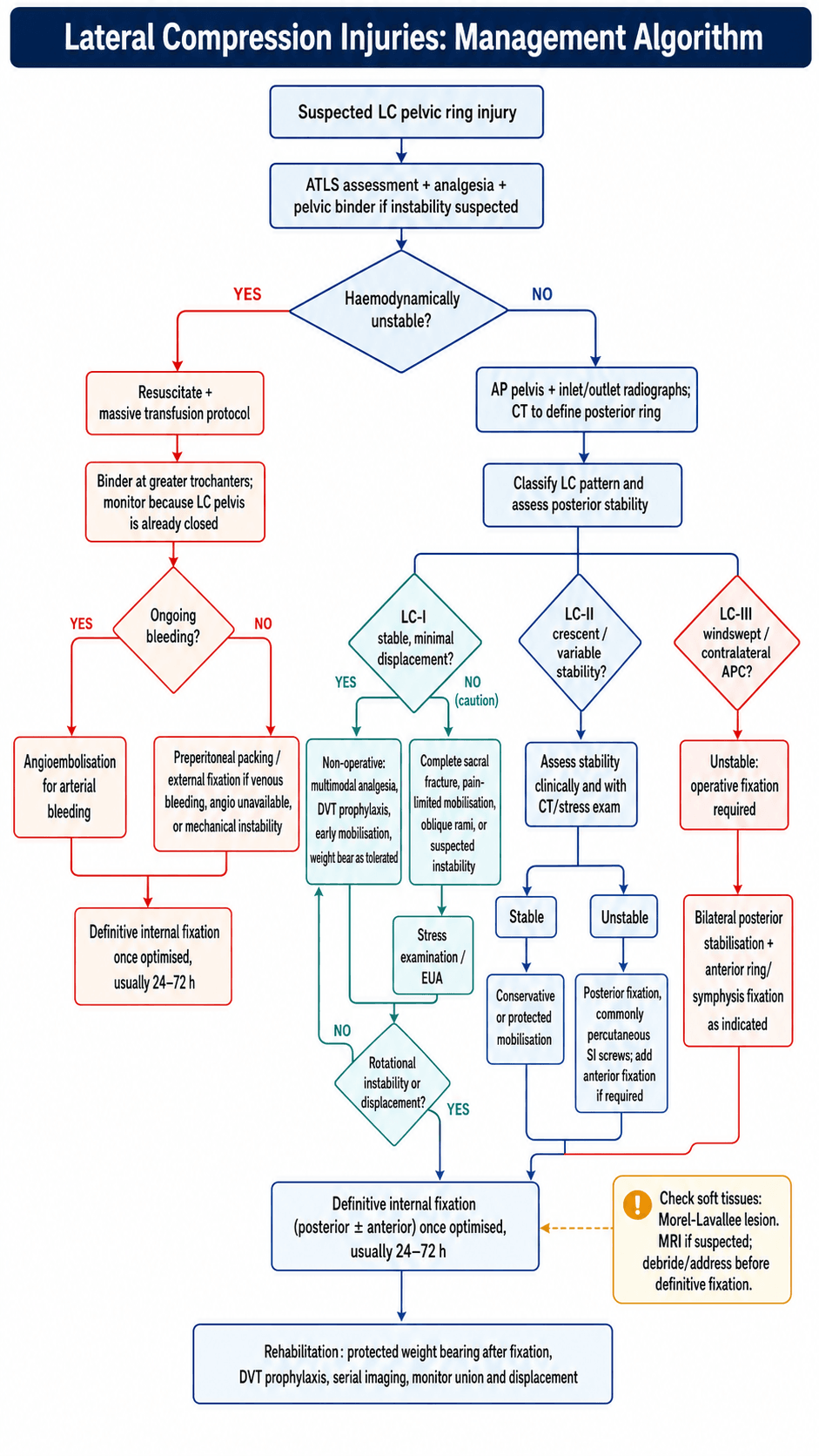
The first decision is haemodynamic. The unstable patient is resuscitated on ATLS principles, with the massive transfusion protocol if needed and a pelvic binder, and the bleeding is controlled by damage-control means: angiography and embolisation first-line for arterial bleeding, preperitoneal packing if angiography is unavailable or the bleeding is venous, and external fixation for temporary stabilisation. Once the patient is stabilised, definitive internal fixation follows at 24-72 hours. The stable patient is imaged completely with CT and the injury classified.
The binder. Apply it in the emergency department if instability is suspected, centred at the level of the greater trochanters, not the iliac crests; a sheet will do if there is no commercial binder, and the skin under it needs monitoring. A binder is a reduction device that closes an open, externally rotated ring, restoring the tamponading pelvic volume by internally rotating the hemipelvis. That is exactly the APC deformity, which is why a binder is dramatically effective there. In a pure LC injury the pelvis is already internally rotated and closed, so the binder has little volume to reduce and adds little haemorrhage benefit; pushed hard it can over-compress the ring, theoretically worsening the deformity, overlapping the rami and even compromising pelvic viscera. In practice:
- Still apply it if the pelvis is unstable, and monitor for worsening internal rotation
- In a bleeding LC patient do not rely on it for haemorrhage control; escalate early to angioembolisation or preperitoneal packing plus resuscitation, because the closed ring will not be tamponaded further by squeezing it
- The one LC pattern where a binder genuinely helps is LC-III, because the contralateral side is an open APC injury that the binder closes
- Remove or convert it promptly to avoid skin necrosis
LC-I. Usually conservative: multimodal analgesia, DVT prophylaxis, early mobilisation as tolerated, weight-bearing as tolerated and guided by symptoms, a physiotherapy assessment and follow-up imaging at 6 weeks. The indications are a stable LC-I with minimal displacement in a patient who can tolerate limited mobilisation, and most such injuries do well non-operatively.
Is this LC-I really stable? "LC-I" is not by itself an answer. Two features call for a stress examination: a complete sacral fracture, and an oblique rather than transverse superior pubic ramus fracture, which allows significantly more deflection under load (Marenghi 2022). The test does not need theatre. Done awake in the emergency department, 10 mm or more of rami overlap on a stress inlet view is positive and indicates fixation; a negative test reliably predicts successful nonoperative treatment (DeKeyser 2022: 81% negative, and all of those followed to three months united without significant displacement, although two patients with a negative test still could not mobilise and were converted to surgery). Under anaesthesia the corresponding threshold is more than 2 cm of translation, which in Tosounidis's series occurred only in pelvises with a complete sacral fracture.
LC-II. Test stability clinically. A stable LC-II may be treated conservatively; if it is unstable, consider fixation, posterior fixation if needed.
LC-III. Surgical fixation is required, of both sides, posteriorly with anterior fixation as indicated, timed for when the patient is optimised.
Indications for surgery. Instability, rotational or vertical, and displacement are the recurring themes:
- LC-II with instability
- All LC-III injuries
- Significant displacement
- Failed conservative management
- An associated acetabular fracture requiring fixation
- Polytrauma requiring mobilisation
Options and timing. Posteriorly, percutaneous sacroiliac screws are the most common fixation, with posterior plating and, for severe instability, spinopelvic fixation as the alternatives. Anteriorly, the symphysis is plated if it is disrupted in an LC-III, rami plating is rarely needed for LC, and external fixation is the damage-control tool. External fixation goes on acutely in damage control and definitive fixation is done when the patient is optimised; an LC-I may never need surgery.
Surgical Technique
Percutaneous sacroiliac screws are the gold standard for posterior ring fixation in LC injuries and the most common technique for LC-II and LC-III. The patient is supine on a radiolucent table with the image intensifier set up for inlet and outlet views; the entry point is on the lateral ilium above the greater sciatic notch, and the screw is directed anteriorly and medially towards the S1 body.
Technique. Fluoroscopy guides every step, and the inlet and outlet views are mandatory throughout:
- Inlet view confirms the anteroposterior trajectory and keeps the screw off the anterior cortex of the sacrum
- Outlet view confirms the superior-inferior trajectory and keeps it out of the neural foramina
- Guidewire placed under fluoroscopy
- Measure screw length, typically 80-100 mm
- Fully threaded lag screw or partially threaded compression screw; compression across the sacroiliac joint improves stability
- One or two screws into S1, or into S2, which in a dysmorphic sacrum is the preferred segment rather than a second-best fallback
Sacral dysmorphism: settle this before planning the screw. About 41% of pelves are dysmorphic (Kaiser 2014), so this is closer to a coin toss than a rarity. Recognise it on the preoperative CT and outlet view (Miller and Routt 2012):
- The upper sacrum lies colinear with the iliac crests on the outlet view
- Mammillary bodies at the mid-alar level (underdeveloped transverse processes)
- Upper sacral foramina that are not circular
- A residual upper sacral disc
- An acute alar slope, and a tongue-in-groove SI joint surface on CT
- Cortical indentation of the anterior ala on the inlet view
Why it matters. The dysmorphic upper sacrum has a narrow, obliquely angled osseous corridor. A screw aimed as though the anatomy were normal perforates the ala and threatens the L5 nerve root as it crosses the sacral ala; in Kaiser's series, no pelvis with a sacral dysmorphism score above 70 had a safe transsacral S1 corridor at all.
What to do. Use S2. In dysmorphic sacra the second segment is the larger target, not the fallback: mean pathway width 15.2 mm at S2 versus 13.2 mm at a dysmorphic S1, accepting a mean screw length of 151.9 mm versus 100.8 mm (Conflitti 2010). The 80-100 mm screw quoted above is about the ceiling a dysmorphic S1 will accept, which is itself a hint that the segment is the wrong one.
Complications
Early. Haemorrhage is less than in APC but still significant, arterial from the superior gluteal or pudendal vessels or venous, and may need angioembolisation or packing. Urethral injury is less common in LC than in APC; bladder injury and neurological injury with sacral fractures also occur. A Morel-Lavallée lesion may need drainage or debridement, can delay wound healing, and risks infection if it is not addressed.
Late. Malunion produces leg length discrepancy, pelvic obliquity, gait abnormality and difficulty sitting. Sacroiliac joint arthritis develops in 20-40% of LC injuries, the risk higher with residual displacement though it may develop despite a good reduction; chronic sacroiliac pain is common and may need delayed fusion. Persistent nerve injury (L5, S1-S4) is more common with sacral fractures through the foramina.
Postoperative Care
The first 24-48 hours. Monitor neurovascular status, control pain with multimodal analgesia, start DVT prophylaxis, which is critical in this high-risk group, use incentive spirometry and mobilise early to the chair.
Weight-bearing and rehabilitation. After conservative treatment of an LC-I the patient bears weight as tolerated, with walking aids at first and progression guided by pain. After fixation of an LC-II or LC-III weight-bearing is staged, and rehabilitation follows the same phases:
- Weight-bearing
- Touch weight-bearing (10-15 kg) with crutches or frame
- Rehabilitation
- Gentle hip and knee range of motion, isometric core strengthening, gait training with aids
- Weight-bearing
- Progressive weight-bearing if radiographic healing
- Rehabilitation
- Strengthening, balance and proprioception training, pool therapy if available
- Weight-bearing
- Full weight-bearing once healed
- Rehabilitation
- Sport-specific rehabilitation, return-to-work planning, address residual deficits
Bilateral injuries may need a wheelchair initially, posterior ring instability delays full weight-bearing, and serial radiographs track healing.
DVT prophylaxis. Pelvic fractures carry a high VTE risk, so prophylaxis is mechanical and pharmacological combined: LMWH or fondaparinux started when safe, compression stockings or intermittent pneumatic compression, and early mobilisation. Continue for a minimum of 6 weeks, and consider 3 months in high-risk patients.
Follow-up. Review at set intervals:
- 2 weeks: wound check, neurovascular assessment
- 6 weeks: radiographs, assess healing, advance weight-bearing
- 12 weeks: radiographs, consider full weight-bearing
- 6 months: final radiographs, functional assessment
- 12 months: long-term outcome evaluation
The red flags at any visit are increasing pain (hardware failure or nonunion), loss of reduction, neurological change, wound complications, and signs of DVT or PE.
Outcomes/Prognosis
By type. LC-I has an excellent prognosis: conservative treatment is highly successful and long-term disability is minimal. LC-II does well, though some patients keep residual sacroiliac pain and need long-term analgesia, and outcomes are better with appropriate fixation when the ring is unstable. LC-III is fair to good, often limited by the associated injuries; patients may require workplace modifications, and the psychological impact is significant.
- LC-I
- Over 90%
- LC-II
- 70-80%
- LC-III
- 50-70%
- LC-I
- Under 20%
- LC-II
- 30-40%
- LC-III
- Over 50%
- LC-I
- Under 10%
- LC-II
- 30-50%
- LC-III
- Over 90%
- LC-I
- 3-6 months
- LC-II
- 4-9 months
- LC-III
- 6-12+ months
- LC-I
- Excellent
- LC-II
- Good
- LC-III
- Fair
What predicts the outcome. Better outcomes follow a stable LC-I pattern, age under 50, no associated injuries, early mobilisation and appropriate treatment selection. Worse outcomes follow an unstable LC-III pattern, age over 65, multiple associated injuries, delayed or inadequate treatment, and comorbidities such as diabetes and osteoporosis.
Union. Most LC injuries unite, with conservative or surgical treatment, in 8-12 weeks. Nonunion is rare, under 5%, and malunion is more common than nonunion. Healing depends on the degree of displacement, the stability of fixation and compliance with weight-bearing restrictions; smoking delays it, and NSAIDs may impair it and are used cautiously.
Life afterwards. Sexual function may be affected, especially after LC-III; discuss it openly and refer to the appropriate specialist if needed. Most women can deliver vaginally after a healed LC injury, though caesarean section may be needed if there is significant pelvic deformity, so involve obstetrics early in pregnancy.
Guidelines, Registries & Global Practice
OrthoVellum is a worldwide resource: this section gives the global standard of care for lateral compression injuries plus the regional differences a candidate may be examined on. Lateral compression is the most common pelvic ring pattern internationally, and the principles below apply across all major trauma systems.
Global Epidemiology
- Evidence
- Largest single mechanism group; Type A and B (which contain most LC) make up 70-80% of all pelvic injuries
- Source
- Tile 1996 (PMID 10795049)
- Evidence
- Motor vehicle / motorcycle collisions; majority of high-energy series
- Source
- Burgess 1990 (PMID 2381002)
- Evidence
- LC mean 3.6 units vs APC 14.8 units
- Source
- Burgess 1990 (PMID 2381002)
- Evidence
- 19% population-based; LC subgroup 7.0% in the original series
- Source
- Gabbe 2011 (PMID 21733513); Burgess 1990
- Evidence
- Age greater than or equal to 65 (OR 7.6), pre-hospital hypotension (OR 5.5), severe chest injury (OR 2.8)
- Source
- Gabbe 2011 (PMID 21733513)
A second, growing population is the elderly low-energy fragility fracture of the pelvis, which is rising with ageing populations worldwide and behaves differently from the high-energy LC injury above.
Major Guidelines Side by Side
- Recommendation for LC pelvic injury
- Classify by Young-Burgess and Tile/AO-OTA; nonoperative weight-bearing for stable LC-I, fixation for demonstrable rotational/vertical instability
- Evidence basis
- Expert consensus; biomechanical and cohort data
- Recommendation for LC pelvic injury
- Pelvic ring injuries managed within a network; binder at greater trochanters pre-hospital; CT in the haemodynamically stable; definitive fixation at a specialist centre
- Evidence basis
- BOAST "Pelvic and Acetabular Fracture" standards (consensus)
- Recommendation for LC pelvic injury
- Pelvic binder for suspected unstable injury; CT for diagnosis in stable patients; major-haemorrhage protocol and IR/packing pathway for the unstable
- Evidence basis
- NICE guideline (mixed evidence)
- Recommendation for LC pelvic injury
- No formal LC-specific guideline; OTA practice favours stress examination of minimally displaced LC1 to triage operative vs nonoperative care
- Evidence basis
- DeKeyser 2022 (PMID 34921551), Level II
- Recommendation for LC pelvic injury
- Algorithmic haemorrhage control: binder, then angioembolisation and/or preperitoneal packing and external fixation by mechanism and response to resuscitation
- Evidence basis
- WSES classification and guidelines (consensus)
Key area of genuine convergence: stable LC-I is treated nonoperatively with early weight-bearing; key area of evolving practice: how aggressively to detect occult instability in LC-1 with a complete sacral fracture (stress examination vs early fixation).
Registry and Trauma-System Evidence
- Trauma registries (e.g. the UK TARN and the Victorian State Trauma Registry) define the small, resource-intensive subgroup of haemodynamically unstable pelvic ring injuries and have shown that survival is driven by haemodynamic control rather than which centre delivers definitive care (Gabbe 2011, PMID 21733513).
- Joint-replacement registries (NJR, AJRR, AOANJRR) are not applicable to acute LC fixation; registry evidence here comes from trauma rather than arthroplasty registries.
Global Practice Variation
- Typical practice
- Pre-hospital binders, 24/7 CT, interventional radiology, percutaneous SI screws under fluoroscopy/navigation
- Reason
- Mature networks and imaging access
- Typical practice
- Binder/sheet, external fixation and preperitoneal packing favoured over angioembolisation; more nonoperative management
- Reason
- Limited IR and theatre access; emphasis on damage control
- Typical practice
- Rising fragility fractures of the pelvis; lower threshold for fixation only if pain or progressive displacement
- Reason
- Demographic shift; poor bone quality
Thromboprophylaxis (Global Principle)
Pelvic fractures carry a high venous thromboembolism risk, so combined mechanical and pharmacological prophylaxis is standard worldwide. Low-molecular-weight heparin is the usual agent, started once haemorrhage is controlled, with renal dose adjustment, plus intermittent pneumatic compression and early mobilisation. Extended prophylaxis (commonly up to 6 weeks, longer in high-risk patients) is recommended for major pelvic injury, in line with international guidance.
Viva Scenarios
Clinical Decision Scenarios
Practise clinical reasoning and management decisions out loud
“A 45-year-old male pedestrian struck by a car presents with lateral pelvic pain. X-ray shows left pubic rami fractures. How would you assess and manage this patient?”
“How do you differentiate LC-I, LC-II, and LC-III injuries? What determines stability?”
“A patient with an LC injury has fluctuance and bruising over the greater trochanter. What is this and how do you manage it?”
MCQ Practice Points
High-Yield Exam Facts
- LC injuries are the MOST COMMON pelvic ring injury pattern (50-60%)
- LC causes INTERNAL rotation - pelvis narrows (opposite of APC)
- LC-I = rami + sacral impaction = STABLE
- LC-II = rami + crescent fracture = VARIABLE stability
- LC-III = windswept pelvis = UNSTABLE (requires surgery)
- Lateral force causes internal rotation deformity
- Pelvis volume DECREASES (vs APC which increases)
- Generally LESS hemorrhage than APC (pelvis closes and tamponades)
- But DON'T be complacent - can still bleed significantly
- Head injuries COMMON - same lateral impact mechanism
- Morel-Lavallee lesion - closed degloving over trochanter
- Acetabular fractures (same mechanism)
- Neurological injury with sacral fractures (L5-S1 roots)
- CT scan is MANDATORY for all pelvic ring injuries
- Sacral impaction often OCCULT on X-ray - need CT
- Look for crescent fracture on CT (LC-II)
- Always check contralateral side (don't miss LC-III)
- MRI for Morel-Lavallee lesion if suspected
- LC-I: Conservative in vast majority (over 90%)
- LC-II: Assess stability - may need fixation
- LC-III: Surgical fixation REQUIRED
- Pelvic binder less effective for LC (pelvis already closed)
- Weight-bearing as tolerated for LC-I
- Protected weight-bearing 6 weeks for LC-II/III post-surgery
- DVT/PE risk HIGH - prophylaxis critical
- Morel-Lavallee can delay surgery or cause infection
- Neurological injury with Zone 2/3 sacral fractures
- SI joint arthritis long-term
- Malunion more common than non-union
- Confusing LC with APC (LC = internal rotation, APC = external rotation)
- Missing sacral impaction on X-ray (need CT)
- Not recognizing LC-III (check both sides)
- Thinking pelvic binder helps LC (actually may worsen internal rotation)
- Assuming LC injuries don't bleed (they can, just less than APC)
- 50-60% = proportion of all pelvic ring injuries that are LC
- 70% = proportion of LC injuries that are LC-I
- 90% = proportion of LC-I that return to full function
- 6 weeks = typical protected weight-bearing period post-surgery
- 8-12 weeks = typical union time
- "What is the most common pelvic ring injury?" = Lateral compression
- "How does the pelvis deform in LC?" = Internal rotation, pelvis narrows
- "Why do LC injuries bleed less?" = Pelvis closes, tamponades bleeding
- "What must you look for on CT in LC?" = Sacral impaction/crescent fracture
- "When does LC-I need surgery?" = Rarely - usually conservative
Q: How do you differentiate LC from APC injuries clinically and radiologically? A: LC = Lateral force causing INTERNAL rotation with pelvis narrowing. APC = Anteroposterior force causing EXTERNAL rotation with pelvis opening. LC has LESS bleeding than APC because the pelvis closes and tamponades. On X-ray, LC shows rami fractures with sacral impaction, APC shows symphysis widening.
Q: Why is CT mandatory in suspected LC pelvic injuries? A: Sacral impaction fractures in LC-I are often OCCULT on plain X-rays and easily missed. CT is mandatory to identify the posterior injury, classify the pattern accurately, and guide treatment decisions. Never rely on X-ray alone for pelvic ring injuries.
Q: When does LC-I require surgical fixation? A: LC-I injuries are stable and rarely need surgery (under 10%). Over 90% can be safely managed conservatively with excellent outcomes. Indications for surgery include clinical instability on examination, polytrauma requiring early mobilization, or significant displacement causing pelvic deformity.
Q: What is a Morel-Lavallee lesion and why is it important? A: Closed internal degloving injury over the greater trochanter caused by the same lateral shearing force as LC injury. Creates large fluid collection between subcutaneous fat and fascia. Must identify with MRI before surgery to prevent wound complications, infection, and surgical failure.
Q: What associated injury must you screen for in LC pelvic fractures? A: Head injury is very common with LC mechanism because the same lateral impact that hits the pelvis also impacts the head. Always perform thorough neurological assessment and maintain high index of suspicion for intracranial injury. Order head CT liberally.
Q: What defines an LC-III injury and why is it important? A: LC-III is "windswept pelvis" - LC pattern on one side with contralateral APC pattern. This is rotationally UNSTABLE (unlike LC-I and LC-II) and requires surgical fixation. Don't miss it by failing to check the contralateral side - always assess both hemipelves carefully.
DEFINITION
- Most common pelvic ring injury (50-60%)
- Lateral force causes INTERNAL rotation
- Pelvis NARROWS (vs APC which opens)
- Named by direction of FORCE, not displacement
CLASSIFICATION
- LC-I: Rami + sacral impaction (STABLE)
- LC-II: Rami + crescent fracture (VARIABLE)
- LC-III: Ipsi LC + contra APC = UNSTABLE
- LC-III = windswept pelvis
KEY ASSOCIATIONS
- Head injuries (same lateral mechanism)
- Morel-Lavallee lesion (closed degloving)
- Sacral fractures with nerve injury
- Acetabular fractures
IMAGING
- AP pelvis first
- CT MANDATORY to classify
- Look for sacral impaction (often occult)
- MRI for Morel-Lavallee lesion
MANAGEMENT
- LC-I: Usually conservative
- LC-II: Assess stability, may need fixation
- LC-III: Surgical fixation required
- Less hemorrhage than APC but don't be complacent
Evidence Base
Young-Burgess Classification - The Defining Study
- Landmark series of 210 consecutive high-energy pelvic ring disruptions (162 with complete charts, from which the figures below derive) that established the mechanism-based classification - lateral compression, anteroposterior compression, vertical shear, combined mechanical - still in worldwide use.
- Mean blood replacement was markedly lower for lateral compression (3.6 units) than for anteroposterior compression (14.8 units), confirming that the internally rotated, closed pelvis bleeds less. Overall average was 5.9 units.
- Overall mortality was 8.6 percent (7.0 percent for LC versus 20.0 percent for APC); the cause of death was attributable to the pelvic fracture in fewer than half of cases, and no patient with an isolated pelvic injury died - the associated injuries are what kill.
Tile Classification - Stability Determined by the Posterior Ring
- Foundational review establishing that, although the anterior structures contribute roughly 40 percent of pelvic stiffness, the posterior sacroiliac complex is the principal determinant of ring stability - so classification is based on the posterior lesion.
- Defined Type A (stable), Type B (rotationally unstable, vertically stable) and Type C (rotationally and vertically unstable); LC injuries span all three groups, with Type A and B making up 70 to 80 percent of all pelvic injuries.
- Key point: LC-I corresponds to Type A or B2 (stable) and LC-III to Type C (unstable).
Occult Instability of LC-1 Injuries with Complete Sacral Fracture
- Prospective study of 63 LC-1 injuries assessed by intra-operative manipulation under anaesthesia; rotational instability (more than 2 cm translation) was present in every case that had a complete sacral fracture.
- Surgically stabilised patients had significantly shorter hospital stay, faster pain-free mobilisation and lower opioid requirements than nonoperatively managed patients.
- Key point: a complete posterior sacral fracture in an LC-1 pattern signals occult rotational instability that may benefit from fixation.
Emergency Department Stress Radiographs for LC-1 Stability
- Prospective study of 70 minimally displaced LC1 injuries (under 10 mm at presentation) showing that awake fluoroscopic stress examination in the emergency department is safe and well tolerated - no patient required general anaesthesia or became haemodynamically unstable. A positive result was 10 mm or more of rami overlap on stress inlet views.
- Fifty-seven of 70 (81 percent) were negative and were allowed to bear weight; all of those with 3-month follow-up united without substantial displacement.
- In the 11 patients who had both tests, the two agreed CATEGORICALLY in every case - no patient was positive on one and negative on the other - and mean displacement was closely similar (15.15 mm in the ED versus 15.60 mm under anaesthesia, p = 0.86), supporting an awake protocol that avoids unnecessary theatre and anaesthesia.
Rami Fracture Morphology Predicts LC-1 Displacement
- Cadaveric biomechanical study showing that oblique superior pubic ramus fractures allow significantly more lateral deflection than transverse fractures in the unfixed pelvis.
- Posterior-only and combined anterior-posterior fixation reduced deflection more than no fixation or anterior fixation alone.
- Key point: oblique rami fractures on injury imaging suggest greater potential for later displacement and warrant examination under anaesthesia.
Anatomic Determinants of Sacral Dysmorphism and Implications for Safe Iliosacral Screw Placement
- 104 uninjured pelvic CT scans analysed: sacral dysmorphism was present in 41 percent - a normal variant, not a rarity
- The five qualitative radiographic signs each appeared in 28 to 53 percent of the cohort, but interobserver agreement was only fair to moderate (kappa 0.26 to 0.59), so eyeballing the outlet view is unreliable on its own
- A sacral dysmorphism score of (S1 coronal angle) plus twice (S1 axial angle) quantified the variation
- No pelvis scoring above 70 had a safe transsacral S1 corridor at all
Radiographic Quantification of Dysmorphic Upper Sacral Anatomy and Associated Iliosacral Screw Insertions
- 24 patients with unstable posterior ring disruptions AND sacral dysmorphism, all fixed with second-segment (S2) iliosacral screws
- The dysmorphic S1 corridor averaged 13.2 mm wide against 15.2 mm at S2 - in a dysmorphic sacrum the SECOND segment is the bigger target
- Maximum screw length averaged 100.8 mm at the dysmorphic S1 but 151.9 mm at S2, so S2 also permits a substantially longer, often transsacral, implant
- 20 of 24 S2 screws were fully intraosseous and 4 juxtaforaminal, with no extruded screws and no neurological injuries
Morel-Lavallee Lesion in Pelvic Trauma
- Series of 24 closed internal degloving injuries associated with pelvic and acetabular fractures, classically over the greater trochanter (the Morel-Lavallee lesion).
- Cultures were positive in 46 percent of cases, and deep infection developed despite treatment - demonstrating the high contamination and wound-complication risk of operating through an unaddressed lesion.
- Recommended early thorough debridement before or at the time of fracture fixation, leaving the wound open with repeat debridement rather than primary closure.
Predictors of Mortality after Severe Pelvic Ring Fracture (Population-Based)
- Population-based registry study of 348 severe pelvic ring fractures; overall mortality was 19 percent.
- Independent predictors of death were age 65 years or older (adjusted OR 7.6), pre-hospital hypotension (adjusted OR 5.5), hypotension on arrival (adjusted OR 3.7) and severe chest injury (adjusted OR 2.8).
- Definitive hospital of management did not affect mortality once these factors were accounted for, underscoring that haemodynamic control - not the choice of centre - drives survival.
Operative versus Non-operative LC1 with Complete Sacral Fracture (TULIP) - protocol only
- Protocol for a UK multicentre FEASIBILITY randomised trial allocating LC1 injuries with a complete sacral fracture, in non-fragility-fracture patients, to operative or non-operative management - designed to inform whether a definitive trial is possible, not to answer the clinical question.
- States the equipoise on both sides explicitly: a complete sacral fracture raises the potential for displacement over time, while non-operative care means restricted weight-bearing, repeated surveillance radiographs and prolonged rehabilitation, and fixation may allow earlier pain-free mobilisation.
- Outcomes to 12 months span quality of life, function and pain, with qualitative interviews and an assessment of which instrument should be the primary outcome - i.e. the field does not yet agree on how to measure success in this injury.
- Registration ISRCTN10649958.