Rockwood Classification Guides Treatment | CC Ligaments Key | Type III Controversial
- CC ligaments (conoid + trapezoid) provide vertical stability - torn in Type III+
- AC ligaments (superior most important) provide horizontal stability
- Type III is controversial - most now treated conservatively unless high-demand athlete/labourer
- Type IV posterior displacement may look like Type III on AP - need axillary view
- Hook plate requires removal at 3-4 months - mandatory second surgery
- “Rockwood classification expanded Tossy (I-III) to include Types IV-VI
- “CC distance greater than 13mm or greater than 50% increase compared to contralateral = Grade III+
- “AC ligament superior portion provides 56% of horizontal stability
- “Type VI inferior dislocation extremely rare - associated with severe trauma
Overview and Epidemiology
Injuries to the acromioclavicular joint account for 9-12% of shoulder injuries and occur particularly in young active males in contact sports, with a male to female ratio of about 5:1. They result from disruption of the ligaments that stabilise the joint.
Mechanism. The common injury is a direct blow: a fall onto the point of the shoulder with the arm adducted. Less often the force arrives indirectly, through a fall onto the outstretched hand with the force transmitted to the shoulder. The settings are contact sports such as rugby, AFL and ice hockey, and cycling crashes.
Risk factors.
- Contact sports participation
- Male gender
- High-velocity activities (cycling, motorcycling)
- Previous AC joint injury
Scope note. This page covers the general classification, biomechanics and management of AC joint injuries. For sport-specific decision-making, in-season management and return-to-play criteria in athletes, see AC joint injuries in athletes.
Anatomy and Biomechanics
The joint. A synovial diarthrodial joint between the lateral clavicle and the medial acromion, containing a fibrocartilaginous intra-articular disc that degenerates with age. The capsule is reinforced by the AC ligaments. The contact area is small, so the stress across it is high.
Two planes, two sets of ligaments. The AC ligaments give the joint its horizontal (anteroposterior) stability; the coracoclavicular ligaments give its vertical stability. This division is what the Rockwood grades measure: an AC-ligament injury with intact CC ligaments is low-grade, and once the CC ligaments are disrupted the clavicle is free to displace.
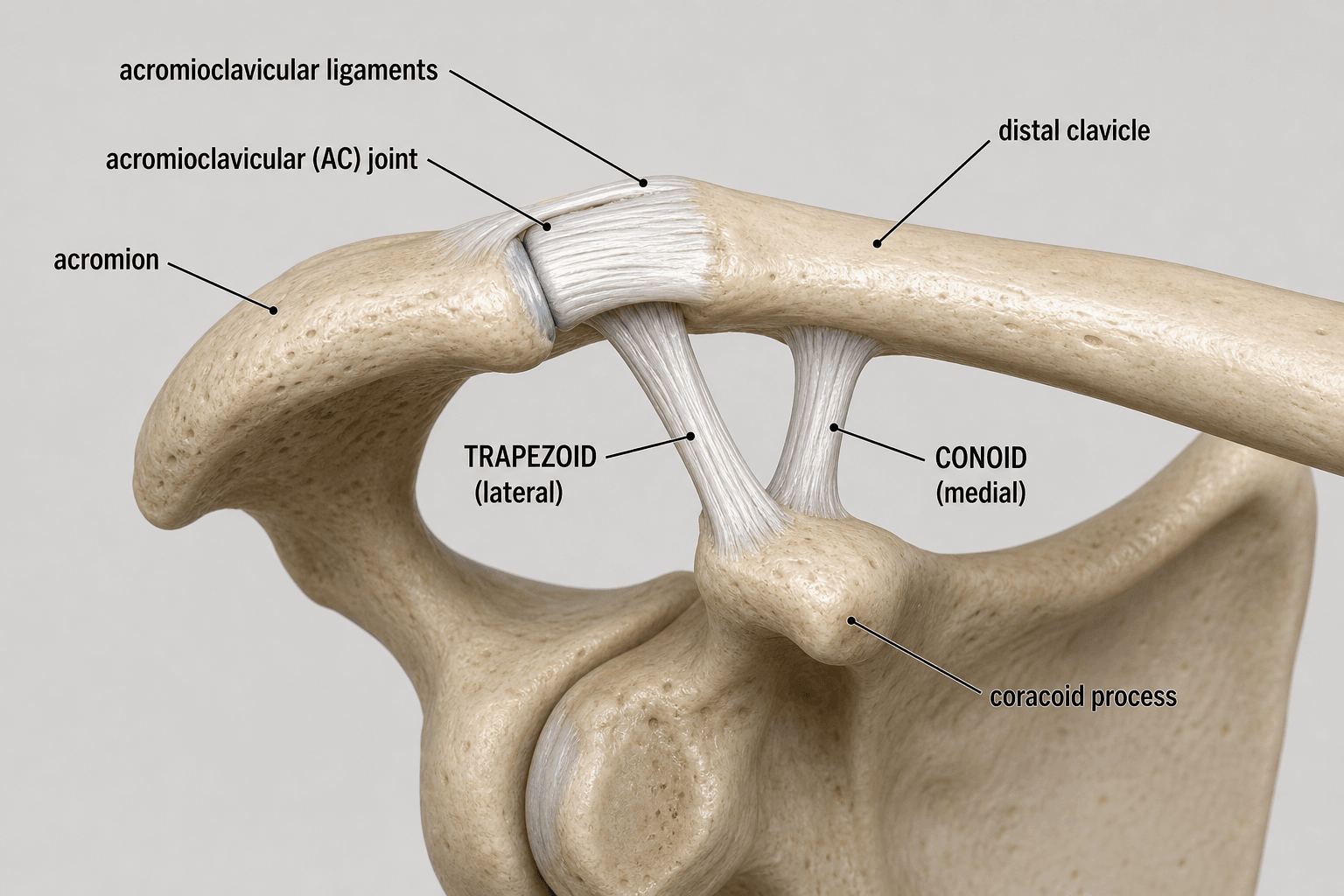
The AC ligaments. There are four, superior, anterior, posterior and inferior, reinforcing the capsule. The superior ligament is the one that matters most: it blends with the deltotrapezial fascia to form a strong superior stabiliser, and the posterior ligament is the next most important. The percentages that get quoted for each come from two experiments that asked different questions, which is why they appear to disagree.
Two cadaveric studies give apparently conflicting answers to "what restrains posterior translation of the clavicle?", and both are right, because they asked different questions.
- Klimkiewicz 1999 (PMID 10226962) serially sectioned the AC capsule alone. Within the capsule, the superior (56% ± 23) and posterior (25% ± 16) ligaments provide the restraint, and the anterior and inferior components contribute nothing significant. This is the answer for distal clavicle excision: spare the superior and posterior capsule.
- Lee 1997 (PMID 9397278) measured in-situ forces with the whole ligament complex intact (10 cadavers, 70 N). The trapezoid carried 55.8% ± 20 of the resisting force in posterior displacement, and the inferior AC capsule was the major restraint to anterior translation.
So the superior and posterior capsule is the primary capsular restraint; with everything intact the trapezoid shoulders most of the posterior load; and the "minor" inferior capsule matters for anterior translation. Quote the experiment with its condition and you have the examiner's answer either way. It is also why modern reconstructions address both the CC ligaments and the AC capsule.
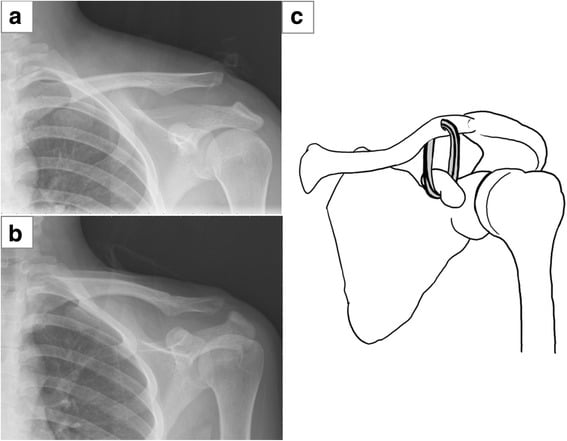
The CC ligaments. The trapezoid is lateral, quadrilateral and the weaker of the two; the conoid is medial, conical and the stronger. Both run from the base of the coracoid process to the undersurface of the clavicle, and together they are the vertical restraint that is lost in Type III and above. Because they act together, an anatomic reconstruction has to recreate both.
- Position
- Lateral
- Shape
- Quadrilateral
- Strength
- Weaker
- Distance from lateral clavicle edge (Rios)
- Centre 25.4 ± 3.7mm (men) / 22.9 ± 3.7mm (women)
- Position
- Medial
- Shape
- Conical
- Strength
- Stronger
- Distance from lateral clavicle edge (Rios)
- Medial edge 47.2 ± 4.6mm (men) / 42.8 ± 5.6mm (women)
The ratio is what transfers. Rios (PMID 17293463; 120 dry and 19 fresh cadaveric clavicles) found the conoid at 0.24-0.31 and the trapezoid at 0.17 of total clavicle length, constant across sex and race. Clavicle length varies, so measure the clavicle intraoperatively and the tunnel positions follow.
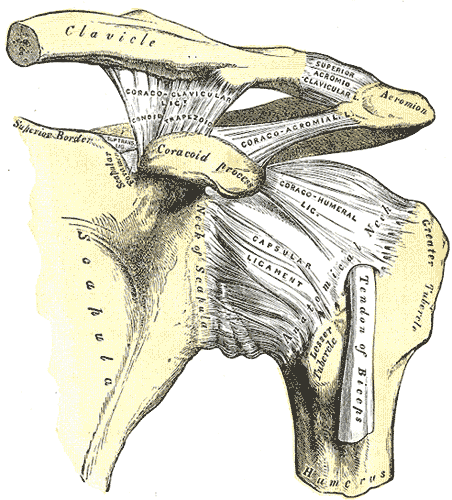
The muscles. The deltoid originates from the lateral clavicle and the acromion anteriorly; the trapezius inserts on the clavicle and acromion posteriorly. Between them the deltotrapezial fascia is critical both to stability and to surgical repair.
Classification Systems
Tossy (1963) described Types I-III. Rockwood expanded the scheme to Types IV-VI, recognising displacement patterns that require surgical intervention. Each grade records which ligaments have failed and where the clavicle has gone, and the treatment follows from that.
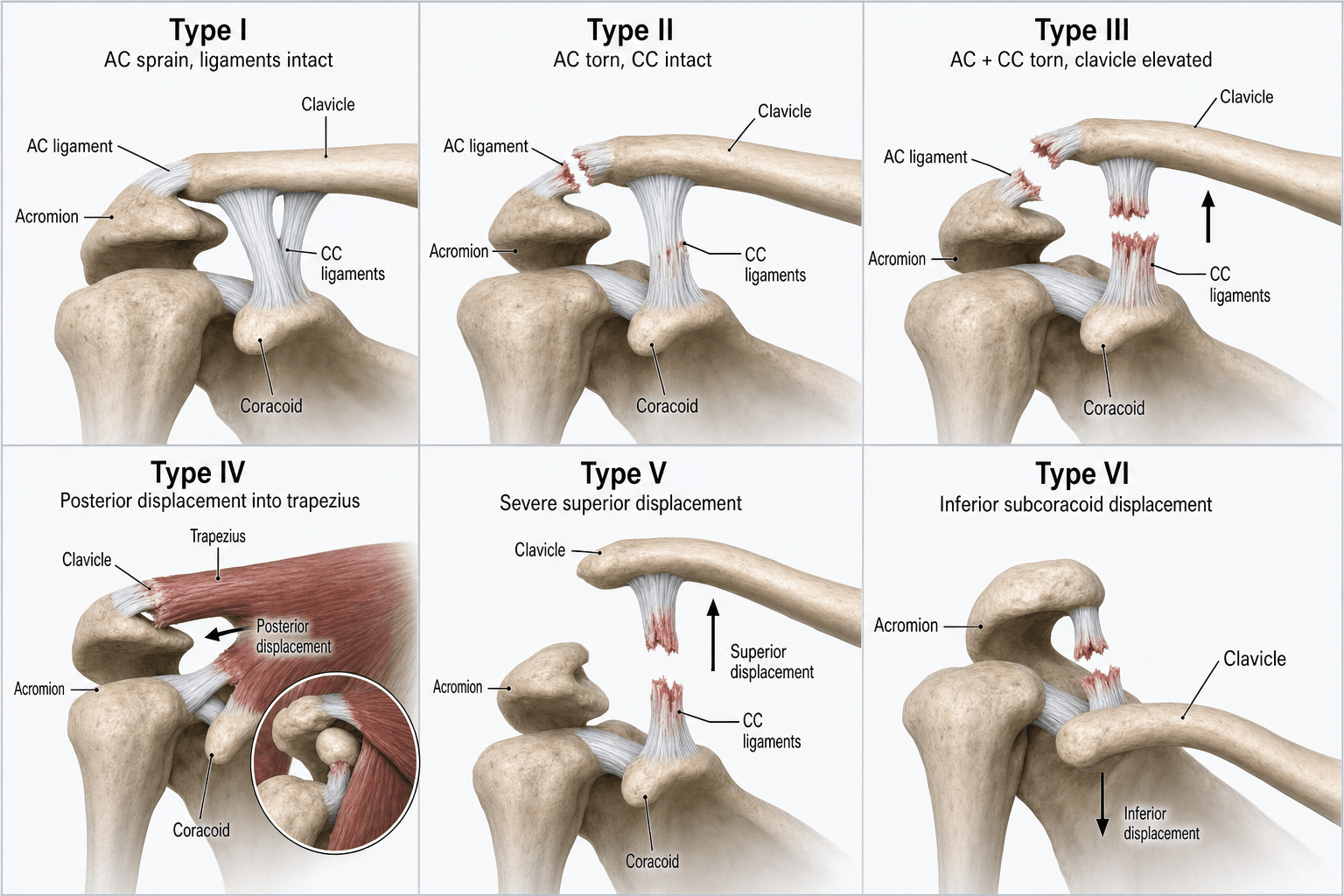
AC ligament sprain. The AC ligaments are sprained but intact, the CC ligaments are intact, and there is no displacement on X-ray; the only finding is tenderness over the AC joint. Treatment is a sling for 1-2 weeks, ice and early range of motion. The prognosis is excellent and full recovery is expected.
- AC Ligaments
- Sprained
- CC Ligaments
- Intact
- Displacement
- None
- Surgery?
- No
- AC Ligaments
- Torn
- CC Ligaments
- Sprained
- Displacement
- Slight (AC widened)
- Surgery?
- No
- AC Ligaments
- Torn
- CC Ligaments
- TORN
- Displacement
- 25-100% superior
- Surgery?
- Controversial
- AC Ligaments
- Torn
- CC Ligaments
- Torn
- Displacement
- Posterior
- Surgery?
- Yes
- AC Ligaments
- Torn
- CC Ligaments
- Torn
- Displacement
- Over 100% superior
- Surgery?
- Yes
- AC Ligaments
- Torn
- CC Ligaments
- Torn
- Displacement
- Inferior
- Surgery?
- Yes
Clinical Presentation and Assessment
History. The mechanism is usually a fall onto the point of the shoulder or a direct blow. Beyond that, the answers that change management:
- Time since injury
- Sport and occupation
- Hand dominance
- Overhead requirements (throwing athlete, labourer)
- Previous AC joint problems
Examination. Tenderness over the joint and pain on cross-body adduction are present at every grade and tell you only that the AC joint is the source. The findings that grade the injury are the step-off, the piano key sign and horizontal instability.
- Type I
- Present
- Type II
- Present
- Type III+
- Present
- Significance
- Non-specific
- Type I
- None
- Type II
- Slight
- Type III+
- Obvious
- Significance
- Indicates severity
- Type I
- Negative
- Type II
- May be positive
- Type III+
- Positive
- Significance
- CC ligament integrity
- Type I
- Positive
- Type II
- Positive
- Type III+
- Positive
- Significance
- AC joint pathology
- Type I
- None
- Type II
- Present
- Type III+
- Present
- Significance
- AC ligament tear
Cross-body adduction (scarf) test. The patient reaches the hand to the opposite shoulder; pain at the AC joint is positive. It is sensitive but not specific for AC injury.
O'Brien (active compression) test. The arm is held at 90° flexion and 10° adduction, internally rotated with the thumb down, and the patient resists a downward force. Pain at the AC joint that is relieved with supination is positive. The test is also positive in SLAP lesions.
Piano key sign. The examiner presses the lateral clavicle inferiorly; it depresses and then springs back. The sign tests vertical stability, and a frank piano key, marked depression with rebound, indicates CC ligament compromise, meaning Type III or above. In a Type II a minor piano key may be present, because the torn AC ligaments let the clavicle ride slightly high and be depressed, but the sprained-yet-intact CC ligaments limit true vertical translation.
Horizontal instability. Stabilise the acromion and translate the clavicle anteroposteriorly; increased translation means the AC ligaments are torn. This is a separate test from the piano key, which says nothing about the horizontal plane.
Associated injuries. Look for a scapula fracture (floating shoulder), a clavicle shaft fracture and rotator cuff pathology, examine neurovascular status, and check for skin tenting, which is a relative surgical indication. High-grade dislocations also carry an appreciable rate of occult intra-articular pathology: arthroscopy in surgically treated Type III-V injuries found intra-articular lesions in 18.2%, including SLAP lesions in 14.3%.
Differentials. For the painful or deformed superolateral shoulder, each entry has a discriminating feature and a test.
- Distinguishing features
- Step-off at AC joint, point tenderness, positive cross-body adduction
- Key investigation
- Zanca + axillary view; CC distance
- Distinguishing features
- Tenderness medial to AC joint, crepitus; can mimic high-grade AC injury (Neer/Craig type II)
- Key investigation
- Plain radiograph; CT if comminuted
- Distinguishing features
- Medial-end pain/asymmetry; posterior type threatens mediastinal structures
- Key investigation
- Serendipity view / CT chest
- Distinguishing features
- Chronic, activity-related pain, no acute trauma; weightlifters (distal clavicle osteolysis)
- Key investigation
- Zanca view; MRI; diagnostic injection
- Distinguishing features
- Painful arc, weakness, Neer/Hawkins positive; cross-body test less localised
- Key investigation
- MRI / ultrasound
- Distinguishing features
- Deep shoulder pain, positive O'Brien relieved by supination; co-exists with high-grade AC injury
- Key investigation
- MR arthrography; arthroscopy
Investigations
AP and Zanca views. The Zanca view is an AP with 10-15° of cephalic tilt centred on the AC joint. The tilt angles the beam perpendicular to the plane of the joint and takes the spine and scapula out from behind it, which is what makes it the optimal view for the joint. On it, compare the CC distance with the other side, measure the AC joint width and assess the percentage displacement.
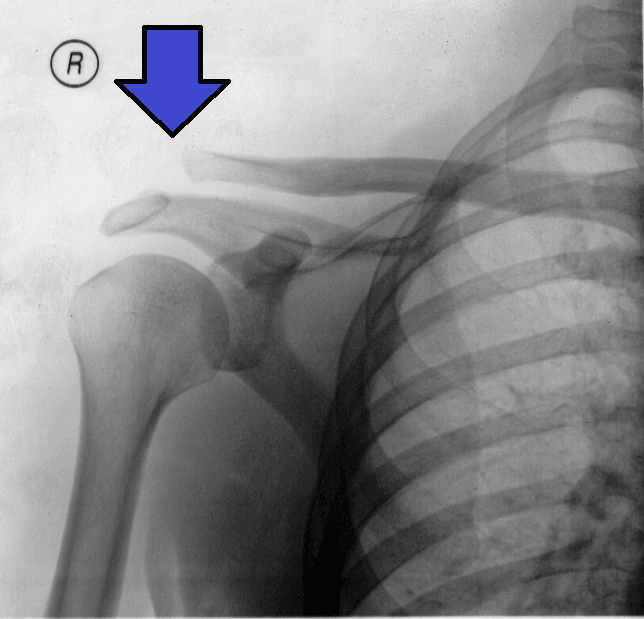
Axillary lateral view. It shows the hook of the acromion, the coracoid and the glenoid, and it is the only view on which posterior displacement can be seen: in a Type IV the clavicle lies posterior to the acromion.
Never diagnose or treat an AC joint injury without an axillary view. Type IV posterior displacement looks identical to Type III on the AP, and a missed Type IV means failed conservative treatment.
Stress views. Weighted views, with 5-10kg in the hands, may help to differentiate a Type II from a Type III and to quantify displacement. Most centres no longer use them routinely, and pain limits their usefulness in the acute setting.
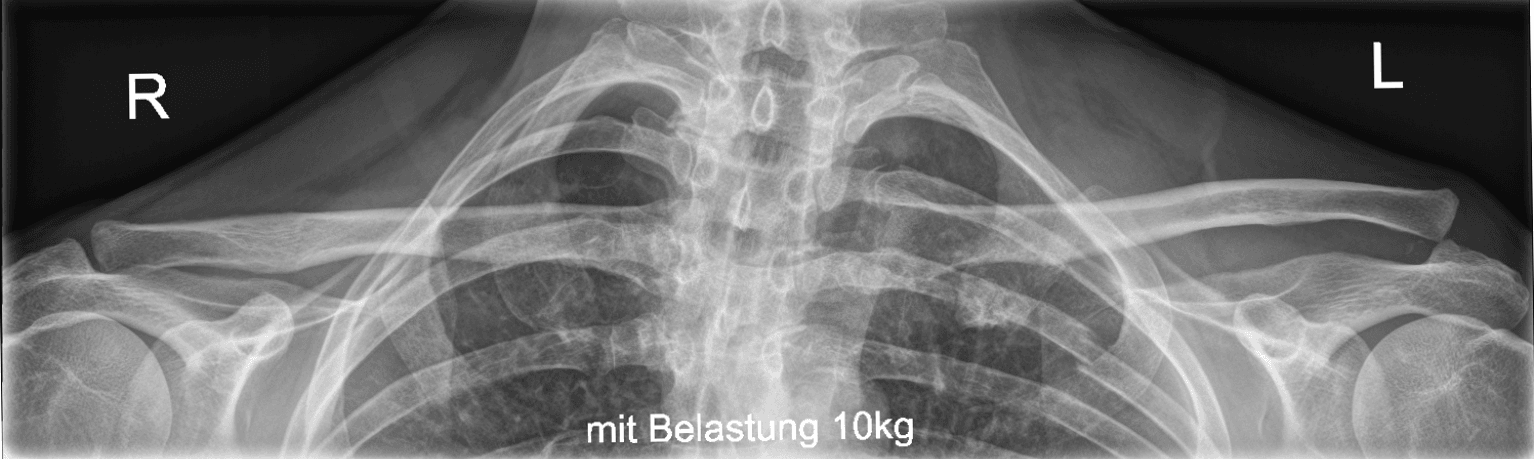
Measurements. The numbers that grade the film:
- Normal
- 11-13mm
- Type III+
- Over 13mm or over 50% increase
- Normal
- 1-3mm
- Type III+
- Over 5mm widening
- Normal
- Under 50%
- Type III+
- Over 50%
CT is for the bone: a suspected fracture of the clavicle, acromion or coracoid, a failure of conservative treatment in which an occult fracture is being sought, and planning before a complex reconstruction.
MRI is for a suspected associated rotator cuff injury, chronic AC joint pain where the disc and any arthritis need assessing, and preoperative assessment before a delayed reconstruction.
Management
The decision. Types I and II are treated conservatively and Types IV to VI surgically. Type III is the argument.
Type III. The current consensus is conservative first: 80-90% of Type III injuries treated conservatively achieve a satisfactory outcome, and multiple RCTs show no difference between operative and non-operative treatment. Pooling the four RCTs restricted to Type III (244 patients) found no significant long-term difference in Constant score (MD 4.82, 95% CI -6.42 to 16.06); surgery gave better early pain relief and a better coracoclavicular distance, at the cost of more complications. Surgery is considered in throwing athletes, heavy labourers and overhead workers, and in the patient with persistent symptoms at 3-6 months, which is uncommon, and only after discussing the risks and benefits. Do not reflexively operate.
Stable or unstable: IIIA and IIIB. The ISAKOS upper-extremity consensus (2014) subdivides Type III by dynamic stability and shoulder function rather than treating it as one group:
- Type IIIA, stable: no overhead or throwing dysfunction, no scapular dyskinesis, and the deformity reduces or is non-disabling; a therapy trial confirms good function. Conservative management. This is the larger group, which is why the trials show no difference: most Type IIIs are functionally IIIA.
- Type IIIB, unstable: persistent overhead dysfunction, scapular dyskinesis or winging, and therapy-resistant symptoms, often with horizontal instability. Consider surgical stabilisation or reconstruction.
The practical sequence is to treat essentially every Type III conservatively for a period with a structured physiotherapy and scapular programme, then re-classify: those who recover function are IIIA and continue non-operatively, those who remain symptomatic with dyskinesis are IIIB and are offered surgery. That is how the literature can show no overall difference while selected patients clearly benefit. In the exam, do not say "Type III is controversial" and stop; say you would trial rehabilitation and subdivide.
Types I and II, and most Type IIIs, follow the same programme:
- Ice, analgesia, NSAIDs
- Sling for comfort
- Avoid aggravating activities
- Gentle pendulum exercises
- Wean sling as pain allows
- Active ROM exercises
- Avoid cross-body movements initially
- No heavy lifting
- Progressive strengthening
- Rotator cuff and scapular exercises
- Sport-specific rehabilitation
- Return to non-contact sport when pain-free
- Return to contact sport when full strength
- Some persistent cosmetic deformity acceptable
- Protective padding if returning to collision sports
The classification and the AP film measure one plane: the CC distance, the vertical restraint. Horizontal (anteroposterior) stability comes from the AC capsule, especially its superior and posterior ligaments, and it is routinely under-assessed. That omission costs in two ways.
- Posterior instability is easily missed. Detecting posterior translation of the clavicle needs the axillary or Alexander (cross-body) views and dynamic assessment with cross-body adduction.
- A CC-only reconstruction can still fail. Restore the vertical ligaments alone and unaddressed horizontal instability leaves persistent pain and a positive cross-body sign despite an "acceptable" CC distance. This is why modern anatomic reconstructions increasingly add an AC-joint stabilisation (AC cerclage or augmentation) on top of the CC reconstruction.
Assess and treat both planes: the CC ligaments on the AP film, and the AC capsule on the axillary and cross-body views.
Surgical Technique
How it works. The hook passes under the acromion into the subacromial space and the plate is fixed to the clavicle, so the construct pulls the clavicle down and reduces the joint. The hook sits 10-15mm medial to the lateral edge of the acromion; impingement is worse if the hook is too long or too medial.
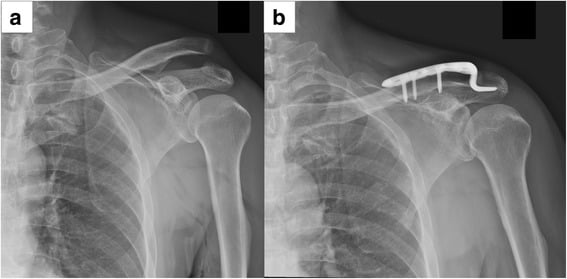
Who it suits. Acute injuries only, under 3 weeks old, in Types III-V where rapid rigid fixation is wanted. It is not suitable for a chronic injury (over 6 weeks): the fixation is temporary, soft-tissue healing has already occurred, and the persistent instability needs an anatomic CC reconstruction instead.
For and against. It is technically simpler than a reconstruction, the fixation is rigid and no graft has to be harvested. Against that, the plate must be removed at 3-4 months, a mandatory second operation, and the hook itself is the source of its complications.
Hook plates must be removed at 3-4 months. Left in, they cause subacromial impingement, acromial erosion, rotator cuff damage and plate breakage. Plan the second operation from the outset.
Use the measured rates, and note which of the two is the larger: it is not the one usually quoted. Prospective sonographic follow-up of 40 patients with an AO clavicular hook plate found subacromial impingement in 37.5% but acromial bony erosion in 50%, with rotator cuff lesions in 6 patients; impingement correlated with poorer DASH and Constant scores (Level II). Erosion is the commonest finding, not an occasional one, because the hook sits under the acromion and wears it. That is the concrete argument for planning removal rather than considering it later, and it is worth stating to the patient at consent for the index operation.
Complications
- Conservative
- 10-20%
- Hook Plate
- 10-20%
- CC Reconstruction
- 10-15%
- Conservative
- Common (accepted)
- Hook Plate
- Low (while in)
- CC Reconstruction
- Low
- Conservative
- N/A
- Hook Plate
- 10-15% (after removal)
- CC Reconstruction
- 10-15%
- Conservative
- N/A
- Hook Plate
- 37.5% (acromial erosion 50%)
- CC Reconstruction
- Rare
- Conservative
- N/A
- Hook Plate
- Common (requires removal)
- CC Reconstruction
- 5-10%
- Conservative
- N/A
- Hook Plate
- Acromion 5-10%
- CC Reconstruction
- Coracoid/clavicle 2-5%
- Conservative
- Rare (under 10%)
- Hook Plate
- 100% (mandatory)
- CC Reconstruction
- 10-20%
After conservative treatment. Persistent pain affects 10-20% and is usually mild, and AC joint arthritis is the long-term risk. The other failure is the patient who needs a delayed reconstruction, and the randomised data put this higher than the usual 5-10% quote: in the ACORN trial of 60 patients aged 16-35 with acute Type III/IV injuries, 5 of the 30 non-operative patients failed and needed delayed reconstruction (Level I). Surgery in that trial produced a far better radiographic reduction (mean residual displacement 1.75mm versus 10.61mm) yet no functional advantage at 1 year (DASH 5.63 versus 4.67), at over four times the cost. The honest counselling position is that conservative care is the right first line, the deformity will usually persist, and a minority will still come to surgery later.
After a hook plate. The complications are the hook's: impingement, acromial erosion and fracture, cuff damage, the mandatory removal, and recurrent instability in 10-15% once the plate is out. The rates are in Surgical Technique.
After CC reconstruction.
- Loss of reduction or failure (10-15%)
- Coracoid fracture during drilling (2-5%)
- Clavicle fracture through the tunnels
- Graft-site morbidity with autograft
- Infection (1-2%)
- Nerve injury (rare: musculocutaneous, suprascapular)
- Heterotopic ossification, which is common
Distal clavicle excision (Mumford procedure) can address AC joint arthritis but does not treat instability. In a chronic AC separation with arthritis, combine CC reconstruction with a limited (5-7mm) distal clavicle excision if needed.
Postoperative Care and Rehabilitation
After CC reconstruction the programme runs in four stages:
- Sling full time
- Pendulum exercises only
- Ice, wound care
- No active shoulder movement
- Sling when walking/out
- Passive ROM to 90° elevation, neutral rotation
- Active elbow and wrist ROM
- No lifting
- Wean sling
- Active-assisted then active ROM
- Progressive strengthening begins at 8 weeks
- No heavy lifting
- Full active ROM
- Progressive strengthening
- Sport-specific training
- Return to contact sport 6-9 months
After a hook plate the early protocol is the same, with hardware removal at 3-4 months built into it. After removal the shoulder is protected for 2-4 weeks and then activity progresses. Some loss of reduction after removal is normal and usually asymptomatic.
Robust deltotrapezial fascia repair is critical to success. This layer shares load with the CC reconstruction and prevents superior instability; failure of the repair leads to persistent pain and weakness.
Outcomes and Prognosis
Conservative treatment. Types I and II do excellently, with full recovery expected, and most patients return to full sport and activity.
Surgery. Types IV-VI do well with surgery, with 90% satisfaction. A Type III operated on late, after failed conservative treatment, does as well as one operated on early.
The bump. A persistent cosmetic deformity is common after conservative and after surgical treatment. It is usually well tolerated and does not correlate with functional outcome, so counsel patients about it preoperatively.
What decides the outcome.
- Accuracy of diagnosis (do not miss a Type IV)
- Patient selection between conservative and surgical treatment
- Surgical technique (anatomic reconstruction preferred)
- Rehabilitation compliance
- Associated injuries (rotator cuff, fractures)
Guidelines, Registries & Global Practice
Global epidemiology:
- In a population-based Scottish study, the acromioclavicular joint accounted for an incidence of 8.9 dislocations per 100,000 per year (Hindle et al., Injury 2013), making it one of the more frequently dislocated joints of the appendicular skeleton.
- Strongly male-predominant and concentrated in the young active population (mean age mid-30s in operative series), with a peak in the second-to-fourth decades.
- Mechanism is typically a direct blow to the point of the shoulder (contact and collision sports - rugby codes, American football, ice hockey, AFL) or a cycling/motorcycling fall; the same mechanism predominates internationally.
- Most injuries are low-grade (Rockwood I-II); complete (III-VI) dislocations are the minority but generate most of the surgical workload and controversy.
Side-by-side guideline and society positions:
- Position on Type III
- Non-operative first-line; surgery individualised for high-demand patients or failed conservative care
- Surgical types
- Type IV-VI (and selected V)
- Evidence level
- Level I RCT and meta-analysis
- Position on Type III
- Conservative initial management; shared decision-making, delayed reconstruction if symptomatic
- Surgical types
- Type IV-VI; selected high-grade III/V
- Evidence level
- Level I (ACORN, Cochrane)
- Position on Type III
- Acute complete injuries - anatomic CC/AC stabilisation when operative; reserves hook plate for selected acute cases
- Surgical types
- Type IV-VI; unstable V
- Evidence level
- Expert consensus + biomechanics
- Position on Type III
- Distinguishes stable vs unstable III (IIIa/IIIb); operative consideration for unstable IIIb and overhead athletes
- Surgical types
- Type IIIb-VI
- Evidence level
- Level II-III
Modern (ISAKOS-influenced) practice increasingly subdivides Rockwood III into IIIA (stable) - treated conservatively - and IIIB (unstable) - unstable on dynamic or cross-body imaging, with scapular dyskinesis, or in an overhead athlete - where surgery is more readily considered. Quoting this nuance shows examiners you are current beyond the simple "III is controversial" line.
- There is no dedicated international AC-joint implant registry, but the pooled Level I evidence (COTS 2015, ACORN 2018, Cochrane 2010, Xie meta-analysis 2024) consistently shows no long-term functional advantage of surgery over conservative care for acute complete dislocations, with higher complication and reoperation rates in operative arms.
- Practice variation persists: surgeons in some European and North American centres favour early anatomic reconstruction (often arthroscopically assisted with suspensory devices) for high-grade injuries and athletes, whereas the default in the UK/Australasia remains conservative-first.
- Non-contact activity: ~6-8 weeks (conservative), ~12 weeks (after reconstruction).
- Contact/collision sport: 12+ weeks (conservative); ~6 months after reconstruction; protective padding for collision sports.
- Heavy manual/overhead work typically resumes ~12-16 weeks after reconstruction.
Be ready to summarise the Level I evidence (COTS, ACORN, Cochrane, Xie meta-analysis) showing equivalent long-term function for operative vs conservative care of complete dislocations, then nuance it with stable vs unstable type III and patient factors (overhead athlete, manual labourer). This combination of evidence plus individualised decision-making is what distinguishes a strong answer.
MCQ Practice Points
Q: Which AC ligament provides the majority of resistance to horizontal translation? A: Superior AC ligament (56%). The posterior AC ligament contributes 25%. The CC ligaments provide vertical (superior-inferior) stability, not horizontal.
Q: What distinguishes Type V from Type III AC joint separation? A: Deltotrapezial fascia detachment in Type V leads to greater than 100-300% superior displacement (vs 25-100% in Type III). Type V represents more severe soft tissue disruption.
Q: Which view is essential to differentiate Type III from Type IV AC separation? A: Axillary lateral view. Type IV has posterior clavicle displacement that cannot be seen on AP view. Missing Type IV leads to failed conservative treatment.
Q: What is the current consensus for treatment of Type III AC separations? A: Conservative management first for most patients. Surgery considered in: throwing athletes, heavy laborers, or after failed conservative treatment at 3-6 months. Multiple RCTs show no significant difference in outcomes.
Q: Why is the hook plate not suitable for chronic AC joint injuries? A: Hook plate provides temporary rigid fixation only (must be removed at 3-4 months). In chronic injuries, soft tissue healing has already occurred and anatomic CC ligament reconstruction is needed to address persistent instability.
Q: What is the anatomic position of the trapezoid vs conoid ligament? A: Trapezoid is LATERAL (centre ~25mm from the lateral clavicle edge), Conoid is MEDIAL (medial edge 47.2 ± 4.6mm in men, 42.8 ± 5.6mm in women) - or by Rios's constant ratios, 0.17 and 0.24-0.31 of clavicle length.
Clinical Decision Scenarios
Practise clinical reasoning and management decisions out loud
“A 25-year-old rugby player presents after a tackle onto his right shoulder. X-rays show a Type III AC joint separation with CC distance 15mm (contralateral 11mm). He wants to return to professional rugby. How would you manage this patient?”
“A 40-year-old manual laborer presents 3 months after a cycling accident. He was treated conservatively for an AC joint injury but has persistent pain and cosmetic deformity. X-rays show 100% superior displacement with AC joint arthritis. What is your assessment and management?”
“A 30-year-old presents after a motorcycle accident with severe shoulder deformity. The AP X-ray shows what appears to be a Type III AC separation with significant superior displacement. On examination, the lateral clavicle cannot be palpated anteriorly and there is fullness posteriorly. What is your concern and management?”
ROCKWOOD CLASSIFICATION
- Type I: AC sprain, intact CC - conservative
- Type II: AC torn, CC sprain - conservative
- Type III: CC torn, 25-100% - CONTROVERSIAL (mostly conservative)
- Type IV: Posterior displacement - SURGICAL (need axillary view!)
- Type V: Over 100% superior, deltotrapezial detached - SURGICAL
- Type VI: Inferior (rare) - SURGICAL
KEY ANATOMY
- CC ligaments = VERTICAL stability (conoid medial, trapezoid lateral)
- AC ligaments = HORIZONTAL stability (superior 56%, posterior 25%)
- Normal CC distance: 11-13mm
- Trapezoid: ~25mm from lateral clavicle edge (lateral)
- Conoid: medial edge 47.2 ± 4.6mm (men) / 42.8 ± 5.6mm (women) from lateral clavicle edge; ratios 0.17 / 0.24-0.31 of clavicle length
TYPE III CONTROVERSY
- Multiple RCTs show NO difference operative vs conservative
- Current consensus: CONSERVATIVE FIRST
- Consider surgery: throwing athletes, heavy laborers, failed conservative
- 80-90% satisfactory outcome with conservative treatment
IMAGING ESSENTIALS
- ALWAYS get AXILLARY VIEW (Type IV looks like III on AP)
- Zanca view: 10-15° cephalic tilt for AC joint
- CC distance increased over 50% or over 13mm = Type III+
- Weighted views controversial - rarely change management
SURGICAL OPTIONS
- Hook plate: ACUTE only, MUST remove at 3-4 months
- Anatomic CC reconstruction: Both ligaments, 10-15% failure
- Weaver-Dunn: Non-anatomic, 20-30% failure (historical)
- CC screw: Must remove 6-8 weeks (breakage risk)
TRAPS AND PEARLS
- Missing Type IV (no axillary view) = failed conservative
- Hook plate in chronic injury = wrong indication
- Forgetting hook plate mandatory removal = complications
- K-wire migration = unacceptable complication rate
- Cosmetic deformity doesn't predict function
Evidence Base
Canadian Orthopaedic Trauma Society (COTS) RCT
- Multicentre RCT of 83 patients with acute complete (Rockwood III-V) AC dislocations randomised to hook-plate fixation versus non-operative care. The non-operative group had significantly better DASH scores at 6 weeks and 3 months, with no significant difference at 6, 12 or 24 months (mean DASH 5-6 in both groups at 2 years). Hook-plate fixation gave superior radiographic alignment but a significantly higher reoperation rate.
ACORN RCT (Murray et al.)
- RCT of 60 patients (16-35 years) with acute type III/IV dislocations randomised to open reduction with tunnelled suspensory device versus non-operative care. Surgery markedly improved radiographic reduction (mean 1.75 mm vs 10.61 mm displacement) but gave no functional benefit at 1 year (DASH 5.63 vs 4.67) and cost over four times as much. However, 5 non-operative patients failed and required delayed reconstruction.
Xie et al. Meta-analysis of RCTs (Type III)
- Meta-analysis of 4 RCTs (244 patients) restricted to Rockwood type III. No significant difference in long-term Constant score (MD 4.82, 95% CI -6.42 to 16.06). Surgery gave better early pain relief and coracoclavicular distance but higher rates of post-traumatic osteoarthritis and hardware-related complications.
Tamaoki et al. Cochrane Review
- Three trials (174 patients) of surgery (CC screws, AC pins/wires) versus sling. No significant difference in unsatisfactory shoulder function (RR 1.49, 95% CI 0.75-2.95) or treatment failure (RR 1.72, 95% CI 0.72-4.12). Fixation failures occurred in all trials (wire breakage 41%); surgery delayed return to work and routinely required implant removal.
Mazzocca et al. Anatomic CC Reconstruction
- Controlled cadaveric study (42 shoulders) comparing anatomic CC reconstruction (free tendon graft reconstructing both conoid and trapezoid) with modified Weaver-Dunn and an arthroscopic technique. The modified Weaver-Dunn had significantly greater laxity than the anatomic reconstruction, which had significantly less anterior and posterior translation and more closely restored the intact state.
Lin et al. Hook-Plate Impingement (Sonographic)
- Prospective sonographic study of 40 patients with an AO clavicular hook plate. Subacromial impingement developed in 37.5%, acromial bony erosion in 50%, and rotator cuff lesions in 6 patients; impingement correlated with poorer DASH and Constant scores.
Klimkiewicz et al. AC Capsule Biomechanics
- Cadaveric serial-sectioning study showing the superior and posterior AC capsular ligaments are the principal restraints to posterior clavicular translation, contributing 56% (+/-23%) and 25% (+/-16%) respectively; the anterior and inferior ligaments had no significant role.
Lee et al. In-situ Ligament Forces
- Universal force-moment sensor study of 10 cadaveric shoulders. The trapezoid ligament was the primary restraint to posterior clavicular displacement, providing 55.8% (+/-20.0%) of the resisting force, while the inferior AC capsule was the major restraint to anterior displacement.
Tischer et al. Associated Intra-articular Injuries
- Arthroscopy in 77 surgically treated acute type III-V dislocations found intra-articular injuries in 18.2%, including SLAP lesions in 14.3% and supraspinatus tears in 3 patients. SLAP lesions were more common in type V (19%) than type IV (3.4%).