Hook vs Body | Sports Injury | Tendon Rupture Risk | Ulnar Nerve
- Hook forms radial wall of Guyon's canal - ulnar motor branch at risk
- Sports mechanism - golf club, racquet, or bat handle impact to palm
- FDP to ring/small fingers passes over hook - rupture if nonunion
- CT scan required - hook NOT visible on standard radiographs
- Excision of hook nonunion gives excellent outcomes for grip sports
- “Hook of hamate pull test: pain with resisted ring/small finger flexion
- “Carpal tunnel view and 45-degree supinated oblique can show hook
- “Body fractures often associated with 4th/5th CMC fracture-dislocations
- “Pisometacarpal ligament attaches to hook - avulsion mechanism
Overview
Hamate fractures make up 2-4% of carpal fractures, and 80-90% of them are fractures of the hook. The hamate is the most ulnar bone of the distal carpal row, and the hook is what makes it interesting: it sits against the ulnar nerve, the flexor tendons to the ring and small fingers, and the handle of whatever the patient was gripping. A hook fracture is easy to miss, slow to declare itself and often fails to unite on its own, so the injury is small and the cost of ignoring it is not.
Mechanism. The classic hook fracture is a direct blow from the handle of sporting equipment striking the palm: a golf club (the most common cause, at the grip pressure point), a racquet in tennis, squash or badminton, the handle end of a bat in baseball, or a weightlifting bar or dumbbell handle in the gym. The other route is avulsion, through the pisohamate or pisometacarpal ligament, both of which attach to the hook. Stress fractures are rare and follow repetitive grip activity.
Body fractures are a different injury in a different patient. They follow a high-energy axial load, such as a punch, and are often part of a dorsal dislocation of the 4th and 5th CMC joints.
Who. Peak incidence is at 20-40 years, the majority are sports-related, and the diagnosis is often delayed by weeks to months.
Why the diagnosis is missed, and what it costs. Hook fractures are missed in up to 50% of initial presentations: standard radiographs often fail to show the hook, the symptoms are put down to a "wrist sprain" or "tendinitis", and associated injuries distract from the hook. The commonest consequence by far is nonunion, which follows almost as a rule rather than as a risk: in Scheufler's series five of six conservatively treated fractures went on to symptomatic nonunion. The others are ulnar nerve motor branch injury, chronic pain with grip weakness, and the feared late sequel, attritional rupture of the flexor tendons to the ring and small fingers, which is taken up under Complications.
Anatomy and Pathophysiology
The body. The hamate body articulates with the capitate radially, the triquetrum proximally and the bases of the 4th and 5th metacarpals distally. The joint with the triquetrum is helicoid, allows the dart-throwing motion, contributes to the ulnar column of the wrist and is important for grip strength. Distally the 4th metacarpal base is relatively immobile while the 5th allows 20-30 degrees of flexion, and that CMC motion is important for power grip.
The hook (hamulus). The hook projects 10-12mm from the volar surface of the body and is the attachment for the flexor retinaculum, the pisohamate and pisometacarpal ligaments and the hypothenar muscles. It forms the ulnar pillar of the carpal tunnel and the radial wall of Guyon's canal, which is why a hook fracture can produce both median nerve symptoms (carpal tunnel compression) and ulnar nerve symptoms (motor branch palsy).
- Attachment Site
- Hook
- Clinical Significance
- Hook forms ulnar pillar of carpal tunnel; maintains carpal arch
- Attachment Site
- Proximal aspect of hook
- Clinical Significance
- Transmits FCU force; avulsion fracture mechanism
- Attachment Site
- Base of hook
- Clinical Significance
- Force transmission to 5th metacarpal
- Attachment Site
- Hook tip and shaft
- Clinical Significance
- Origin of hypothenar muscle
- Attachment Site
- Hook tip
- Clinical Significance
- Origin of hypothenar muscle
The ulnar nerve. The motor branch curves around the radial aspect of the hook. Injury weakens the intrinsic muscles: Froment's sign becomes positive as FPL substitutes for thumb adduction, and first dorsal interosseous weakness impairs key pinch.
The ulnar artery passes superficially in Guyon's canal. A hook fracture can cause thrombosis or a pseudoaneurysm, and repetitive trauma to the same spot produces hypothenar hammer syndrome.
The flexor tendons. FDP to the ring and small fingers pass directly over the volar aspect of the hook, so a sharp fracture edge can wear through them. That attrition rupture is uncommon and has no established population rate, the literature being case reports and small series, but it is the reason a symptomatic nonunion is not left alone.
Blood supply. The hamate as a whole is supplied from several sources: dorsal branches from the dorsal carpal arch, volar branches from the palmar carpal arch and direct branches from the ulnar artery. The hook is not so fortunate. It receives single or few nutrient vessels from the ulnar artery, a tenuous supply that explains the high nonunion rate with conservative treatment.
Why the hook does not unite. Several things work against a hook fracture left in a cast: the tenuous blood supply, tensile force from the pisohamate ligament pulling on the fragment, motion transmitted by the adjacent flexor tendons, and the fact that a delayed presentation is already a nonunion by the time it is seen. That reasoning underlies the whole of management.
Classification
Hook fractures (80-90%) are the common pattern and the sports injury: a direct blow from an equipment handle or an avulsion through the pisohamate ligament, with a high nonunion rate under conservative treatment. Body fractures (10-20%) follow a high-energy mechanism, are often part of a CMC fracture-dislocation and commonly involve the articular surface, so they need ORIF for joint stability; their consolation is a better healing potential than the hook.
- Mechanism
- Flexor retinaculum avulsion
- Associated Injuries
- Carpal tunnel symptoms
- Treatment
- Immobilisation vs excision
- Mechanism
- Direct impact (most common)
- Associated Injuries
- FDP attrition risk
- Treatment
- Excision usually needed
- Mechanism
- High force impact
- Associated Injuries
- Larger fragment
- Treatment
- ORIF possible vs excision
- Mechanism
- CMC dislocation
- Associated Injuries
- 4th/5th CMC subluxation
- Treatment
- ORIF + CMC stabilisation
- Mechanism
- Axial load
- Associated Injuries
- Articular incongruity
- Treatment
- ORIF for joint surface
- Mechanism
- Repetitive microtrauma
- Associated Injuries
- Subtle changes on MRI
- Treatment
- Rest; excision if symptomatic
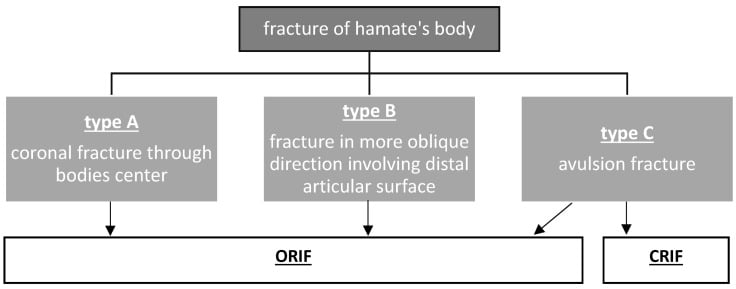
- Hook Fracture
- 80-90% of hamate fractures
- Body Fracture
- 10-20% of hamate fractures
- Hook Fracture
- Direct blow from sports equipment handle
- Body Fracture
- High-energy axial load, punch
- Hook Fracture
- Athletes: golf, tennis, baseball
- Body Fracture
- Trauma, altercation (boxer)
- Hook Fracture
- Nonunion, then attritional FDP rupture (uncommon but classic)
- Body Fracture
- CMC joint arthrosis
- Hook Fracture
- CT gold standard (X-ray misses 50%)
- Body Fracture
- Usually visible on X-ray
- Hook Fracture
- Excision for nonunion; ORIF for acute
- Body Fracture
- ORIF with K-wires/screws
- Hook Fracture
- 6-8 weeks after excision
- Body Fracture
- 8-12 weeks after ORIF
Clinical Assessment
History. The hook fracture patient plays golf (the most common), tennis, baseball or squash, felt a "pop" or sharp pain with a swing, and has pain that is worse with gripping. Presentation may be delayed by weeks, and there may be paraesthesias in the ring and small fingers from the ulnar nerve. The body fracture patient has had a high-energy injury, a fall, a punch or a road traffic collision, or a direct blow to the dorsum of the hand, with immediate swelling and deformity, often in a polytrauma setting and with associated metacarpal injuries.
Examination. The hook lies 2cm distal and radial to the pisiform, and point tenderness there is the finding to seek. Grip is painful and weak compared with the other hand, and the pull test, resisted DIP flexion of the ring and small fingers, reproduces pain at the hook.
- Technique
- Press 2cm distal/radial to pisiform
- Positive Finding
- Point tenderness over hook
- Sensitivity
- High if done correctly
- Technique
- Resist DIP flexion of ring/small fingers
- Positive Finding
- Pain at hook location
- Sensitivity
- ~80%
- Technique
- Patient pushes against table with palm
- Positive Finding
- Pain in hypothenar region
- Sensitivity
- Moderate
- Technique
- Compare grip strength bilaterally
- Positive Finding
- Decreased by 20-30% on affected side
- Sensitivity
- Variable
- Technique
- Test ring/small finger sensation
- Positive Finding
- Decreased suggests ulnar nerve injury
- Sensitivity
- Low (late finding)
The ulnar nerve. Assess the motor branch in every suspected hook fracture. Test the first dorsal interosseous by index finger abduction against resistance, the palmar interossei by finger adduction (the paper grip test), and thumb adduction for Froment's sign, where FPL substitution is positive. Sensation is tested by two-point discrimination of the small finger and light touch over the hypothenar eminence (palmar cutaneous branch), and small finger abduction at rest, Wartenberg's sign, suggests an ulnar nerve palsy.
The flexor tendons. Test FDP to the ring and small fingers at every visit, because rupture, especially of the small finger tendon, is a late complication of the missed fracture. Stabilise the PIP joint to isolate the DIP, ask for active DIP flexion, compare strength with the other side and palpate for tendon continuity at the wrist.
G - R - I - PHook Examination - 'GRIP'
Hook:GRIP sports cause hook fractures - test GRIP function
Differential diagnosis. Ulnar-sided wrist and hypothenar pain has a short list of alternatives, and each has a finding that separates it from the hook.
- Distinguishing Features
- Grip-sport mechanism; tenderness 2cm distal/radial to pisiform; pain on resisted ring/small finger flexion
- Key Investigation
- CT (gold standard); X-rays normal in many cases
- Distinguishing Features
- Tenderness over pisiform; pain on direct pisiform compression and shear
- Key Investigation
- Supinated 30-degree oblique view; CT
- Distinguishing Features
- Ulnar fovea tenderness; pain on ulnar deviation/loading; positive fovea sign
- Key Investigation
- MR arthrography; wrist arthroscopy
- Distinguishing Features
- Cold intolerance, digital ischaemia; repetitive palmar trauma
- Key Investigation
- Doppler ultrasound; CT/MR angiography; Allen test
- Distinguishing Features
- Intrinsic weakness/clawing; sensory loss sparing dorsum; Froment sign
- Key Investigation
- Nerve conduction studies; CT/MRI for mass or fracture
- Distinguishing Features
- Tenderness along FCU at pisiform insertion; pain on resisted flexion-ulnar deviation
- Key Investigation
- Ultrasound; radiograph for calcification
- Distinguishing Features
- Dorsal ulnar tenderness; dorsal chip on lateral X-ray
- Key Investigation
- Lateral and oblique radiographs; CT
Investigations
Radiographs. On the standard PA view the body is visible but the hook is often obscured, and the lateral shows it poorly; standard views miss up to 50% of hook fractures. Obtain them if a fracture is suspected, and add the projections that profile the hook:
- Carpal tunnel view: wrist dorsiflexed, beam parallel to the palm
- 45-degree supinated oblique: profiles the hook
- Lateral with supination: improves hook visibility
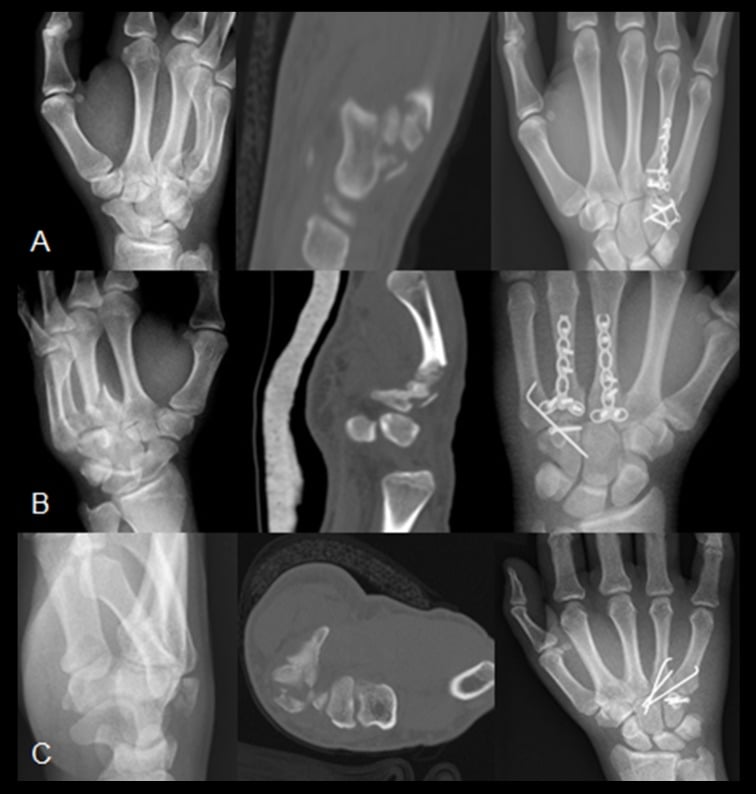
These are more sensitive but still miss fractures. Andresen's cadaver study puts a number on it: even a complete radiographic series including the carpal tunnel view reached a sensitivity of only 72.2% against 100% for CT, so roughly one fracture in four escapes a full series and negative films do not exclude the diagnosis.
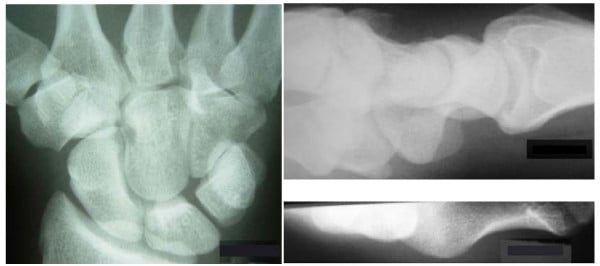
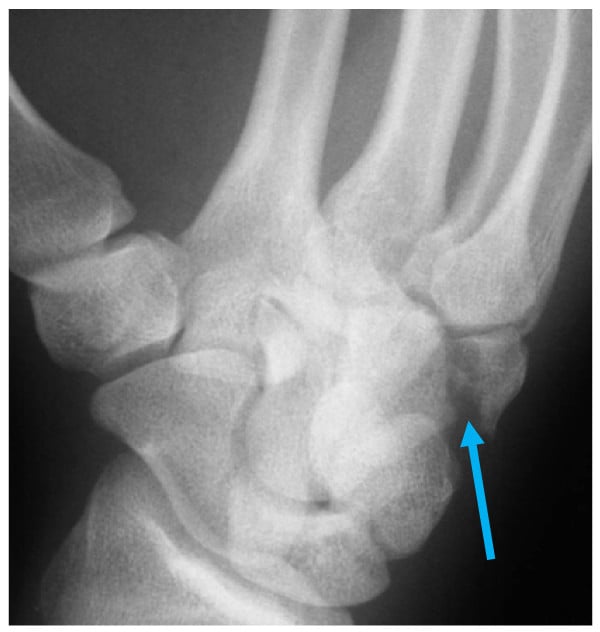
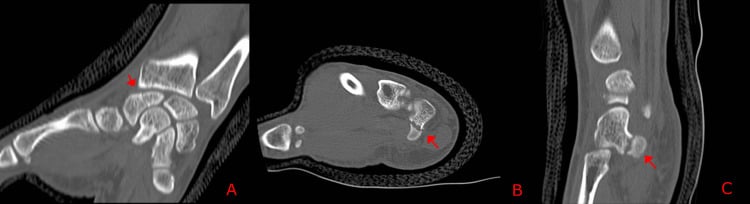
CT is the gold standard, with a sensitivity that approaches 100%. Get it when clinical suspicion persists despite negative radiographs, for preoperative planning before ORIF, and to evaluate union after conservative treatment. The protocol is 1mm axial slices through the carpus with sagittal and coronal reconstructions, comparing with the contralateral side if needed. It shows the fracture line through the hook at any level, displacement and fragment size, the signs of nonunion (sclerosis, gap, cyst formation) and any associated body fracture.
- Sensitivity for Hook
- 50%
- Best Use
- Initial screening
- Limitations
- Hook often not visible
- Sensitivity for Hook
- 70%
- Best Use
- Clinical suspicion
- Limitations
- Positioning dependent
- Sensitivity for Hook
- 95-100%
- Best Use
- Definitive diagnosis; surgical planning
- Limitations
- Radiation; cost
- Sensitivity for Hook
- 90%
- Best Use
- Stress fractures; soft tissue
- Limitations
- Cost; availability
The sequence, in order:
- Suspicion based on history and examination: standard X-rays first
- If negative but high clinical suspicion: CT scan, without delay
- MRI reserved for occult stress fractures, soft-tissue assessment or tendon evaluation
- Ultrasound can identify tendon ruptures if there is concern
Do not rely on normal X-rays to exclude a hook fracture in a patient with the classic presentation.
An unfused accessory ossification centre of the hook (os hamuli proprium, or bipartite hamulus) closely mimics a hook fracture or established nonunion, and mislabelling it leads to unnecessary surgery; it is a classic imaging trap examiners use. It is a developmental variant in which the hook's secondary ossification centre fails to fuse.
Telling it from a fracture or nonunion rests on the margins, the other wrist and the marrow. An os hamuli proprium has smooth, rounded, well-corticated edges on both elements, whereas a fracture or symptomatic nonunion has irregular, sclerotic or jagged margins, often with a visible gap, cyst or fragmentation. The accessory ossicle is frequently bilateral and symmetrical, so imaging the opposite wrist is the single most useful discriminator, a traumatic fracture being unilateral. On MRI there is no bone marrow oedema in a quiescent ossicle, whereas an acute fracture or active stress reaction shows oedema. It is usually an incidental, asymptomatic finding.
The caveat that keeps it examinable: an os hamuli proprium is not always innocent. It carries the same FDP-attrition and ulnar-nerve relationships as a normal hook, can become symptomatic, and a fracture can occur through its synchondrosis. So a corticated, bilateral ossicle in a pain-free patient is a normal variant to leave alone, but the same lesion presenting with acute grip-related pain warrants the same assessment (FDP integrity, ulnar nerve) and management as a fracture.
Management
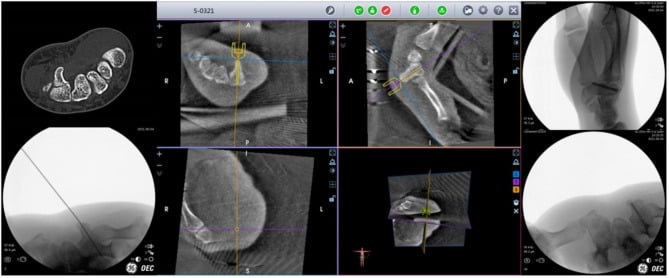
The decision. Timing, the level of the fracture and what the patient needs from the hand decide it. A hook fracture seen acutely, within 2 weeks, with a large basal fragment can be fixed, or excised early in an athlete; a symptomatic nonunion or a presentation beyond 6 weeks is excised; a displaced body fracture is fixed to restore the CMC joint. Conservative treatment of the hook fails often, with up to 50% going on to nonunion, for the reasons set out under Anatomy.
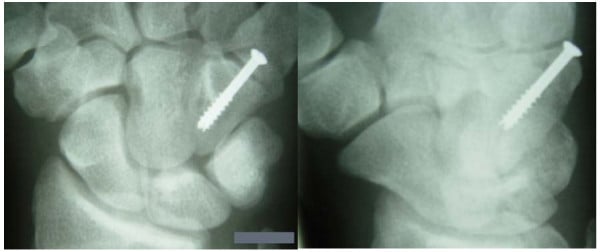
Excision or fixation. The evidence needs stating carefully. Excision is what almost all published patients received, it returns athletes slightly sooner than ORIF (6 versus 7.8 weeks in Donohue's review) and it removes any possibility of nonunion; most sports medicine surgeons recommend early excision for athletes who need to return to grip sports, citing predictable outcomes and faster recovery. The same review, though, could not determine a consistent difference between excision and ORIF, and Scheufler's series found the two comparable, so the optimal operation is not established and the choice is a judgement about this fracture and this patient.
Who. Immobilisation is for the acute, non-displaced hook tip fracture, the very early presentation (within days), the stress fracture caught early, the low-demand patient, and the patient who prefers a trial of immobilisation.
The protocol.
- Short arm cast or thermoplastic splint
- 6-8 weeks of immobilisation minimum
- Avoid gripping activities
- Serial CT to assess union
The failure rate, and the reasons for it set out under Anatomy, are why the operations that follow exist.
Surgical Technique
Set-up. Supine with the arm on a hand table, a tourniquet on the upper arm, the wrist in neutral and the fingers slightly flexed. Mark the pisiform before the incision: it is the landmark, with the hook palpable distal to it.
Approach.
- Curvilinear incision over the hypothenar eminence
- Identify the pisiform proximally and the hook distally
- Protect the ulnar nerve: the motor branch courses radial to the hook, so stay ulnar
- Incise the hypothenar fascia and retract the muscles to expose the hook
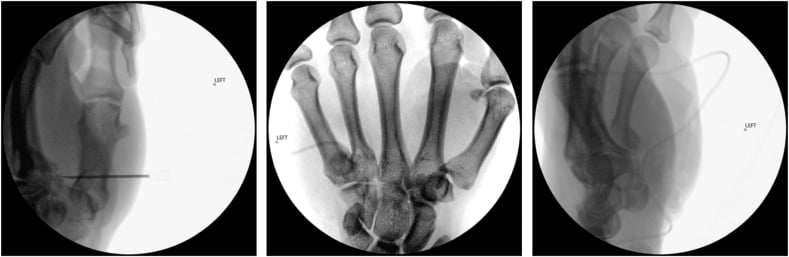
Excision.
- Clear soft tissue from the hook circumferentially
- Curved osteotome at the base of the hook
- Direct the osteotome toward the palm, away from the tendons
- Remove the entire hook as a single fragment
- Smooth the residual base with a rongeur or burr to prevent tendon irritation
- Inspect the FDP tendons for damage
- Check the integrity of the ulnar nerve
Closure. Repair the hypothenar fascia, close the skin with interrupted sutures and apply a soft dressing. Immediate finger motion is allowed, and early motion is what prevents stiffness and keeps the tendons gliding.
Complications
Attritional rupture of FDP to the ring or small finger is the most devastating complication of the missed hook fracture. The sharp fracture edge wears through the tendon over weeks to months, the small finger FDP is most commonly affected, and the patient notices that they cannot flex the DIP joint. It is uncommon and has no established population rate, because the literature is case reports and small series: it is a red flag to recognise, not a percentage to assert. When rupture does occur it follows a predictable ulnar-to-radial sequence, small finger FDP, then small finger FDS, then ring finger FDP, then ring finger FDS, so examine each of those four tendons separately in anyone with a chronic hook nonunion.
If the rupture is acute the tendon can be repaired where the ends can be approximated. Most cases require tendon grafting or an FDS-to-FDP transfer, and the outcome is not as good as an intact tendon.
Early and late. The early complications are nonunion after conservative treatment, ulnar nerve motor branch palsy, ulnar artery thrombosis, infection if the injury was open, and complex regional pain syndrome. The late ones are the FDP rupture above, chronic pain and grip weakness, chronic ulnar neuropathy from compression, CMC arthrosis after body fractures, and hypothenar atrophy.
The ulnar nerve. Where the nerve is injured along Guyon's canal determines what is lost, and hamate fractures injure it in one place above all.
- Affected Structures
- Superficial and deep branches
- Clinical Finding
- Sensory + motor loss
- Prognosis
- May need decompression
- Affected Structures
- Deep motor branch only
- Clinical Finding
- Motor weakness, no sensory loss
- Prognosis
- Most common; usually recovers
- Affected Structures
- Superficial sensory only
- Clinical Finding
- Sensory loss only
- Prognosis
- Rare with hamate fractures
- Affected Structures
- Variable
- Clinical Finding
- Progressive weakness
- Prognosis
- Excision usually curative
A Zone II injury, to the deep motor branch as it passes around the hook, is the most common pattern with hamate fractures: weakness of the interossei and hypothenar muscles, a positive Froment's sign from adductor pollicis weakness, and visible first dorsal interosseous atrophy, with no sensory loss because the sensory branch takes a separate course. It usually improves after hook excision and decompression.
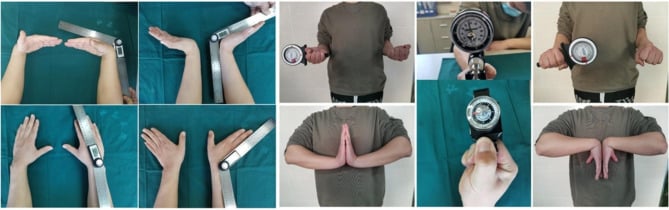
Grip after excision. The concern that removing the hook will weaken grip is reasonable and the evidence answers it. Grip strength averages 80-90% of the contralateral side after excision, there is no significant difference between excision and ORIF in athletes, a larger handle diameter compensates for any weakness, return to elite golf and racquet sports is documented, and patient satisfaction is high despite the measurable decrease. Set against ongoing pain or the tendon rupture risk of a nonunion, the reduction is minimal and well tolerated.
In a grip-trauma patient with ulnar-sided hand symptoms, think beyond the bone and the nerve to the ulnar artery. It runs superficially through Guyon's canal directly over the hook, so the same repetitive palmar trauma that fractures the hook, and the sharp fracture fragment itself, can damage the vessel and produce ulnar artery thrombosis or pseudoaneurysm: hypothenar hammer syndrome. It affects the same population, athletes and manual workers who use the heel of the palm as a hammer: mechanics, carpenters, golfers, baseball and hockey players.
Recognition. Cold intolerance and digital ischaemia (pallor, pain, splinter haemorrhages, even ulceration), typically of the ulnar three digits and sparing the thumb, which is supplied by the radial artery; a tender, sometimes pulsatile hypothenar mass if a pseudoaneurysm has formed; and a positive Allen test with delayed or absent ulnar refill.
Confirmation. Doppler ultrasound, then CT/MR or catheter angiography showing ulnar artery occlusion, the classic "corkscrew" tortuosity, and distal embolic cut-offs.
Management. Stop the repetitive trauma, smoking cessation, vasodilators (calcium-channel blockers) and anticoagulation; catheter-directed thrombolysis for acute distal emboli; and surgical resection of the diseased segment with reversed vein-graft reconstruction (or simple ligation if the superficial palmar arch provides good collateral flow), while addressing any associated hook fracture at the same time.
Postoperative Care
No cast is needed after excision; early motion is the whole point, and the timeline below is built around it.
- Soft bulky dressing, not cast
- Immediate finger ROM encouraged
- Elevation and oedema control
- Wound check at 10-14 days
- Suture removal at 2 weeks
- Full active wrist ROM begins
- Light grip strengthening with putty
- Scar massage and desensitisation
- Protective padding for sport activities
- Avoid heavy gripping
- Sport-specific grip exercises
- Gradual return to equipment use
- Modified grip diameter (larger handle)
- Progressive resistance training
- Monitor for tendon symptoms
- Full sport participation
- May use grip modification initially
- Protective padding optional
- Grip strength typically 80-90% of contralateral
- Follow up PRN
Outcomes and Prognosis
- Union Rate
- 50%
- Return to Sport
- Variable (if heals)
- Grip Strength
- Variable
- Satisfaction
- Low (frequent nonunion)
- Union Rate
- N/A (removed)
- Return to Sport
- 6-8 weeks
- Grip Strength
- 80-90% contralateral
- Satisfaction
- High (85-95%)
- Union Rate
- 75-85%
- Return to Sport
- 10-12 weeks
- Grip Strength
- 90-95% if heals
- Satisfaction
- Moderate (may need revision)
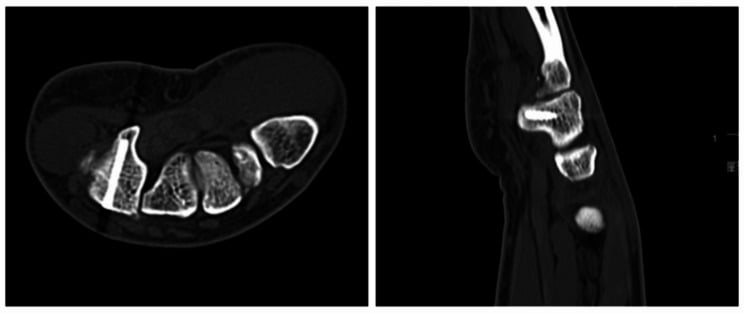
The athlete. For an athlete who needs a reliable return to grip sports, excision is preferred over conservative treatment or ORIF: 85-95% return to full sport, the timeline is predictable, there is no risk of nonunion because the hook is gone, grip is acceptably preserved, and return to elite-level golf, tennis and baseball is documented. ORIF may offer slightly better grip strength if union is achieved, but 15-25% require excision anyway because of nonunion, the rehabilitation is longer, and it is reserved for select acute cases with large fragments.
Body fractures. The prognosis is set by what was achieved at surgery and by the injury itself.
- Good: anatomic reduction, stable fixation, early presentation, an isolated injury without CMC dislocation, good compliance
- Poor: articular comminution, associated CMC dislocation, delay to treatment, polytrauma, tobacco use
In the long term. After hook excision most patients have no lasting problems; grip strength stabilises by 3-6 months, hypothenar weakness is rare and follows motor branch injury, and recurrent symptoms are very rare and usually mean the excision was incomplete. After body ORIF, CMC arthrosis may develop over 10-20 years, more likely with comminution or residual incongruity; it is usually manageable with activity modification, and CMC arthrodesis is rarely needed.
Guidelines, Registries & Global Practice
Global Epidemiology
- Hamate fractures: 2-4% of carpal fractures (hook predominates)
- Strongly male, peak age 20-40 years
- Hook fractures cluster in grip/racquet sports: golf, baseball/softball, tennis, squash, hockey, and (regionally) underwater rugby
- Body fractures arise from high-energy axial load with 4th/5th CMC fracture-dislocation
- Diagnosis is frequently delayed, with many presentations as established nonunion
- Cadaveric study: combined radiographic sensitivity 72.2% vs CT 100% (Andresen 1999, PMID 9888053)
- Meta-analysis of 823 athletes: 94.5% return to play, mean 45 days, 95.6% treated by excision (Luxenburg 2025, PMID 38419427)
- Systematic review: excision gives faster return (6 vs 7.8 weeks) and less residual pain (6.1% vs 33.3%) than ORIF (Donohue 2024, PMID 38903831)
Guidance and Society Positions
No major orthopaedic body (AAOS, BOA/BSSH, NICE, AO Foundation, EFORT) publishes a disease-specific clinical practice guideline dedicated to hamate fractures; management is guided by hand-surgery consensus and the systematic-review evidence below. There is no carpal-fracture-specific national joint registry (the AOANJRR/NJR/AJRR cover arthroplasty, not carpal trauma), so registry-level outcome data are not available for this injury.
- Consensus Position
- CT is the modality of choice; radiographs (including carpal tunnel view) cannot exclude a hook fracture
- Evidence Level
- Level II cadaveric (PMID 9888053)
- Consensus Position
- Surgical management (most commonly excision) is recommended over continued immobilisation
- Evidence Level
- Level IV series (PMID 15692355)
- Consensus Position
- Excision favoured for predictable, rapid return
- Evidence Level
- Level III review/meta-analysis (PMID 38903831, 38419427)
- Consensus Position
- ORIF is a reasonable alternative with comparable outcomes in selected cases
- Evidence Level
- Level III-IV (PMID 38903831, 15692355)
- Consensus Position
- ORIF to restore carpometacarpal congruity and stability
- Evidence Level
- Level IV expert/series
Practice Variation
- Worldwide literature is dominated by excision (over 95% of pooled surgical cases)
- ORIF remains operator- and region-dependent, used selectively for acute basal fragments
- No high-level trial establishes superiority of either - the main systematic review explicitly calls for a prospective cohort with standardised outcomes
- Outcomes hinge on timely CT access and clinician awareness, both of which vary by health system
- Delayed diagnosis (and thus nonunion and FDP rupture risk) is more frequent where advanced imaging is rationed or the diagnosis is unfamiliar
- High suspicion in grip-sport athletes with hypothenar pain is the key cross-system safeguard
In any global fellowship exam, be ready to:
- Justify CT as first-line when suspicion is high despite normal radiographs
- Describe hook excision technique and ulnar motor branch protection
- Quote the return-to-sport evidence (around 94% RTP, mean 45 days, mostly after excision)
- Recognise the delayed-presentation/nonunion pattern and the attritional FDP rupture it can cause - name it as a recognised complication and give the ulnar-to-radial failure order rather than inventing a percentage
Viva Scenarios
Clinical Decision Scenarios
Practise clinical reasoning and management decisions out loud
“A 35-year-old right-hand dominant professional golfer presents with 2 weeks of ulnar-sided wrist pain after feeling a 'pop' during a swing. He has point tenderness 2cm distal to the pisiform and pain with gripping. X-rays are normal. What is your approach?”
“A 28-year-old tennis player presents with 4 months of hypothenar pain and now notices weakness flexing her small finger. She was previously told she had a 'wrist sprain.' CT shows hook of hamate nonunion with sclerotic margins. What are your concerns and how would you manage this?”
“A 40-year-old punches a wall and presents with dorsal hand swelling and unable to make a fist. X-rays show a fracture through the hamate body with dorsal subluxation of the 5th CMC joint. Describe the injury pattern and your management.”
MCQ Practice Points
- Hook forms radial wall of Guyon's canal (ulnar nerve at risk)
- Hook also forms ulnar border of carpal tunnel (median nerve)
- CT sensitivity 95-100% vs X-ray sensitivity 50%
- 50% nonunion rate with conservative treatment
- Attritional FDP rupture with untreated nonunion - uncommon, no established rate, small finger first
- Hook is radial to pisiform, not ulnar (2cm distal and radial)
- Motor branch of ulnar nerve at risk, NOT sensory
- X-rays are often normal with hook fractures
- Body fractures need ORIF, hook fractures often need excision
- Grip sports (golf, tennis) cause hook, not body fractures
Sample MCQ Concepts
- Key Point to Remember
- CT scan (gold standard) - X-rays miss 50%
- Key Point to Remember
- Hook excision - not conservative, not ORIF
- Key Point to Remember
- Motor branch of ulnar nerve (Zone II - around hook)
- Key Point to Remember
- 6-8 weeks after excision
- Key Point to Remember
- Direct blow from sports equipment (golf club)
- Key Point to Remember
- FDP to ring and small fingers
- Key Point to Remember
- 2cm distal AND RADIAL to pisiform
Q: A golfer presents with hypothenar pain after hitting the ground during a swing. Plain radiographs are normal. What is the best next investigation?
A: CT scan of the wrist. Hook of hamate fractures are notoriously difficult to visualize on plain radiographs (50% sensitivity). CT has 95-100% sensitivity for hook fractures and is the gold standard imaging modality.
Q: Which neural structure passes through Guyon's canal and is most at risk with hook of hamate fractures?
A: The motor branch of the ulnar nerve (deep branch). The hook of hamate forms the radial wall of Guyon's canal. Injury causes weakness of intrinsic muscles (interossei, hypothenar muscles) without sensory loss in Zone II injuries.
Q: A baseball player presents 6 weeks after injury with persistent hypothenar pain. CT confirms hook of hamate nonunion. What is the recommended treatment?
A: Hook excision. Hook of hamate nonunion has a 50% rate with conservative management. Excision reliably resolves symptoms with excellent outcomes, allows return to sport in 6-8 weeks, and eliminates the risk of FDP tendon rupture from the sharp nonunion fragment.
Q: What tendon is at risk of rupture with an untreated hook of hamate fracture, and in what order does it fail?
A: The flexor digitorum profundus (FDP) tendons to the ring and small fingers are at risk from attrition against the sharp fragment of an untreated nonunion. Rupture is uncommon and no reliable rate exists - the evidence is case reports and small series - so describe it as a recognised complication rather than quoting a figure. What is worth knowing is the order: small finger FDP, then small finger FDS, then ring FDP, then ring FDS, moving ulnar to radial.
Q: What distinguishes hook of hamate fractures from body of hamate fractures in terms of mechanism and treatment?
A: Hook fractures result from direct impact during grip sports (golf, baseball) and are often treated with excision if symptomatic or nonunion develops. Body fractures result from high-energy trauma, often with associated CMC injuries, and require ORIF to restore carpometacarpal articulation.
Q: Where is the hook of hamate palpated on clinical examination?
A: The hook is palpated 2cm distal AND radial to the pisiform. It forms the ulnar border of the carpal tunnel and the radial wall of Guyon's canal. Point tenderness at this location with grip weakness is highly suggestive of hook fracture.
Anatomy Points
- Hook = radial wall of Guyon's canal + ulnar pillar of carpal tunnel
- Motor branch of ulnar nerve curves around hook - intrinsic weakness if injured
- FDP to ring and small fingers pass over hook - attritional rupture if nonunion, small finger first
- Pisohamate ligament attaches proximally - transmits FCU force
Clinical Keys
- Hook tenderness: 2cm distal and RADIAL to pisiform (not ulnar)
- Pull test: resisted DIP flexion of ring/small fingers causes hook pain
- Test FDP function at every visit - rupture is late complication
- Ulnar motor testing: 1st dorsal interosseous and thumb adduction
Imaging
- Standard X-rays miss 50% of hook fractures - carpal tunnel view better
- CT is GOLD STANDARD - 100% sensitivity, get if clinical suspicion
- MRI for stress fractures or occult injuries
- Nonunion on CT: sclerotic margins, gap, cyst formation
Hook Treatment
- Conservative: 50% nonunion rate - reserved for acute, non-displaced only
- Excision: gold standard for symptomatic nonunion, 85-95% return to sport
- ORIF: option for acute base fractures, 75-85% union rate
- Return to grip sports: 6-8 weeks after excision
Body Treatment
- ORIF required for displaced body fractures
- Address CMC joint stability (often associated fracture-dislocation)
- K-wires or mini screws depending on fragment size
- Watch for long-term CMC arthrosis
Complications to Know
- FDP rupture - uncommon, no established rate; small finger first, then ulnar to radial
- Ulnar motor branch injury - Zone II (around hook) most common
- Nonunion - 50% with conservative treatment of hook fractures
- Grip weakness after excision - 80-90% of contralateral (well tolerated)
Evidence Base
Return to Play After Hook of Hamate Fracture (Meta-analysis)
- PRISMA systematic review and meta-analysis of 20 studies (823 athletes). 94.5% (778/823) returned to play, and 91.2% returned at similar or improved performance. Mean time to return to play was 45 days (range 21-168). Surgical excision was used in 95.6% of patients, open reduction and internal fixation (ORIF) in 2.2%, and casting in 1.6%.
Surgical Management: ORIF versus Excision (Systematic Review)
- Systematic review of 27 studies (1954-2023) comparing excision (n=779) with ORIF (n=51). Excision gave a shorter return to sport (6 vs 7.8 weeks) and lower rates of persistent pain (6.1% vs 33.3%), but slightly higher rates of ulnar nerve sensory (4.2% vs 0%) and motor (1.5% vs 0%) dysfunction. Chronic fractures had a longer return to sport than acute injuries (7.2 vs 5.7 weeks).
CT versus Conventional Radiography for Hamate Fractures
- Cadaveric study (18 hands) with controlled hamate fractures imaged by all conventional projections (AP, lateral, oblique, carpal tunnel view) versus high-resolution CT. Combined radiographic sensitivity was only 72.2% (specificity 88.8%, accuracy 80.5%), whereas CT sensitivity was 100% (specificity 94.4%, accuracy 97.2%). Axial or sagittal CT planes were optimal.
Critical Evaluation of Therapeutic Procedures
- Series of 14 hook of hamate fractures. Five of six conservatively treated fractures progressed to symptomatic nonunion, whereas all eight patients treated by primary surgery (excision or screw fixation) were asymptomatic by three months. Primary surgical success (8/8) was significantly higher than conservative treatment (1/6); excision and ORIF gave comparable results.
Excision in Competitive Golfers
- Seven competitive golfers with isolated hook of hamate fractures treated by excision. All had complete resolution of pain and all returned to their previous level of play, supporting an overuse/repetitive-motion mechanism in this group.