Extracapsular | Stable vs Unstable | SHS vs CMN | TAD under 25mm
- Extracapsular - blood supply preserved, low AVN risk
- Stability = posteromedial cortex - determines implant choice
- TAD under 25mm - prevents lag screw cutout
- Center-inferior screw position - optimal biomechanics
- Early surgery - within 24-48 hours reduces mortality
- “CMN for reverse oblique and unstable patterns
- “SHS requires intact lateral wall for stability
- “Lateral wall under 20.5mm predicts secondary wall fracture with a SHS - an implant-choice threshold, not a definition of stability
- “Shortened and externally rotated leg on presentation
Overview and Epidemiology
Intertrochanteric fractures are extremely common, about 50% of all hip fractures, and a major public health burden: roughly 1.6 million hip fractures a year worldwide, rising with population ageing. Unlike femoral neck fractures they are extracapsular, and the questions the exam asks are about stability assessment and implant selection.
Who. Mean age is over 80, women outnumber men 3:1, osteoporosis is the primary risk factor and a fall from standing is the most common mechanism. The distribution is bimodal:
- Elderly (90%) - low-energy falls in osteoporotic bone
- Young (10%) - high-energy trauma (motor vehicle accident, fall from height)
Why it matters. The mortality that follows is related to frailty rather than to the surgery, the risk of a second hip fracture is elevated, and the figures for survival, function and independence afterwards are set out under Outcomes and Prognosis.
Anatomy and Biomechanics
The region. The fracture runs between the greater and lesser trochanters. The structures around it are the landmarks of stability:
- Location
- Lateral, posterosuperior
- Clinical Significance
- Gluteus medius/minimus insertion, abductor function
- Location
- Medial, inferior
- Clinical Significance
- Iliopsoas insertion, medial buttress, stability marker
- Location
- Posteromedial cortex
- Clinical Significance
- Dense bone, resists compressive forces
- Location
- Anterior
- Clinical Significance
- Capsule insertion, extracapsular location
- Location
- Posterior
- Clinical Significance
- Quadratus femoris insertion
Why extracapsular matters. The capsule inserts on the intertrochanteric line, so the fracture lies outside it and the blood supply from the medial femoral circumflex artery is not disrupted. AVN is extremely rare and union rates exceed 95%.
Loading. The hip joint reaction force is 2.5-3 times body weight in walking and puts a bending moment on the proximal femur: compression on the medial side, which the calcar resists, and tension on the lateral side, which is why the lateral wall matters.
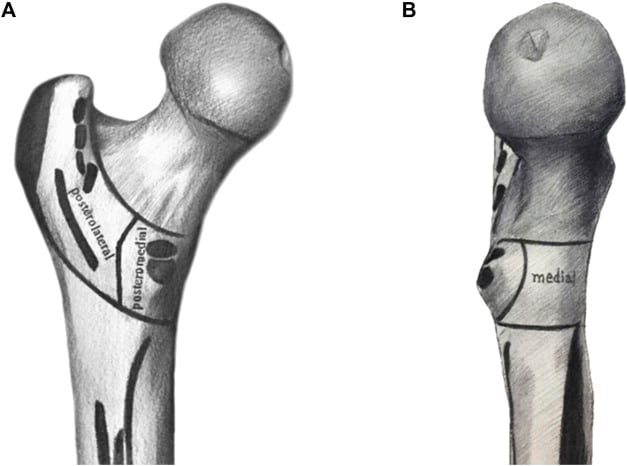
What decides stability. The posteromedial cortex is the key indicator: it is the calcar buttress that resists varus and shortening, and its comminution or loss marks an unstable pattern. The lesser trochanter is its marker, since a separate lesser trochanter fragment means the medial buttress has gone. Reverse obliquity is unstable in its own right. Lateral wall thickness is a different kind of measure: a wall under 20.5mm predicts the wall breaking after a sliding hip screw (Hsu), so it selects the implant rather than grading the fracture.
Load-sharing versus load-bearing. A sliding hip screw is a load-sharing device. It needs an intact medial buttress to share the load with, allows controlled collapse as the fracture heals, and fails if there is no medial support. A cephalomedullary nail is load-bearing: it carries the load independent of cortical integrity, so it works even with comminution.
Classification Systems
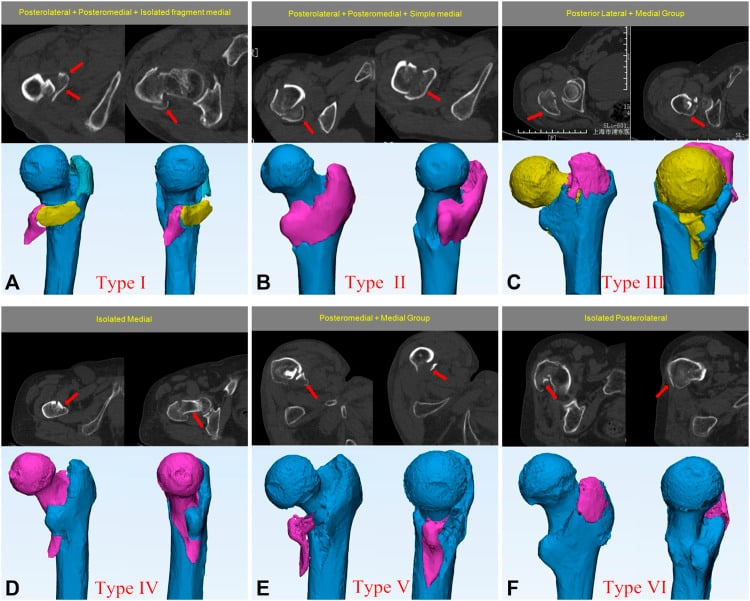
Evans/Jensen and AO/OTA describe the same axis. The question behind both is whether the fracture can be anatomically reduced and provide a stable medial buttress; if it cannot (comminution, loss of the lesser trochanter, reverse obliquity) it is unstable and needs a nail.
- Pattern
- 2-part, undisplaced
- Stability
- Stable
- Treatment
- SHS or CMN
- Pattern
- 2-part, displaced
- Stability
- Stable
- Treatment
- SHS or CMN
- Pattern
- 3-part, greater trochanter
- Stability
- Unstable
- Treatment
- CMN preferred
- Pattern
- 3-part, lesser trochanter
- Stability
- Unstable
- Treatment
- CMN preferred
- Pattern
- 4-part, comminuted
- Stability
- Unstable
- Treatment
- CMN
- Pattern
- Fracture from medial proximal to lateral distal
- Stability
- Very unstable
- Treatment
- CMN mandatory
The lateral wall. Measured on the AP radiograph as a horizontal line 3cm below the innominate tubercle to the lateral cortex. Over 20.5mm the wall is adequate for a SHS; under 20.5mm use a CMN. A thin lateral wall can fracture during SHS insertion or afterwards (Hsu's series, from which the threshold comes, recorded post-operative secondary lateral wall fractures after a dynamic hip screw), and the result is loss of stability and collapse. A CMN bypasses the problem because it is a load-bearing construct. Lateral wall integrity is the key determinant of implant selection in modern practice.
Clinical Assessment
History. A fall from standing in the elderly, high-energy trauma in the young; hip or groin pain and inability to weight-bear. Pre-injury function is critical for surgical planning, and the comorbidities to ask about are cardiac, respiratory and anticoagulation. The questions that change management:
- Walking aids used before the injury?
- Living situation: independent, with family, nursing home?
- Cognitive status: dementia increases mortality
- Anticoagulation: warfarin, DOACs, and whether reversal is needed
Examination. The classic deformity is a leg shortened by 2-3cm and externally rotated 30-60°, from the unopposed pull of iliopsoas (flexion, external rotation) and gluteus medius (abduction). There is tenderness over the greater trochanter, the patient cannot lift the leg and log-roll is painful. Check the distal pulses, though injury to the vessels is rare.
- Key Distinguishing Feature
- Shortened, externally rotated; extracapsular
- Imaging Clue
- Fracture line between trochanters, lesser trochanter fragment
- Why It Matters
- SHS vs CMN decision; AVN rare
- Key Distinguishing Feature
- Shortened, externally rotated; intracapsular
- Imaging Clue
- Fracture line within capsule, above intertrochanteric line
- Why It Matters
- AVN/non-union risk; arthroplasty often chosen in displaced fractures
- Key Distinguishing Feature
- Thigh deformity, proximal fragment flexed/abducted
- Imaging Clue
- Fracture within 5cm distal to lesser trochanter
- Why It Matters
- Long cephalomedullary nail; high stress zone
- Key Distinguishing Feature
- Pain on weight-bearing, normal initial X-ray
- Imaging Clue
- MRI (or CT) shows fracture not seen on plain film
- Why It Matters
- Missed diagnosis leads to displacement; image if clinical suspicion high
- Key Distinguishing Feature
- Low/no trauma, prior pain, known malignancy
- Imaging Clue
- Lytic lesion, cortical destruction at fracture site
- Why It Matters
- Staging, biopsy considerations, reconstruction nail
- Key Distinguishing Feature
- Localised tenderness, able to weight-bear partially
- Imaging Clue
- Isolated GT fragment, no intertrochanteric line
- Why It Matters
- Usually managed non-operatively
- Key Distinguishing Feature
- Pre-existing groin pain, no true deformity
- Imaging Clue
- Joint-space loss, no fracture line
- Why It Matters
- Avoid over-treatment; confirm no occult fracture
A patient with hip pain and inability to weight-bear after a fall, but a normal X-ray, may have an occult fracture. Plain radiographs miss up to 2-10% of hip fractures. If clinical suspicion persists, obtain an MRI (most sensitive) or CT before discharge. Missing it risks displacement and conversion of a simple fixation into an arthroplasty.
Investigations
Radiographs. An AP pelvis, which shows both hips for comparison, and a cross-table lateral of the affected hip are the first line, and from them come the fracture pattern, the classification and the stability features. If the pattern or displacement is hard to read, a traction internal rotation view under sedation and analgesia reduces the fracture for a better look.
- Significance
- Standard vs reverse oblique
- Implication
- Reverse = CMN mandatory
- Significance
- Attached vs separate fragment
- Implication
- Separate = loss of medial buttress
- Significance
- Intact vs comminuted
- Implication
- Comminuted = unstable
- Significance
- Greater or less than 20.5mm
- Implication
- Thin = CMN preferred
- Significance
- Present or absent
- Implication
- Present = long CMN needed
CT. For surgical planning in complex patterns, for assessment of posterior comminution, and where a pathological fracture is suspected.
Preoperative work-up. The essential tests are a full blood count for baseline haemoglobin (expect 500-1500ml of occult blood loss), urea and electrolytes for renal function, an INR if on warfarin, group and hold for 2 units of red cells, and a baseline ECG. The geriatric assessment runs alongside:
- Cognitive screening: AMT, and 4AT for delirium
- Nutritional status: albumin, weight
- Medication review: anticoagulation, polypharmacy
- ASA status for anaesthetic risk
Management Algorithm
Surgery within 24-48 hours of admission. Delay beyond 48 hours is associated with increased mortality, higher pneumonia rates, more pressure sores and a longer hospital stay, and medical optimisation should not delay surgery beyond this window.
The decision. Stability chooses the implant. A stable fracture can be fixed with either device; an unstable one, a reverse oblique or a fracture with subtrochanteric extension needs a load-bearing nail. A vertical fracture line (an unstable pattern), a segmental fracture at multiple levels, revision after failed fixation and extreme osteoporosis with poor bone for screw purchase are further indications for a nail.
- Stability
- Stable
- Implant
- SHS or CMN
- Key Point
- Either acceptable, SHS cost-effective
- Stability
- Unstable
- Implant
- CMN
- Key Point
- Load-bearing fixation required
- Stability
- Unstable
- Implant
- CMN mandatory
- Key Point
- SHS causes medialisation
- Stability
- Unstable
- Implant
- Long CMN
- Key Point
- Short nail = stress riser
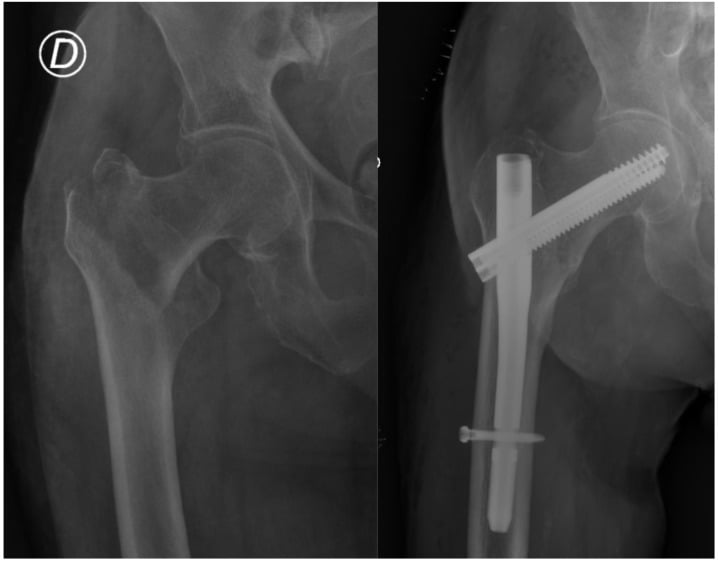
Stable patterns (Evans 1A/1B, AO 31-A1). A two-part fracture with a simple line, an intact posteromedial cortex, the lesser trochanter attached, standard obliquity, an intact anterior cortex without anterior comminution, and no basicervical involvement extending into the femoral neck. SHS or CMN are both acceptable. The SHS may be preferred for cost, simplicity and the absence of shaft fracture risk, provided the lateral wall is adequate (over 20.5mm); a CMN is acceptable by surgeon preference. The Cochrane review (2022) found no difference in mortality or function between SHS and CMN, in stable patterns or in any stability subgroup, but nails carried a higher rate of implant-related femoral fracture and, in stable fractures, a slightly higher reoperation rate.
Unstable patterns (Evans 2A/2B/3, AO 31-A2). A separate lesser trochanter fragment, posteromedial comminution, or a fracture in which a stable reduction cannot be achieved. A CMN is preferred: load-bearing fixation gives stability independent of the cortex while still allowing controlled collapse with healing. A thin lateral wall (under 20.5mm) also points to a nail, as an implant-choice consideration rather than a stability grade. Be clear about what the evidence does and does not show: the Cochrane review found no difference between stability subgroups, so the case for the nail in unstable patterns rests on mechanics and on pattern-specific series (Haidukewych) rather than on that review.
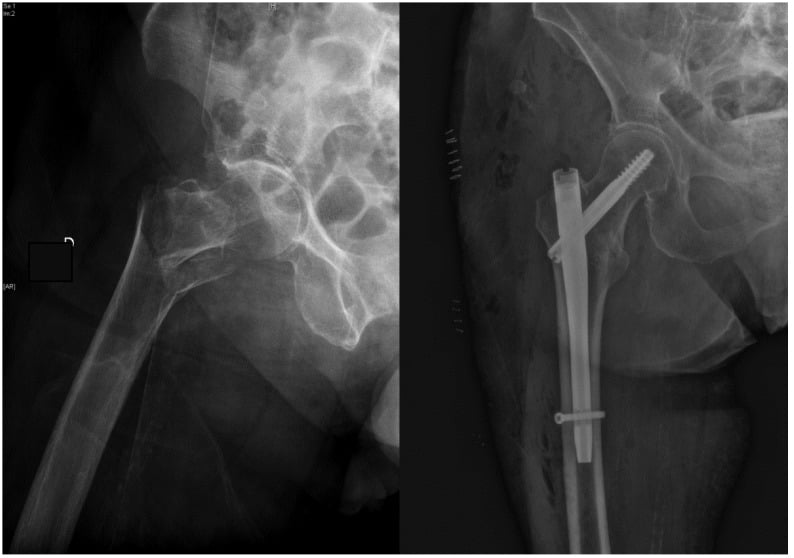
Reverse oblique (AO 31-A3). The fracture line runs from medial proximal to lateral distal, the opposite direction to a standard intertrochanteric fracture, and the muscle forces cause medialisation. A CMN is mandatory; the SHS has historically high failure rates here.
The mechanics of the SHS, sliding along the barrel, medialise the shaft with a reverse oblique pattern, and the result is malunion, hardware failure and loss of fixation.
Subtrochanteric extension. The fracture extends below the lesser trochanter into the subtrochanteric region, a high-stress area of the femur at risk of stress concentration. A long CMN is required, extending to the supracondylar region, because a short nail creates a stress riser at its tip; bypass the stress riser by 2 cortical diameters, consider a long reconstruction nail, and be ready to use cerclage wires for the reduction. Subtrochanteric extension changes the biomechanics and requires a load-bearing implant.
Surgical Technique
Set-up. Supine on a fracture table with a well-padded perineal post, since the pudendal nerve is the structure at risk, and the contralateral leg in a lithotomy holder or extended. Traction and internal rotation reduce the fracture; confirm the reduction on AP and lateral fluoroscopy, and make sure the C-arm can reach both views, because the lateral is critical for screw placement and for measuring TAD.
Reduction goals. Anatomic reduction is ideal but not always achievable. Slight valgus of 5-10° is acceptable and reduces strain on the fixation; varus is not acceptable, because it increases the failure rate significantly, and slight valgus is preferable to a varus malreduction.
Varus/valgus is only half of reduction quality. The other half (Chang and colleagues) is the anteromedial cortical apposition between the head-neck fragment and the femoral shaft, graded on the immediate post-reduction films as positive, neutral or negative:
- Positive medial cortical support: the medial cortex of the head-neck fragment sits superomedial to, resting on, the medial cortex of the shaft. As the fracture slides under load the cortices impact and lock, limiting further collapse; this is the desired reduction.
- Neutral (anatomic): cortices flush end-to-end; acceptable.
- Negative: the head-neck medial cortex lies medial to and unsupported by the shaft cortex. It will slide off, predicting excessive collapse, loss of reduction, varus and lag-screw cutout, and should be corrected at the time of surgery.
With a load-sharing or even a load-bearing implant, a fracture that cannot rest on its anteromedial cortex keeps sliding, so positive or at least neutral anteromedial cortical contact matters as much as TAD and valgus alignment for preventing mechanical failure. The sentence to carry: accept positive or neutral anteromedial cortical support; a negative medial buttress predicts collapse and cutout and should be re-reduced.
External fixation. Its indications in intertrochanteric fractures are very limited: the medically unstable patient who cannot tolerate standard surgery, severe cardiac comorbidity with limited anaesthetic tolerance, active infection precluding internal fixation, and the palliative setting with limited mobility goals. It is not recommended as routine treatment, with higher complication rates and worse functional outcomes than internal fixation.
Complications
- Incidence
- 1-5%
- Risk Factors
- TAD greater than 25mm, superior position, varus
- Management
- Revision to CMN or arthroplasty
- Incidence
- Under 5%
- Risk Factors
- Instability, inadequate fixation
- Management
- Revision fixation or arthroplasty
- Incidence
- Variable
- Risk Factors
- Poor reduction, unstable pattern
- Management
- Observation or corrective osteotomy
- Incidence
- 2-5%
- Risk Factors
- Diabetes, open fracture
- Management
- Debridement, antibiotics, revision
- Incidence
- 10-15%
- Risk Factors
- Immobility, elderly
- Management
- Prophylaxis, anticoagulation
- Incidence
- 30-50%
- Risk Factors
- Age, dementia, drugs
- Management
- Prevention, geriatric co-care
- Incidence
- 1-2%
- Risk Factors
- Osteoporosis, stress riser
- Management
- Long nail, plate
Lag screw cutout. The most common mechanical failure and the most common reason for reoperation. Of its risk factors, a TAD over 25mm is the single most important; an unstable fracture pattern and osteoporosis add to the superior screw position and varus malreduction listed above.
Medical complications. For delirium, prevention is key. Pneumonia rates rise with a delay to surgery beyond 48 hours, urinary tract infection is common and catheter-associated, and early mobilisation is essential against pressure injuries.
Postoperative Care
Postoperative Protocol
DVT prophylaxis (mechanical + LMWH). Pain management (multimodal, minimise opioids). Urinary catheter out early.
Weight-bear as tolerated (WBAT) for stable fixation. Physiotherapy. Sit out of bed. Delirium prevention.
Progressive mobilisation. Transfer training. Falls risk assessment. Discharge planning.
Wound check, suture/staple removal. Check X-rays. Assess mobility.
Repeat X-rays. Continue weight-bearing. Physiotherapy continuation.
Confirm union. Bone health assessment. Osteoporosis treatment initiation. Falls prevention programme.
Weight-bearing. SHS and CMN both allow immediate full weight-bearing, so the order for stable internal fixation is weight-bear as tolerated. Restricted weight-bearing is difficult for the elderly to comply with, is associated with worse outcomes, and is not necessary with modern fixation.
Orthogeriatric care. A shared care model between orthopaedics and geriatrics, covering delirium prevention and management, medication review, multimodal analgesia and early mobilisation. It reduces length of stay and mortality, improves functional outcomes, reduces complications and is cost-effective.
Outcomes and Prognosis
Mortality. By timeframe, with the factors that drive each:
- Rate
- 5-10%
- Key Factors
- Cardiopulmonary complications, infection
- Rate
- 8-12%
- Key Factors
- Pre-existing comorbidities, age
- Rate
- 20-30%
- Key Factors
- Frailty, mobility loss, second hip fracture
- Rate
- 50-60%
- Key Factors
- Return to baseline mortality after year 1
Function and independence. Between 40 and 60% return to their pre-injury walking level, 25-30% need walking aids long-term and 10-15% become non-ambulatory; outcomes are better with stable fixation and early mobilisation. 50-70% return to their previous residence, 20-30% need an increased level of care and 10-20% need nursing home placement, and cognitive status is the major predictor.
Prognostic factors. The good and the bad are largely mirror images:
- Good: pre-fracture independent mobility, a stable fracture pattern, surgery within 48 hours, normal cognitive function, younger age (relative)
- Poor: pre-existing dementia, multiple comorbidities (ASA III-IV), surgery delayed beyond 48 hours, an unstable fracture pattern, non-ambulatory before the injury
Registry benchmarks. Pooled from national hip-fracture registries (NHFD in the UK, ANZHFR in Australia and New Zealand, European audits), the 30-day mortality of 7-10% overlaps the lower end of the 30-day range in the table above, with a median hospital stay of 7-10 days, a target of 80% or more operated within 48 hours, and a reoperation rate of 3-5% at one year.
Guidelines, Registries & Global Practice
Global Epidemiology
- Worldwide burden: Hip fractures are projected to rise from roughly 1.6 million per year (2000) toward an estimated 4.5-6 million per year by 2050, driven by population ageing, with the largest absolute increases expected in Asia.
- Intertrochanteric share: Extracapsular fractures account for roughly half of all hip fractures; the proportion of unstable patterns rises with age and bone fragility.
- Demographics: Mean age in the ninth decade, female predominance approximately 3:1, the great majority following a low-energy fall in osteoporotic bone.
Side-by-Side Guideline Comparison
- Timing
- Surgery on day of, or day after, admission
- Implant Guidance
- SHS for trochanteric A1/A2; intramedullary nail for reverse-oblique/subtrochanteric (A3)
- System of Care
- Orthogeriatric co-management, early mobilisation, fascia iliaca block
- Timing
- Surgery within 24-48h improves outcomes
- Implant Guidance
- Strong evidence supports both constructs; nail favoured for unstable patterns
- System of Care
- Multidisciplinary care, VTE and delirium protocols
- Timing
- Early stable fixation
- Implant Guidance
- Stability-based: load-sharing SHS if medial buttress intact, load-bearing nail if not
- System of Care
- Emphasis on reduction quality, TAD, lateral wall
- Timing
- Within 48h
- Implant Guidance
- Nail increasingly default for unstable and reverse-oblique patterns
- System of Care
- Fragility-fracture liaison and secondary prevention
Universal agreement: extracapsular A3 reverse-oblique and subtrochanteric-extension patterns need a long cephalomedullary nail, NOT an SHS; surgery within 24-48h; orthogeriatric co-management; and routine bone-health / secondary-prevention follow-up. The main practice variation is in stable A1 patterns - the UK (NICE/BOA) still recommends the cheaper SHS as default, whereas many US and European units use a nail for almost all patterns.
Registry Evidence
- Major registries (NHFD UK, ANZHFR Australia/NZ, others across Europe and Asia) benchmark time-to-surgery, orthogeriatric review, mobilisation day 1, and 30-day mortality.
- Typical reported 30-day mortality 7-10% and 1-year mortality 20-30% across high-income settings.
- Registry feedback loops have driven measurable falls in time-to-surgery and mortality.
- Where care is linked to audited standards (surgery within 36-48h, orthogeriatric review, falls and bone-health assessment), registries show improved process compliance and lower mortality.
- Standardised pathways, not a single implant choice, are the dominant driver of outcome.
High- vs Limited-Resource Practice Variation
- High-Resource Setting
- Within 24-48h, dedicated trauma lists
- Limited-Resource Setting
- Often delayed by theatre access, blood, anaesthetic capacity
- High-Resource Setting
- SHS or CMN per stability; helical blades, InterTAN available
- Limited-Resource Setting
- Implant availability may dictate choice; SHS more widely stocked
- High-Resource Setting
- Orthogeriatric co-management, regional blocks
- Limited-Resource Setting
- Limited geriatric input; conservative (non-operative) care still used for very frail
- High-Resource Setting
- Fracture liaison services, anti-osteoporosis therapy
- Limited-Resource Setting
- Limited DXA and drug access; emphasis on falls counselling
Conservative (non-operative) treatment of an intertrochanteric fracture carries high rates of malunion, pressure injury, pneumonia and death from immobility. It is reserved for the rare patient who is unfit for any anaesthetic or in a palliative setting, and is more frequently encountered where surgical resources are constrained.
Controversies and Areas of Uncertainty
Some units now nail virtually every trochanteric fracture, arguing for a single reproducible technique and earlier full weight-bearing. The Cochrane data show equivalent function but a real, design-independent increase in implant-related femoral fracture with nails, plus higher implant cost. For truly stable A1 patterns the SHS remains defensible and cheaper.
Helical blades compact rather than ream the head, theoretically improving purchase in osteoporotic bone. However, medial migration / central perforation ("cut-through") is a recognised failure mode. Evidence has not shown clear superiority of blade over screw; TAD and reduction quality matter more than the device.
Integrated dual-screw designs (InterTAN) provide linear compression and rotational control and may reduce cutout and femoral neck shortening, but at higher cost and a more demanding technique. Benefit over standard single-screw nails remains debated.
Primary arthroplasty is occasionally proposed for severely comminuted unstable fractures or in pre-existing arthritis, but it is technically demanding (calcar deficiency), carries higher early morbidity, and is not standard. Internal fixation remains first-line; arthroplasty is mainly a salvage option after failed fixation.
State the mainstream position first (stability-based implant choice, TAD under 25mm, surgery within 48h), then acknowledge the controversy and justify a balanced, evidence-anchored stance. Examiners reward candidates who can defend a position with data rather than dogma.
MCQ Practice Points
Q: Which fracture pattern requires cephalomedullary nailing (CMN mandatory)?
A: Reverse oblique - the fracture line runs from medial proximal to lateral distal. SHS causes medialization of the shaft with this pattern, leading to malunion and failure.
Q: What is the threshold Tip-Apex Distance (TAD) for acceptable lag screw positioning?
A: Under 25mm - TAD greater than 25mm is associated with cutout rates exceeding 15%, compared to under 1% when TAD is under 25mm.
Q: Why is AVN rare in intertrochanteric fractures?
A: Extracapsular location - the fracture occurs outside the hip capsule, preserving the blood supply from the medial femoral circumflex artery which enters the femoral head via the retinacular vessels.
Q: What lateral wall thickness indicates stable fracture pattern suitable for SHS?
A: Greater than 20.5mm - lateral wall thickness under 20.5mm predicts risk of iatrogenic lateral wall fracture during SHS insertion and should be treated with CMN.
Q: What is the recommended timeframe for surgery in hip fracture?
A: Within 24-48 hours - delays beyond 48 hours increase mortality, pneumonia, and pressure sore rates. Medical optimization should not delay surgery beyond this window.
Q: What is the optimal position for lag screw in the femoral head?
A: Center-inferior quadrant - superior position has the highest cutout risk. The screw should be within 10mm of subchondral bone while maintaining TAD under 25mm.
Exam Viva Scenarios
Practise clinical reasoning and management decisions out loud
“82-year-old woman presents after a fall at home. X-rays show a displaced intertrochanteric fracture with loss of the posteromedial buttress and the lesser trochanter is a separate fragment. She is on warfarin for AF with INR 2.8.”
“78-year-old man with a stable 2-part intertrochanteric fracture (Evans Type 1B). The registrar has listed him for a CMN. The consultant asks your opinion on implant choice.”
“You are reviewing a postoperative X-ray of a patient who had sliding hip screw fixation for an intertrochanteric fracture. The measured TAD is 32mm and the screw appears to be in the superior quadrant of the femoral head.”
Classification
- Evans/Jensen: Type 1 stable, Type 2-3 unstable
- AO 31-A1 stable, A2 unstable, A3 reverse oblique
- Stability = intact posteromedial cortex
- Reverse oblique = CMN mandatory
Implant Selection
- Stable: SHS or CMN (either acceptable)
- Unstable: CMN (load-bearing required)
- Reverse oblique: CMN mandatory
- Subtrochanteric extension: Long CMN
TAD Rule
- TAD = AP + Lateral tip-apex distance
- Under 25mm = cutout under 1%
- Greater than 25mm = cutout greater than 15%
- Target center-inferior position
Lateral Wall
- Greater than 20.5mm = SHS safe
- Less than 20.5mm = Use CMN
- Measure 3cm below innominate tubercle
Postoperative
- WBAT from day 1
- DVT prophylaxis essential
- Orthogeriatric co-management
- Start osteoporosis treatment
Evidence Base
These are the landmark papers an examiner expects you to be able to cite by name. Each card links to the original PubMed record for independent verification. Quote the headline number (TAD 25mm, lateral wall 20.5mm, surgery within 48h) rather than vague statements.
Cochrane Review: Cephalomedullary Nails vs Extramedullary Implants
- 76 studies, 10,979 participants. Probably little or no difference between CMN and extramedullary devices (mainly SHS) in mortality at 4 months (RR 0.96) or 12 months (RR 0.99).
- CMN reduced superficial infection (RR 0.71) and non-union (RR 0.55), but increased intraoperative implant-related fracture (RR 2.94) and later periprosthetic fracture (RR 3.62) - a risk NOT abolished by newer nail designs.
- No difference seen between stability subgroups, nail length, or nail generation.
HIP ATTACK: Accelerated vs Standard Surgery
- International RCT, 2970 patients, 17 countries. Median time to surgery 6h (accelerated) vs 24h (standard).
- No significant reduction in 90-day mortality (HR 0.91, 95% CI 0.72-1.14) or composite of major complications (HR 0.97).
Timing of Surgery and Mortality
- 35 studies, over 190,000 patients. Surgery within 48 hours associated with lower risk of death (pooled OR 0.74, 95% CI 0.67-0.81) and fewer pressure sores (OR 0.48).
- Effect persisted in adjusted prospective studies; conservative delay strategies should be avoided.
- THE AUTHORS FLAGGED THEIR OWN FRAGILITY, AND WERE RIGHT TO: their Bayesian analysis predicted that roughly 20% of future studies might find early surgery NOT beneficial for mortality. The HIP ATTACK trial above then found exactly that for the 6-versus-24-hour comparison. This is observational data, and the confounding runs one way - the patients who wait are usually the patients who are unwell.