Radicular Pain | Straight Leg Raise | Microdiscectomy for Failed Conservative Care
- Radicular pain (leg worse than back) is hallmark - back pain alone is NOT disc herniation
- Straight leg raise (SLR) positive if reproduces radicular pain below knee at less than 60 degrees
- MRI confirms clinical diagnosis - never operate on imaging alone without matching symptoms
- Conservative management first - 90% improve by 6 weeks without surgery
- Surgery indicated for: cauda equina, progressive motor deficit, or failed 6 weeks conservative care
- Microdiscectomy gold standard - remove herniated fragment, preserve disc space, early mobilization
- “SLR positive at less than 60 degrees with radicular pain = disc herniation until proven otherwise
- “Crossed SLR (raising opposite leg reproduces ipsilateral leg pain) is highly specific
- “L5-S1 disc herniation affects S1 nerve root (ankle jerk, plantar flexion, lateral foot numbness)
- “Cauda equina syndrome = surgical emergency - saddle anesthesia, bowel/bladder dysfunction, bilateral symptoms
- “Surgery gives faster relief; by 1-2 years both pathways reach a similar destination (Peul: 95% perceived recovery in BOTH arms). SPORT itself disclaims conclusions of superiority OR equivalence because of 50%/30% bidirectional crossover
Overview and Epidemiology
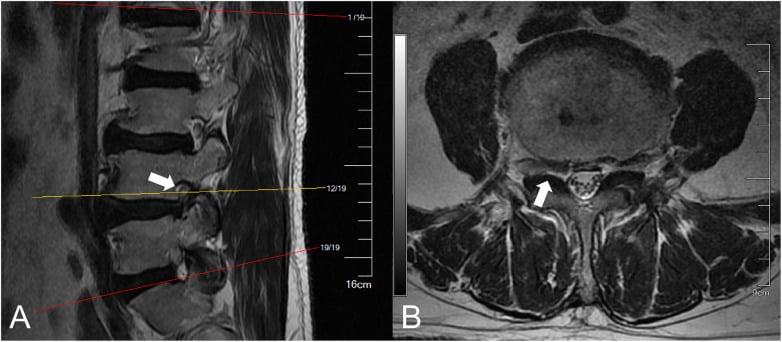
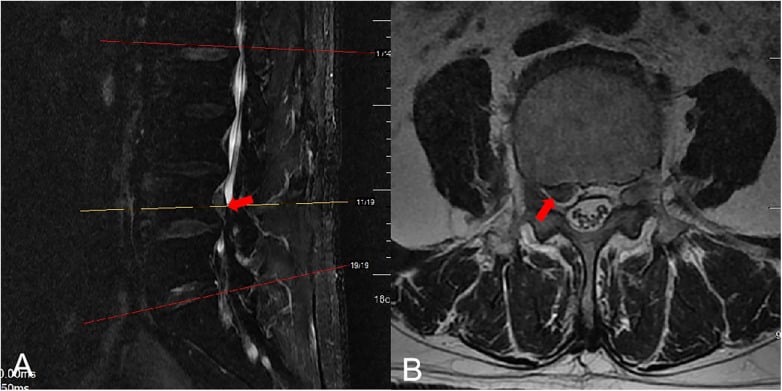
Lumbar disc herniation is the most common cause of sciatica, radicular pain down the leg. The disc herniates posterolaterally and compresses a nerve root: the traversing root in the lateral recess, or the exiting root in the foramen.
Why it hurts. Compression alone does not explain the pain. The herniated nucleus pulposus is intrinsically inflammatory: it expresses tumour necrosis factor-alpha, phospholipase A2 and other cytokines that irritate and sensitise the nerve root, a chemical radiculitis, independently of how hard the root is squeezed. Mechanical compression produces the motor and sensory deficit; the chemical irritation is largely what produces the pain.
That one idea unifies the clinical picture:
- A small herniation can cause severe sciatica while a large one is silent
- The MRI correlates poorly with symptoms
- An epidural steroid injection, an anti-inflammatory that changes nothing mechanically, can relieve radicular pain
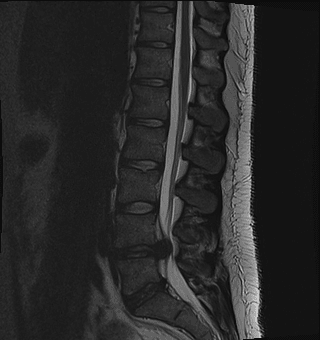
Natural history. Spontaneous resolution is the norm: herniated fragments resorb over time, and 90% of patients improve with conservative care within 6 weeks. Surgery is reserved for specific indications and is not a primary treatment.
Disc fragments undergo inflammatory resorption. Extruded and sequestered fragments are exposed to the epidural space, with more contact with blood supply and macrophages, so they resorb faster than contained protrusions. This is why large sequestered fragments paradoxically have the better prognosis, and why a large herniation may resolve faster than a small one.
Who. Peak incidence is 30-50 years, while the disc still has a hydrated nucleus pulposus, and men are affected twice as often as women (2:1). The risk factors are heavy lifting, vibration exposure, smoking, obesity and genetics.
Where. L5-S1 accounts for 50% of herniations and L4-L5 for 45%. L3-L4 contributes 5%, and higher levels are rare.
Pathophysiology and Mechanisms
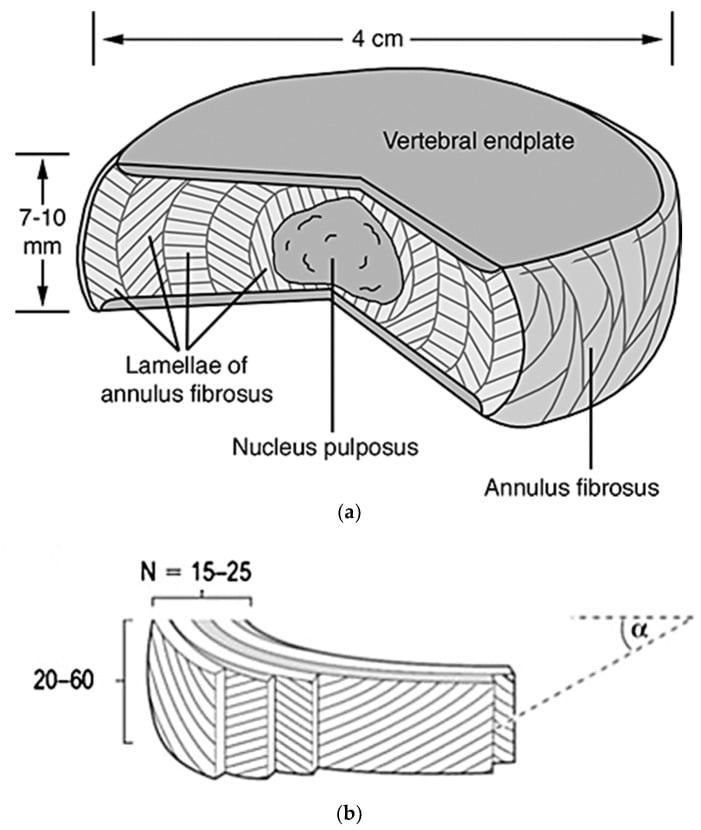
The nucleus pulposus is 80% water, with proteoglycans (aggrecan) and type II collagen. It absorbs compressive load and distributes force. With age it dehydrates, loses proteoglycans and loses height.
The annulus fibrosus is type I collagen laid down in 15-20 organised lamellae (the figure above counts 15-25). It contains the nucleus and resists tensile force. Its weak point is the posterolateral annulus, the thinnest region, which lies beyond the support of the anterior longitudinal ligament.
Why herniations go posterolateral. The anterior longitudinal ligament is strong and thick and prevents anterior herniation. The posterior longitudinal ligament is strong in the midline but narrows laterally, leaving the posterolateral annulus, already the thinnest region, without reinforcement. The result is that 95% of herniations occur posterolaterally, into the lateral recess.
The roots. The spinal cord ends as the conus medullaris at L1-L2. Below it the dural sac contains the cauda equina and ends at S1-S2. Each lumbar root exits below its own pedicle, so at any disc level there are two roots to think about:
- The traversing root crosses the disc space in the lateral recess (L5 at L4-L5)
- The exiting root leaves through the foramen at the same level (L4 at L4-L5)
A posterolateral L4-L5 herniation compresses the L5 root, the traversing root in the lateral recess, not L4: the L4 root has already exited above. A far lateral herniation at the same level catches the exiting L4 root.
Which root is caught depends on where the herniation sits in the axial plane, which is the location classification below.
Classification Systems
A herniation is described in three ways: its morphology (the NASS nomenclature), its position in the axial plane, and whether the fragment has migrated in the sagittal plane. The process begins with degeneration, an initial weakening of the disc with annular fissures, and runs through prolapse and extrusion to sequestration.
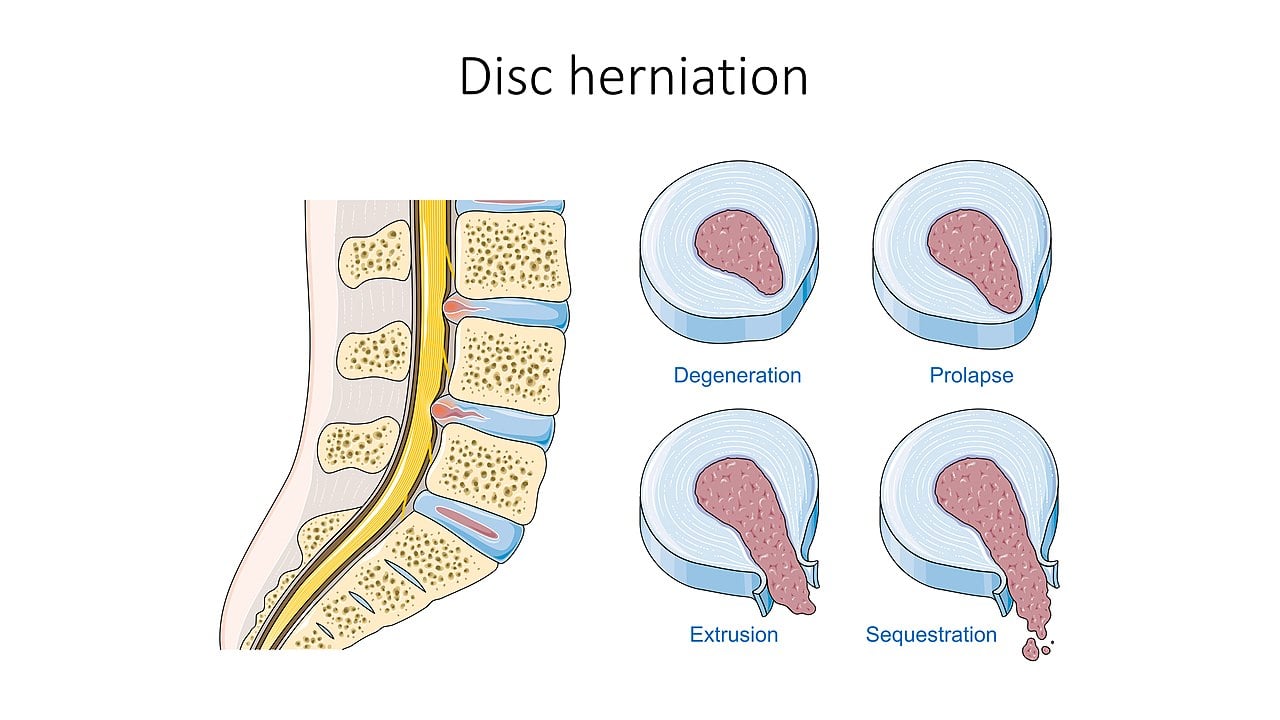
The North American Spine Society nomenclature.
- Definition
- No disc extension beyond vertebral body
- Prognosis
- Not pathological
- Treatment
- None
- Definition
- Circumferential extension, not focal
- Prognosis
- Usually asymptomatic
- Treatment
- Conservative
- Definition
- Focal herniation, base wider than dome, contained by annulus
- Prognosis
- May resolve spontaneously
- Treatment
- Conservative first
- Definition
- Focal herniation, base narrower than dome, through annulus
- Prognosis
- May migrate, variable resolution
- Treatment
- Consider surgery if symptomatic
- Definition
- Fragment separated from parent disc, free in canal
- Prognosis
- Good prognosis for resorption
- Treatment
- Often resolves, surgery if symptomatic
Clinical Presentation and Assessment
History. The complaint that matters is leg pain worse than back pain, in a dermatomal distribution below the knee: sharp, shooting, electric or burning. Sitting, bending forward and Valsalva (cough, sneeze) aggravate it; standing, lying and walking relieve it. Ask directly about the red flags: saddle anaesthesia, bowel or bladder change, bilateral symptoms and progressive weakness.
Examination. The gait is antalgic, and a foot-drop gait betrays L5 weakness. Look for a sciatic scoliosis, classically away from the side of pain (the list is explained in its own section below), for calf wasting in a chronic S1 radiculopathy, and for reduced lumbar flexion. Then perform the straight leg raise and a neurological examination by dermatome and myotome: motor, sensory and reflexes.
The straight leg raise. With the patient supine, lift the extended leg. The test is positive only if it reproduces radicular leg pain below the knee at less than 60 degrees; back pain or hamstring tightness does not count, and pain beyond 60 degrees is often hamstring or sacroiliac joint pain. Sensitivity is 90% but specificity only 25%, so there are many false positives.
The crossed straight leg raise. Raising the opposite leg and reproducing the ipsilateral leg pain is the specific sign: 95% specific for disc herniation.
By level. The root decides the pattern of weakness, numbness and reflex loss. The femoral stretch test listed for L4 is described in the upper lumbar section.
- Motor
- Quadriceps, knee extension
- Sensation
- Medial leg, medial ankle
- Reflex
- Knee jerk (patellar)
- SLR
- Femoral stretch test
- Motor
- EHL, ankle dorsiflexion, foot eversion
- Sensation
- Dorsum of foot, first web space
- Reflex
- None (or medial hamstring)
- SLR
- Positive SLR
- Motor
- Ankle plantar flexion, toe plantar flexion
- Sensation
- Lateral foot, sole of foot
- Reflex
- Ankle jerk (Achilles)
- SLR
- Positive SLR
Differential diagnosis. Radicular leg pain has other causes, each with its own distinguishing features and key investigation.
- Distinguishing features
- Leg pain worse than back pain, dermatomal, positive SLR, worse with sitting/Valsalva
- Key investigation
- MRI: focal posterolateral herniation matching level
- Distinguishing features
- Older patient, neurogenic claudication, eased by flexion/sitting, negative SLR
- Key investigation
- MRI: multilevel canal narrowing, hypertrophic ligamentum flavum/facets
- Distinguishing features
- Bilateral symptoms, saddle anaesthesia, bladder/bowel dysfunction
- Key investigation
- Emergency MRI: large central compressive lesion
- Distinguishing features
- Buttock pain, normal neurology, pain on resisted external rotation, no clear dermatome
- Key investigation
- Clinical; MRI normal lumbar spine
- Distinguishing features
- Stocking distribution, bilateral, non-dermatomal, distal sensory loss
- Key investigation
- Nerve conduction studies / EMG, glucose/HbA1c
- Distinguishing features
- Groin pain referred to thigh/knee, limited internal rotation, no pain below knee
- Key investigation
- Hip radiograph; intra-articular anaesthetic block
- Distinguishing features
- Calf pain with walking relieved by standing still, absent pulses, no postural change
- Key investigation
- ABPI, arterial duplex/angiography
- Distinguishing features
- Night pain, weight loss, fever, age extremes, history of malignancy
- Key investigation
- MRI with contrast, inflammatory markers, bone imaging
Cauda equina syndrome is a surgical emergency. Its features:
- Saddle anaesthesia (perianal and perineal numbness)
- Bowel dysfunction (incontinence or retention)
- Bladder dysfunction (urinary retention, overflow incontinence, loss of sensation)
- Bilateral leg symptoms (weakness or numbness)
- Sexual dysfunction (erectile dysfunction, loss of sensation)
It needs urgent MRI and emergency decompression; the timing is in the Management section. Delayed surgery results in permanent bowel and bladder dysfunction.
Upper Lumbar Disc Herniation and the Femoral Nerve Stretch Test
Upper lumbar herniations (L1-L2, L2-L3 and L3-L4) present differently from the classic L5 and S1 patterns, and they are easily missed when the examiner reaches reflexively for the straight leg raise.
- Upper lumbar (L1-L4 roots)
- Older, herniation more often foraminal or far lateral
- Lower lumbar (L5, S1 roots)
- 30-50 years, posterolateral/paracentral most common
- Upper lumbar (L1-L4 roots)
- Anterior or anteromedial thigh, groin, medial knee/leg (L2-L4)
- Lower lumbar (L5, S1 roots)
- Buttock and posterior/lateral leg below the knee (sciatica)
- Upper lumbar (L1-L4 roots)
- Quadriceps and hip-flexor weakness, reduced knee jerk (L3-L4)
- Lower lumbar (L5, S1 roots)
- EHL and dorsiflexion (L5), plantar flexion and ankle jerk (S1)
- Upper lumbar (L1-L4 roots)
- Femoral nerve stretch test positive; SLR often negative
- Lower lumbar (L5, S1 roots)
- Straight leg raise and crossed SLR positive
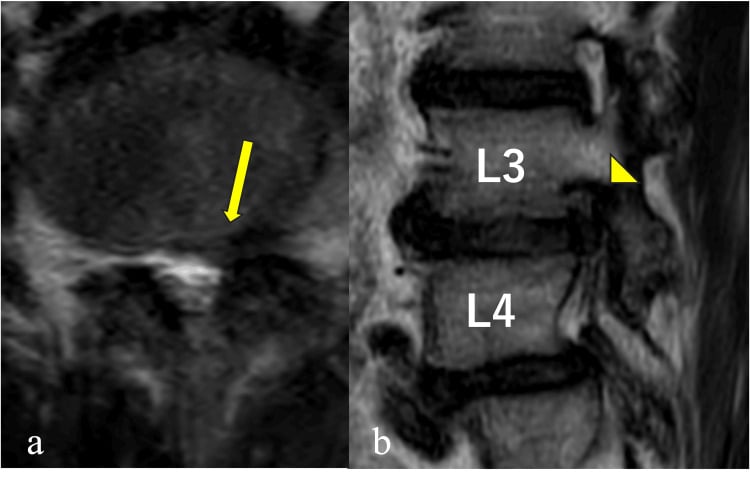
The femoral nerve stretch test (reverse straight leg raise, prone knee-bend) is the upper-lumbar equivalent of the SLR. With the patient prone, flex the knee and extend the hip: this stretches the femoral nerve and its L2-L4 contributions, and reproduction of anterior thigh pain is a positive test. The SLR mainly tensions the L4-S1 (sciatic) roots, so it is frequently negative in upper lumbar herniation; a normal SLR does not exclude a high disc.
Anterior thigh or groin pain with quadriceps weakness and a depressed knee jerk points to an L2-L4 root, not the classic L5/S1 sciatica. The differential for anterior thigh pain is wider (hip osteoarthritis, femoral neuropathy, diabetic amyotrophy and retroperitoneal or psoas pathology), so an upper lumbar herniation is easy to overlook unless the right provocative test is used and the MRI level is matched to the dermatome.
The Sciatic List: Shoulder vs Axillary Herniation
A sciatic list (sciatic or antalgic scoliosis) is a lateral trunk shift the patient adopts to take tension off the compressed root. It is not idiopathic scoliosis: it disappears when the radiculopathy settles. The classically taught direction depends on where the fragment sits relative to the root, because the patient unconsciously moves the root off the disc.
- Relationship to root
- Disc lies on the shoulder of the nerve root
- Typical list
- Patient lists AWAY from the side of pain (draws the root off the fragment)
- Surgical note
- Retract the root medially to deliver the fragment
- Relationship to root
- Disc lies in the axilla between root and dura
- Typical list
- Patient lists TOWARD the side of pain
- Surgical note
- Axillary fragment is a recognised blind spot - retract carefully and inspect the axilla
How far to trust it. The pattern is clinically variable, so it is a clue rather than a rule. Where it earns its keep is in theatre: knowing whether the fragment is on the shoulder or in the axilla dictates which way to retract the root safely, and the axilla is the blind spot where a residual fragment is most often left behind.
Investigations
When to image. Typical radiculopathy without red flags needs no imaging in the first 6 weeks: the natural history favours spontaneous resolution, so treat conservatively and observe. Immediate MRI is for:
- Cauda equina syndrome
- Progressive motor deficit
- Bilateral symptoms
- Severe or rapidly worsening symptoms
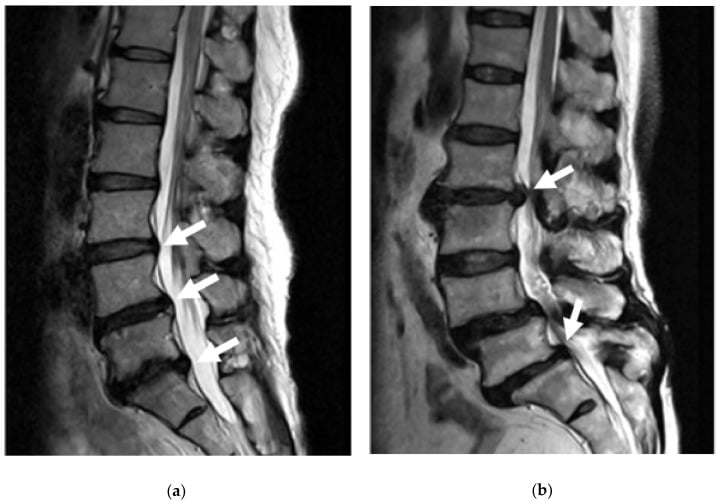
After 6 weeks, MRI of the lumbar spine is indicated for symptoms persisting despite conservative care, and when surgery is being considered, to confirm the level and type of herniation. If MRI is contraindicated (pacemaker, claustrophobia), CT myelography shows the nerve root compression and the herniation, with less soft-tissue detail.
What the sequences show. The T1 and T2 appearances of the normal, degenerated and herniated disc, and what each sequence is used for:
- T1-weighted
- Intermediate signal
- T2-weighted
- Bright signal (high water content)
- T1-weighted
- Decreased signal
- T2-weighted
- Dark signal (loss of water)
- T1-weighted
- Intermediate signal, displaces thecal sac or nerve root
- T2-weighted
- Intermediate signal, may enhance with contrast
- T1-weighted
- Anatomy, foraminal stenosis, bone marrow changes
- T2-weighted
- Disc hydration, nerve root compression, CSF bright
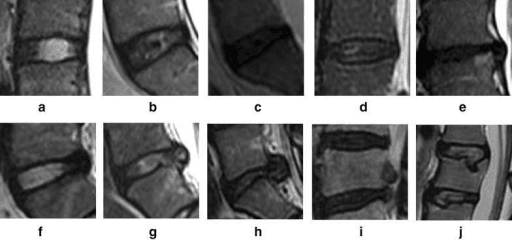
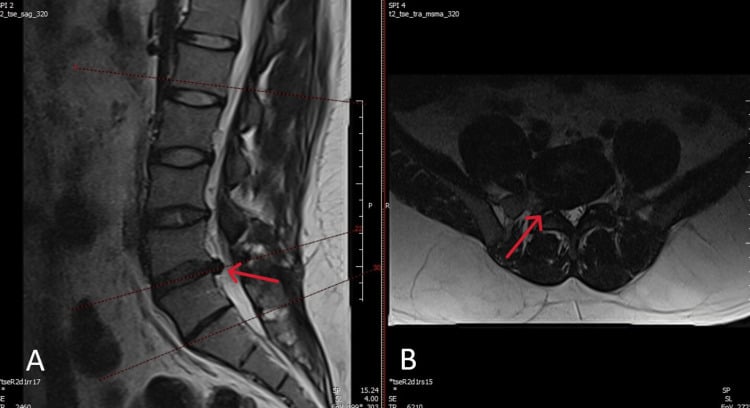
Up to 30% of asymptomatic adults have disc bulges or herniations on MRI. Never operate on imaging alone. The herniation level must correlate with the examination (dermatomal pain, motor weakness, reflex changes); a mismatch between imaging and examination suggests an alternate diagnosis.
Electrodiagnostics. EMG and nerve conduction studies are for the atypical case:
- Symptoms not matching the expected dermatomal pattern
- Suspected peripheral neuropathy (diabetes, alcoholism)
- Timing a neurological deficit: denervation changes take 2-3 weeks to appear, which distinguishes acute from chronic
- Medicolegal documentation of baseline function before surgery
Management Algorithm
The decision. Management is conservative by default, for 6 weeks unless there are red flags, and surgical only for specific reasons: cauda equina syndrome, a progressive motor deficit, or radiculopathy that has failed conservative care. The goal of conservative care is symptom relief while the natural history of disc resorption runs its course. Surgery gives faster relief; it does not change where the patient ends up (the trial evidence is set out in the Outcomes section).
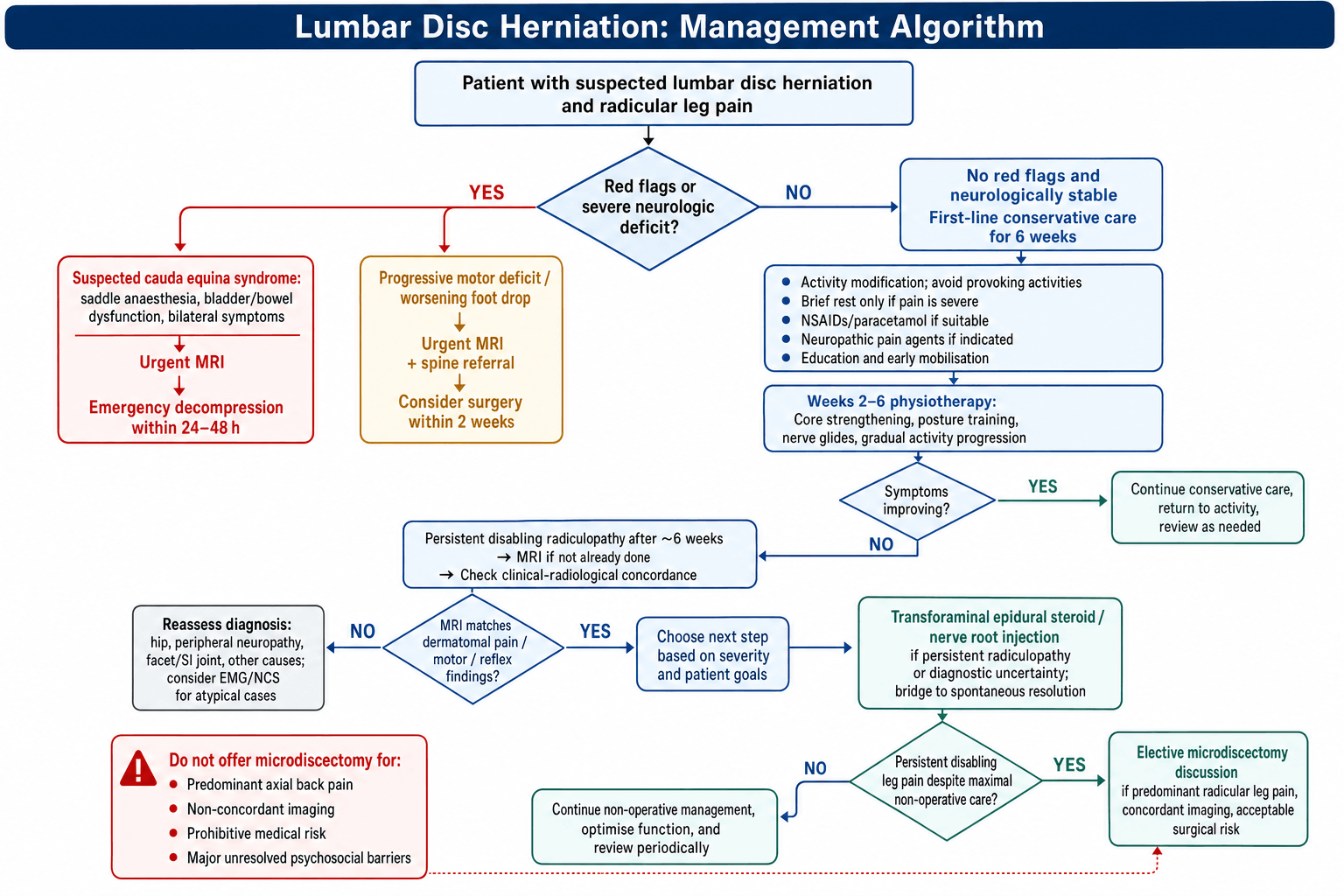
First-line treatment for 6 weeks, unless there are red flags.
Conservative Protocol
- Activity modification: avoid prolonged sitting, heavy lifting and bending
- Analgesia: NSAIDs (if no contraindications), paracetamol, neuropathic agents (gabapentin, pregabalin)
- Short rest of 1-2 days if severe, then encourage mobilisation
- Education: reassure about natural resolution, avoid bed rest
- Physiotherapy: core strengthening, posture education, nerve glides
- Gradual return to activities as tolerated
- Nerve root injection: consider if symptoms persist, diagnostic and therapeutic
- Review progress: if improving, continue conservative care
- Reassess: MRI if not already done
- Multidisciplinary input: pain clinic, psychology, functional restoration
- Consider surgery if symptoms persist and impact function or quality of life
Surgical Technique - Microdiscectomy
Consent. The risks to discuss are recurrent herniation, dural tear (usually repaired primarily), nerve root injury with a possible new deficit, superficial infection and deep infection (discitis), and the rare postoperative cauda equina syndrome from a haematoma. There is no guarantee: pain may persist, and surgery does not prevent future disc disease. The incidences are in the Complications section.
Equipment. Have ready:
- Microscope or loupes for magnification of the nerve root
- Fluoroscopy to confirm the level intraoperatively
- Self-retaining retractors (e.g., Taylor, Caspar) for exposure
- Curettes and pituitary rongeurs for fragment removal
- Bipolar cautery for haemostasis around the root
- Nerve root retractor to protect the root during fragment retrieval
Level localisation. The iliac crest marks the L4-L5 level, the most common one; L5-S1 is the lumbosacral junction, found by palpating the sacral prominence. Fluoroscopy is mandatory before the incision: wrong-level surgery is a never event.
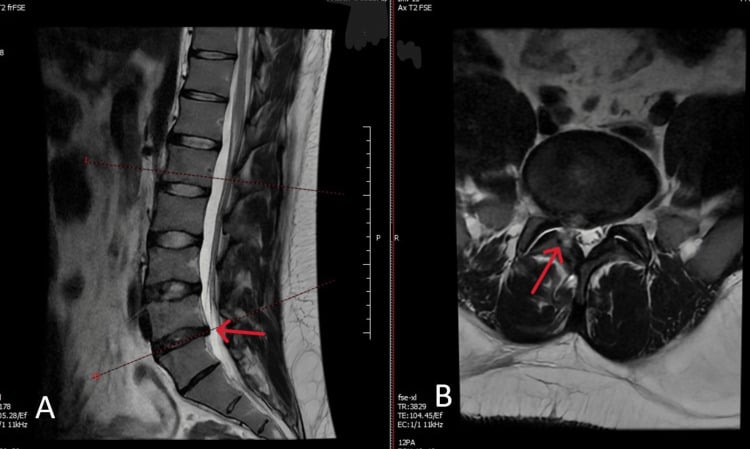
Complications
- Incidence
- 5-10%
- Prevention/Management
- Preserve disc height, patient education (avoid heavy lifting), smoking cessation
- Incidence
- 1-5%
- Prevention/Management
- Primary repair if identified, bed rest if unrecognised, reoperation if CSF leak persists
- Incidence
- Less than 1%
- Prevention/Management
- Gentle retraction, avoid excessive traction, microsurgical technique
- Incidence
- 1-2%
- Prevention/Management
- Perioperative antibiotics, sterile technique, early debridement if deep
- Incidence
- 0.5-1%
- Prevention/Management
- Prolonged antibiotics (6-12 weeks), rest, rarely requires debridement
- Incidence
- Less than 1%
- Prevention/Management
- Fluoroscopy confirmation, preoperative imaging review
- Incidence
- Less than 1%
- Prevention/Management
- Meticulous haemostasis, early recognition (cauda equina symptoms), emergency evacuation
- Incidence
- 10-20%
- Prevention/Management
- Realistic expectations, not all pain resolves, consider other pain sources
Recurrent herniation is a return of radiculopathy after initial improvement, months to years after surgery, and at the same level in 80%. The risk factors are smoking, obesity, heavy lifting, young age and a large annular defect. It is managed like a primary herniation, conservatively first, with revision discectomy if that fails.
An epidural haematoma can cause an acute postoperative cauda equina syndrome. Suspect it with new bowel or bladder dysfunction, bilateral leg weakness or saddle anaesthesia, and act on it with immediate MRI and emergency reoperation to evacuate the haematoma. It is time-sensitive: operate within hours.
The dural tear. Recognised intraoperatively, it is repaired primarily with 5-0 or 6-0 suture behind a water-tight fascial closure, and a small tear may seal with the fascial closure and bed rest. A postoperative CSF leak declares itself as persistent headache or wound drainage, and is reoperated on for repair if conservative measures fail. The consequences are meningitis risk, CSF fistula and pseudomeningocele.
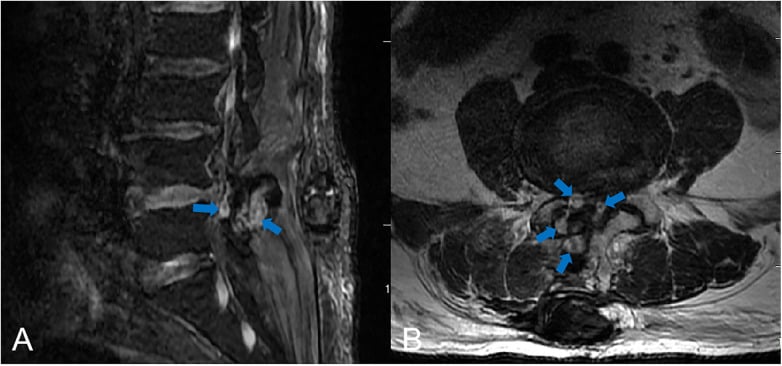
Postoperative Care and Rehabilitation
The principles. Early mobilisation reduces stiffness and improves outcomes, and prolonged bed rest delays recovery. Core strengthening protects the spine from recurrence, and the patient is taught lifting technique, ergonomics and weight management. Leg pain improves immediately; back pain may persist, because microdiscectomy decompresses the nerve root and does not address disc degeneration or back pain. Set realistic expectations: surgery is for leg pain relief, not a cure for back pain.
Postoperative Protocol
- Out of bed the same day, walking within hours
- Simple analgesia (paracetamol, NSAIDs), minimise opioids
- Keep the dressing clean and dry
- Discharge usually the next day (day case in some centres)
- Light activities and short walks; avoid prolonged sitting
- Driving after 2 weeks, once an emergency stop is safe
- Desk work after 2 weeks; modify heavy work
- No restrictions on bending, twisting or lifting light objects
- Physiotherapy: core strengthening, posture education
- Gradual return to normal activities
- Avoid heavy lifting (greater than 10 kg) and repetitive bending
- Most patients return to work by 6 weeks
- Most activities unrestricted by 3 months
- Contact sports after 3 months
- Lifting progressed gradually, with technique education
- Lifestyle modification: smoking cessation, weight loss, core strengthening
- Recurrence prevention: avoid prolonged sitting and heavy lifting
- Discharge from follow-up at 6 weeks if no concerns
Outcomes and Prognosis
Outcomes with microdiscectomy. Leg pain does well; back pain is variable.
- Result
- 85-90% good to excellent at 1 year
- Result
- Variable, often persists (not primary indication)
- Result
- 80-95% by 3 months (depends on occupation)
- Result
- 80-90% satisfied at 1 year
- Result
- 5-10% within 2 years
Who does well. The patient with dominant leg pain, a positive straight leg raise, an MRI that matches the examination, symptoms of less than 6 months and a first episode rather than a revision. A large sequestration paradoxically does better, because the fragment is removable.
Who does badly. Predominant back pain, symptoms of more than 12 months, psychosocial factors (secondary gain, litigation, depression), multiple-level disease with adjacent segment pathology, and smoking, which impairs healing and increases recurrence.
The SPORT trial (Spine Patient Outcomes Research Trial, JAMA 2006) reported 2-year outcomes in 501 randomised patients:
- Both groups improved substantially. Intention-to-treat differences consistently favoured surgery but were small and NOT statistically significant for the primary outcomes
- Crossover was large and bidirectional - only 50% of those assigned to surgery had it within 3 months, while 30% of those assigned to non-operative care crossed over to surgery
- The trial's own conclusion is the examinable point, and it cuts both ways: because of that crossover, "conclusions about the superiority OR EQUIVALENCE of the treatments are not warranted based on the intent-to-treat analysis." SPORT therefore cannot be quoted to show surgery is better, and it equally cannot be quoted to show the two are the same
So do not cite SPORT for "similar outcomes". The cleaner evidence for equivalent destination is Peul's trial, where the probability of perceived recovery at one year was 95% in both arms while leg-pain relief and recovery were significantly faster after early surgery. Surgery accelerates what would happen naturally in most cases - that claim rests on Peul and on Jacobs's review, not on SPORT's intention-to-treat result.
Guidelines, Registries & Global Practice
Global epidemiology:
- Lifetime sciatica affects roughly 10-40% of adults depending on definition; symptomatic lumbar disc herniation peaks at 30-50 years with a modest male predominance.
- Asymptomatic findings are the norm with age: in a systematic review of 3110 pain-free people, disc bulges were present in 30% at age 20 rising to 84% at age 80 (Brinjikji W et al, AJNR 2015, PMID 25430861) — the evidence base for insisting on clinical-radiological correlation.
- Burden: low back pain and radiculopathy are consistently among the leading global causes of years lived with disability, driving high rates of imaging, injection and surgery worldwide.
Side-by-side guideline guidance:
- Imaging
- No routine early MRI; image only if it would change management
- Conservative first?
- Yes - exercise, self-management, avoid bed rest
- Surgery threshold
- Refer for spinal opinion if radicular pain persists despite non-surgical care
- Evidence emphasis
- Strong steer against early imaging and opioids
- Imaging
- MRI is the imaging of choice when surgery considered
- Conservative first?
- Yes for 6 weeks unless red flags
- Surgery threshold
- Discectomy for persistent radiculopathy concordant with imaging after failed conservative care
- Evidence emphasis
- SPORT-informed shared decision-making
- Imaging
- Urgent MRI for suspected cauda equina; otherwise after failed conservative care
- Conservative first?
- Yes
- Surgery threshold
- Emergency decompression for CES; elective microdiscectomy for failed conservative care
- Evidence emphasis
- Cauda equina pathway and timely MRI
- Imaging
- MRI to confirm level before surgery
- Conservative first?
- Yes; epidural steroid injection as an option
- Surgery threshold
- Microdiscectomy when disabling radiculopathy persists
- Evidence emphasis
- Aligns with Peul and Jacobs evidence
Across NICE, AAOS/NASS, BOA/BASS and European bodies the message is consistent: conservative care first for around 6 weeks, no routine early MRI, image only when it will change management, and reserve surgery for cauda equina, progressive deficit, or concordant radiculopathy that fails conservative treatment. Disagreement is mainly about the role and timing of epidural steroid injection.
- Spine registries (e.g. the UK British Spine Registry, the Swedish Swespine register, the Norwegian NORspine register and similar national datasets) collect patient-reported outcomes (ODI, leg-pain VAS, EQ-5D) before and after lumbar discectomy. They consistently report large early improvements in leg pain and function and reoperation/reherniation rates broadly in line with the trial literature (around 5-10% within 2 years).
- Registry data are observational and used for benchmarking and case-mix-adjusted comparison rather than establishing efficacy, which rests on the randomised evidence (SPORT, Peul/Leiden).
- Surgical rates vary several-fold between countries and regions, driven by access, reimbursement model, surgeon supply and patient preference rather than disease prevalence — a classic example of preference-sensitive care highlighted by SPORT.
- Injection use (transforaminal epidural steroid) varies widely; offered routinely in some systems and reserved for diagnostic or bridging use in others.
- Access and waiting times: in publicly funded systems, elective microdiscectomy waiting times are typically longer than in the private sector, and disc herniation remains a leading reason for specialist spine referral. Work-related lifting injuries often enter workers' compensation or occupational-insurer pathways with structured return-to-work planning, and smoking cessation support is relevant given smoking's association with recurrence.
Key documentation requirements:
- Pre-operative: Document failed conservative care (6 weeks physio, medications, injections), informed consent including recurrence risk
- Intra-operative: Level confirmation (fluoroscopy images), nerve root decompression achieved, any complications (dural tear)
- Post-operative: Immediate motor/sensory exam, discharge planning, follow-up arrangements
- Cauda equina cases: Time of symptom onset, time of MRI, time to theatre - timing is medicolegally scrutinized
- Wrong level surgery: Always confirm level with fluoroscopy (never event)
- Delayed cauda equina surgery: Document time of presentation, MRI, and surgery; delays beyond 48 hours are scrutinized
- Informed consent: Discuss recurrence risk, persistent pain, nerve injury - document in notes
- Nerve root injury: Rare but serious; ensure gentle technique, document any intraoperative concerns
- Return to work planning: Discuss with patient and employer; may need modified duties
- Workers' compensation / insurance claims: Coordinate with the relevant insurer, functional capacity assessment
- Vocational rehabilitation: Consider referral if unable to return to previous occupation
MCQ Practice Points
Q: An L4-L5 disc herniation typically compresses which nerve root? A: L5 nerve root (the traversing root). Lumbar nerve roots exit BELOW their corresponding pedicle. At L4-L5 level, the L4 root has already exited, and the L5 root crosses the disc space in the lateral recess. Far lateral herniations at L4-L5 level would compress the exiting L4 root.
Q: What is the most specific clinical sign for lumbar disc herniation? A: Crossed straight leg raise (raising the unaffected leg reproduces pain in the symptomatic leg). This has 95% specificity for disc herniation. Standard SLR has high sensitivity (90%) but low specificity (25%).
Q: When is MRI indicated for acute sciatica? A: MRI is NOT needed in the first 6 weeks unless red flags are present (cauda equina, progressive motor deficit, bilateral symptoms, severe or rapidly worsening pain). 90% of disc herniations resolve with conservative care, and MRI findings do not change initial management. MRI is indicated if considering surgery after failed conservative care.
Q: What is the evidence for surgery vs conservative care for lumbar disc herniation? A: Surgery provides faster pain relief without altering the eventual destination - in Peul's randomised trial the probability of perceived recovery at one year was 95% in both arms, and Jacobs's systematic review found no difference at 1 and 2 years. Be careful how you cite SPORT here: its intention-to-treat analysis showed differences favouring surgery that were small and non-significant, but because only 50% of the surgical arm had surgery within 3 months while 30% of the non-operative arm crossed over, the authors state explicitly that conclusions about superiority or equivalence are not warranted. Quote SPORT for the crossover problem and for the observation that both groups improve substantially; quote Peul for equivalent one-year recovery.
Q: What are the absolute indications for surgery in lumbar disc herniation? A: Cauda equina syndrome is the only absolute indication (emergency surgery within 24-48 hours). Progressive motor deficit (e.g., worsening foot drop) is a relative indication for earlier surgery. Failed conservative care (6 weeks) with persistent disabling symptoms is an elective indication. Predominant back pain alone is NOT an indication for microdiscectomy.
Q: What is the most common complication after microdiscectomy? A: Recurrent disc herniation (5-10% within 2 years). Risk factors include large annular defect, smoking, heavy occupation, young age. Aggressive discectomy (removing all nucleus) does NOT reduce recurrence rate. Revision surgery is performed if conservative management fails for recurrence.
Exam Viva Scenarios
Practise clinical reasoning and management decisions out loud
“A 45-year-old manual laborer presents with 8 weeks of right leg pain radiating to the dorsum of the foot. Pain is worse than back pain, aggravated by sitting and coughing. On examination, he has weak ankle dorsiflexion (EHL grade 3/5), numbness in the first web space, and positive straight leg raise at 40 degrees. MRI shows a right paracentral disc herniation at L4-L5 compressing the L5 nerve root. What is your assessment and management?”
“A 55-year-old woman presents to ED with 48 hours of bilateral leg weakness, numbness around her perineum, and urinary retention requiring catheterization. She has a background of chronic low back pain and left leg sciatica for 6 months. On examination, she has bilateral ankle dorsiflexion weakness (grade 3/5), absent ankle jerks, saddle anesthesia, and reduced anal tone. How do you assess and manage this patient?”
“A 38-year-old man presents with recurrent right L5 radiculopathy 18 months after successful microdiscectomy at L4-L5. He had complete resolution of leg pain after the initial surgery and returned to his job as a builder. The pain recurred 2 weeks ago after lifting a heavy object at work. MRI shows a recurrent right paracentral disc herniation at L4-L5. He asks what went wrong and what can be done. How do you manage this?”
Key Anatomy
- Nucleus pulposus = 80% water, proteoglycans, type II collagen
- Annulus fibrosus = type I collagen, posterolateral region thinnest
- PLL weak laterally = posterolateral herniation in 95%
- L4-L5 disc compresses L5 root (traversing), L4 root already exited
- Cauda equina starts below conus (L1-L2 level), ends at S1-S2
Classification
- Protrusion = base wider than dome, contained
- Extrusion = base narrower than dome, through annulus
- Sequestration = fragment separated, free in canal, best prognosis
- Paracentral = most common (70%), compresses traversing root
- Far lateral = compresses exiting root, needs different approach
Clinical Diagnosis
- Radicular pain worse than back pain = hallmark feature
- SLR positive if leg pain at less than 60 degrees (not back pain)
- Crossed SLR = 95% specificity for disc herniation
- L5: EHL weakness, first web space numbness, no reflex
- S1: Plantar flexion weakness, lateral foot numbness, absent ankle jerk
- Cauda equina = saddle anesthesia + bowel/bladder + bilateral symptoms
Management Algorithm
- Conservative first (6 weeks) unless red flags - 90% improve
- MRI only after 6 weeks or if red flags present
- Surgery for: CES (emergency), progressive motor deficit, failed conservative care
- Microdiscectomy = remove fragment, preserve disc height, early mobilization
- Never operate on imaging alone - must match clinical findings
Surgical Technique
- Confirm level with fluoroscopy before incision
- Interlaminar window: remove ligamentum flavum, expose nerve root
- Gentle nerve retraction - never pull forcefully
- Remove loose fragments only - do not excise entire disc
- Valsalva before closure to check for dural tear
- Early mobilization - discharge same day or next day
Outcomes and Evidence
- 85-90% good outcomes for leg pain (back pain may persist)
- Recurrence rate 5-10% at 2 years
- SPORT: both groups improved; ITT differences small and NON-significant; 50%/30% bidirectional crossover means neither superiority nor equivalence can be concluded
- CES: Operate within 24-48h for best bladder recovery (50-70%)
- Revision surgery: 70-80% success (vs 85-90% primary)
- Fusion NOT indicated for first recurrence
Evidence Base and Key Trials
SPORT Trial (Spine Patient Outcomes Research Trial)
- Randomised trial of 501 surgical candidates comparing open discectomy vs individualised non-operative care for imaging-confirmed lumbar disc herniation with at least 6 weeks of radiculopathy
- Both groups improved substantially over 2 years; intent-to-treat between-group differences favoured surgery but were small and not statistically significant for the primary outcomes
- Adherence was limited: only 50% assigned to surgery had surgery within 3 months, while 30% assigned to non-operative care crossed over to surgery
- Companion observational cohort (Weinstein JN et al, JAMA 2006, PMID 17119141) showed greater improvement with surgery, but as a non-randomised comparison must be interpreted cautiously
Systematic Review: Surgery vs Conservative Care for Sciatica from Disc Herniation
- Systematic review of randomised trials of surgery vs conservative therapy (including epidural injections) for sciatica from lumbar disc herniation; 5 studies identified, 2 at low risk of bias
- One large low-risk trial showed early surgery in patients with 6-12 weeks of radicular pain gives faster pain relief than prolonged conservative care, with no difference at 1 and 2 years
- Another large low-risk trial found no statistically significant difference between surgery and usual conservative care on any primary outcome at 1 and 2 years
- Data were not pooled because of clinical heterogeneity and poor reporting
Fragment Type, Anular Competence and Reherniation after Discectomy
- Prospective study of 187 patients undergoing single-level primary discectomy, classified by intra-operative fragment type and anular defect
- Fragment-Fissure herniations (fragment with small anular defect) had the best outcomes and lowest reherniation (1%) and reoperation (1%) rates
- Fragment-Defect herniations (extruded fragment with massive posterior anular loss) had high reherniation (27%) and reoperation (21%) rates
- No Fragment-Contained herniations did poorly: 38% had recurrent or persistent sciatica
- Intra-operative anular competence predicted outcome better than demographic or clinical variables