Dashboard Injury | Posterior Drawer | Isolated vs Combined
- PCL is PRIMARY restraint to posterior tibial translation
- Dashboard injury = flexed knee against dashboard
- Isolated Grade I-II injuries often do well non-operatively
- Combined injuries (especially with PLC) = surgical indication
- Posterior drawer test is the key examination
- “PCL has better blood supply than ACL - some healing capacity
- “Posterior sag sign - observe with hip and knee 90 degrees
- “MRI sensitivity 99%+ for PCL injuries
- “Reconstruct early if combined injury to avoid contracture
Overview and Epidemiology
PCL injuries account for 3-40% of knee ligament injuries. Motor vehicle collisions are the most common cause; in sport the injury comes from football, soccer and skiing. Males are affected more often than females. Associated injuries are common, present in 60% or more.
Mechanism. The classic is the dashboard injury: the proximal tibia strikes the dashboard with the knee flexed, and the force drives the tibia posteriorly. After a dashboard injury, always check the vascular status. The other mechanisms:
- Fall on the flexed knee - a direct blow
- Hyperflexion - forced flexion
- Hyperextension - may also tear the PCL
- Sports contact - a direct blow to the tibia
Pathophysiology and Mechanisms
Attachments. The PCL arises from the lateral aspect of the medial femoral condyle, within the notch, and inserts into the posterior intercondylar area of the tibia, in a depression below the plateau. It is 32-38mm long, and its cross-sectional area is greater than the ACL's.
Two bundles. The anterolateral (AL) bundle is the larger and is tight in flexion; the posteromedial (PM) bundle is smaller and tight in extension. The AL bundle is the primary restraint throughout the flexion range, and under load it fails first, followed by the PM bundle.
Blood supply. The middle genicular artery supplies the ligament. Its blood supply is better than the ACL's, which gives the PCL some healing capacity.
Function. The PCL is the primary restraint to posterior tibial translation, providing 95% of that restraint near full flexion. It is a secondary restraint to external rotation, and to varus and valgus in extension. Lose it and the tibia translates further posteriorly, and the kinematics of the knee become abnormal. The meniscofemoral ligaments, Humphrey (anterior) and Wrisberg (posterior), provide some backup to the PCL.
The posterolateral corner. The PLC is commonly injured with the PCL because the mechanism is similar: a varus and external rotation force injures both.
Always perform the dial test at 30 and 90 degrees. Missing a PLC injury leads to poor outcomes.
Classification Systems
Grading. The injury is graded on the posterior drawer by the residual step-off: where the tibial plateau comes to rest relative to the femoral condyles.
- Translation
- 0-5mm
- Tibial Position
- Anterior to femoral condyles (step-off reduced but preserved)
- Implication
- Partial tear, good prognosis
- Translation
- 5-10mm
- Tibial Position
- Flush with condyles
- Implication
- Complete tear, often conservative
- Translation
- Greater than 10mm
- Tibial Position
- Posterior to condyles
- Implication
- Usually indicates associated PLC or capsular injury
Chronicity. Injuries are classified by the time since injury:
- Acute (within 3 weeks) - hemarthrosis, limited range of motion, an identifiable mechanism
- Subacute (3 weeks to 3 months) - the swelling has settled and the knee is easier to examine
- Chronic (over 3 months) - adaptive changes, possibly OA
Pattern. Combined injuries have worse outcomes if missed, so classify every injury by what else is torn:
- Isolated PCL - a single ligament
- PCL with PLC - the most common combination
- PCL with ACL - a floating knee equivalent
- Multiligament - a knee dislocation pattern, in which vascular assessment is critical
Clinical Assessment
History. PCL injuries are often missed at first presentation. The pain is in the back of the knee and may be mild, the swelling is often less than after an ACL injury, and the instability shows going downstairs and on deceleration. Look for a subtle posterior sag; MRI confirms the diagnosis.
The step-off. With the knee flexed to 90 degrees, the anterior margin of the medial tibial plateau normally sits about 10mm in front of the femoral condyle. When the PCL is torn the tibia drops backwards under gravity and the step-off is lost; a posterior drawer force then displaces the tibia further back.
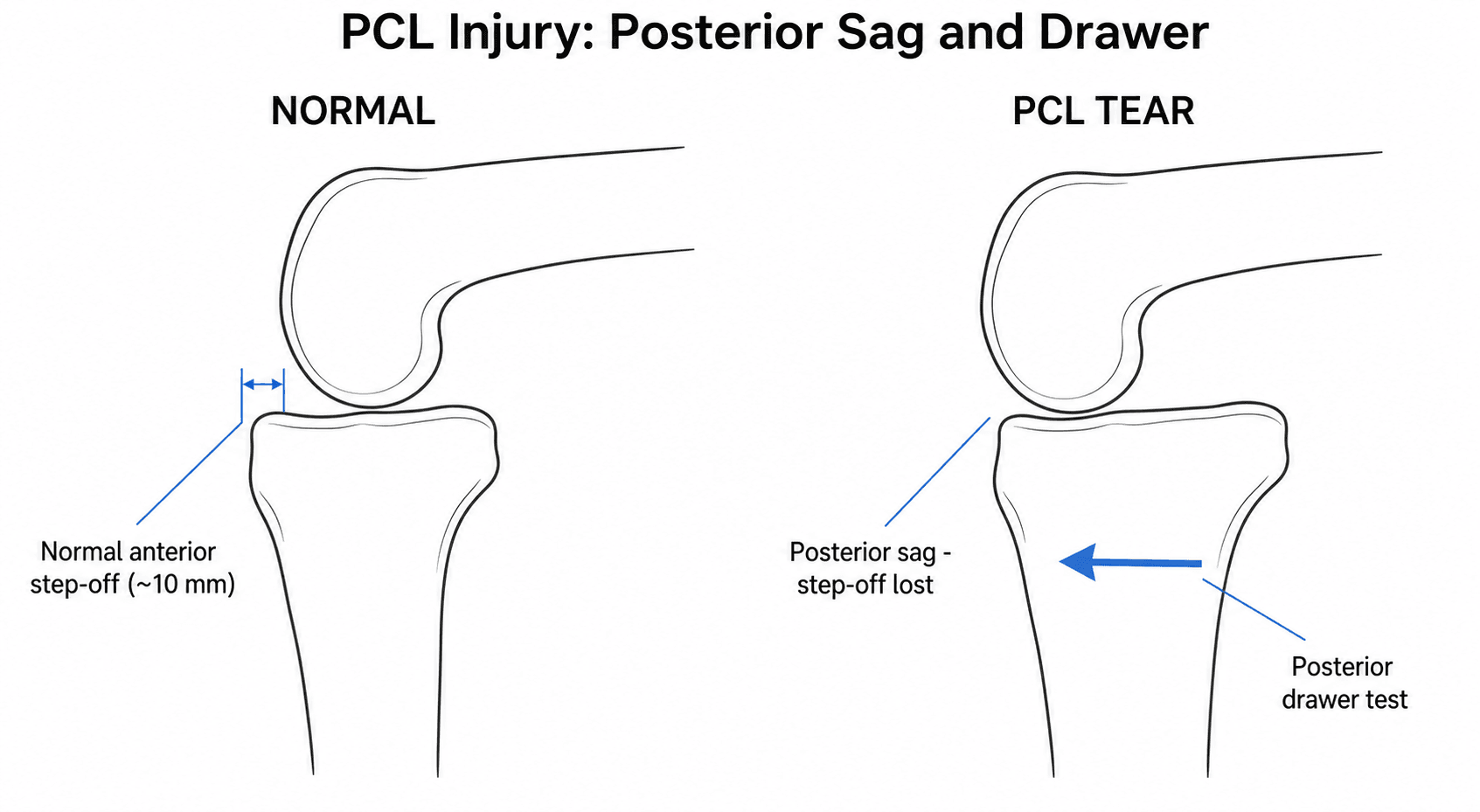
Posterior sag sign. With the patient supine and the hip and knee at 90 degrees, observe the profile of the tibial tuberosity. A sagged tibia means a PCL injury.
Posterior drawer. The key test. With the patient supine and the knee at 90 degrees, first make sure the tibia has not already sagged, so that the test starts from a reduced position, then push the tibia posteriorly. Grade by the position of the tibial plateau relative to the femoral condyles, and compare with the other knee.
Quadriceps active test. From the 90/90 position the patient contracts the quadriceps. The test is positive when the tibia translates forward, reducing the posterior sag.
The rest of the examination. Perform the dial test at 30 and 90 degrees for the PLC, set out in the next section, and test varus and valgus to check the collaterals.
The false anterior drawer. The cardinal trap is to mistake a posterior sag for a positive anterior drawer, which is why the drawer starts from a reduced tibia and the two sides are always compared. The mimics separate as follows.
- Key Examination Finding
- Posterior sag, posterior drawer positive, dial negative
- Distinguishing Feature
- Translation only; no rotatory laxity
- Key Examination Finding
- Posterior drawer positive PLUS dial positive at 30 AND 90 degrees
- Distinguishing Feature
- Increased external rotation persists at 90 degrees
- Key Examination Finding
- Dial positive at 30 degrees only, varus laxity, normal posterior drawer
- Distinguishing Feature
- Rotation normalises at 90 degrees (PCL intact)
- Key Examination Finding
- Lachman/anterior drawer positive
- Distinguishing Feature
- Tibia reduces from a posteriorly sagged start - mimics anterior translation
- Key Examination Finding
- Gross multidirectional laxity, possible dimple sign
- Distinguishing Feature
- Vascular and nerve assessment mandatory; ABPI
- Key Examination Finding
- Joint line tenderness, positive McMurray
- Distinguishing Feature
- Mechanical symptoms, no ligamentous laxity
The Dial Test: Technique and Interpretation
The dial test separates an isolated PLC injury from a combined PCL and PLC injury.
Technique. With the patient prone (preferred) or supine, flex the knee to 30 degrees, then to 90 degrees, and externally rotate both feet. Measure the thigh-foot angle and compare the two sides.
Threshold. An increase of more than about 10 to 15 degrees of external rotation over the normal side is positive. The side-to-side difference is the key, not the absolute angle.
Why 30 versus 90 degrees. At 30 degrees the posterolateral corner is the dominant restraint to external rotation, so an isolated PLC injury increases external rotation at 30 degrees only and the rotation normalises at 90. At 90 degrees the PCL becomes the principal restraint to external rotation, so if the increased rotation persists at 90 degrees the PCL must also be torn. A dial test positive at both angles therefore signals a combined injury, and shifts management toward reconstructing both the PCL and the PLC.
Investigations
MRI. MRI is the gold standard for diagnosing a PCL injury, with a sensitivity of 99%+ and a very high specificity. Findings include increased signal, discontinuity and thickening; look for a bucket-handle appearance (a horizontal tear pattern) and assess both bundles.
Associated injuries. Always evaluate the PLC, the menisci, the cartilage and the other ligaments. MRI is essential for surgical planning and for identifying all the pathology.
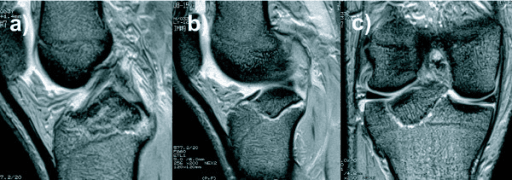
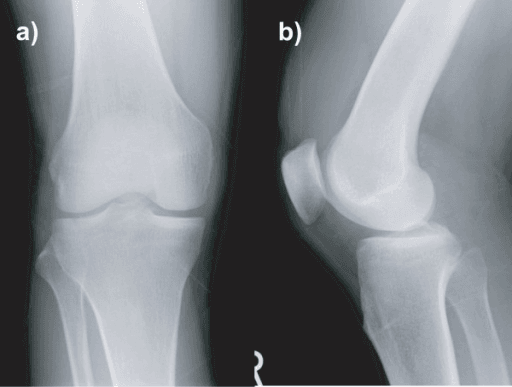
Radiographs. Plain films show a tibial insertion avulsion fracture. Weight-bearing views assess alignment and arthrosis.
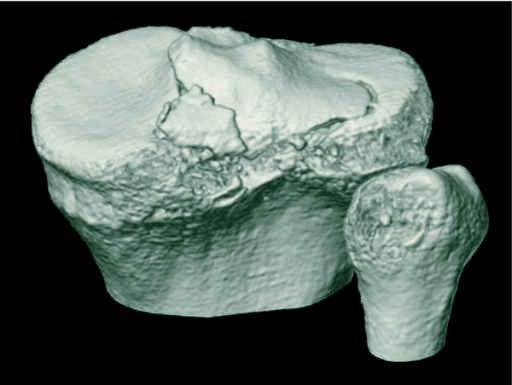
CT. CT gives detailed characterisation of an avulsion fracture for surgical planning.
Stress radiography. A Telos device applies a standardised posterior force at 90 degrees and measures the translation; gravity kneeling views compare posterior translation bilaterally, and with standing views. Either gives an objective, numerical side-to-side measurement that is far more reproducible than the manual drawer.
What the number does. It quantifies the instability and grades the injury objectively, flags a likely combined injury when the difference is large, and gives a baseline for monitoring treatment, including graft laxity over time after reconstruction.
- Interpretation
- Partial PCL injury
- Implication
- Usually managed nonoperatively
- Interpretation
- Complete isolated PCL tear (grade III)
- Implication
- Individualised - nonoperative trial versus reconstruction
- Interpretation
- Combined PCL plus posterolateral/capsular injury
- Implication
- Favours surgical reconstruction of all injured structures
Management Algorithm
The decision. Grade the injury, decide whether it is isolated or combined, and check the PLC with the dial test. Isolated grade I-II injuries are treated conservatively. Combined injuries, with the PLC or ACL or with persistent instability, go to surgery that reconstructs all injured structures, and early: in a combined injury, early surgery prevents PLC contracture.
The isolated grade III knee. Consider surgery in an active patient with significant laxity; a low-demand patient may trial conservative treatment.
Nonoperative treatment. It suits isolated grade I-II injuries, the low-demand patient with grade III, and the patient who prefers it after counselling. The programme:
- Brace in extension initially
- Quadriceps strengthening, which prevents posterior sag
- No hamstring exercises, which increase the posterior force on the tibia
- Progressive return to activity
Absolute indications
- Combined PCL/PLC injury
- Multiligament injury
- Tibial avulsion fracture (fix the fragment)
Relative indications
- Isolated grade III in an active patient
- Failed conservative treatment
- Symptomatic chronic instability
COGSPCL Reconstruction Indications
Hook:Turn the COGS toward surgery when indicated!
Surgical Technique
Graft choice. Achilles allograft is the most common graft. BTB autograft offers stronger fixation, and hamstring autograft less morbidity.
Tunnels. The femoral tunnel is placed at the native PCL footprint and the tibial tunnel posteriorly. Double-bundle reconstruction may better restore rotation but is technically demanding, and all-inside techniques minimise dissection.
Popliteal artery at risk during tibial tunnel drilling. Stay within the safe zone for the popliteal vessels. Use a posterior approach or a trans-septal technique to visualise, and avoid exiting too far posteriorly.
Combined PCL and PLC. An acute combined injury is reconstructed in a single stage; a chronic one may need staging, with the PLC first because of contracture. The order of surgery is to address the PCL first, then reconstruct the PLC, then tension in the appropriate position. Missing or undertreating the PLC leads to PCL graft failure.
Tibial avulsion. When the bone fragment is good, it is fixed, open or arthroscopically, rather than the ligament being reconstructed. The technique is a posterior approach with screw or suture anchor fixation. Fixation is anatomic and has healing potential, and the outcomes are usually excellent, with bony healing.
Complications
- Cause
- Graft stretch, tunnel malposition
- Prevention
- Anatomic placement, adequate graft
- Management
- Revision or accept
- Cause
- Immobilisation, adhesions
- Prevention
- Early ROM
- Management
- Manipulation, arthrolysis
- Cause
- Tibial tunnel drilling
- Prevention
- Safe zone, visualisation
- Management
- Immediate repair
- Cause
- Altered kinematics
- Prevention
- Restore PCL function
- Management
- Symptomatic treatment
Postoperative Care
Protect the graft. Hamstring activation increases posterior tibial translation, so it is avoided early and the quadriceps are emphasised. The programme progresses more slowly than ACL rehabilitation.
PCL Reconstruction Rehabilitation
Brace locked extension. Non-weight bearing or toe touch. Quad sets only.
Progressive flexion (avoid beyond 90 degrees early). Avoid hamstring loading.
Full ROM. Weight bearing progression. Closed chain exercises.
Sport-specific preparation. Pool running. Light jogging.
Full activity after passing functional tests. May be longer than ACL.
Outcomes and Prognosis
Isolated injuries. Treated conservatively, many do well with rehabilitation, though some develop chronic laxity and OA over time. Reconstruction gives good outcomes in motivated patients, and return to sport is possible.
Combined injuries. Outcomes depend on addressing all the injured structures.
The long term. Chronic PCL deficiency may be well tolerated, but it risks patellofemoral and medial compartment OA. Patellofemoral OA is a common long-term sequela, and medial compartment OA is also increased with chronic laxity. The altered kinematics increase joint loading, and early intervention in combined injuries may prevent this.
Guidelines, Registries & Global Practice
Global Epidemiology
PCL injuries account for roughly 3-40% of acute knee ligament injuries depending on the population studied, with the higher proportions reported in trauma centres and the lower proportions in general sports clinics. Two distinct injury populations dominate worldwide: high-energy road-traffic trauma (the classic dashboard mechanism, and the predominant cause of displaced bony tibial avulsions in regions with high motorcycle/two-wheeler use such as parts of South and East Asia) and sporting contact injuries (football/soccer, rugby, skiing). Up to 60% of PCL injuries occur as part of a combined or multiligament injury pattern.
Side-by-Side Guidance
- Position on Isolated Low-Grade
- Structured nonoperative rehabilitation for grade I-II
- Position on Combined / Bony Avulsion
- Surgery for combined instability and displaced avulsions
- Position on Isolated Low-Grade
- Conservative, quadriceps-focused programme first-line
- Position on Combined / Bony Avulsion
- Refer for reconstruction in combined/multiligament knees
- Position on Isolated Low-Grade
- Emphasises bony avulsion fixation principles
- Position on Combined / Bony Avulsion
- ORIF of displaced tibial avulsion; reconstruct midsubstance tears
- Position on Isolated Low-Grade
- Nonoperative for isolated grade I-II
- Position on Combined / Bony Avulsion
- Anatomic reconstruction; address PLC concurrently
The substantive agreement across societies is greater than the disagreement: isolated grade I-II injuries are rehabilitated, while combined patterns and displaced bony avulsions are operated. Differences are largely emphasis (graft choice, single vs double bundle, timing) rather than principle.
Registry and Outcome Notes
- Unlike arthroplasty, PCL surgery is not captured by dedicated implant registries (NJR/AJRR/AOANJRR track joint replacement, not ligament reconstruction). Outcome evidence therefore comes from prospective cohorts and meta-analyses rather than national registries.
- The Danish and Norwegian knee-ligament reconstruction registries (which began with the ACL) increasingly capture PCL and multiligament procedures, and are emerging as the best population-level data source for revision and re-operation rates.
High- vs Limited-Resource Practice Variation
- Routine MRI and stress radiography for diagnosis and grading
- Allograft availability supports single-stage multiligament reconstruction
- Subspecialist sports/knee surgeons; arthroscopic and all-inside techniques
- Diagnosis may rely on clinical examination and plain films; MRI access limited
- Allograft often unavailable - autograft and open techniques predominate
- Displaced bony avulsions managed by open posterior ORIF (reliable, low-cost, good outcomes)
PCL injuries are important viva topics globally. Know the grading system, dial test interpretation, and when to operate. Be prepared to discuss combined injuries and the rationale for addressing the PLC at the index operation.
Controversies and Areas of Uncertainty
There is no high-level RCT defining the threshold for reconstructing isolated grade III injuries. Practice ranges from nonoperative rehabilitation to early reconstruction in high-demand patients. Decision rests on activity level, symptomatic instability and the long-term arthritis concern.
Double-bundle reconstruction improves objective posterior translation in meta-analysis but has not translated into a reproducible functional advantage, while adding technical complexity and cost. Most surgeons still use single-bundle.
The "killer turn" at the proximal tibial tunnel aperture is implicated in graft attrition. Tibial inlay (open posterior bone-block fixation) avoids this acute angle but is more invasive; comparative clinical superiority remains unproven.
Allograft (commonly Achilles) avoids donor-site morbidity and suits multiligament reconstruction; autograft avoids disease transmission and may have a biological healing advantage. No robust evidence establishes superiority for the PCL specifically.
MCQ Practice Points
Q: What is the primary function of the PCL? A: Restraint to posterior tibial translation - provides 95% of restraint near full flexion.
Q: What is the classic mechanism for PCL injury? A: Dashboard injury - proximal tibia strikes dashboard with knee flexed, driving tibia posteriorly.
Q: What defines a Grade II PCL injury? A: Tibia flush with femoral condyles on posterior drawer. 5-10mm translation. Complete tear but may do well conservative.
Q: Dial test positive at 30 degrees only vs 30 and 90 degrees? A: 30 degrees only = isolated PLC. 30 and 90 degrees = combined PCL + PLC. At 90 degrees, intact PCL prevents rotation.
Q: What are long-term consequences of PCL deficiency? A: Patellofemoral and medial compartment OA. Altered kinematics increase loading on these compartments.
Q: Why do combined PCL/PLC injuries need surgery? A: PLC must be addressed to prevent PCL graft failure. Isolated PCL reconstruction with untreated PLC has high failure rate.
Exam Viva Scenarios
Practise clinical reasoning and management decisions out loud
“A 35-year-old man presents after an MVC. His knee hit the dashboard. He has posterior knee pain and mild swelling. Posterior drawer shows the tibia flush with the femoral condyles. Dial test is negative. MRI confirms isolated PCL tear. How would you manage this?”
“A 28-year-old football player has a knee injury during a game. He has posterior and lateral knee pain. Posterior drawer shows Grade III laxity. Dial test shows 15 degrees increased external rotation at both 30 and 90 degrees compared to the opposite side. What is your management?”
“A 40-year-old presents with anterior knee pain and medial knee pain for 2 years. He had a PCL injury 10 years ago treated conservatively. He now has difficulty with stairs. X-rays show Grade 2 patellofemoral and medial OA. Posterior drawer is Grade II. What would you recommend?”
Grading (Posterior Drawer)
- Grade I: Tibia anterior to condyles (0-5mm)
- Grade II: Tibia flush with condyles (5-10mm)
- Grade III: Tibia posterior to condyles (greater than 10mm)
- Grade III often indicates combined injury
Clinical Tests
- Sag sign: Observe at 90/90
- Posterior drawer: Key test at 90 degrees
- Dial test: 30 and 90 degrees for PLC
- Quadriceps active: Forward translation
Dial Test
- Positive at 30 only = isolated PLC
- Positive at 30 AND 90 = combined PCL + PLC
- At 90 degrees, intact PCL prevents rotation
- Critical for operative planning
Treatment Guidelines
- Isolated Grade I-II: Conservative with quad rehab
- Isolated Grade III: Consider surgery if active
- Combined injuries: Surgery for both
- Address PLC or PCL graft will fail
Surgical Pearls
- Fix tibial avulsions if present
- Tibial tunnel: beware popliteal artery
- Reconstruct PLC if combined
- Early surgery prevents PLC contracture
Evidence Base and Key Studies
Natural History of Acute Isolated Nonoperatively Treated PCL Injury
- Prospective study of 133 acute isolated PCL injuries, mean age 25 years
- Mean follow-up 5.4 years; objective laxity unchanged from injury to review
- Knee function was INDEPENDENT of the grade of laxity
- Roughly half returned to the same sport at the same or higher level
Minimum 10-Year Follow-Up of Nonoperatively Treated Isolated PCL Injury
- 68 patients with acute isolated PCL injury followed prospectively (mean 14-17 years)
- Mean quadriceps strength 97% of the uninvolved leg with full range of motion maintained
- Prevalence of moderate-to-severe radiographic osteoarthritis was 11%
- Osteoarthritis grade did NOT differ by PCL laxity grade
Outcomes of Acute Grade-III Posterolateral (PLC) Knee Injuries
- Prospective series of 30 knees with grade-III posterolateral injury treated within 6 weeks
- 4 had an associated PCL tear and 8 had both cruciate ligaments torn
- Varus side-to-side gap improved from 6.2 mm to 0.1 mm at final follow-up
- Mean IKDC subjective score improved from 29 to 82 points
Single-Bundle vs Double-Bundle PCL Reconstruction (Meta-Analysis)
- Systematic review and meta-analysis of 11 studies, 441 patients (232 SB, 209 DB)
- No significant difference in Lysholm or Tegner scores between SB and DB
- DB gave significantly better objective posterior translation (Telos) at 90 degrees
- Both techniques produced improved patient-reported outcomes
Open vs Arthroscopic Fixation of Displaced PCL Avulsion Fractures
- Systematic review of 12 studies: 134 open posterior approach, 174 arthroscopic suture fixation
- Lysholm scores 85-100 (open) and 80-100 (arthroscopic)
- 90-100% rated normal/nearly normal on subjective IKDC in both groups
- Side-to-side laxity difference 0-5 mm for both approaches
All-Inside PCL Reconstruction - Current Practice
- PRISMA systematic review of 14 studies on all-inside PCL reconstruction technique
- Allograft was the preferred graft in 9 of 14 studies; semitendinosus when autograft used
- Quadruple-folded graft, 8-12 mm diameter, was the commonest configuration
- Most docked the graft into the tibial socket first then the femoral socket
International Expert Consensus on Management of PCL Injuries (17 Countries)
- Modified Delphi process with an expert panel of 90 clinicians in orthopaedics and sports medicine from 17 countries, over two rounds
- Statements cover clinical decision-making, treatment strategy and postoperative management
- Isolated grade I-II injuries: structured nonoperative rehabilitation with quadriceps emphasis
- Combined injuries (especially PCL with posterolateral corner) and displaced bony avulsions: surgical management, addressing all injured structures at the index procedure