Retrograde Blood Supply | AVN Risk | Vascularized Bone Graft | SNAC Progression
- Retrograde blood supply - proximal pole at highest AVN risk (80% from dorsal scaphoid branch)
- Humpback deformity - flexion through nonunion site creates dorsal angulation
- DISI pattern develops - lunate extends as scaphoid flexes (carpal collapse)
- SNAC progression is the rule, but slow - radial styloid, then scaphocapitate, then capitolunate, over years to decades
- VBG (1,2 ICSRA) indicated for AVN or failed previous fixation
- “Lateral intrascaphoid angle greater than 45 degrees = significant humpback requiring wedge graft
- “MRI with gadolinium assesses AVN - lack of enhancement suggests AVN; confirmed AVN requires VBG
- “Non-vascularized graft if viable proximal pole, VBG if AVN or failed surgery
- “Union rates: 90-95% non-VBG viable bone, 80-90% VBG for AVN
Overview and Epidemiology
Scaphoid nonunion is failure of a scaphoid fracture to heal, typically defined as absence of radiographic union at 6 months despite treatment, or the presence of an established nonunion pattern. Between 5 and 15% of all scaphoid fractures progress to it.
Who is at risk. The rate is higher with:
- Proximal pole location, with its poor blood supply: nonunion in up to 30%
- Displacement greater than 1mm
- Delayed presentation or treatment, greater than 4 weeks, and the missed diagnosis
- Smoking, the major modifiable factor, with a 2-3x increased risk
- NSAID use, which inhibits healing
- AVN at the outset
- Poor compliance with immobilisation
Natural history. Degeneration is progressive and time-dependent, not immediate. In Mack's series, changes were confined to the scaphoid at a mean of 8.2 years, radioscaphoid arthritis appeared at 17 years and generalised wrist arthritis at 31.6 years, and roughly half the series (23 of 47) had no wrist arthritis at review. Few nonunions stayed undisplaced, stable and arthritis-free beyond 10 years, and displacement and carpal instability (lunate dorsiflexion 10 degrees or more) predicted the severity.
Scaphoid nonunion is not a "will it matter?" problem: degeneration follows a predictable radial-to-ulnar sequence. But the timescale is long and variable, so argue from the sequence and its drivers, displacement and carpal instability, rather than claiming universal progression.
Children. Scaphoid nonunion in the skeletally immature child or adolescent behaves differently from the adult, carries a better prognosis, and is a distinct examinable scenario.
- Paediatric scaphoid fractures are more often distal-third or avulsion injuries than waist fractures, and are frequently missed or treated late, which is the main driver of the (uncommon) nonunion
- The child's robust periosteal vascularity and remodelling mean a trial of immobilisation in a cast can still unite an established nonunion in a way it rarely would in an adult, so consider a cast trial first; AVN and SNAC are comparatively rare
- Persistent nonunion is treated with debridement, bone grafting (usually non-vascularised distal radius or iliac crest) and fixation with a screw or K-wires sized to the small bone, with high union rates (often over 90%) and good remodelling
- Vascularised grafts are rarely needed because proximal pole AVN is uncommon in this group; reserve them for the rare avascular or revision case
Anatomy and Blood Supply
The bone. The largest carpal bone in the proximal row, the scaphoid spans both carpal rows and acts as the kinematic link between them. About 80% of it is covered by articular cartilage, which limits its periosteal blood supply.
The blood supply. The dorsal scaphoid branch of the radial artery enters at the dorsal ridge at the waist and supplies 70-80% of the bone, most of it by retrograde flow. Palmar branches from the superficial palmar arch enter at the scaphoid tubercle and supply the distal pole and tuberosity, the remaining 20-30%. Any direct supply to the proximal pole is variable and reaches only a small portion of it: only 20-30% of the proximal pole has any direct blood supply.
Why it matters. Because the flow is retrograde, the proximal pole is at the highest AVN risk, and a waist fracture interrupts the main supply to it.
Proximal pole fractures have the highest nonunion and AVN rates because they completely disrupt the retrograde blood supply from the main dorsal scaphoid branch. Always consider these high-risk injuries.
Pathophysiology of Nonunion
The strut fails. The scaphoid normally acts as a strut connecting the proximal and distal carpal rows. When it fails to unite, the nonunion site loses its structural integrity and the scaphotrapezial ligament pulls the distal fragment into flexion. The scaphoid angulates dorsally through the nonunion, and the dorsal convexity is the humpback.
Measuring the humpback. The lateral intrascaphoid angle is measured on a lateral radiograph or sagittal CT, between lines drawn along the axes of the proximal and distal poles. Normal is less than 35 degrees. Greater than 45 degrees is a significant humpback, and it must be corrected with a wedge graft for union to succeed.
The carpus follows. Normally the scaphoid's flexion tendency is balanced by the lunate, which sits in neutral, and the scapholunate angle is 30-60 degrees. In a nonunion the scaphoid collapses into flexion and the lunate, attached to the proximal fragment, extends. This is dorsal intercalated segment instability (DISI): the scapholunate angle rises above 60 degrees and load is distributed abnormally across the wrist.
Where it ends. Those abnormal mechanics end in SNAC wrist (Scaphoid Nonunion Advanced Collapse), the usual endpoint of a displaced, unstable nonunion left untreated. The arthritis appears in a fixed order, typically over years to decades, and faster with displacement and carpal instability.
Classification Systems
- Description
- Fibrous union
- Characteristics
- Minimal motion, may heal with prolonged immobilisation
- Treatment
- ORIF, may not need graft
- Description
- Pseudarthrosis
- Characteristics
- Established nonunion, mobile but viable
- Treatment
- ORIF + bone graft
- Description
- Sclerotic
- Characteristics
- Dense sclerosis at nonunion margins
- Treatment
- Debride + extensive graft
- Description
- Avascular necrosis
- Characteristics
- No proximal pole vascularity
- Treatment
- Vascularised bone graft
Herbert D is the exam standard. D4 (AVN) is the critical type and requires a vascularised bone graft; D1-D3 may be treated with a non-vascularised graft if the bone is viable.
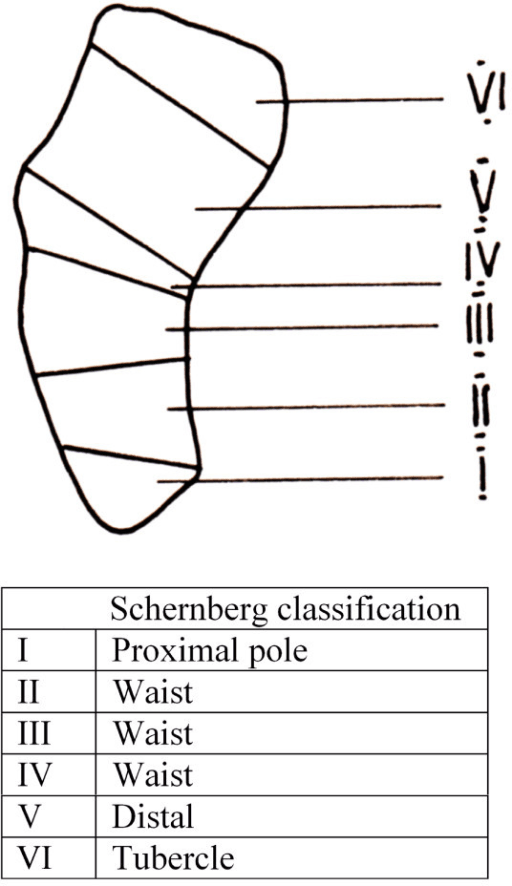
Slade-Geissler. Alongside Herbert, the Slade-Geissler classification grades the nonunion by the degree of healing and sclerosis seen arthroscopically and on CT. The grade maps onto whether a percutaneous or arthroscopic approach is feasible, or whether open structural grafting is required:
- Grades I-II (delayed union, fibrous union without sclerosis): minimal pathology, amenable to percutaneous headless compression screw fixation alone, with no formal graft
- Grades III-IV (progressive minimal-to-comprehensive sclerosis at the nonunion): arthroscopic-assisted debridement and bone grafting with percutaneous screw fixation can achieve union while avoiding an open approach and preserving blood supply
- Grades V-VI (cyst formation and resorption, then a wide gap with humpback and carpal collapse): the deformity and bone loss demand open reduction with a structural (wedge) graft, and an avascular proximal pole demands a vascularised graft
The arthroscopic trade. Arthroscopic-assisted grafting is soft-tissue-sparing and protects the dorsal blood supply, with union rates comparable to open surgery in selected nonunions: lower-grade, without humpback, with a vascular pole. It is not appropriate where a humpback must be corrected, and the Slade-Geissler grade is the practical tool for choosing between percutaneous, arthroscopic and open surgery.
Clinical Assessment
History. Presentation is often delayed, with chronic wrist pain, and the injury may be remote enough to have been forgotten. The patient reports pain with gripping and loading the wrist, weakness with reduced grip strength, and loss of motion.
Many scaphoid nonunions are "forgotten fractures" and the patient may not recall the injury. Keep a high index of suspicion for nonunion in chronic wrist pain with snuffbox tenderness.
Look and feel. Swelling is often minimal in chronic cases, though dorsal wrist fullness may be present; compare with the contralateral side and assess the overall posture of the wrist. Palpate for tenderness in the anatomical snuffbox, over the scaphoid tubercle on the volar side and over the dorsal scaphoid, and check for crepitus.
Provocative tests.
- Scaphoid shift (Watson) test: a painful clunk with radial deviation
- Thumb compression: pain with axial load through the thumb
- Grip strength, compared with the contralateral side
Movement. Wrist flexion, extension and radial deviation are decreased; ulnar deviation may be relatively preserved.
- Key features
- Snuffbox tenderness, prior injury (often forgotten), reduced grip
- Distinguishing finding
- CT shows nonunion gap/sclerosis; MRI assesses proximal pole AVN
- Key features
- Recent fall on outstretched hand, snuffbox tenderness
- Distinguishing finding
- Fracture line without sclerosis; MRI positive within days
- Key features
- Dorsal SL tenderness, positive Watson scaphoid shift
- Distinguishing finding
- Widened SL interval (Terry Thomas sign), no scaphoid fracture line
- Key features
- Insidious radial wrist pain, no fracture history
- Distinguishing finding
- MRI AVN of intact (non-fractured) scaphoid
- Key features
- Pain over 1st dorsal compartment, positive Finkelstein
- Distinguishing finding
- Tenderness/swelling over APL-EPB, normal scaphoid imaging
- Key features
- Pain at thumb base, positive CMC grind
- Distinguishing finding
- Trapeziometacarpal joint changes, not scaphoid
- Key features
- Tenderness more proximal/dorsal, crepitus
- Distinguishing finding
- Soft-tissue, normal bony scaphoid imaging
Investigations
Radiographs. A four-view series:
- Assessment
- Overall alignment, DISI
- Key Findings
- Signet ring sign, widened SL interval
- Assessment
- Humpback measurement, DISI
- Key Findings
- Intrascaphoid angle, SL angle greater than 60 degrees
- Assessment
- Nonunion site detail
- Key Findings
- Gap, sclerosis, cystic changes
- Assessment
- Scaphoid length
- Key Findings
- Additional nonunion detail
Across the series, a nonunion shows a gap at the fracture site with sclerotic margins, cystic change and bone resorption, the humpback and DISI on the lateral, and SNAC changes once it is advanced.
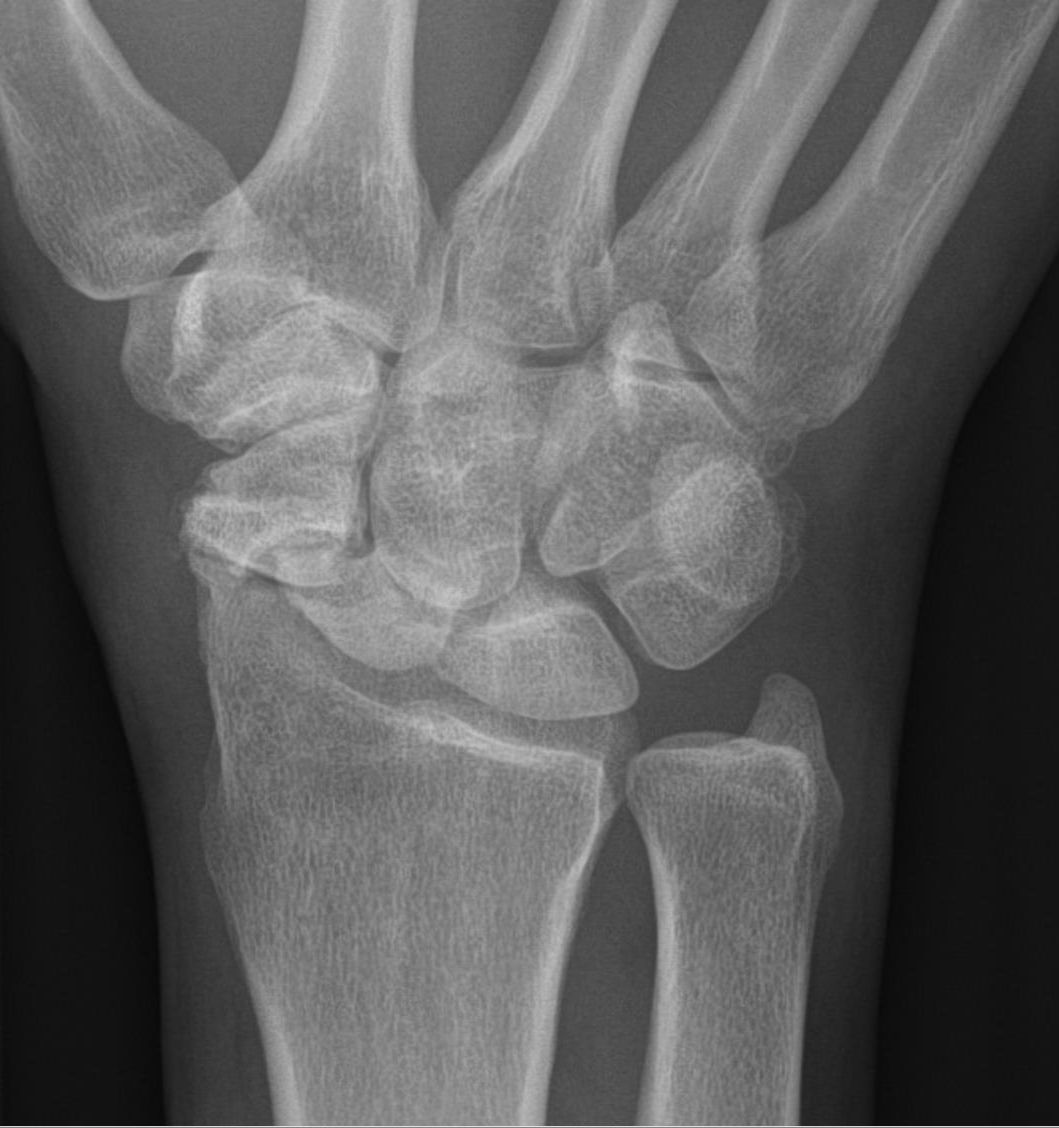
CT is the gold standard for judging union or nonunion, and essential for surgical planning. Sagittal reconstructions measure the humpback, and the scan shows cystic change and sclerosis and stages any SNAC arthritis.
MRI is essential for AVN assessment, because it determines the graft. T1 sequences show the marrow signal and gadolinium enhancement confirms vascularity; absent enhancement of the proximal pole suggests AVN.
MRI with gadolinium is mandatory before scaphoid nonunion surgery and is the best preoperative test of proximal pole vascularity, but intraoperative punctate bleeding of the proximal pole remains the reference standard. The two disagree often enough that the final call is made in theatre. Confirmed AVN requires a vascularised bone graft; a non-vascularised graft in AVN has a high failure rate.
Bone scan is less commonly used now. Decreased uptake suggests AVN, but the test is non-specific.
Management Algorithm
The goals, in order:
- Achieve union, the primary goal
- Restore anatomy: correct the humpback and restore length
- Prevent SNAC progression
- Maintain or restore function: motion and grip strength
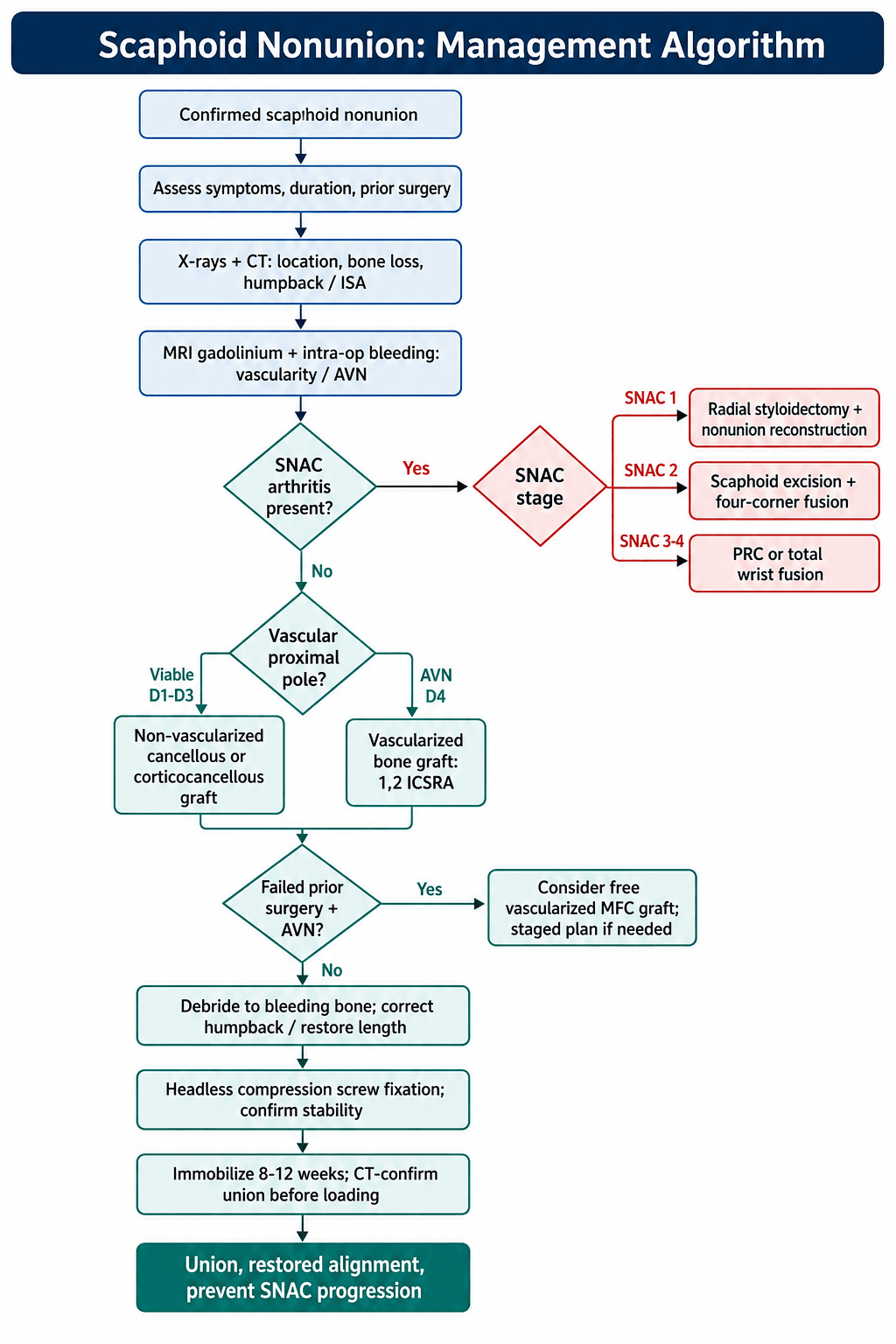
Who needs surgery. Virtually all symptomatic scaphoid nonunions, asymptomatic nonunions in young patients (to prevent SNAC), and those with progressive arthritic change. Relative contraindications are SNAC Stage 3-4, where salvage procedures are indicated instead, severe comorbidities that preclude surgery, and patient preference after informed discussion.
The work-up. Each step feeds the decision:
- History and examination: symptom duration and prior treatment
- Plain radiographs (4 views) to confirm the nonunion
- CT for nonunion detail and bone quality
- MRI with gadolinium for AVN
- A check for SNAC changes, which decides whether salvage is needed
Together they place the nonunion by Herbert D type, location, SNAC stage if arthritis is present, and degree of humpback (the intrascaphoid angle), and that complete assessment guides the treatment.
The decision. Graft selection is the most critical decision in scaphoid nonunion surgery. It rests on the vascularity of the proximal pole and on the deformity; once SNAC arthritis is present, the answer is a salvage procedure chosen by stage.
- Assessment
- Minimal motion at nonunion
- Treatment
- ORIF alone may suffice
- Graft Type
- Cancellous graft if needed
- Assessment
- Mobile nonunion, viable bone
- Treatment
- ORIF + bone graft
- Graft Type
- Iliac crest cancellous
- Assessment
- ISA greater than 45 degrees, MRI signal intact
- Treatment
- Correct deformity + fix
- Graft Type
- Corticocancellous wedge
- Assessment
- No MRI enhancement, no intraop bleeding
- Treatment
- Vascularised bone graft
- Graft Type
- 1,2 ICSRA pedicled graft
- Assessment
- Prior nonunion repair failed
- Treatment
- Revision with VBG
- Graft Type
- Free vascularised MFC graft
Failed prior surgery. Consider a free vascularised graft (MFC); staged procedures may be needed, and the risk of a poor outcome is higher. Careful patient selection and realistic expectations are essential.
Bone Graft Selection
When. A viable proximal pole, shown by MRI enhancement and intraoperative bleeding: Herbert D1, D2 or D3 with vascularity, in primary nonunion surgery.
- Source
- Distal radius, iliac crest
- Indication
- Minimal deformity, fill defect
- Source
- Iliac crest
- Indication
- Moderate defect, some stability
- Source
- Iliac crest
- Indication
- Humpback correction
- Source
- Iliac crest
- Indication
- Classic corticocancellous inlay
Technique. Size the graft to correct the deformity, and pack cancellous bone around the cortical strut.
- Indication
- D1-D3, no AVN
- Union Rate
- 85-95%
- Time to Union
- 8-12 weeks
- Indication
- Humpback correction
- Union Rate
- 85-95%
- Time to Union
- 10-14 weeks
- Indication
- D4, AVN
- Union Rate
- 80-90%
- Time to Union
- 12-16 weeks
- Indication
- Failed VBG
- Union Rate
- 70-85%
- Time to Union
- 14-20 weeks
Surgical Technique
The principles, whatever the graft.
- Debride the nonunion, sclerotic bone included, to punctate bleeding
- Correct the humpback deformity with a structural graft
- Insert the appropriate graft
- Fix with a headless compression screw, the preferred fixation
- Immobilise for 8-12 weeks
Modified Russe volar approach. For waist nonunions, humpback deformity requiring correction, and non-vascularised bone grafting.
- Incision: longitudinal over the scaphoid tubercle, between FCR and the radial artery. Protect the palmar cutaneous branch of the median nerve.
- Exposure: incise the joint capsule and identify the nonunion site. Wrist flexion improves access.
- Debridement: remove fibrous tissue and debride the sclerotic margins until punctate bleeding is seen. Preserve periosteum where possible.
- Graft insertion: size a wedge graft to correct the humpback, insert it into the prepared slot and pack cancellous bone around it. Confirm correction on fluoroscopy.
- Fixation: headless compression screw (Acutrak, Herbert), with guidewire placement checked fluoroscopically. The screw should cross the nonunion and engage the proximal pole.
Complications
- Incidence
- 5-20%
- Prevention
- Appropriate graft selection, technique
- Management
- Revision with VBG if AVN
- Incidence
- Variable
- Prevention
- VBG for at-risk cases
- Management
- Free vascularised graft
- Incidence
- If nonunion persists
- Prevention
- Achieve union
- Management
- Salvage procedure
- Incidence
- 10-20%
- Prevention
- Early motion when healed
- Management
- Physiotherapy
- Incidence
- 5-10%
- Prevention
- Appropriate screw sizing
- Management
- Hardware removal if symptomatic
- Incidence
- 5-10%
- Prevention
- Minimise graft size
- Management
- Symptomatic treatment
- Incidence
- less than 2%
- Prevention
- Sterile technique, prophylaxis
- Management
- Antibiotics, debridement
Persistent nonunion. Identify the cause (inadequate graft, AVN, poor fixation, smoking) and address the modifiable factors before revising:
- A failed non-vascularised graft is revised with a vascularised graft
- After a failed pedicled VBG, consider a free vascularised (MFC) graft
- If SNAC is advanced, salvage procedures, chosen by stage as in the SNAC classification
Postoperative Care and Rehabilitation
Rehabilitation Protocol
- Thumb spica cast or splint
- Immobilise wrist and thumb IP joint
- Allow finger motion
- Serial radiographs at 4, 6, 8 weeks
- No loading, gripping
- CT scan at 8 weeks to assess union
- If signs of healing, transition to removable splint
- Gentle active ROM exercises
- Continue night splinting
- No resistance activities
- Progressive strengthening if union confirmed
- Grip exercises, putty
- Proprioception work
- Gradually increase resistance
- Return to manual work when pain-free, strong
- Contact sports delayed until 6 months
- Monitor for complications
Judging union. Serial CT is the best way to assess union. Bridging trabeculae indicate healing and complete bridging is union, which may take 12 weeks or more in VBG cases.
Outcomes and Prognosis
What drives the result. Union rates are lower with AVN, and a chronic nonunion does worse than an acute one. Outcome also turns on addressing the humpback, choosing the appropriate graft, and smoking cessation.
Function. Prognosis is excellent if union is achieved: most patients get pain relief and return to normal function. Grip strength and range of motion reach 70-85% of the contralateral side, and return to work or sport comes at 4-6 months if the scaphoid unites.
Guidelines, Registries & Global Practice
Global Epidemiology
The scaphoid is the most commonly fractured carpal bone, and nonunion is the dominant late complication that drives carpal collapse and arthritis worldwide.
- Figure
- approximately 12.4 in 100,000 per year
- Source population
- UK regional cohort (Garala 2016)
- Figure
- Young men, highest aged 15-19 years
- Source population
- UK regional cohort (Garala 2016)
- Figure
- Waist 64%, tubercle 18.1%
- Source population
- UK regional cohort (Garala 2016)
- Figure
- approximately 5-15% (up to 30% proximal pole)
- Source population
- Pooled clinical series
- Figure
- approximately 27.9 years (87.8% male)
- Source population
- Systematic review, 7,671 patients (Duncumb 2022)
Incidence rises with social deprivation and shows summer seasonality, reflecting the high-energy sporting and occupational mechanisms typical of the young male population at risk (Garala 2016).
Guideline and Society Guidance, Side by Side
There is no single high-level (Level I) guideline dedicated to scaphoid nonunion; recommendations are drawn from society resources and pooled evidence, which broadly agree.
- Core guidance on scaphoid nonunion
- CT to confirm nonunion and assess deformity; debride to bleeding bone, restore length/alignment, structural graft plus stable internal fixation (headless compression screw)
- Evidence basis
- Expert consensus / surgical reference
- Core guidance on scaphoid nonunion
- Refer suspected nonunion to a hand unit; image with CT (union/deformity) and MRI (proximal pole viability); graft and fix; counsel that untreated nonunion risks collapse and arthritis
- Evidence basis
- Society best-practice / narrative
- Core guidance on scaphoid nonunion
- Operative reconstruction for symptomatic nonunion; vascularised graft considered for avascular proximal pole or failed prior surgery; salvage (4-corner fusion, PRC) once SNAC arthritis established
- Evidence basis
- Society resources / pooled series
- Core guidance on scaphoid nonunion
- Consistent with AO: address vascularity, deformity and stability; reserve vascularised grafts for avascular or revision cases
- Evidence basis
- Instructional / consensus
confirm nonunion and deformity on CT; assess proximal pole vascularity (MRI plus intra-operative bleeding); debride, correct humpback and stabilise; salvage rather than reconstruct once SNAC arthritis is established.
- Vascularised versus non-vascularised graft. Classic series and the Merrell meta-analysis favour vascularised grafts for avascular proximal poles, but the larger Duncumb 2022 systematic review found no significant difference in pooled union (88.7% versus 87.5%), and called for randomised trials.
- Open versus arthroscopic-assisted grafting for nonunion without major humpback, where union rates appear comparable.
Registry Evidence
Unlike arthroplasty, scaphoid nonunion is not tracked by national joint registries (NJR, AJRR, AOANJRR, SHAR, NZJR), which capture hip, knee and other joint replacements rather than carpal reconstruction. The best population-level evidence therefore comes from epidemiological cohorts (Garala 2016) and large pooled systematic reviews (Duncumb 2022) rather than implant registries.
Global Practice Variation
- Routine CT for union/deformity and MRI for proximal pole viability
- Access to headless compression screws and vascularised graft (1,2 ICSRA, free MFC) techniques
- Microsurgical capability concentrated in tertiary hand units
- Reliance on plain radiographs; delayed or missed initial diagnosis more common
- K-wire fixation and non-vascularised iliac crest/distal radius grafts predominate
- Later presentation increases the proportion presenting with established SNAC
Exam framing: scaphoid nonunion has no Level I guideline, so candidates should reason from principles - confirm nonunion and deformity (CT), assess vascularity (MRI plus intra-operative bleeding), debride, correct humpback, stabilise, and salvage once SNAC arthritis is established - and be able to cite the controversy that pooled data (Duncumb 2022) question the assumed superiority of vascularised grafts.
Viva Scenarios
Clinical Decision Scenarios
Practise clinical reasoning and management decisions out loud
“A 28-year-old male presents with wrist pain 2 years after a fall. He recalls being told he fractured his wrist but didn't follow up after initial casting. CT shows a waist nonunion with humpback deformity (intrascaphoid angle 55 degrees). MRI shows no gadolinium enhancement of the proximal pole.”
“A 22-year-old female presents with 1 year of wrist ache after a fall playing netball. She was initially treated in a cast for 6 weeks. CT shows a waist nonunion with minimal deformity (intrascaphoid angle 35 degrees). MRI shows normal proximal pole signal with good gadolinium enhancement.”
“A 45-year-old manual laborer presents with progressive wrist pain and stiffness. Radiographs show a long-standing scaphoid nonunion with arthritic changes at the radial styloid and scaphocapitate joint. The capitolunate joint appears preserved.”
MCQ Practice Points
Q: What is the primary blood supply to the scaphoid and why is the proximal pole at risk for AVN?
A: The dorsal scaphoid branch of the radial artery provides 70-80% of the blood supply. It enters the scaphoid at the dorsal ridge (waist level) and supplies the bone via retrograde flow. The proximal pole receives only 20-30% of its supply directly, making it highly vulnerable to AVN when the waist is fractured.
Q: What lateral intrascaphoid angle indicates significant humpback deformity requiring wedge graft correction?
A: A lateral intrascaphoid angle greater than 45 degrees indicates significant humpback deformity. Normal is less than 35 degrees. Angles between 35-45 degrees are borderline. Significant humpback must be corrected with a wedge graft (e.g., Fisk-Fernandez) to restore scaphoid length and allow union.
Q: When is a vascularized bone graft indicated for scaphoid nonunion?
A: Vascularized bone graft (typically 1,2 ICSRA) is indicated for:
- AVN of the proximal pole (no MRI gadolinium enhancement)
- Failed previous non-vascularized graft
- Prolonged nonunion (greater than 5 years)
Non-vascularized graft in AVN has unacceptably low union rates (less than 60%). VBG achieves 80-90% union in AVN.
Q: Where is the 1,2 ICSRA located and how is it harvested?
A: The 1,2 ICSRA (1,2 Intercompartmental Supraretinacular Artery) runs between the 1st extensor compartment (APL, EPB) and the 2nd extensor compartment (ECRL, ECRB) in the supraretinacular plane (above the extensor retinaculum). It is harvested from the dorsal distal radius as a pedicled bone flap, maintaining the vascular pedicle for transfer to the scaphoid nonunion site.
Q: What is the sequence of joint involvement in SNAC wrist?
A: SNAC wrist progresses through 4 stages:
- Stage 1: Radial styloid to scaphoid
- Stage 2: + Scaphocapitate joint
- Stage 3: + Capitolunate joint
- Stage 4: Pancarpal (including radiolunate)
Key difference from SLAC: In SNAC, radiolunate is preserved until Stage 4, allowing salvage procedures (4-corner fusion, PRC) in earlier stages.
Q: How often, and how quickly, do untreated scaphoid nonunions develop arthritis?
A: Arthritis is usual but not universal, and it takes years. In Mack's natural-history series of 47 nonunions followed 5 to 53 years, changes were still confined to the scaphoid in 23 (about half) at a mean of 8.2 years; radioscaphoid arthritis appeared at a mean of 17 years and generalised wrist arthritis at 31.6 years. Few nonunions remained undisplaced, stable and arthritis-free beyond ten years, and displacement and carpal instability predicted severity - which is why the authors recommended grafting all displaced ununited fractures regardless of symptoms. The often-repeated "100% progress to SNAC" overstates both the certainty and the speed.
Key Statistics
- 5-15% nonunion rate (30% proximal pole)
- Arthritis usual but not universal: radioscaphoid at ~17 yrs (Mack)
- 80% blood from dorsal scaphoid branch (retrograde)
- Only 20-30% of proximal pole has direct supply
Herbert D Classification
- D1: Fibrous union - ORIF, may not need graft
- D2: Pseudarthrosis - ORIF + bone graft
- D3: Sclerotic - Debride + extensive graft
- D4: AVN - VASCULARIZED bone graft required
Humpback Deformity
- Flexion through nonunion site
- Creates dorsal convexity (humpback)
- Measure lateral intrascaphoid angle
- Greater than 45 degrees = significant = wedge graft needed
Graft Selection
- Viable bone (MRI signal+) = Non-vascularized graft
- AVN (no MRI enhancement) = VBG (1,2 ICSRA)
- Failed surgery = Free vascularized (MFC)
- 1,2 ICSRA: between 1st and 2nd compartments, supraretinacular
SNAC Stages
- Stage 1: Radial styloid-scaphoid
- Stage 2: + Scaphocapitate
- Stage 3: + Capitolunate
- Stage 4: Pancarpal (including radiolunate)
Must Know for Exam
- Retrograde blood supply - proximal pole at risk
- MRI with gadolinium for AVN assessment
- VBG for AVN: 1,2 ICSRA pedicled; free MFC if carpal collapse
- Correct humpback with wedge graft
- Untreated displaced nonunions usually become SNAC, over years
Evidence Base
1,2 ICSRA Vascularized Bone Graft (Zaidemberg)
- Cadaveric study (10 dissections) defined a consistent vascularised bone graft from the distal dorsoradial radius (later termed the 1,2 ICSRA graft)
- Used in 11 patients with long-standing scaphoid nonunion with good results
- Described as technically easy, offering shorter immobilisation and a higher union rate than conventional inlay grafting
- Pedicled graft avoids the microsurgical anastomosis needed for free transfers
Natural History of Scaphoid Nonunion (Mack)
- 47 nonunions in 46 symptomatic patients; duration of nonunion 5 to 53 years
- Three radiographic stages: changes confined to scaphoid (8.2 years), radioscaphoid arthritis (17.0 years), generalised wrist arthritis (31.6 years)
- Fracture displacement and carpal instability (lunate dorsiflexion 10 degrees or more) correlated with severity of degeneration
- Few nonunions remained undisplaced, stable or arthritis-free beyond 10 years
Scaphoid Malunion and Humpback Deformity (Amadio)
- 45 patients with 46 healed scaphoid fractures assessed by trispiral tomography after union
- Normal lateral intrascaphoid angle defined as less than 35 degrees; humpback malunion ranged up to 60 degrees
- Normal alignment gave 83% satisfactory outcomes and only 22% post-traumatic arthritis
- Lateral intrascaphoid angulation greater than 45 degrees gave just 27% satisfactory outcomes and 54% arthritis
Treatment of Scaphoid Nonunions: Quantitative Meta-analysis (Merrell)
- Meta-analysis of 36 eligible studies addressing scaphoid nonunion treatment
- Unstable nonunions: screw fixation with grafting 94% union versus K-wires and wedge grafting 77%
- Avascular proximal pole: vascularised graft 88% union versus 47% with screw and wedge fixation
- Solid screw fixation showed no clear benefit from prolonged postoperative casting
Medial Femoral Condyle vs Distal Radial Pedicle Graft for Avascular Nonunion (Jones)
- 22 scaphoid waist nonunions with an avascular proximal pole and carpal collapse, treated at two institutions
- Free vascularised medial femoral condyle (MFC) graft: 12 of 12 united (100%) at a median 13 weeks
- Distal radial pedicled graft: only 4 of 10 united (40%) at a median 19 weeks
- Union rate significantly higher and time to union shorter with the MFC graft (p = 0.005)
Vascularised vs Non-vascularised Grafting: Systematic Review (Duncumb)
- 78 studies, 7,671 patients (mean age 27.9 years, 87.8% male) pooled for scaphoid nonunion union rates
- Mean union 88.7% for non-vascularised versus 87.5% for vascularised grafts, with no significant difference (p = 0.685)
- No significant difference between fixation techniques, or between distal radius and iliac crest graft sources
- Studies excluding both proximal pole fractures and AVN achieved 96.5% union, significantly higher than the rest (86.8%, p less than 0.001)