Superior Labrum Anterior to Posterior | Biceps Anchor | Type II Critical
- Type II is the CLINICALLY SIGNIFICANT SLAP tear - biceps anchor is detached
- O-Brien test and Speed test are key provocative tests
- Overhead athletes (throwers) are high-risk population
- SLAP repair outcomes declining in literature - tenotomy/tenodesis rising
- Age over 40: consider biceps tenotomy/tenodesis over SLAP repair
- “MR arthrography is the best available imaging test for SLAP; arthroscopy is the definitive diagnosis
- “Peel-back test: arthroscopic confirmation (ABER position)
- “High failure rate of SLAP repair in throwing athletes
- “Type II can be subdivided: anterior, posterior, combined
Overview and Epidemiology
A SLAP lesion is a tear of the superior labrum, anterior to posterior, at the biceps anchor. Snyder described it in 1990, and it is diagnosed more and more often as MRI and arthroscopy are used.
Who. Peak age is 26-50 years, men are affected more than women, and overhead athletes are over-represented.
Mechanism. The lesion arises in several ways:
- Compression - a fall on the outstretched hand with the arm forward and abducted
- Traction - a sudden pulling force on the arm
- Peel-back - the late-cocking phase of throwing
- Repetitive overhead activity - cumulative microtrauma
- Degeneration - age-related, in Type I
The shift away from repair. SLAP repairs peaked and then declined through the 2000s and 2010s as studies showed high failure rates, especially in throwers and in patients over 40. Practice has moved toward biceps tenotomy or tenodesis, which gives reliable pain relief with comparable outcomes and faster recovery.
Pathophysiology and Mechanisms
The superior labrum. It runs from 10 to 2 o'clock on the glenoid and is meniscoid: less firmly attached than the anterior labrum, so it may look loose at arthroscopy. The zone from 10 to 12 o'clock is relatively avascular, which limits healing.
The biceps anchor. The long head of biceps (LHB) inserts mainly at the supraglenoid tubercle, blending with the superior labrum, and its posterior fibres blend with the posterosuperior labrum. Its role as a humeral head depressor is debated; it has some anterior stability function.
Peel-back. In abduction and external rotation (ABER) the LHB becomes more vertical and peels the posterior labrum off the glenoid.
Normal variants. Knowing these avoids over-treating normal anatomy:
- Sublabral foramen - detachment of the anterosuperior labrum at 1-3 o'clock
- Buford complex - a cord-like middle glenohumeral ligament (MGHL) with an absent anterosuperior labrum
- Meniscoid labrum - the loose superior attachment, distinguished from SLAP by the lack of instability or fraying
The sublabral foramen and Buford complex are normal variants that should NOT be repaired. A true SLAP tear shows fraying, instability of the biceps anchor, extension toward the biceps and a positive peel-back test.
The Thrower's Shoulder: Internal Impingement, GIRD and the "Dead Arm"
In the overhead athlete the posterior (Type IIB) SLAP is the end of a recognised pathological cascade (Burkhart/Morgan, the "disabled throwing shoulder"):
- Scapular dyskinesis (the "SICK" scapula) and repetitive late-cocking load lead to a posteroinferior capsular contracture.
- This causes GIRD (glenohumeral internal rotation deficit), a loss of internal rotation compared with the other side, with a posterosuperior shift of the humeral-head contact point.
- The shifted contact produces posterosuperior (internal) impingement: the undersurface of the rotator cuff and the greater tuberosity abut the posterosuperior glenoid and labrum in abduction-external rotation.
- The vertical biceps vector then peels back the posterosuperior labrum, giving a Type IIB SLAP, often with undersurface cuff fraying.
- The clinical endpoint is the "dead arm": sudden loss of throwing velocity and control.
Treating GIRD. Rehabilitation comes first. The sleeper stretch and the cross-body adduction stretch restore internal rotation and resolve symptoms in the large majority. Arthroscopic posteroinferior capsular release is reserved for GIRD that remains symptomatic despite a dedicated stretching programme of about 3 months.
Why it matters at surgery. Addressing the GIRD and the scapula is essential. Operating on the labrum while ignoring the contracture is a classic cause of failure.
Classification Systems
Snyder's original four types are the ones that matter clinically. Maffet and colleagues extended the scheme to Type X, but Types VIII-X are rarely used.
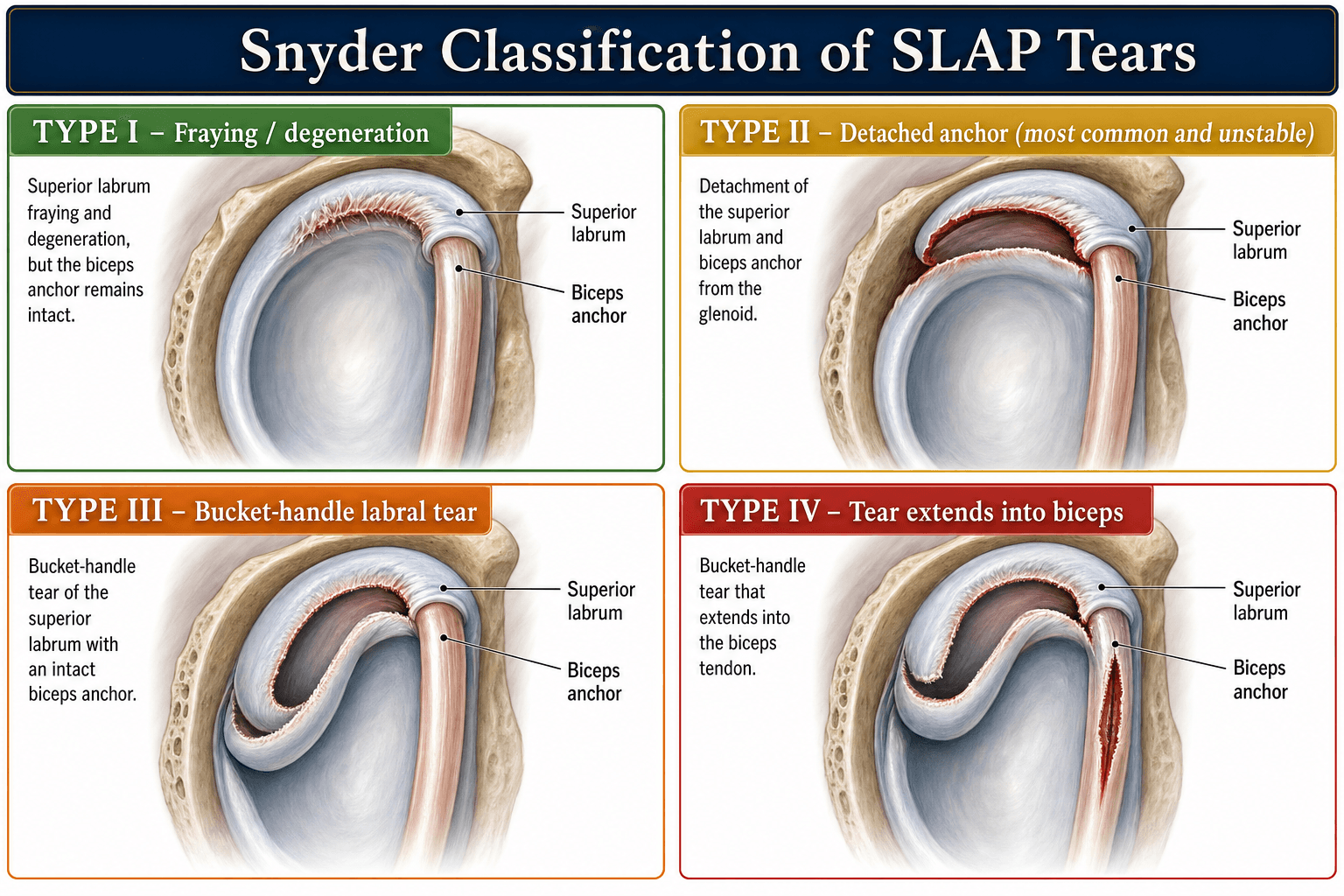
- Pathology
- Degenerative fraying of the superior labrum
- Biceps anchor
- Intact - leave it
- Pathology
- Biceps anchor detached from the glenoid
- Biceps anchor
- Detached - must be addressed; the clinically significant type
- Pathology
- Bucket-handle tear of the labrum
- Biceps anchor
- Intact - preserve it
- Pathology
- Bucket-handle tear extending into the LHB
- Biceps anchor
- Biceps tendon split
- Pathology
- Combined lesions
- Biceps anchor
- Variable - case dependent
Type II subtypes. The detachment can extend in either direction:
- IIA - anterior extension
- IIB - posterior extension, the thrower's lesion, from peel-back in late cocking
- IIC - both anterior and posterior extension
The extended types (Maffet et al.).
- Type V - SLAP with an anterior Bankart lesion
- Type VI - flap tear of the labrum with an unstable anchor
- Type VII - SLAP extending into the MGHL
Clinical Assessment
History. Pain is anterior or deep in the shoulder and comes with overhead activity. Clicking or popping is a common complaint, and some patients report weakness overhead. Establish the mechanism (compression, traction or throwing) and the sport and level played, which is critical in the overhead athlete.
Examination. The provocative tests:
- O'Brien (active compression) test - arm at 90° forward flexion, 10-15° adduction and thumb down (internal rotation); resist downward pressure, then repeat palm up (external rotation). Pain with internal rotation, relieved with external rotation, is positive. It is the most commonly used clinical test for SLAP
- Speed test - resisted forward flexion with the elbow extended
- Anterior slide - hand on hip, with a forward and upward force applied
- Biceps load test - biceps contraction in abduction and external rotation
SOAPSLAP Clinical Tests
Hook:SOAP up the shoulder tests for SLAP diagnosis!
The overhead athlete. Measure internal rotation against the other side: GIRD here is a deficit greater than 20°. Look too for posterior capsular tightness and scapular dyskinesis.
Associated pathology. SLAP tears are often associated with rotator cuff pathology, so assess the cuff thoroughly.
Differential diagnosis. Deep anterior shoulder pain with overhead activity overlaps with several conditions. No single SLAP test is reliable in isolation, so the differential must be worked through clinically and on imaging.
- Discriminating Features
- Pain over bicipital groove, point tender, Speed/Yergason positive
- Best Test
- Ultrasound or MRI of groove; diagnostic LHB block
- Discriminating Features
- Painful arc, weakness on cuff testing, night pain
- Best Test
- MRI; often coexists with SLAP
- Discriminating Features
- Posterior pain in late cocking, GIRD, throwers
- Best Test
- ABER MR arthrography; arthroscopy
- Discriminating Features
- Apprehension, prior dislocation, relocation positive
- Best Test
- MR arthrography (anteroinferior labrum)
- Discriminating Features
- Point tenderness over AC joint, cross-body pain
- Best Test
- Targeted exam, AC joint injection
- Discriminating Features
- No fraying, stable biceps anchor, asymptomatic
- Best Test
- Arthroscopic recognition - do NOT repair
Investigations
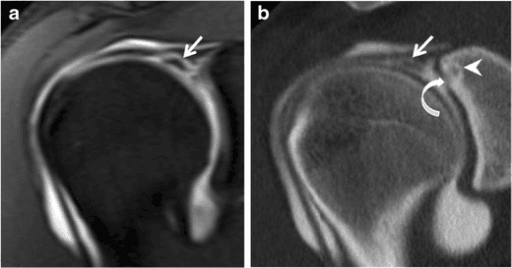
MR arthrography is the best available imaging test and is superior to standard MRI for labral pathology. Intra-articular gadolinium improves visualisation of the labrum, and the key finding is contrast extending between the superior labrum and the glenoid. An ABER sequence increases sensitivity for peel-back lesions.
Accuracy. A 2025 meta-analysis of 53 studies and 5,487 patients, with arthroscopy as the reference, pooled MRA for SLAP lesions at sensitivity 86% (95% CI 80-90) and specificity 91% (95% CI 83-96). When "superior labral tear" rather than a defined SLAP lesion is the target, sensitivity falls to 77% and specificity to 83%, with very wide confidence intervals.
Quote the specificity. The clinical problem on this topic is over-diagnosis. Superior labral signal change is common in asymptomatic shoulders and increases with age, so a positive scan in a middle-aged patient may be reporting a normal variant or an incidental degenerative finding rather than the cause of the pain. MRA supports a diagnosis already suspected clinically; it does not establish one on its own.
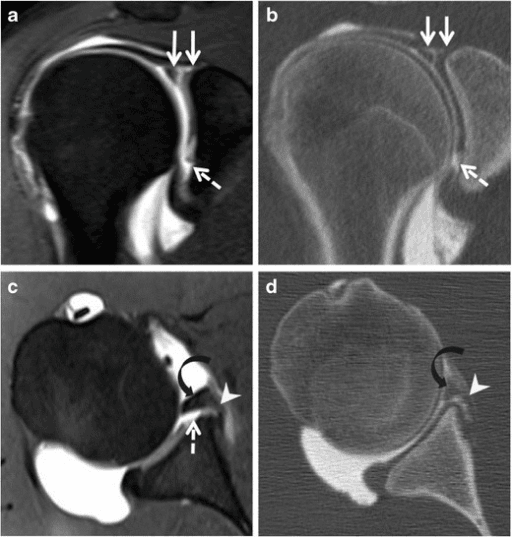
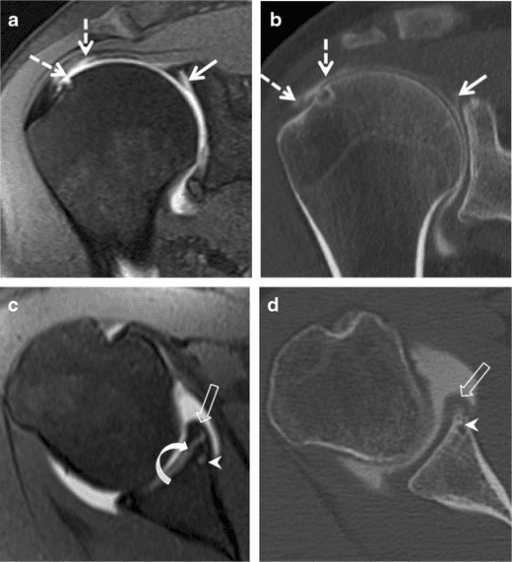
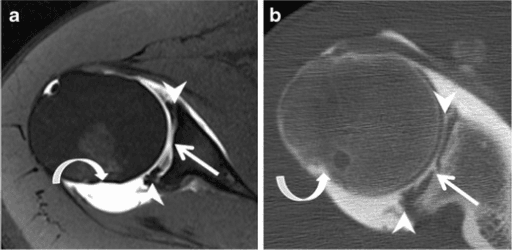
Standard MRI. Look for increased signal at the labral-glenoid junction. It is less sensitive than MR arthrography and may miss subtle Type II lesions, but it is useful for associated pathology: the rotator cuff and other labral tears.
Arthroscopy makes the definitive diagnosis and allows treatment at the same sitting. Probe the biceps anchor for stability, distinguish the normal variants, and perform the peel-back test: bring the arm into ABER and watch for the posterosuperior labrum lifting off the glenoid.
A positive peel-back test means a Type II SLAP, especially Type IIB in throwers.
Management Algorithm
Treatment by type. Each type has its own treatment:
- Type I - debride the frayed tissue. The anchor is intact and needs no repair
- Type II - the anchor is detached and must be addressed, by SLAP repair or a biceps procedure
- Type III - excise the displaced bucket-handle fragment and preserve the intact anchor
- Type IV - excise the bucket handle, with or without repair or a biceps procedure. With less than 30% biceps involvement, excision; with more than 30%, biceps tenotomy or tenodesis
- Types V-X - address each component
Type II: repair or a biceps procedure. Under 40, SLAP repair is reasonable in a motivated patient. Over 40, where degenerative labral change is common, a biceps procedure is preferred: tenotomy for the low-demand patient, tenodesis for the active one.
These favour repair:
- High-demand athlete wanting to preserve the biceps
- Isolated Type II without other pathology
- Motivated for prolonged rehabilitation
- Non-thrower
And these favour a biceps procedure:
- Concomitant biceps tendon pathology
- Failed conservative treatment
- Failed previous SLAP repair
- Throwing athlete, given the high failure rate of repair
- Low-demand patient
Weigh the patient's preferences and activity goals in the final choice.
Non-operative management. Suited to mild symptoms, the low-demand patient and one willing to modify activity. The programme is rest from aggravating activities, NSAIDs for pain, physiotherapy for rotator cuff and scapular strengthening, stretching for GIRD if present, and a gradual return to overhead activity.
Success is variable, and many high-demand patients progress to surgery.
Surgical Technique
Arthroscopic SLAP repair.
Surgical Steps
Confirm the SLAP type, perform the peel-back test and assess the quality of the biceps tendon.
Debride frayed tissue, decorticate the glenoid rim to bleeding bone and mobilise the labrum.
Place 1-3 suture anchors at the superior glenoid rim, at 10-11 o'clock and 12-1 o'clock.
Pass sutures through the labrum and tie them to restore the labral bumper and the stability of the biceps anchor.
Anchors belong on the glenoid rim at the articular margin. Too posterior risks the suprascapular nerve at the spinoglenoid notch; too medial on the glenoid neck gives inadequate purchase.
Biceps tenotomy. For the patient over 40 with low demands and a degenerative biceps. The LHB is simply cut at its origin, retracts into the groove and scars there. It is simple, recovery is fast and pain relief is excellent and reliable, with minimal functional deficit for most patients. The costs are a Popeye deformity, potential cramping and cosmetic concern.
Biceps tenodesis. For the patient over 40 who is active or cosmetically concerned. The LHB is released and fixed distally with an interference screw or anchor, either suprapectorally (arthroscopic) or subpectorally (open). It maintains the biceps length-tension relationship and makes a Popeye deformity much less likely. The subpectoral position is preferred: it removes all the biceps from the groove and reduces persistent pain.
Complications
- Procedure
- SLAP repair
- Incidence
- Common
- Management
- Aggressive PT, avoid in throwers
- Procedure
- SLAP repair
- Incidence
- Common in throwers
- Management
- Revision or biceps procedure
- Procedure
- Tenotomy
- Incidence
- Higher than after tenodesis (see Outcomes)
- Management
- Cosmetic - counsel preop
- Procedure
- Repair
- Incidence
- Rare
- Management
- Avoid superior/posterior anchor
- Procedure
- Any
- Incidence
- Variable
- Management
- Address all pathology, consider revision
Glenoid chondrolysis. A devastating, rapid loss of glenohumeral articular cartilage in a young patient after labral surgery, presenting as pain and progressive stiffness within months. Its recognised associations are intra-articular pain-pump catheters (especially bupivacaine), thermal or radiofrequency devices, and prominent or bioabsorbable (PLLA) anchors.
Prevention is the key message: avoid intra-articular pain pumps, minimise thermal energy, and seat anchors below the articular surface.
Hardware. Proud or backed-out anchors, and reactions to bioabsorbable anchors (synovitis, cyst formation), can damage cartilage or cause persistent pain.
Stiffness. Over-tightening the repair, especially with too many anchors, is a frequent cause of postoperative stiffness, which throwers tolerate poorly.
Postoperative Care
Rehabilitation Protocol (SLAP Repair)
Sling immobilisation. Elbow and hand exercises. Gentle pendulums only. No active biceps.
Wean the sling. Passive to active-assisted range of motion. Avoid the ABER position. No resisted biceps.
Full active range of motion. Isometric cuff strengthening. Begin light biceps activity.
Progressive resistance. Sport-specific training. No throwing until 6 months minimum.
After a biceps procedure. Recovery is faster than after repair. After tenotomy, a sling for 1-2 weeks and no restrictions by 6 weeks. After tenodesis, protect the biceps for 6 weeks and avoid heavy biceps loading for 3 months.
Outcomes and Prognosis
SLAP repair. Overall return to sport is around 70% (Thayaparan 2019), but pitchers return at only 57.5%. The 87.1% quoted for non-pitchers is their return-to-activity rate, which counts return to work as well as sport, so it is not a like-for-like comparison. Peel-back forces during late cocking stress the repair, and many surgeons now favour biceps tenodesis for throwers with a Type II SLAP. Outcomes are also poorer in older patients and workers' compensation cases, and postoperative stiffness is the most common concern.
Tenotomy versus tenodesis. Level I evidence (Belk 2021) shows equivalent pain and functional scores. The key difference is cosmetic: a Popeye deformity in 23.3% after tenotomy against 6.8% after tenodesis.
Tenodesis. Pain relief is comparable to tenotomy with a much lower deformity rate, so it is preferred in younger, active or cosmetically concerned patients. It is also an effective salvage for the failed SLAP repair (McCormick 2014, Boileau 2009).
Return to sport. After SLAP repair, 6-9 months for non-throwing sports; throwers may take 9-12 months, with variable return to their prior level. Biceps procedures often allow a faster return, at 3-4 months.
Guidelines, Registries & Global Practice
Global Epidemiology
SLAP lesions account for a small proportion of all shoulder arthroscopies (around 6% in large series; Erickson 2016) but are over-represented in overhead athletes - baseball pitchers, volleyball and tennis players, swimmers and javelin throwers. Peak presentation is in active adults roughly 20-50 years, with a male predominance reflecting sport and occupational exposure. Isolated SLAP tears are uncommon; most coexist with rotator cuff or biceps pathology, particularly over 40, where degenerative superior labral change is frequently incidental.
Guidelines & Society Positions (Side by Side)
- Emphasis
- Evidence-based, shared decision-making
- Practical Position
- No isolated SLAP CPG; supports trial of non-operative care and procedure choice by age/demand
- Emphasis
- Stepwise, rehab-first
- Practical Position
- Physiotherapy and activity modification before surgery; tenodesis favoured in older patients
- Emphasis
- Technique and classification fidelity
- Practical Position
- Distinguish true SLAP from normal variants; address concomitant pathology
- Emphasis
- Athlete-centred
- Practical Position
- Individualised approach in throwers; caution about repair outcomes
There is no dedicated randomised-trial-based clinical practice guideline specific to SLAP repair; recommendations are consensus- and cohort-driven. The consistent global theme across societies is a rehabilitation-first approach and a shift from labral repair toward biceps tenodesis, especially with increasing age.
Registry & Database Signals
- Surgeon practice databases (US): Both single-practice (Erickson 2016) and the nationwide ABOS examination database (Cvetanovich 2020) show a significant fall in SLAP repair volume and a rise in biceps tenodesis over the last decade, with tenodesis concentrated in patients over 35.
- SLAP repair has no implant-survivorship registry equivalent to arthroplasty (NJR / AOANJRR / SHAR); evidence comes from cohort series and the database trends above.
High- vs Limited-Resource Practice Variation
- MR arthrography and ABER sequences readily available
- Arthroscopic repair, tenodesis and tenotomy all offered
- Structured sports-physiotherapy and return-to-throwing programmes
- Procedure choice driven by age, sport and patient preference
- Diagnosis often clinical plus standard MRI or even plain films to exclude bony pathology
- Biceps tenotomy favoured - cheap, fast, no implants, minimal rehab burden
- Repair reserved for young high-demand athletes where anchors and rehab are accessible
- Greater reliance on activity modification and analgesia
SLAP tears are a common viva topic. Know the Snyder classification (especially Type II), clinical tests (O-Brien, peel-back), and the global trend toward biceps tenotomy/tenodesis. Be prepared to discuss treatment in overhead athletes and why outcomes are variable.
Controversies and Areas of Uncertainty
Repair or primary tenodesis in the young. The biggest unresolved question. Registry data show a clear practice shift to tenodesis, and Boileau (2009) reported far better sport return after tenodesis, but his tenodesis group was older, confounding the comparison. Whether a motivated patient under 30 with an isolated Type II tear does better with repair, which preserves native anatomy, or with primary tenodesis remains unsettled.
Does the anchor matter? The biomechanical role of the biceps anchor in glenohumeral stability is debated. If its contribution is minor, sacrificing it by tenotomy or tenodesis carries little functional cost, which would favour the move away from repair. Cadaveric and clinical data remain conflicting.
Over-diagnosis. A meniscoid attachment, like the superior labral signal described under Investigations, is common in asymptomatic shoulders and increases with age. A "SLAP" seen on imaging or at arthroscopy is not necessarily the pain generator, and over-treatment of normal variants and age-related change is a real risk.
The throwing athlete. No approach reliably returns elite pitchers to their prior performance. Whether to repair, add a posterior capsular release for GIRD, or proceed directly to tenodesis is individualised and controversial, and honest counselling about an uncertain return is essential.
MCQ Practice Points
Q: Which SLAP type is the most clinically significant? A: Type II - biceps anchor is detached from the glenoid. This requires surgical treatment (repair or biceps procedure). Types I and III can usually be debrided.
Q: How is a Type I SLAP treated? A: Debridement only. Type I is degenerative fraying with intact biceps anchor. No repair is needed - simply debride the frayed tissue.
Q: What does a positive peel-back test indicate? A: Type II SLAP tear (especially Type IIB). In ABER position, the biceps vector becomes vertical and peels the posterosuperior labrum off the glenoid.
Q: How is the O-Brien test performed? A: Arm at 90° forward flexion, 10-15° adduction, thumb down (IR). Resist downward pressure. Repeat with palm up (ER). Positive: pain with IR, relieved with ER.
Q: What is the sublabral foramen? A: Normal anatomical variant - detachment of anterosuperior labrum at 1-3 o-clock position. Should NOT be repaired. Distinguished from SLAP by stable biceps anchor.
Q: Why is SLAP repair less recommended in patients over 40? A: Degenerative labral and biceps changes reduce healing potential, and registry data (Cvetanovich 2020) show tenodesis is preferentially performed in patients over 35. Biceps tenotomy or tenodesis gives more reliable pain relief in this group.
Exam Viva Scenarios
Practise clinical reasoning and management decisions out loud
“A 28-year-old recreational volleyball player presents with right shoulder pain during overhead serving. O-Brien test is positive. MR arthrography shows a Type II SLAP lesion with intact biceps tendon. How would you manage this?”
“A 35-year-old had SLAP repair 18 months ago but has persistent anterior shoulder pain with overhead activities. MRI shows the repair appears intact. What is your approach?”
“A 22-year-old elite baseball pitcher has posterior shoulder pain during the cocking phase of throwing. MR arthrography shows a posterosuperior Type IIB SLAP tear. Examination also reveals 25° GIRD. What is your treatment plan?”
Classification (Snyder I-IV)
- Type I: Fraying - debride only
- Type II: Biceps anchor detached - MOST IMPORTANT
- Type III: Bucket handle - excise, anchor intact
- Type IV: Bucket into biceps - excise +/- tenotomy
Clinical Tests (SOAP)
- Speed test: Resisted forward flexion
- O-Brien test: Forward flex/adduct/IR vs ER
- Anterior slide: Hand on hip, force applied
- Peel-back: Arthroscopic ABER position
Type II Decision Factors
- Under 40: Consider SLAP repair
- Over 40: Biceps tenotomy or tenodesis
- Throwing athlete: High failure rate - consider tenodesis
- Degenerative biceps: Tenotomy or tenodesis
Imaging
- MR arthrography: Best imaging test (arthroscopy definitive)
- Look for contrast at labral-glenoid junction
- ABER sequence increases sensitivity
- Peel-back test confirms at arthroscopy
Outcomes
- SLAP repair: ~70% return to sport overall
- Pitchers return to sport at only ~58% (the ~87% for non-pitchers is return to activity)
- Tenotomy: Popeye deformity ~23% vs ~7% tenodesis
- Tenodesis: Equivalent pain/function, less deformity
Normal Variants (Do NOT repair)
- Sublabral foramen (1-3 o-clock)
- Buford complex (cord-like MGHL)
- Meniscoid labrum (loose attachment)
- Distinguish by stable biceps anchor
Evidence Base and Key Studies
Original Description of SLAP Lesions (Snyder Classification)
- Retrospective review identifying 27 SLAP lesions among more than 700 shoulder arthroscopies
- Defined the four original types (I-IV); injury runs posterior to anterior including the biceps anchor
- Most common mechanism was a compression force from a fall onto an outstretched arm
- No preoperative imaging test reliably defined the lesion - diagnosis was arthroscopic
Declining SLAP Repair, Rising Biceps Tenodesis
- 619 SLAP repairs among 9,765 shoulder arthroscopies (6.3%) across four surgeons, 2004-2014; mean age 31.2 +/- 11.9 years
- Percentage of SLAP repairs fell significantly over the decade (P less than .001)
- Number and percentage of biceps tenodeses rose significantly over the same period
- Most SLAP repairs were performed for Type II tears; mean patient age fell over time
ABOS Database - Nationwide Decline in SLAP Repair
- 9,908 cases from the American Board of Orthopaedic Surgery part-II examination database, 2012-2017
- Significant decline in SLAP repair rate over the study period (P less than .001)
- Patients receiving biceps tenodesis were significantly more likely to be over 35 years
- SLAP repair remained concentrated in younger patients