Precarious Blood Supply | Hawkins Classification | AVN Risk | Urgent Reduction
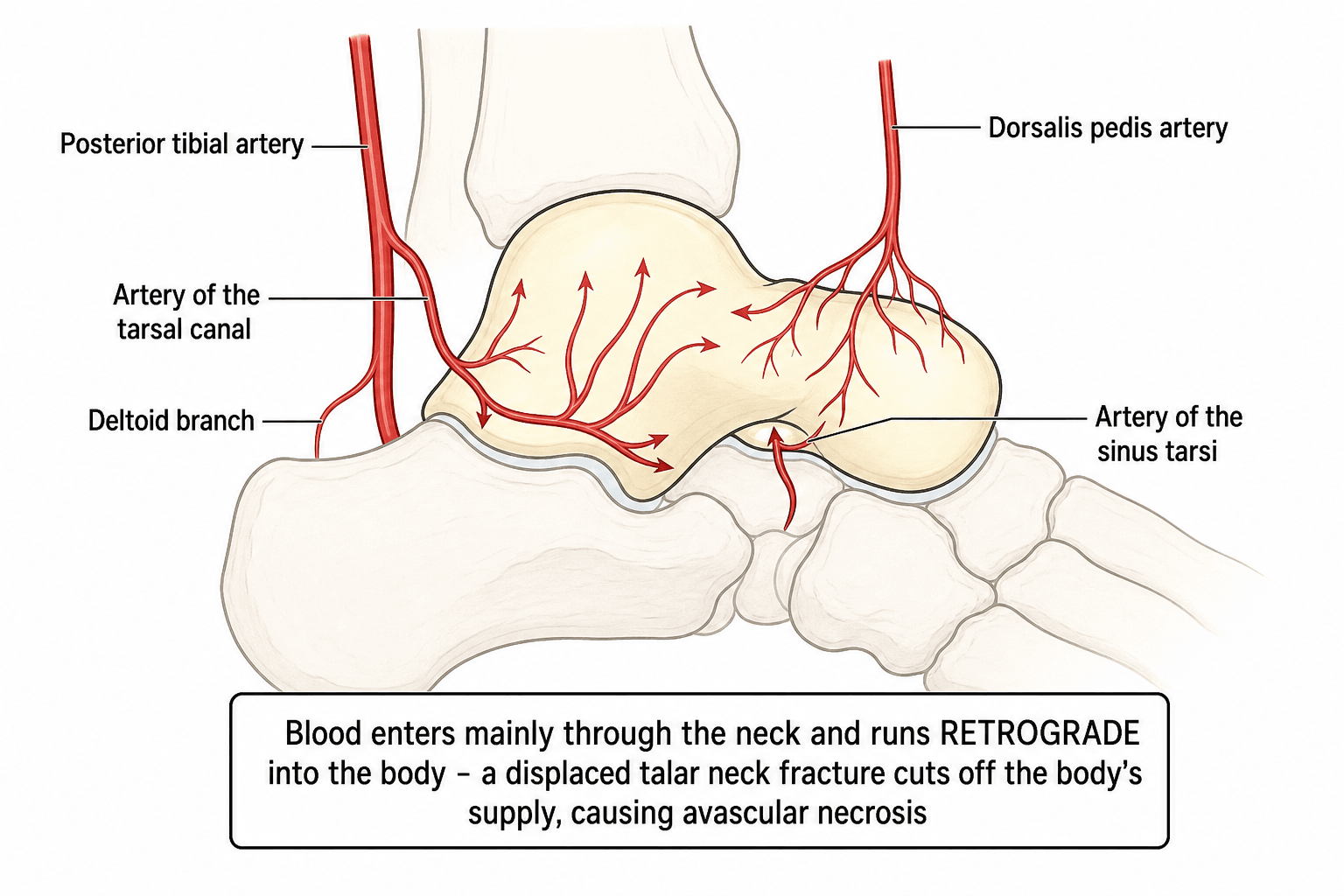
- Blood supply enters inferiorly at the neck via the arteries of the tarsal canal and sinus tarsi and runs retrograde into the body - displaced fractures disrupt this
- Hawkins sign at 6-8 weeks (subchondral lucency) indicates revascularization occurring, AVN unlikely
- Absence of Hawkins sign does NOT confirm AVN - need longer follow-up and MRI
- Dislocated talus (Hawkins II-IV) needs urgent reduction for skin/neurovascular safety; AVN is driven by initial displacement more than time-to-fixation
- Malunion causes hindfoot varus and medial ankle arthritis from altered biomechanics
- “Osteonecrosis by Hawkins type, from MODERN operatively-treated series: type I low (none in Vallier's 2014 series, but about 10% pooled in the Dodd and Lefaivre meta-analysis); type II 25-39%; type III 41-64%; type IV highest but numbers are tiny. The classic 80-100% for type III comes from older series and overstates it - and 37-44% of those who develop osteonecrosis revascularise WITHOUT dome collapse
- “Canale view: foot maximally plantarflexed and pronated 15°, beam 75° from horizontal - shows talar neck en face
- “Dual incisions (anteromedial and anterolateral) for complex talar neck fractures
- “Body fractures treated based on displacement and pattern - often need CT for operative planning
Overview and Epidemiology
The talus is the second most commonly fractured tarsal bone after the calcaneus, and talus fractures account for about 1-2% of all fractures, yet outcomes are often worse because of the blood supply. The bone is unique: 60% of its surface is articular cartilage, it has no muscular attachments, and its blood supply is precarious. That combination makes talus fractures challenging, with a high AVN risk, difficult surgical access and poor outcomes.
Mechanism. Forced dorsiflexion drives the talar neck against the anterior tibial plafond. Anderson's original description was in aviators, the rudder bar injury.
- High-energy trauma - motor vehicle accidents and falls from height, the most common cause of displaced fractures
- Sports - basketball, football and snowboarding, the last giving the lateral process "snowboarder's" fracture
Where. The neck is the commonest fracture site, about 50% of talus fractures. The body accounts for 20-30%.
Anatomy and Blood Supply
The bone. The talus has three zones:
- Head - articulates with the navicular at the talonavicular joint; supplied by branches of the dorsalis pedis
- Neck - the watershed zone of the blood supply and the most vulnerable area; the Hawkins classification applies here
- Body - articulates with the tibia at the ankle and the calcaneus at the subtalar joint; its superior surface, the dome, is weight-bearing
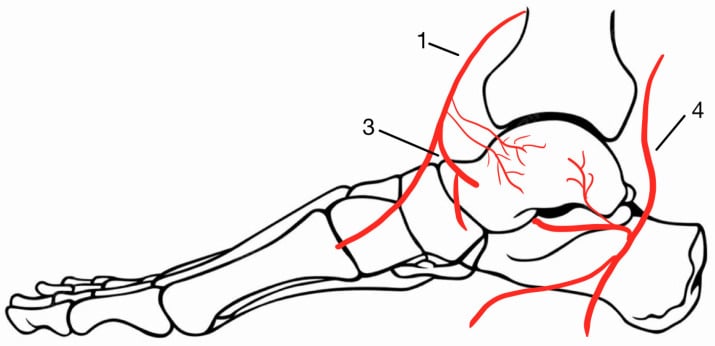
The blood supply. Cartilage covers so much of the surface that vessels have little room to enter, and with no muscular attachments the bone is entirely dependent on a ligamentous blood supply. The vessels come in through a narrow non-articular corridor:
- Artery of the tarsal canal - from the posterior tibial artery, entering through the tarsal canal; the dominant supply to the body (70-80%), and the vessel disrupted in Hawkins II-IV
- Artery of the sinus tarsi - from the dorsalis pedis (anterior tibial artery), forming an anastomosis between the anterior tibial and peroneal arteries; supplies the lateral body and anastomoses with the artery of the tarsal canal
- Deltoid branch - from the posterior tibial artery to the medial body; a minor and inconsistent contributor, yet often the last remaining supply, so it must be protected during approaches and reduction
- Superior neck vessels - from the dorsalis pedis to the neck and head; preserved in most neck fractures
Why a neck fracture threatens the body. The dominant supply enters inferiorly at the neck and runs retrograde, backwards, into the body. A displaced neck fracture therefore cuts the body off from its inflow. Stripping the neck or injuring the remaining medial branches at surgery compounds the vascular damage the displacement has already done.
Classification Systems
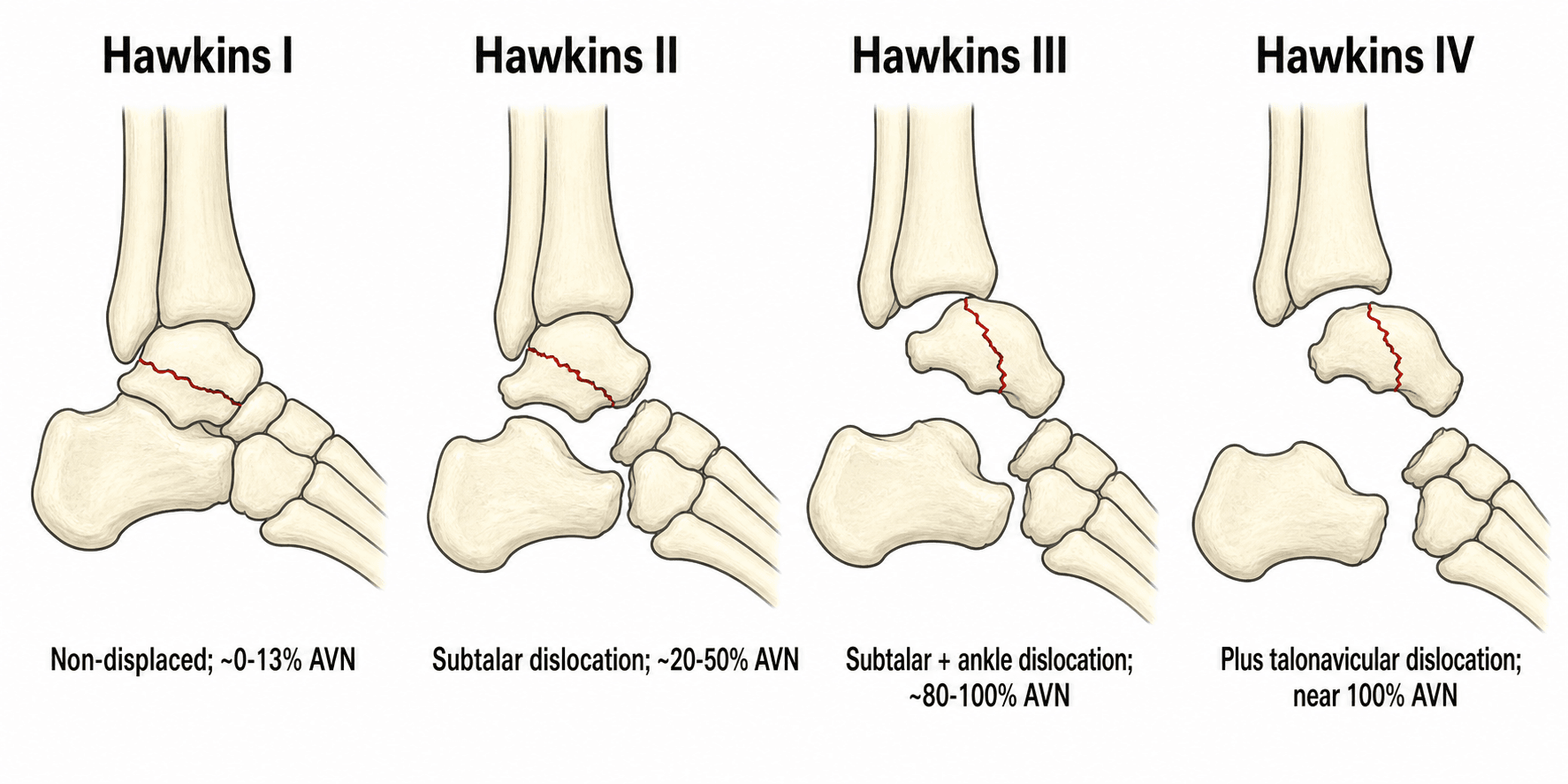
Hawkins (talar neck). The most important classification for talus fractures. It grades the injury by the number of joints dislocated, not simply by fracture displacement, because each additional dislocation severs more of the retinacular vessels. Canale and Kelly added type IV.
- Fracture Pattern
- Vertical neck fracture, non-displaced
- Dislocation
- None
- Osteonecrosis (modern series)
- Low: none in Vallier 2014; about 10% pooled (Dodd and Lefaivre meta-analysis)
- Treatment Urgency
- Semi-urgent (24-48h acceptable)
- Fracture Pattern
- Vertical neck fracture, displaced
- Dislocation
- Subtalar joint only
- Osteonecrosis (modern series)
- 25-39%
- Treatment Urgency
- Urgent (6-12h reduction goal)
- Fracture Pattern
- Vertical neck fracture, displaced
- Dislocation
- Subtalar AND ankle joints
- Osteonecrosis (modern series)
- 41-64%
- Treatment Urgency
- EMERGENCY (immediate reduction)
- Fracture Pattern
- Vertical neck fracture, displaced
- Dislocation
- Subtalar, ankle, AND talonavicular
- Osteonecrosis (modern series)
- Highest, but series contain only a handful of cases
- Treatment Urgency
- EMERGENCY (immediate reduction)
Reading the numbers. Osteonecrosis is driven by subtalar dislocation; in one modern series it never occurred without it. [8] It is not zero in type I, though: a meta-analysis of talar neck series pooled the type I rate at 9.8%. [10] The classic 80-100% for type III comes from older series and overstates the risk, and 37-44% of those who develop osteonecrosis revascularise without dome collapse.
The types in practice. Type II is the most common. Type IV is an extremely high-energy injury, so check for compartment syndrome.
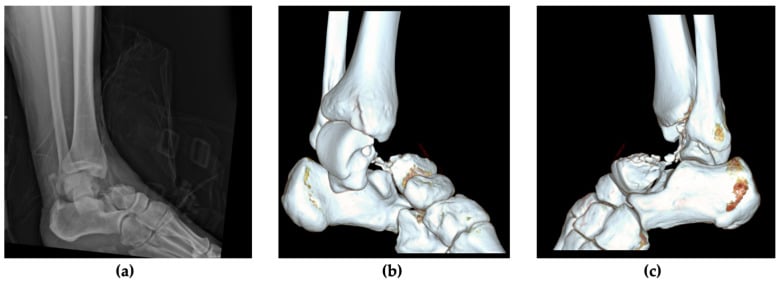
Talar body fractures. These are classified by the orientation of the fracture plane.
- Fracture Plane
- Divides anterior from posterior
- Typical Mechanism
- Axial loading with ankle in dorsiflexion
- Fracture Plane
- Divides medial from lateral
- Typical Mechanism
- Axial loading with inversion/eversion
- Fracture Plane
- Osteochondral or dome fracture
- Typical Mechanism
- Shear force to talar dome
- Fracture Plane
- Multiple fragments
- Typical Mechanism
- High-energy axial load
Lateral process fracture. The snowboarder's fracture, from dorsiflexion with inversion or eversion. It is often missed initially: look carefully on the mortise view, and obtain CT if it is suspected clinically but the radiograph is negative. Non-displaced fractures are treated conservatively, and displaced fractures with a step-off greater than 2mm need ORIF. A missed or malunited fracture leads to subtalar arthritis.
Talar head fracture. A rare injury, usually part of complex midfoot trauma, from an axial load through the midfoot in plantarflexion. The cancellous head is often comminuted, and a navicular fracture or Lisfranc injury commonly accompanies it. A displaced head fracture is fixed if it is reconstructible; otherwise consider talonavicular fusion. Both of these patterns need a high index of suspicion and often CT for diagnosis.
Clinical Assessment
History. Establish the energy of the injury first: high-energy (motor vehicle accident, fall from height) or low-energy (sports). Then:
- Pain location - ankle, hindfoot or diffuse
- Weight-bearing - complete inability suggests a significant injury
- Time of injury - critical for planning urgent reduction
- Associated injuries - always screen for polytrauma after a high-energy mechanism
- Neurovascular symptoms - numbness, tingling, coldness
Examination. Look, feel and move, then the neurovascular status and the compartments:
- Look - swelling, deformity, skin integrity (open fracture?) and the compartments
- Feel - bony tenderness (the talar neck is palpable anteromedially); dorsalis pedis and posterior tibial pulses
- Move - passive range of motion is painful, with crepitus on manipulation
- Neurovascular - a mandatory full assessment, documenting the tibial nerve, deep peroneal nerve and sensation
- Compartments - palpate all 9 compartments of the foot after a high-energy mechanism
The talus has a thin soft tissue envelope, especially anteriorly and medially. High-energy displaced talar neck fractures carry a substantial open-fracture rate (around 30% in some level-1 trauma series). [8] Any skin breach near the ankle or hindfoot in the setting of a talus fracture should be assumed to communicate with the fracture until proven otherwise. Open talus fractures carry markedly higher infection and osteonecrosis risk and require urgent surgical debridement and stabilisation. [4]
Investigations
Radiographs. A minimum of three views, with the Canale view added when a neck fracture is suspected:
- Ankle AP and lateral - the talar body, the dome and the relationship to the ankle joint
- Ankle mortise - best for lateral process fractures and talar dome lesions
- Foot AP and lateral - the talar head and the talonavicular joint
- Canale view - the talar neck en face, without overlap
Look for the fracture line, displacement, dislocation of the subtalar, ankle or talonavicular joints, and associated fractures of the calcaneus or malleoli.
Patient positioning: Foot maximally plantarflexed and pronated 15 degrees. X-ray beam angled 75 degrees from horizontal (directed caudad). This view projects the talar neck without overlap from the ankle joint, allowing assessment of displacement and fracture plane. Essential for preoperative planning of talar neck fractures.
CT. Usually required, and indicated for all displaced talus fractures, for body fractures and for preoperative planning. Even a seemingly minor injury warrants CT, because subtle displacement changes both the Hawkins grade and the operative plan. Radiographs usually suffice to classify a neck fracture, but body fractures almost always need CT: the fracture plane, fragment size and comminution are difficult to judge on plain films. Where an emergency reduction is needed, CT follows it and precedes definitive ORIF. It shows:
- The fracture plane (coronal or sagittal) and fragment size
- The degree of comminution and column length
- Occult fracture lines extending into the neck, head or other adjacent zones
- Subtalar and ankle joint congruity, and any intra-articular step
- Associated process fractures that plain films miss
- The trajectory for screws, and so the approach and fixation strategy
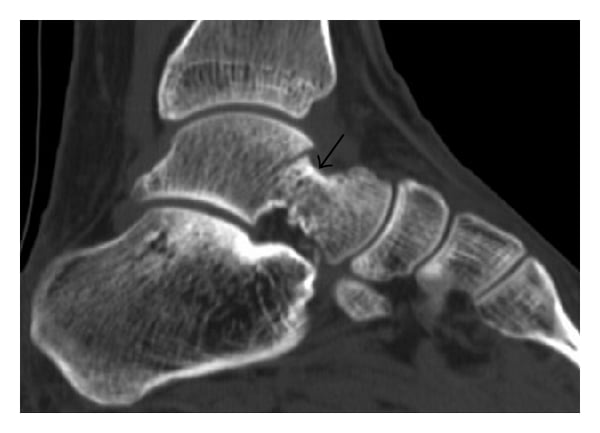
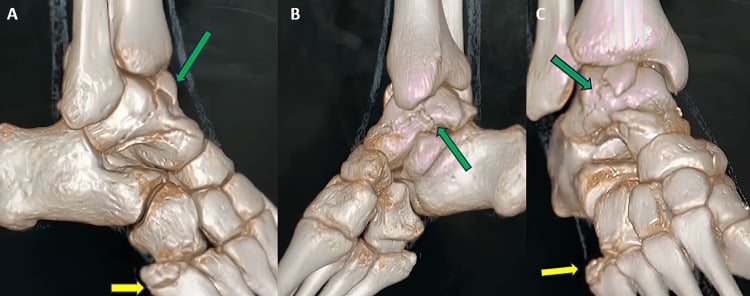
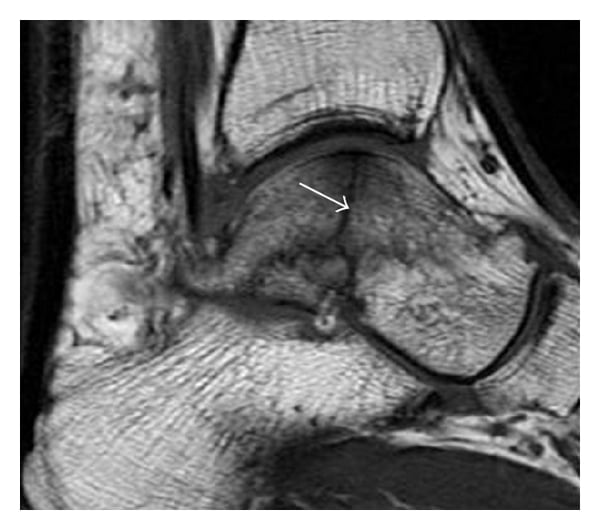
MRI. The most sensitive test for a radiographically occult or stress fracture of the talus. Later in the course it is the investigation of choice for early avascular necrosis, covered with the rest of osteonecrosis surveillance under Complications.
Management Algorithm
A truly non-displaced neck fracture can be held in a cast; a displaced one is reduced urgently and fixed. The urgency attaches to the dislocation, which threatens the skin and the neurovascular structures. Body fractures are managed by their pattern and displacement.
Why a cast is acceptable. Osteonecrosis is uncommon without subtalar dislocation, because the blood supply is largely preserved (pooled type I rate about 10%), so a truly non-displaced fracture can be treated conservatively when follow-up is reliable. Screw fixation is the alternative, and it can often wait 24-48 hours for the swelling to settle. The goal is to maintain alignment while the fracture heals; secondary displacement can occur, so close monitoring is essential.
Treatment Protocol
- Non-weight-bearing in a below-knee cast or boot
- Repeat radiographs at 1 week to confirm no displacement
- Admit if the patient is unreliable or compliance is a concern
- Continue non-weight-bearing if bridging callus is not visible
- Weekly radiographs for the first month, then every 2 weeks
- At 6 weeks, check for the Hawkins sign (reassuring if present)
- Progressive weight-bearing if radiographs show healing
- Ankle and subtalar range-of-motion exercises begin at 8 weeks
- Return to normal activities by 12 weeks if healed
Any displacement on follow-up radiographs is an indication for ORIF, done immediately. Even 2mm of displacement can lead to malunion and altered hindfoot biomechanics. Do not persist with conservative treatment once displacement occurs - the window for optimal reduction is narrow.
Open and extruded tali. For selected open extrusion injuries, meticulous debridement, reimplantation and staged stabilisation may preserve length and joint relationships, accepting a substantial risk of infection, osteonecrosis and arthritis.
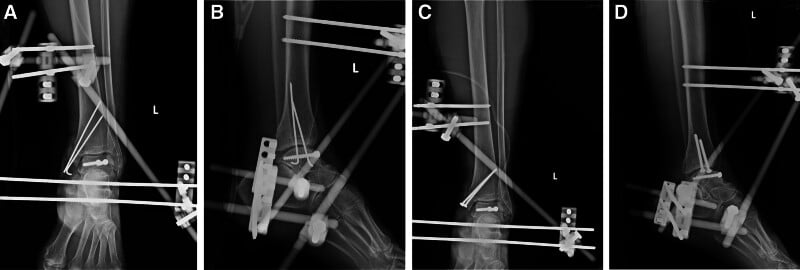
Surgical Technique
Position. Supine on a radiolucent table.
- Head secured on a donut or headrest; arms tucked or on arm boards
- Contralateral limb extended or frog-legged to allow C-arm access
- Operative leg with the hip externally rotated and the knee slightly flexed
- Padding for the sacrum and contralateral heel, and no pressure on the contralateral fibular head (peroneal nerve)
- Thigh tourniquet, sterile or non-sterile and covered by the drape, inflated to 300mmHg (or 100mmHg over systolic) for clear visualisation, and deflated after fixation to check perfusion
- Drape the entire leg from mid-thigh to toes, with the foot free for manipulation during reduction
- C-arm from the opposite side of the table; confirm AP, lateral and mortise views are obtainable before prep, and take them to confirm the starting position
Equipment.
- Implants - 3.5mm or 4.0mm partially threaded cannulated screws
- Guidewires - 2.0mm K-wires for temporary fixation and screw placement
- Drill - cannulated bit matching the screw size
- Reduction tools - pointed reduction forceps, bone hook
- Small fragment set - for a plate if there is comminution
Consent. Cover osteonecrosis (which may require fusion later), infection, nonunion (which may need bone grafting and revision), varus malunion leading to medial ankle arthritis, post-traumatic arthritis of the ankle and subtalar joints, wound complications, including skin necrosis, from the thin soft tissue envelope, and nerve injury: the sural nerve with the anterolateral approach and the saphenous nerve with the anteromedial. The rates are in the Complications section.
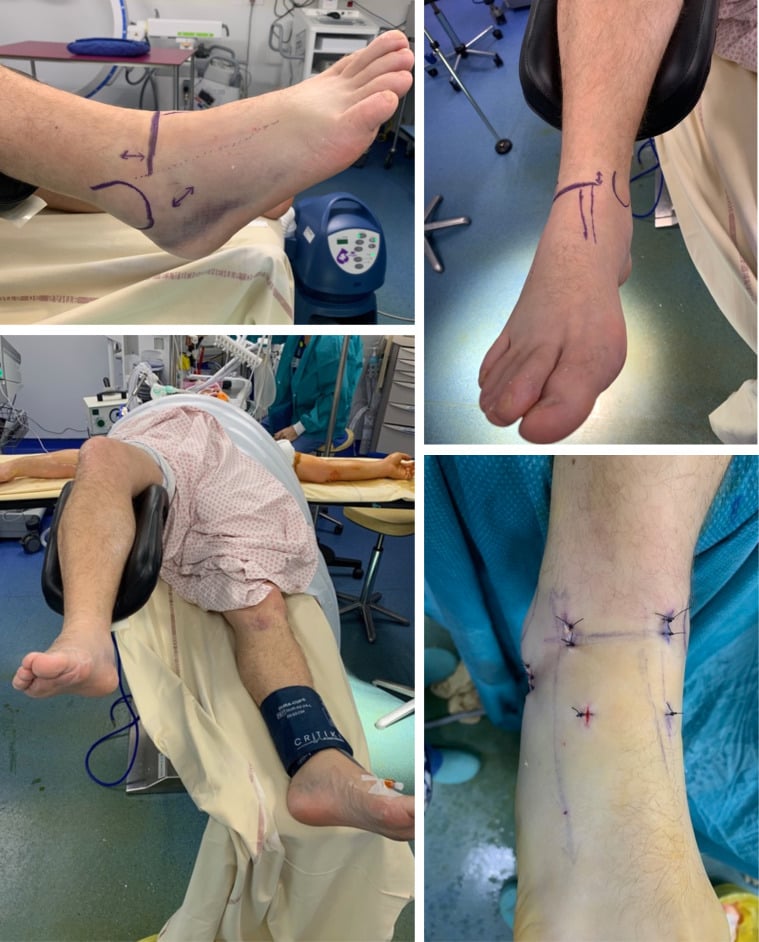
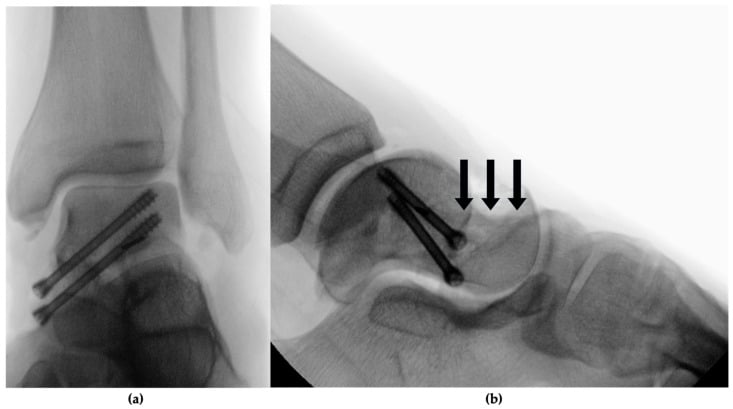
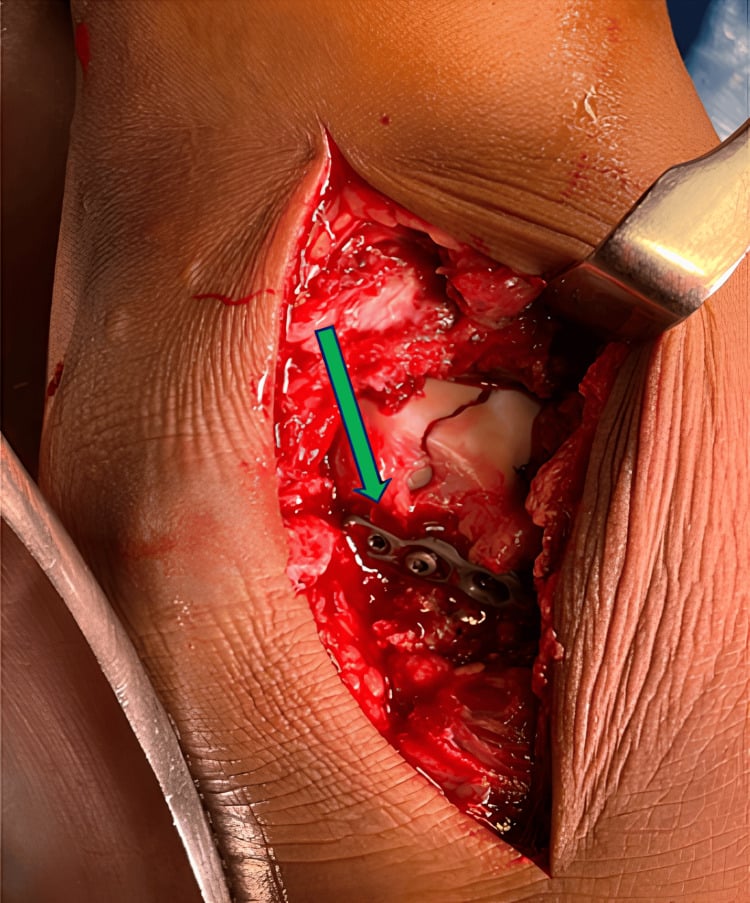
Complications
- Incidence
- By Hawkins type (see Classification)
- Risk Factors
- Displaced fracture with subtalar dislocation, comminution, open fracture
- Prevention and Management
- Driven by the initial displacement rather than time to fixation. MANAGEMENT: Protected weight-bearing, monitor with X-ray and MRI, consider fusion if collapse
- Incidence
- 15-20% if not anatomically reduced
- Risk Factors
- Inadequate reduction, comminution, poor fixation
- Prevention and Management
- PREVENTION: Anatomic reduction mandatory, check fluoroscopy rigorously. MANAGEMENT: Corrective osteotomy vs fusion if symptomatic
- Incidence
- Neck: 5-10%, Body: 15-25%
- Risk Factors
- Poor blood supply, malreduction, smoking, diabetes
- Prevention and Management
- MANAGEMENT: Revision ORIF with bone grafting (iliac crest or distal tibia), consider fusion if bone quality poor
- Incidence
- Ankle: 50-70%, Subtalar: 60-90% at 5 years; talonavicular also affected
- Risk Factors
- Articular surface damage, malunion, AVN
- Prevention and Management
- PREVENTION: Anatomic reduction. MANAGEMENT: Activity modification, bracing, eventual fusion (ankle, subtalar, or triple arthrodesis)
- Incidence
- 10-15% of talar neck ORIF (dehiscence, necrosis)
- Risk Factors
- Thin soft tissue, dual incisions, smoking, diabetes
- Prevention and Management
- PREVENTION: Gentle soft tissue handling, avoid tension. MANAGEMENT: Early plastic surgery consult, possible flap coverage
- Incidence
- Superficial 5-10%; deep 2-5% in closed fractures; open fractures 25%
- Risk Factors
- Open fracture, contamination, diabetes, smoking
- Prevention and Management
- PREVENTION: Early debridement for open fractures, IV antibiotics. MANAGEMENT: Debridement, hardware retention if stable, long-term antibiotics
Osteonecrosis declares itself slowly. It develops over months to years and can declare itself up to 2 years after injury. It is followed with the Hawkins sign on radiographs and with MRI.
The Hawkins sign. A subchondral lucency in the talar dome on the ankle mortise view at 6-8 weeks, produced by revascularisation and resorption. Its presence means revascularisation is occurring and AVN is unlikely (90% predictive value). Its absence does not confirm AVN: revascularisation may simply be delayed, or AVN may be real.
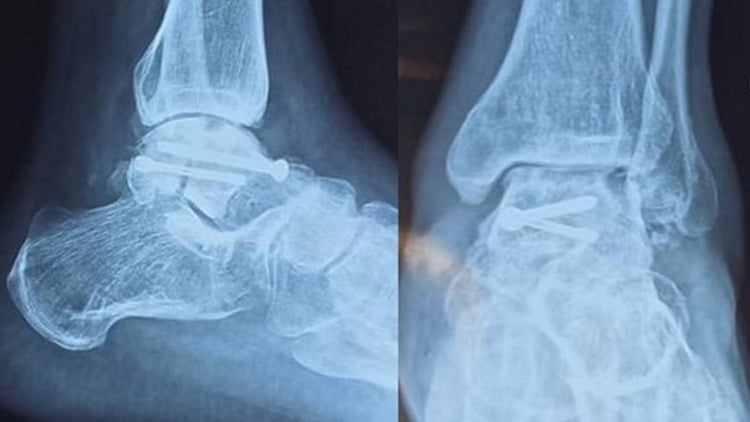
MRI. The gold standard for diagnosing AVN, showing bone marrow oedema and signal change consistent with avascular bone before radiographic increased density appears. Obtain it, typically at 3-6 months, when the Hawkins sign is absent and the patient is symptomatic, or when there is other clinical concern.
Reading an abnormal MRI. Early MRI changes do not predict the final outcome: some patients with changes do well, and some collapse despite revascularisation. Early signal change does not by itself mandate salvage, so correlate it with symptoms and serial morphology. Even with MRI evidence of AVN, some patients remain asymptomatic and do not require intervention.
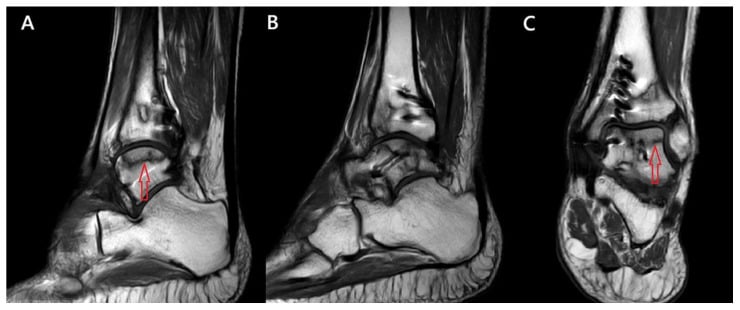
Salvage of Talar AVN and Collapse
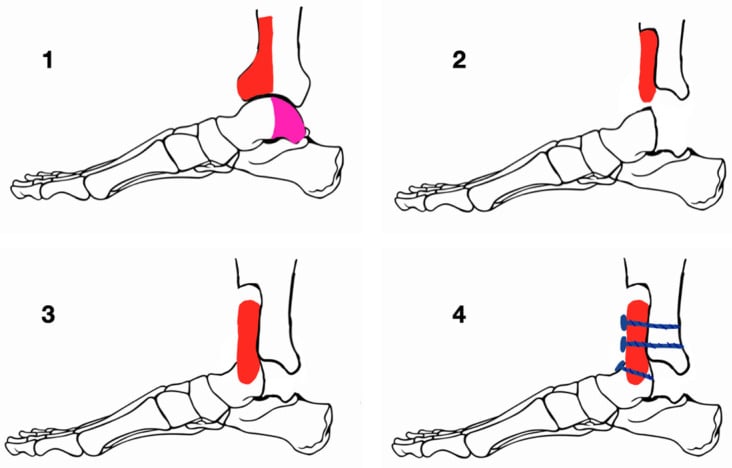
Established AVN is managed by stage. Before collapse the talus is observed, because many cases revascularise; once the avascular body collapses and is symptomatic, arthrodesis is the reliable salvage, and the fusion chosen depends on what remains viable.
- Option
- Observation with serial radiographs/MRI; protected weight-bearing
- Key point
- Many revascularise without collapse; prolonged offloading is NOT indicated for partial AVN and does not reliably prevent collapse
- Option
- Core decompression (and/or vascularised bone graft) as an adjunct
- Key point
- Borrowed from hip AVN; limited talar evidence - not standard and does not reliably prevent collapse
- Option
- Blair fusion: tibiotalar arthrodesis with an anterior sliding cortical graft from the distal tibia into the preserved talar neck/head
- Key point
- Preserves hindfoot height and some subtalar motion
- Option
- Tibiotalocalcaneal fusion (retrograde nail or plate; bulk graft to restore height)
- Key point
- Salvages a plantigrade foot when both joints are gone
- Option
- Tibiocalcaneal fusion was satisfactory in Canale's series but shortens the limb; talectomy alone did poorly and is avoided
- Key point
- Choose limb-shortening salvage only when reconstruction or a Blair fusion is not feasible
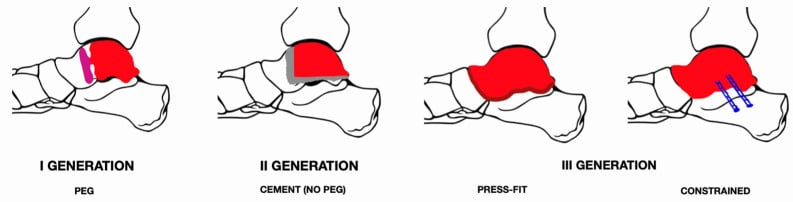
Total talus replacement. Specialist reconstruction with limited long-term evidence.
Postoperative Care and Rehabilitation
The standard protocol for most talar neck fractures treated with ORIF (Hawkins I-II).
Rehabilitation Timeline
- Non-weight-bearing with crutches, below-knee posterior splint in neutral dorsiflexion
- Elevation above heart level as much as possible
- DVT prophylaxis - aspirin 325mg daily or LMWH (discuss with patient)
- Wound check at 10-14 days, remove sutures
- Radiographs at the first visit to confirm maintained reduction
- Below-knee cast or CAM boot (removable for hygiene), still non-weight-bearing
- Ankle pumps - gentle plantarflexion and dorsiflexion in the boot, no inversion or eversion
- Radiographs at 4 and 6 weeks to assess healing
- Hawkins sign assessed at 6-8 weeks
- Partial weight-bearing from 6 weeks if radiographs show bridging callus, progressing to full by 10-12 weeks if healed
- Boot until 10-12 weeks
- Physical therapy - ankle plantarflexion/dorsiflexion and subtalar inversion/eversion range of motion
- Strengthening - Theraband exercises, toe raises, balance training
- Regular shoes with a supportive insert
- Jogging from 4-5 months if range of motion and strength are full
- Sports at 6 months if cleared by the surgeon
- Radiographs every 3 months for the first year to monitor for AVN
Varus Malunion: Recognition and Correction
Varus is the commonest malunion after a talar neck fracture, and a classic viva endpoint: the examiner wants to hear how it arises, what it does to the foot, and how it is corrected.
How it arises. It usually comes from under-appreciated dorsomedial neck comminution: the neck heals short and in varus, often with dorsiflexion and medial deviation, and over-compressing a lag screw across the medial comminution frequently makes it worse.
What it does. The result is a stiff, in-toed foot: hindfoot varus with forefoot adduction and supination, weight-bearing and callus along the lateral border, the subtalar joint locked and eversion lost. It drives medial peritalar and ankle arthritis.
Recognising it. Clinically, hindfoot varus with forefoot adduction. The Canale view and CT show the medial neck shortening, varus and rotation; always compare with the contralateral side.
Preventing it. Read the medial comminution, and hold length with a medial plate and/or bone graft rather than crushing it with compression, confirming alignment on the Canale view.
Correcting it. A symptomatic varus malunion with preserved joints is corrected by a talar neck osteotomy that recreates the original fracture plane. Once the peritalar joints are arthritic, a corrective arthrodesis such as a triple is preferred.
Outcomes and Prognosis
Guarded, even when it goes well. Even with perfect reduction and fixation, 50-90% of patients develop post-traumatic arthritis of the ankle or subtalar joints within five years. After a displaced neck fracture, secondary reconstructive surgery, usually fusion, rises from about a quarter of patients at one year to roughly half at ten. ORIF aims to delay the onset of arthritis and potentially avoid or delay fusion; it does not prevent arthritis, and patients should be counselled with realistic expectations.
- Good Prognosis
- Type I (non-displaced)
- Poor Prognosis
- Type III-IV (triple dislocation)
- Good Prognosis
- Neck fracture, isolated
- Poor Prognosis
- Body fracture or neck+body combined
- Good Prognosis
- Closed fracture
- Poor Prognosis
- Open fracture (infection + AVN risk)
- Good Prognosis
- Anatomic (under 1mm step-off)
- Poor Prognosis
- Malreduced (varus or step-off over 2mm)
- Good Prognosis
- No AVN or AVN without collapse
- Poor Prognosis
- AVN with talar dome collapse
Guidelines, Registries & Global Practice
- Rare injury: talar fractures account for only a small fraction of fractures (roughly 1% of all fractures and the second most common tarsal fracture after the calcaneus) [9]
- High-energy mechanism worldwide: motor-vehicle crashes and falls from height dominate displaced neck/body fractures; the great majority of patients in trauma-centre series are polytraumatised [5]
- Open fractures common: high-energy displaced injuries have a substantial open-fracture rate because of the thin soft-tissue envelope [4]
- Distinct sport pattern: the lateral process ("snowboarder's") fracture is the characteristic low-energy variant from dorsiflexion-eversion
- CT for operative planning: advanced imaging to assess the subtalar joint is endorsed across modern reviews, as even slight subtalar displacement predisposes to arthritis [7]
- Anatomical reduction is the goal: restoration of length, rotation and the subtalar/ankle joints, by ORIF where displaced [2,3]
- Modified Hawkins for AVN prediction: subtalar dislocation (Hawkins IIB/III) is the key driver of osteonecrosis [7,8]
- Emergency = the dislocation, not the clock to definitive fixation [4,8]
- Position on Talar Neck/Body Fractures
- Urgent reduction of dislocations; anatomical ORIF (screws +/- mini-plates), dual approaches for comminuted patterns; CT planning
- Evidence Level
- Expert consensus / Level V
- Position on Talar Neck/Body Fractures
- Dual anteromedial + anterolateral approaches with plate fixation increasingly favoured; modified Hawkins to predict AVN; subtalar joint scrutiny on CT
- Evidence Level
- Narrative review / Level V [7]
- Position on Talar Neck/Body Fractures
- Open talar fractures follow open-fracture standards: early IV antibiotics, combined ortho-plastic debridement, definitive skeletal and soft-tissue cover on a planned list
- Evidence Level
- National standard / consensus
- Position on Talar Neck/Body Fractures
- Timing of DEFINITIVE fixation does not drive AVN; stage ORIF until soft tissues settle once any dislocation is reduced
- Evidence Level
- Level III cohorts [3,4,8]
- National joint arthroplasty registries (NJR, AJRR, AOANJRR, SHAR, NZJR) do not track acute talus fracture fixation, so registry-level implant-survival data of the kind available for hip/knee arthroplasty do not exist for this injury
- The evidence base is therefore retrospective cohorts and reviews from trauma centres, not registries or large RCTs - reflected in the relatively low evidence levels above [5,7]
- Salvage data (ankle/hindfoot fusion) for failed talus fractures is likewise drawn from case series rather than registries [6]
- High-resource centres: CT planning, dual-approach plate fixation, ortho-plastic teams for open injuries, MRI surveillance for AVN
- Limited-resource settings: greater reliance on closed/percutaneous reduction and screw fixation, plain-film follow-up, and earlier acceptance of arthrodesis when reconstruction is not feasible
- Universal priorities everywhere: reduce any dislocation urgently, protect the soft tissues, achieve anatomical alignment, and counsel realistically about arthritis and AVN
References
- Hawkins LG. Fractures of the neck of the talus. J Bone Joint Surg Am. 1970;52(5):991-1002. PMID: 5479485.
- Canale ST, Kelly FB Jr. Fractures of the neck of the talus. Long-term evaluation of seventy-one cases. J Bone Joint Surg Am. 1978;60(2):143-156. PMID: 417084.
- Lindvall E, Haidukewych G, DiPasquale T, Herscovici D Jr, Sanders R. Open reduction and stable fixation of isolated, displaced talar neck and body fractures. J Bone Joint Surg Am. 2004;86(10):2229-2234. PMID: 15466732. doi:10.2106/00004623-200410000-00014.
- Vallier HA, Nork SE, Barei DP, Benirschke SK, Sangeorzan BJ. Talar neck fractures: results and outcomes. J Bone Joint Surg Am. 2004;86(8):1616-1624. PMID: 15292407.
- Elgafy H, Ebraheim NA, Tile M, Stephen D, Kase J. Fractures of the talus: experience of two level 1 trauma centers. Foot Ankle Int. 2000;21(12):1023-1029. PMID: 11139032. doi:10.1177/107110070002101208.
- Sanders DW, Busam M, Hattwick E, Edwards JR, McAndrew MP, Johnson KD. Functional outcomes following displaced talar neck fractures. J Orthop Trauma. 2004;18(5):265-270. PMID: 15105747. doi:10.1097/00005131-200405000-00001.
- Buza JA, Leucht P. Fractures of the talus: current concepts and new developments. Foot Ankle Surg. 2017;24(4):282-290. PMID: 29409210. doi:10.1016/j.fas.2017.04.008.
- Vallier HA, Reichard SG, Boyd AJ, Moore TA. A new look at the Hawkins classification for talar neck fractures: which features of injury and treatment are predictive of osteonecrosis? J Bone Joint Surg Am. 2014;96(3):192-197. PMID: 24500580. doi:10.2106/JBJS.L.01680.
- Rammelt S, Zwipp H. Talar neck and body fractures. Injury. 2009;40(2):120-135. PMID: 18439608. doi:10.1016/j.injury.2008.01.021.
- Dodd A, Lefaivre KA. Outcomes of talar neck fractures: a systematic review and meta-analysis. J Orthop Trauma. 2015;29(5):210-215. PMID: 25635362. doi:10.1097/BOT.0000000000000297.
MCQ Practice Points
Q: What is the MAIN blood supply to the talar body?
A: The artery of the tarsal canal, a branch of the posterior tibial artery. This vessel provides 70-80% of the blood supply to the talar body and enters through the tarsal canal beneath the sustentaculum tali. It is disrupted in displaced talar neck fractures with subtalar dislocation (Hawkins Type II-IV), leading to AVN risk.
Q: A 25-year-old has a displaced talar neck fracture with dislocation of the subtalar joint only. The ankle joint is reduced. What is the Hawkins classification and approximate AVN risk?
A: Hawkins Type II, with AVN risk of 20-50%. Type II is defined as a displaced talar neck fracture with subtalar dislocation but the ankle joint remains reduced. Type III would require BOTH subtalar AND ankle dislocation. The AVN risk in Type II is intermediate because the artery of the tarsal canal entering through the sinus tarsi is disrupted.
Q: What does the PRESENCE of the Hawkins sign indicate? What does ABSENCE mean?
A: Presence of Hawkins sign (subchondral lucency on mortise view at 6-8 weeks) indicates revascularization is occurring and AVN is unlikely (90% predictive value). Absence of Hawkins sign does NOT confirm AVN - it may indicate delayed revascularization or true AVN. Further workup with MRI at 3 months is indicated if clinically concerned.
Q: A Hawkins Type III talar neck fracture is seen in the ED. What is the time window for reduction and why?
A: The dislocation should be reduced as an emergency (closed reduction in the ED, or immediate open reduction if irreducible or the skin is threatened) to relieve neurovascular and soft-tissue compromise and restore alignment. The historical claim that each hour of delay proportionally raises AVN is not supported by current series (Vallier and colleagues; Lindvall and colleagues): osteonecrosis correlates with the degree of initial displacement, comminution and open injury rather than time-to-fixation. [4,8] Definitive ORIF can then be staged until soft tissues are safe. In the exam, distinguish the genuine emergency (reducing the dislocation) from the timing of definitive fixation.
Q: What is the internervous plane for the anteromedial approach to the talar neck? What nerve is at risk?
A: The anteromedial approach uses the interval between tibialis anterior (medial, supplied by deep peroneal nerve) and the neurovascular bundle (lateral, containing anterior tibial artery and deep peroneal nerve). The nerve at risk is the deep peroneal nerve, which runs just lateral to the extensor hallucis longus tendon. It must be identified and gently retracted laterally during exposure.
Q: What is the most common malunion deformity after talar neck fracture and what is the clinical consequence?
A: Varus malunion is the most common deformity. Clinical consequence is medial ankle pain and arthritis because the malunion shifts load medially, increasing pressure on the medial talar dome and tibial plafond. This leads to accelerated medial ankle arthritis and often requires corrective osteotomy or fusion if symptomatic.
Exam Viva Scenarios
Practise clinical reasoning and management decisions out loud
“A 32-year-old male presents to the ED after a motor vehicle accident. He has severe right ankle pain and deformity. On examination, there is gross swelling and deformity of the ankle. Dorsalis pedis pulse is present but diminished. Initial radiographs show a displaced talar neck fracture with subtalar dislocation. How do you assess and manage this patient?”
“You are in the operating room to perform ORIF of a Hawkins Type II talar neck fracture. The patient is positioned supine, the limb is prepped and draped. Walk me through your surgical approach, reduction technique, and fixation strategy for this fracture.”
“A 28-year-old female had ORIF of a Hawkins Type III talar neck fracture 8 weeks ago. She returns to clinic complaining of persistent pain. On examination, there is mild swelling and tenderness over the ankle. Radiographs show maintained reduction and no obvious AVN. However, you note the Hawkins sign is ABSENT on the mortise view. The patient is concerned. How do you counsel and manage this patient?”
Key Anatomy
- Artery of tarsal canal (posterior tibial) provides 70-80% of talar body blood supply
- Enters posteriorly through sinus tarsi - disrupted by anterior neck displacement
- 60% of talus is articular cartilage - limits surface for vessel entry
- No muscular attachments - entirely dependent on ligamentous blood supply
- Talar neck indicates watershed zone indicates most vulnerable to fracture and AVN
Hawkins Classification
- Type I: Non-displaced vertical neck indicates osteonecrosis low (about 10% pooled) indicates ORIF (can delay 24-48h)
- Type II: Displaced neck + subtalar dislocation indicates 25-39% osteonecrosis indicates Urgent reduction
- Type III: Type II + ankle dislocation indicates 41-64% osteonecrosis indicates EMERGENCY reduction (for skin and neurovascular structures)
- Type IV: Type III + talonavicular dislocation indicates highest osteonecrosis risk (few reported cases) indicates EMERGENCY
- Hawkins sign (6-8 weeks) indicates subchondral lucency indicates revascularization indicates AVN unlikely
Treatment Algorithm
- Hawkins I: NWB cast 6 weeks, ORIF if any displacement on follow-up
- Hawkins II-IV: Emergency closed reduction, then ORIF within 24 hours
- Body fractures (over 2mm displacement): ORIF with lag screws (often dual approach)
- Comminuted body: Consider primary fusion (poor prognosis with ORIF)
- Open fractures: Emergent debridement + ORIF or temporary K-wire fixation
Surgical Pearls
- Anteromedial approach indicates workhorse (between tibialis anterior and NV bundle)
- Deep peroneal nerve at risk - runs lateral to EHL tendon
- Screw trajectory: Anteroposterior from dorsal neck into posterior body (2-3 screws)
- Use partially threaded screws for lag effect (interfragmentary compression)
- Avoid varus malreduction - leads to medial ankle arthritis
- Dual incisions (anteromedial + anterolateral) for complex fractures
Complications
- Osteonecrosis: Type I low (about 10% pooled), Type II 25-39%, Type III 41-64%, Type IV highest (few cases)
- Post-traumatic arthritis: 50-90% at 5 years (ankle and subtalar)
- Malunion (varus): 15-20% - causes medial ankle arthritis
- Nonunion: Neck 5-10%, Body 15-25% (requires bone grafting)
- Wound complications: 10-15% (thin soft tissue envelope)
Evidence Base and Key Trials
Hawkins Classification and AVN Risk - Original Description
- Retrospective series defining the three-part talar neck classification (Type I non-displaced, Type II with subtalar subluxation/dislocation, Type III with subtalar AND ankle dislocation)
- Osteonecrosis risk rose with the degree of dislocation across the three groups
- Described the Hawkins sign - subchondral lucency of the talar dome at roughly 6-8 weeks indicating preserved vascularity (revascularisation)
- Established that absence of the Hawkins sign is not by itself diagnostic of osteonecrosis
- NOTE ON VERIFICATION: PubMed indexes NO ABSTRACT for this 1970 paper. The classification and the Hawkins sign as described above are the settled content of the original article as it is universally reproduced, but none of it can be checked against an abstract
Canale and Kelly - Long-Term Evaluation of 71 Talar Neck Fractures
- Long-term review of 71 talar neck fractures with mean follow-up 12.7 years; good or excellent results in 59%
- Avascular necrosis of the talar body in 52% overall - 2 of 13 non-displaced, about half of those with subtalar subluxation/dislocation, and 16 of 19 with complete dislocation of the talar body
- Recommended accurate anatomical reduction of displaced fractures, by open reduction and internal fixation if necessary
- Complications required 25 secondary procedures; triple arthrodesis and tibiocalcaneal fusion did well, talectomy did not
ORIF of Displaced Talar Neck and Body Fractures - Timing and Outcomes
- Retrospective review of 26 isolated displaced talar neck and/or body fractures treated with ORIF, mean follow-up 74 months
- Overall union rate 88%; all closed displaced talar neck fractures healed regardless of the delay to surgery
- A delay in surgical fixation did NOT appear to affect outcome, union, or the prevalence of osteonecrosis
- SUBTALAR ARTHRITIS OCCURRED IN EVERY SINGLE PATIENT - it was seen in all of them, with 16 having more than one joint involved. Osteonecrosis, by comparison, followed 13 of the 26 fractures (50 per cent) and 6 of the 7 open fractures
- Reduction quality: 16 anatomic, 5 nearly anatomic, 5 poor - and all eight non-comminuted fractures were reduced anatomically, so comminution is what defeats reduction
- The authors' counselling instruction is explicit: patients should be told that post-traumatic arthritis and chronic pain are EXPECTED outcomes even after anatomic reduction and stable fixation, especially after open fracture