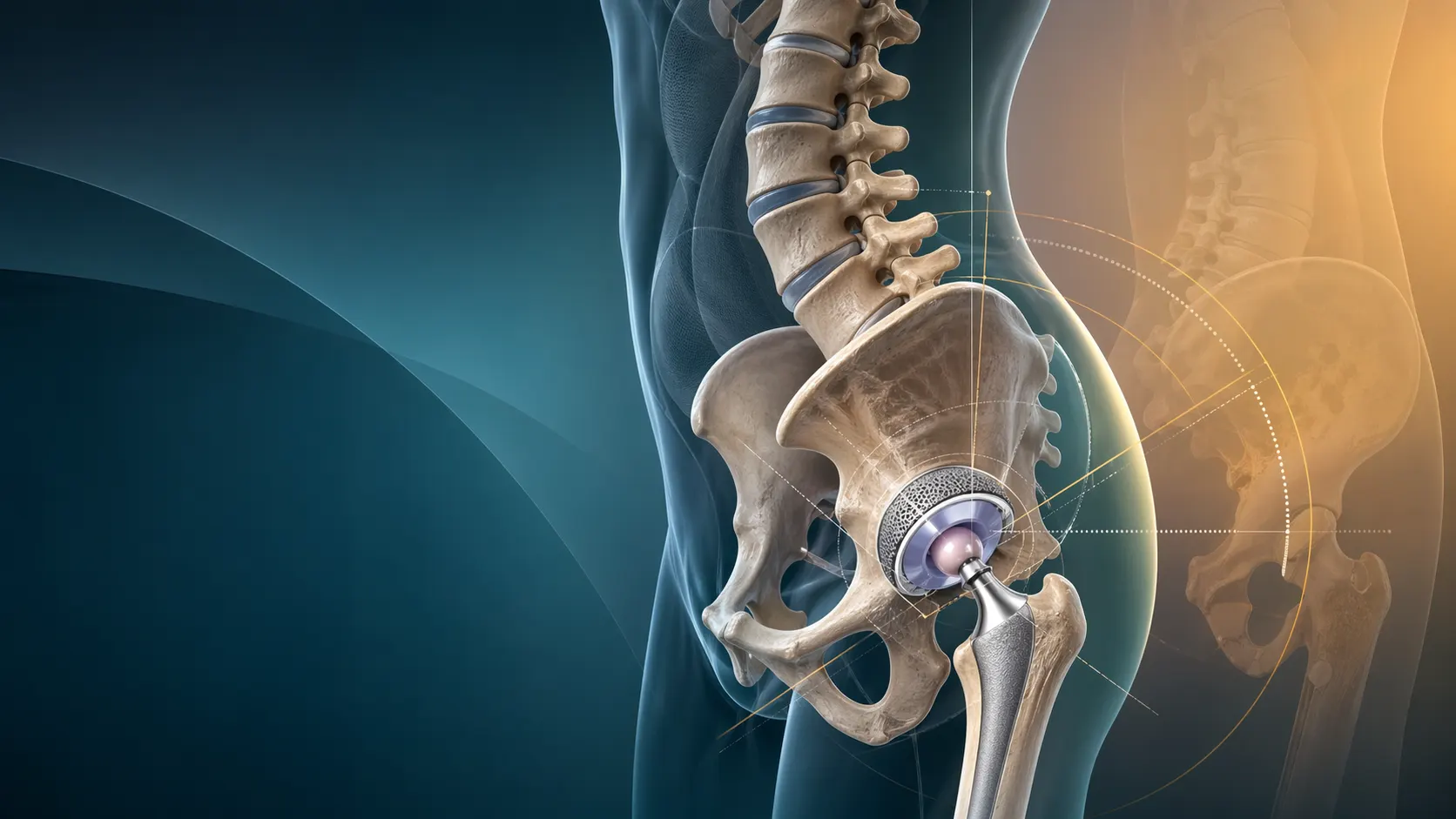
Adult Reconstruction: Bearing Surfaces Today and Beyond
Bearing surfaces in hip and knee arthroplasty: the tribology of lubrication, the clinical realities of AOANJRR data, and where bearings go next.
By OrthoVellum Editorial TeamPublished 13 min read
Educational content for clinicians, not medical advice. Editorial policy
On this page20 sections
The choice of bearing surface—the interface where motion occurs in an artificial joint—is arguably the most critical decision in total joint arthroplasty, second only to accurate implant positioning. It determines the longevity of the construct, the biological response of the host, and ultimately, the survivorship of the joint replacement. For the orthopaedic surgery trainee preparing for fellowship exams, mastering bearing surfaces is not optional; it is a guaranteed high-yield topic that bridges basic science, biomechanics, and clinical outcomes.
This comprehensive review synthesizes the latest tribological principles, material science advancements, and long-term registry data (specifically the Australian Orthopaedic Association National Joint Replacement Registry - AOANJRR) to provide a definitive guide for the modern arthroplasty surgeon.
Part 1: Tribology Fundamentals
To understand why bearings fail, one must first understand the physics of their interaction. Tribology is the science of interacting surfaces in relative motion, encompassing the principles of friction, lubrication, and wear.
Sir John Charnley's initial failure with Teflon (PTFE) in the 1960s was a harsh lesson in tribology: the material lacked wear resistance, leading to massive particulate debris, severe foreign body giant cell reactions, and catastrophic early failure. This led to his revolutionary adoption of Ultra-High Molecular Weight Polyethylene (UHMWPE), setting the standard for decades.
The Stribeck Curve and Lubrication Regimes
The ultimate goal of any artificial bearing is to separate the two moving surfaces with a microscopic film of fluid (synovial fluid), thereby minimizing friction and wear. The effectiveness of this separation is mathematically described by the Lambda Ratio (λ):
Where is the fluid film thickness and is the root-mean-square surface roughness of each respective component. Based on the Lambda ratio, a joint operates in one of three lubrication regimes (visualized on the Stribeck Curve):
- Boundary Lubrication (λ < 1): Significant surface asperity contact occurs. The load is borne entirely by the surfaces, resulting in high friction and high wear. In human joints, this occurs during gait initiation (heel strike), standing from a seated position, or during very slow motion.
- Mixed Lubrication (1 < λ < 3): Partial separation. The load is shared between the pressurized fluid film and the direct contact of surface asperities.
- Fluid Film Lubrication (λ > 3): Complete separation of surfaces by a continuous fluid layer. Theoretically, this results in zero wear.
- Hard-on-Hard bearings (Ceramic-on-Ceramic) can frequently achieve fluid film lubrication due to their ultra-low surface roughness, high hardness, and excellent wettability (hydrophilic nature).
- Hard-on-Soft bearings (Metal-on-Polyethylene) generally operate in the boundary or mixed lubrication regimes, making wear an inevitable consequence of motion over time.
Essential Exam Definitions
- Volumetric Wear: The total volume of material removed from the bearing. According to Archard's Law (), volumetric wear is directly proportional to load and sliding distance, and inversely proportional to the hardness of the material. This is the primary driver of osteolysis.
- Linear Wear: The one-dimensional penetration of the femoral head into the polyethylene liner (often measured on 2D radiographs).
- Cross-Shear: Multidirectional motion at the bearing interface forces polymer chains to repeatedly realign, significantly increasing wear. This is a major issue in the highly unconstrained hip joint.
Wear Mechanisms
Understanding how material is lost is critical for diagnosing failure modes:
- Adhesive Wear: Microscopic junctions form between the two surfaces under load. As motion occurs, these junctions shear off, pulling fragments of the softer material away. This is the primary wear mode in standard Metal-on-Polyethylene bearings.
- Abrasive Wear: Hard particles plow through the softer surface like sandpaper. This can be two-body (a rough metal head scratching the poly) or three-body (retained cement mantle fragments, bone chips, or fractured ceramic shards trapped between the articulating surfaces).
- Fatigue Wear: Cyclic loading causes subsurface shear stresses, leading to microscopic crack propagation and eventual delamination. This was a historical disaster in knee arthroplasty when polyethylene was gamma-sterilized in air, causing subsurface oxidation and massive delamination.
- Corrosive Wear: Chemical attack combined with mechanical motion. The classic modern example is Mechanically Assisted Crevice Corrosion (MACC) at the modular head-neck junction (trunnionosis).
Part 2: Total Hip Arthroplasty (THA) Bearings
The hip is a highly congruent ball-and-socket joint. For decades, the primary battle in THA was against wear-induced osteolysis (the "particle disease" cascade where macrophages phagocytose sub-micron polyethylene debris, releasing cytokines like TNF-α and IL-1, leading to osteoclast activation and bone resorption).
1. Highly Crosslinked Polyethylene (XLPE)
The introduction of XLPE in the late 1990s is arguably the single greatest success story in modern arthroplasty. It fundamentally changed the survivorship curve of the total hip.
- Manufacturing the Magic: Standard UHMWPE is irradiated (using Electron beam or Gamma rays at doses of 5-10 Mrad). This energy breaks the polymer chains, creating free radicals. These chains then recombine (crosslink) to form a dense, interconnected 3D network. This dramatically improves resistance to adhesive wear and cross-shear.
- The Engineering Trade-off: Crosslinking significantly reduces mechanical properties, specifically fracture toughness, ultimate tensile strength, and ductility. Furthermore, residual free radicals left after irradiation will combine with oxygen over time, making the plastic brittle (oxidation).
- Thermal Treatment: To eliminate these free radicals, first-generation XLPE was either remelted (heated above its melting point of ~135°C, which eliminates all free radicals but further reduces mechanical strength and crystallinity) or annealed (heated below the melting point, which preserves mechanical strength but leaves some free radicals, requiring packaging in an inert vacuum).
- The "Head Size Paradox": Historically, larger femoral heads increased volumetric wear due to increased sliding distance per step (Archard's Law). XLPE effectively decoupled wear from head size. Surgeons can now routinely use 32mm or 36mm heads to increase jumping distance and reduce dislocation risk, without paying the penalty of accelerated osteolysis.
- Evidence: Registry data is unequivocal. AOANJRR data shows XLPE has virtually eliminated wear-related revision at 15-20 years compared to conventional PE.
2. Ceramic-on-Ceramic (CoC)
- Material Evolution: We have moved from early pure alumina (which had unacceptable fracture rates) to modern mixed-oxide ceramics. The gold standard today is Biolox Delta, an alumina matrix composite (82% Alumina, 17% Zirconia, with Strontium oxide and Chromium oxide—giving it its distinct pink color).
- Transformation Toughening: This is a crucial concept for the FRCS/FRACS. The zirconia particles in Biolox Delta exist in a metastable tetragonal phase. When a microscopic crack begins to propagate through the material, the stress energy triggers the zirconia to transform into a monoclinic phase. This phase change involves a 4% volume expansion, which physically clamps the advancing crack shut, halting its progression.
- Pros: Hardest bearing material, incredibly scratch-resistant, highly wettable (promotes fluid-film lubrication). Wear rates are vanishingly small (< 1 micron/year). The wear debris generated is biologically inert compared to polyethylene or metal ions.
- Cons:
- Squeaking: Occurs in 0.5-2% of patients. It is a tribological phenomenon linked to loss of fluid film lubrication, edge loading (steep cup abduction angles), or micro-separation during swing phase.
- Fracture: Catastrophic but exceedingly rare with modern Delta ceramic (< 0.001%).
3. Ceramic-on-Polyethylene (CoP)
- The "Safe" Hybrid: This combination is rapidly becoming the dominant bearing choice globally for primary THA.
- Rationale: It elegantly combines the safety and forgiveness of an XLPE liner (zero risk of catastrophic liner fracture, no squeaking, excellent shock absorption) with the tribological superiority of a ceramic head. Ceramic heads are harder, smoother, and more scratch-resistant than Cobalt Chrome (CoCr) heads. If a ceramic head articulates against poly, it produces significantly less abrasive wear over time.
- Mitigating MACC: Crucially, using a ceramic head eliminates a metal-metal interface at the trunnion. This significantly reduces the risk of Mechanically Assisted Crevice Corrosion (MACC) and trunnionosis—a major issue seen when large CoCr heads were placed on titanium stems.
4. Metal-on-Metal (MoM)
- Current Status: Contraindicated and largely abandoned.
- History: Heavily popularized in the early 2000s for hip resurfacing and large-head primary THA to prevent dislocation. It failed disastrously. The wear generated massive amounts of cobalt and chromium ions.
- Pathophysiology: These ions triggered severe Adverse Local Tissue Reactions (ALTR), also known as Aseptic Lymphocytic Vasculitis-Associated Lesions (ALVAL). This resulted in massive soft tissue destruction, pseudotumors, and catastrophic failure of the abductor mechanism.
- Surveillance: Trainees must know the follow-up protocol. Patients with retained MoM hips require regular surveillance, including whole blood cobalt and chromium ion levels, clinical functional assessment, and MARS-MRI (Metal Artifact Reduction Sequence) if symptomatic or if ion levels are rising.
Summary of AOANJRR Revision Rates (15 Years)
When pressed in an exam, rely on the registry:
- Ceramic-on-Ceramic: Lowest overall Revision Rate (~5.0%)
- Ceramic-on-XLPE: A statistically indistinguishable close second (~5.2%)
- Metal-on-XLPE: Slightly higher, largely driven by older patients and trunnion issues (~6.5%)
- Metal-on-Conventional PE: Historically poor, high rates of osteolysis (>10%)
Part 3: Total Knee Arthroplasty (TKA) Bearings
The knee is not a simple ball-and-socket. It is a complex rolling, gliding, and rotational joint with much lower inherent conformity than the hip. The priorities and failure modes differ significantly. In modern TKA, "wear" leading to massive osteolysis is far less common than failure due to aseptic loosening, infection, or instability.
1. Polyethylene in TKA
- The Kinematic Challenge: The sliding and rolling motion in the knee creates high subsurface shear stresses. Historically, this point-loading led to catastrophic delamination of the polyethylene, especially if it had been oxidized.
- XLPE in Knees: While XLPE became standard in hips rapidly, its adoption in knees was slower and more controversial. Surgeons feared that the reduced fracture toughness of crosslinked plastic would lead to post fracture (in posterior-stabilized designs) or rapid delamination in the less conforming knee environment.
- The Verdict: Modern, second and third-generation XLPE formulations have proven remarkably safe and effective in TKA. However, because cross-shear is less of a driving force in the predominantly unidirectional motion of the knee (compared to the multidirectional hip), standard polyethylene still performs adequately.
- Registry Data: The AOANJRR shows no significant difference in overall revision rates between XLPE and Conventional PE in primary TKA at the 10-to-15 year mark. Despite this, the industry is steadily shifting toward universal XLPE usage.
2. Oxidized Zirconium (Oxinium)
- What is it? A proprietary zirconium alloy metal that is subjected to a proprietary heating process, causing the surface to oxidize into a 5-micron thick ceramic layer. It is often described as having a "Metal heart, Ceramic skin."
- Theoretical Advantages: It is harder than standard CoCr (making it highly scratch-resistant to third-body debris) and has a lower coefficient of friction. Most importantly, it contains virtually no nickel, making it the implant of choice for patients with documented severe metal allergies.
- Clinical Reality: While laboratory simulator data is highly promising, large-scale registry data (AOANJRR and the UK NJR) has not consistently demonstrated a reduction in long-term revision rates compared to standard Cobalt Chrome femoral components. It remains a premium, high-cost option primarily indicated for metal hypersensitivity.
3. Mobile vs. Fixed Bearing
- Fixed Bearing: The polyethylene insert is rigidly locked into the titanium tibial tray.
- Mobile Bearing: The polyethylene insert is free to rotate (and in some designs, translate AP) on a highly polished tibial baseplate.
- The Theory: Mobile bearings were designed to solve a fundamental engineering conflict in TKA: conformity vs. constraint. By allowing the poly to move with the femur, you can create a highly conforming (curved) surface that maximizes contact area and minimizes contact stress, without transmitting excessive torsional shear stresses to the tibial fixation interface.
- The Reality: Despite the elegant theory, decades of randomized controlled trials, systematic reviews, and registry data consistently show no clinical difference in survivorship, range of motion, or patient-reported outcome measures (PROMs) between mobile and fixed bearings. Furthermore, mobile bearings introduce a unique, specific failure mode: Bearing Spin-out / Dislocation, often requiring revision.
Part 4: Future Directions and Innovations
Vitamin E Polyethylene (Third-Generation XLPE)
This is the current frontier of soft bearings. Antioxidant stabilization using Vitamin E (alpha-tocopherol) solves the historical compromise of XLPE. Vitamin E acts as a powerful free radical scavenger; it donates a hydrogen atom to quench the free radical before it can react with oxygen. This allows manufacturers to heavily irradiate the plastic (maximizing wear resistance) without needing to perform a post-irradiation remelting step. Therefore, Vitamin E poly retains the high ultimate tensile strength, fatigue resistance, and toughness of virgin plastic, while boasting the ultra-low wear rates of XLPE. Early to medium-term clinical data is outstanding.
Dual Mobility Cups
- Design Concept: Originally designed by Bousquet in France, dual mobility involves a standard small femoral head (usually 22mm or 28mm) which is snap-fitted into a larger, mobile polyethylene sphere. This large poly sphere then articulates freely within a highly polished metal acetabular shell. You have two distinct articulations.
- Biomechanics: Primary motion occurs at the small inner articulation. When the neck impinges on the rim of the poly sphere, the larger outer articulation engages. This provides a massive effective head size, drastically increasing the jumping distance required for dislocation.
- Modern Indications: Historically reserved for revision surgery, recurrent dislocators, or patients with severe neuromuscular disease (e.g., Parkinson's), the advent of XLPE has mitigated historic concerns about wear at the large outer convex poly surface. Dual mobility is increasingly being utilized in primary THA for patients at high risk of falls (e.g., fractured neck of femur patients or the frail elderly).
- The Catch - IPD: Trainees must know the specific complication of Intra-prosthetic dislocation (IPD). This occurs when the small inner head levers out of the poly sphere (the "bottle-opener" effect), leading to metal-on-metal articulation between the head and the outer shell.
3D Printed Surfaces
While not a "bearing" surface per se, the backside of implants is being revolutionized by 3D printing (additive manufacturing). Highly porous titanium structures with custom topographies and high coefficients of friction are providing unprecedented initial scratch-fit stability and long-term biologic fixation, complementing the longevity provided by modern bearings.
Conclusion
The "Bearing Wars" of the late 20th century have largely been won, and the victor is material science. With the advent of highly crosslinked polyethylene and Vitamin E stabilization, the catastrophic, rapidly progressive wear-induced osteolysis of the 1990s is steadily becoming a historical footnote.
Today, the choice of bearing surface often comes down to balancing marginal, theoretical wear benefits against cost-effectiveness and the risk of material-specific complications (like ceramic squeaking or fracture). For the modern surgeon, sticking to registry-proven combinations—predominantly Ceramic or Metal on XLPE for hips, and CoCr on Poly for knees—ensures that mechanical loosening or infection will likely dictate the lifespan of the joint, rather than the bearing surface itself.
References
- AOANJRR Annual Report 2024. Australian Orthopaedic Association National Joint Replacement Registry.
- Charnley, J. (1961). "Arthroplasty of the hip. A new operation." The Lancet. (The landmark paper transitioning from Teflon to UHMWPE).
- D'Antonio, J. A., et al. (2012). "Second-generation annealed highly cross-linked polyethylene exhibits low wear at 8 years." Clinical Orthopaedics and Related Research.
- Kurtz, S. M., et al. (2011). "Reasons for revision of first-generation highly cross-linked polyethylenes." Journal of Arthroplasty.
- Morlock, M., et al. (2001). "Mechanisms of taper corrosion and trunnionosis in total hip arthroplasty." Journal of Biomechanics.
Share this article
Cite this article
OrthoVellum Editorial Team. Adult Reconstruction: Bearing Surfaces Today and Beyond [Internet]. OrthoVellum; 2025 Jan 9 [cited 2026 Oct 4]. Available from: https://www.orthovellum.com/blog/adult-recon-bearing-surfaces-2025
About this content
Prepared by the OrthoVellum Editorial Team from cited sources, under our editorial policy.
For education and exam preparation; not medical advice or a substitute for clinical judgement and local guidance.
Spotted an error? Tell us; every report is read.
Get new articles by email
New clinical explainers, landmark-trial summaries and exam guidance from the OrthoVellum blog. No account needed; unsubscribe from any email.