
Article summary
How to design a revision day that balances focus, breaks and recovery so you actually retain what you study.
Educational content is reviewed for source visibility, editorial coherence, and correction readiness.
No individual clinician credential is claimed unless a named person is shown.
Verify before clinical use; this is not medical advice or a substitute for local guidance.
Mastering the vast syllabus of orthopaedic surgery—whether you are preparing for your final medical school exams, the Member of the Royal College of Surgeons (MRCS) examinations, or the rigorous Fellowship of the Royal College of Surgeons (FRCS) in Trauma and Orthopaedics—requires more than just raw intelligence. It demands a strategic, sustainable approach to learning. Designing a productive revision day is not about cramming for fourteen hours straight; it is about meticulously structuring your time to balance periods of intense cognitive focus with adequate breaks and genuine neurological recovery, ensuring that the complex biomechanics, anatomical pathways, and clinical management algorithms you study actually stick.
Aligning Your Revision Modality with the Cognitive Load
Before you sit down at your desk, you must recognise that not all revision tasks are created equal. A productive day is built on the foundation of matching your study modality to your brain's natural energy levels. In the morning, when your prefrontal cortex is rested and your cognitive battery is fully charged, you should tackle the highest-yield, conceptually demanding material. For orthopaedic trainees and medical students, this typically means active recall of complex topics like the brachial plexus, regional anaesthetic blocks, or the intricate biomechanics of gait and joint replacement.
As the day progresses and your cognitive fatigue naturally increases, you should shift towards less demanding, yet equally important, modalities. After lunch is the ideal time to review previously learned material through spaced repetition flashcards, or to watch a surgical approach video. By categorising your study materials into "heavy cognitive load" (learning new anatomy, solving complex clinical vignettes) and "light cognitive load" (consolidating old notes, listening to an audio podcast on paediatric hip pathology), you prevent the afternoons from becoming a frustrating battle against fatigue.
Avoid the Passive Reading Trap
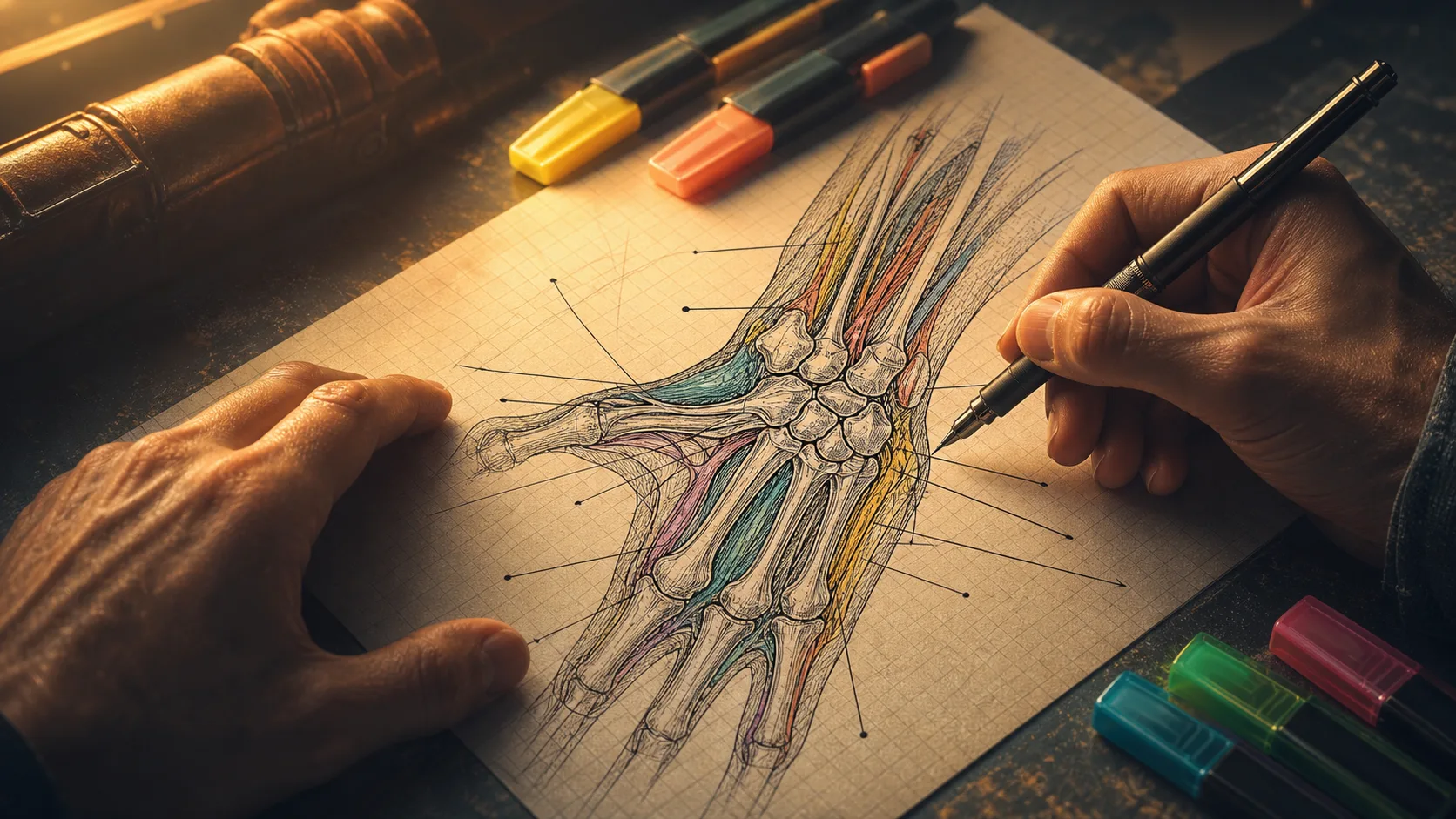
The most common mistake examinees make is falling into the trap of passive reading. Highlighting a textbook on open reduction and internal fixation of the acetabulum feels productive, but it creates a dangerous illusion of competence. True retention requires active engagement. You must force your brain to retrieve information. When reviewing a topic like carpal tunnel syndrome, close the book and speak aloud: What are the anatomical boundaries of the carpal tunnel? What are the contents? What are the typical clinical signs and neurophysiological grading scales? If you cannot explain it out loud to an imaginary junior colleague, you do not know it well enough for a viva voce examination.
The Architecture of the Workday: Structuring the Surge
Once your materials are categorised, you need to apply a rigid, repeatable structure to your day. The human brain is not designed for unbroken, multi-hour focus. Attempting to absorb the management of polytrauma or the classification systems for proximal humeral fractures in a single four-hour block will result in diminishing returns and poor retention.
Instead, divide your day into distinct, highly focused "surges". Work in blocks of time—often ranging from forty-five to ninety minutes—where you commit entirely to a single topic with absolutely zero distractions. During these blocks, your phone should be in another room, and your web browser should be closed. Once the block is over, enforce a strict break.
The "First Hour" Rule
How you begin your day sets the tone for your productivity. Adopt the "First Hour" rule: the very first study block of the day must be dedicated to your most challenging, weakest subject. If you are dreading the developmental dysplasia of the hip (DDH) or complex hand rheumatology, attack it when your mental resolve is strongest. Completing your most feared topic first generates a psychological momentum that carries you through the rest of the day. Subsequent study blocks will feel easier by comparison.

Non-Negotiable Micro-Breaks and the Orthopaedic Body
A productive revision schedule does not simply permit breaks; it actively mandates them. Breaks are not a reward for hard work; they are a biological requirement for memory consolidation. During your focused study blocks, your brain is acquiring information. During your breaks, your brain begins the process of encoding that information into your long-term memory. If you skip breaks, you overwrite your short-term memory before it has had a chance to set.
However, what you do during your breaks is just as critical as the study blocks themselves.
Preserving the Surgeon’s Body
As an orthopaedic surgical aspirant or trainee, your physical health is your career. Sitting at a desk hunched over a laptop for weeks on end is a fast track to neck pathology, lower back pain, and shoulder impingement—the very conditions you are studying to treat. During your short, ten-to-fifteen-minute micro-breaks, you must physically separate yourself from your study space.
Get up, walk around, and perform active stretches. Hang from a pull-up bar to decompress your spine, or perform a sequence of thoracic mobility exercises to open your chest and protect your cervical alignment. Do not simply swap your orthopaedic textbook for a social media scroll on your phone, as this keeps you physically sedentary and floods your brain with cheap dopamine, undermining the focus required for your next study block.
Active Consolidation and Spaced Repetition Mechanics
To genuinely retain information for high-stakes examinations like the FRCS or MRCS, you must move beyond rote memorisation and implement systematic consolidation. The forgetting curve is steep; if you review the O’Brien classification for proximal humeral fractures today, you will forget the vast majority of it within a week unless you deliberately revisit it.
Implementing a spaced repetition system (SRS) is non-negotiable for the modern surgical examinee. Whether you use digital flashcard software or a physical Leitner box, the principle remains the same: you review information at increasing intervals just as you are on the verge of forgetting it.
Weaving Weekly Review Blocks
A well-structured revision day should include a dedicated period—usually in the late afternoon—exclusively for reviewing material studied in previous days and weeks. When you encounter a complex topic, such as the management of supracondylar fractures in children, create flashcards testing the Gartland classification, the indications for open versus closed reduction, and the signs of nerve injury. Later in the week, your structured revision day should force you to recall these facts. This constant pulling of information from your memory alters the physical neural pathways in your brain, making the recall of orthopaedic algorithms automatic and effortless under exam pressure.
Navigating the Mid-Afternoon Slump
Every examinee knows the feeling. It is approximately 3:00 PM, the sun has shifted in the sky, and reading another sentence on the biomechanics of the foot feels like wading through treacle. The mid-afternoon slump is a physiological reality, governed by your circadian rhythm. The worst thing you can do is sit at your desk, stubbornly re-reading the same paragraph on Charcot arthropathy over and over again while feeling guilty about your lack of focus.
A highly productive revision day anticipates this slump and plans for it. Instead of forcing heavy cognitive learning during this low-energy window, pivot your revision strategy.
Low-Energy, High-Yield Tasks
Use the afternoon slump for tasks that require less active, grueling synthesis but are still highly educational. This is the perfect time to draw out the surgical approach for a total hip replacement, labelling the neurovascular structures at risk. It is an excellent time to organise your notes, format your flashcards, or practice drawing the Salter-Harris physeal fracture classification from memory. You might also use this time to listen to an orthopaedic interview podcast or watch a consultant performing an arthroscopy. By shifting to visual, auditory, or organisational tasks, you keep your revision momentum alive without burning out your exhausted cognitive faculties.
Fuel, Hydration, and Environmental Control
You cannot expect peak cognitive performance from a biological machine that is poorly maintained. The brain consumes roughly twenty percent of the body's energy. If you are surviving on vending machine coffee, refined sugar, and a poor night's sleep, your capacity to absorb the intricacies of complex regional pain syndrome or spinal cord compression will plummet.
Take a professional approach to your revision environment and your physiology.
- Hydration: Keep a large bottle of water at your desk at all times. Dehydration physically shrinks the brain tissue and impairs concentration.
- Nutrition: Avoid heavy, carbohydrate-rich meals at lunchtime, which will exacerbate your mid-afternoon slump. Opt for high-protein, nutrient-dense meals that release energy slowly.
- Sleep and Memory: Understand that sleep is not merely "rest"—it is the critical phase where your brain actively files away the orthopaedic knowledge you absorbed that day. Deep sleep and REM sleep are absolutely vital for spatial and procedural memory. Sacrificing sleep to study an extra two hours is counterproductive; you are sacrificing the very mechanism your brain uses to store the information you just studied.
Ensure your study environment is fiercely controlled. It should be well-lit, well-ventilated, and completely free of clutter. Treat your revision day with the same respect, discipline, and environmental optimisation you would apply to a day in the operating theatre.
Adapting Your Plan: The End-of-Day Audit
The final component of a productive revision day happens when the studying is over. Before you close your textbooks and step away for the evening, you must conduct a brief, objective audit of your performance. This takes no more than ten minutes but is the secret to continuous improvement over a long study campaign.
Ask yourself what went well and what failed. Did you spend two hours trying to understand a single, obscure paper on meniscal repair when it was only worth a fraction of a per cent of the exam? Did your phone distract you during your morning surge? Did you skip your stretches, resulting in a stiff lower back by 4:00 PM?
Use the answers to these questions to write a brief, realistic plan for the following day. If you found that your pomodoro timer was too short to get into deep focus on complex lower limb biomechanics, extend it. If you realised your afternoon slump was unbearable, shift your schedule earlier in the day or schedule a brisk twenty-minute walk to break it up. A productive revision day is not a rigid, static formula; it is a dynamic, adaptable system that you must constantly refine to suit your individual learning style and physiological needs.

A productive revision day is ultimately a delicate balance of intensity and recovery. By actively engaging with high-yield material, fiercely protecting your focus, and respecting your physiological limits, you transform passive reading into permanent knowledge. Treat your study schedule with the same meticulous discipline you apply in a surgical theatre, and the vast landscape of orthopaedic surgery will soon become second nature.
Share this article
Useful for a journal club, study list, or teaching session.