Lisfranc Injuries: Diagnosis, Classification, and Management
A comprehensive guide to tarsometatarsal injuries. Why they are missed, how to fix them, and the debate between ORIF and Primary Fusion.
By OrthoVellum Editorial TeamPublished 10 min read
Educational content for clinicians, not medical advice. Editorial policy
On this page17 sections
The Lisfranc joint complex (tarsometatarsal joint) is the "Keystone" of the midfoot. It provides the structural integrity for the longitudinal arch and transfers force from the midfoot to the forefoot during the terminal stance phase of gait.
Injuries to this complex are notorious in orthopaedic surgery training for two distinct reasons:
- They are commonly missed (up to 20% in some emergency department series), often dismissed as benign "midfoot sprains."
- The outcomes of missed injuries are catastrophically poor, leading to rapid post-traumatic arthritis, flatfoot deformity (plano-valgus), and chronic, debilitating pain.
For any registrar deep in fellowship exam preparation (whether FRACS, FRCS, or ABOS), mastering the Lisfranc injury is non-negotiable. It tests your understanding of functional foot anatomy, your vigilance in trauma evaluation, and your grasp of the evolving biomechanical debates in surgical education.
This guide covers the functional anatomy, the subtle radiological signs you cannot afford to miss, and the definitive surgical algorithms required to ace your exams and, more importantly, treat your patients correctly.
Functional Anatomy: The Roman Arch and The Three Columns
To understand the pathology, you must first master the architecture. The stability of the midfoot relies on the "Roman Arch" configuration, supported by both bony geometry and a robust ligamentous complex.
The Column Theory
Modern foot and ankle surgery divides the foot into three functional columns:
- Medial Column: 1st Metatarsal and Medial Cuneiform. (Rigid, accommodates high forces).
- Middle Column: 2nd and 3rd Metatarsals, Middle and Lateral Cuneiforms. (Highly rigid, the structural core).
- Lateral Column: 4th and 5th Metatarsals and the Cuboid. (Mobile, essential for accommodating uneven terrain during gait).
Bony Stability: The Keystone
The base of the 2nd Metatarsal is recessed proximally into a mortise formed by the medial, middle, and lateral cuneiforms. It acts exactly like the keystone in a Roman arch. Because of this recessed position, any significant medial-lateral translation of the midfoot requires either a fracture of the 2nd metatarsal base or a massive disruption of the mortise.
Ligamentous Stability
The ligaments of the TMT joints are divided into dorsal, plantar, and interosseous groups. Crucially, the plantar ligaments are significantly stronger and thicker than the dorsal ligaments. This is why Lisfranc dislocations are almost always dorsal—the weaker dorsal ligaments fail first under plantarflexion stress.
- The Lisfranc Ligament: This is the largest, strongest, and most critical interosseous ligament. It runs obliquely from the lateral surface of the Medial Cuneiform (C1) to the medial base of the 2nd Metatarsal (M2).
- Intermetatarsal Ligaments: Connect the bases of the lesser metatarsals (2 to 5).
- The Anatomical Vulnerability: There is NO transverse intermetatarsal ligament connecting the 1st and 2nd metatarsal bases. The Lisfranc ligament is the only structure preventing diastasis (separation) of the 1st and 2nd rays.
Remember the hierarchy of ligamentous strength at the TMT joint: Interosseous (strongest) > Plantar > Dorsal (weakest). When the foot is subjected to extreme plantarflexion, the weak dorsal ligaments rupture, leading to the classic dorsal dislocation of the metatarsals.
Diagnosis: Cultivating a High Index of Suspicion
In orthopaedic surgery training, we are taught that missed diagnoses often stem from a failure to suspect, rather than a failure to see.
Mechanism of Injury
- Direct Trauma: Crush injuries (e.g., a heavy object dropped on the dorsum of the foot, industrial accidents). These usually result in severe, highly comminuted, open, or high-energy soft tissue injuries.
- Indirect Trauma: This is far more common. It classically involves an axial load applied to a hyper-plantarflexed foot. Examples include a foot caught in a horse's stirrup, a misstep stepping off a curb, or a classic sports tackle where a player falls onto the heel of another player whose foot is planted and plantarflexed (common in rugby and American football).
Clinical Signs
- Plantar Ecchymosis: If you see bruising on the plantar aspect of the midfoot (the instep), it is a Lisfranc injury until proven otherwise. This sign is pathognomonic for a rupture of the plantar capsuloligamentous structures.
- Midfoot Tenderness: Exquisite point tenderness over the TMT joints dorsally.
- Provocative Tests:
- Pronation/Abduction Test: Passively pronating and abducting the forefoot while holding the hindfoot fixed will elicit severe pain.
- Piano Key Test: Grasping the metatarsal heads individually and moving them dorsally and plantarly (like pressing piano keys) will cause pain at the injured TMT joint.
Radiological Evaluation: Accept No Substitutes
You absolutely must obtain weight-bearing or stress radiographs. Non-weight-bearing films can miss up to 50% of purely ligamentous, unstable injuries because the foot's arch recoils into a seemingly normal position when unloaded.
The Radiological Checklist:
- AP View: The medial border of the 2nd Metatarsal MUST perfectly align with the medial border of the Middle Cuneiform. Any step-off indicates diastasis.
- Oblique View: The medial border of the 4th Metatarsal MUST align with the medial border of the Cuboid.
- Lateral View: Look for a dorsal bony step-off at the TMT joints (the "Step-up" sign) and flattening of the longitudinal arch. Look closely for the "plantar plate avulsion" fragment.
- The Fleck Sign: A tiny avulsion fracture in the primary interosseous space between the 1st and 2nd metatarsal bases. This represents the bony avulsion of the Lisfranc ligament and is absolutely diagnostic of a major unstable injury.
Classification Systems for the Exam
You need to know two distinct classifications for your fellowship exam preparation: one for high-energy trauma, and one for low-energy athletic injuries.
Myerson Classification (Modified Quenu and Kuss / Hardcastle)
Used to describe high-energy, displaced injuries. It is descriptive but does not perfectly dictate treatment.
- Type A (Total Incongruity): All metatarsals (1-5) displace in one uniform direction (usually laterally and dorsally).
- Type B (Partial Incongruity): Only a portion of the TMT joint is displaced.
- B1: Medial displacement (1st ray displaces medially in isolation).
- B2: Lateral displacement (Lesser rays 2-5 displace laterally, leaving the 1st ray intact).
- Type C (Divergent): The 1st ray displaces medially, while the lesser rays (2-5) displace laterally. This can be partial or total.
Nunley-Vertullo Classification
Crucial for sports medicine and subtle, low-energy athletic injuries.
- Stage 1: Clinical pain and tenderness, but non-displaced on weight-bearing X-ray. Positive bone scan or MRI showing ligament sprain. (Stable - Non-operative).
- Stage 2: Diastasis of 2-5mm between the 1st and 2nd metatarsals. No loss of arch height on the lateral view. The Lisfranc ligament is ruptured, but the plantar ligaments are intact. (Unstable - Operative).
- Stage 3: Diastasis > 5mm PLUS a loss of longitudinal arch height on the lateral view. Both Lisfranc and plantar ligaments are ruptured. (Frank instability - Operative).
The Treatment Algorithm: Evidence and Debate
Management depends entirely on stability. Displacement of >2mm in any plane is an absolute indication for surgery.
Non-Operative Management
- Indication: Strictly for Nunley Stage 1 (Stable sprains) with absolutely no displacement on weight-bearing views.
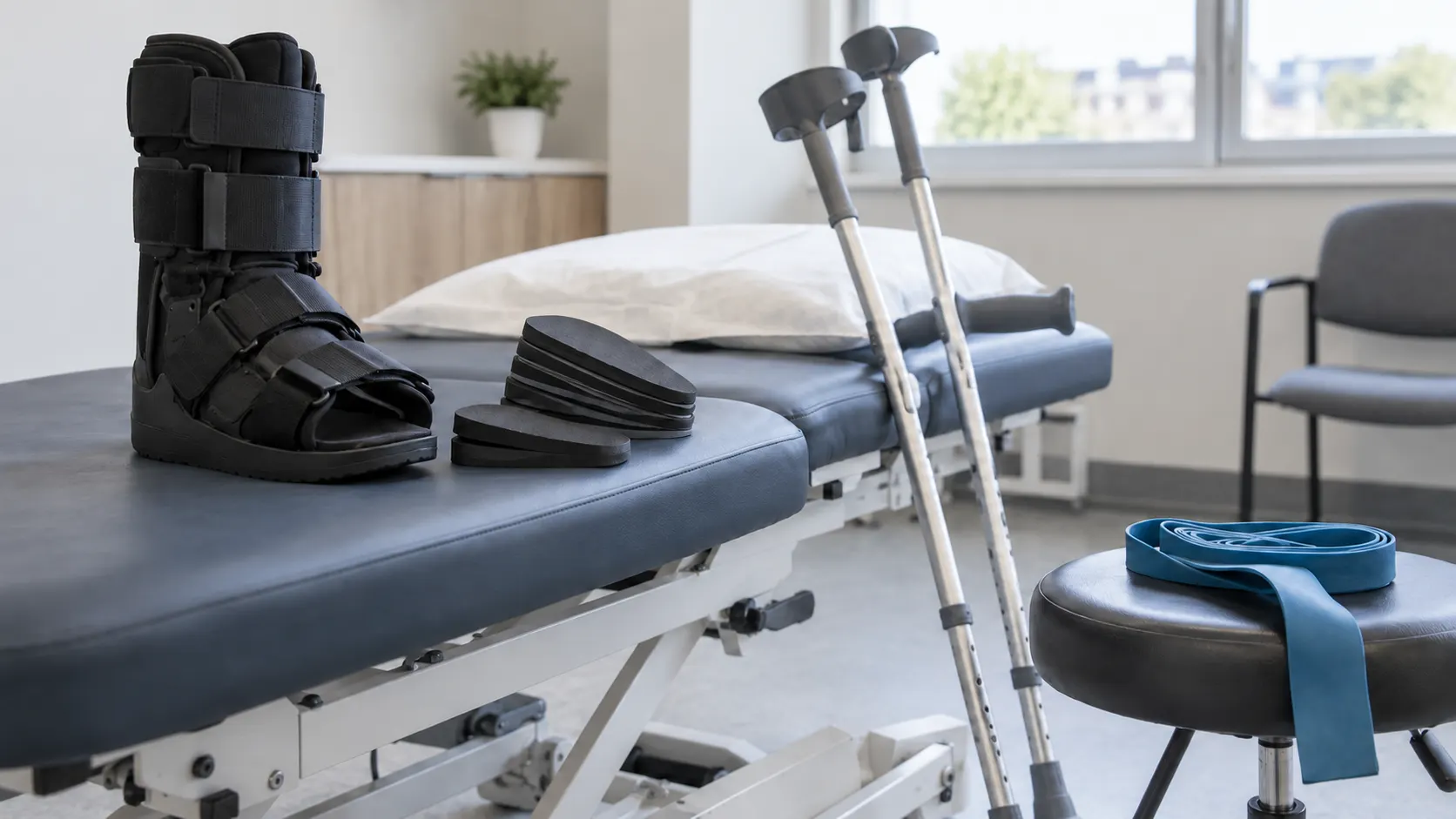
- Protocol: Strict non-weight bearing (NWB) in a well-molded cast or rigid boot for 6 weeks.
- The Catch: There is a high risk of delayed displacement as swelling subsides. You MUST perform repeat weight-bearing X-rays at 10 to 14 days to ensure the joint hasn't drifted.
Operative Management: The Great Debate (ORIF vs Primary Fusion)
For decades, anatomic reduction and rigid fixation (ORIF) was the undisputed gold standard. However, surgical education has shifted rapidly over the last 15 years, making this one of the most tested controversies in orthopaedic exams.
1. Open Reduction Internal Fixation (ORIF)
- Philosophy: Restore perfect native anatomy, rigidly hold it to allow the ligaments to heal via scar formation, and optionally remove the metal later to restore some native midfoot motion.
- Surgical Approach: Typically a dual-incision technique.
- Dorsomedial Incision: Centered over the 1st/2nd intermetatarsal space. Danger: Protect the superficial peroneal nerve branches, and dissect carefully between the Extensor Hallucis Longus (EHL) and Extensor Digitorum Longus (EDL) to find the deep peroneal nerve and dorsalis pedis artery.
- Dorsolateral Incision: Centered over the 3rd/4th TMT joints.
- Fixation Techniques:
- Trans-articular Screws: The traditional method. Solid 3.5mm or 4.0mm cortical screws are placed through the joint surfaces. Advantage: Excellent compression. Disadvantage: Iatrogenic damage to the articular cartilage (screws destroy up to 2-3% of the joint surface area per pass), predisposing to arthritis.
- Dorsal Bridge Plating: The modern preference for ORIF. Plates span across the joint without violating the cartilage. Advantage: Protects articular cartilage and provides stiffer biomechanical constructs than screws alone.
2. Primary Arthrodesis (Fusion)
- Philosophy: Even with perfect, anatomical ORIF, ligaments heal via "creep" (stretching), and damaged cartilage undergoes post-traumatic degeneration. Because the medial and middle columns are inherently rigid anyway, fusing them solves the problem permanently, preventing the almost inevitable late midfoot collapse and secondary arthritis.
- The Landmark Evidence: You must quote the Ly and Coetzee study (JBJS 2006). This randomized controlled trial compared ORIF vs Primary Arthrodesis for purely ligamentous Lisfranc injuries. The fusion group had significantly better functional outcomes (AOFAS scores), less pain, and dramatically lower rates of revision surgery (hardware removal or salvage fusion).
- Current Indications for Primary Fusion:
- Purely ligamentous injuries (no bony fractures to heal).
- Severe intra-articular comminution (cartilage is unsalvageable).
- Delayed presentations (missed injuries presenting weeks/months later).
- Older, lower-demand patients.
- The Golden Rule of Midfoot Fusion: You may fuse the Medial (1st) and Middle (2nd/3rd) columns. NEVER fuse the Lateral (4th/5th) column. The lateral column is highly mobile and essential for normal gait accommodation. If the lateral column is unstable, reduce it and pin it with temporary K-wires that are removed at 6 weeks.
Regardless of whether you choose ORIF or Fusion, the critical step of the operation is reconstructing the Lisfranc ligament vector. This is classically done with the "Home Run Screw"—a solid, fully threaded cortical screw running from the Medial Cuneiform into the Base of the 2nd Metatarsal, placed in lag fashion to pull the 2nd metatarsal tightly back into the keystone mortise.
Rehabilitation and Outcomes
The rehabilitation process for Lisfranc injuries is grueling and requires extensive patient education. Setting expectations early is key to good clinical practice.
- 0-2 Weeks: Strict Non-Weight Bearing (NWB) in a bulky Jones splint. Elevation is critical to prevent wound breakdown.
- 2-6 Weeks: Transition to a NWB rigid cast or CAM boot. Sutures removed at 2-3 weeks once soft tissues are healed.
- 6-12 Weeks: Progressive weight bearing in a boot, advancing to a stiff-soled shoe with a custom orthotic (arch support).
- Hardware Removal: If trans-articular screws are used, they must be removed at 3-6 months before the patient returns to full unprotected weight-bearing or impact sports, otherwise they will almost certainly break due to midfoot motion. Bridge plates are generally removed at 4-6 months to restore joint mobility. K-wires in the lateral column are pulled in the clinic at 6 weeks.
Setting Patient Expectations
Be brutally honest with your patients: a Lisfranc injury is a life-altering event. Even with perfect, anatomical surgical management and flawless rehabilitation, many patients will experience some degree of permanent residual stiffness, aching in cold weather, and difficulty returning to high-impact activities like sprinting or heavy lifting. Up to 30% of ORIF patients will eventually require a salvage midfoot fusion due to post-traumatic arthritis.
Summary Checklist for the Orthopaedic Trainee
- Suspect it: Plantar ecchymosis is the smoking gun.
- Stress it: Non-weight-bearing films are useless. Demand weight-bearing X-rays, or pull the fluoroscopy machine into the bay and stress the foot yourself.
- Scan it: Have a low threshold for a CT scan to map out articular comminution.
- Fix it: Any displacement >2mm requires surgical stabilization.
- Fuse it: Strongly consider primary arthrodesis for purely ligamentous injuries, severe comminution, or delayed presentations, but remember to never fuse the 4th and 5th TMT joints.
Related Topics to Review:
- Midfoot Post-Traumatic Arthritis
- Jones Fractures and 5th Metatarsal Base Anatomy
- Compartment Syndrome of the Foot (Fasciotomy approaches)
- Navicular Stress Fractures
Share this article
Cite this article
OrthoVellum Editorial Team. Lisfranc Injuries: Diagnosis, Classification, and Management [Internet]. OrthoVellum; 2025 Jan 6 [cited 2026 Oct 4]. Available from: https://www.orthovellum.com/blog/lisfranc-injury-diagnosis-fixation
About this content
Prepared by the OrthoVellum Editorial Team from cited sources, under our editorial policy.
For education and exam preparation; not medical advice or a substitute for clinical judgement and local guidance.
Spotted an error? Tell us; every report is read.
Get new articles by email
New clinical explainers, landmark-trial summaries and exam guidance from the OrthoVellum blog. No account needed; unsubscribe from any email.