Never Events: Wrong Site, Wrong Implant, Retained Items
Never events in orthopaedics: wrong site surgery is the commonest, and orthopaedics has a large share of wrong-implant events. Why they occur, what stops them.
By OrthoVellum Editorial TeamPublished 8 min read
Educational content for clinicians, not medical advice. Editorial policy
On this page8 sections
The term is a promise the system cannot keep. A never event is defined as a serious, largely preventable incident that should not occur where established safety barriers have been properly implemented — and yet they occur, in every health system, every year, in good hospitals staffed by careful people.
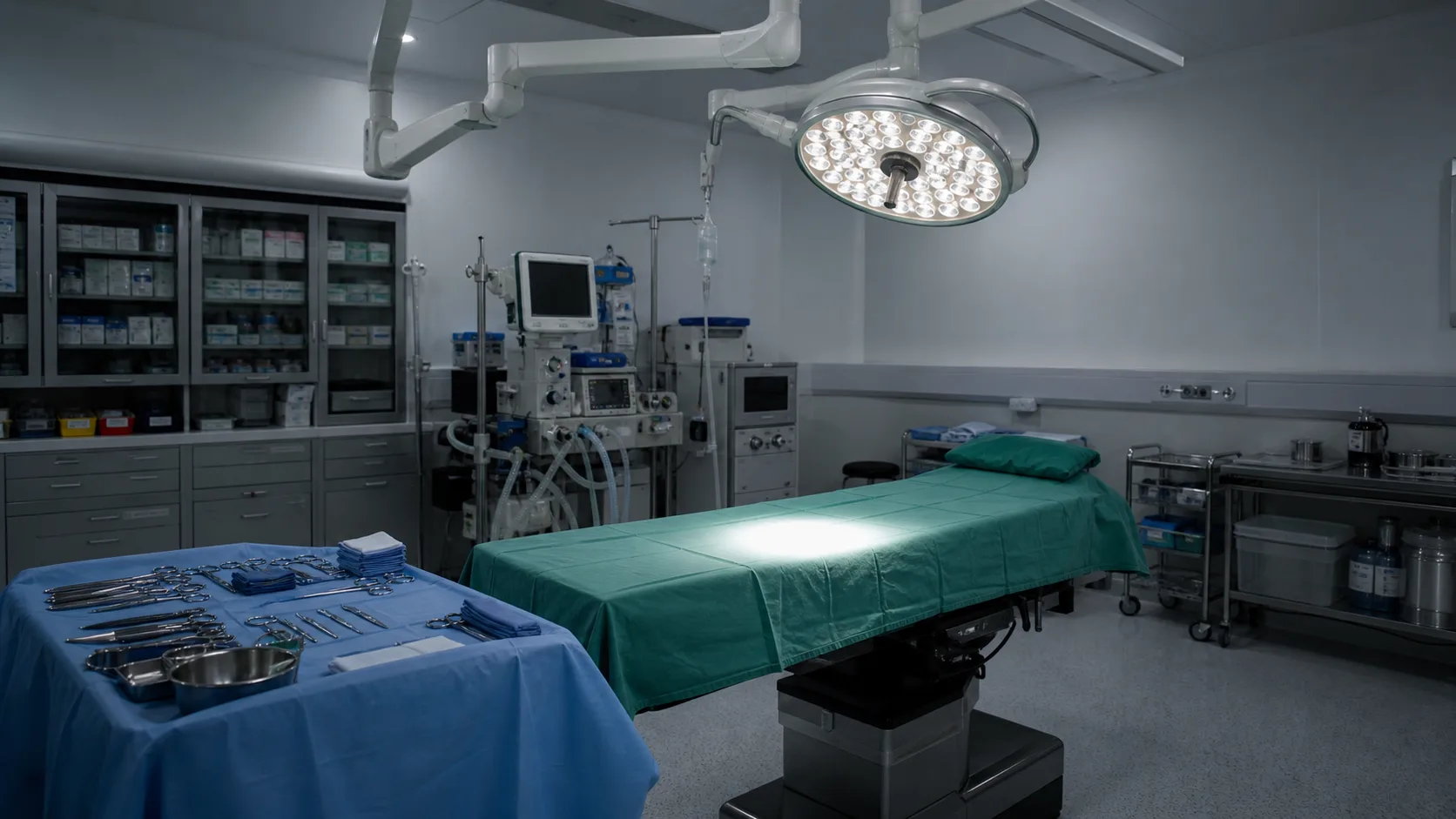
Orthopaedics is not a bystander here. We operate on paired limbs, on multiple levels of the same spine, on patients positioned so the surgical mark is out of sight, using implants that come in dozens of sizes and both sides, with counted items that are small, sharp and radiolucent. The specialty is structurally exposed to exactly the three events that dominate the list.
This post covers why they happen and what genuinely prevents them. It sits within our medico-legal and governance series.
The scale, in real numbers
NHS England's provisional data for 1 April 2024 to 31 March 2025 recorded 421 incidents as never events, of which 403 appeared to meet the 2018 definition at the time of reporting.
The distribution is the part surgeons should sit with:
| Category | Count |
|---|---|
| Wrong site surgery | 185 — the single largest category |
| Wrong implant or prosthesis | 50 |
| — of which knees | 14 |
| — of which hips | 4 |
Eighteen of the fifty wrong-implant events were arthroplasty. That is our specialty, in a single line.
Figures are NHS England provisional data for 2024/25 against the 2018 Never Events list, last updated February 2021. Accurate as of July 2026 — check the current publication for updated figures.
The framework itself is UK-specific in name. Comparable schemes exist elsewhere — the US uses serious reportable events, and other jurisdictions have their own lists — but the failure modes below are universal, because they arise from how operating theatres work rather than from how they are regulated.
Why "never" is the wrong word
Calling these never events was intended to convey seriousness. It has two unhelpful side effects worth naming.
It implies that occurrence proves negligence. It does not. Wrong-site surgery has occurred in units with exemplary checklist compliance, performed by careful surgeons, because the barriers failed in combination rather than because anyone was careless.
And it raises the stakes of reporting to a level that can suppress it. A category defined as something that must never happen creates pressure to find a reason why this particular case was not really one — which is precisely the reasoning that stops learning. See Root Cause Analysis for how the analysis should run instead.
Wrong site surgery
The largest category, and the one most specific to us.
How it actually happens. Almost never through a single error. The recurring pattern is a chain: laterality documented inconsistently between referral, consent and list; the mark applied but then covered by drapes or positioning; imaging displayed flipped or reported with the side stated only in the body of the text; a team brief conducted while the patient was being moved; and a checklist completed by someone reading aloud while nobody else stopped what they were doing.
Orthopaedic-specific amplifiers:
- Bilateral pathology. The patient has arthritis in both knees. The worse one is being done. Both are marked in the notes at different times by different people.
- Positioning that hides the mark. Prone, lateral, or a limb prepped and draped such that the mark is no longer visible at the moment it matters most.
- Spinal levels. Wrong-level surgery is its own hazard, not solved by side-marking at all. It requires intraoperative imaging with a counted, documented reference — and transitional anatomy defeats casual counting.
- Digits. Marking a specific finger or toe is genuinely harder than marking a limb, and the mark is small relative to the prepped field.
- Multiple procedures on one list where the same operation is done on different sides in sequence.
The barriers, and how each fails:
| Barrier | How it fails in practice |
|---|---|
| Site marking | Applied by someone who did not see the imaging; covered by drapes; washed off by prep |
| Consent form | Laterality abbreviated, or inconsistent with the referral |
| Imaging | Displayed flipped; side stated only in prose; not visible from the operating position |
| WHO checklist | Performed during positioning; read aloud while people continue working |
| Team brief | Skipped when the list is running late — exactly when risk is highest |
Stop Before You Block deserves specific mention: a dedicated pause immediately before a regional block, separate from the main checklist, because wrong-sided blocks have their own timing and their own failure pattern.
Wrong implant or prosthesis
The category where orthopaedics is most exposed, and the one least discussed.
The mechanisms:
- Size confusion — trial versus definitive, or a size read from the box rather than confirmed against the plan
- Laterality — left and right components in visually similar packaging
- Mixed manufacturers — components that appear compatible and are not
- Inventory pressure — the intended size unavailable, a substitution made verbally mid-case, never re-checked
- Boxes opened early to save time when the list is behind
- Rep dependence — the implant representative as the effective source of truth on what is in the tray, with no independent verification
What actually helps. Not vigilance — structure. The implant confirmed out loud against the pre-operative plan by two people before the box is opened. The plan physically present in theatre rather than remembered. A recorded pause at the point of opening the definitive implant, not just at the start of the case. Where a substitution is needed, an explicit re-check rather than a verbal agreement across the table.
Note where this sits in the hierarchy of interventions: "confirm before opening" is a moderate-strength control because it uses a forcing function at the decisive moment. "Be careful with implant selection" is the weakest possible control and is what most departments actually rely on.

Retained foreign objects
The definition covers items subject to a formal counting or checking process — swabs, needles and similar — at the start of the procedure and before its completion.
Orthopaedic-specific hazards go beyond swabs:
- Guidewires and K-wires — thin, easily migrated, and sometimes cut intraoperatively
- Drill bits and taps that break, where the fragment may not be obvious
- Broken instrument tips
- Cement restrictors and small trial components
- Items placed outside the counted field — under drapes, in a limb positioner
The count is the barrier, and counts fail predictably: during handovers of scrub staff mid-case, in emergencies where the count is deferred, when an item is added to the field without being entered, and when a discrepancy is resolved by assumption rather than by imaging.
A discrepant count is a stop signal, not a puzzle to be reasoned away. The most instructive retained-item cases are usually not those where the count was skipped, but those where the count was wrong, discussed, and then rationalised.
Why checklists fail
The WHO checklist demonstrably works. It also fails routinely, and always in the same ways:
- Performed as a recitation rather than a pause — read aloud while everyone continues working
- Done at the wrong moment — during positioning or prep, when nobody can attend to it
- Compliance measured as completion, so audits show 98% and reveal nothing about quality
- Hierarchy — the person who noticed the discrepancy did not feel able to say so
That fourth point is the one that ends cases badly. Every serious surgical incident review turns up someone who had a doubt and did not voice it, or voiced it once and was talked past. The fix is not a better checklist; it is a theatre culture where a scrub practitioner or a student can stop the list and be thanked for it.
A concrete test for your own theatre: when did someone last halt a case because something did not add up, and what happened to them afterwards? If nobody can remember an instance, that is not evidence that nothing has ever been wrong.

If one happens
The sequence matters and the instinct to contain it is wrong.
- Look after the patient. Clinical management first, including whatever corrective procedure is needed.
- Tell the patient, early and in person, and apologise. This is squarely within duty of candour and almost certainly above any statutory threshold.
- Preserve everything — the implant, its packaging, the instrument, the imaging. Do not discard the box.
- Contemporaneous note. Facts, times, who was present. Never alter an earlier entry; add a dated addendum.
- Report it. See Incident Reporting.
- Contact your indemnity provider before writing any formal statement.
- Support the team. Everyone in that theatre is affected, and the most junior person present often worst.
The uncomfortable summary
These events do not happen because surgeons are careless. They happen because operating theatres are complex, time-pressured environments in which several independently reasonable decisions can combine into an unreasonable outcome — and because the barriers we rely on are mostly weak controls that depend on people being alert.
Wrong site surgery is the most common never event in the NHS by a wide margin, and 18 of 50 wrong-implant events in the most recent year were knees and hips. That is not a rebuke. It is a description of where the risk in our specialty actually sits, and it should inform where a department puts its attention — which is at the moment the box is opened, and at the moment someone in the room is not quite sure.
Share this article
Cite this article
OrthoVellum Editorial Team. Never Events: Wrong Site, Wrong Implant, Retained Items [Internet]. OrthoVellum; 2026 Aug 18 [cited 2026 Oct 23]. Available from: https://www.orthovellum.com/blog/never-events-in-orthopaedic-surgery
About this content
Prepared by the OrthoVellum Editorial Team from cited sources, under our editorial policy.
For education and exam preparation; not medical advice or a substitute for clinical judgement and local guidance.
Spotted an error? Tell us; every report is read.
Get new articles by email
New clinical explainers, landmark-trial summaries and exam guidance from the OrthoVellum blog. No account needed; unsubscribe from any email.