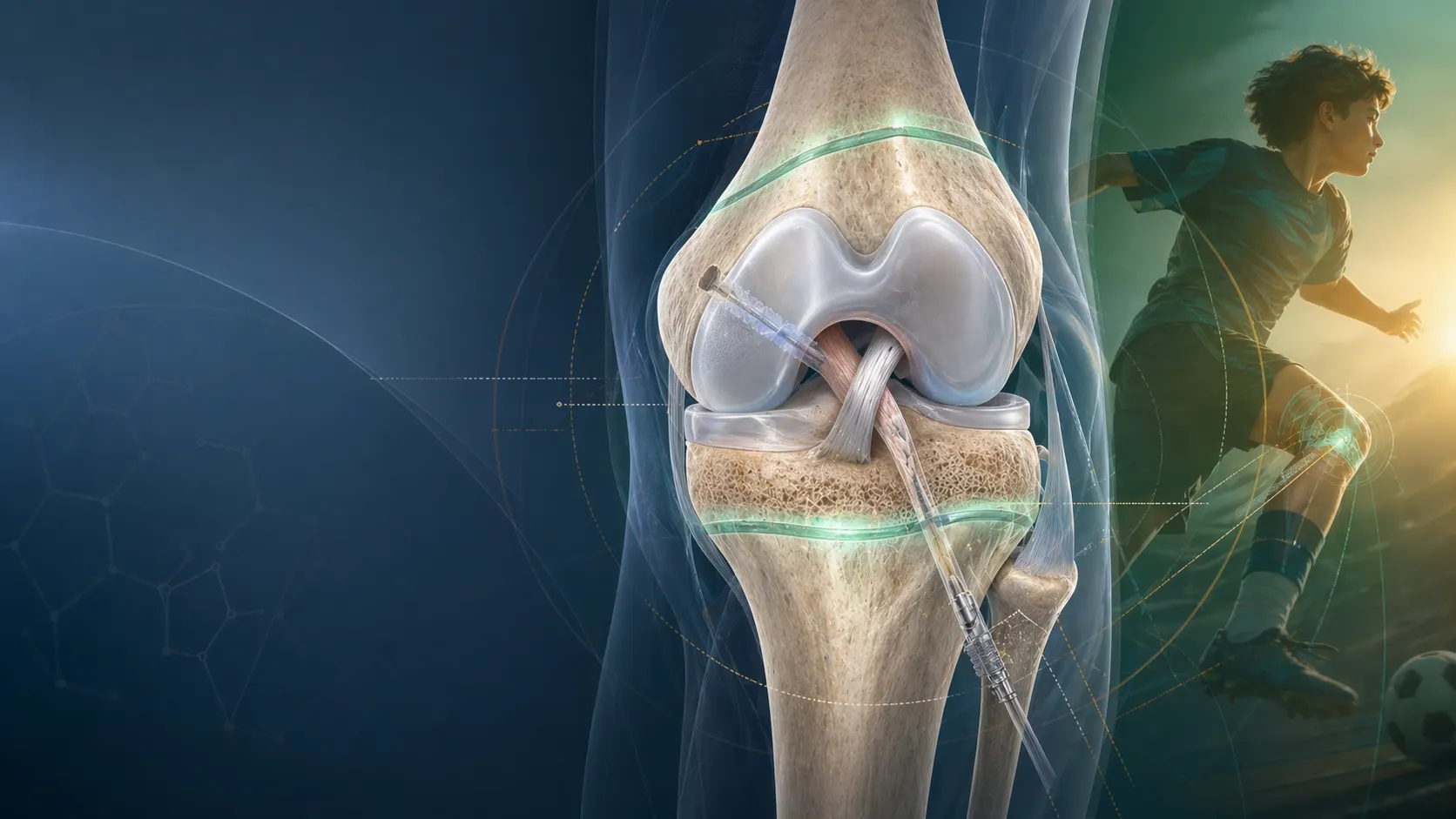
Return to Sport Testing after ACL Reconstruction: Beyond Time
The 'wait 9 months' rule is obsolete. A comprehensive guide to functional testing, limb symmetry indices, and psychological readiness for the ACL athlete.
By OrthoVellum Editorial TeamPublished 9 min read
Educational content for clinicians, not medical advice. Editorial policy

On this page13 sections
For decades, the clearance for Return to Sport (RTS) after Anterior Cruciate Ligament (ACL) reconstruction was based entirely on the calendar. The prevailing surgical dogma was alarmingly simple: "It's been 6 months, the graft has healed, go play."
The result of this time-only approach? A catastrophic secondary ACL injury rate. Studies have consistently demonstrated a re-tear rate of up to 20-30% in young, active athletes returning to pivoting sports. Even more concerning is the incidence of contralateral ACL tears, which often exceeds the rate of ipsilateral graft failure in the early return-to-sport period.
We now understand that Time is a necessary, but entirely insufficient, criterion for safely returning an athlete to the field. While the graft may be biologically maturing (ligamentization), the Neuromuscular Control and dynamic joint stability may be profoundly compromised. The central nervous system essentially "rewires" itself to protect the injured knee, leading to subtle but dangerous compensatory movement patterns. These altered biomechanics place extraordinary stress on both the reconstructed knee and the contralateral limb.
Modern orthopaedic surgery training emphasizes that Return to Sport is not a single event or a date on a calendar. It is a comprehensive, criteria-driven continuum—a battery of objective biological, functional, biomechanical, and psychological tests designed to protect the athlete and the surgical reconstruction.
In this comprehensive guide, we will break down the modern RTS paradigm into actionable criteria that every orthopaedic surgery trainee must understand for fellowship exam preparation and clinical practice.
Part 1: The Biology (Time Criteria and Ligamentization)
Despite our best efforts in aggressive, functional rehabilitation, biology cannot be cheated. The structural properties of an ACL graft undergo a complex, multiphasic biological transformation known as ligamentization.
The Ligamentization Process
When a free tendon graft (whether Bone-Patellar Tendon-Bone, Hamstring, or Quadriceps tendon) is placed into the intra-articular environment, it goes through distinct phases:
- Necrosis: The central core of the graft undergoes ischemic necrosis in the first few weeks. The graft is actually at its weakest mechanically between 6 and 12 weeks post-operatively.
- Revascularization: Synovial fluid provides initial nutrition before intrinsic revascularization occurs from the infrapatellar fat pad and synovium.
- Cellular Proliferation: Fibroblasts repopulate the scaffold.
- Remodeling: The collagen matrix reorganizes in response to mechanical stress.
This process takes at least 9 months to approximate the structural integrity of a native ACL, and human histological studies suggest the remodeling phase continues for up to 2 years.
The "9-Month Rule" and the Evidence
The landmark 2016 study by Grindem et al. fundamentally changed how we counsel patients. They demonstrated that returning to Level 1 sports (jumping, pivoting, hard cutting like soccer or basketball) before 9 months resulted in a significantly higher reinjury rate.
- The Crucial Statistic: For every month RTS was delayed up to 9 months, the reinjury rate was reduced by 51%.
- Athletes who returned to sport before 9 months had a re-injury rate of nearly 40%, compared to roughly 11% for those who waited.
When discussing the biological timeline, remember that allografts undergo a significantly delayed ligamentization process compared to autografts. Due to the sterilization processes (like irradiation) and the lack of living cells, allograft incorporation can take nearly twice as long. If you use an allograft in a young athlete (which is generally discouraged), RTS should be delayed to at least 12-15 months.
Part 2: Clinical Baseline Assessment (The Prerequisites)
Before you even consider putting an athlete through dynamic functional testing, they must pass the clinical prerequisites. If the knee is quiet and functional, they move to the next phase. If not, testing is contraindicated.
- Minimal to No Effusion: Assessed via the modified stroke test. An effusion indicates the joint is not tolerating current loads.
- Full Range of Motion (ROM): Symmetrical hyperextension and flexion compared to the contralateral side. A lack of terminal extension alters gait and quad activation.
- Knee Stability: A negative or 1A Lachman, and a negative pivot shift.
- No Patellofemoral Pain: Essential for tolerating the loading required in plyometric testing.
Part 3: The Function (Physical and Biomechanical Testing)
Once the biological time criteria are met and clinical baselines are established, we must quantify functional readiness. We aim for a Limb Symmetry Index (LSI) of > 90%. This means the injured leg performs at least 90% as well as the uninjured leg.
1. Strength Testing (Objective Quantification)
Manual Muscle Testing (MMT) in the clinic (e.g., asking the patient to push against your hand) is completely inadequate for RTS clearance. The examiner's hand cannot accurately detect a 15-20% strength deficit, which is massive in a high-level athlete. You need objective numbers.
- Isokinetic Dynamometry (Biodex/Cybex): This is the Gold Standard for strength testing. It measures torque at a constant speed (usually 60°/sec for strength and 180°/sec or 300°/sec for power/endurance).
- Quadriceps Strength Target: Peak torque/body weight > 3.0 Nm/kg.
- Hamstring-to-Quad (H:Q) Ratio: Should be > 60% (and ideally closer to 80% at higher speeds). The hamstrings act as a dynamic agonist to the ACL, preventing anterior tibial translation. A weak hamstring relative to the quad is a major risk factor for re-tear.
- Hand-Held Dynamometry (HHD): A cheaper, more accessible alternative to isokinetics. However, to be valid, the dynamometer must be rigidly fixed (e.g., to a table or wall) with a strap. Manual resistance against an HHD will underestimate true peak torque.
2. The Hop Testing Battery (Power & Control)
Hop tests are designed to assess power, neuromuscular control, and confidence in the limb. A standard battery consists of 4 distinct tests, comparing the distance or time of the injured vs. uninjured leg.
- Single Hop for Distance: The athlete stands on one leg, hops forward as far as possible, and must land with control (hold the landing for 2 seconds without putting the other foot down).
- Triple Hop for Distance: Three consecutive maximal hops on the same leg. Tests power endurance and repetitive stretch-shortening cycle control.
- Crossover Hop for Distance: Three consecutive hops crossing back and forth over a central line (typically 15cm wide). This introduces a lateral/medial dynamic stability component.
- 6-Meter Timed Hop: Happing as fast as possible over a 6-meter distance. Measures speed and explosive power.
Passing Criteria: LSI > 90% on all 4 tests.
3. Movement Quality (Video Analysis)
Distance isn't everything. In fact, relying solely on distance is dangerous. An athlete might muscle through a 2-meter hop but land in massive Dynamic Valgus (the knee caving inward). If the biomechanics are poor, the tissue stress is high, and they fail the test regardless of the distance achieved.
- Drop Vertical Jump (DVJ): The athlete drops off a 31cm box, lands with both feet, and immediately performs a maximal vertical jump.
- What to look for: We are assessing the neuromuscular control during the landing phase (eccentric load). Look for knee valgus, asymmetrical weight bearing, ipsilateral trunk lean, and stiff/heavy landings (lack of hip and knee flexion).
- LESS Score (Landing Error Scoring System): A validated clinical tool using video analysis (frontal and sagittal views) to quantify these landing mechanics. A lower score is better; a high score indicates dangerous, high-risk movement patterns.
Part 4: The Psychology (The Head Game)
Perhaps the most overlooked aspect of surgical education and fellowship exam preparation is the psychological state of the injured athlete. The mind is often the hidden killer of an athletic career. An athlete can have tree-trunk quads, perfect hop symmetry, and a pristine MRI, but if they are terrified of pivoting, their risk of injury skyrockets.
Kinesiophobia and Its Consequences
Kinesiophobia is the irrational fear of movement or re-injury. When an athlete lacks confidence in their knee, their motor programming changes:
- They "stiffen" the joint by co-contracting the quad and hamstring excessively.
- They avoid planting heavily on the reconstructed limb.
- They shift their center of mass away from the injured side, chronically overloading the contralateral limb. (This explains the high rate of contralateral ACL tears post-RTS).
Assessing Psychological Readiness
We can no longer just ask, "Do you feel ready?" We must use validated patient-reported outcome measures (PROMs).
- ACL-RSI (Return to Sport after Injury) Scale: The gold standard psychological assessment for this population.
- It is a 12-item questionnaire assessing emotions, confidence in performance, and risk appraisal.
- Score Interpretation: It is scored out of 100.
- A score > 60-65 generally suggests adequate psychological readiness to return to play.
- A score < 50 suggests high fear, poor psychological readiness, and a significantly higher likelihood that the athlete will either not return to their pre-injury level or will suffer a reinjury due to compensatory mechanics.
Part 5: The RTS Decision Continuum
Returning to sport is not a binary "Yes/No" decision made in a single 15-minute clinic visit. It is a phased, progressive continuum of risk management. Orthopaedic surgery training must emphasize this transition.
- Return to Participation: The athlete is cleared for modified practice. This means controlled drills, individual technical work, and strength and conditioning. No contact, no chaotic scrimmages.
- Return to Sport: The athlete is cleared for full, unrestricted practice and match play. They are back in the game, but likely on restricted minutes.
- Return to Performance: The ultimate goal. The athlete is not only playing but performing at or above their pre-injury level of play, without physical or psychological hesitation.
Conclusion: The Ultimate RTS Checklist
Clearance for return to sport is a massive responsibility. It must be a shared decision-making process involving the Orthopaedic Surgeon, the Physiotherapist/Athletic Trainer, and the Athlete.
Do not yield to pressure from coaches, parents, or the calendar. Rely on objective data.
The Mandatory Checklist:
- Time: > 9 months post-operation (longer for allografts or complex multiligamentous injuries).
- Clinical Basics: Full ROM, no effusion, stable ligamentous exam.
- Strength: Isokinetic Quadriceps peak torque > 3.0 Nm/kg and Quad/Hamstring LSI > 90%.
- Function: Hop Test Battery LSI > 90% on all four measures.
- Quality: Excellent dynamic control on video analysis (e.g., passing LESS score during Drop Vertical Jump, no dynamic valgus).
- Psychology: ACL-RSI score > 60.
If the athlete does not pass every single one of these criteria, they do not play. It is that simple. As a surgeon, you must be willing to be the "bad guy" in the short term to save their knee—and their long-term joint health—in the future.
Return to Sport Criteria: Full Topic
Review the complete return-to-sport topic — objective testing batteries, strength and hop-test thresholds, and psychological readiness assessment.
Share this article
Cite this article
OrthoVellum Editorial Team. Return to Sport Testing after ACL Reconstruction: Beyond Time [Internet]. OrthoVellum; 2025 Jan 6 [cited 2026 Oct 4]. Available from: https://www.orthovellum.com/blog/return-to-sport-testing-acl
About this content
Prepared by the OrthoVellum Editorial Team from cited sources, under our editorial policy.
For education and exam preparation; not medical advice or a substitute for clinical judgement and local guidance.
Spotted an error? Tell us; every report is read.
Get new articles by email
New clinical explainers, landmark-trial summaries and exam guidance from the OrthoVellum blog. No account needed; unsubscribe from any email.