OrthoVellum
Knowledge Hub

Study

  • Topics
  • MCQs
  • ISAWE
  • Operative Surgery
  • Flashcards

Company

  • About Us
  • For Training Programs
  • Authors
  • Editorial Policy
  • Editorial Board
  • Content Methodology
  • Advertising Policy
  • Contact
  • FAQ
  • Blog

Legal

  • Terms of Service
  • Privacy Policy
  • Cookie Policy
  • Medical Disclaimer
  • Copyright & DMCA
  • Refund Policy

Support

  • Help Center
  • Accessibility
  • Report an Issue
OrthoVellum

© 2026 OrthoVellum. For educational purposes only.

Not affiliated with the Royal Australasian College of Surgeons.

Back to Operative Surgery
Adult Reconstruction

Posterolateral Approach to the Knee

Comprehensive guide to the posterolateral approach to the knee for FRCS exam preparation

Core Procedure
intermediate
By OrthoVellum Medical Education Team

Reviewed by OrthoVellum Editorial Team

Orthopaedic clinicians and medical editors • Published by OrthoVellum Medical Education Team

Editorial boardMethodologyReview policyReport a correction
High Yield Overview

POSTEROLATERAL KNEE APPROACH

PLC Reconstruction | Tibial Plateau | CPN Protection

PLPosterolateral corner
CPNCommon peroneal nerve
Biceps-ITInterval
Lat PlateauFracture access

Uses

PLC
PatternReconstruction/repair
TreatmentLCL, popliteus, PFL
Fracture
PatternLateral tibial plateau
TreatmentPosterior column fixation
Tumor
PatternLateral access
TreatmentProximal fibula, lateral tibia

Critical Must-Knows

  • Common peroneal nerve is critical structure at risk
  • CPN wraps around fibular neck ~2-3cm distal to head
  • Interval: Between biceps femoris and iliotibial band
  • Access to LCL, popliteus, posterolateral capsule
  • Protect CPN with knee flexion (relaxes nerve)

Examiner's Pearls

  • "
    CPN is most commonly injured nerve at knee
  • "
    Identify and protect CPN before any deep dissection
  • "
    May need to mobilize CPN for wider exposure
  • "
    Can extend distally (access fibula, lateral tibia)

Critical Posterolateral Knee Approach Points

Common Peroneal Nerve

Most commonly injured nerve at knee. Palpable behind biceps tendon. Winds around fibular neck ~2-3cm distal to head. Identify and protect before deep dissection.

Interval

Between biceps femoris (posterior) and iliotibial band (anterior). Both structures insert on fibular head/Gerdy's tubercle area.

Structures Accessed

LCL, popliteus tendon, posterolateral capsule, arcuate ligament, popliteofibular ligament. Lateral tibial plateau (posterior column).

Knee Flexion

Flexing the knee relaxes the CPN and makes dissection safer. Position the knee in 45-90° flexion during dissection around the posterolateral corner.

At a Glance

The posterolateral approach to the knee provides access to the posterolateral corner (PLC), lateral tibial plateau, and proximal fibula through the interval between biceps femoris (posterior) and iliotibial band (anterior). The common peroneal nerve (CPN) is the critical structure at risk—it wraps around the fibular neck 2-3cm distal to the head and must be identified early before deep dissection. Knee flexion to 45-90° relaxes the CPN and facilitates safer dissection. Primary indications include PLC reconstruction (LCL, popliteus, popliteofibular ligament), lateral tibial plateau fractures (posterior column), and peroneal nerve exploration. The approach can be extended distally for fibular access.

Mnemonic

FIBCPN Safety

F
Fibular neck
Nerve wraps around here
I
Identify early
Before deep dissection
B
Biceps tendon
Nerve is just posterior to this

Memory Hook:FIB = Fibular neck, Identify early, Behind Biceps!

Indications and Position

Indications:

  • Posterolateral corner (PLC) reconstruction/repair
  • LCL reconstruction
  • Lateral tibial plateau fractures (posterior column)
  • Biceps tendon repair
  • Proximal fibula excision/biopsy
  • Peroneal nerve exploration

Patient Position:

  • Supine with bump under contralateral hip
  • Lateral decubitus
  • Knee flexed 45-90° during dissection

Overview

Posterolateral Knee Approach Overview

The posterolateral approach provides essential exposure for the posterolateral corner (PLC), lateral tibial plateau, and peroneal nerve.

Key Concepts:

  • Access to posterolateral corner structures (LCL, popliteus, PFL)
  • Common peroneal nerve (CPN) is critical structure at risk
  • Interval between biceps femoris and iliotibial band
  • Essential for multiligament knee injury management
  • Can be extended distally for proximal fibula access

Historical Context:

  • PLC anatomy described by LaPrade and colleagues
  • Anatomic reconstruction techniques now standard
  • Recognition that PLC injuries often missed leading to ACL/PCL failure

Indications

IndicationDetails
PLC reconstructionLCL, popliteus, popliteofibular ligament
LCL repair/reconstructionIsolated or combined injuries
Lateral tibial plateau fracturePosterior column access, Schatzker II, VI
Biceps femoris avulsionDirect repair or reconstruction
Proximal fibula pathologyTumor, osteomyelitis, fracture
Peroneal nerve explorationPalsy, entrapment, repair
Arcuate ligament repairCombined with PLC procedures
Lateral capsule repairAvulsion injuries

Advantages and Disadvantages

Advantages:

  • Direct access to all PLC structures
  • Allows anatomic tunnel placement for reconstruction
  • Can be extended distally for fibular access
  • Combines well with other knee approaches
  • Good visualization of lateral plateau

Disadvantages:

  • Common peroneal nerve at risk (most commonly injured nerve at knee)
  • Learning curve for anatomic identification
  • Limited access to medial structures
  • Prone positioning may be required for some techniques
  • Risk of lateral wound complications

Anatomy

Surface Anatomy

Palpable Landmarks:

  • Fibular head: Key landmark, palpable posterolaterally
  • Biceps femoris tendon: Inserts on fibular head
  • Lateral femoral epicondyle: LCL origin
  • Iliotibial band: Palpable anterolaterally
  • Common peroneal nerve: Palpable behind biceps

Incision Planning:

LandmarkPosition
Proximal extent5 cm above joint line
CenterOver fibular head
Distal extentAlong fibular neck
OrientationCurved or oblique

Posterolateral Corner Anatomy

Primary Stabilizers (LaPrade Classification):

StructureFunction
LCL (fibular collateral)Primary varus restraint
Popliteus tendonExternal rotation restraint
Popliteofibular ligamentConnects popliteus to fibula

Secondary Structures:

  • Arcuate ligament
  • Fabellofibular ligament
  • Posterolateral capsule
  • Lateral gastrocnemius tendon

Isometric Points:

  • LCL femoral origin: 1.4mm proximal and 3.1mm posterior to lateral epicondyle
  • Popliteus: Anterior to LCL in popliteal groove

Common Peroneal Nerve Course

Anatomical Relationships:

  • Lies posterior to biceps femoris tendon at knee
  • Winds around fibular neck 2-3 cm distal to head
  • Divides into deep and superficial branches at neck
  • Tethered at fibular neck (vulnerable to stretch)

CPN Safety Zone:

LocationDistance from Fibular Head
Safe zoneProximal to fibular head
Danger zone2-4 cm distal to head
Nerve divisionAt fibular neck

Clinical Pearl:

  • Knee flexion relaxes the nerve
  • Identify CPN before any deep dissection
  • May need to mobilize for wider exposure

Classification

Posterolateral Approach Variations

VariationDescriptionIndication
Standard posterolateralBiceps-ITB intervalPLC reconstruction
Extended posterolateralIncludes fibular neck exposureCPN exploration, fibula access
Posterolateral + lateralCombined for plateauBicondylar fractures
Fibular head excisionThrough posterolateralProximal fibula tumors

Interval Options:

  • Anterior: ITB to biceps (main working interval)
  • Posterior: Biceps to lateral gastrocnemius (deeper access)

PLC Injury Classification

Fanelli Classification:

TypeDescription
Type AFibular head avulsion
Type BMidsubstance tear
Type CFemoral avulsion

Injury Patterns:

  • Isolated PLC injury (rare, 2%)
  • Combined PLC + ACL (more common)
  • Combined PLC + PCL (knee dislocation)
  • Combined PLC + ACL + PCL (multiligament)

Severity:

  • Grade I: Sprain, no laxity
  • Grade II: Partial tear, mild laxity
  • Grade III: Complete tear, significant laxity

History

Preoperative History

Mechanism of Injury:

  • Direct blow to anteromedial tibia (varus force)
  • Hyperextension injury
  • Contact sports, motor vehicle accident
  • Low-velocity: isolated PLC; High-velocity: multiligament

Key History Elements:

ElementSignificance
Instability"Giving way" with pivoting, stairs
Pain locationPosterolateral knee
SwellingOften minimal with isolated PLC
Neurological symptomsFoot drop, numbness (CPN injury)
Previous surgeryACL/PCL failure may indicate missed PLC

Examination

Physical Examination

Observation:

  • Varus thrust during gait (lateral thrust)
  • Recurvatum with standing
  • Swelling, ecchymosis posterolaterally

Palpation:

  • Tenderness over fibular head
  • LCL along its course
  • Biceps femoris tendon

Neurovascular:

  • Essential: Check CPN function
  • Ankle dorsiflexion, toe extension (deep peroneal)
  • First web space sensation
  • Foot eversion (superficial peroneal)

Special Tests for PLC

TestTechniquePositive Finding
Varus stress 30°Varus force at 30° flexionIncreased opening = LCL tear
Dial testCompare ER 30° and 90°Increased ER 30° = PLC
Posterolateral drawerPosterolateral translationIncreased = PLC
Reverse pivot shiftExtension to flexionClunk = PLC
External rotation recurvatumGravity ER and extensionPositive = PLC + possible PCL

Dial Test Interpretation:

  • Increased at 30° only: Isolated PLC
  • Increased at 30° and 90°: Combined PLC + PCL

Investigations

Imaging Studies

Radiographs:

ViewFinding
APSegond fracture (pathognomonic), fibular head avulsion
LateralArcuate sign (fibular head avulsion)
Stress viewsVarus opening, increased ER
Long legVarus alignment assessment

MRI (Gold Standard):

  • LCL tear: Location and quality
  • Popliteus tendon: Musculotendinous vs insertion
  • Popliteofibular ligament: Often difficult to visualize
  • Associated injuries: ACL, PCL, meniscal
  • Bone bruise pattern: Posteromedial (varus injury)

Special Studies

Vascular Assessment:

  • Mandatory for knee dislocations
  • CT angiography if concern
  • ABI (ankle-brachial index)

Nerve Conduction Studies:

  • If CPN palsy present
  • Baseline before surgery
  • Helps with prognosis

EUA/Arthroscopy:

  • Examine under anesthesia confirms laxity
  • Arthroscopy: Rule out associated injury
  • "Drive-through" sign lateral compartment

Management

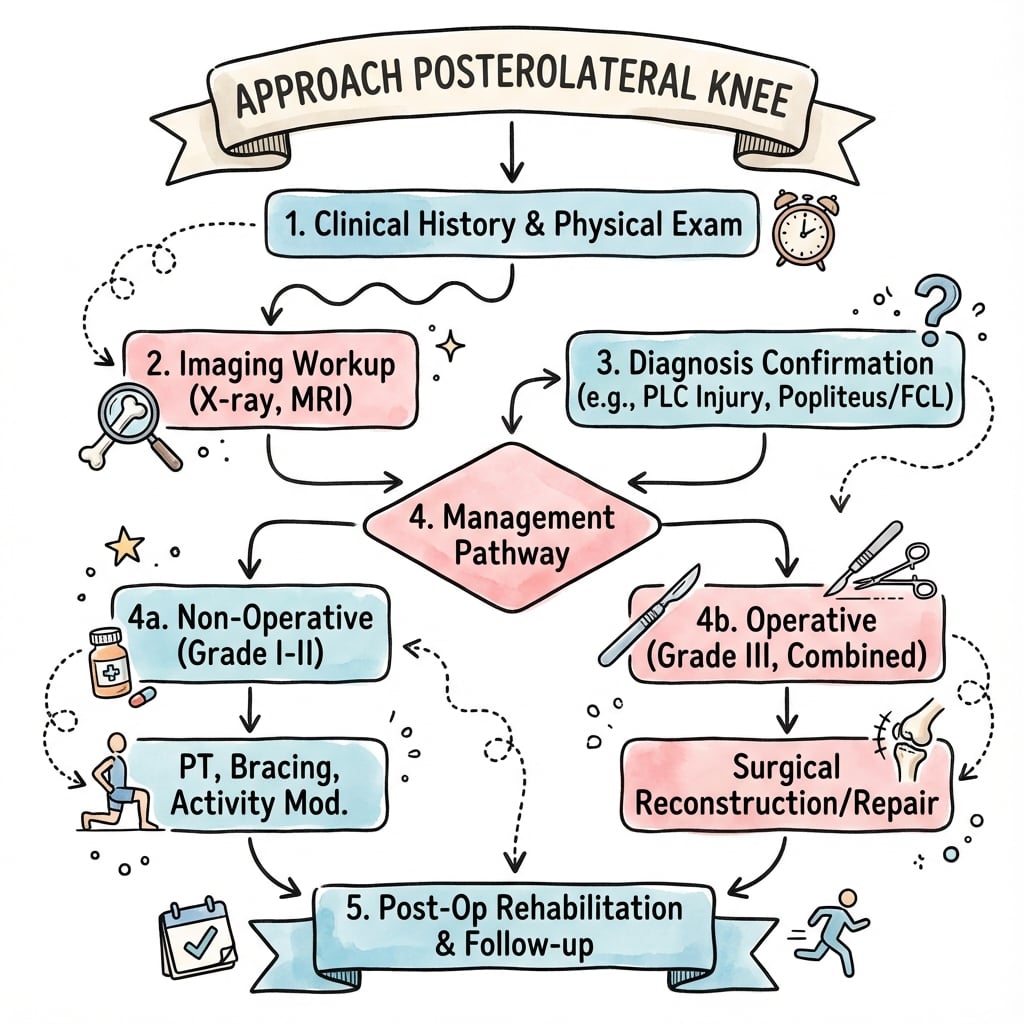
📊 Management Algorithm
Management algorithm for Approach Posterolateral Knee
Click to expand
Management algorithm for Approach Posterolateral KneeCredit: OrthoVellum

Non-operative Management

Indications:

  • Grade I, II injuries
  • Elderly, low-demand patients
  • Significant comorbidities

Protocol:

PhaseManagement
Acute (0-2 weeks)Hinged brace, protected weight bearing
Intermediate (2-6 weeks)ROM exercises, quadriceps strengthening
Late (6-12 weeks)Progressive strengthening, proprioception

Bracing:

  • Hinged knee brace locked in extension initially
  • Progress ROM as healing occurs
  • Long-term lateral unloader brace if residual varus

Operative Management

Indications:

  • Grade III PLC injuries
  • Combined ligament injuries
  • Functional instability
  • Young, active patients

Timing:

  • Acute repair: within 2-3 weeks (if reparable)
  • Delayed reconstruction: after 3 weeks
  • Combined injuries: address all ligaments

Graft Options:

GraftIndication
Allograft AchillesLCL reconstruction
Semitendinosus/gracilisPFL, combined
Split bicepsPopliteus reconstruction
ITB stripLCL augmentation

Surgical Technique Principles

CPN Protection:

  • Identify early in approach
  • Knee flexion relaxes nerve
  • May need to mobilize nerve
  • Consider prophylactic release

Tunnel Placement:

  • Anatomic isometric points critical
  • Fluoroscopic guidance helpful
  • Avoid tunnel convergence

Fixation:

  • Interference screws in tunnels
  • Suture anchors for avulsions
  • Tension at 30-60° flexion, neutral rotation

Combined Injuries:

  • Reconstruct PLC before ACL/PCL
  • Prevents rotational instability
  • Stage if needed for wound healing

Surgical Technique

Incision: Curved incision over posterolateral knee, centered on fibular head. Approximately 8-12cm.

Interval: Develop between iliotibial band (anterior) and biceps femoris (posterior).

CPN Identification: Critical first step. Palpate CPN behind biceps tendon. Identify and protect. The nerve winds around the fibular neck 2-3cm distal to the fibular head.

Knee Flexion: Keep knee flexed to relax CPN.

LCL: Identified running from lateral femoral epicondyle to fibular head.

Popliteus Tendon: Deep to LCL, courses from popliteal groove to posteromedial tibia.

Posterolateral Capsule: Incise to access joint if needed.

Arcuate Complex: Arcuate ligament, popliteofibular ligament identified.

Lateral Gastrocnemius: May need to release for wider exposure distally.

For PLC reconstruction, this approach allows:

  • Identification of torn structures
  • Tunnel placement in fibula and femur
  • Graft passage for LCL and popliteofibular ligament reconstruction
  • Access to lateral femoral condyle for isometric point

Structures at Risk

Critical Structures

Common Peroneal Nerve (CPN): Posterior to biceps tendon, winds around fibular neck. Most commonly injured nerve at knee. Injury causes foot drop. Identify and protect in all cases.

Lateral Inferior Genicular Artery: May be encountered deep in dissection.

Popliteal Vessels: Lie medially but at risk with deep dissection toward joint.

Complications

Common Peroneal Nerve Injury

Risk Factors:

  • Preoperative CPN palsy (traction injury)
  • Varus malalignment
  • Revision surgery
  • Inadequate nerve protection

Presentation:

DeficitNerve Affected
Foot drop (dorsiflexion weakness)Deep peroneal
Toe extension weaknessDeep peroneal
First web space numbnessDeep peroneal
Lateral leg/foot numbnessSuperficial peroneal
Eversion weaknessSuperficial peroneal

Management:

  • Observation: Most neurapraxias recover
  • EMG/NCS at 6 weeks, 3 months
  • AFO for foot drop
  • Exploration if no recovery at 3-6 months

Other Complications

ComplicationIncidenceManagement
Wound complications5-10%Debridement, VAC if severe
Infection1-2%Antibiotics, washout
Haematoma3-5%Aspiration, drainage
Stiffness5-15%Physiotherapy, MUA
DVT1-3%Prophylaxis protocol
Residual instability10-20%Revision, brace

Prevention:

  • Meticulous hemostasis
  • Careful wound closure
  • VTE prophylaxis
  • Early mobilization when safe

Graft Failure

Causes:

  • Non-anatomic tunnel placement
  • Inadequate graft tensioning
  • Failure to address alignment
  • Missed combined injuries
  • Aggressive rehabilitation

Risk Factors:

  • Varus alignment (unaddressed)
  • Combined ACL/PCL injury
  • High-demand activity return
  • Revision surgery

Management:

  • Identify cause of failure
  • Address alignment (HTO if varus)
  • Revision reconstruction
  • Consider allograft vs autograft

Postoperative Care

Immediate Postoperative Care

Day 0-1:

  • Hinged brace locked in extension
  • Ice, elevation
  • DVT prophylaxis
  • Check CPN function (critical)

Protection Phase (Weeks 0-6):

WeekActivity
0-2Brace locked extension, NWB or TTWB
2-4Brace 0-90°, TTWB
4-6Brace 0-120°, progress WB

Key Points:

  • Protect graft healing
  • Avoid varus stress
  • Check wound, neurovascular status

Rehabilitation Protocol

Phase 1 (0-6 weeks):

  • Quad sets, SLR (brace locked)
  • Patellar mobilization
  • No active hamstring exercises

Phase 2 (6-12 weeks):

  • Progress ROM to full
  • Closed chain exercises
  • Proprioception training
  • Stationary cycling

Phase 3 (3-6 months):

  • Full weight bearing
  • Progressive strengthening
  • Sport-specific training
  • Pool exercises

Return to Sport:

  • Typically 9-12 months
  • Must pass functional testing
  • Gradual return to contact

Follow-up Schedule

TimeframeAssessment
2 weeksWound, CPN function, ROM
6 weeksROM, laxity, radiographs
3 monthsStability, strength, function
6 monthsFunctional testing, sport prep
12 monthsFull assessment, return to sport
AnnuallyLong-term surveillance

Red Flags:

  • New onset foot drop
  • Recurrent instability
  • Wound breakdown
  • Increasing pain
  • Loss of motion

Outcomes

Functional Outcomes

PLC Reconstruction Results:

OutcomeResult
Stability restoration80-90%
Return to sport (any level)70-80%
Return to previous level50-60%
Patient satisfaction75-85%
Residual laxity10-20%

Scoring Outcomes:

  • Lysholm score: Average improvement 30-40 points
  • IKDC: Majority achieve normal/near-normal
  • Tegner: Often reduced by 1-2 levels

Acute Repair vs Reconstruction

OutcomeAcute RepairReconstruction
Stability70-80%80-90%
StiffnessLessMore
Technical easeEasierMore complex
Tissue qualityVariableGraft dependent
TimingWithin 2-3 weeksDelayed OK

Evidence:

  • Recent data favors anatomic reconstruction
  • Repair alone has higher failure rate
  • Combined repair/augmentation may be optimal

Prognostic Factors

Favorable:

  • Isolated PLC injury
  • Acute treatment
  • Normal alignment
  • No preoperative CPN palsy
  • Anatomic reconstruction technique

Unfavorable:

  • Combined multiligament injury
  • Chronic injury (more than 3 weeks)
  • Varus alignment (uncorrected)
  • CPN palsy at presentation
  • Previous failed surgery

Alignment Considerations:

  • Address varus with HTO
  • Lateral compartment overload leads to failure
  • Correct alignment before or with PLC reconstruction

Evidence Base

Key Studies

StudyYearFinding
LaPrade et al2003Described anatomic PLC landmarks
Stannard et al2005Repair vs reconstruction outcomes
Levy et al2010Anatomic reconstruction technique
Kim et al2011Single vs double bundle PLC
Geeslin et al2016Long-term reconstruction outcomes

Level of Evidence:

  • Mostly Level III-IV studies
  • Few RCTs in PLC literature
  • Anatomic techniques now preferred (expert consensus)
  • Biomechanical studies support anatomic reconstruction

Technique Evolution

Historical:

  • Early: Biceps tenodesis (non-anatomic)
  • 1990s: Larson technique
  • 2000s: Anatomic reconstruction (LaPrade)

Current Standard:

  • Anatomic reconstruction of LCL + popliteus + PFL
  • Allograft most common for adults
  • Address alignment concurrently
  • Combined staging for multiligament

Future Directions:

  • Patient-specific tunnel planning
  • Improved graft materials
  • Accelerated rehabilitation protocols
  • Better outcome measures for rotational stability

Exam Viva Scenarios

Practice these scenarios to excel in your viva examination

VIVA SCENARIOStandard

Scenario 1: Posterolateral Knee Approach

EXAMINER

"Describe the posterolateral approach to the knee and how you protect the common peroneal nerve."

EXCEPTIONAL ANSWER
The posterolateral approach to the knee is used primarily for posterolateral corner (PLC) reconstruction, LCL surgery, and lateral tibial plateau fractures. The patient is positioned supine with a bump under the contralateral hip to externally rotate the leg, or in lateral decubitus. I keep the knee flexed 45-90° during dissection as this relaxes the common peroneal nerve. The incision is curved, centered over the fibular head. The interval is between the iliotibial band anteriorly and biceps femoris posteriorly. The critical first step is identification and protection of the common peroneal nerve. The CPN is palpable just posterior to the biceps tendon. It winds around the fibular neck approximately 2-3cm distal to the fibular head. This is the most commonly injured nerve at the knee and damage causes foot drop. I identify it early before any deep dissection and protect it throughout. With the nerve protected, I can access the lateral collateral ligament running from the lateral femoral epicondyle to the fibular head, the popliteus tendon, the arcuate complex including the popliteofibular ligament, and the posterolateral capsule. For PLC reconstruction, I would create tunnels in the fibula and lateral femur and pass grafts to reconstruct the LCL and popliteofibular ligament. The approach can be extended distally for access to the proximal fibula and lateral tibia.
KEY POINTS TO SCORE
CPN is critical structure to protect
Identify CPN behind biceps tendon before deep dissection
Keep knee flexed to relax CPN
Interval: IT band - biceps femoris
COMMON TRAPS
✗Not identifying CPN first
✗Not knowing course of CPN (fibular neck)
✗Operating with knee extended (tethers CPN)
LIKELY FOLLOW-UPS
"What happens if you injure the CPN?"
"What structures of the PLC would you reconstruct?"
VIVA SCENARIOChallenging

Scenario 2: PLC Reconstruction Tunnel Placement - Technical Decision-Making

EXAMINER

"You are performing an anatomic posterolateral corner reconstruction in a 28-year-old rugby player who sustained a grade III PLC injury 5 weeks ago (varus stress with hyperextension mechanism). MRI shows complete tears of the LCL, popliteus tendon, and popliteofibular ligament. He has an associated ACL tear which you plan to reconstruct in a staged procedure after the PLC has healed. You have successfully exposed the posterolateral corner via the standard approach (IT band-biceps interval), identified and protected the common peroneal nerve, and prepared your allograft (Achilles tendon allograft for LCL reconstruction, hamstring allograft for popliteofibular ligament). You are now preparing to drill your femoral tunnels for the LCL and popliteus reconstructions. You need to place two femoral tunnels: one for the LCL at the lateral femoral epicondyle, and one for the popliteus tendon in the popliteal groove. Your assistant asks about the exact anatomic location for these tunnels and expresses concern about tunnel convergence (tunnels being too close together risking fracture). How do you determine the isometric points for tunnel placement and how do you avoid tunnel convergence?"

EXCEPTIONAL ANSWER
This requires precise understanding of the anatomic landmarks for PLC reconstruction based on the work of LaPrade and colleagues who defined the isometric points for anatomic PLC reconstruction. For the LCL femoral tunnel: The isometric point is 1.4mm proximal and 3.1mm posterior to the lateral femoral epicondyle. I use the lateral epicondyle as my primary landmark - I can palpate this prominently on the lateral femoral condyle. Using fluoroscopy, I place a guide wire at this precise location (1.4mm proximal, 3.1mm posterior to the center of the epicondyle). For the popliteus femoral tunnel: This is located in the popliteal groove (popliteal sulcus) which lies anterior and distal to the LCL insertion. The popliteal groove is approximately 18mm anterior to the LCL femoral insertion when measured along the joint line. I identify the popliteal groove by palpation (it's a depression in the lateral femoral condyle anterior to the epicondyle) and confirm with fluoroscopy. Regarding tunnel convergence: This is a legitimate concern as placing two femoral tunnels in close proximity risks fracture or tunnel coalescence. The key is the different depths and orientations of the tunnels. The LCL tunnel is drilled from lateral to medial aiming toward the opposite cortex (trans-femoral tunnel), while the popliteus tunnel is typically shorter and oriented differently (can be socket or trans-femoral depending on technique). I use fluoroscopy in both AP and lateral planes to visualize tunnel trajectories before drilling. I ensure at least 5-10mm of bone bridge between the tunnels to prevent convergence. If using interference screws, I plan tunnel diameter accordingly (typically 7-9mm tunnels with corresponding interference screws). An alternative technique to avoid convergence is using the 'LaPrade technique' with separate smaller tunnels, or using cortical suspensory fixation which allows smaller tunnels. For fibular tunnel placement: I drill a tunnel in the fibular head for the LCL distal insertion (anatomic insertion site on posterolateral fibular head) and a separate tunnel for the popliteofibular ligament if doing anatomic reconstruction. After tunnel preparation, I pass the grafts: LCL graft from femoral epicondyle to fibular head, and popliteofibular graft from popliteal groove to fibular insertion. I tension and fix the grafts with the knee at 30-60° of flexion in neutral rotation - this is critical as the PLC structures are isometric at this position. I use interference screw fixation in the tunnels (typically 7-8mm screws), ensuring the grafts are tensioned appropriately to restore varus and rotational stability without over-constraining the knee. Intraoperatively I check knee stability with varus stress testing and dial test to confirm adequate reconstruction.
KEY POINTS TO SCORE
LCL femoral isometric point - 1.4mm proximal and 3.1mm posterior to lateral epicondyle (LaPrade anatomic study): Use lateral epicondyle as primary landmark (palpable, visible on fluoroscopy), place guide wire at precise location under fluoroscopic guidance, drill trans-femoral tunnel from lateral to medial; Popliteal groove location - 18mm anterior to LCL insertion along joint line, identify by palpation (depression in lateral femoral condyle), confirm with fluoroscopy
Tunnel convergence prevention - maintain 5-10mm bone bridge between tunnels: LCL tunnel drilled trans-femoralally lateral-to-medial, popliteus tunnel at different depth and orientation (can be socket or trans-femoral), fluoroscopy in AP and lateral planes essential to visualize trajectories; Typical tunnel diameter 7-9mm for interference screw fixation; Alternative: cortical suspensory fixation allows smaller tunnels
Fibular tunnel placement - LCL inserts on posterolateral fibular head: Drill tunnel in fibular head for LCL distal insertion, separate tunnel for popliteofibular ligament if anatomic reconstruction; Protect CPN during fibular drilling (nerve wraps around fibular neck 2-3cm distal); Use fluoroscopy to confirm tunnel position
Graft tensioning and fixation critical - tension at 30-60° knee flexion, neutral rotation: PLC structures isometric at this position (biomechanical studies), interference screw fixation in tunnels (7-8mm screws typical), ensure adequate tension to restore varus/rotational stability without over-constraint; Check intraoperative stability with varus stress and dial test
Staged vs concurrent ACL reconstruction - PLC before ACL is standard: Untreated PLC injury causes ACL graft failure (rotational instability overloads ACL graft, 30-40% failure rate if PLC not addressed); Options: (1) Stage PLC first, ACL 8-12 weeks later (allows PLC healing, reduces stiffness risk), (2) Concurrent reconstruction (longer surgery, higher stiffness risk); Most surgeons favor staging for combined injuries
COMMON TRAPS
✗Drilling femoral tunnels without identifying anatomic landmarks - non-anatomic tunnel placement common technical error; Must use LaPrade's defined isometric points (1.4mm proximal, 3.1mm posterior to epicondyle for LCL, popliteal groove for popliteus); Non-anatomic placement leads to graft failure, recurrent instability
✗Not using fluoroscopy for tunnel placement - blind drilling risks malposition, tunnel convergence, cortical breach; Fluoroscopy in AP and lateral planes essential to visualize landmarks, confirm trajectory, assess bone bridge between tunnels; Anatomic variation exists requiring intraoperative assessment
✗Inadequate bone bridge between tunnels (less than 5mm) - risks tunnel coalescence or femoral fracture; LCL and popliteus tunnels in close proximity on lateral femoral condyle; Must plan tunnel trajectories to maintain bone bridge; If concerned, consider cortical suspensory fixation or modified techniques
✗Incorrect graft tensioning position - tensioning in full extension or excessive flexion causes non-isometric reconstruction; Must tension at 30-60° flexion, neutral rotation (isometric position for PLC structures); Biomechanical studies show lengthening/slackening outside this range; Wrong tension causes either over-constraint (stiffness, graft failure) or under-constraint (residual instability)
✗Not staging ACL reconstruction - concurrent PLC + ACL increases stiffness risk, technically demanding, prolonged surgical time; Standard approach: PLC reconstruction first, allow 8-12 weeks healing, then ACL reconstruction; Untreated PLC causes ACL graft failure; Examiner expects knowledge of staging rationale
LIKELY FOLLOW-UPS
"What are the isometric points for PLC reconstruction according to LaPrade?"
"How would you modify your technique if you were concerned about tunnel convergence?"
"What position do you tension the PLC grafts and why?"
"Would you reconstruct the ACL at the same time or stage it, and what is your reasoning?"
VIVA SCENARIOCritical

Scenario 3: Iatrogenic Common Peroneal Nerve Injury - Critical Complication Management

EXAMINER

"You are performing a posterolateral corner reconstruction in a 32-year-old motorbike accident victim who sustained a knee dislocation 3 weeks ago (multiligament injury: ACL, PCL, and PLC all torn, vascular injury ruled out, no baseline neurological deficit). You have made your posterolateral approach through the IT band-biceps interval and identified the common peroneal nerve posterior to the biceps tendon. The nerve appears normal and you have been protecting it with a Penrose drain looped around it. You are now drilling the fibular tunnel for the LCL insertion. Despite careful technique, your drill suddenly advances more than expected and you feel a 'pop'. On inspection, you realize the drill has partially transected the common peroneal nerve - approximately 40-50% of the nerve diameter has been cut by the drill, with nerve continuity maintained in the remaining fascicles. The patient begins moving his foot spontaneously under anesthesia. You have not yet completed the PLC reconstruction and still need to address the ACL and PCL in a staged procedure. How do you manage this intraoperative CPN injury and what are the implications for the patient's outcome?"

EXCEPTIONAL ANSWER
This is a devastating iatrogenic nerve injury requiring immediate recognition, documentation, repair, and honest post-operative counseling. Common peroneal nerve injury is the most feared complication of the posterolateral approach, and iatrogenic injury during surgery is associated with worse outcomes than pre-existing traumatic injuries. My immediate management: (1) I would immediately stop drilling and assess the extent of nerve injury. In this case, I have a partial nerve transection (40-50% diameter) with continuity maintained in remaining fascicles. This is a Sunderland grade IV-V injury depending on whether the remaining fascicles are intact (grade IV) or if there is complete loss of continuity requiring re-anastomosis (grade V). (2) I would inform my assistant and anaesthetist of the complication, request microsurgical instruments if available (loupes at minimum, ideally operating microscope), and prepare for nerve repair. The key decision is whether to repair NOW intraoperatively, or to plan delayed nerve repair with a specialist peripheral nerve surgeon. The gold standard is immediate primary repair if the surgeon is competent in microsurgical nerve repair - acute repair within 72 hours has better outcomes than delayed repair. (3) For nerve repair technique: I would sharply debride the damaged nerve ends back to healthy fascicular architecture (may need to convert this to a complete transection to get clean ends for repair). I would perform primary neurorrhaphy using 8-0 or 9-0 nylon sutures under magnification (loupes minimum 2.5-3.5x, ideally microscope). The repair should be tension-free - if there is a nerve gap greater than 2-3cm after debridement, primary repair is not feasible and I would need nerve grafting (sural nerve autograft) or conduit. In this case, with partial transection, I may be able to preserve the intact fascicles and repair only the damaged portion, which has better outcomes than complete transection repair. (4) After nerve repair is secured, I face the critical decision of whether to complete the PLC reconstruction. The options are: (A) Complete the PLC reconstruction as planned - risks additional nerve trauma from continued dissection, graft passage, and fixation. The nerve repair may be compromised by further manipulation. (B) Abort the PLC reconstruction and stage it for later - requires second surgery exposing patient to additional anesthetic and surgical risks, but protects the nerve repair. (C) Modify the PLC reconstruction to a less invasive technique - e.g., simplified reconstruction avoiding the area of nerve injury. My approach: I would complete a modified PLC reconstruction avoiding further dissection near the nerve repair. This likely means completing the LCL and popliteus reconstruction using alternative fixation methods (e.g., suture anchors rather than fibular tunnel if that was the site of injury), and protecting the nerve repair site. I would NOT abort the procedure entirely as the PLC instability must be addressed to prevent ACL/PCL graft failure. However, I would modify my technique to minimize risk to the nerve. (5) Post-operatively: I must immediately inform the patient and family of the nerve injury when the patient wakes up. Documentation in the operation note must be meticulous: exact nature of injury, repair performed, prognosis discussed. I would examine CPN function immediately post-op (ankle dorsiflexion, toe extension, first web space sensation, foot eversion). If there is complete foot drop (expected given the injury), I would provide an ankle-foot orthosis (AFO) and refer to physiotherapy for foot drop management. I would arrange baseline EMG/NCS at 3-6 weeks (too early immediately post-op), and serial studies at 3 months, 6 months, and 12 months to monitor for reinnervation. Prognosis counseling: Iatrogenic CPN injury with partial transection repaired primarily has approximately 40-60% chance of meaningful recovery (grade 3 or better motor function) but full recovery is rare. Complete motor recovery occurs in only 10-20% of cases. Recovery timeline if it occurs is 6-12 months minimum (regeneration rate 1-2mm per day, so for CPN to reinnervate tibialis anterior approximately 20-25cm distance requires 100-125 days minimum, plus additional time for functional recovery). Many patients are left with permanent foot drop requiring long-term AFO. If there is no recovery by 12 months, I would consider tendon transfers (tibialis posterior transfer to dorsum of foot) or ankle fusion for salvage. Regarding the multiligament reconstruction plan: This complication may alter my surgical staging. I would likely delay the ACL/PCL reconstruction for longer (3-6 months rather than 8-12 weeks) to allow nerve healing and determine CPN recovery trajectory before subjecting the patient to further knee surgery. Prevention is key: This injury could have been prevented by (1) better CPN mobilization before fibular drilling, (2) using a drill guide or fluoroscopic guidance for tunnel placement, (3) drilling with incremental depth checks, (4) protecting the nerve with retractors during drilling. The fact that the nerve was looped with Penrose suggests I identified it, but clearly protection was inadequate during the critical step of fibular tunnel drilling.
KEY POINTS TO SCORE
Immediate recognition and primary repair - acute repair within 72 hours superior to delayed: Partial nerve transection (40-50% diameter) = Sunderland grade IV-V injury depending on remaining fascicle integrity; Sharply debride damaged ends to healthy fascicular architecture, may need to convert to complete transection for clean repair; Primary neurorrhaphy with 8-0 or 9-0 nylon under magnification (loupes 2.5-3.5x minimum, microscope ideal); Tension-free repair essential - nerve gap greater than 2-3cm requires grafting (sural nerve autograft) or conduit
Intraoperative decision: complete, modify, or abort PLC reconstruction: Completing reconstruction risks additional nerve trauma from continued dissection; Aborting requires second surgery with additional risks; Optimal approach: modified PLC reconstruction avoiding nerve repair area - alternative fixation (suture anchors instead of fibular tunnel if injury site), protecting nerve repair; Must address PLC instability to prevent ACL/PCL graft failure (staged) but minimize nerve trauma
Post-operative management - immediate patient disclosure, meticulous documentation, serial monitoring: Inform patient/family immediately post-op (ethical and medicolegal requirement), document comprehensively in operation note; Examine CPN function post-op (ankle dorsiflexion, toe extension, first web space sensation, eversion); Provide AFO for foot drop, refer physiotherapy; Baseline EMG/NCS 3-6 weeks, serial studies 3, 6, 12 months to monitor reinnervation
Prognosis - iatrogenic CPN injury has worse outcomes than traumatic injury: Partial transection repaired primarily: 40-60% meaningful recovery (grade 3+ motor), 10-20% complete recovery; Recovery timeline 6-12 months minimum (regeneration 1-2mm/day, CPN to tibialis anterior ~20-25cm = 100-125 days); Many patients permanent foot drop requiring long-term AFO; If no recovery by 12 months, consider tendon transfers (tibialis posterior to dorsum) or ankle fusion salvage
Prevention strategies - this injury was avoidable with better technique: (1) Adequate CPN mobilization before fibular drilling - nerve must be retracted out of harm's way; (2) Drill guide or fluoroscopic guidance for tunnel placement; (3) Incremental depth drilling with frequent checks; (4) Nerve protected with retractors during drilling not just Penrose loop; (5) Consider alternative PLC reconstruction techniques avoiding fibular tunnel if CPN adherent; Looping nerve with Penrose insufficient - active protection required during high-risk steps
COMMON TRAPS
✗Not performing immediate nerve repair - delaying repair worsens outcomes; Nerve repair within 72 hours (acute) superior to delayed repair (weeks-months later); If surgeon not competent in microsurgical technique, should have specialist available or refer; Nerve gaps due to delayed repair have worse outcomes
✗Completing PLC reconstruction without modifying technique - continued dissection and manipulation around nerve repair site increases injury severity; Must modify reconstruction to protect nerve (alternative fixation, avoiding nerve area); However, completely aborting PLC reconstruction also problematic (requires second surgery, PLC instability causes ACL/PCL failure)
✗Not informing patient immediately post-operatively about nerve injury - ethical requirement for immediate disclosure; Medicolegal disaster if patient discovers nerve injury without being informed; Must document detailed discussion in medical record; Failure to disclose is indefensible and suggests awareness of preventability
✗Providing overly optimistic prognosis - iatrogenic nerve injuries have worse outcomes than traumatic injuries; Partial transection: only 40-60% meaningful recovery, 10-20% complete recovery; Most patients have permanent deficit requiring AFO; Counseling 'most likely will recover' is false and sets patient up for disappointment; Realistic expectations essential
✗Not having prevention discussion with patient - must acknowledge injury was avoidable with better technique; Patient entitled to understand what went wrong; Discussing prevention strategies demonstrates insight and professional accountability; Avoiding prevention discussion suggests defensiveness; Honest discussion of technical factors that contributed to injury is professional standard
LIKELY FOLLOW-UPS
"What is the Sunderland classification of nerve injury and where does this injury fit?"
"What is the expected rate of nerve regeneration and timeline to recovery?"
"If there is no recovery by 12 months, what are your options for the patient?"
"How would this complication affect your plan for staging the ACL and PCL reconstructions?"
"What specific technical factors contributed to this injury and how could it have been prevented?"

MCQ Practice Points

Exam Pearl

Q: What are the surgical indications for the posterolateral approach to the knee?

A: Primary indications: Posterolateral corner (PLC) reconstruction; LCL repair/reconstruction; Popliteus tendon repair; Posterolateral tibial plateau fractures (Schatzker VI, Moore I); Fibular head fractures; Arcuate ligament complex repair; Revision multiligament surgery. Essential for addressing posterolateral rotatory instability and varus-posterolateral instability patterns.

Exam Pearl

Q: What is the key structure at risk in the posterolateral approach and how is it protected?

A: The common peroneal nerve (CPN) is the most critical structure. It courses around the fibular neck, approximately 2cm distal to fibular head. Protection: (1) Identify and protect nerve early in dissection; (2) Avoid excessive traction; (3) Release peroneus longus fascia to mobilize nerve if needed; (4) Maintain knee in flexion during dissection. CPN injury causes foot drop (ankle dorsiflexion, toe extension weakness) and lateral leg numbness.

Exam Pearl

Q: What are the components of the posterolateral corner (PLC)?

A: Three main static stabilizers: (1) LCL (fibular collateral ligament) - primary restraint to varus; (2) Popliteus tendon - resists external rotation and posterolateral translation; (3) Popliteofibular ligament - connects popliteus to fibular head. Additional structures: Arcuate ligament, lateral capsule, fabellofibular ligament, posterolateral capsule. The PLC resists varus stress, external rotation, and posterior translation of the lateral tibia.

Exam Pearl

Q: What is the interval used in the posterolateral knee approach?

A: Two main intervals: (1) Anterior interval: Between iliotibial band (ITB) and biceps femoris - exposes LCL, lateral femoral condyle. (2) Posterior interval: Between biceps femoris and lateral gastrocnemius - exposes popliteus, posterolateral capsule, fibular head. The CPN lies along posterior border of biceps, requiring identification before posterior dissection. The lateral geniculate vessels mark the joint line.

Exam Pearl

Q: How do you test for posterolateral corner insufficiency clinically?

A: Dial test: Prone, compare tibial external rotation at 30° and 90° knee flexion. Increased ER at 30° only = isolated PLC; at both 30° and 90° = combined PLC + PCL. Posterolateral drawer: Increased posterolateral translation. Reverse pivot shift: Knee reduced in extension, subluxes posterolaterally in flexion. Varus stress at 30°: Increased opening indicates LCL insufficiency. External rotation recurvatum test: Tibia rotates externally and knee hyperextends with gravity.

Australian Context

Australian Epidemiology

Incidence:

  • PLC injuries occur in 2-16% of acute knee injuries
  • Higher incidence in multiligament injuries
  • Contact sports (AFL, rugby) significant mechanism
  • Motor vehicle accidents common in severe cases

At-Risk Activities:

ActivityMechanism
AFL/RugbyDirect tackle, varus stress
Motor vehicleDashboard injury
SkiingHyperextension, rotation
WorkplaceCrush, falls

Australian Practice Patterns

Referral Patterns:

  • Sports medicine physicians
  • Emergency departments
  • General practitioners
  • Often delayed presentation for isolated PLC

Training:

  • FRACS training includes PLC reconstruction
  • Subspecialty sports surgery fellowship recommended
  • AOA courses on multiligament injury

Graft Availability:

  • Allograft through Australian tissue banks
  • Autograft (hamstrings, ITB) commonly used
  • Some centers import specific allografts

POSTEROLATERAL KNEE APPROACH

High-Yield Exam Summary

Common Peroneal Nerve

  • •Critical structure - identify first
  • •Posterior to biceps tendon
  • •Winds around fibular neck 2-3cm from head
  • •Flex knee to relax nerve

Interval

  • •IT band (anterior)
  • •Biceps femoris (posterior)

Structures Accessed

  • •LCL
  • •Popliteus tendon
  • •Popliteofibular ligament
  • •Posterolateral capsule

Indications

  • •PLC reconstruction
  • •LCL repair/reconstruction
  • •Lateral plateau fracture (posterior)
  • •Peroneal nerve exploration
Quick Stats
Complexityintermediate
Reading Time25 min
Updated2025-12-25
Related

Browse all procedures

View full catalog