Decreased Neck-Shaft Angle (less than 120°) | HE Angle is Key
- Definition: Neck-Shaft angle less than 120 degrees (Normal is 135).
- Hilgenreiner's Epiphyseal Angle (HEA): The most important prognostic factor. Normal less than 25°. greater than 60° always progresses and needs surgery.
- Biomechanics: Coxa Vara shortens the lever arm of the abductors (Trendelenburg) and increases shear stress across the physis (slip risk).
- Fairbank's Triangle: Triangular bony fragment in the inferior femoral neck metaphysis - pathognomonic for congenital coxa vara.
- Treatment: Valgus Intertrochanteric Osteotomy is the gold standard for progressive curves.
- “Do NOT confuse with developmental dysplasia of the hip (DDH) - in Coxa Vara the head is IN the socket.
- “Trendelenburg gait is due to mechanical disadvantage (short neck), not nerve injury.
- “HEA less than 45° usually corrects spontaneously. HEA greater than 60° basically never does.
Overview and Epidemiology
Coxa vara is a femoral neck-shaft angle of less than 120 degrees, against a normal 135 degrees in the adult and 150 degrees in the infant. The neck is short and the greater trochanter relatively overgrown. The deformity is in the neck, not the head or the shaft, and untreated it is a progressive dysplasia.
Who. It is rare, 1 in 25,000 live births, and 30-50% of cases are bilateral. There is no significant gender predilection, and it is more common in the African American population. Inheritance is not clearly Mendelian, but familial clustering has been reported, autosomal dominant with incomplete penetrance.
The lesion. In the classic developmental type the primary defect is in enchondral ossification of the inferior femoral neck. The inferior neck fails to lengthen while the superior neck continues to grow, and that tilts the head into varus.
Pathophysiology and Mechanisms
The normal hip. The neck has 15 degrees of anteversion, and the capital physis is generally horizontal and loaded in compression, which stimulates growth (Hueter-Volkmann). Gluteus medius inserts on the greater trochanter, and the distance from the centre of rotation in the head to the trochanter is the abductor lever arm. That geometry favours joint stability, gait efficiency and freedom from an abductor lurch.
The vicious cycle. In coxa vara the physis turns vertical. A vertical physis sees excessive shear (the Pauwels effect), and shear inhibits physeal growth (Hueter-Volkmann), which worsens the deformity. The deformity is therefore self-perpetuating: the vicious cycle of developmental varus.
The pathoanatomy. In the deformed hip:
- A neck-shaft angle under 120 degrees, often severe at under 90 degrees
- A vertical physis
- Fairbank's triangle, pathognomonic: a triangular bony fragment in the inferior femoral neck metaphysis, with an inverted-V radiolucency that represents the cartilaginous defect in ossification
- An acetabulum that is often shallow (dysplastic) from the altered forces
- A short, retroverted femur
The mechanics. The short neck and the relatively elevated greater trochanter functionally shorten the abductor lever arm, so gluteus medius cannot hold the pelvis level. The Trendelenburg gait is mechanical disadvantage, not nerve injury. The same loss of mechanical advantage raises the joint reaction force, which accelerates degenerative change.
The physis at risk. Increased shear across the vertical physis predisposes to progressive physeal slippage, radiographically mimicking a slipped capital femoral epiphysis, or to progression of the varus deformity.
Classification
Congenital or developmental? The terms are used loosely. In the aetiological scheme they are separate: congenital coxa vara is present at birth, with a short femur and an association with femoral dysplasia or PFFD; developmental (infantile) coxa vara is normal at birth, presents at walking age with a waddle, and is the classic type with Fairbank's triangle. The Fairbank's-triangle disease this page centres on is the developmental type, which several of the series in the evidence section, and the practice questions, call congenital.
Acquired coxa vara. The causes:
- Trauma: physeal arrest or malunion
- Infection: a septic hip destroying the head and neck
- Metabolic: rickets, where metabolic softening lets the weight-bearing neck bend, and renal osteodystrophy
- Dysplasia: fibrous dysplasia (the shepherd's crook) and osteogenesis imperfecta, whose brittle, soft bone bends
- Perthes disease: the sequel of head collapse, with coxa magna, breva and vara
Whichever the type, congenital, developmental or acquired, the aetiology guides the recurrence risk.
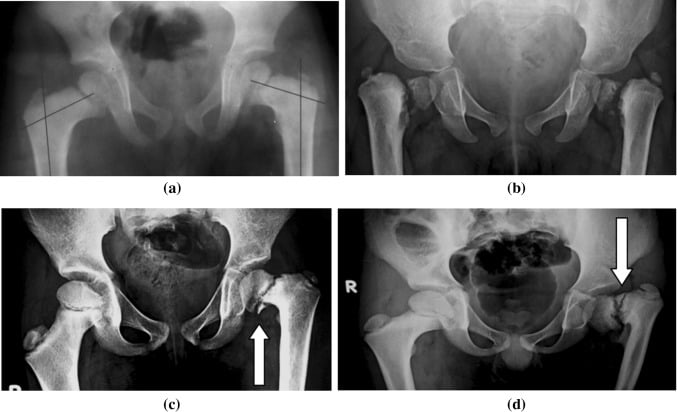
Amstutz classified the radiographic appearance, although the HE angle is more useful for prognosis:
- Type 1: no visible physeal defect
- Type 2: vertical physis with Fairbank's triangle, the classic type
- Type 3: an old healed or fused physis, in the adult
Clinical Presentation and Examination
History. The complaint is a painless limp, usually noticed after walking begins, at 2-5 years. Pain is rare in childhood; when it is present, suspect a stress fracture or superimposed pathology. Ask about hip problems in siblings and parents, because a parent with a premature hip replacement is a clue.
Gait and stance. The gait is Trendelenburg, lurching to the affected side, or a waddle when both hips are involved, and the Trendelenburg test is positive. There is true shortening on the affected side, and increased lumbar lordosis if the disease is bilateral.
Range of motion. Check abduction, internal rotation and flexion:
- Abduction is restricted, from impingement of the greater trochanter on the ilium
- Internal rotation is restricted, from the retroversion
- Flexion is usually preserved
Coxa vara or DDH? In DDH the femoral head is subluxed or dislocated. In coxa vara the head sits centrally in the acetabulum, and it is the neck that is deformed.
SHORTFeatures of Congenital Coxa Vara
Hook:The leg is SHORT and the abductors are weak.
Investigations
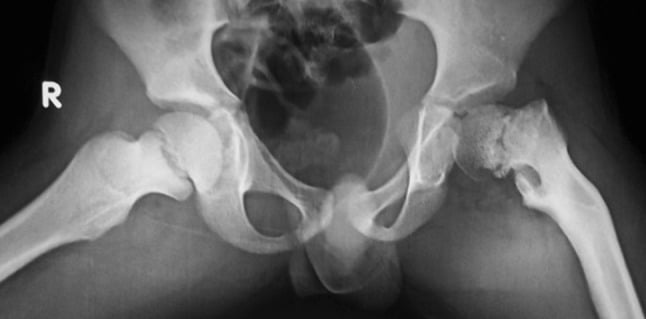
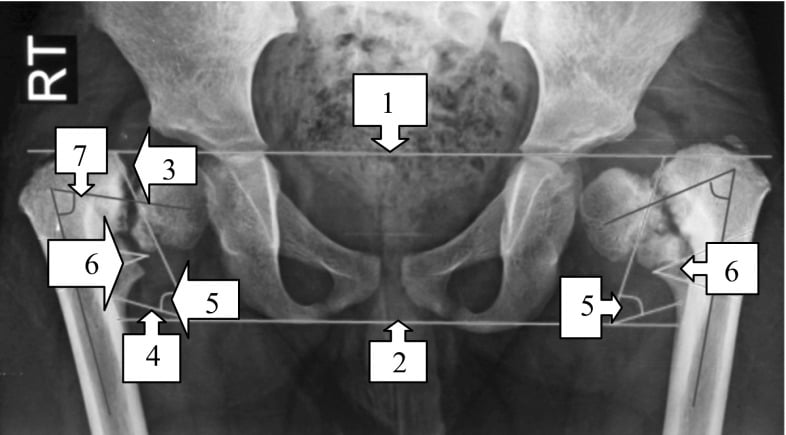
Radiographs. An AP pelvis (standing) and a frog lateral. On them, measure the neck-shaft angle and the HE angle and look for Fairbank's triangle:
- Neck-shaft angle: the intersection of the neck axis and the shaft axis; under 120 degrees is diagnostic
- Hilgenreiner's epiphyseal (HE) angle: between Hilgenreiner's line, drawn through the triradiate cartilages, and a line through the capital femoral physis; normal is under 25 degrees, pathological over 60 degrees
Positioning. Rotation changes the measured angle. Internal rotation of the leg can artificially simulate coxa valga and external rotation simulates coxa vara, so insist on a standardised AP pelvis with the patellae forward.
Further tests. Beyond the plain films, investigation is selective:
- Skeletal survey, if a generalised dysplasia such as cleidocranial dysostosis or rickets is suspected: look for absent clavicles and widened metaphyses
- Calcium, phosphate, ALP and vitamin D, only if rickets is suspected
- MRI or CT is rarely indicated; CT may help plan a three-dimensional osteotomy for complex rotation
The Head-Shaft Angle (When the Neck Itself Is Bent)
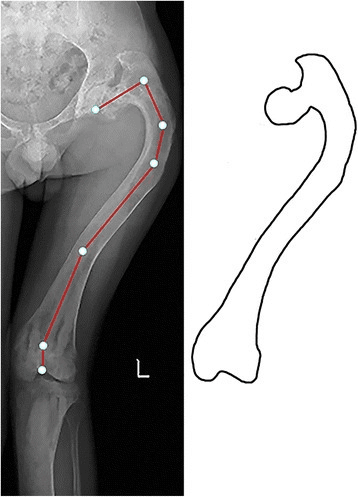
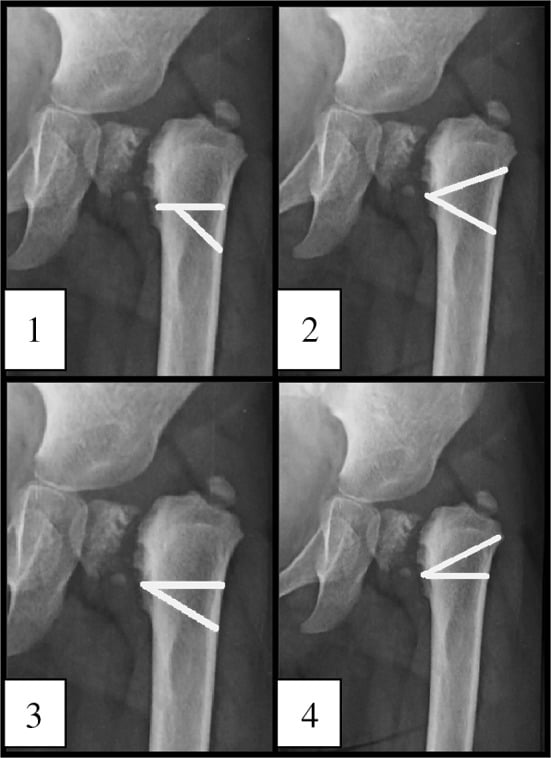
Why the neck-shaft angle fails here. It is drawn from the femoral shaft axis to the femoral neck axis. In coxa vara the neck is short, bent and often carries an ossification defect, so a reproducible neck axis is hard to draw and the angle becomes unreliable.
The head-shaft (HS) angle avoids the neck. It measures from the shaft axis to a line along the base of the capital epiphysis, through the head, so it reports the true orientation of the head on the shaft independent of the shape of the neck.
Three angles, three jobs. Each answers a different question:
- HE angle: physeal obliquity, the shear and prognosis measure that decides whether to operate (over 60 degrees)
- Head-shaft angle: the corrected head-shaft geometry, and the surgical target
- Neck-shaft angle: the classic definition (under 120 degrees), but the least reproducible once the neck is deformed
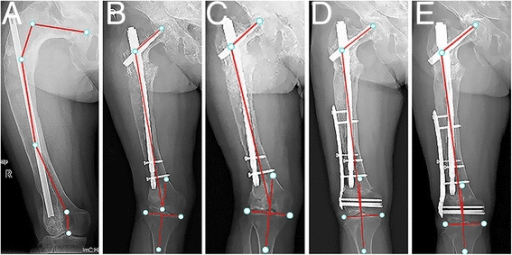
In practice the HE angle decides whether to operate, and the head-shaft angle, with the HE angle, judges how much was corrected. Desai's target for a durable result was an HE angle of 35 degrees or less and a head-shaft angle of 130 degrees or more.
Differential Diagnosis
- Key Discriminator
- Vertical physis, painless limp at walking age
- Femoral Head Position
- Reduced (in acetabulum)
- Pathognomonic / Classic Sign
- Fairbank's triangle; high HE angle
- Key Discriminator
- Subluxation/dislocation, Ortolani/Barlow in infancy
- Femoral Head Position
- Subluxed or dislocated
- Pathognomonic / Classic Sign
- Shallow acetabulum, broken Shenton's line
- Key Discriminator
- Adolescent, overweight, hip/knee pain, external rotation
- Femoral Head Position
- Slipped posteroinferiorly
- Pathognomonic / Classic Sign
- Klein's line not intersecting epiphysis
- Key Discriminator
- Older child, prior head necrosis, coxa magna/breva
- Femoral Head Position
- Reduced but deformed
- Pathognomonic / Classic Sign
- Fragmentation then coxa magna
- Key Discriminator
- Severe femoral shortening from birth
- Femoral Head Position
- May be absent/dysplastic
- Pathognomonic / Classic Sign
- Markedly short femur, Aitken classification
- Key Discriminator
- Bilateral bowing, biochemical abnormality
- Femoral Head Position
- Reduced
- Pathognomonic / Classic Sign
- Widened physes, low vitamin D / phosphate
Management Algorithm
The HE angle decides. It sorts the child into one of three zones. The thresholds come from a single retrospective series (Weinstein), a weakness the evidence section sets out.
- Prognosis
- Benign / Spontaneous Correction
- Management
- Observation
- Prognosis
- Indeterminate / Grey Zone
- Management
- Close radiographic monitoring
- Prognosis
- Progressive / Malignant
- Management
- Valgus Osteotomy
Observation. Curves with an HE angle under 45 degrees resolve spontaneously in 80%, the majority correcting as the child grows. A child in this zone who is asymptomatic and shows no progression on serial films is observed, with radiographs every 6-12 months. Shoe lifts can treat the leg length discrepancy but do not correct the deformity.
Surgery. Operate for any of the following:
- HE angle over 60 degrees, where progression is certain (100% in the natural history); untreated, it leads to severe shortening, a limp and early OA
- HE angle 45-60 degrees with documented progression
- Significant gait abnormality or Trendelenburg gait
- Pain, which is rare
The operation is a valgus intertrochanteric osteotomy, with four goals:
- Make the physis horizontal, an HE angle under 30 degrees, to convert shear to compression
- Correct the neck-shaft angle to over 140 degrees, overcorrecting into valgus to prevent recurrence; how far to go is debated (see Controversies)
- Restore the abductor length-tension relationship
- Correct the retroversion
Surgical Technique
Vascular Safety: The medial circumflex femoral artery (MCFA) is at risk during posterior approaches or aggressive medial dissection. The lateral approach is safer but requires deeper retraction. Avoid damaging the trochanteric apophysis in young children (less than 5 years) to prevent iatrogenic growth arrest.
The principle. A closing-wedge valgus osteotomy removes a laterally based wedge; the alternative is a medial opening wedge. Closing wedge is safer for union.
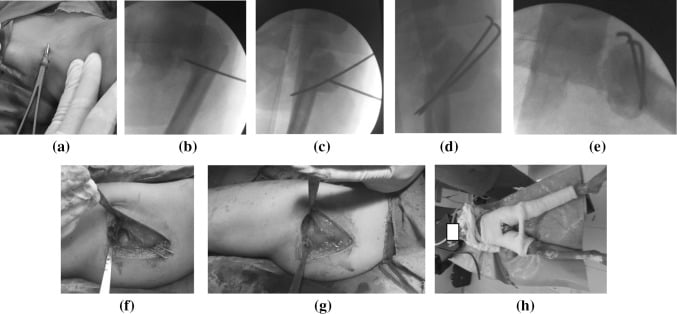
The steps. The osteotomy runs in this sequence:
- Supine on a radiolucent table, with fluoroscopy.
- Direct lateral approach to the proximal femur, elevating vastus lateralis. Take care with haemostasis of the perforating vessels and expose the flare of the greater trochanter.
- Insert a guide wire into the femoral neck and head. Its angle of insertion determines the correction: with a 130-degree blade plate, insert it at the predetermined angle to the shaft that gives the desired valgus.
- Insert the seating chisel over or parallel to the wire.
- Make the intertrochanteric cut and remove a laterally based wedge, calculated from the preoperative tracing. On some plating systems the wedge size in millimetres roughly equals the degrees of correction needed, but templates are safer.
- Abduct the shaft to close the osteotomy, bringing the head-neck unit into valgus.
- Fix with a blade plate or a paediatric locking plate (cannulated screw system).
- Correct retroversion, if needed, by internally rotating the distal fragment before plating.
- A percutaneous adductor tenotomy is often required, because the valgus lengthens the leg and tightens the adductors.
Pitfalls. Careful preoperative planning avoids them, and the wedge size is critical:
- Under-correction, with a high recurrence rate
- Anterior penetration of the plate, because the femoral neck is retroverted
- Injury to the trochanteric apophysis (posterior approach)
The Pauwels Y-osteotomy. A Y-shaped intertrochanteric osteotomy for extremely severe deformity, where a simple valgus cut is insufficient. It corrects varus and retroversion and creates stability, and it is mechanically elegant, but it is technically very demanding and rarely performed now that locking plates are better. Most surgeons stick to the standard closing-wedge valgus osteotomy.
Greater Trochanteric Overgrowth and Trochanteric Advancement
Why the trochanter matters. The abductors act through the lever arm from the hip centre to the greater trochanter. In coxa vara the short varus neck and trochanteric overgrowth bring the trochanter up to or above the centre of the femoral head, shortening that lever arm and slackening the muscle. That is the mechanical basis of a Trendelenburg gait that can persist even after the neck angle is corrected, and in Desai's series 12 of 20 hips developed trochanteric overgrowth, 5 of them with abductor weakness.
Measuring it. The articulo-trochanteric distance (ATD) is the vertical distance from the tip of the greater trochanter to the top of the femoral head on an AP film, and normally the head sits roughly 1 to 2 cm above the trochanter tip. A reduced, zero or negative ATD, with the trochanter at or above the head, quantifies trochanteric overgrowth and abductor insufficiency.
Absolute or relative. In absolute overgrowth the trochanteric apophysis keeps growing while the capital physis is arrested, classically after premature capital-physis closure gives a short neck (coxa breva), so the trochanter overtakes the head. In relative overgrowth the neck is simply short or varus, so a normally growing trochanter sits relatively high.
What to do about it. Two operations address the high trochanter:
- Distal (and lateral) trochanteric advancement or transfer: osteotomise the greater trochanter and move it distally to restore abductor length-tension and the lever arm. It is used for the high trochanter in an older child or after coxa breva.
- Greater trochanteric (apophyseal) epiphysiodesis: in a young child with growth remaining, arresting the trochanteric apophysis lets the neck catch up and prevents future overgrowth.
Complications
- Risk Factor
- Under-correction (HEA greater than 35)
- Prevention
- Overcorrect to valgus
- Management
- Repeat Osteotomy
- Risk Factor
- Surgical trauma to physis
- Prevention
- Stay 1cm from physis
- Management
- Epiphysiodesis contralateral
- Risk Factor
- Vessel injury
- Prevention
- Careful dissection
- Management
- Bisphosphonates / Salvage
- Risk Factor
- Loss of fixation
- Prevention
- Spica cast augmentation
- Management
- Osteotomy
- Risk Factor
- Unilateral disease
- Prevention
- Shoe lifts
- Management
- Contralateral Epiphysiodesis
- Risk Factor
- Surgeon error
- Prevention
- Antibiotics
- Management
- Washout
Premature physeal closure. Closure of the capital femoral physis is a devastating complication. It usually results from direct surgical trauma, by drill or chisel, or from vascular injury, and it leaves a short femoral neck (coxa breva) with recurrence of varus if the trochanter continues to grow.
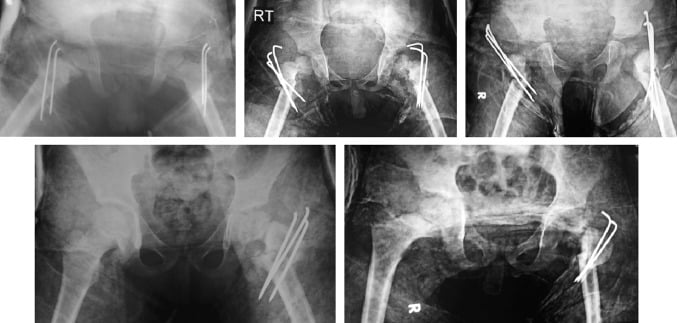
The most common cause of recurrence is under-correction. If the HEA is not restored to less than 40 degrees (ideally less than 30), the shear forces remain, and the deformity will recur via the Hueter-Volkmann principle.
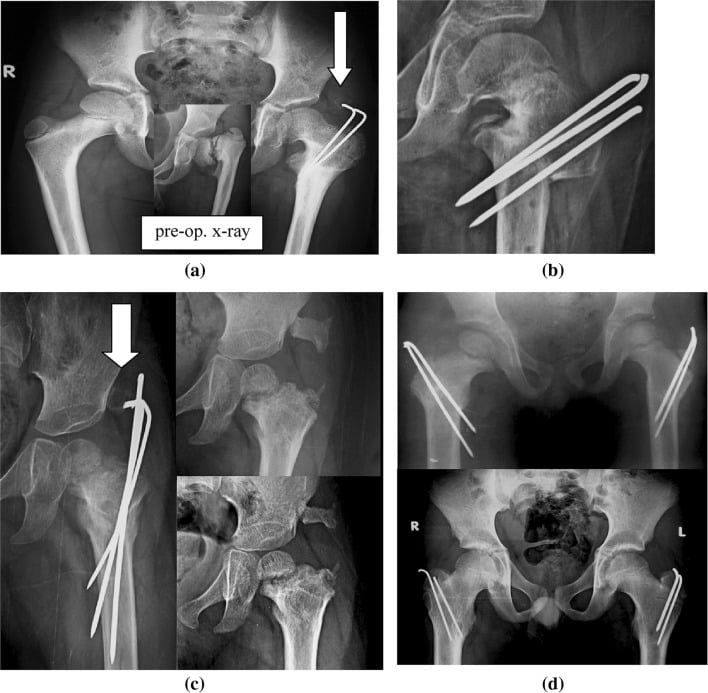
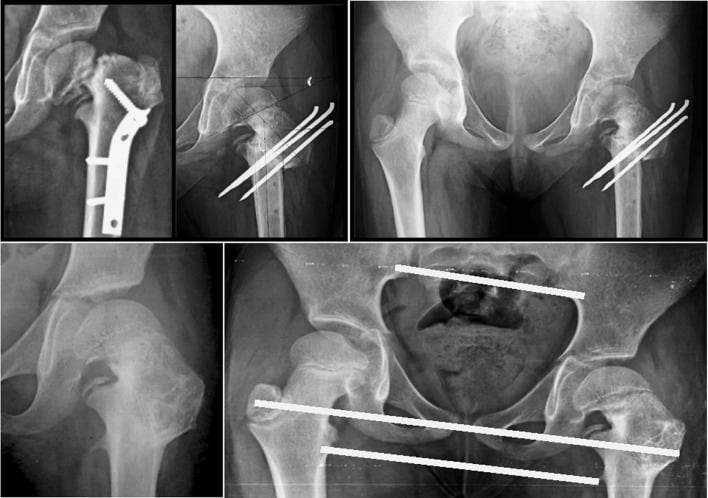
Postoperative Care
- Age less than 6-8 years: hip spica cast for 6 weeks - fixation alone is often insufficient for active children
- Age greater than 8 years: touch weight-bearing with crutches (if reliable)
- Ensure cast comfort; monitor for cast sores
- Cast removal; X-ray to confirm union at 6 weeks
- Hydrotherapy / pool walking; gentle active ROM (abduction, flexion)
- Touch weight-bearing progressing as union consolidates
- Full weight-bearing; abductor strengthening (clamshells); normalise gait
- Monitor for leg length discrepancy
- Serial X-rays at 3 months, 6 months and 1 year to confirm maintained correction
- Hardware removal often required once healed - the plate becomes buried in bone and is hard to remove later, and blade plates can act as stress risers
- Annual review to skeletal maturity: recurrence of varus, trochanteric overgrowth with abductor weakness, and physeal behaviour all declare late
Outcomes and Prognosis
After osteotomy. Correction succeeds in 90% if adequate valgus is achieved, and the limp usually resolves if the biomechanics are restored. Hold that against Yang and Huang in the evidence section, where only 3 of 12 hips maintained more than 80% of the correction at a minimum of two years, all of them developmental.
Leg length. The osteotomy lengthens the leg as it gains valgus, but pre-existing physeal arrest may result in permanent shortening of 0.5-2 cm.
The long term. Even with correction the hip is rarely "normal". Acetabular dysplasia usually remodels if the head is centred, and in Yang and Huang's series acetabular depth improved significantly when surgery was done before age 6. A mild risk of OA remains.
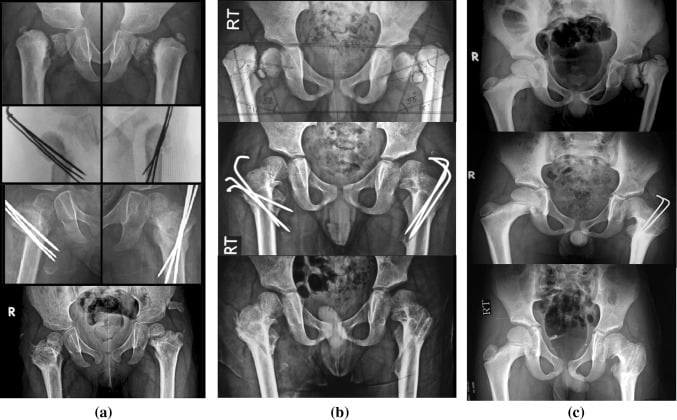
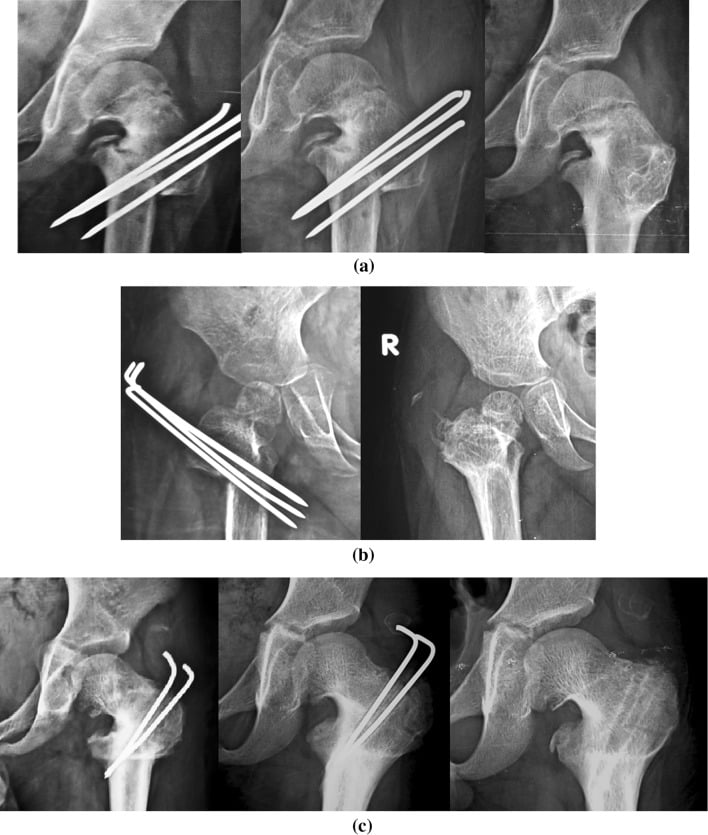
Guidelines, Registries & Global Practice
Global Epidemiology:
- Developmental/congenital coxa vara is rare (~1 in 25,000 live births) and far less common than DDH.
- Reported across all populations; some series describe higher frequency in populations of African descent and in Scandinavian cohorts (echoing the distribution of Blount disease).
- Often diagnosed late once the child is walking; delayed presentation is most marked in limited-resource and rural settings.
Guideline & Consensus Position (side by side):
- Position on Coxa Vara
- HE-angle-based decision: surgery for HE angle greater than 60 degrees; observe less than 45 degrees; serial review for the 45-60 grey zone
- Position on Coxa Vara
- Refer progressive, painful, or unilateral deformity to a tertiary paediatric orthopaedic unit; observation for non-progressive minor varus
- Position on Coxa Vara
- Valgus intertrochanteric osteotomy with fixed-angle (blade plate) or pediatric LCP; aim to convert vertical physis to horizontal
- Position on Coxa Vara
- Concordant with HE-angle thresholds; emphasise correction of version and trochanteric overgrowth in older children
There is broad international agreement: the HE angle drives the decision and valgus intertrochanteric osteotomy is the definitive operation. Differences are largely in implant preference and timing.
Registry & Implant Notes:
- No dedicated paediatric coxa-vara registry exists; this is a rare deformity managed in tertiary centres rather than tracked at population scale.
- Pediatric proximal femoral locking compression plates (LCP) have largely replaced fixed-angle blade plates in many units for ease of application; published series report high but reliable hardware-removal rates for trochanteric irritation.
- Fixed-angle blade plates remain a robust, low-cost option and are still widely taught.
High- vs Limited-Resource Practice Variation:
- High-resource: 3D CT planning for combined varus/version correction, image intensifier-guided osteotomy, modern locking implants, early mobilisation.
- Limited-resource: Reliance on plain radiographs and templating; blade plates or even smooth wires with hip spica for fixation; later presentation means larger corrections and more frequent need for concomitant trochanteric advancement.
- Across all settings, the principle is identical — overcorrect to valgus, restore a near-horizontal physis, and protect the construct until union.
Controversies & Areas of Uncertainty
Timing. Earlier osteotomy, before age 6, allows acetabular remodelling, but smaller bones are technically harder and recurrence is higher if the physis remains sick. There is no consensus on the ideal age window; most operate once the HE angle reaches greater than 60 degrees or progression is documented, regardless of age.
How much overcorrection. Targets range from a postoperative HE angle of 35 degrees or less to deliberate overcorrection to a neck-shaft angle of 150 degrees. Excess valgus risks abductor lengthening and a Trendelenburg lurch; under-correction risks recurrence.
Implant choice. Fixed-angle blade plates give predictable geometry but are unforgiving. Paediatric locking plates are easier to apply but carry high hardware-removal rates for trochanteric irritation, and no high-level trial demonstrates the superiority of either.
Guided growth. Hemiepiphysiodesis is attractive, but the proximal femoral physis in coxa vara is intrinsically abnormal, so the response is unpredictable. It is not an established substitute for corrective osteotomy in significant deformity.
Evidence is limited to small retrospective series (rarity of the condition precludes randomised trials). There is no validated threshold for the precise amount of overcorrection, no consensus on managing the grey-zone (45-60 degrees) HE angle, and no registry-level long-term arthritis data. Treat published "rules" as expert-derived guidance, not Level 1 evidence.
MCQ Practice Points
Q: The most reliable radiographic measurement for predicting progression in Congenital Coxa Vara is: A. Neck-Shaft Angle B. Hilgenreiner's Epiphyseal Angle (HEA) C. Acetabular Index D. Articulo-trochanteric distance Answer: B. The HEA measures the obliquity of the physis. A vertical physis (greater than 60 deg) predicts progression due to shear.
Q: Which feature distinguishes Congenital Coxa Vara from Developmental Dysplasia of the Hip (DDH)? A. Short leg B. Trendelenburg gait C. Head located in acetabulum D. Limited abduction Answer: C. In DDH, the head is subluxed/dislocated. In Coxa Vara, the head is reduced, but the neck is bent.
Q: An HE Angle of 70 degrees is an indication for: A. Observation B. Shoe lift C. Valgus Osteotomy D. Arthrodesis Answer: C. HEA greater than 60 degrees is the absolute indication for surgery as spontaneous resolution does not occur.
Q: Fairbank's triangle represents: A. A fracture B. A defect in ossification C. A tumor D. Infection Answer: B. It is a triangular cartilaginous defect in the inferior femoral neck ossification center.
Q: The primary biomechanical goal of osteotomy in Coxa Vara is to: A. Lengthen the leg B. Convert shear forces to compression C. Improve cosmesis D. Reduce the head Answer: B. By making the physis horizontal (HEA less than 30), shear forces (which inhibit growth) are converted to extensive/compressive forces (which stimulate growth).
Exam Viva Scenarios
Practise clinical reasoning and management decisions out loud
“A 3-year-old is brought in by parents for a waddling gait. Painless. Unremarkable birth history. Describe your assessment.”
“You see a 4-year-old with bilateral Coxa Vara. HE Angle is 50 degrees on the right and 55 on the left. Parents are worried. Plan?”
“You performed a osteotomy 1 year ago. X-rays now show the varus has returned. What happened and what now?”
“A 10-year-old presents with neglected coxa vara. Short leg (-3cm). HEA 70 degrees. Is it too late?”
“A 30-year-old presents with unilateral hip pain. X-rays show a pistol-grip deformity and mild OA. History of childhood osteotomy. What is this?”
Key Numbers
- Normal NSA: 135 deg
- Coxa Vara: less than 120 deg
- Severe Vara: less than 90 deg
- Normal HEA: less than 25 deg
- Surgery Indicator: HEA greater than 60 deg
- Grey Zone: 45-60 deg
Pathology
- Vertical Physis
- Ossification defect (Fairbank's Triangle)
- Shear forces inhibit growth
- Short neck + High Trochanter
Clinical
- Painless limp
- Trendelenburg Gait
- Short leg
- Limited Abduction/Int Rotation
Surgery
- Valgus Intertrochanteric Osteotomy
- Adductor Tenotomy
- Spica Cast (if young)
- Overcorrect (Valgus is good)
Evidence Base
HE Angle: The Prognostic Cornerstone
- Retrospective review of 42 coxa vara cases, 22 true congenital
- Introduced the Hilgenreiner-epiphyseal (HE) angle as the operative threshold
- HE angle greater than 60 degrees: indication for surgery
- HE angle 45-60 degrees: grey zone, observe; less than 45 degrees: generally corrects spontaneously
Valgus Osteotomy: 20-Year Outcomes
- 20 hips (12 patients) with congenital coxa vara, valgus subtrochanteric osteotomy, mean 20-year follow-up
- Mean preoperative HE angle 66 degrees, head-shaft angle 96 degrees
- Postoperative HE angle of 35 degrees or less AND head-shaft angle of 130 degrees or more correlated with satisfactory results
- Trochanteric overgrowth with abductor weakness in 5 of 12 hips with that finding
Valgus Osteotomy & Acetabular Remodelling
- 8 patients (12 hips), valgus intertrochanteric osteotomy, mean age 7.9 years
- Mean HE angle improved from 75 to 25 degrees; neck-shaft angle 95 to 137 degrees (125 degrees at follow-up)
- Only 3 hips maintained more than 80% correction at minimum 2-year follow-up — all developmental subtype
- Acetabular depth improved significantly when surgery was done before age 6
Classification & Management Review
- Classifies childhood coxa vara as developmental, congenital, dysplastic, or traumatic
- Evaluation must seek family history, trauma/infection, and associated skeletal dysplasia
- Surgery indicated when the deformity is progressive, painful, unilateral, or causes leg-length discrepancy
- Radiographs determine laterality and whether deformity is at or below the physis
Pediatric LCP for Proximal Femoral Osteotomy
- 13 hips (11 patients) using a low-profile pediatric proximal femoral locking compression plate
- All hips improved radiographic parameters, pain, and Merle d'Aubigne-Postel scores
- 11 of 13 hips (85%) required plate removal at mean 15.8 months, usually for greater-trochanter discomfort
- Lower profile than blade plates but lateral hip irritation remains common
Biomechanics of the Varus Hip
- Foundational biomechanical analysis of physeal loading in the varus hip
- Distinguished shear from compressive forces across the proximal femoral physis
- A vertical (varus) physis converts protective compression into growth-inhibiting shear
- Provides the rationale for converting a vertical physis to horizontal via valgus osteotomy