Navigating the Transitional Zone
- Asymmetric Closure: Creates transitional fractures.
- Tillaux: SH III, anterolateral epiphyseal fragment.
- Triplane: SH IV pattern, three-plane fracture.
- 2mm Rule: quote it as the pragmatic threshold for reducing an articular step - but it is convention rather than trial-derived, and is modulated by remaining growth and by where in the joint the step lies.
- Growth Arrest is Less Common: Occurs near skeletal maturity.
- “Know the closure pattern (Central-Medial-Lateral)
- “Tillaux vs Triplane distinction
- “CT is essential for transitional fractures
- “ORIF if step-off greater than 2mm
Overview and Epidemiology
Distal tibial physeal injuries occur in two settings. Standard Salter-Harris fractures behave much as they do at other physes and can occur at any age. The transitional fractures, the juvenile Tillaux and the triplane, are unique to adolescents because the physis closes asymmetrically, and they occur between 12 and 15 years.
Who. Transitional fractures are more common in boys, because their physes close later.
Mechanism. External rotation is the most common mechanism of the transitional fractures.
Against the distal femur. The distal tibial physis contributes 45% of tibial length. Set beside the distal femur, it differs in growth contribution, in arrest risk and in treatment priority.
- Distal Tibia
- 45% of tibia
- Distal Femur
- 70% of femur
- Distal Tibia
- Low (near maturity)
- Distal Femur
- High (30-50%)
- Distal Tibia
- Tillaux, Triplane
- Distal Femur
- Rare
- Distal Tibia
- Articular reduction
- Distal Femur
- Physis protection
Anatomy and Pathomechanics
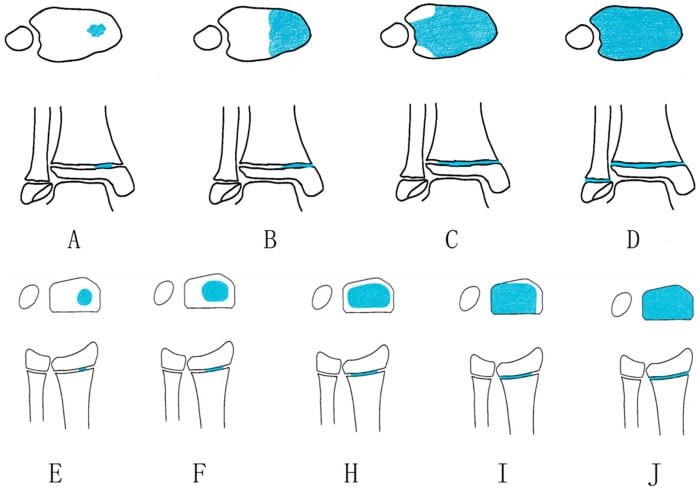
The closure sequence. The distal tibial physis closes asymmetrically over 18 months. The centre closes first, at approximately 12-14 years; the medial (anteromedial) part follows; the lateral (posterolateral) part closes last, at approximately 14-16 years. Central, medial, lateral: CML.
Why the Tillaux fragment is anterolateral. The juvenile Tillaux occurs when the medial physis has closed but the lateral part is still open. The anterior inferior tibiofibular ligament (AITFL) attaches to the anterolateral epiphysis, so an external rotation force avulses that fragment through the still-open lateral physis, as a Salter-Harris III fracture.
Classification Systems
Standard Salter-Harris fractures. Away from the transitional patterns, the distal tibia follows the usual classification:
- Type I runs through the physis only, and may be occult
- Type II carries a metaphyseal fragment and is the most common pattern in younger children
- Types III and IV are intra-articular and require anatomical reduction
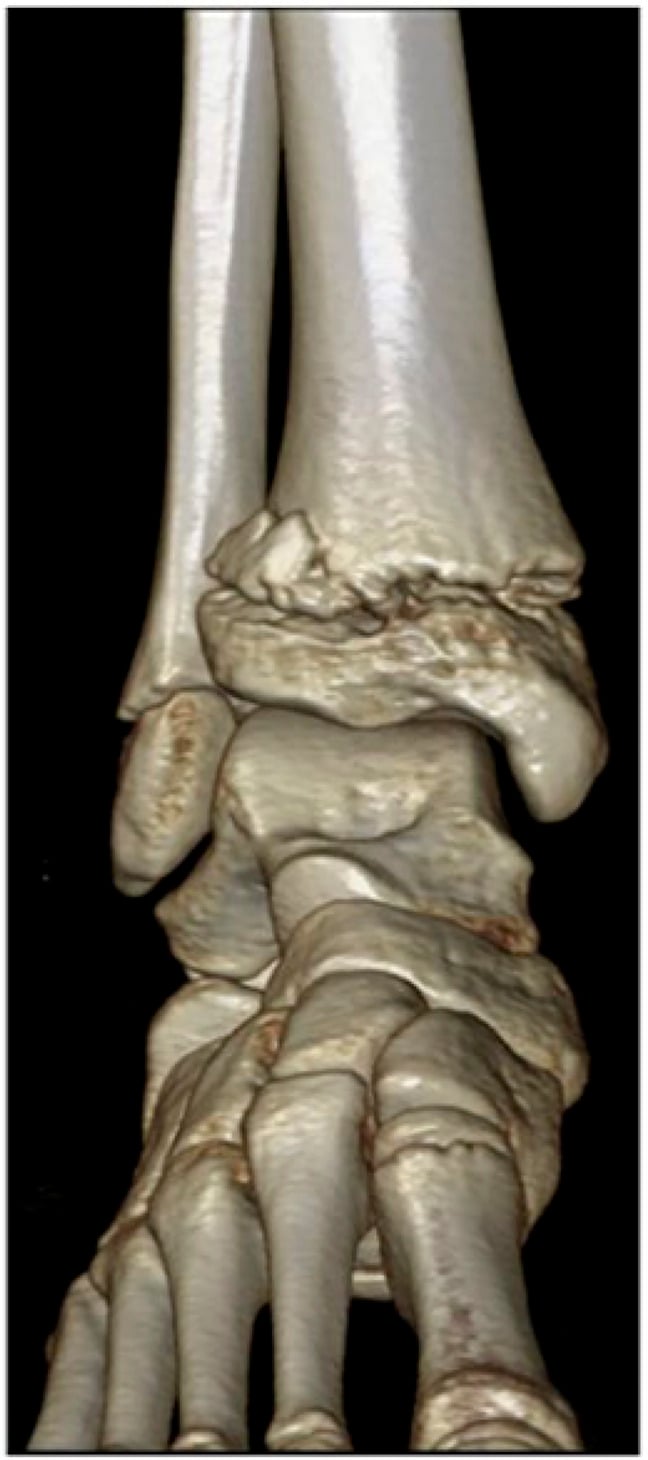
Juvenile Tillaux. A Salter-Harris III fracture of the anterolateral epiphysis, involving the epiphysis and physis only.
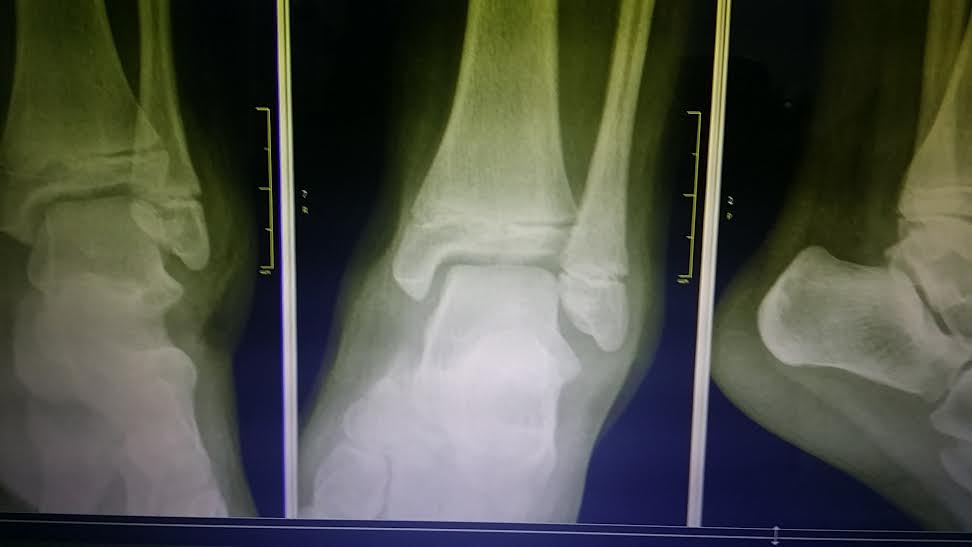
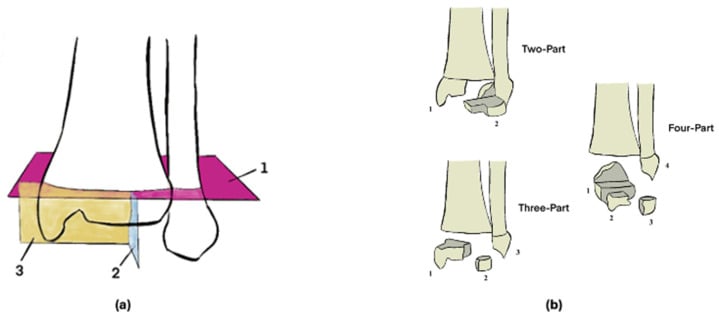
Triplane. A Salter-Harris IV pattern with fracture lines in three planes:
- Sagittal, through the epiphysis, as in the Tillaux
- Horizontal, through the physis
- Coronal, through the metaphysis, as in a Salter-Harris II
The fragments form two-, three- or four-part patterns:
- Two-part: a sagittal epiphyseal split and a horizontal physeal split, with a large posterolateral fragment
- Three-part: an additional anterolateral fragment, like a Tillaux plus a metaphyseal fragment
- Four-part: more comminuted
- Tillaux
- Type III
- Triplane
- Type IV
- Tillaux
- Epiphysis and physis only (sagittal epiphyseal line)
- Triplane
- Three planes
- Tillaux
- Anterolateral epiphysis
- Triplane
- Variable (2-4 part)
- Tillaux
- 12-15 years
- Triplane
- 12-15 years
- Tillaux
- ORIF if greater than 2mm
- Triplane
- ORIF if greater than 2mm
The Medial Malleolar Physeal Fracture: The High-Arrest Pattern
The Salter-Harris III fracture of the medial malleolus is the important non-transitional distal tibial physeal injury. It behaves very differently from the Tillaux and triplane: it carries the highest arrest risk of the Salter-Harris patterns at this site.
The injury. A vertical, intra-articular split through the medial part of the distal tibial epiphysis and physis: Salter-Harris III, or IV if a metaphyseal fragment is included. It is produced by supination-adduction (inversion), the talus shearing off the medial malleolus.
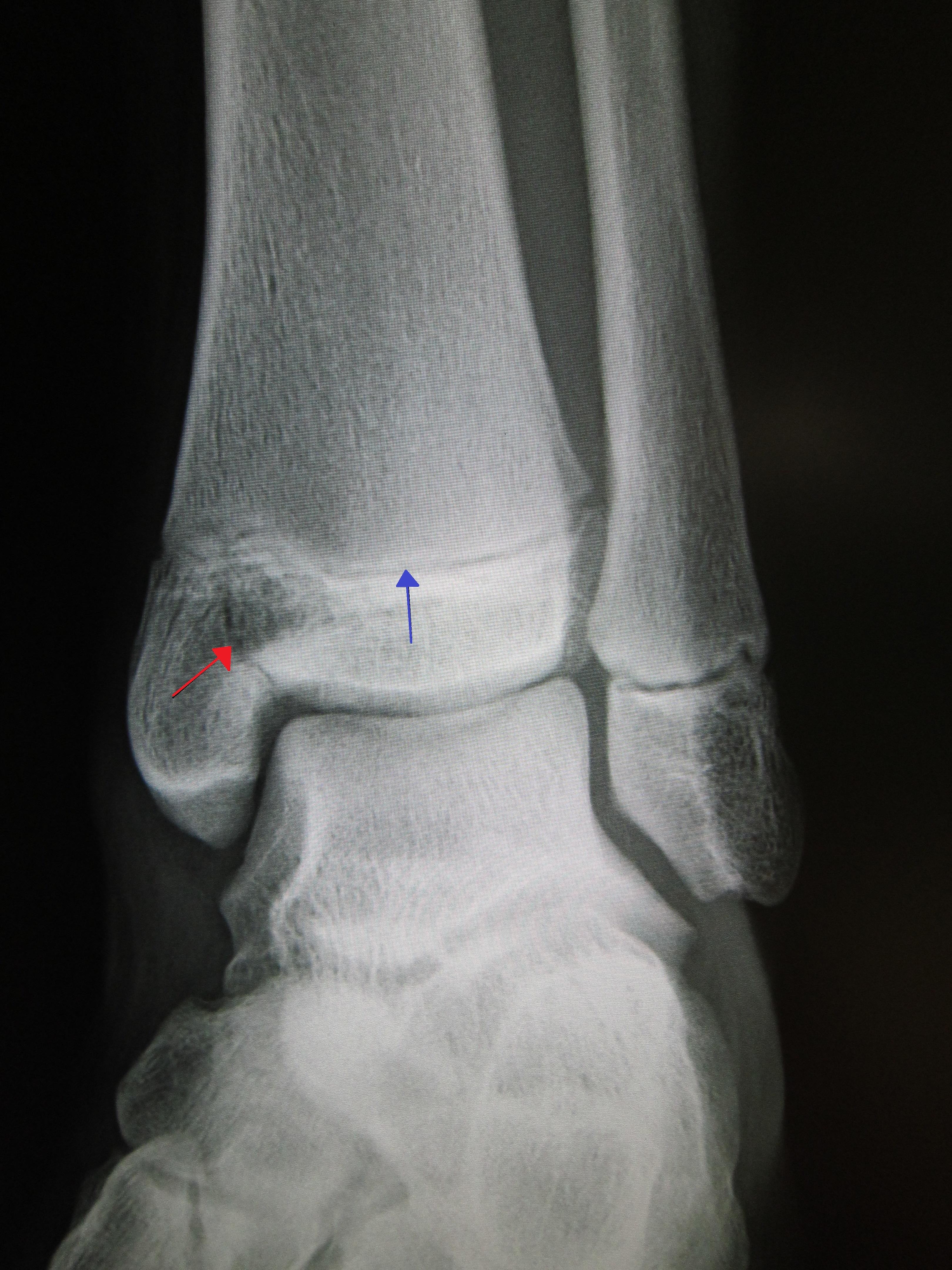
Why it arrests. The transitional fractures occur near skeletal maturity, so they rarely arrest, and an arrest matters little with so little growth left. The medial malleolar fracture typically occurs in a younger child with substantial growth remaining. It crosses the germinal medial physis and is intra-articular, and periosteum is often interposed medially. A medial bar then tethers the medial physis while the lateral keeps growing, driving progressive ankle varus and shortening.
Management. Achieve anatomical reduction, open if needed, because interposed medial periosteum can block it; a residual physeal gap over 3 mm is the warning sign (Podeszwa). Fix with an epiphyseal screw parallel to the joint, avoiding the physis. Unlike the transitional fractures, follow these children long-term for growth arrest.
Clinical Assessment
History. Establish the mechanism: a twist (external rotation), an inversion or direct trauma. Age tells you whether the patient is in the transitional window.
Examination. Inspect for swelling, ecchymosis and deformity, and palpate for tenderness over the physis, anterolateral in the Tillaux. Range of motion is limited by pain. Document the neurovascular status, and check the fibula for an associated fracture.
Investigations
Radiographs. AP, lateral and mortise views are standard and may show widening or the fragment. Radiographs show only two planes, and transitional fractures are three-dimensional, so plain films underestimate their displacement.
CT with 3D reconstruction is essential for transitional fractures. It measures the articular step-off against the 2mm threshold, identifies the number of fragments (two-, three- or four-part triplane), and the 3D reconstruction aids surgical planning. On the scan, look for:
- Articular step-off, measured on axial and sagittal images
- The fracture pattern, with every fragment identified
- The extent of physeal involvement
- A fibular injury, which is often associated
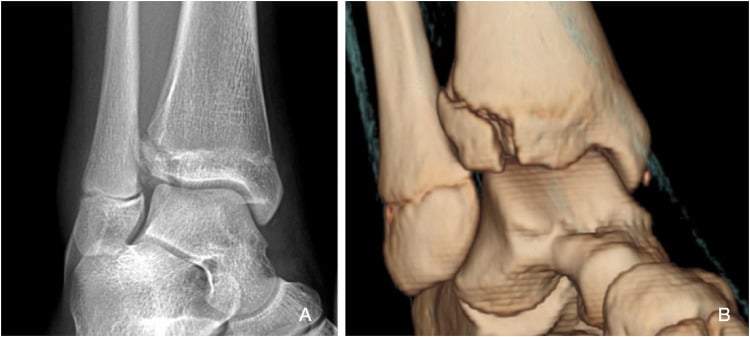
Routine or selective CT. CT clearly changes classification and the operative decision in transitional fractures (Eismann, Nenopoulos), but it irradiates the immature skeleton. Practice therefore varies between CT for all suspected transitional fractures and CT reserved for those that appear displaced on radiographs.
Differential Diagnosis
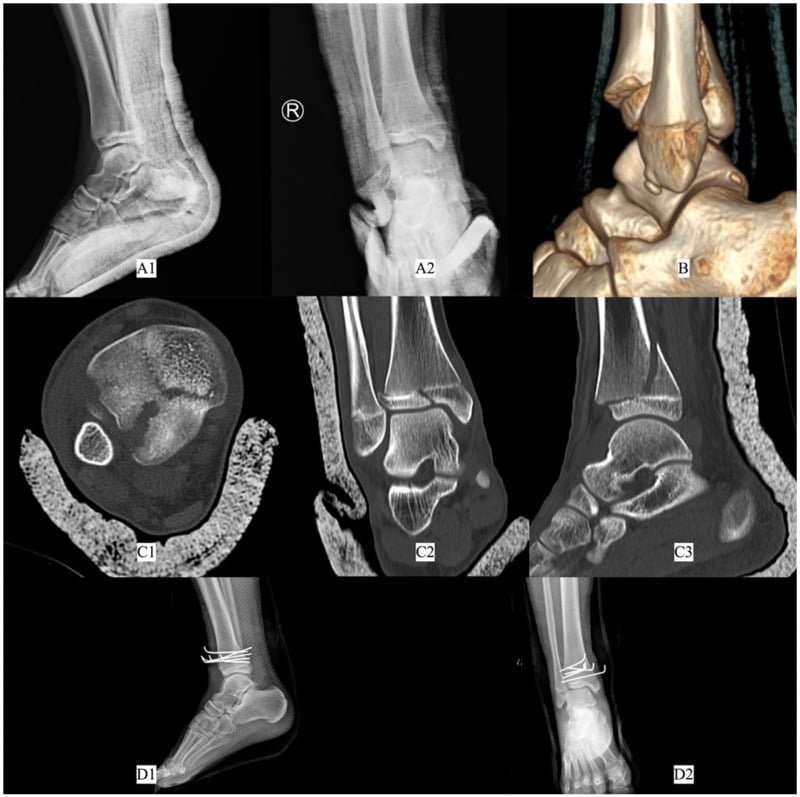
The adolescent with a twisted, swollen ankle after sport is the classic crossover, and distinguishing a transitional fracture from a "sprain" is the high-yield decision.
- Key clinical clue
- Anterolateral joint-line tenderness, age 12-15
- Imaging finding
- SH III anterolateral epiphyseal fragment; CT for step
- Pitfall
- Missed on AP if undisplaced - get mortise view
- Key clinical clue
- Diffuse swelling, age 12-15
- Imaging finding
- Physeal line plus posterior metaphyseal fragment; three planes on CT
- Pitfall
- Radiograph underestimates parts and step
- Key clinical clue
- Tenderness over the whole physis, younger child
- Imaging finding
- Physeal widening +/- metaphyseal (Thurston-Holland) fragment
- Pitfall
- SH I may be radiographically occult
- Key clinical clue
- Medial joint-line tenderness
- Imaging finding
- Vertical epiphyseal split medially
- Pitfall
- Highest arrest risk of the SH patterns - reduce anatomically
- Key clinical clue
- Point tenderness over distal fibula
- Imaging finding
- SH I fibula or avulsion
- Pitfall
- Often coexists with tibial injury - examine both
- Key clinical clue
- Pain on squeeze/external-rotation stress
- Imaging finding
- Tibiofibular clear-space widening
- Pitfall
- Rare in open physes; suspect with high fibular tenderness
- Key clinical clue
- Tenderness over ATFL, not the physis
- Imaging finding
- Radiograph normal
- Pitfall
- Diagnosis of exclusion - physeal tenderness means fracture until proven otherwise
Management
The 2mm threshold. Articular displacement greater than 2mm is the accepted trigger for reduction, because intra-articular malunion drives arthritis in a joint that must last a lifetime. Quote 2mm, but know that it is a pragmatic convention derived from articular-step extrapolation and small series; no randomised data define the exact cut-off. Some authors accept up to 2.5 mm in the very mature ankle, while others reduce any visible step in a younger adolescent, so be ready to justify a deviation by the growth remaining and where in the joint the step lies.
Non-displaced (step-off less than 2mm). A below-knee cast for 4-6 weeks, non-weight-bearing initially, with close follow-up and radiographs at 1-2 weeks.
Displaced (step-off greater than 2mm). Attempt closed reduction under fluoroscopy first, with percutaneous pinning if the reduction is acceptable, then cast immobilisation. Open reduction and internal fixation follows if closed reduction fails.
Closed or open for the displaced Tillaux. Closed reduction by internal rotation with percutaneous screw fixation can succeed, but periosteal or AITFL interposition may block it. There is no consensus on how many closed attempts are acceptable before converting to open reduction, and repeated forceful manipulation itself raises physeal-arrest risk.
Surgical Techniques
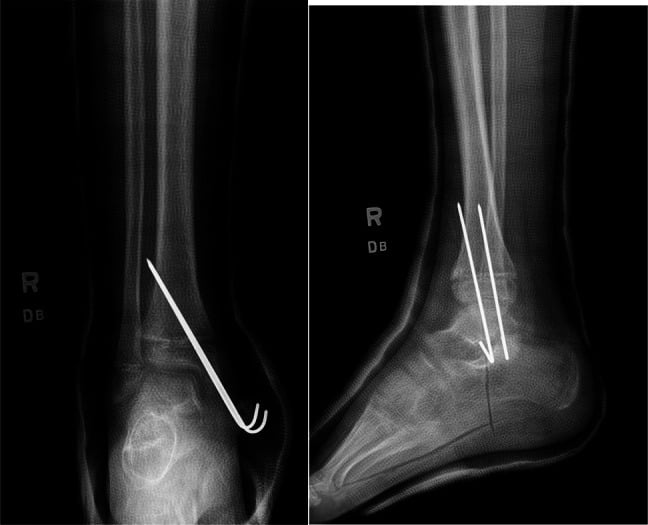
Closed reduction and percutaneous fixation (Tillaux). For a displaced Tillaux amenable to closed reduction. Under fluoroscopy, internally rotate the foot to reduce the anterolateral fragment. If the reduction is anatomical on mortise and lateral views, pass a 4.0mm cannulated screw from anterolateral to posteromedial under fluoroscopic guidance, staying within the epiphysis and parallel to the joint.
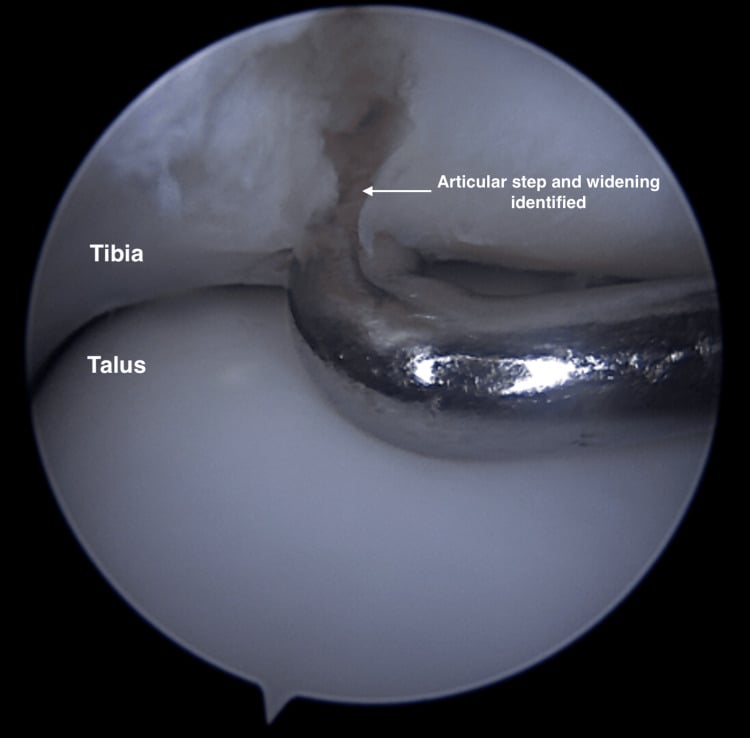
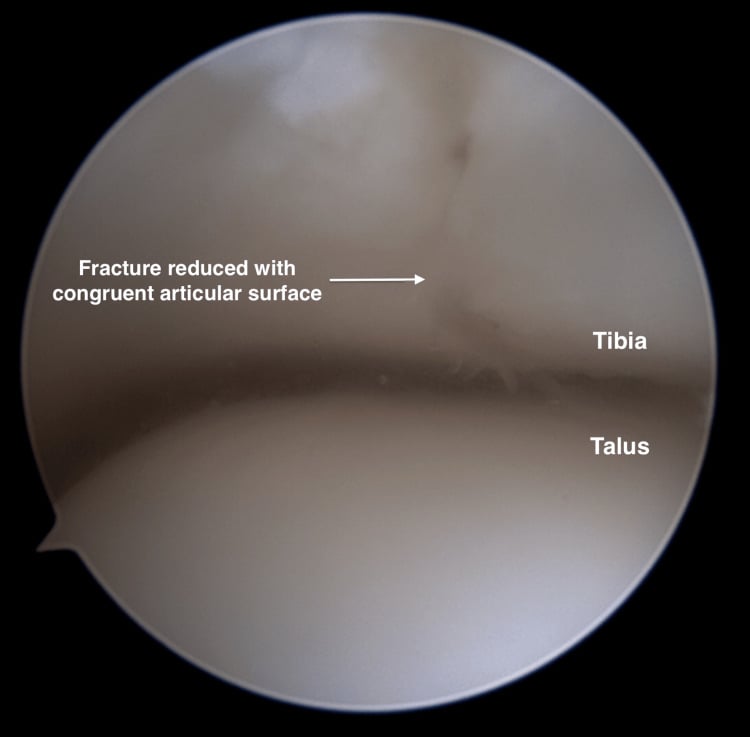
Open reduction and internal fixation (Tillaux). Indicated when closed reduction fails or a step-off greater than 2mm persists. Through an anterolateral approach, between EHL and EDL, visualise the fracture line, reduce it and hold it with a K-wire. Place cannulated screw(s) parallel to the joint, without crossing the intact physis.
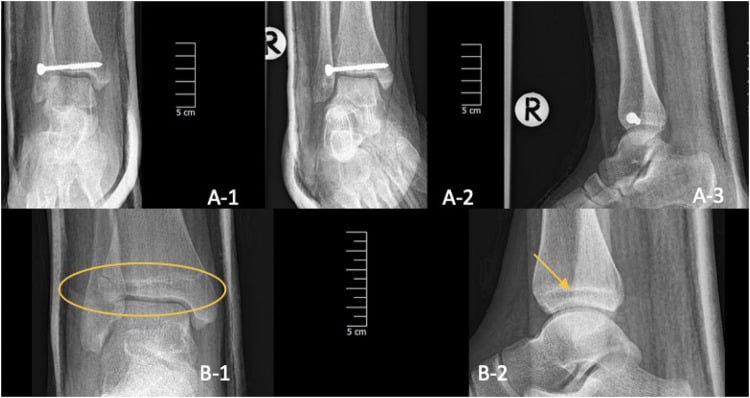
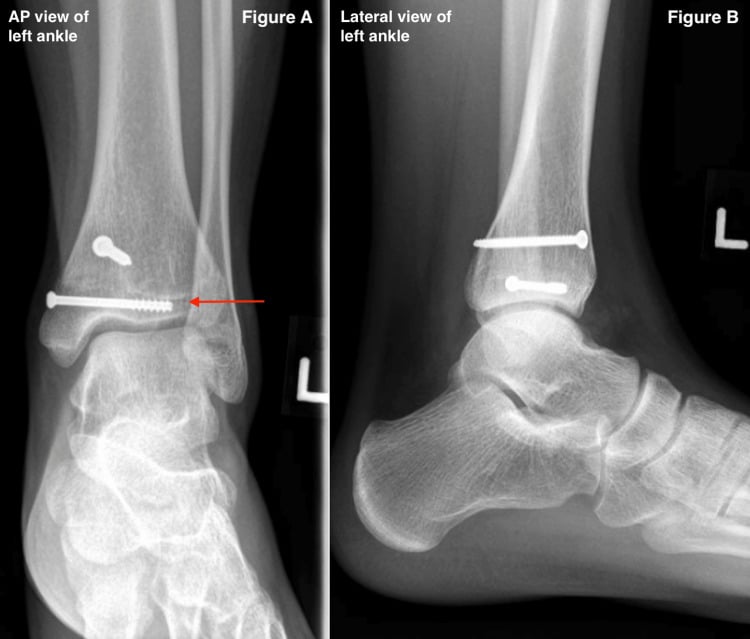
Open reduction and internal fixation (triplane). For a displaced triplane with a step-off greater than 2mm. It may need an anterolateral and/or anteromedial approach, depending on the fragment pattern. Reduce each fragment anatomically and fix with cannulated screws; the metaphyseal component may require a separate screw.
Fixation principles. Screw fixation is superior to K-wires for compression. Screws should run parallel to the joint and avoid crossing the physis.
Complications
- Rate
- Low if ORIF is done
- Prevention/Management
- Anatomical reduction. Post-op CT confirmation.
- Rate
- Risk with greater than 2mm step-off
- Prevention/Management
- Anatomical reduction.
- Rate
- Low (fractures occur near maturity)
- Prevention/Management
- Monitor if significant growth remaining.
- Rate
- Rare
- Prevention/Management
- Careful soft tissue handling.
- Rate
- Occasional
- Prevention/Management
- May require screw removal.
Premature Physeal Closure at the Distal Tibia: Predict, Survey, Manage
Predict. Leary's data overturn the intuition that the dramatic transitional fractures are the dangerous ones for growth.
- Effect
- 67% of all PPC - NOT the transitional fractures
- Source
- Leary 2009
- Effect
- Each 1 mm of displacement carries a relative risk of ~1.15 for PPC
- Source
- Leary 2009
- Effect
- Independently predictive of arrest
- Source
- Leary 2009
- Effect
- Suggests entrapped periosteum - extract it (open) or PPC follows
- Source
- Podeszwa 2012
- Effect
- Essentially no arrest in these patterns
- Source
- Leary 2009
Two patterns to watch. In Leary's series Salter-Harris II fractures accounted for 67% of all premature physeal closure (PPC), the largest share of any pattern. The medial malleolar SH III/IV fracture, described above, carries the highest arrest risk. Neither is a transitional fracture.
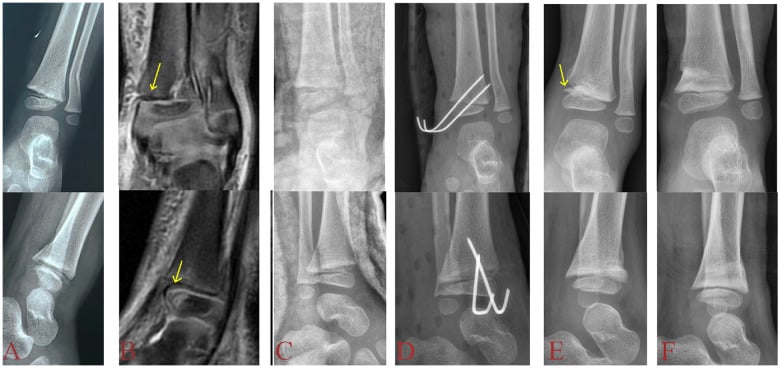
Survey. Follow the at-risk child (younger, displaced, SH II, or with a residual gap) with Harris growth-arrest lines. The transverse sclerotic line laid down after the injury should run parallel to the physis; if it converges towards the physis on one side, a bar is forming there. Confirm and map a suspected bar with CT or MRI (the percentage and location of the physeal area involved), and track length and remaining growth with serial scanograms and bone age.
How long to watch. Because these injuries cluster near maturity, growth surveillance is less critical than at other physes, and the value of prolonged Harris-line and scanogram follow-up is debated. Where significant growth remains, monitor.
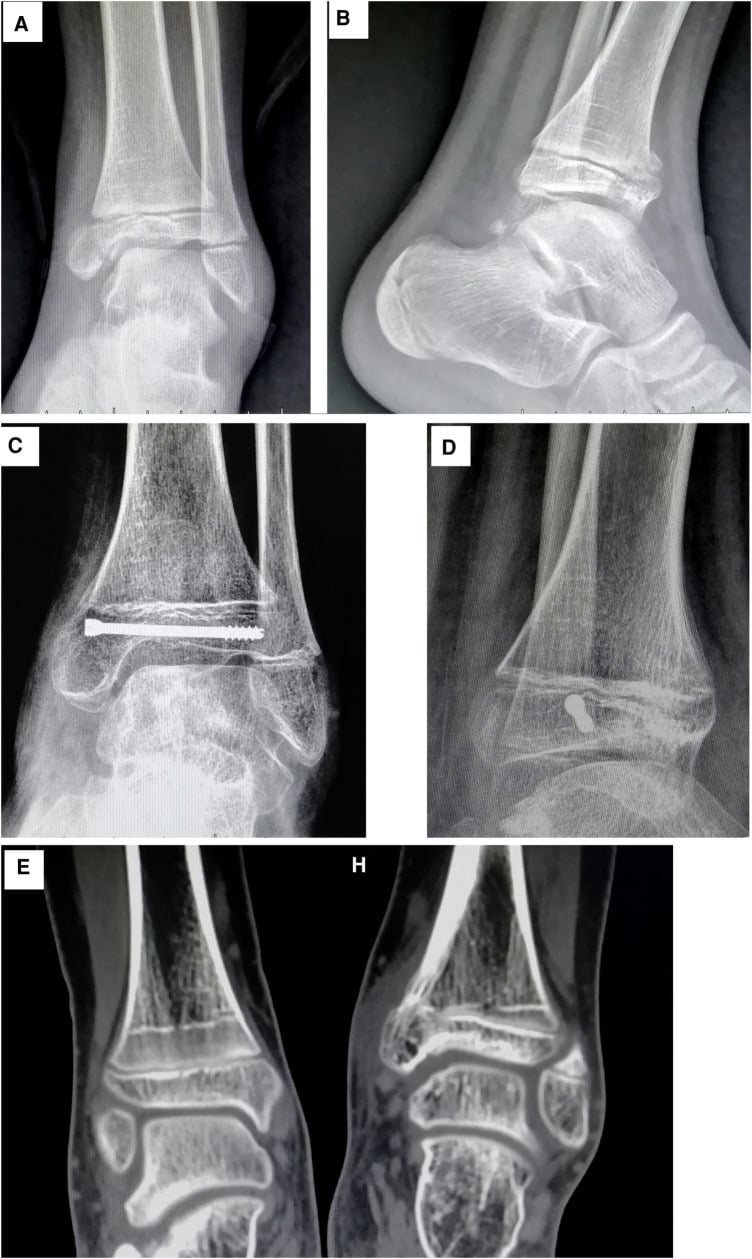
Manage. The deformity depends on where the bar lies:
- Medial bar: the ankle tilts into varus
- Lateral bar: valgus
- Central bar: tents the physis and shortens the bone, with leg-length discrepancy as growth remains
A small bar with meaningful growth left is treated by bar resection with interposition, plus correction of any deformity. A large bar, or one near maturity, is treated by completing the epiphysiodesis, managing the leg-length discrepancy (contralateral epiphysiodesis or lengthening), and a corrective osteotomy for the angular deformity.
Postoperative Care and Rehabilitation
Immobilisation. A below-knee cast for 4-6 weeks, non-weight-bearing initially, then weight bearing as tolerated at 4-6 weeks. Review at 2 weeks (wound check), 6 weeks (cast removal) and 3 months.
Post-operative CT. Always obtain a post-operative CT: it is mandatory to confirm anatomical reduction, especially for the triplane, and is repeated if there is any concern about reduction quality. Its need and timing are nonetheless debated: it adds radiation, and some surgeons rely on intra-operative fluoroscopy and arthroscopic visualisation instead.
Rehabilitation runs in four phases:
- Phase 1, immobilisation (0-6 weeks): below-knee cast, non-weight-bearing initially, toe wiggling and calf pumps
- Phase 2, early mobilisation (6-10 weeks): cast removal, ankle dorsiflexion and plantarflexion exercises, progressive weight bearing
- Phase 3, strengthening (10-16 weeks): resistance exercises (theraband), proprioception and balance training, gait normalisation
- Phase 4, return to sport (4-6 months): sport-specific training, full range of motion and strength, clearance by the surgeon
Outcomes and Prognosis
Non-displaced fractures do excellently with casting. Displaced fractures that are anatomically reduced do well, with a low risk of arthritis; a malunion with a step greater than 2mm carries a risk of post-traumatic arthritis. Growth arrest is uncommon because these fractures occur near skeletal maturity.
Guidelines, Registries & Global Practice
Global epidemiology
- Distal tibial physeal fractures are among the most common physeal injuries, peaking in the adolescent growth spurt (girls roughly 8-14, boys roughly 10-16 years).
- Triplane fractures represent approximately 5-10% of paediatric ankle physeal injuries (6% in the original Cooperman/Spiegel series); Tillaux is rarer and seen in the narrower 12-15 year window.
- Mechanism is overwhelmingly low-energy sport/recreational external rotation; both patterns reflect the ascending (central to medial to lateral) physeal closure sequence rather than a discrete injury entity.
Where guidance converges (society and consensus positions)
- Position on transitional ankle fractures
- CT recommended for displaced intra-articular and transitional patterns; anatomical articular reduction with greater than 2 mm step-off as the operative trigger.
- Position on transitional ankle fractures
- Cross-sectional imaging for intra-articular paediatric ankle fractures; restore joint congruity, screw fixation outside the closing physis where possible.
- Position on transitional ankle fractures
- Same 2 mm articular incongruity threshold; epiphyseal/metaphyseal screws kept parallel to and out of the open physis; reduce articular fragment first.
- Position on transitional ankle fractures
- Endorses CT-guided planning and anatomical reduction; emphasises avoiding repeated forceful manipulations (periosteal interposition risk).
There is no genuine guideline-level disagreement on the core principles: the 2 mm threshold, CT for transitional patterns, and anatomical articular reduction are universal. Differences are in access, not recommendation.
Registry note: There is no dedicated implant registry for paediatric transitional ankle fractures (these are low-volume, screw-only constructs). The evidence base is therefore case series and systematic review rather than registry survivorship - this is itself an exam point distinguishing it from arthroplasty topics.
High- vs limited-resource practice variation
- Well-resourced: routine pre-operative CT with 3D reconstruction, arthroscopic-assisted or fluoroscopic percutaneous cannulated-screw fixation, and confirmatory post-operative CT.
- Limited-resource: reliance on plain mortise/lateral radiographs and stress/internal-rotation views, with a lower threshold for open reduction when CT is unavailable to confirm the closed result. The principle (anatomical articular reduction) does not change; only the imaging confirmation does.
MCQ Practice Points
Q: Which part of the distal tibial physis closes first? A: Central. Then medial, then lateral (CML pattern).
Q: A Tillaux fracture is which Salter-Harris type? A: Type III. It involves the physis and epiphysis only.
Q: A Triplane fracture is which Salter-Harris type? A: Type IV. It involves the metaphysis, physis, and epiphysis.
Q: What is the threshold for operative treatment in transitional fractures? A: Greater than 2mm of articular step-off.
Q: In what order does the distal tibial physis close? A: Central, Medial, Lateral (CML) - this asymmetric closure creates transitional fractures.
Q: What imaging modality best defines transitional fracture anatomy? A: CT scan - essential to determine fracture pattern (2-part vs 3-part triplane) and articular step-off.
Self-Assessment Quiz
Viva Scenarios
Practise clinical reasoning and management decisions out loud
“14-year-old with ankle pain after a twisting injury playing soccer. X-ray shows an anterolateral fragment of the distal tibial epiphysis. CT shows 3mm of articular step-off.”
“13-year-old with ankle injury after a fall. X-ray shows a fracture through the physis with a metaphyseal fragment. CT shows a 3-part triplane fracture with 4mm step-off.”
“15-year-old with ankle pain. X-ray shows a probable Tillaux fracture. CT shows 1.5mm of articular step-off.”
“14-year-old, 1 year after a Tillaux fracture. Now has slight valgus of the ankle and 0.5cm LLD.”
KEY FACTS
- 45% Tibial Growth
- Central-Medial-Lateral Closure
- Tillaux = SH III
- Triplane = SH IV
TILLAUX
- Anterolateral fragment
- AITFL avulsion
- External rotation
- Age 12-15
TRIPLANE
- 3 Planes (S/H/C)
- 2-4 Parts
- CT Essential
- Age 12-15
TREATMENT
- Less than 2mm: Cast
- Greater than 2mm: ORIF
- Post-Op CT
- 4-6 Week Immob
Evidence Base
Cooperman, Spiegel & Laros (Triplane fracture)
- Defining description of the triplane epiphyseal fracture in 15 children (mean age 13 years)
- Triplane accounted for 6% of 237 consecutive ankle epiphyseal fractures
- Tomography clarified the three-plane geometry; the lateral fragment carried a posterior metaphyseal spike and attached fibula
- At mean 26 months, 3 of 14 had premature symmetrical closure but under 0.5 cm shortening and no angular deformity
Eismann & Mehlman (CT vs radiographs)
- 25 triplane fractures rated by 5 readers with radiographs alone then with CT
- Rapariz classification reliability rose from poor (kappa 0.17) to moderate (kappa 0.41) once CT was added
- CT changed the fracture pattern in 46%, moved displacement across the 2 mm threshold in 39%, and changed the operative decision in 27% of ratings
Nenopoulos et al. (CT and treatment decision)
- 64 intra-articular distal tibial fractures (32 SH III/IV, 32 transitional) read blinded on radiographs then CT
- CT changed the treatment decision in 24 of 64 patients
- Impact was greatest for transitional fractures; minimal change for SH III/IV
Leary et al. (Premature physeal closure)
- 124 distal tibial physeal fractures; premature physeal closure (PPC) in 12.1%
- 67% of all PPC occurred in SH II fractures; none in SH I or Tillaux
- Each 1 mm of initial displacement carried a relative risk of 1.15 for PPC (P less than 0.01)
Podeszwa & Mubarak (SH I-IV review)
- Nondisplaced distal tibial physeal fractures can be treated nonoperatively
- Residual physeal gapping over 3 mm after reduction suggests entrapped periosteum and predicts PPC
- Open reduction of displaced SH III/IV preserves joint congruity and limits physeal arrest
Tak et al. (Tillaux systematic review)
- Systematic review of 13 studies, 114 adolescent Tillaux fractures (mean follow-up 42.8 months)
- Outcomes were excellent across ORIF, CRIF and arthroscopic fixation
- Radiographic deformity (incongruity, angulation, shortening) occurred only in nonoperatively managed fractures left with 2 mm residual displacement; no premature physeal closure in any group