Most Common Long Bone Deficiency | Achterman-Kalamchi Classification | Syme vs Reconstruction | Foot Preservability Key
- Treatment based on foot preservability, NOT fibula length - key principle: assess foot rays (under 3 = Type 2 = amputation usually)
- Achterman-Kalamchi classification: Type IA (mild), IB (moderate), II (severe) - guides treatment approach
- Birch classification: Type 1 (foot preservable, 4-5 rays) vs Type 2 (foot not preservable, under 3 rays)
- Syme amputation: Indicated for predicted LLD over 30-40cm, under 3 foot rays, severe ankle valgus over 30 degrees
- Reconstruction: Multiple lengthenings, foot centralisation, ankle stabilisation - long treatment course (10-15 years)
- “Treatment decision based on FOOT (not fibula) - under 3 rays = Type 2 = usually amputation
- “Syme amputation preserves plantar heel pad for end weight-bearing - better function than BKA
- “LLD percentage is constant throughout growth - predict final LLD using multiplier method
- “Reconstruction requires 2-4 lengthenings, each 4-8cm, starting age 6-8 years
Overview and Epidemiology
Fibular hemimelia is the most common congenital long bone deficiency: partial or complete absence of the fibula, on a spectrum that runs from mild hypoplasia to complete absence. A limb length discrepancy and a deformed foot come with it.
Who. About 1 in 40,000 live births, with a male to female ratio of 1.5:1. The right side is slightly more often affected, and bilateral involvement is reported in anywhere from 9 to 52% of cases.
Cause. The fibula fails to develop normally during embryogenesis, and the exact cause is unknown. It may involve:
- Vascular insult during development
- Genetic factors, in rare familial cases
- Teratogenic exposure
- Failure of mesenchymal condensation
Pathophysiology and Mechanisms
What the fibula normally does. The fibula is the lateral bone of the lower leg. It carries minimal weight, 10-15%, but it contributes to the ankle mortise, gives the ankle its lateral stability, and anchors the peroneals and flexor hallucis longus.
What its absence does. Without the fibula the ankle loses its lateral support and lateral tether, and it drifts into valgus. The tibia bows anteromedially, a compensatory deformity and the characteristic one, and the lateral column of the foot is affected. Because the fibula contributes to length, the limb is short, and that limb length discrepancy is the main problem.
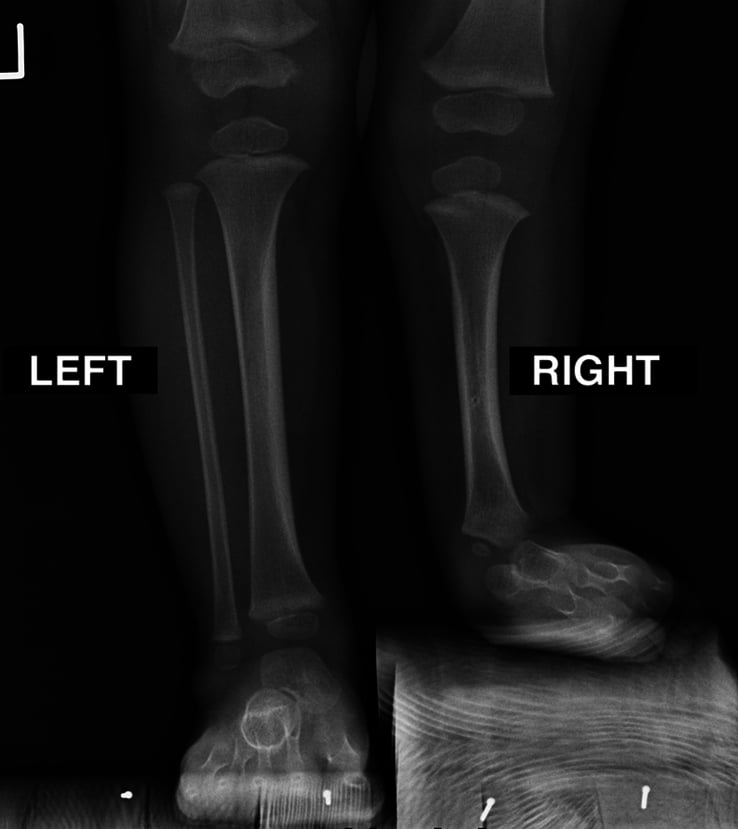
The whole limb is involved. Associated anomalies are common and run the length of the limb, so assess all of it:
- Foot: equinovalgus, the most common deformity; absent lateral rays and tarsal coalition, both common; syndactyly
- Knee: cruciate ligament deficiency, genu valgum, lateral femoral condyle hypoplasia
- Hip and femur: PFFD in 50%, coxa vara, acetabular dysplasia
- Upper limb: ulnar hemimelia may be associated
Classification Systems
Three classifications are in use. Achterman-Kalamchi describes severity by whether the fibula is present and the state of the foot. Birch sorts by whether the foot can be preserved, which is what matters most for treatment. Paley combines foot rays with the tibia-femur ratio to guide lengthening.
Achterman-Kalamchi Classification (1979)
- Fibula
- Present, hypoplastic (under 50% short)
- Foot
- Normal (5 rays)
- Treatment
- Reconstruction
- Fibula
- Present (over 50% short)
- Foot
- 3-4 rays
- Treatment
- Reconstruction or Syme
- Fibula
- Complete absence
- Foot
- 0-3 rays
- Treatment
- Syme amputation (usually)
Type IA is the mildest form, reconstructed with lengthening and an epiphysiodesis if needed. Type IB is of moderate severity: reconstruction is possible but complex, and whether to reconstruct or perform a Syme amputation depends on the discrepancy and the family's preference. Type II is the most severe and is usually treated by Syme amputation.
Clinical Assessment
History. A short lower limb is noted at birth, and a foot deformity may be noted with it. Ask about family history, which is rare but may be present, difficulty with walking or activities, and previous treatment in an established case.
Inspection and palpation. The limb is short, with anteromedial tibial bowing that can be felt as well as seen and a foot deformity, equinovalgus most commonly. The fibula may be absent or hypoplastic. Look at both legs for bilateral involvement and at the hip, knee and upper limb for associated deformity.
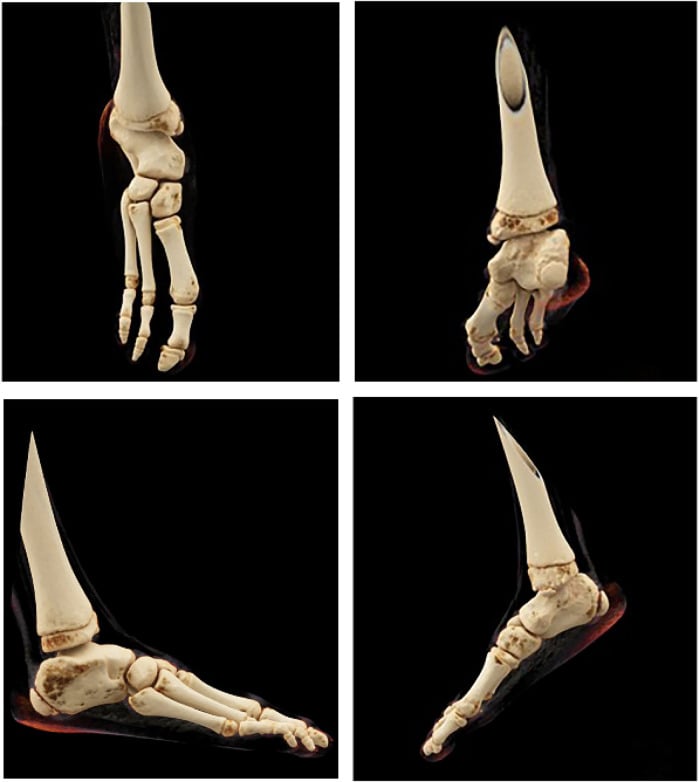
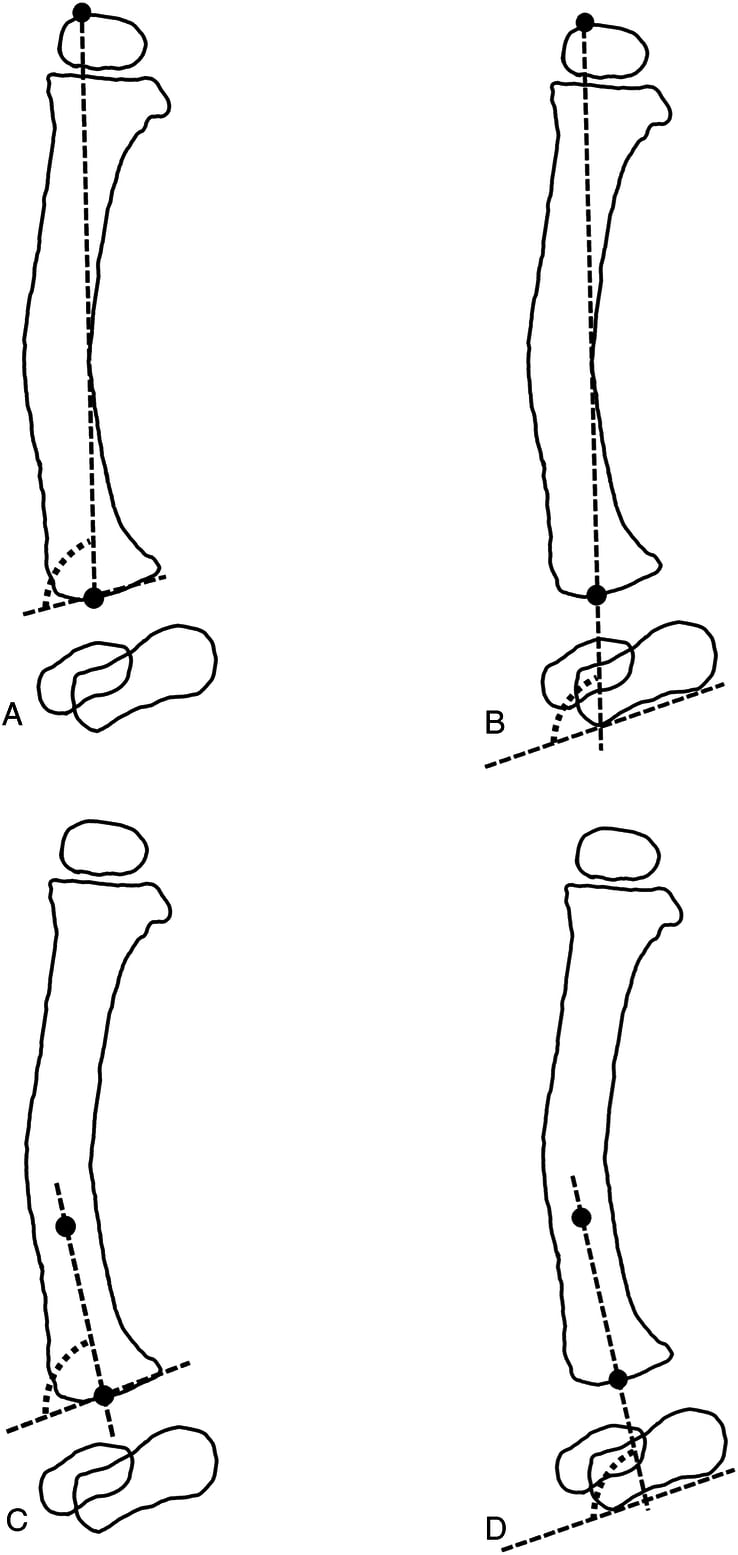
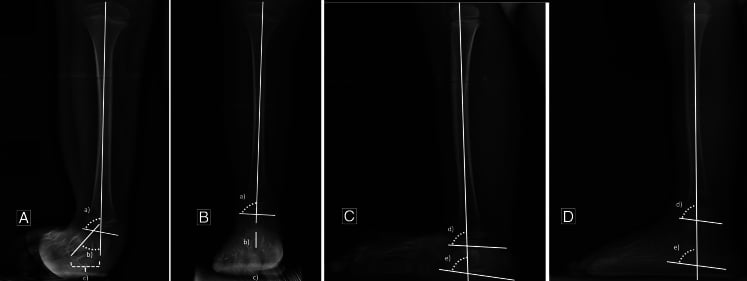
The foot and ankle. Count the functional rays (the toes) and record the foot position, equinovalgus or equinovarus, any tarsal coalition and the ankle valgus angle. Assess ankle stability; the ankle may have limited motion and a valgus deformity.
Above the ankle. At the knee, look for valgus and assess cruciate function. At the hip, assess for PFFD and coxa vara. Look for contractures throughout, examine the upper limbs for ulnar hemimelia, and check the cardiac and renal systems for their rare associations.
Measurements. True leg length is measured from the ASIS to the medial malleolus, apparent leg length from the umbilicus to the medial malleolus, and tibial length from the knee joint line to the ankle. The final discrepancy is then predicted (see Investigations).
Investigations
Radiographs. AP and lateral films of the lower limb show whether the fibula is present, the anteromedial tibial bowing, the limb length discrepancy, the ankle valgus angle and the foot (ray count and tarsal coalition). Dedicated foot radiographs count the functional rays and assess the tarsal coalition, the foot structure and the ankle valgus.
Full-length standing radiographs (scanogram). These give an accurate LLD measurement, show alignment and the tibia-femur ratio, and are the basis for planning treatment.
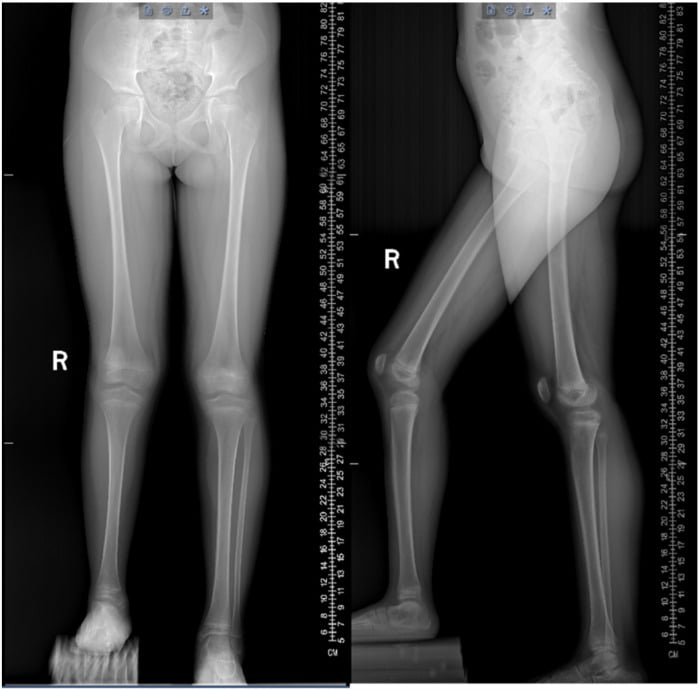
CT and other imaging. CT is used if reconstruction is being considered, for detailed foot and ankle anatomy, the tarsal coalition and planning the foot centralisation. MRI may assess the soft tissue structures; ultrasound is usually not needed.
Predicting the discrepancy. The LLD percentage is constant throughout growth, so the final discrepancy can be predicted. The multiplier method multiplies the current LLD by the multiplier to give the predicted final LLD. The growth remaining method accounts for growth and is more complex.
Differential Diagnosis
The combination of a short lower limb, anteromedial bowing and a valgus foot has a focused differential. The discriminator is usually the radiographic status of the fibula, the apex/direction of any bowing, and the pattern of associated anomalies.
- Key discriminating feature
- Hypoplastic or absent FIBULA; ball-and-socket ankle
- Bowing / deformity
- Anteromedial tibial bowing
- Foot & ankle
- Equinovalgus, lateral ray loss, tarsal coalition
- Key discriminating feature
- Deficient/absent TIBIA; relatively intact fibula
- Bowing / deformity
- Varus, knee flexion contracture
- Foot & ankle
- Equinovarus; assess quadriceps/knee extension
- Key discriminating feature
- Proximal FEMORAL deficiency (short thigh)
- Bowing / deformity
- Hip flexion-abduction-ER posture
- Foot & ankle
- Often coexists with fibular hemimelia
- Key discriminating feature
- Normal fibula; benign, resolves
- Bowing / deformity
- POSTEROmedial apex (calcaneovalgus foot)
- Foot & ankle
- Calcaneovalgus, residual LLD only
- Key discriminating feature
- Anterolateral bowing, sclerosis/cyst, pseudarthrosis
- Bowing / deformity
- ANTEROlateral apex
- Foot & ankle
- Foot usually normal; cafe-au-lait spots
Direction of tibial bowing is a fast differentiator: anteromedial = fibular hemimelia; posteromedial = benign congenital posteromedial bowing (calcaneovalgus foot, self-correcting, leaves only LLD); anterolateral = congenital pseudarthrosis of the tibia (NF1 - do NOT biopsy or osteotomise casually).
The Ball-and-Socket Ankle: the Signature Radiographic Sign
What it is. Instead of the normal hinged mortise, the talar dome becomes rounded and the distal tibial articular surface correspondingly concave, producing a ball-and-socket articulation on the AP radiograph.
Why it forms. It is an acquired, adaptive change. The absent or deficient lateral malleolus removes the normal lateral bony buttress, and an underlying tarsal coalition, usually talocalcaneal, abolishes subtalar inversion and eversion. The ankle remodels into a ball-and-socket to substitute a multiaxial range of motion, including the coronal-plane motion the fused subtalar joint can no longer provide.
Why it matters. On a paediatric film it is a red flag, not an isolated normal variant. It also signals that the ankle's stability and coronal alignment are abnormal, which is relevant before any lengthening.
A ball-and-socket ankle on a child's radiograph is a signature of a longitudinal deficiency (fibular hemimelia) with tarsal coalition. Search for the deficient fibula, the coalition and the limb length discrepancy.
Management
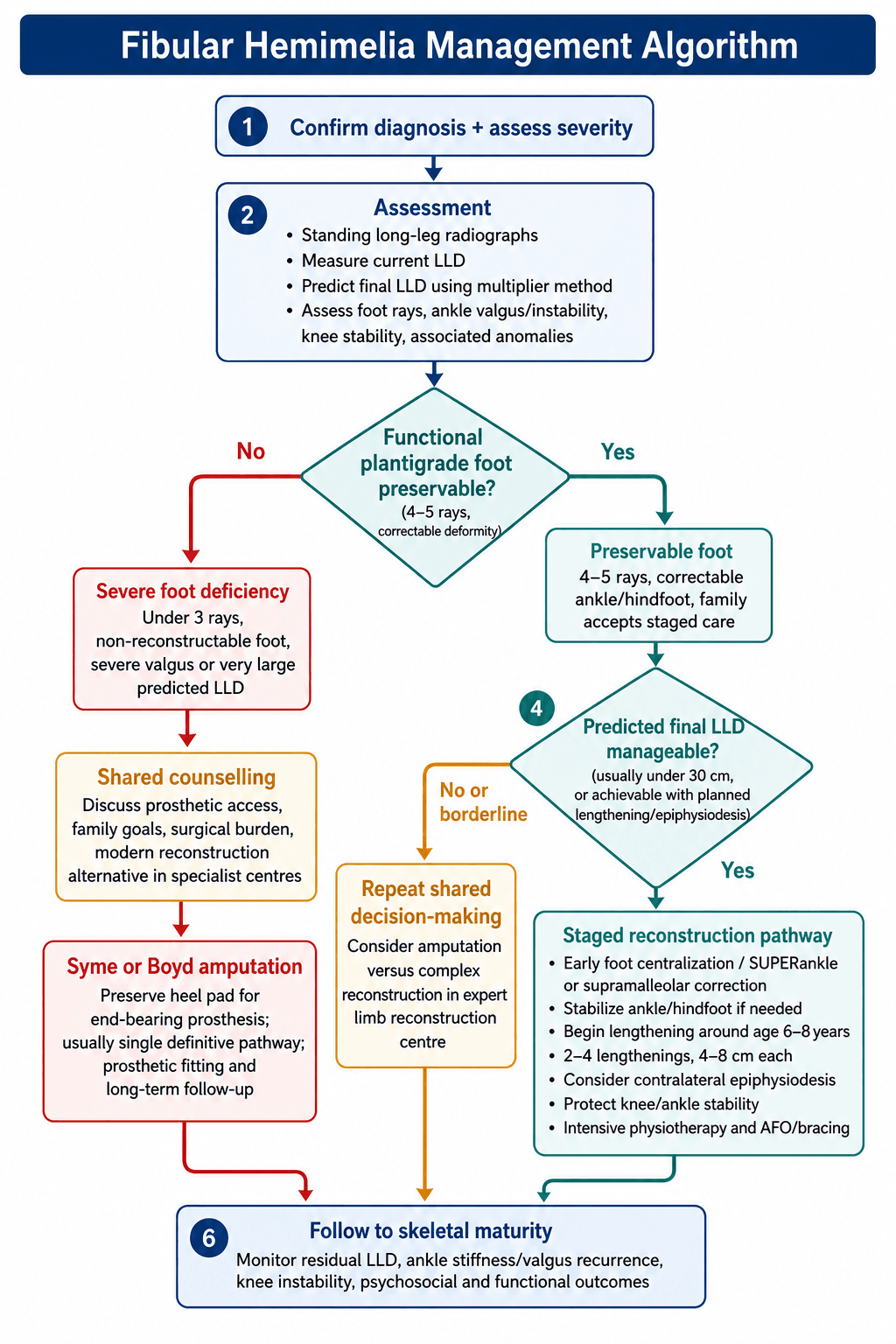
The principle. Treatment is based on whether the foot can be preserved, not on the length of the fibula. Four factors decide it:
- Foot rays: under 3 rays (Birch Type 2) usually means amputation; 4-5 rays (Type 1) make reconstruction possible
- Predicted LLD: over 30-40cm favours amputation; under 30cm, reconstruction is possible
- Ankle valgus: over 30 degrees favours amputation; under 30 degrees may be correctable
- Family preference, after counselling about both options
- Predicted LLD
- Under 30cm
- Ankle Valgus
- Under 30 degrees
- Treatment
- Reconstruction
- Predicted LLD
- 30-40cm
- Ankle Valgus
- 30-40 degrees
- Treatment
- Reconstruction or Syme
- Predicted LLD
- Over 30-40cm
- Ankle Valgus
- Over 30 degrees
- Treatment
- Syme amputation
The old teaching and the evidence. Syme amputation has been taught to give better function than reconstruction in severe cases. The only study to compare the two paths directly found no clinically significant functional or psychosocial difference in mid-childhood (see Outcomes), so there is no "wrong" choice between them and the decision is shared with the family.
Indications. Syme amputation is for the severe end of the spectrum:
- Predicted LLD over 30-40cm
- Foot with under 3 functional rays (Birch Type 2)
- Severe ankle valgus, over 30 degrees and uncorrectable
- Family acceptance after counselling
What it offers. A single operation and a short treatment course, where reconstruction needs many, with a low complication rate. Function with a prosthesis is excellent, with minimal restrictions. The plantar heel pad is preserved for end weight-bearing, which is its advantage over a below-knee amputation.
Surgical Techniques
For the indications set out under Management.
- Incision. Transverse across the anterior ankle, just above the joint line, with a plantar extension in racquet fashion that encompasses the plantar heel pad.
- Dissection. Divide the nerves high to prevent neuroma: sural, saphenous, deep peroneal and tibial. Ligate the posterior tibial and anterior tibial vessels and divide the tendons.
- Disarticulation. Disarticulate the ankle joint and remove the foot, then resect the medial malleolus flush and smooth the tibial end.
- Heel pad. Preserve the heel pad with its posterior tibial artery branches and fix it centrally to the tibia with sutures through drill holes.
- Closure. Close without tension over the end weight-bearing stump.
The SUPERankle Procedure
What it is. SUPERankle, Paley's Systematic Utilitarian Procedure for Extremity Reconstruction of the ankle, is a single-stage foot-and-ankle realignment. It converts a fixed equinovalgus, ball-and-socket, subluxated ankle into a stable, plantigrade foot positioned under the tibia, so that the limb can then be lengthened rather than amputated.
What it corrects. In one sitting it combines:
- Release of the tight lateral/posterolateral structures and the fibular anlage, the fibrocartilaginous band that tethers the ankle into valgus and equinus
- A supramalleolar (distal tibial) osteotomy to correct the distal tibial valgus and procurvatum
- Resection of the tarsal coalition/subtalar realignment to reposition the hindfoot
- Realignment of the ankle to make it congruent and plantigrade, held with wires/an external fixator
Where it sits. It is the enabling first step of the reconstruction (preservation) route for a preservable foot, performed before or with the first lengthening. It is the advance that has shifted some historically "amputation-only" few-ray feet into the reconstructable group.
The trade-off. It is a demanding, specialist procedure with a real risk of stiffness, recurrence of deformity and neurovascular compromise, and it commits the family to the long multi-lengthening course. It does not abolish the shared decision with a well-executed Syme amputation.
Complications
After reconstruction. Early problems are infection, in 20-30% with external fixators, wound healing problems, neurovascular injury and inadequate correction. Late ones are persistent LLD that may need additional lengthening, ankle instability, stiffness or arthritis, knee valgus and cruciate deficiency, recurrence of foot deformity or tarsal coalition, ankle and knee contractures, and hardware problems.
From lengthening.
- Pin site infection (common)
- Ankle and knee stiffness
- Contractures
- Delayed union
- Premature consolidation
- Nerve injury, peroneal most commonly
- Refracture
After Syme amputation. Wound healing problems occur in 5-10%; infection is rare. The heel pad may migrate if it is not properly fixed, and migration or bony overgrowth may need revision later. Problems with prosthetic fitting are rare.
Prevention. Prevention rests on careful patient selection, meticulous surgical technique and realistic expectations, with aggressive physical therapy and long-term bracing after reconstruction.
Postoperative Care
After Syme amputation. Pain management, wound care and a cast for 2-3 weeks. Once healed, the prosthesis is fitted at 6-8 weeks, followed by gait training and return to activities. The prosthesis is adjusted as the child grows, and the stump is watched for heel pad migration and bony overgrowth.
After reconstruction. Immediate care is pain management, wound care and care of the cast or external fixator. The lengthening phase needs daily pin site cleaning, the distraction protocol, regular radiographs and physical therapy, which is critical.
After union. Protected weight-bearing, then a long-term AFO, physical therapy and a gradual return to activities; foot centralisation is followed by the same protected weight-bearing and long-term AFO. Assess annually until skeletal maturity, monitoring the progression of the LLD and function and addressing complications.
Outcomes and Prognosis
Amputation versus reconstruction. Amputation has been taught as functionally superior for forty years, and the one study that compared the two paths directly found no such difference. Birch 2019 compared 20 primary amputations with 22 staged reconstructions, at a mean age of 9 and a minimum of 2 years after treatment:
- No significant functional or psychological differences between the groups
- Psychosocial and quality-of-life scores in both groups were comparable to healthy populations, and to each other
- Gait-analysis and timed-dash differences were statistically but not clinically significant
- The majority of patients and parents in both groups were satisfied and would choose the same again
The caveat that travels with it. Families choosing amputation had lower economic and educational levels and were more ethnically diverse, so the groups differed in who they were as well as in what was done. The authors attribute the single difference they found, lower perceived school-related quality of life among boys treated by amputation, to exactly that. Socioeconomic circumstance influences these scores independently of the operation: a reason to support families, not a reason to prefer an operation. Psychosocial support matters in both pathways.
What still differs. These differences are not in dispute:
- Syme or Boyd amputation
- Single definitive operation, short course
- Staged reconstruction
- Multiple lengthenings over 10-15 years
- Syme or Boyd amputation
- Lifelong, with replacement and fitting costs
- Staged reconstruction
- Avoided
- Syme or Boyd amputation
- None to manage below the stump
- Staged reconstruction
- Residual discrepancy and ankle problems are common - Unprasert's series left a mean 0.94 cm and reported ankle stiffness with equinus specifically in the Type II cases
- Syme or Boyd amputation
- Cruciate deficiency remains but is not stressed by distraction
- Staged reconstruction
- Cruciate deficiency must be addressed before or during lengthening or the knee subluxes
- Syme or Boyd amputation
- Irreversible
- Staged reconstruction
- Can convert to amputation later, having spent the years
How to counsel. The honest position is that the functional evidence does not favour either path in mid-childhood, that the burden of treatment differs enormously and predictably, and that the decision therefore belongs to an informed family. Say plainly that the long-term adult comparison has not been made: Birch's cohort was assessed at a mean age of nine, which the authors themselves call an interim stage.
What predicts success. Appropriate patient selection on either path. For Syme, proper technique and preservation of the heel pad; for reconstruction, a motivated family, adequate rays and a manageable LLD.
The long term. After Syme the child needs prosthetic adjustments while growing and is otherwise stable. After reconstruction additional procedures may be needed and ankle problems may worsen. On both paths most patients function independently.
Guidelines, Registries & Global Practice
Global epidemiology:
- Most common congenital long-bone deficiency; reported birth prevalence approximately 1 in 40,000 (longitudinal limb deficiencies overall ~1 per 20,000)
- Male predominance (~1.5:1); right side slightly more common; bilateral in roughly 10-25% of series
- Predominantly sporadic - the large majority are isolated with no Mendelian inheritance; rare familial/syndromic cases exist
- Strongly co-segregates with ipsilateral femoral deficiency (PFFD) and cruciate/lateral femoral condyle dysplasia
Side-by-side practice positions (no single global guideline exists):
- Primary framework
- Foot function + LLI + associated anomalies (Birch)
- Default for severe (Type II / under 3 rays)
- Amputation favoured - fewer complications, but reconstruction indications expanding
- Primary framework
- Aggressive reconstruction (SUPERankle + lengthening)
- Default for severe (Type II / under 3 rays)
- Reconstruction attempted in many Type II if foot reconstructable
- Primary framework
- Shared decision making - outcomes comparable
- Default for severe (Type II / under 3 rays)
- No mandated pathway; family preference central
- Primary framework
- Achterman-Kalamchi + predicted final LLD
- Default for severe (Type II / under 3 rays)
- Syme or Boyd amputation pragmatic in severe LLD
- No dedicated arthroplasty-style registry exists for fibular hemimelia; evidence is from single-centre series and pooled cohorts
- Comparative cohort data (amputation vs reconstruction) show comparable quality-of-life and function in mid-childhood, shifting practice toward shared decision-making
- Long-term registries of paediatric limb reconstruction track lengthening index, complication and re-operation rates rather than implant survival
- High-resource settings: magnetic intramedullary lengthening nails (e.g. PRECICE), staged SUPERankle reconstruction, gait labs, and lifelong prosthetic upgrades make reconstruction feasible
- Limited-resource settings: external-fixator (Ilizarov) lengthening or early Syme/Boyd amputation with a durable end-bearing stump is often the most reliable, cost-effective route to independent ambulation
- Prosthetic access and the ability to fund multiple childhood prosthesis changes materially influence whether amputation is the pragmatic choice
- Major, often irreversible decision - informed consent and realistic expectations are mandatory
- Document foot ray count, predicted final LLD, and ankle/knee stability
- No "wrong" choice between a well-executed amputation and a well-executed reconstruction; follow to skeletal maturity
Controversies & Areas of Uncertainty
Amputation versus reconstruction in severe disease. The comparative cohort data under Outcomes (Birch/Paley/Herzenberg 2019) challenge the historic teaching that amputation gives superior function in Type II, and the "right" answer is increasingly shared decision-making rather than a fixed algorithm.
How many foot rays are "reconstructable"? The under-3-rays threshold for amputation is a guide, not a hard rule. With modern foot and ankle reconstruction (SUPERankle) some experienced centres reconstruct feet that older series would have amputated, and definitions of a "functional plantigrade foot" are not standardised.
Lengthening nails versus external fixation. Magnetic intramedullary nails (PRECICE) reduce pin-site morbidity and improve comfort, but they require adequate bone stock, add cost, and may not suit the smallest or most deformed segments, where Ilizarov frames remain the workhorse. Long-term implant data are still maturing.
Timing and total burden of lengthening. The optimal age to start, the number of lengthenings, and the trade-off between repeated distraction (stiffness, contracture, neurovascular risk) and contralateral epiphysiodesis remain individualised. The cumulative anaesthetic and psychosocial burden over 10-15 years is hard to quantify.
Unresolved questions. Three remain open:
- No validated, disease-specific patient-reported outcome measure for fibular hemimelia exists; cross-study comparison is limited
- The genetic/embryological basis is still unclear (vascular insult vs mesenchymal condensation failure); most cases remain sporadic and unexplained
- Whether proactive cruciate reconstruction at the time of lengthening should be routine (versus reactive) is not yet supported by high-level evidence
MCQ Practice Points
Q: What is the most important factor in determining treatment for fibular hemimelia - amputation vs reconstruction? A: Foot preservability (number of functional rays), NOT fibula length - this is the key principle. Under 3 foot rays (Type 2) = usually Syme amputation. 4-5 foot rays (Type 1) = reconstruction possible. The decision is based on the foot, not the fibula.
Q: What is the Achterman-Kalamchi Type II fibular hemimelia? A: Complete absence of fibula with foot having 0-3 rays - this is the most severe form. Treatment is usually Syme amputation, as reconstruction is complex and often has inferior outcomes compared to amputation in these severe cases.
Q: What are the indications for Syme amputation in fibular hemimelia? A: Predicted LLD over 30-40cm, foot with under 3 functional rays (Type 2), severe ankle valgus over 30 degrees, and family acceptance - Syme amputation provides better function than complex reconstruction in severe cases and is the standard treatment for Type 2 fibular hemimelia.
Q: How many lengthening procedures are typically needed for fibular hemimelia reconstruction? A: 2-4 lengthenings, each achieving 4-8cm - reconstruction requires multiple staged lengthenings starting at age 6-8 years. Each lengthening takes 2-3 months per cm for consolidation. Total treatment course is 10-15 years with significant complication rates.
Q: What percentage of fibular hemimelia cases are associated with proximal femoral focal deficiency (PFFD)? A: 50% - fibular hemimelia and PFFD are commonly associated. Always assess the hip when evaluating fibular hemimelia. Other common associations include anteromedial tibial bowing, tarsal coalition, equinovalgus foot, and cruciate ligament deficiency.
Exam Viva Scenarios
Practise clinical reasoning and management decisions out loud
“A 1-year-old child presents with fibular hemimelia. On examination, the fibula is completely absent, there is anteromedial tibial bowing, the foot has 2 functional rays, and there is severe ankle valgus (40 degrees). How would you assess and manage this child?”
“A 2-year-old child with fibular hemimelia has a hypoplastic fibula (Type IA), foot with 4 functional rays (Type 1), predicted LLD of 12cm, and moderate ankle valgus (20 degrees). The family prefers reconstruction over amputation. What is your treatment plan?”
“You have decided to perform a Syme amputation for a 2-year-old with Type 2 fibular hemimelia. Describe the key technical steps and how you preserve the heel pad for end weight-bearing.”
Key Facts
- Incidence: 1 in 40,000 live births (most common long bone deficiency)
- Treatment based on FOOT (not fibula) - key principle
- Achterman-Kalamchi: Type IA (mild), IB (moderate), II (severe)
- Birch: Type 1 (4-5 rays, preservable) vs Type 2 (under 3 rays, not preservable)
Achterman-Kalamchi Classification
- Type IA: Fibula present, hypoplastic (under 50% short), foot normal = Reconstruction
- Type IB: Fibula present (over 50% short), foot 3-4 rays = Reconstruction or Syme
- Type II: Complete fibular absence, foot 0-3 rays = Syme amputation (usually)
- Severity correlates with LLD and foot deformity
- Most common presentation is Type II (complete absence)
Treatment Decision (Birch)
- Type 1 (4-5 rays): Reconstruction possible - foot centralization, lengthenings
- Type 2 (under 3 rays): Usually Syme amputation - better function in severe cases
- Key: Foot rays determine treatment, NOT fibula length
- LLD over 30-40cm predicted also favors amputation
Surgical Pearls
- Syme: Preserve plantar heel pad with posterior tibial artery branches
- Fix heel pad centrally to tibia (drill holes, sutures) - prevents migration
- Reconstruction: Foot centralization first, then staged lengthenings (2-4 total)
- Lengthening: 1mm/day distraction, aggressive PT critical, 2-3 months per cm
Complications
- Reconstruction: Infection (20-30%), stiffness, contractures, delayed union
- Syme: Heel pad migration (if not properly fixed), wound healing (5-10%)
- Reconstruction: Residual LLD (2-5cm common), ankle problems (instability, stiffness)
- Prevention: Careful patient selection, meticulous technique, aggressive PT
Evidence Base
Achterman-Kalamchi Classification (Original Paper)
- 97 limbs in 81 patients reviewed; defined Type I (hypoplastic fibula) vs Type II (complete absence)
- Femoral anomalies in 76% of Type I and 59% of Type II limbs
- Mean limb shortening 13% (Type I) and 19% (Type II) - constant percentage during growth
- Type I aimed at length equalisation; Type II treated with foot amputation and prosthesis
Birch Functional Classification (Modern Treatment Framework)
- Birch classification stratifies by foot functionality, limb-length inequality, and associated anomalies - not fibula length
- Treatment goals: plantigrade functional foot, equal limb length, normal weight-bearing
- Amputation for severe forms shows favourable results with fewer complications than lengthening
- Advances in lengthening may extend reconstruction indications for severe deficiency
Amputation vs Staged Reconstruction - Comparative Outcomes
- 20 children managed by primary amputation vs 22 by staged reconstruction/lengthening
- Psychosocial and quality-of-life scores comparable to healthy populations in BOTH groups
- Only statistical (not clinically significant) gait-analysis and timed-dash differences between groups
- Majority of patients and parents satisfied and would choose the same treatment again
Cruciate Dysplasia Severity Correlates with Fibular Deficiency
- 75 patients with unilateral fibular deficiency assessed for tibial spine and cruciate changes
- Severity of tibial spine (cruciate) dysplasia correlated with severity of fibular deficiency (p under 0.0001)
- Lateral femoral condylar hypoplasia mean ratio 0.85; greater with more severe deficiency
- Cruciate dysplasia associated with foot ray deficiency (p = 0.036)
Ilizarov Lengthening - Reconstruction Outcomes Series
- 9 patients with fibular hemimelia treated by Ilizarov tibial lengthening (Types IA, IB, II)
- Mean lengthening 7.5cm (range 4-13cm); lengthening index 1.28 months/cm
- Mean residual leg-length discrepancy 0.94cm at mean 5-year follow-up
- Ankle stiffness/mild equinus in Type II cases but all walked without aids; all satisfied
Concomitant Lengthening and Cruciate Reconstruction
- 5 patients with complex fibular hemimelia - intramedullary lengthening (PRECICE) plus ACL reconstruction in one stage
- All achieved objective improvement in knee stability
- Successful lengthening without joint-stability-related complications
- Combining procedures reduces total operations and instability risk during lengthening