Chronic Childhood Inflammatory Arthritis
- Oligoarticular: Most common type. 4 or fewer joints.
- Polyarticular: 5 or more joints. More severe.
- Systemic (Still's): Fever, rash, serositis.
- Growth Disturbance: Initial overgrowth, then undergrowth.
- Biologics: Revolutionised medical treatment.
- “Oligoarticular most common
- “Knee overgrowth then undergrowth
- “Biologics escalate from NSAIDs and methotrexate; IL-1/IL-6 blockade is first-line in systemic JIA
- “Surgery after medical optimisation
Overview/Epidemiology
Definition. Juvenile idiopathic arthritis is chronic inflammatory arthritis in a child: onset before the age of 16, persisting for more than 6 weeks, with no other cause found.
Frequency and classification. The incidence is 1-4 per 10,000 children. The ILAR classification divides the disease into seven subtypes, set out below, and oligoarticular disease is the most common of them.
Pathophysiology and Mechanism
Joint damage. Chronic synovitis forms a pannus, which erodes cartilage and subchondral bone. If the inflammation is not controlled, the joint destruction progresses.
Growth disturbance. In the early phase, chronic inflammation causes hyperaemia around the physis, and the increased blood flow drives physeal overgrowth, so the limb lengthens. In the late phase, prolonged inflammation damages the physeal chondrocytes, the physis closes prematurely and the limb shortens. The net effect is often lengthening followed by shortening, and a leg length discrepancy.
Which joints. The knee is the joint most commonly affected, and valgus deformity and flexion contracture are common there. The hip develops a flexion-adduction contracture and coxa valga. In severe polyarticular JIA the cervical spine can become unstable at C1-C2, which calls for cervical spine precautions.
Classification Systems
Two systems are used. The ILAR classification (International League of Associations for Rheumatology) names the subtype, and orthopaedic staging grades the joint from synovitis to end-stage destruction.
- Oligoarticular - 4 or fewer joints in the first 6 months. The most common subtype (50%), and the one with the uveitis risk.
- Polyarticular RF-negative - 5 or more joints, RF negative. Symmetric, of moderate severity.
- Polyarticular RF-positive - 5 or more joints, RF positive. Similar to adult rheumatoid arthritis.
- Systemic (Still's disease) - a variable number of joints, with quotidian fever, salmon-pink rash, hepatosplenomegaly and serositis. IL-1/IL-6 driven.
- Enthesitis-related arthritis - HLA-B27 associated, with axial involvement. Related to ankylosing spondylitis.
- Psoriatic arthritis - arthritis with psoriasis or dactylitis.
- Undifferentiated - does not fit the other categories.
Clinical Assessment
History. The child presents with joint pain, swelling and stiffness, and the morning stiffness improves with activity. Ask about systemic symptoms, the fever and rash of systemic JIA, and about the eyes, remembering that the uveitis of oligoarticular disease is typically asymptomatic (see JIA-Associated Uveitis).
Examination. Work through the joints and then the consequences of the disease:
- Joints - swelling, warmth, effusion, limited range of motion
- Gait - antalgic
- Leg length - discrepancy
- Contractures - hip and knee flexion
- Eyes - refer for slit-lamp examination for uveitis
Investigations
Blood tests. ESR and CRP are elevated. The serology lines up with the subtypes:
- ANA - positive in oligoarticular disease, and a marker of uveitis risk
- RF - positive in RF-positive polyarticular disease
- HLA-B27 - enthesitis-related arthritis
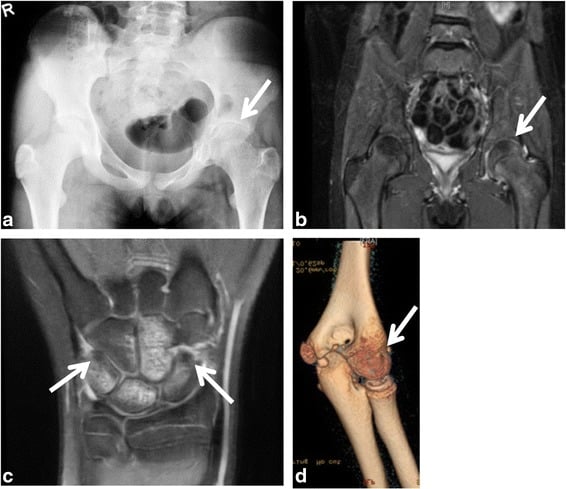
Imaging. Radiographs show soft-tissue swelling and osteopenia, with erosions appearing late. MRI shows the synovitis and the effusion.
Differential Diagnosis
- Distinguishing Features
- Acute, single joint, febrile, elevated WCC
- Distinguishing Features
- Post-infectious, self-limiting
- Distinguishing Features
- Endemic area, tick bite, Borrelia serology
- Distinguishing Features
- Night pain, bone pain, abnormal blood film
- Distinguishing Features
- Hip, resolves within 2 weeks, normal bloods
Management Algorithm
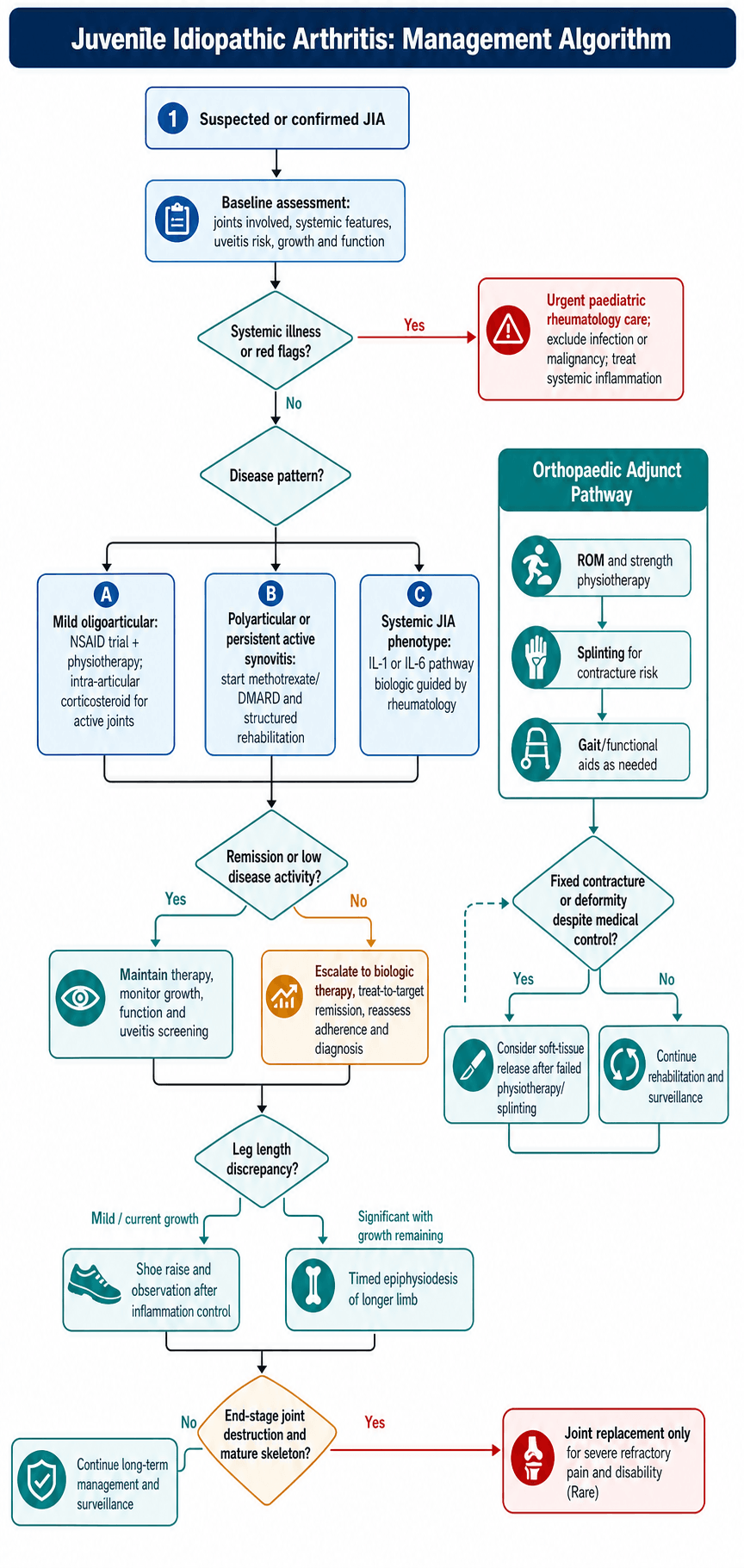
Medical control comes first. Surgery follows medical optimisation and is reserved for refractory contractures or end-stage joints.
Medical treatment. The goal is remission and the prevention of joint damage, and treatment is matched to the disease pattern:
- NSAIDs - first-line for mild disease
- Intra-articular steroids - oligoarticular disease
- DMARDs - methotrexate for polyarticular disease
- Biologics - TNF inhibitors (etanercept, adalimumab), and IL-1/IL-6 inhibitors for systemic JIA
Joint destruction from uncontrolled synovitis is managed with early biologic therapy.
Orthopaedic support. Physiotherapy maintains range of motion and strength, and splinting treats contractures. The surgical options below are for what these cannot correct.
Surgical Techniques
Soft-tissue release. The indication is a fixed contracture that has not responded to physiotherapy and splinting. At the knee this means a posterior capsular release and hamstring lengthening. At the hip, iliopsoas, rectus and adductor release, and a severe contracture may need an open release.
Leg length. While the affected limb is lengthening in the initial phase, a mild discrepancy is managed with a shoe raise and monitoring: it may self-correct if the inflammation is controlled. Once it is shortening in the late phase, epiphysiodesis of the longer leg is timed to the growth remaining. Limb lengthening is rarely needed.
Joint replacement. The indication is end-stage joint destruction, which is rare in the biologic era. Hip and knee arthroplasty are both possible, but the patients are young, so durability is a concern, the bones are small, and disease activity should be quiescent before the operation.
Postoperative Care
Aggressive physiotherapy is essential to maintain the gains, with night splints to prevent recurrence, and contractures can recur, so monitor for it. Continue medical therapy and do not stop biologics or DMARDs. Rheumatology co-management is essential.
JIA-Associated Uveitis
What it is. The classic JIA-associated eye disease is a chronic anterior uveitis (chronic iridocyclitis), often bilateral. It is typically asymptomatic and "white", with no pain, redness or photophobia, so the eye looks normal while sight-threatening inflammation progresses silently. Screening, not symptoms, is what finds it.
The contrast. HLA-B27 enthesitis-related arthritis produces the opposite: an acute, symptomatic anterior uveitis, a painful red photophobic eye.
Who is at risk. Young, ANA-positive, oligoarticular girls within the first few years of disease carry the greatest risk. Risk is highest early and falls with time, but it persists for years and is independent of joint disease activity: the eyes can be inflamed while the joints are quiet.
OAFYUveitis Risk Factors
Hook:OAFY - Oligo, ANA+, Female, Young.
Screening. Asymptomatic high-risk children need regular slit-lamp examination by ophthalmology. The frequency is risk-stratified by subtype, ANA status, age at onset and disease duration: as often as roughly every 3 months in the highest-risk early ANA-positive oligoarticular child, spacing out as risk declines, and continued for years after the arthritis settles.
If it is missed. Posterior synechiae, band keratopathy, cataract, glaucoma, macular oedema and permanent vision loss.
Treatment. Topical corticosteroids plus a mydriatic come first. Steroid-dependent or refractory disease moves to systemic methotrexate and then an anti-TNF biologic. The monoclonal antibodies adalimumab and infliximab are effective for uveitis, whereas etanercept is not, so the choice of biologic is driven partly by eye involvement.
Macrophage Activation Syndrome (MAS)
What it is. MAS is a form of secondary haemophagocytic lymphohistiocytosis (HLH), an uncontrolled cytokine storm, that complicates systemic JIA and adult-onset Still's disease; the general HLH picture is developed in that topic. It may be the presenting feature, or be triggered by infection, a disease flare or a medication change.
Clinical picture. A rapid deterioration, with unremitting high fever that loses the quotidian pattern, hepatosplenomegaly, lymphadenopathy, encephalopathy or CNS dysfunction, bleeding and disseminated intravascular coagulation, progressing to multi-organ failure.
Laboratory hallmarks. Several of these run against expectation and catch people out:
- Markedly elevated ferritin - the hallmark; very high values are a major red flag
- Falling cell counts - platelets, then white cells and haemoglobin (cytopenias from haemophagocytosis)
- A paradoxically falling ESR - fibrinogen is consumed, so the ESR drops while CRP and ferritin climb
- Low fibrinogen, rising triglycerides, and rising transaminases and LDH (hepatic dysfunction and coagulopathy)
- Bone-marrow haemophagocytosis - may be seen, but is neither always present nor required for diagnosis
Spot the emergency. In a febrile systemic-JIA child, a sudden fall in ESR with a rising ferritin, falling platelets and rising transaminases is MAS until proven otherwise, not improvement. A child who looks "less inflamed" by ESR may actually be deteriorating.
Classification. The 2016 EULAR/ACR/PRINTO criteria for MAS in systemic JIA require a febrile patient with a high ferritin plus two or more of:
- Low platelets
- High AST
- High triglycerides
- Low fibrinogen
Treatment. MAS is a medical emergency. Give high-dose corticosteroids (IV methylprednisolone), ciclosporin and the IL-1 antagonist anakinra, with intensive-care support, and identify and treat any triggering infection.
Outcomes/Prognosis
Biologics have dramatically improved outcomes. Oligoarticular disease has the best prognosis, and RF-positive polyarticular disease the worst, similar to adult rheumatoid arthritis. Systemic disease is variable and can be severe.
Guidelines, Registries & Global Practice
Global epidemiology
- JIA is the most common chronic inflammatory rheumatic disease of childhood. Population-based studies show wide variation: incidence roughly 1.6-23 per 100,000/year and prevalence 3.8-400 per 100,000.
- Oligoarticular onset predominates in European/North American cohorts; systemic and polyarticular onset are relatively more common in parts of Asia, Africa and Latin America.
- Female predominance overall (especially ANA-positive oligoarticular and uveitis); enthesitis-related arthritis is more common in older boys.
Major guidelines — side by side
- Scope
- Treatment by disease group + prognostic features
- Core position
- Stepwise escalation: NSAIDs/intra-articular steroid → methotrexate → biologic for poor-prognosis or refractory disease
- Scope
- Points to consider, systemic JIA & non-systemic
- Core position
- Treat-to-target to inactive disease; early biologic in systemic JIA; window-of-opportunity concept
- Scope
- Biologic eligibility & uveitis screening
- Core position
- Structured ophthalmology screening schedule; biologics for inadequate methotrexate response
- Scope
- Classification
- Core position
- Seven-category framework underpinning all guidelines
Registry & long-term data
- Pharmacovigilance registries (e.g. German BiKeR, UK BSPAR-ETN/BCRD, US CARRA Registry, Pharmachild/PRINTO) track biologic safety — malignancy and serious-infection signals have been reassuring at population scale.
- Joint-replacement registries show end-stage arthroplasty for JIA is now uncommon; when performed, survivorship is good but technically demanding (small implants, deformity, osteopenia).
High- vs limited-resource practice variation
- Well-resourced settings: early methotrexate, prompt biologic access, protocolised slit-lamp uveitis screening, MDT (rheumatology, ophthalmology, physiotherapy, orthopaedics, psychology), structured adolescent transition to adult services.
- Limited-resource settings: delayed diagnosis, reliance on NSAIDs/steroids and methotrexate due to biologic cost/availability, higher burden of established deformity, contractures and growth disturbance at presentation — raising the relative role of orthopaedic soft-tissue and reconstructive surgery.
- Universal priorities: control inflammation early, screen the eyes, preserve growth and function, and assess the cervical spine and TMJ before any anaesthetic in polyarticular disease.
Controversies and Areas of Uncertainty
Classification in flux. A PRINTO consensus is moving toward a biology-based system (e.g. systemic JIA, RF-positive arthritis, enthesitis/spondylitis-related, early-onset ANA-positive arthritis) that may eventually replace the descriptive ILAR categories. Exam answers should acknowledge ILAR as the current standard while noting the proposed revision.
Systemic JIA as an autoinflammatory disease. It is increasingly viewed as IL-1/IL-6-driven autoinflammation rather than classic autoimmune arthritis, which supports first-line IL-1/IL-6 blockade and a possible "window of opportunity" for early biologics.
When to start biologics. Early aggressive biologic use to prevent damage is debated against a step-up strategy after methotrexate failure, balancing cost, access and long-term safety.
Treatment de-escalation. The optimal timing and method of tapering biologics after sustained remission remain unresolved, and the flare risk on withdrawal is significant.
Surgical timing and choice. Synovectomy and arthroplasty have a diminishing role in the biologic era. The timing of epiphysiodesis is uncertain for an inflammation-driven leg length discrepancy that may partially self-correct once the disease is controlled.
Macrophage activation syndrome. For this life-threatening complication of systemic JIA, the thresholds for diagnosis and the role of anakinra in treatment continue to evolve.
MCQ Practice Points
Q: What is the most common JIA subtype? A: Oligoarticular (≤4 joints).
Q: What causes initial leg lengthening in JIA? A: Hyperemia from inflammation causes physeal overgrowth.
Q: What eye complication is associated with oligoarticular JIA? A: Uveitis (especially if ANA positive).
Q: Which JIA subtype has the worst prognosis? A: RF-positive polyarticular - similar to adult rheumatoid arthritis.
Q: What is the characteristic rash in systemic JIA? A: Salmon-pink, evanescent rash that appears with fever spikes.
Q: What cervical spine concern exists in polyarticular JIA? A: C1-C2 instability - requires pre-operative assessment before intubation.
Self-Assessment Quiz
Viva Scenarios
Practise clinical reasoning and management decisions out loud
“10-year-old with oligoarticular JIA affecting the left knee. 3cm left leg lengthening noted.”
“Same patient has a 30-degree knee flexion contracture despite physiotherapy.”
“Teenager with long-standing polyarticular JIA needs tonsillectomy. What are the anaesthetic concerns?”
TYPES
- Oligoarticular (most common)
- Polyarticular RF+/-
- Systemic (Still's)
- Enthesitis-related
GROWTH
- Initial overgrowth (hyperemia)
- Later undergrowth (physeal damage)
- Leg length discrepancy
- Valgus knee common
UVEITIS RISK
- Oligoarticular subtype
- ANA positive
- Female
- Young onset
TREATMENT
- NSAIDs for mild
- DMARDs (methotrexate)
- Biologics (TNF, IL-1/6)
- Physio essential
SURGERY
- After medical optimization
- Contracture release
- Epiphysiodesis for LLD
- Arthroplasty (rare)
CERVICAL SPINE
- C1-C2 instability risk
- Pre-op imaging
- TMJ may limit mouth opening
- Communicate with anaesthesia
Evidence Base
Lovell et al. — Etanercept in polyarticular JRA (RCT)
- Landmark double-blind RCT: 69 children with methotrexate-refractory polyarticular JIA
- 74% responded in open-label phase; on withdrawal, disease flare in 28% (etanercept) vs 81% (placebo)
- Median time to flare over 116 days vs 28 days with placebo (less than 0.001)
Petty et al. — ILAR classification, 2nd revision (Edmonton 2001)
- Defines the seven mutually exclusive ILAR categories used worldwide
- Arthritis onset under 16 years, persisting over 6 weeks, no other cause
- Categories: oligo (persistent/extended), poly RF-neg, poly RF-pos, systemic, ERA, psoriatic, undifferentiated
Ravelli & Martini — Juvenile idiopathic arthritis (review)
- Authoritative review of heterogeneous JIA arthritides of unknown cause
- Prognosis greatly improved by anticytokine agents for conventional-therapy-resistant disease
- Subtype-specific presentation, genetics and outcome
Malattia et al. — Tocilizumab radiographic progression (TENDER & CHERISH)
- Post hoc radiographic analysis of two RCTs (systemic and polyarticular-course JIA)
- Wrist/hand films scored by adapted Sharp-van der Heijde and Poznanski methods over 104 weeks
- Most patients showed no structural progression on IL-6 blockade
Wallace et al. — Validation of clinical remission criteria (OMERACT)
- Validated criteria for inactive disease, clinical remission on and off medication
- Built from 34-country Delphi survey and chart review of 437 JIA patients
- Patients reaching off-medication remission stayed disease-free longest
Martin et al. — Adolescent total knee arthroplasty
- 29 TKAs in 19 patients aged 20 years or younger (JIA the leading diagnosis)
- Implant survivorship 96% at 5 years and 94-95% at 10 years
- TKA volume for inflammatory arthritis has fallen with biologic therapy
Beukelman et al. — ACR treatment recommendations for JIA
- ACR recommendations on initiation and safety monitoring of JIA therapeutics
- Treatment by disease group and prognostic features rather than ILAR category alone
- Escalation to DMARDs/biologics for poor-prognosis or refractory disease
Cassidy & Petty — Textbook of Pediatric Rheumatology
- Standard reference for ILAR classification detail
- Orthopaedic manifestations and growth disturbance
- Multidisciplinary management principles