NF1 Orthopaedic Challenges
- Dystrophic Scoliosis: Sharp, angular curve with poor prognosis.
- Tibial Dysplasia: Anterolateral bowing → pseudarthrosis risk.
- Cafe-au-lait Spots: 6 or more spots of 5mm or more (prepubertal).
- NF1 Gene: Tumour suppressor (neurofibromin).
- Surgery is challenging: High failure rates.
- “Dystrophic vs non-dystrophic scoliosis
- “Anterolateral tibial bowing
- “6 or more cafe-au-lait spots is one diagnostic criterion; two criteria are needed
- “NF1 is a tumour suppressor
Overview and Epidemiology
Neurofibromatosis type 1 (NF1, von Recklinghausen disease) is a common autosomal dominant disorder. The NF1 gene on chromosome 17 encodes neurofibromin, a tumour suppressor. The incidence is 1 in 3,000, and 50% of cases are new mutations, so there is often no family history.
What the orthopaedic surgeon meets. The key clinical features are café-au-lait spots, neurofibromas and Lisch nodules. In the skeleton the problems are dystrophic scoliosis, tibial dysplasia with its risk of pseudarthrosis, and other long bone deformities.
Malignancy. The lifetime risk of malignant peripheral nerve sheath tumour (MPNST) is 8-13%.
Pathophysiology, Anatomy & Pathomechanics
Neurofibromin. Neurofibromin is a tumour suppressor that acts as a Ras-GAP. Its loss leads to uncontrolled cell proliferation, which is what produces neurofibromas, and the effect reaches Schwann cells, melanocytes and bone.
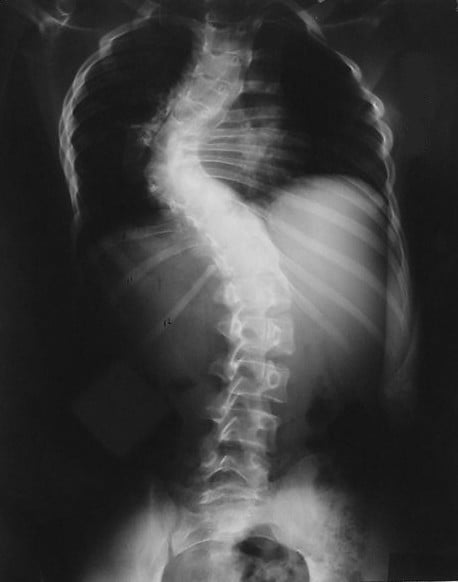
Why the spine curves. Dystrophic features suggest a mesodermal dysplasia, and the vertebral scalloping comes from dural ectasia and abnormal bone. Neurofibromas also expand the neural foramina and erode or scallop the adjacent vertebrae, producing a dysplastic scoliosis and complex pedicle anatomy. Non-dystrophic curves are likely due to neurofibromas affecting the paraspinal muscles.
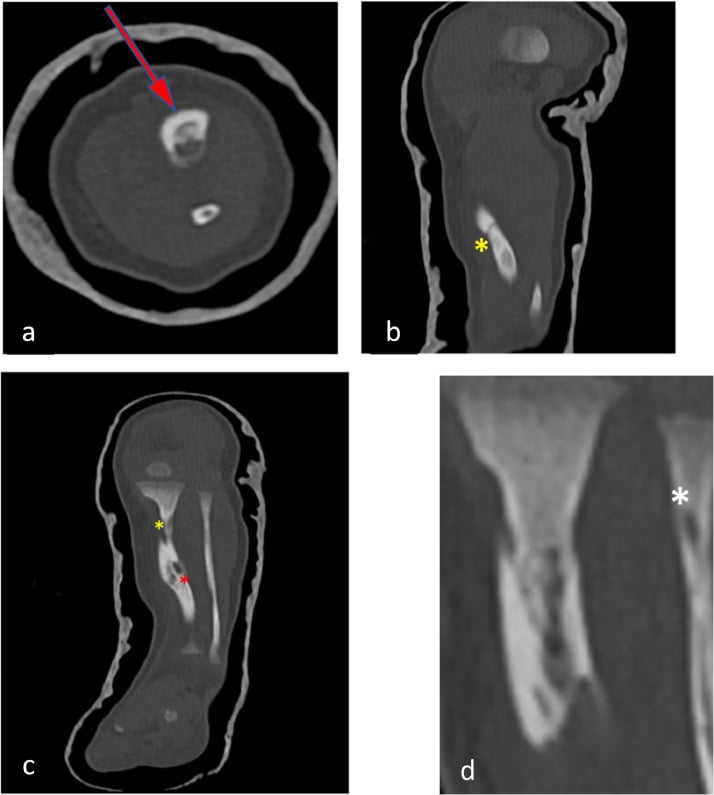
Why the tibia will not heal. The defect is local, in the mesodermal tissue of the tibial periosteum and bone. This dysplasia produces weak, poorly vascularised bone and fibrous hamartoma that resist ordinary fracture healing. The anterolateral bow progresses to fracture, and the fracture to non-union.
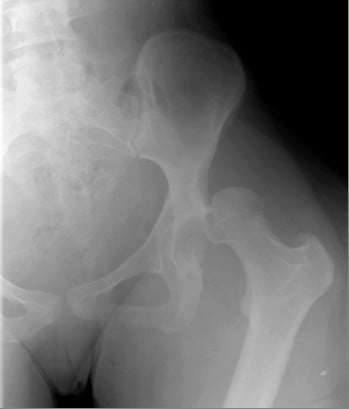
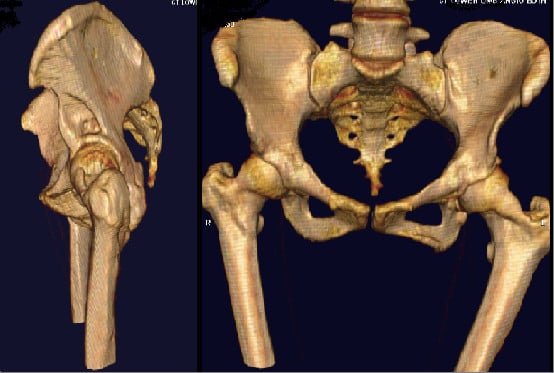
The hip. Hip instability in NF1 may reflect local dysplasia, bony erosion and mass effect from an adjacent neurofibroma, rather than ordinary traumatic dislocation. Plexiform neurofibroma and dysplastic bone can compromise a major joint, and the structural loss explains recurrent instability.
Classification Systems
Dystrophic or non-dystrophic. NF1 scoliosis is classified as dystrophic or non-dystrophic, and the distinction sets the prognosis. A dystrophic curve has a poor prognosis and progresses rapidly, even after fusion. A non-dystrophic curve is similar to idiopathic scoliosis, lacks the dystrophic vertebral changes and has a better prognosis.
The dystrophic features are:
- A short-segment, sharp, angular curve
- Vertebral scalloping, wedging and rotation
- Rib penciling (thin ribs)
- Spindling of the transverse processes
- Dural ectasia (an expanded dural sac)
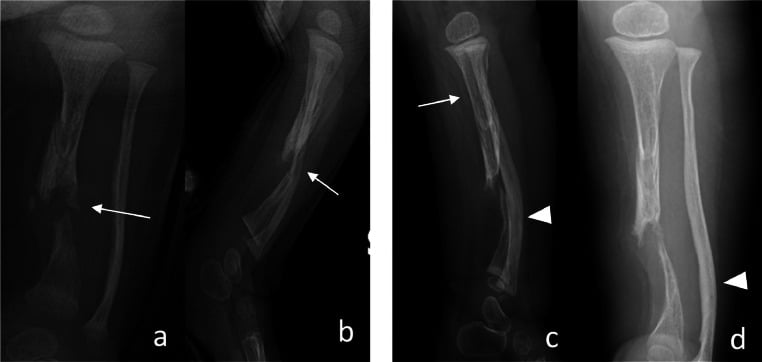
The Crawford classification of tibial dysplasia. Every type has anterolateral bowing; the types differ in what the bone shows. Types III and IV have the worst outcomes.
- Anterolateral bowing with
- Increased cortical density
- Anterolateral bowing with
- A sclerotic medullary canal
- Anterolateral bowing with
- A cystic lesion
- Anterolateral bowing with
- Frank fracture or pseudarthrosis
Dural Ectasia in NF1
What it is. Dural ectasia is a progressive circumferential dilatation of the dural sac and a hallmark dystrophic feature of NF1. It is also seen in Marfan and Ehlers-Danlos syndromes, covered in their own topics. It is thought to arise from a combination of mesodermal dysplasia of the dura and chronic cerebrospinal-fluid pulsation against a structurally weak dura.
The signs it makes. Dural ectasia underlies most of the dystrophic radiographic signs, because the expanding dura erodes the surrounding bone:
- Posterior vertebral body scalloping, where the dura presses on the back of the vertebral body
- A widened interpedicular distance and an enlarged spinal canal
- Enlarged, scalloped neural foramina, and spindled (thinned) transverse processes and pedicles
- Lateral (thoracic) meningoceles, out-pouchings of dura herniating through the widened foramina
MRI best demonstrates the dilated thecal sac and the meningoceles; CT shows the bony erosion.
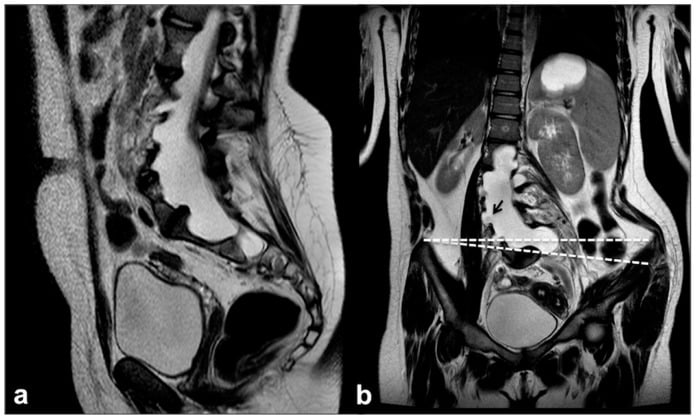
Why it matters surgically. It also underlies most of the surgical difficulty. The same ectasia that scallops the bone leaves thin, dysplastic, eroded pedicles and a dilated, attenuated dura. Pedicle-screw purchase is poor and screws can breach into the enlarged canal, a major reason instrumentation fails, while lateral meningoceles and a thinned dura raise the risk of dural tear and CSF leak.
Together these drive the high implant-failure and pseudarthrosis rates that make dystrophic curves so difficult. That is why pre-operative MRI is mandatory, and why many surgeons add anterior-column support.
Clinical Assessment
The NIH criteria. The diagnosis needs two or more of these seven:
- ≥6 café-au-lait spots (≥5mm prepubertal, ≥15mm postpubertal)
- ≥2 neurofibromas or 1 plexiform neurofibroma
- Freckling in the axillary or inguinal region
- Optic glioma
- ≥2 Lisch nodules (iris hamartomas)
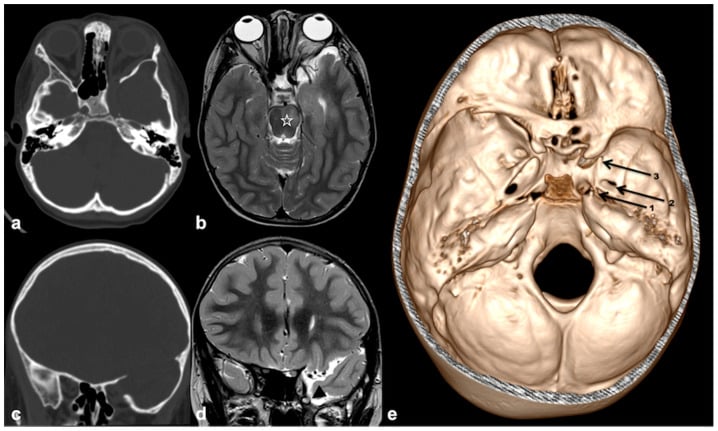
- A bony lesion (sphenoid dysplasia, tibial dysplasia)
- A first-degree relative with NF1
Examination. Look at the skin for café-au-lait spots, neurofibromas and freckling, assess the spine for scoliosis and the lower limbs for tibial bowing. Slit-lamp examination of the eyes shows the Lisch nodules.
Sphenoid dysplasia. The absent greater sphenoid wing enlarges the orbit and permits temporal-lobe and plexiform-neurofibroma herniation toward the orbit. Sphenoid dysplasia is a characteristic osseous NF1 lesion and must be distinguished from tumour-driven erosion.
The 2021 Revised Diagnostic Criteria
The seven-item list is the classic 1988 NIH set. An international revision published in 2021 is now the current diagnostic standard, and its changes are a recurring exam update.
What it added. Two criteria join the NIH seven:
- Two or more choroidal anomalies: bright, patchy nodules seen on near-infrared reflectance imaging or OCT of the fundus, a new and fairly specific sign
- A heterozygous pathogenic NF1 variant with a variant allele fraction of around 50 percent in apparently normal tissue (such as leukocytes), so that a confirmed constitutional NF1 mutation now counts as a criterion in its own right
The decision rule. The revision also formalised the count. In a person with no parent meeting the criteria, two or more criteria are required; in a child with an affected parent, one suffices. The café-au-lait and freckling definitions were tightened for count, size and intertriginous distribution.
Legius syndrome. A young child whose only features are café-au-lait macules and intertriginous freckling, especially with a normal NF1 genetic test, should prompt consideration of Legius syndrome (SPRED1). It shares the pigmentary signs but lacks the neurofibromas, Lisch nodules, optic glioma and the skeletal and malignant complications. Distinguishing the two changes the prognosis and the entire surveillance pathway, so genetic testing is the discriminator.
Investigations
Genetic testing. NF1 mutation testing is available but not always needed for a clinical diagnosis.
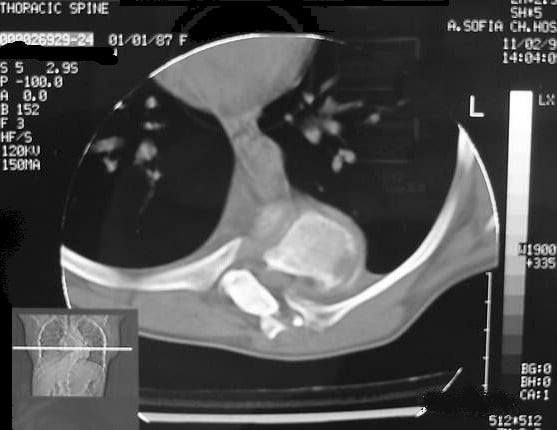
The spine. Radiographs show the scoliosis and the vertebral changes. Before scoliosis surgery, whole-spine MRI looks for dural ectasia and intraspinal neurofibromas, and cross-sectional imaging defines both the tumour burden and the structural corridor available for fixation.
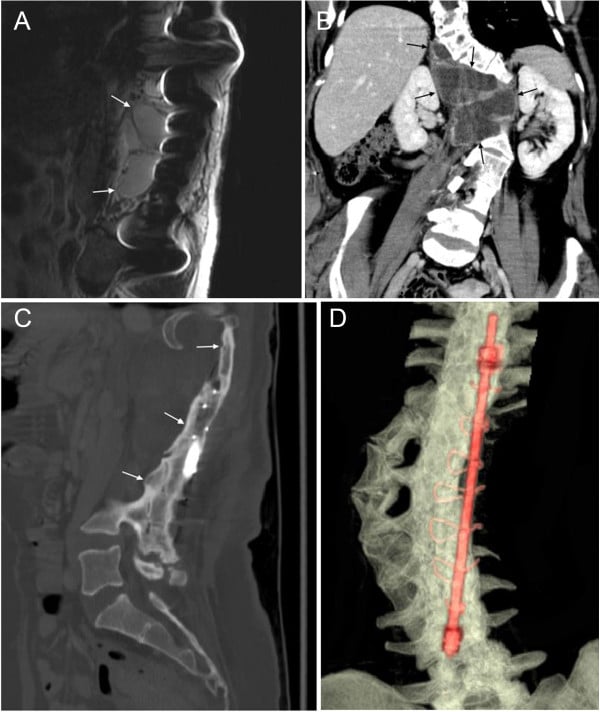
CT and MRI together. CT defines bony intrusion into the canal, such as a pencilled rib head dislocated through an enlarged neural foramen. MRI is required to show the cord, the dural ectasia and the neurofibroma relationships before correction.
Limbs and brain. Lower-limb radiographs show tibial bowing, and brain MRI screens for optic pathway glioma.
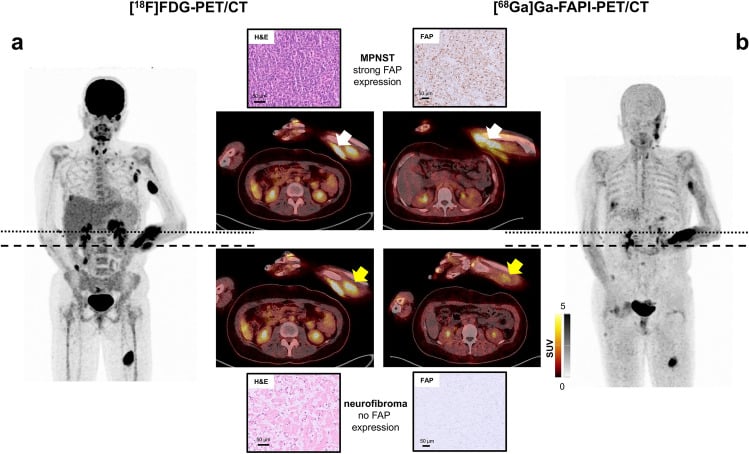
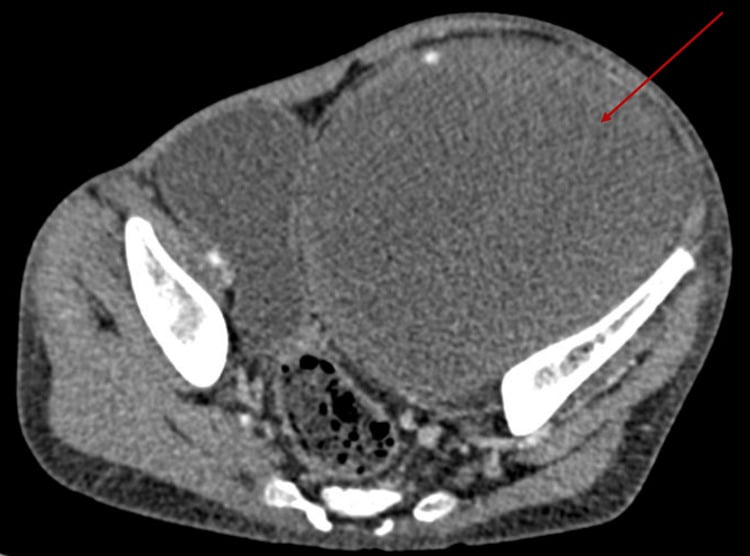
The plexiform neurofibroma that changes. Rapid growth, new persistent pain, a neurological deficit or heterogeneous MRI triggers urgent sarcoma-pathway imaging and biopsy. Malignant transformation may present late when it arises at a deep site such as the pelvis. Cross-sectional staging and image-guided core biopsy must precede oncological resection.
Differential Diagnosis
Cafe-au-lait Spots and Related Conditions:
- Key Features
- Multiple CAL spots, neurofibromas
- Differentiator
- NIH criteria, Lisch nodules
- Key Features
- Bilateral acoustic neuromas
- Differentiator
- Different gene (NF2), no CAL spots
- Key Features
- CAL spots, polyostotic FD
- Differentiator
- Coast-of-Maine borders, precocious puberty
- Key Features
- CAL spots, freckling
- Differentiator
- No neurofibromas, SPRED1 mutation
- Key Features
- CAL spots
- Differentiator
- Short stature, cardiac defects
Key Distinguishing Points:
- NF1 vs NF2: NF1 has CAL spots and peripheral neurofibromas; NF2 has acoustic neuromas
- NF1 vs McCune-Albright: NF1 has smooth-bordered CAL spots; McCune-Albright has "coast of Maine" irregular borders
- NF1 vs Legius: Very similar but Legius lacks neurofibromas (SPRED1 mutation)
Management
Dystrophic scoliosis. Bracing has limited effect. Because these curves progress rapidly, the treatment is early combined (anterior and posterior) fusion for curves greater than 20-25 degrees. Monitor these curves closely.
Non-dystrophic scoliosis. Manage it like idiopathic scoliosis: bracing for curves of 25-40 degrees and surgery for curves greater than 40-50 degrees.
Tibial dysplasia. Anterolateral bowing in infancy carries a high risk of fracture and pseudarthrosis, and bracing protects the tibia from fracture. Once anterolateral bowing or fracture appears, ordinary casting rarely restores durable union. A fracture or pseudarthrosis is treated surgically:
- Ilizarov
- Vascularised fibular graft
- Bone morphogenetic protein
Amputation is the last resort and may be needed after multiple failures.
Surgical Techniques
Combined anterior-posterior fusion. The operation for dystrophic scoliosis has these parts:
- Anterior release and fusion
- Posterior instrumented fusion
- The dural ectasia addressed intra-operatively
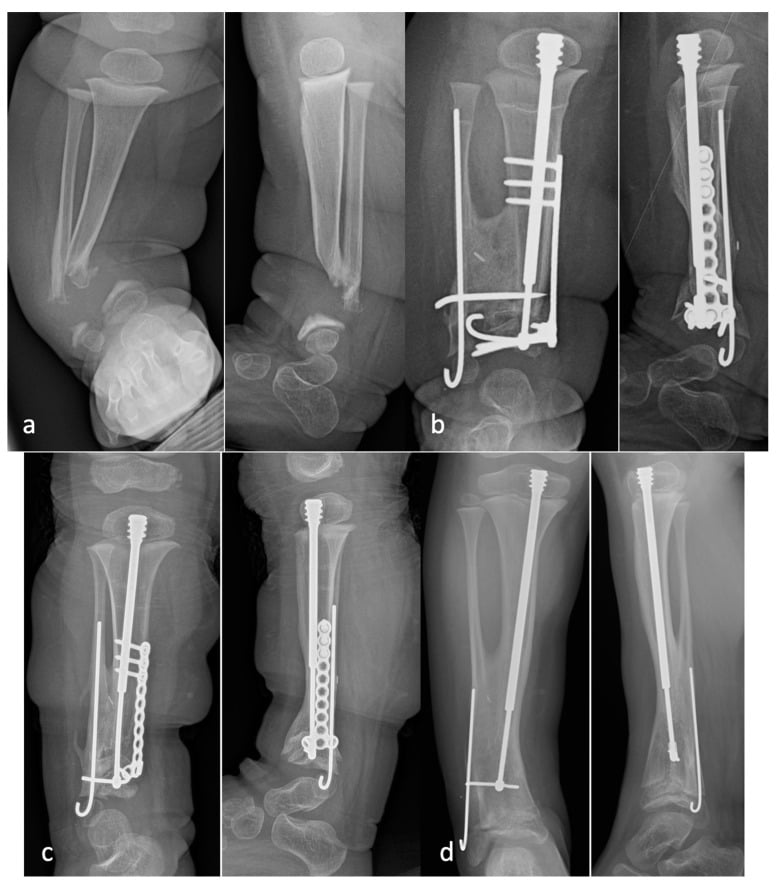
Ilizarov. An external fixator applies compression at the pseudarthrosis site, and the frame may include bone transport.
Vascularised fibular graft. Taken from the contralateral leg, it brings a good blood supply for healing. BMP and bone grafting are used as adjuncts.
Cross-union. After excision of the hamartoma and grafting, cross-union converts the dysplastic tibia and fibula into a single load-sharing construct. Intramedullary support protects the regenerate, and long-term surveillance continues through growth because refracture remains possible.
Complications
- Context
- Post-scoliosis surgery
- Management
- Combined fusion, revision
- Context
- Multiple surgeries
- Management
- Ilizarov, amputation if fails
- Context
- Despite fusion
- Management
- Revision, extend fusion
- Context
- Plexiform neurofibroma
- Management
- Oncology, wide excision
- Context
- Scoliosis surgery
- Management
- Primary repair
Postoperative Care
After scoliosis surgery the patient is braced and followed closely for pseudarthrosis. After tibial surgery weight-bearing is protected and the external fixator needs care. Every patient, whatever the operation, needs long-term surveillance for malignancy.
Outcomes/Prognosis
Dystrophic scoliosis is challenging, with a high failure rate even after combined fusion. Tibial pseudarthrosis heals with difficulty, and multiple surgeries are often needed.
Why NF1 surgery is hard. Pseudarthrosis recurs, fusions fail, bone consolidation is impaired and revision is difficult. Plan for complications and counsel families accordingly.
Life expectancy is reduced by malignant transformation (MPNST) and other complications.
Guidelines, Registries & Global Practice
Global epidemiology
- NF1 affects roughly 1 in 2,500-3,000 births worldwide with no major ethnic or geographic variation — it is one of the most common single-gene disorders.
- About half of cases are de novo mutations, so a negative family history is common.
- Scoliosis is the commonest skeletal manifestation (around 10-30%); congenital pseudarthrosis of the tibia is rare but disproportionately associated with NF1 (NF1 implicated in roughly half of all cases, Hefti EPOS series).
Side-by-side guidance
- Focus
- Clinical diagnosis
- Practical emphasis
- Two or more of the seven criteria; the 2021 international revision added the choroidal anomaly and an NF1 pathogenic variant as criteria
- Focus
- Diagnosis + lifelong surveillance
- Practical emphasis
- Structured monitoring of spine, optic pathway and MPNST; multidisciplinary clinics
- Focus
- Dystrophic scoliosis
- Practical emphasis
- Pre-operative MRI mandatory; early instrumented fusion for dystrophic curves; growth-friendly constructs in the very young
- Focus
- Tibial dysplasia
- Practical emphasis
- Protect with bracing until union attempted; combine biological (vascularized fibula, autograft, BMP) and mechanical (intramedullary rod, Ilizarov) strategies
Registry and surveillance notes
- There is no single global NF1 implant registry, but national NF registries (e.g. UK regional registers used by Evans et al) provide the population-level MPNST and cancer-risk data.
- Spinal deformity and limb-reconstruction outcomes are tracked through specialist paediatric spine and pseudarthrosis databases rather than arthroplasty registries.
High- vs limited-resource practice variation
- Well-resourced settings: genetic confirmation, MRI surveillance, MEK inhibitors (e.g. selumetinib) for symptomatic inoperable plexiform neurofibromas, and microvascular fibular transfer for tibial pseudarthrosis.
- Limited-resource settings: diagnosis remains clinical (NIH criteria), surveillance is examination-based, and tibial reconstruction relies more on Ilizarov/autograft techniques; refractory cases more often proceed to amputation and prosthetic fitting.
- Universal principles: multidisciplinary care (genetics, neurology, orthopaedics, ophthalmology, dermatology, oncology) and a low threshold for sarcoma-MDT referral when a lesion enlarges or becomes painful.
Controversies & Areas of Uncertainty
- Timing of dystrophic curve surgery: Most agree dystrophic curves need early instrumented fusion, but the threshold (Cobb angle, age, degree of modulation) and whether to perform combined anterior-posterior versus posterior-only with modern pedicle-screw constructs remain debated.
- Combined vs posterior-only fusion: Historically combined fusion was standard for high pseudarthrosis rates; modern segmental instrumentation has led some centres to favour posterior-only, though dural ectasia, thin dystrophic pedicles and bone quality still drive failures.
- Best biology for tibial pseudarthrosis: No technique reliably prevents refracture. Vascularized fibula, Ilizarov, intramedullary rodding, autograft and BMP are all used, often in combination; the optimal sequence is unsettled and recurrence to skeletal maturity is the rule rather than the exception.
- Role of BMP: Bone morphogenetic protein is used off-label as an adjunct in congenital pseudarthrosis, but evidence is low-level and theoretical oncological concerns in a tumour-predisposition syndrome are unresolved.
- MEK inhibitors and bone: Selumetinib transformed management of inoperable plexiform neurofibromas; whether MEK-pathway modulation can aid bone healing in pseudarthrosis is an active research question.
- Surveillance intensity for MPNST: Whole-body MRI and FDG-PET can detect malignant transformation early, but cost, radiation and false positives mean there is no universal consensus on routine imaging surveillance versus symptom-triggered investigation.
MCQ Practice Points
Q: What gene is mutated in NF1? A: NF1 gene on chromosome 17 (neurofibromin).
Q: What type of scoliosis has a poor prognosis in NF1? A: Dystrophic scoliosis (short, sharp, angular).
Q: What tibial deformity is associated with NF1? A: Anterolateral bowing with risk of pseudarthrosis.
Q: What malignancy are NF1 patients at risk for? A: MPNST (malignant peripheral nerve sheath tumor) - 8-13% lifetime risk. Arises from plexiform neurofibromas.
Q: What is the Crawford classification for? A: Tibial dysplasia in NF1. Types I-IV based on bowing characteristics and presence of fracture/pseudarthrosis.
Q: What eye finding is seen in NF1? A: Lisch nodules (iris hamartomas) - seen on slit lamp exam.
Self-Assessment Quiz
Additional Quiz Questions
Viva Scenarios
Practise clinical reasoning and management decisions out loud
“12-year-old with NF1 has a 30-degree thoracic curve with vertebral scalloping and rib penciling on X-ray.”
“6-month-old with NF1. X-ray shows anterolateral bowing of the tibia.”
“25-year-old with NF1 presents with rapid growth and pain in a previously stable plexiform neurofibroma on the thigh.”
GENETICS
- NF1 Gene
- Chromosome 17
- Autosomal Dominant
- Tumor suppressor
DIAGNOSIS
- ≥6 cafe-au-lait spots
- Neurofibromas
- Lisch nodules
- Tibial dysplasia
SCOLIOSIS
- Dystrophic = poor prognosis
- Sharp angular curve
- Combined fusion
- Non-dystrophic = better
TIBIA
- Anterolateral bowing
- Pseudarthrosis risk
- Brace to protect
- Ilizarov if fractured
DYSTROPHIC FEATURES
- Vertebral scalloping
- Rib penciling
- Dural ectasia
- Spindling TP
MALIGNANCY
- MPNST 8-13% risk
- Arises from plexiform
- Rapid growth = concern
- Wide excision
Evidence Base
Crawford & Bagamery — Osseous manifestations of NF
- Foundational review describing the spectrum of skeletal NF1 (scoliosis, kyphosis, tibial pseudarthrosis, sphenoid dysplasia)
- Source of the Crawford classification of anterolateral tibial bowing / congenital pseudarthrosis
- Distinguishes dystrophic from non-dystrophic spinal deformity
Durrani et al — Modulation of spinal deformities in NF1
- 91 NF1 patients: deformities 'modulate', acquiring dystrophic features over time, so the dystrophic/non-dystrophic label is not fixed
- Curves diagnosed under age 7 modulated in 81% vs 25% if diagnosed after age 7
- Three or more penciled ribs (or three or more dystrophic features) predicts near-certain progression (≈85-87%)