The 'Grey Zone' Deformity
- Do not equate reducibility with normalisation: COT remains dorsally dislocated on plantarflexion, but less severely and more flexibly than CVT
- Differentiate from FFF-STA: a flexible flatfoot with a short tendo-Achilles restores normal talonavicular alignment on plantarflexion
- Measure the navicular proxy: use plantarflexion talus-first metatarsal angle and foot-CORA because the infant navicular is unossified
- Assess the talus separately: dorsiflexion tibiotalar angle describes talar verticality and tendo-Achilles rigidity
- Treatment evidence is incomplete: do not apply a CVT casting-and-pinning pathway automatically to COT
- “The navicular deformity, not the word 'oblique', determines the diagnosis
- “Obtain paired maximum dorsiflexion and plantarflexion lateral radiographs
- “A plantarflexion talus-first metatarsal angle that remains negative indicates persistent dorsal malalignment
- “Normalisation on plantarflexion suggests flexible flatfoot with a short tendo-Achilles rather than COT
Overview and Epidemiology
Congenital oblique talus (COT) is a rocker-bottom deformity with a dorsally dislocated navicular that is less severe and more flexible than congenital vertical talus (CVT). Current objective work rejects the old assumption that the diagnosis is simply a talonavicular subluxation that returns to normal on plantarflexion.
Definition. COT is persistent dorsal navicular dislocation on plantarflexion stress imaging, with less severe angular deformity and greater flexibility than CVT. Plantarflexion imaging therefore does not simply divide a reducible COT from an irreducible CVT: both retain dorsal navicular dislocation. If the talonavicular relationship becomes anatomically aligned on plantarflexion, consider flexible flatfoot with a short tendo-Achilles (FFF-STA), not COT.
Associations. COT is associated with neuromuscular disorders, genetic syndromes of ligamentous laxity and developmental delay.
- Cerebral palsy, especially spastic diplegia: the muscle imbalance (spastic peroneals and gastrocnemius) pulls the foot into valgus
- Spina bifida: muscle weakness leading to instability
- Ehlers-Danlos syndrome: a collagen defect causing hypermobility
- Marfan syndrome: a similar mechanism; arachnodactyly may be noted
- Down syndrome (trisomy 21): hypotonia and ligamentous laxity are hallmark features
- Larsen syndrome: multiple joint dislocations
- Developmental delay: hypotonia contributes to the "flat" appearance
Anatomy and Pathoanatomy
The defining lesion. COT is best understood as a less severe, more flexible dorsal navicular dislocation within the rocker-bottom group. The defining abnormality is at the talonavicular joint; talar verticality is associated but not determinative.
- Navicular: dorsally dislocated and proximally translated. On infant radiographs the first metatarsal axis is used as its proxy
- Talus: generally less vertical and more flexible than in CVT, although talar position alone does not define the diagnosis
- Calcaneus: valgus and everted within the rocker-bottom configuration
- Soft tissues: the dorsal talonavicular structures and the tendo-Achilles contribute to rigidity, and their relative contracture must be assessed separately
Biomechanics. The medial longitudinal arch is obliterated. During weight-bearing the ground reaction force pushes the talar head further plantarward and the navicular further dorsal. In a flexible flatfoot the locking mechanism of the midfoot is intact during push-off; the oblique talus foot remains unlocked and unstable, leading to an inefficient gait and fatigue.
The Spring Ligament: The Linchpin of the Deformity
Anatomy. The spring (plantar calcaneonavicular) ligament complex runs from the sustentaculum tali of the calcaneus to the plantar-medial navicular, forming a hammock or sling beneath the head of the talus. It has two principal components:
- the superomedial band, which is broad, contains fibrocartilage where the talar head rests, and blends with the tibialis posterior tendon sheath and the deltoid ligament
- the inferior (plantar or short) band
Static and dynamic support. The spring ligament is the primary static support of the talar head, and it works alongside the other stabilisers of the medial longitudinal arch.
- Type of support
- Static (primary)
- Role
- Holds the talar head up like a hammock; resists plantar-medial migration
- Type of support
- Dynamic (primary)
- Role
- Inverts/supinates, reinforces the spring ligament, locks the midtarsal joints for push-off
- Type of support
- Static (windlass)
- Role
- Tensions on toe dorsiflexion to elevate the arch
- Type of support
- Static
- Role
- Keystone alignment of the talar head in the navicular
Its role in COT. The plantar calcaneonavicular complex supports the talar head, but its precise causal role in congenital oblique talus has not been established. Do not import the adult progressive-collapsing-foot model wholesale into this congenital deformity.
Why the anatomy still matters. The sling and its blend with tibialis posterior matter during talonavicular reconstruction. If reconstruction is considered, define the actual talonavicular, subtalar and tendon pathology rather than assuming universal spring-ligament failure. The diagnosis itself rests on stress-radiographic navicular position and rigidity, not on an assumed spring-ligament tear.
Classification Systems
The objective framework (Mosca, Ganjwala and Shah, 2024). Maximum plantarflexion and dorsiflexion lateral radiographs separate the normal foot, FFF-STA, COT and CVT.
- Plantarflexion talus-first metatarsal relationship
- Zero or plantarflexed
- Foot-CORA
- Talar head
- Interpretation
- Normal talonavicular alignment and ankle dorsiflexion
- Plantarflexion talus-first metatarsal relationship
- Zero or plantarflexed
- Foot-CORA
- Talar head
- Interpretation
- Normal talonavicular alignment with restricted ankle dorsiflexion
- Plantarflexion talus-first metatarsal relationship
- Remains dorsiflexed but less severely
- Foot-CORA
- Proximally translated, typically tibial zone
- Interpretation
- Persistent but more flexible navicular dislocation
- Plantarflexion talus-first metatarsal relationship
- Remains dorsiflexed more severely
- Foot-CORA
- Posterior talus or ankle-joint zones
- Interpretation
- Persistent rigid navicular dislocation
Angle and CORA together. The plantarflexion talus-first metatarsal angle measures navicular angulation, while the foot-CORA location detects proximal translation. Use both: the angle alone exists on a continuum, whereas CORA location separates aligned from dislocated feet.
The dorsiflexion view. The dorsiflexion tibiotalar angle describes talar verticality and tendo-Achilles rigidity. In FFF-STA it shows the short tendo-Achilles; in COT the talus is generally oblique and more flexible, and in CVT generally vertical and more rigid.
Categories, not stages. These categories should not be presented as a proven temporal progression from flexible flatfoot through COT to CVT.
Hamanishi (historical). Hamanishi classified CVT by aetiology into neural-tube, neuromuscular, malformation-syndrome, chromosomal and idiopathic groups, and the same paper introduced TAMBA and CAMBA. It did not create a three-group sequence of flexible flatfoot, oblique talus and vertical talus by age.
Clinical Assessment
History. Parents describe a foot posture that "fails to thrive" and ankles "rolling in". The older child reports pain or fatigue with sport, and shoes show medial wear.
Standing. A severe planovalgus foot with a prominent medial malleolus. The talar head bulges on the medial border, the "double malleolus" sign.
Tiptoe and heel rise. On tiptoe the heel may go into some varus, indicating some power, but the arch often does not reconstitute fully. In oblique talus and flexible flatfoot the heel should invert at heel rise, though often delayed or weak; in vertical talus the heel remains in valgus.
Jack's test. Extending the big toe fails to elevate the arch: windlass failure.
Manual flexibility. Plantarflex and dorsiflex the foot while palpating the talar head and midfoot. Record the range and rigidity, but do not claim anatomical talonavicular reduction from palpation alone.
Neurological examination. Essential. Check tone, reflexes and gait for mild cerebral palsy or spina bifida, and assess the Beighton score for hyperlaxity.
Gait. Stance shows increased medial foot contact and an absent arch. Propulsion is disorganised: push-off occurs from the midfoot rather than the metatarsal heads because of the midfoot break (sag). Using accessory muscles to stabilise the foot leads to early tiring, the "carry me" sign.
Investigations
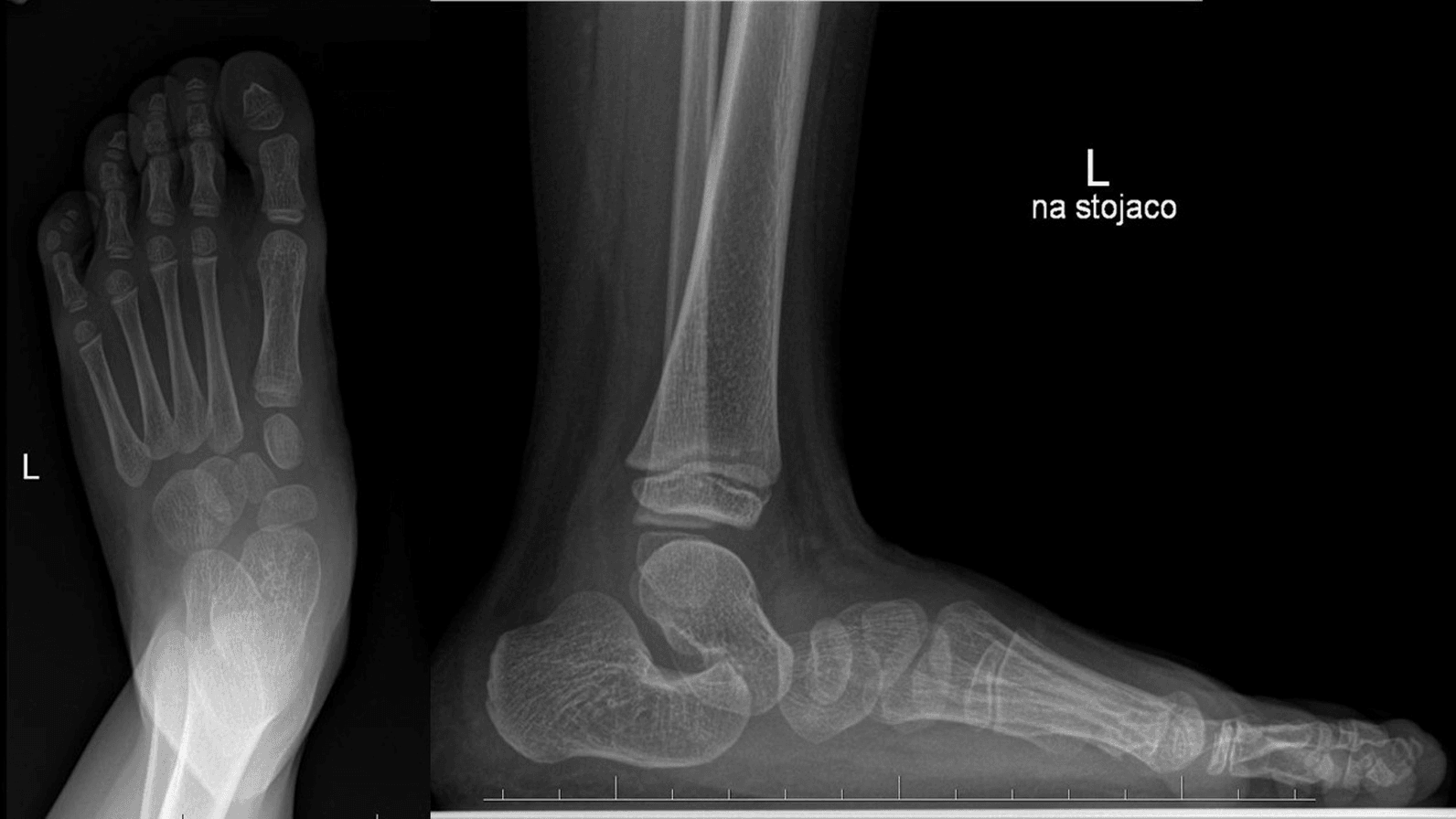
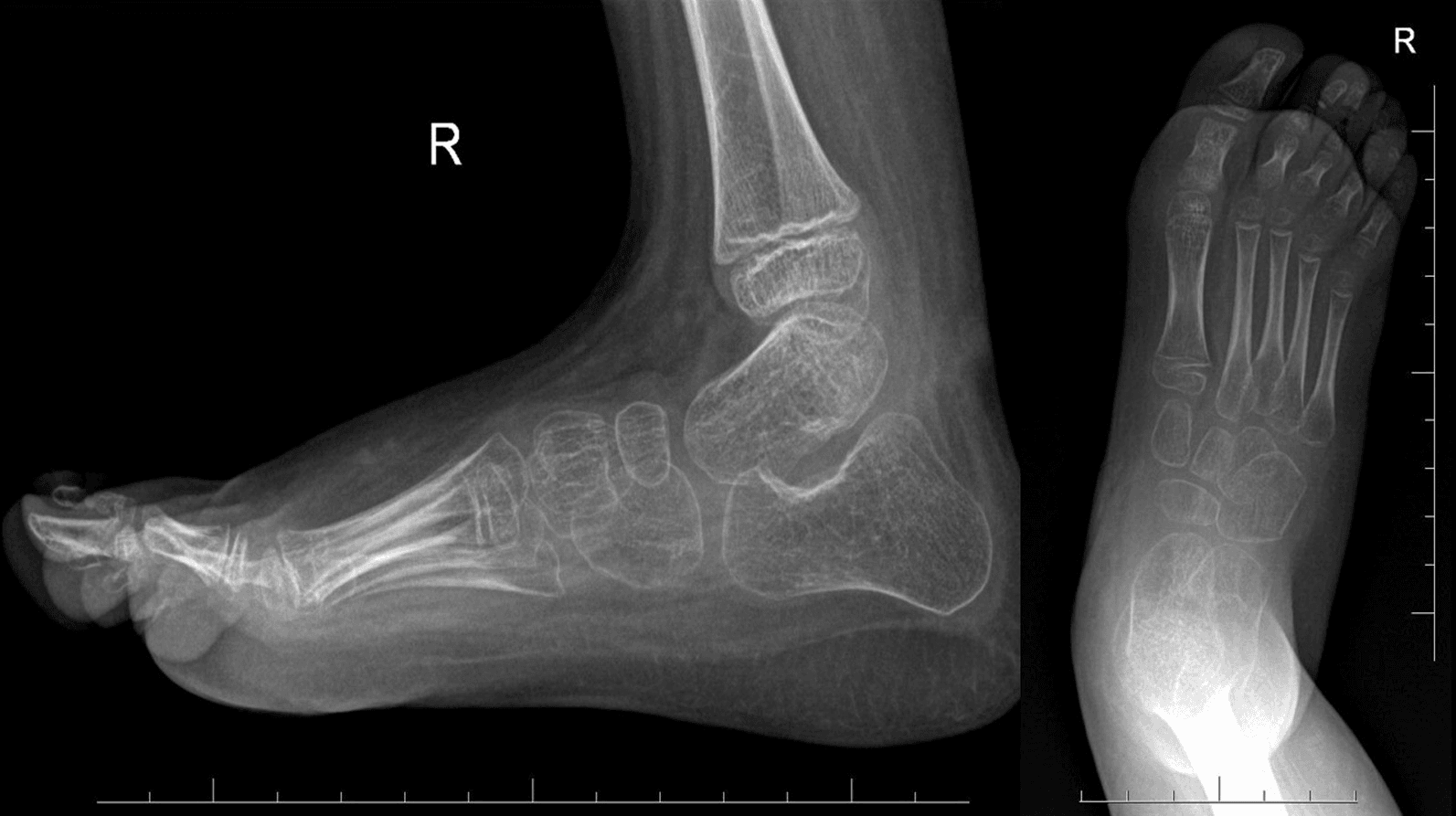
Paired stress laterals. The diagnosis needs a maximum dorsiflexion lateral and a maximum plantarflexion lateral. Maximum plantarflexion tests the severity and flexibility of dorsal navicular angulation and proximal translation. Maximum dorsiflexion tests the severity and rigidity of talar plantarflexion and the tendo-Achilles contracture.
Measuring them. The infant navicular is unossified, so the first metatarsal is its proxy.
- On the maximum plantarflexion lateral, draw the central axes of the talus and first metatarsal and measure their angle. A negative (dorsiflexed) relationship means talonavicular malalignment persists.
- Locate the foot-CORA, the intersection of those axes, along the talar axis. A CORA at the talar head supports normal alignment; proximal migration supports navicular dislocation.
- On the maximum dorsiflexion lateral, measure the tibiotalar angle to quantify talar plantarflexion (verticality) and tendo-Achilles rigidity.
- Interpret the measurements together, against the categories in the classification table.
AP foot. Documents forefoot abduction and talocalcaneal divergence but does not replace the paired lateral stress views.
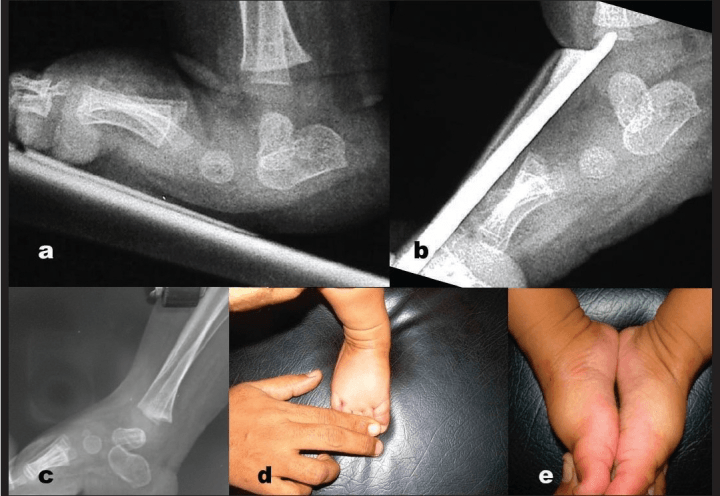
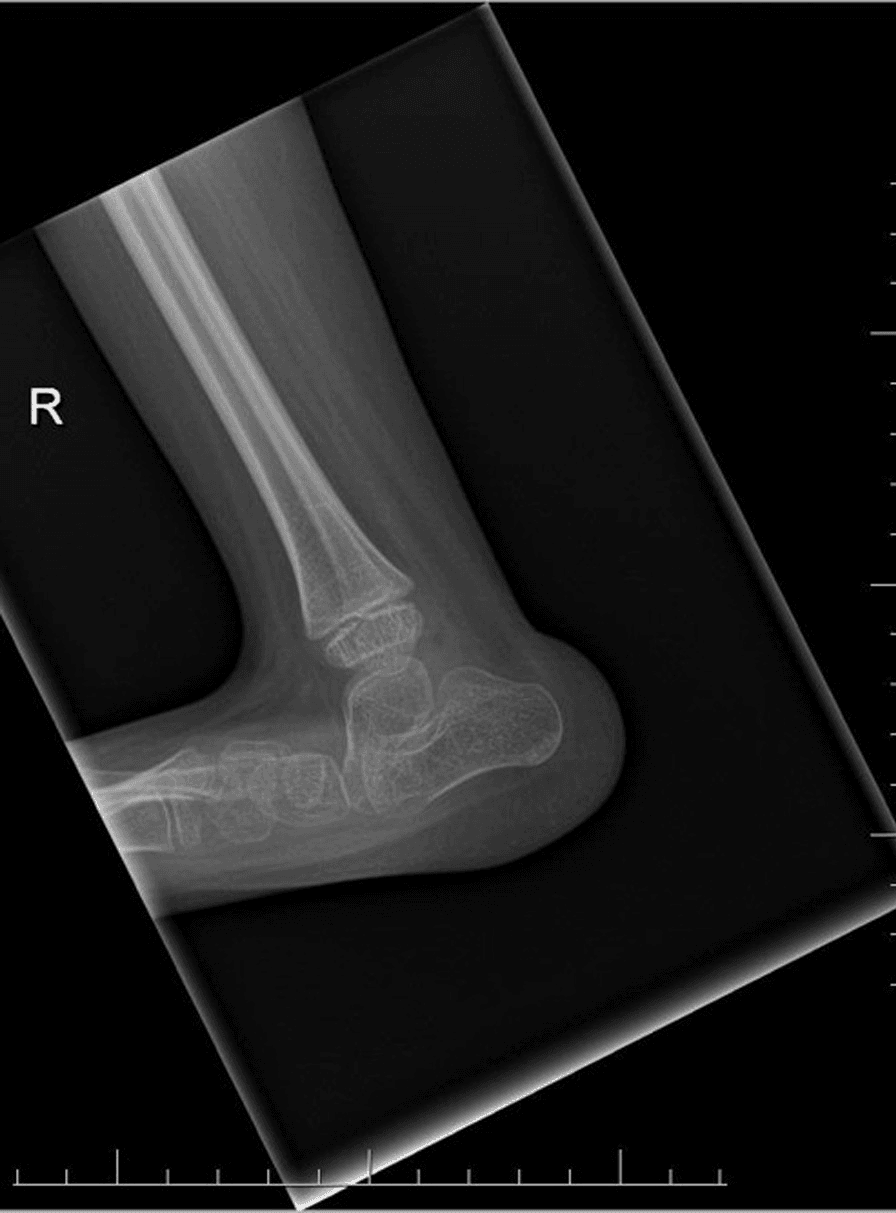
Historical measurements. Hamanishi's TAMBA and CAMBA relate the talar or calcaneal axis to a point at the first-metatarsal base. They are historically important and still appear in CVT outcome series, but a point cannot represent the rotational axis of the first metatarsal. Different first-metatarsal rotations can therefore produce the same TAMBA or CAMBA.
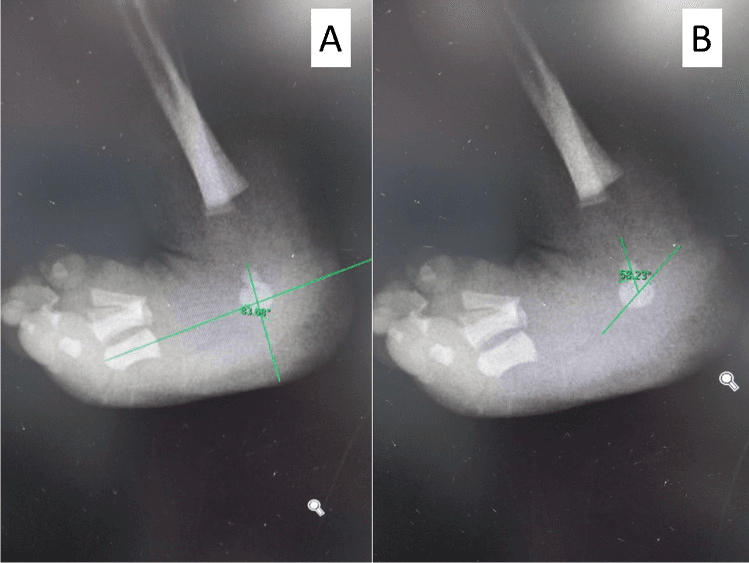
Do not say that a normalising TAMBA proves COT. Anatomical talonavicular alignment on plantarflexion supports FFF-STA; objectively defined COT retains a less severe, more flexible navicular dislocation.
Management
The diagnosis must be settled before treatment, because the evidence cannot support one shared pathway for FFF-STA, COT and CVT.
- Confirm the category with paired stress laterals before predicting prognosis, and screen any congenital rocker-bottom foot for neurological, spinal and syndromic associations.
- FFF-STA: treat symptoms and heel-cord contracture; orthoses may improve comfort but do not remodel alignment.
- COT: refer an objectively dislocated talonavicular joint to a paediatric foot specialist. Current objective definitions are newer than the treatment literature, so natural history, casting thresholds and operative indications remain insufficiently established. Follow symptoms, function, rigidity and radiographic alignment rather than appearance alone.
- CVT: use the established vertical-talus pathway, serial reverse-Ponseti manipulation and casting followed by talonavicular reduction and temporary pin fixation, with Achilles tenotomy when indicated.
- Do not route by age or one angle alone. Symptoms, rigidity, residual dislocation, associated diagnosis and prior treatment determine escalation.
The Dobbs casting-and-pinning evidence is for congenital vertical talus. It may inform treatment of a related rocker-bottom deformity, but it is not proof that every COT requires reverse-Ponseti casting, K-wire fixation, Evans osteotomy or an age-based operation.
Surgical Technique
The pinning and reverse-Ponseti sequence below is established for CVT; calcaneal lengthening is established for selected symptomatic planovalgus feet. Apply either to COT only after objective diagnosis and deformity-specific planning.
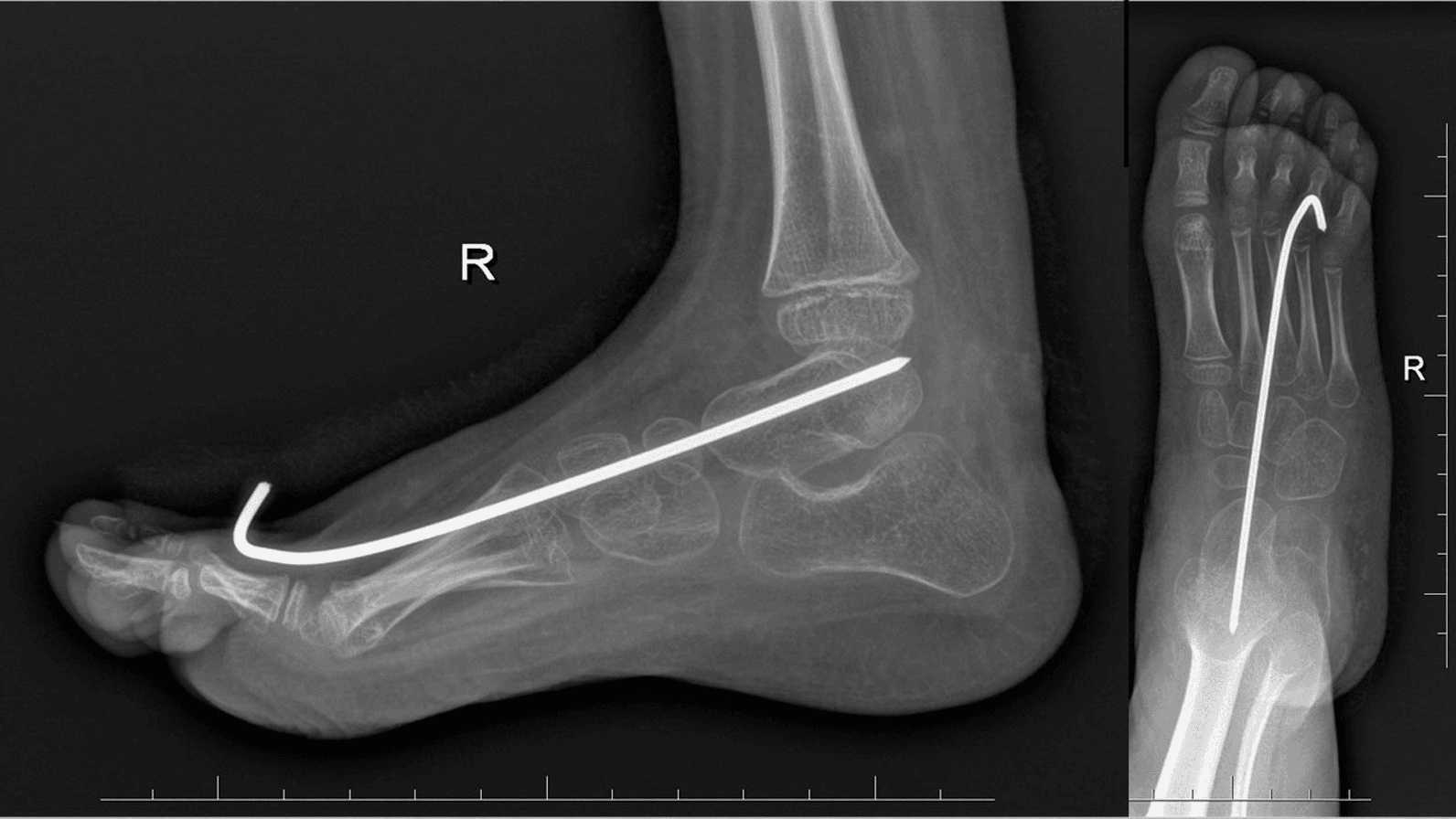
Minimally invasive pinning (modified Dobbs technique). The reference indication is persistent talonavicular dislocation after serial casting in CVT. Its role in objectively defined COT remains uncertain.
- Percutaneous stabilisation: hold the foot in the corrected position (plantarflexion and inversion)
- Drive a K-wire retrograde from the dorsum of the first metatarsal, through the navicular, into the talus
- Confirm on the image intensifier
- Cast for 6-8 weeks
Temporary fixation protects a confirmed talonavicular reduction while soft tissues heal. The duration and wire trajectory follow the selected CVT protocol; do not infer that pinning is routine for COT.
Complications
- Risk Factors
- Incomplete initial correction, persistent rigidity, associated neuromuscular disease.
- Prevention/Management
- Reassess paired stress views and the full talonavicular/subtalar deformity before revision.
- Risk Factors
- Pressure, migration, infection, loss of correction.
- Prevention/Management
- Frequent skin and neurovascular checks; radiographic pin surveillance; remove or revise when clinically indicated.
- Risk Factors
- Extensive dissection and overcorrection.
- Prevention/Management
- Prefer limited, anatomy-preserving exposure when reduction is required.
- Risk Factors
- Excessive calcaneal lengthening.
- Prevention/Management
- Avoid using an Evans osteotomy to force reduction of an unreduced talonavicular joint.
- Risk Factors
- Treating FFF-STA, COT and CVT as one continuum.
- Prevention/Management
- Re-measure the plantarflexion angle, foot-CORA and dorsiflexion tibiotalar angle.
Postoperative Care
Postoperative care is procedure-specific. For CVT reduction and pinning, follow the selected casting, pin-surveillance and brace protocol, with serial skin, neurovascular and radiographic checks.
For any COT intervention, document the corrected talonavicular relationship and follow rigidity, recurrence, pain and function. There is no validated universal six-to-eight-week or six-month radiograph schedule for COT.
Outcomes and Prognosis
Natural history. The natural history of objectively defined COT is not yet established. Older reports combined COT with severe flexible flatfoot or mild CVT, so claims about spontaneous resolution, inevitable arthritis or a fixed treatment sequence are not reliable.
Non-operative treatment. Orthoses may relieve symptoms in flexible flatfoot, but no high-level evidence establishes their effect on COT dislocation.
Casting and fixation. The outcome evidence is predominantly CVT evidence and must not be presented as COT-specific.
Reconstruction. Procedure selection depends on persistent joint dislocation, rigidity, associated deformity and underlying diagnosis. COT-specific comparative outcomes are unavailable.
Guidelines, Registries & Global Practice
Global evidence
- COT is rare and lacks a dedicated registry; the best current diagnostic evidence is a single Level II radiographic study.
- No AAOS, POSNA, BOA/BSCOS, NICE or EFORT guideline provides a COT-specific treatment algorithm.
- Flexible-flatfoot guidance cannot be applied to a persistently dislocated talonavicular joint, and CVT treatment series cannot automatically be relabelled as COT evidence.
Practice principles
- Obtain paired stress laterals when a congenital rocker-bottom deformity is suspected.
- Use the same objective measurements in all settings; a single comfortable-position lateral is insufficient.
- Screen for neurological, spinal, chromosomal and syndromic associations.
- Refer persistent navicular dislocation to a paediatric orthopaedic foot service.
- Record uncertainty honestly and use shared decision-making when considering treatment without COT-specific comparative evidence.
Controversies & Areas of Uncertainty
- Objective definition is recent: the 2024 axis-and-foot-CORA framework supersedes the traditional reducing-subluxation description, but external validation is still needed.
- Threshold direction and nomenclature: published tables and figure conventions can be confusing; inspect the radiographs and use severity plus CORA location rather than memorising an isolated sign.
- Natural history is unknown: older series mixed COT with FFF-STA and mild CVT, so prognosis cannot be inferred reliably.
- Treatment evidence lags diagnosis: there are no comparative trials defining observation, casting, pinning or reconstruction thresholds for objectively defined COT.
- Associated disease matters: neuromuscular and syndromic feet may behave differently, but diagnosis still requires the same stress-radiographic discipline.
MCQ Practice Points
Q: Which studies distinguish COT, CVT and FFF-STA? A: Paired maximum dorsiflexion and maximum plantarflexion lateral radiographs. The plantarflexion view tests navicular angulation and translation; the dorsiflexion view tests talar and tendo-Achilles rigidity.
Q: Does the talonavicular joint become anatomically aligned in COT on plantarflexion? A: No. In objectively defined COT the navicular remains dislocated but less severely and more flexibly than in CVT. Anatomical alignment supports FFF-STA.
Q: Why pair the talus-first metatarsal angle with foot-CORA? A: The angle measures dorsal angulation; foot-CORA detects proximal translation. A normal-looking angle without the position measurement can misclassify the talonavicular relationship.
Q: Can the Dobbs CVT protocol be called the standard treatment for COT? A: No. Reverse-Ponseti casting and temporary talonavicular fixation have CVT evidence. COT-specific natural-history and comparative-treatment data remain inadequate.
Additional Quiz Questions
Viva Scenarios
Practise clinical reasoning and management decisions out loud
“A newborn presents with a rocker-bottom foot. How do you distinguish CVT, COT and flexible flatfoot with a short tendo-Achilles?”
“Stress radiographs show persistent but less severe navicular dislocation consistent with COT. How do you counsel the family?”
Definition
- Congenital rocker-bottom deformity
- Persistent dorsal navicular dislocation
- Less severe and more flexible than CVT
- Not a reducing talonavicular subluxation
Required Imaging
- Maximum plantarflexion lateral
- Maximum dorsiflexion lateral
- Talus-first metatarsal angle plus foot-CORA
- Tibiotalar angle for talar/Achilles rigidity
Differential
- CVT: severe rigid dislocation
- COT: less severe flexible dislocation
- FFF-STA: TN alignment normalises
- Talus position alone is insufficient
Management
- Confirm objective category first
- Screen neurological and syndromic associations
- COT-specific thresholds remain uncertain
- Do not automatically apply the CVT Dobbs pathway
Evidence Base
Mosca, Ganjwala and Shah - Objective CVT/COT Differentiation
- Evaluated paired maximum dorsiflexion and plantarflexion lateral radiographs from 62 presumed CVT feet
- Separated CVT, COT and flexible flatfoot with a short tendo-Achilles using tibiotalar angle, plantarflexion talus-first metatarsal angle and foot-CORA
- Found that COT retains a less severe, more flexible navicular dislocation rather than reducing to normal alignment
Harris - Defining the Oblique Talus Deformity
- Described historical uncertainty around whether oblique talus is distinct from severe flexible flatfoot or mild CVT
- Emphasised that older definitions lacked objective radiographic criteria
- Provided a useful record of the diagnostic controversy but predates current foot-CORA criteria
Hamanishi - CVT Classification & TAMBA/CAMBA
- Classified 69 congenital vertical talus cases into five aetiological groups
- Introduced historical talar-axis and calcaneal-axis to first-metatarsal-base measurements
- The base-point method is now recognised as rotationally insensitive and should not replace full first-metatarsal axis and foot-CORA assessment
Dobbs - Reverse Ponseti Method for CVT
- 11 patients (19 feet) treated with serial reverse-Ponseti casts (mean 5 casts), percutaneous Achilles tenotomy and talonavicular pin fixation, minimum 2-year follow-up
- All radiographic parameters improved significantly (p less than 0.0001) and reached normal age-matched values without extensive soft-tissue release
- Dorsal navicular subluxation recurred in 3 patients, ALL of whom had NOT undergone talonavicular pin fixation
Mosca - Calcaneal Lengthening for Hindfoot Valgus
- 31 severe symptomatic valgus feet (flatfoot and skewfoot) in 20 children corrected by a modified Evans calcaneal lengthening osteotomy
- Satisfactory correction of all hindfoot components in all but the 2 most severe feet, with subtalar motion preserved (joint-sparing)
- 26 of 31 deformities were neuromuscular in origin, supporting use in lax/spastic feet while avoiding arthrodesis
Carr - Pediatric Pes Planus State-of-the-Art Review
- Most paediatric flatfoot is flexible, painless and resolves by adolescence; observation is safe and appropriate for the asymptomatic child
- Orthotics are generally unproven to alter the natural course of flexible flatfoot but may relieve pain when present
- No large prospective trials compare natural history versus treatment, so surgery is reserved for the painful or rigid foot