Collagen Defect and Fragile Bones
- Type I: Mildest. Normal stature. Blue sclerae.
- Type II: Lethal. Perinatal death.
- Type III: Severe deforming. Progressive.
- Type IV: Moderate. Variable sclerae.
- Bisphosphonates: reliably increase bone mineral density. Fracture reduction is the SURROGATE trap - it is widely believed, the signal points the right way, but randomised evidence has not confirmed it.
- Rodding: Bailey-Dubow or Fassier-Duval telescoping rods.
- “Sillence classification
- “Collagen I defect
- “Bisphosphonates raise BMD; say fracture benefit is unconfirmed
- “Telescoping rods for deformity
Overview and Epidemiology
Osteogenesis imperfecta (OI) is a group of genetic bone fragility disorders caused by defects in type I collagen. Its hallmarks are recurrent fractures, blue sclerae, dentinogenesis imperfecta and hearing loss, and its severity runs from the mild type I to the lethal type II.
Inheritance and frequency. Most cases are autosomal dominant, from mutations in COL1A1 or COL1A2. The incidence is 1 in 10,000-20,000.
Care. Treatment is multidisciplinary, built around bisphosphonates and telescoping intramedullary rods.
Pathophysiology and Molecular Basis
Why the bones break. Type I collagen is the main organic component of bone. When it is defective the bone is of poor quality despite normal mineral, and so structurally weak: minimal trauma causes fractures, and bones may bow and deform from repeated microfractures.
Normal type I collagen is a triple helix of two pro-alpha-1 (COL1A1) chains and one pro-alpha-2 (COL1A2) chain, with a glycine at every third residue (Gly-X-Y) that lets the helix pack tightly. The defect lies in these two genes, and the genotype-phenotype link is what examiners probe: why a type I patient is mild and a type II or III patient is devastated.
Quantitative defect: less collagen, milder disease. A null or loss-of-function COL1A1 allele produces about half the normal amount of structurally normal collagen (haploinsufficiency). Less-but-normal collagen gives the mildest phenotype, the classic type I.
Qualitative defect: abnormal collagen, more severe disease. A glycine substitution, or another structural mutation, produces an abnormal chain that is still incorporated into the triple helix, where it disrupts folding of the whole molecule. This dominant-negative ("protein suicide") effect makes abnormal collagen worse than too little collagen. Structural variants in COL1A1 or COL1A2 span the lethal type II, the severely deforming type III and the more moderate type IV, and substitutions nearer the carboxy-terminus tend to be more severe.
Recessive OI. A minority of cases are autosomal recessive, caused by defects in the genes that handle collagen post-translational modification and folding: CRTAP, P3H1 (LEPRE1) and PPIB (the prolyl-3-hydroxylation complex) and chaperones. They produce severe phenotypes without a primary collagen-gene mutation, and are over-represented in consanguineous populations.
This is why the field is moving from the purely clinical Sillence types towards a gene-based classification. The biochemistry of collagen synthesis itself is developed in our Proteoglycans & Collagen topic.
Less normal collagen = usually mild; structurally abnormal collagen = usually more severe.
Classification Systems
Sillence. The four clinical types are separated by severity, sclerae and stature.
- Severity
- Mild
- Sclerae
- Blue
- Stature
- Normal
- Other features
- Typically fewer than 20 fractures
- Severity
- Lethal
- Sclerae
- Blue
- Stature
- Not applicable (perinatal death)
- Other features
- Severe bone fragility; multiple intrauterine fractures
- Severity
- Severe deforming, progressive
- Sclerae
- Blue or grey
- Stature
- Short
- Other features
- Severity
- Moderate
- Sclerae
- Normal or grey
- Stature
- Variable short stature
- Other features
Expanded classification. Types V-VIII and beyond have been described, and they overlap with other brittle bone conditions. Type V shows hyperplastic callus and calcification of the interosseous membrane; type VI is a mineralisation defect with no scleral changes.
Clinical Assessment
History. Count the fractures and note the age at the first. Take the family history, and ask about mobility and function.
Examination. Look for:
- Sclerae - blue in types I, II and III (blue or grey in type III); normal or grey in type IV
- Teeth - opalescent and weak (dentinogenesis imperfecta)
- Hearing - may be impaired (otosclerosis)
- Stature - normal in type I, short in types III and IV
- Limbs - bowing and deformity
- Skin - thin, with easy bruising
Multiple fractures in OI can mimic non-accidental injury (NAI). Look for blue sclerae, wormian bones, a family history and dentinogenesis imperfecta. Metaphyseal corner fractures are not typical of OI; they are highly suggestive of inflicted injury. OI does not exclude the possibility of concurrent abuse.
Investigations
Genetic testing. Identifying a COL1A1 or COL1A2 mutation is confirmatory.
Imaging. Radiographs show osteopenia, bowing and callus, and wormian bones in the skull. DEXA shows low bone density.
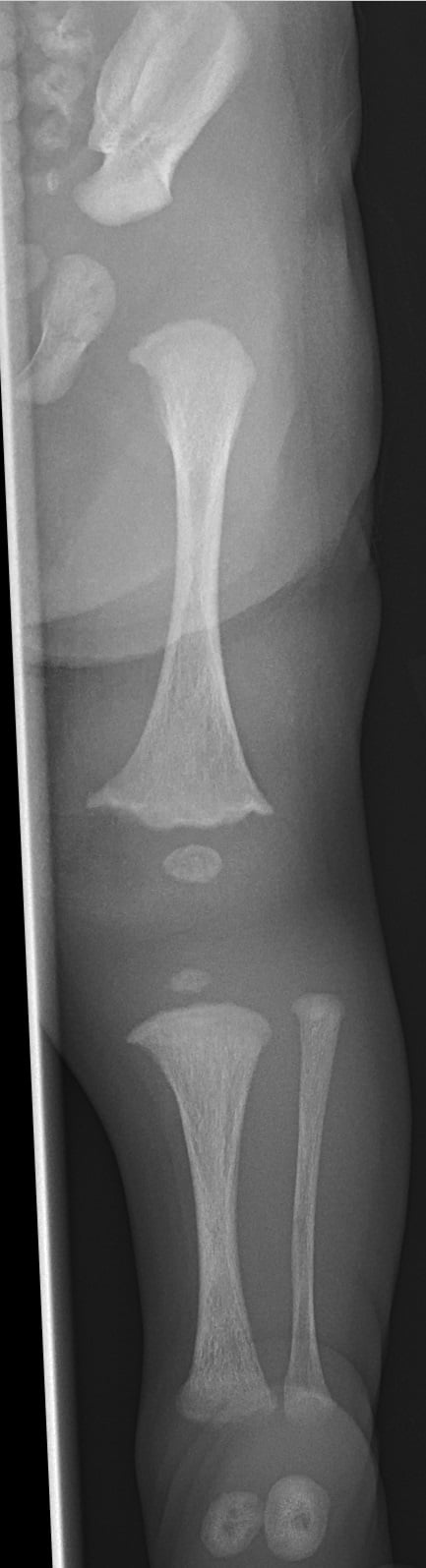
Other assessments. Audiometry for hearing, and a dental assessment for dentinogenesis imperfecta.
Differential Diagnosis
- Distinguishing Features
- Metaphyseal corner fractures, posterior rib fractures, inconsistent history
- Distinguishing Features
- Widened physes, cupping, bowing - but normal bone quality
- Distinguishing Features
- Low alkaline phosphatase, premature tooth loss
- Distinguishing Features
- No blue sclerae, no dentinogenesis imperfecta
- Distinguishing Features
- Hypermobility predominant, not bone fragility
Management
Bisphosphonates. Pamidronate (intravenous) or zoledronate are the agents most commonly used in children. They inhibit osteoclast activity and so increase bone density, and vertebral shape improves. Start them early in moderate-to-severe OI.
What the evidence establishes. This is the highest-value distinction in OI, because the drug is standard of care and the claim usually attached to it outruns the evidence. A Cochrane review of 14 randomised or quasi-randomised trials (819 participants) found that oral and intravenous bisphosphonates increase bone mineral density in children and adults with osteogenesis imperfecta. Every trial reporting lumbar spine BMD showed a significant rise in z-score at one or more time points, and the oral and intravenous routes did not differ in their ability to do so (DOI).
What it does not. For the outcome that actually matters, the same review concludes it is unclear whether treatment consistently decreases fractures. Pooling the intravenous trials for the proportion of participants sustaining at least one fracture gave a risk ratio of 0.56 (95% CI 0.30 to 1.06): a point estimate favouring treatment, with an interval that includes no effect. The trials do not show that bisphosphonates conclusively improve clinical status (pain, growth or functional mobility), and a separate systematic review of 26 studies in 801 children found that randomised trials specifically failed to show improved function and mobility with oral therapy.
Holding both halves. No trial showed an increased fracture rate, several report reduction independently, and the direction of effect is consistent. That is an argument for honest uncertainty, not for withholding a drug that is standard of care in severe disease.
Two errors. Both are real and overstatement is much the commoner: promising a family that bisphosphonates will stop the fractures sets up a betrayal when the next one happens. The opposite error, denying treatment because fracture reduction is unproven, would withhold a reliable BMD benefit on the basis of imprecision rather than absence of effect.
Around surgery. Bisphosphonates suppress remodelling, which is why they are usually withheld around planned osteotomies, and why delayed union after rodding is a live concern rather than a theoretical one. Whether to pause them is debated: Azzam's series continued therapy without postponement and reported acceptable union rates, so it need not be postponed around rodding. After surgery, continue per protocol.
Say: we know it strengthens the bone on scans; we believe but have not proven that it means fewer fractures; and we time it around surgery because it slows healing.
Fractures. Acute fractures heal normally, but immobilisation worsens the osteopenia, so keep it minimal. Protect the limb but mobilise early, in a lightweight cast for a short duration.
Intramedullary rodding. The indications are recurrent fractures and progressive bowing of the femur or tibia. Non-telescoping rods (Rush rods, K-wires) are outgrown; telescoping rods (Bailey-Dubow, Fassier-Duval) grow with the child.
Surgical Technique
Telescoping rodding. Multiple osteotomies (the Sofield procedure) correct the bowing, and a Fassier-Duval telescoping rod is inserted intramedullarily: two components that slide apart as the child grows. Weight bearing is protected at first, then progressed to full, with physiotherapy to maintain strength.
Rod complications.
- Migration - the rod moves proximally or distally, and is managed by revision
- Failure to telescope - the components do not slide
- Peri-implant fracture - at the rod tip, through weak bone; careful technique
- Infection - rare but serious
- Revision - as the child outgrows the rod
Scoliosis surgery. Progressive scoliosis is treated by posterior spinal fusion. The bone is very fragile, so screws are placed with care, and basilar invagination (skull settling) is a concern in severe OI.
Perioperative and Anaesthetic Considerations
Rodding, osteotomies and scoliosis surgery all carry OI-specific perioperative and anaesthetic risks that make any operation hazardous. It is high-yield because these patients return to theatre repeatedly.
Airway and cervical spine. Fragile, brittle teeth (dentinogenesis imperfecta) are easily damaged at laryngoscopy. A relatively large head and short neck, cervical-spine fragility and possible basilar invagination mean the neck must be handled gently, without forceful extension or manipulation. Anticipate a potentially difficult airway.
Positioning. An anaesthetised OI patient can fracture from handling alone, so pad carefully, position gently, and avoid forceful limb manipulation and tourniquets where possible. Avoid a standard automated blood-pressure cuff, whose repeated inflation can fracture the humerus; use the lowest cuff/least frequent cycling or an arterial line. Consider that suxamethonium fasciculations may provoke fractures or hyperthermia.
Intra-operative hyperthermia. OI carries a recognised tendency to intra-operative hyperthermia and a hypermetabolic response, a metabolic phenomenon distinct from classic malignant hyperthermia, though the two can be confused. Monitor temperature, avoid over-warming, and treat hyperthermia actively.
Bleeding. Mild platelet dysfunction and capillary and vessel fragility give an increased bleeding tendency. Anticipate blood loss in osteotomy and spinal surgery.
Regional anaesthesia. Spinal deformity, short stature and fragile bone make neuraxial and regional techniques harder, though they are not absolutely contraindicated. Plan within the multidisciplinary team. General anaesthetic and regional technique are covered in our General Anaesthesia in Orthopaedics and Regional Anaesthesia topics, and the craniocervical problem in our Basilar Invagination topic.
Complications
Of the disease. Recurrent fractures are managed with bisphosphonates and rodding. Basilar invagination in severe OI needs neurosurgical assessment, and hearing loss needs audiology. The complications of the rods themselves are listed under Surgical Technique.
Outcomes and Prognosis
By type. Type I carries a near-normal lifespan and function, and type II is lethal. Type III is often wheelchair-dependent, with significant disability; type IV is variable, and many are ambulatory.
In the modern era. Bisphosphonates and surgery together have improved outcomes.
Guidelines, Registries & Global Practice
Global epidemiology
- Birth prevalence approximately 1 in 15,000-20,000; Type I (mild) is the most common form worldwide.
- Autosomal dominant COL1A1/COL1A2 mutations account for the majority; recessive (e.g. CRTAP, P3H1/LEPRE1) and other rare forms are over-represented in consanguineous populations.
Side-by-side practice across major settings
- Consensus / Society Position
- Cyclic IV bisphosphonates (pamidronate or zoledronate) are standard for moderate-severe OI across North American, European and international metabolic bone units; oral agents used in milder disease
- Consensus / Society Position
- Telescopic intramedullary rodding (Fassier-Duval, Sheffield/Bailey-Dubow) with Sofield-type osteotomies is the global standard for deforming long-bone disease
- Consensus / Society Position
- International OI consensus and specialist centres advocate multidisciplinary clinics (orthopaedics, endocrinology/metabolic bone, genetics, rehab, dental, audiology)
- Consensus / Society Position
- Anti-sclerostin antibodies (e.g. setrusumab) and combination anabolic strategies are in later-phase trials, not yet routine
Registry & cohort evidence
- No dedicated implant registry equivalent to arthroplasty registries exists for OI; the evidence base is single-centre series (e.g. Shriners network) and natural-history cohorts.
- Key practical signal from cohorts: high lifetime revision burden for telescopic rods (around half of patients), driven mainly by growth.
High- vs limited-resource practice variation
- High-resource settings: early genetic confirmation, cyclic IV bisphosphonates from infancy, telescopic rodding, DXA surveillance, allied-health teams.
- Limited-resource settings: diagnosis is largely clinical/radiographic; bisphosphonate access and telescopic implants may be constrained, with greater reliance on bracing, non-telescopic rods (Rush rods/K-wires) and conservative fracture care.
Controversies & Areas of Uncertainty
- Do bisphosphonates actually reduce fractures? They reliably raise BMD, but the Cochrane review found fracture reduction is not conclusively proven and clinical-function benefits are inconsistent. BMD gain is a surrogate, not a guaranteed clinical endpoint.
- Optimal agent, dose and duration. Pamidronate vs zoledronate, IV vs oral, and how long to continue (risk of over-suppression, atypical fractures, delayed osteotomy healing) remain unresolved.
- Bisphosphonates and surgery. Whether to pause therapy around osteotomy/rodding is debated; some series (Azzam et al) continued therapy without postponement and reported acceptable union rates.
- Telescopic vs non-telescopic rods. Telescopic rods reduce re-operation for growth but carry their own failure modes (failure to telescope, migration); high overall revision rates persist regardless of implant.
- Emerging anabolics. Anti-sclerostin antibodies and other Wnt-pathway/anabolic agents show biochemical and BMD benefit in early trials, but fracture-reduction efficacy and paediatric safety are not yet established.
- OI and child protection. A genetic OI diagnosis does not exclude concurrent non-accidental injury; the threshold for safeguarding work-up remains a clinical judgement.
MCQ Practice Points
Q: Which OI type is lethal? A: Type II.
Q: What collagen type is affected in OI? A: Type I collagen (COL1A1/COL1A2).
Q: What is the mechanism of bisphosphonates? A: Inhibit osteoclasts → reduce bone resorption → increase bone density.
Q: What is the advantage of Fassier-Duval rods? A: Telescoping - they grow with the child.
Q: Which OI type has normal sclerae? A: Type IV - moderate severity with normal or gray sclerae.
Q: What fracture pattern is NOT typical of OI and suggests NAI? A: Metaphyseal corner fractures (bucket-handle) - the classic metaphyseal lesion, strongly associated with inflicted injury and not a feature of OI. Phrase it carefully, because the association has never been quantified: Kemp's systematic review (BMJ 2008, PMID 18832412) computed a probability of abuse for ribs, humerus, femur and skull, but found insufficient comparative studies to calculate one for the CML at all, and concluded that no fracture on its own distinguishes an abusive from a non-abusive cause. "Highly suggestive of inflicted injury" is defensible in court and in the exam; "specific for" or "diagnostic of" abuse is not.
Self-Assessment Quiz
Viva Scenarios
Practise clinical reasoning and management decisions out loud
“5-year-old with Type III OI. Fourth femur fracture in 2 years. Progressive bowing. On bisphosphonates.”
“Infant presents with multiple fractures. Parents claim OI. How do you differentiate from NAI?”
“How do bisphosphonates work in OI?”
GENETICS
- COL1A1/COL1A2
- Type I collagen
- Autosomal dominant
- Wormian bones
CLASSIFICATION
- I: Mild, blue sclerae
- II: Lethal
- III: Severe deforming
- IV: Moderate
FEATURES
- Fractures
- Blue sclerae
- Dentinogenesis
- Hearing loss
TREATMENT
- Bisphosphonates
- Telescoping rodding
- Protected mobilization
- Multidisciplinary
OI vs NAI
- Blue sclerae suggests OI
- Wormian bones suggests OI
- Metaphyseal corners = NAI
- OI does NOT exclude abuse
RODDING PEARLS
- Fassier-Duval = telescoping
- Sofield osteotomies correct bowing
- Complications: migration, failure
- Continue bisphosphonates post-op
Evidence Base
Sillence, Rimoin & Danks
- Foundational genetic-clinical classification of OI into four types (I-IV)
- Distinguished phenotypes by severity, sclerae, inheritance and fracture pattern
- Established variable expressivity vs genetic heterogeneity framework
Glorieux et al (pamidronate)
- Uncontrolled observational study, 30 children with severe OI on cyclic IV pamidronate
- Mean BMD rose 41.9% per year; z-score improved from -5.3 to -3.4
- Fracture incidence fell by 1.7 per year (p less than 0.001); healing and growth unaffected
Rauch & Glorieux (seminar)
- Authoritative seminar; expanded the four classical types to seven distinct phenotypes
- Most cases due to COL1A1/COL1A2 mutations; some have no detectable collagen mutation
- Bisphosphonates are an adjunct, not a cure; gene therapy remains preclinical
Dwan et al (Cochrane review)
- Systematic review of 14 trials (819 participants), oral and IV bisphosphonates
- Consistently increase lumbar-spine BMD in children and adults
- Fracture reduction not conclusively proven; zoledronate vs pamidronate showed no clear superiority
Azzam et al (Fassier-Duval rodding)
- Single-surgeon series: 58 children, 179 lower-limb Fassier-Duval telescopic rods
- Revision required in 53% (mean 52 months), mostly growth-related; nonunion 14.5%
- Bisphosphonates continued perioperatively without postponement; mobility improved
Glorieux et al (BPS804 anti-sclerostin)
- Randomised phase 2a trial, 14 adults with moderate OI, anti-sclerostin antibody (setrusumab/BPS804)
- Stimulated bone formation markers (P1NP +84%) and reduced resorption (CTX-1 -44%)
- Lumbar-spine aBMD increased 4% (p=0.038); generally well tolerated