The Stiffness is the Key
- Definition: A flatfoot with restricted subtalar motion and no arch reconstitution
- Peroneal Spastic Flatfoot: A clinical description (not a diagnosis) usually caused by Coalition
- Differential: Tarsal Coalition, Vertical Talus, Septic Arthritis, JIA, Trauma
- Workup: Weight-bearing X-rays are first line; CT is gold standard for bony coalition; MRI for fibrous
- Management: Depends on cause (Resection vs Fusion)
- “If the heel stays in valgus when they go on tiptoes, think RIGID
- “Always check subtalar motion - if it's stiff, get a CT
- “Unilateral flatfoot is suspicious
- “Pain in the sinus tarsi or medial malleolus suggests coalition
Overview and Epidemiology
A rigid flatfoot is a foot that lacks a medial longitudinal arch and is stiff. The term is descriptive; unlike the ubiquitous flexible flatfoot, a rigid flatfoot is almost always pathological.
Aetiology by age. The age of the patient narrows the list:
- Infant: congenital vertical talus (CVT)
- Child: calcaneonavicular coalition, which ossifies earlier
- Adolescent: talocalcaneal coalition, which ossifies later
- Any age: septic arthritis, osteomyelitis, trauma, tumour (osteoid osteoma)
How common coalition is. Symptomatic coalition is quoted at under 1%, and that figure counts symptoms, not coalitions. In a study of 100 cadaver feet scanned by spiral CT and then dissected, the dissections found nine non-osseous coalitions, two talocalcaneal and seven calcaneonavicular, and the authors open by stating that clinical studies report an incidence under 1% precisely because they disregard asymptomatic coalitions (DOI). Anatomical coalitions are considerably commoner than the quoted figure, and most never cause symptoms. The clinical question is therefore whether a common anatomical variant is the cause of this child's pain.
More than one bar. Coalitions are bilateral in 50-60%, and up to about 20% of patients have more than one coalition, in the same or the opposite foot. A calcaneonavicular and a talocalcaneal bar can coexist in the same foot.
Anatomy and Biomechanics
The normal subtalar joint. It allows inversion and eversion, which is how the foot accommodates uneven ground: the "torque converter" of the foot.
Where the bars lie. A calcaneonavicular (CN) coalition connects the anterior process of the calcaneus to the navicular. A talocalcaneal (TC) coalition typically lies at the middle facet of the subtalar joint.
What a block to subtalar motion does. A bony or cartilaginous bar (coalition) or a dislocation (CVT) prevents subtalar inversion and eversion, and the heel is locked in valgus. Because the hindfoot cannot invert, the midfoot cannot lock through the locking-wedge mechanism of the transverse tarsal joint, so it never becomes a rigid lever for push-off.
Why the peroneals spasm. On uneven ground the ground reaction force attempts to invert the heel, and the rigid subtalar joint cannot invert. That stress falls on the peroneal muscles, which fire reflexively to hold the foot in eversion (valgus) and protect the stiff joint from forced inversion; over time they shorten, or spasm, to prevent painful inversion against the bar. The spasm is usually a protective reflex splinting a painful, stiff subtalar joint, typically because of a coalition, and it may also be seen in inflammatory conditions such as subtalar arthritis.
"Peroneal spastic flatfoot" is a historical term describing the clinical appearance of a rigid flatfoot held in rigid valgus, the peroneal tendons tight or in spasm. It is a sign of an underlying pathology, usually tarsal coalition, and never a diagnosis in itself. Do not stop at the label: always find the underlying cause.
Pathophysiology: Tarsal Coalition
Pathogenesis. A coalition is a failure of mesenchymal segmentation during fetal development. The bar starts as fibrous (syndesmosis) or cartilaginous (synchondrosis) tissue that allows some motion, which is why young children are asymptomatic. As the child grows and the bar ossifies (synostosis), stiffness increases, micro-fractures occur across the rigid bar during activity, and pain develops.
Timing. Symptoms follow ossification, so the two common bars present at different ages:
- Calcaneonavicular: ossifies between 8-12 years, and symptoms appear at this age
- Talocalcaneal: ossifies between 12-16 years, and symptoms appear later in adolescence
Associations. Fibular hemimelia is often associated with tarsal coalition, and coalition is also seen with Apert syndrome and Nievergelt-Pearlman syndrome.
Congenital Vertical Talus
The lesion. Congenital vertical talus, the "rocker-bottom foot", is a dorsolateral dislocation of the talonavicular joint. The talus is locked in a vertical (plantarflexed) position and the navicular is dislocated onto the dorsal neck of the talus. It is the hallmark of a rigid flatfoot in a newborn.
Pathoanatomy. The deformity runs the length of the foot:
- Hindfoot: severe valgus and equinus, with the calcaneus plantarflexed
- Midfoot: dorsally dislocated
- Forefoot: abducted and dorsiflexed
- Soft tissues: contractures of the Achilles, peroneals, tibialis anterior and extensor digitorum longus
Aetiology. Half of cases are idiopathic and half syndromic. The syndromic half is highly associated with arthrogryposis, spina bifida (myelomeningocele) and genetic syndromes (trisomy 13, 15, 18).
Oblique talus. Rigidity is what separates the two. In CVT the navicular does not reduce on a plantarflexion radiograph; in oblique talus, which is flexible and reducible, the navicular slides back on plantarflexion.
Inflammatory, Septic and Neoplastic Causes
Septic arthritis of the subtalar joint. An acute-onset rigid flatfoot with refusal to bear weight, fever and elevated CRP/ESR. Pus in the joint causes severe spasm (splinting) of the surrounding muscles, the peroneals. It is a surgical emergency requiring washout.
Juvenile idiopathic arthritis. Stiffness comes on insidiously, often bilateral but starting unilaterally, and the subtalar joint is a common target; the signs are warmth, swelling and morning stiffness. If uncontrolled, it leads to spontaneous fusion (ankylosis) of the subtalar joint and a permanent rigid flatfoot in adulthood.
Osteoid osteoma. The classic site is the talar neck or the subtalar joint. The tumour secretes prostaglandins, which cause intense local inflammation and reflexive muscle spasm, producing a peroneal spastic flatfoot. The key symptom is night pain relieved by aspirin or NSAIDs, and CT reveals the nidus.
Classification Systems
Coalitions are classified by the tissue of the bar and by their morphology on CT; CVT is separated from its flexible mimic; and the clinical classification decides whether anything needs treating at all.
- Syndesmosis: fibrous union; stiff, but maybe some motion
- Synchondrosis: cartilaginous union; stiffer
- Synostosis: bony union; rigid
Clinical Assessment
History. The pain is often vague, felt in the ankle or the sinus tarsi, and worse with activity or on uneven ground. Recurrent ankle sprains occur because the subtalar joint cannot accommodate, so the ankle rolls. The patient may say the foot does not move like the other one.
Look. A flattened arch, hindfoot valgus and the "too many toes" sign of forefoot abduction.
Feel. Tenderness points to the bar. The sinus tarsi is tender in CN coalition or arthritis, and the medial malleolus and sustentaculum in TC coalition. Tight peroneal tendons bowstring behind the lateral malleolus.
Move. Test subtalar motion by locking the talus in the mortise with the ankle dorsiflexed and swinging the heel; in a rigid flatfoot it is restricted or absent. The tiptoe (heel rise) test and Jack's test complete the examination, and they are what separate a rigid foot from a flexible one:
- Flexible Flatfoot
- Heel Inverts (Varus)
- Rigid Flatfoot (e.g. Coalition)
- Heel Remains Valgus
- Flexible Flatfoot
- Arch Reconstitutes
- Rigid Flatfoot (e.g. Coalition)
- Arch Remains Flat
- Flexible Flatfoot
- Normal
- Rigid Flatfoot (e.g. Coalition)
- Restricted / Absent
- Flexible Flatfoot
- Usually Asymptomatic
- Rigid Flatfoot (e.g. Coalition)
- Often Painful
- Flexible Flatfoot
- Normal Anatomy (just flat)
- Rigid Flatfoot (e.g. Coalition)
- Bony/Cartilaginous Abnormalities
Differential diagnosis. Coalition is the commonest cause, but the other causes separate on age, tempo and a single discriminating feature:
- Typical Age / Clue
- Child-adolescent, recurrent sprains
- Discriminating Feature
- C-sign / anteater nose, restricted subtalar motion
- Confirmatory Test
- CT (bony) or MRI (fibrous)
- Typical Age / Clue
- Newborn, rocker-bottom sole
- Discriminating Feature
- Irreducible dorsal navicular dislocation
- Confirmatory Test
- Forced plantarflexion lateral X-ray
- Typical Age / Clue
- Any age, acute, febrile
- Discriminating Feature
- Refusal to weight-bear, raised CRP/ESR
- Confirmatory Test
- Aspiration / MRI, washout
- Typical Age / Clue
- Child, insidious, may be bilateral
- Discriminating Feature
- Morning stiffness, synovitis, warmth
- Confirmatory Test
- MRI synovitis, inflammatory markers
- Typical Age / Clue
- Adolescent, night pain
- Discriminating Feature
- Pain relieved by NSAIDs/aspirin
- Confirmatory Test
- CT nidus
- Typical Age / Clue
- Adult, unilateral, progressive
- Discriminating Feature
- Flexible early then rigid, too-many-toes sign
- Confirmatory Test
- MRI / dynamic exam
- Typical Age / Clue
- Any age, history of injury
- Discriminating Feature
- Prior fracture, deformity
- Confirmatory Test
- X-ray / CT
Investigations
Weight-bearing radiographs are the first study. The views and what each shows:
- AP foot: talonavicular uncoverage (below)
- Lateral, C-sign: a continuous C-shaped line from the talar dome to the sustentaculum, in TC coalition
- Lateral, anteater nose sign: an elongated anterior process of the calcaneus, in CN coalition
- Lateral, talar beak: a dorsal osteophyte on the talar head (below)
- Lateral, vertical talus: the talar axis points to the sole, with the navicular dorsal
- Harris heel view: a special view to see the posterior and middle facets
Meary's angle. On the lateral view, the angle between the long axis of the talus and the long axis of the first metatarsal (the talo-first-metatarsal angle). The two are normally collinear, about 0 degrees; in pes planus the line breaks with the apex pointing plantarward at the talonavicular or naviculocuneiform level, which localises where the arch has sagged.
Calcaneal pitch. The angle between the inferior border of the calcaneus and the floor, normally roughly 20-30 degrees. It is reduced in flatfoot, which quantifies the loss of the arch objectively.
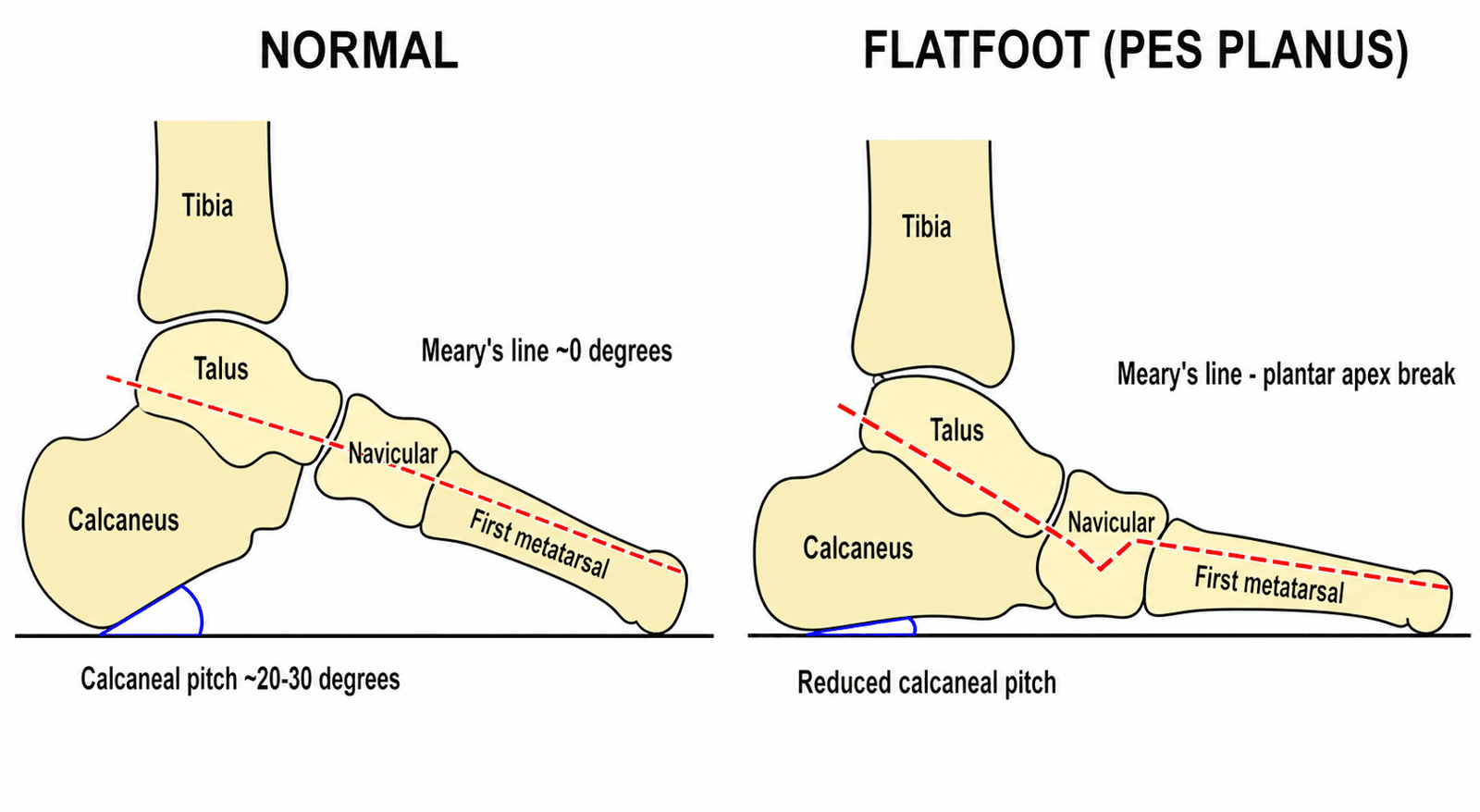
Talonavicular coverage. On the AP view the navicular is abducted and uncovered laterally on the talar head, and the AP talus-first-metatarsal angle increases with forefoot abduction: the AP correlate of the deformity.
Why measure. These angles define pes planus objectively, independently of the coalition signs. They quantify severity and localise the apex of the deformity, which guides where an osteotomy or fusion is directed.
The talar beak. A dorsal osteophyte on the head of the talus, and often the first clue on a lateral radiograph that the subtalar joint is stiff, even when the coalition itself is not visible; it signifies abnormal mechanics. It is a traction spur and does not signify osteoarthritis of the talonavicular joint. Because the subtalar joint is rigid, the navicular overrides the talar head during dorsiflexion, which puts excessive tension on the dorsal talonavicular capsule and ligament; the pull on the periosteum leads to bone formation, an enthesophyte.
Beak or degenerative spur. The distinction decides the operation:
- Talar beak: proximal to the joint line, with the joint space preserved; resection is still an option
- Degenerative spur: at the joint margin (lipping), with joint space narrowing; resection is contraindicated and fusion is needed
CT. The gold standard for defining bony anatomy and mapping coalitions, and essential for surgical planning: the size of the bar and the hindfoot valgus angle. Each coalition is best seen in its own plane:
- Coronal: TC coalition (middle facet)
- Sagittal: the C-sign
- Oblique or axial: CN coalition
True joint space narrowing, as distinct from beaking, matters on CT too: resection is contraindicated if there is greater than 50% joint narrowing.
Image the whole foot. A second coalition is easily missed, so the preoperative CT should map the entire hindfoot and midfoot, with the other foot imaged if it is symptomatic. Finding one bar does not exclude another.
MRI. Useful for fibrous and cartilaginous coalitions, which may be invisible on CT, and for soft-tissue and inflammatory causes such as synovitis. CT's blind spot is real: in the cadaver study above, CT missed several of the non-osseous bars it was meant to detect.
Management
Non-operative care is first line for a symptomatic coalition or arthritis. A genuine, supervised trial of all four measures is expected before surgery is discussed, and a proportion of children settle and need nothing more:
- Activity modification: avoid uneven ground
- NSAIDs for acute flare-ups
- Immobilisation for 4-6 weeks in a short leg cast or CAM boot, which calms the peroneal spasm and inflammation
- Orthotics: a UCBL or rigid arch support, often poorly tolerated in rigid feet because it pushes against a stiff arch
Resection. Indicated after failure of non-operative care when there is no established degenerative change, which is the firmer criterion. A CN bar is excised and fat graft or EDB muscle interposed; for a TC bar the middle-facet bridge is resected and fat graft interposed. Success depends on the cartilage of the remaining joint surfaces, and on interposing something to stop the bar reforming. If hindfoot valgus is severe, greater than 15-20 degrees, resection alone will not correct the alignment and a calcaneal osteotomy is needed.
The 50% rule. The classic threshold is a bar under 50% of the joint: a bar involving greater than 50% of the posterior facet does poorly with resection and favours fusion. Treat it as a guide rather than a hard cut-off. A long-term study of 32 resections in patients under 18, followed to a mean age of about 26, found no association between the size of the talocalcaneal coalition or the hindfoot valgus angle and the outcome scores, and states plainly that favourable results were attained even when resecting bars greater than 50% of the posterior facet with valgus over 16 degrees (DOI, level III). Resected talocalcaneal and calcaneonavicular bars behaved similarly for function and satisfaction, though inversion and eversion remained significantly poorer after talocalcaneal resection.
Holding both halves. That is a single level III series with 13 talocalcaneal feet, so the 50% threshold remains a sensible default and should still be quoted, but it should not be applied as though crossing it mandated arthrodesis. The two possible errors are not symmetrical. Resecting a large bar that then fails costs a revision, and the fusion you were going to do anyway remains available. Fusing a child's subtalar joint that would have done well with resection is irreversible: it sacrifices hindfoot motion permanently and loads the adjacent joints, the ankle and midfoot, for the rest of the patient's life. Where the joint surfaces are preserved the balance favours trying resection, and established arthritis, not bar size, is the finding that genuinely closes the door.
Reconstruction and arthrodesis. The indications are degenerative change (the strongest), failed resection, severe fixed valgus, or a very large coalition, bar size above 50% being a relative rather than an absolute trigger. Fusion buys pain relief at the cost of hindfoot motion, so it is the last option considered, not the first. Three operations are used:
- Calcaneal osteotomy: mild arthritis but severe valgus
- Subtalar fusion: isolated TC pathology
- Triple arthrodesis: the definitive, "gold standard" salvage for the severe, rigid, painful, deformed foot with degenerative change or a failed coalition resection, such as a late untreated vertical talus or a massive coalition
Surgical Technique
Approach. A lateral oblique (Ollier's) incision over the sinus tarsi, in the lines of skin tension. Protect the sural nerve posteriorly and the superficial peroneal nerve dorsally.
- Elevate extensor digitorum brevis (EDB) from its origin and reflect it distally
- Identify the bar, palpable between the anterior process of the calcaneus and the navicular
- Resect it with an osteotome or burr, generously, as a rectangular block
- Visualise the talar head (medially) and the cuboid (laterally) to confirm a full-width resection
- Sew the EDB muscle belly into the defect with absorbable suture, as a spacer to prevent regrowth
The intra-operative rule. After an adequate resection, subtalar motion should return immediately on the table. If the foot is still stiff after a technically complete resection, assume either an unaddressed second coalition or established degenerative arthritis, and do not simply close and hope. These are the commonest reasons a resection fails with persistent pain and stiffness, and both are avoided by whole-foot preoperative imaging and an intra-operative motion check.
Complications
- Risk Factors
- Inadequate resection, no interposition
- Prevention/Management
- Prevention: generous resection and EDB or fat interposition
- Risk Factors
- Missed second coalition, underlying arthritis
- Prevention/Management
- Prevention: pre-op CT of the whole foot. Management: fusion
- Risk Factors
- Lateral approach
- Prevention/Management
- Prevention: identify and protect
- Risk Factors
- Medial approach (TC coalition)
- Prevention/Management
- Prevention: careful handling of skin
- Risk Factors
- Prolonged immobilisation; failure to mobilise after resection
- Prevention/Management
- Prevention: early ROM if stable
Complex regional pain syndrome. A high risk in foot surgery. Early movement and desensitisation are the key prevention strategies, and vitamin C 500 mg daily is often prescribed.
Postoperative Care
After coalition resection. The wound is protected first, then motion is restored:
- Weeks 0-2: splint or cast, non-weight-bearing; elevate significantly to prevent wound breakdown
- Weeks 2-6: active range-of-motion exercises (writing the alphabet with the foot); physiotherapy for peroneal strengthening and subtalar eversion and inversion; touch-down weight bearing in a boot
- Week 6 onwards: weight bearing as tolerated in shoes; physiotherapy continued for 3-6 months; return to sport at 3-4 months
After triple arthrodesis. The fusion is protected from weight for 6-12 weeks, until union:
- Weeks 0-2: backslab, strictly non-weight-bearing, elevation
- Weeks 2-6: lightweight fibreglass cast or locked CAM boot, still non-weight-bearing to protect the fusion mass
- Weeks 6-12: progressive weight bearing in the CAM boot; X-ray at 6 weeks to check alignment and at 12 weeks to confirm union
- Months 3-6: wean out of the boot into a stiff-soled shoe; gait retraining (expect a stiff gait); no impact sports
Outcomes and Prognosis
Tarsal coalition. Resection yields good results in young patients, with about 75-80% relief. Results are poorer in older patients or with large bars, although the long-term series discussed under Management found no association between talocalcaneal bar size and outcome scores.
Vertical talus. The Dobbs technique gives excellent functional results and avoids the stiff, small feet associated with extensive releases.
Untreated rigid flatfoot. It leads to progressive degenerative arthritis of the triple joint complex and may require triple arthrodesis in adulthood.
Surgical Tips and Tricks
- Headlight: Essential for visualization, especially medial approach.
- Bone Wax: Use liberally on the raw bone surfaces after resection to prevent hematoma and re-ossification.
- Fat Graft: Don't skimp. Harvest a large plug from the Kager's triangle (retro-calcaneal fat pad). It has a robust blood supply.
- Intra-op Fluoroscopy: Use it to confirm the amount of bone removed. The "Harris Line" (middle facet) must be clear.
- Dynamic Check: After resection, the subtalar motion should return immediately. If it's still stiff, you haven't taken enough bone, or there's another coalition.
- Order of Fixation:
- Talonavicular (TN): This sets the version of the foot. Reduce this first.
- Subtalar (TC): Corrects the valgus/varus.
- Calcaneocuboid (CC): Follows the others.
- Screw Position:
- Subtalar screw should aim for the talar dome but NOT penetrate it.
- TN screws should be placed from navicular into talar head (or vice versa), avoiding the joint surface.
- Bone Graft: Use local autograft from the resected wedges to pack the fusion sites.
Guidelines, Registries & Global Practice
Global Epidemiology:
- Tarsal coalition: Classically quoted at under 1% symptomatic prevalence, but cadaver/CT studies show non-osseous coalition in roughly 11-13% of feet - most are asymptomatic. Bilateral in 50-60%. Calcaneonavicular and talocalcaneal account for the vast majority; up to 20% of patients have more than one coalition.
- Congenital vertical talus: Rare (around 1 in 10,000 live births). Roughly half are syndromic (arthrogryposis, myelomeningocele, chromosomal anomalies).
Side-by-Side Practice (no single national framework):
- Convergent global practice
- Weight-bearing radiographs for every rigid flatfoot
- Where opinion still differs
- CT vs MRI as the next study (CT for bony mapping; MRI better for fibrous/cartilaginous bars and marrow oedema)
- Convergent global practice
- Minimally invasive reverse-Ponseti (Dobbs) method is now the international standard of care
- Where opinion still differs
- Role and extent of soft-tissue release in non-idiopathic/syndromic feet
- Convergent global practice
- Resection + interposition for symptomatic, non-arthritic bars
- Where opinion still differs
- The 50% posterior-facet "rule" - newer data (Khoshbin) suggest larger TC bars can still do well
- Convergent global practice
- Address hindfoot valgus, not just the bar
- Where opinion still differs
- Calcaneal lengthening osteotomy vs subtalar/triple fusion for severe valgus
High- vs Limited-Resource Settings:
- Well-resourced: Routine CT/MRI, motion-preserving reconstruction (resection plus lengthening osteotomy), early Dobbs-method CVT casting in infancy.
- Limited-resource: Diagnosis often delayed to symptomatic adolescence or neglected CVT; reliance on plain films; later presentation shifts the balance toward arthrodesis/salvage. Naviculectomy with limited release has been described as an affordable "third way" for neglected/complex CVT.
- Registries: There is no dedicated coalition or CVT registry; evidence is drawn from single-centre series and small cohorts, which is itself a key limitation (see Controversies).
Controversies & Areas of Uncertainty
- The 50% posterior-facet rule: The traditional teaching that talocalcaneal coalitions involving over 50% of the posterior facet require fusion rather than resection is being challenged. Khoshbin et al. found favourable long-term outcomes after resecting TC bars exceeding 50% of the facet with hindfoot valgus over 16 degrees, and Mosca's calcaneal lengthening offers a motion-preserving alternative even for "unresectable" coalitions.
- Treat the deformity or the bar?: Resecting the coalition without correcting fixed hindfoot valgus can leave a painful, poorly aligned foot. There is no consensus on the valgus threshold mandating an added calcaneal lengthening osteotomy versus resection alone.
- Interposition material: EDB, fat graft, bone wax and tendon have all been used to prevent reossification after resection; no high-level comparative evidence establishes one as superior.
- Pinning in CVT: Dobbs' own series showed recurrence only in feet that were NOT pinned, but the optimal duration of talonavicular K-wire fixation and casting is not standardised.
- Asymptomatic coalition: Whether an incidentally discovered coalition should ever be resected prophylactically (e.g. in a young athlete) remains unresolved - current practice treats symptoms, not the radiograph.
- Evidence quality: Nearly all data are Level III-IV retrospective series from single centres with no registry; there are no randomised trials comparing resection strategies or CVT techniques.
Parent's Guide: Frequently Asked Questions
Q: Will my child grow out of it? A: Unlike flexible flatfeet (which often improve), a rigid flatfoot (Tarsal Coalition) is a structural problem. The "bar" between the bones will not disappear. Symptoms might fluctuate, but the stiffness remains.
Q: Is surgery always needed? A: No. If the foot is not painful, we leave it alone. We treat the symptoms, not the X-ray. Many adults have coalitions they don't know about.
Q: Can they play sports after surgery? A: Yes. After resection, most children return to sports. If a fusion (Triple Arthrodesis) is performed, high-impact sports (running, soccer) may be difficult, but cycling and swimming are excellent.
Q: Why is the cast on for so long? A: To allow the swelling to settle (after resection) or to allow the bones to knit together (after fusion). Rushing rehabilitation can lead to persistent pain.
MCQ Practice Points
Q: The 'Anteater Nose' sign is pathognomonic for which condition? A: Calcaneonavicular Coalition. It represents the elongated anterior process of the calcaneus.
Q: Which facet is most commonly involved in Talocalcaneal coalitions? A: Middle Facet. It is often hard to see on standard lateral views (requires Harris view or CT).
Q: What is the primary contraindication to coalition resection? A: Degenerative Changes (Arthritis) in the subtalar or talonavicular joint. If arthritis is present, resection will fail; fusion is required.
Q: What is the characteristic finding of Peroneal Spastic Flatfoot? A: Rigid Valgus that does not correct on tiptoeing, with tight/bowstrung peroneal tendons.
Q: What is the gold standard imaging for diagnosing Talocalcaneal coalition? A: CT Scan. It best demonstrates bony anatomy and the extent of the coalition (less than 50% = resection, greater than 50% = fusion).
Q: What tissue is interposed after calcaneonavicular coalition resection? A: Extensor Digitorum Brevis (EDB) muscle belly. This prevents bony regrowth and maintains the resection gap.
Viva Scenarios
Practise clinical reasoning and management decisions out loud
“13-year-old boy, recurrent ankle sprains, painful flat feet. Exam shows restricted subtalar motion.”
“Newborn with a rigid flatfoot, convex sole (Rocker Bottom). Top of foot touches shin.”
“35-year-old male, sudden onset painful unilateral flatfoot. No trauma. History of 'minor' sprains.”
DEFINITION
- Restricted Subtalar Motion
- No Arch Reconstitution
- Fixed Valgus
- Peroneal Spasm (Reactive)
DIFFERENTIAL
- Tarsal Coalition
- Vertical Talus
- Arthritis (Septic/JIA)
- Trauma
- Tumor
WORKUP
- Tip-Toe Test
- Jack's Test
- X-ray (C-sign, Anteater)
- CT (Gold Standard for Bone)
MANAGEMENT
- Symptomatic: Resection
- Arthritic/Large: Fusion
- Infant (CVT): Casting + Pinning
- Always rule out 2nd coalition
RED FLAGS
- Unilateral
- Night Pain (Tumor)
- Systemic Symptoms (Sepsis)
- Fever / Elevated CRP
Evidence Base
Dobbs et al. - Minimally Invasive CVT (Reverse Ponseti)
- 11 patients (19 feet) with idiopathic congenital vertical talus, minimum 2-year follow-up
- Serial reverse-Ponseti casts (mean 5) then talonavicular pinning plus percutaneous Achilles tenotomy; no extensive releases needed
- Initial correction achieved in all 19 feet; recurrence in 3 feet - all of which had NOT had talonavicular pin fixation
Cummings & Hosseinzadeh - Long-Term PROMIS After Minimally Invasive CVT
- 24 children treated with the minimally invasive (Dobbs) method; radiographic recurrence in 7 (29%)
- Mean PROMIS scores within 1 SD of the reference population for pain interference, mobility and peer relations
- Children who started treatment after 12 months of age had significantly lower mobility scores
Khoshbin et al. - Long-Term Function of Resected Coalitions
- 24 patients (32 resections: 19 calcaneonavicular, 13 talocalcaneal), mean follow-up to age 25-27 years
- CN and TC resections produced similar long-term function and satisfaction scores
- Favourable results were attained even for TC coalitions over 50% of the posterior facet and hindfoot valgus over 16 degrees
Mosca & Bevan - Calcaneal Lengthening for TC Coalition
- 8 patients (13 painful talocalcaneal coalitions) treated with calcaneal lengthening osteotomy, with or without resection
- Osteotomy corrected valgus and relieved pain even when the coalition was unresectable, preserving talonavicular/calcaneocuboid motion
- All feet underwent concurrent gastrocnemius or Achilles lengthening
Saxena et al. - Coalition Resection & Return to Activity
- 78 patients / 97 coalition resections (49 talocalcaneal, 47 calcaneonavicular, plus rarer types)
- Mean return to desired activity 18.3 weeks; mean post-operative Roles & Maudsley score 1.3 (excellent/good)
- Most patients returned to their desired activity level after excision
Solomon et al. - Cadaver Prevalence & CT Sensitivity
- 100 cadaver feet dissected after spiral CT: non-osseous coalition prevalence 12.7% (CN most common single type, 9.1%)
- True prevalence is far higher than the classically quoted under 1%, because most coalitions are asymptomatic
- Spiral CT detected only ~55% of coalitions and missed 4 non-osseous bars
Smith et al. - Triple Arthrodesis, Minimum 10-Year Follow-Up
- 27 adults (31 feet) with non-paralytic disease, mean 14-year follow-up; 93% satisfied with the result
- Severe adjacent-joint arthrosis developed in the ankle (7 ankles), naviculocuneiform and tarsometatarsal joints; 3 later needed ankle fusion
- 74% reported moderate-to-severe difficulty on uneven ground; SF-36 physical score well below the population mean