Combining Functional and Anatomical Imaging for Orthopaedic Diagnosis
Planar bone scan: 2D, whole-body, sensitive but poor anatomical localisation, lowest dose
SPECT-CT: 3D, regional, better contrast resolution, precise anatomical localisation, moderate dose
PET-CT: 3D, whole-body or regional, superior resolution and specificity, highest dose
Key: SPECT-CT bridges the gap between the low-cost whole-body planar bone scan and the expensive high-resolution PET-CT
- SPECT acquires 3D nuclear medicine data (like CT does for X-rays), providing volumetric functional information compared to the 2D planar bone scan.
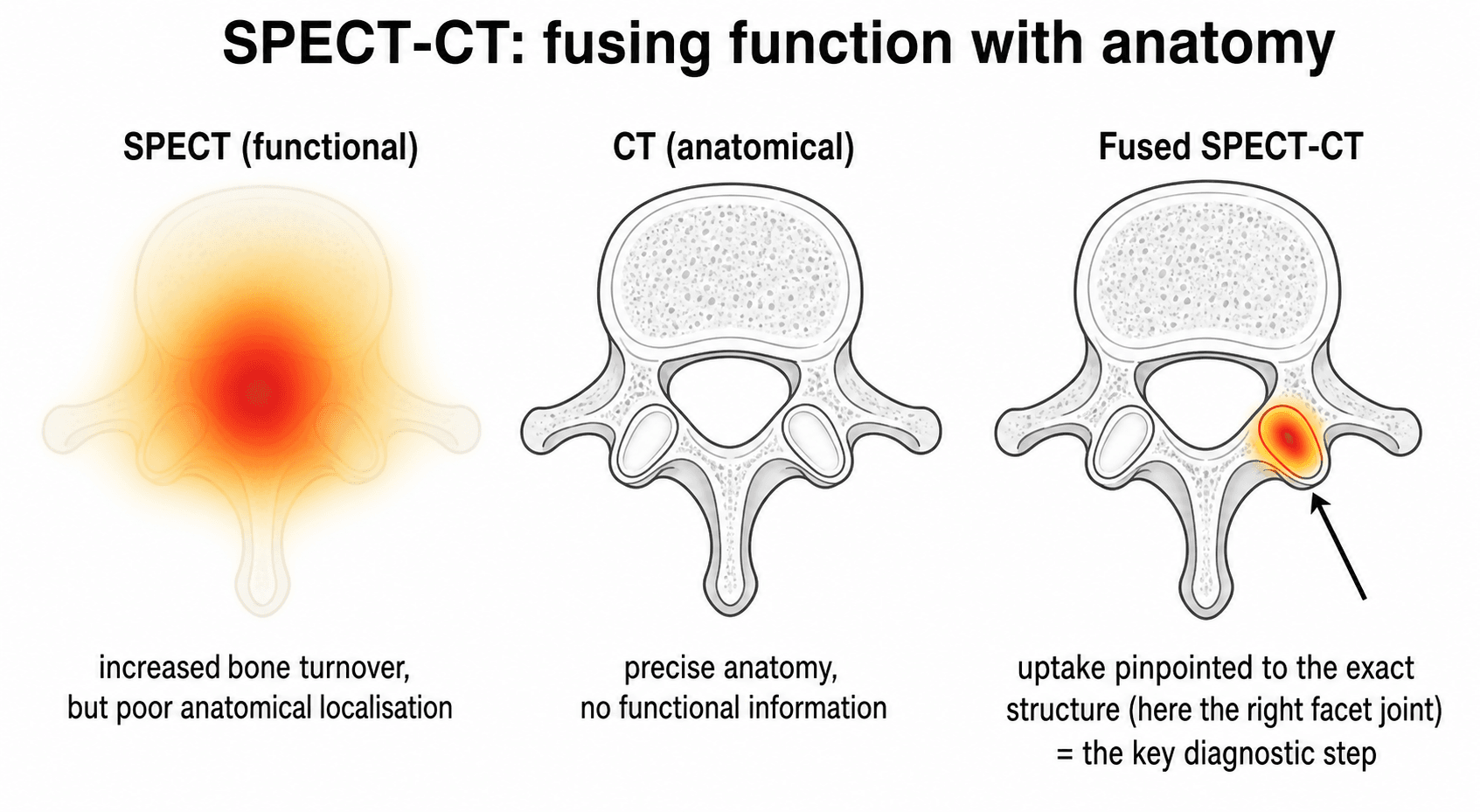
- SPECT-CT combines SPECT functional data with CT anatomical data through co-registration — localising the metabolic abnormality to a specific anatomical structure.
- SPECT-CT adds diagnostic value in approximately 30% of cases over planar bone scan, often changing the clinical management.
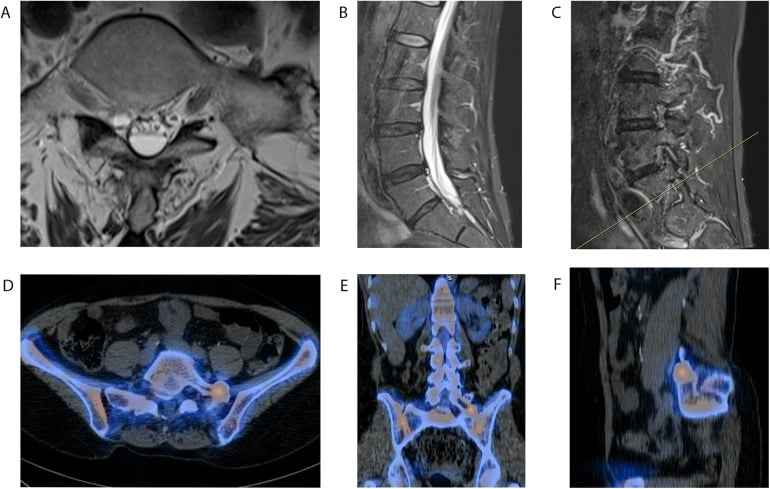
- Key orthopaedic applications: painful arthroplasty evaluation, patellofemoral assessment, spinal fusion assessment, facet joint disease localisation, and stress fracture detection.
- SPECT-CT is particularly valuable when the planar bone scan shows uptake in a complex anatomical region (spine, wrist, foot) where precise localisation is needed.
- “SPECT provides better contrast resolution and sensitivity than planar bone scan — it detects lesions that are invisible on the planar study.
- “The CT component serves dual purposes: attenuation correction (improving SPECT accuracy) and anatomical localisation of uptake.
- “In painful total knee replacement, SPECT-CT can differentiate patellofemoral from tibiofemoral sources of uptake — guiding targeted revision.
- “For spinal fusion assessment, SPECT-CT can confirm whether a fusion is solid (no uptake) or actively remodelling/pseudarthrosis (focal uptake at the fusion site).
- “SPECT-CT dose is higher than planar bone scan alone due to the CT component (typically 3-10 mSv additional).
SPECT-CT is examined in the context of specific clinical indications where its hybrid nature adds diagnostic value. You must understand: how SPECT differs from planar bone scan (3D vs 2D), why the CT component is essential (anatomical localisation and attenuation correction), and the specific orthopaedic applications — particularly painful arthroplasty, spinal fusion assessment, and stress fracture localisation. A common viva question involves explaining when SPECT-CT changes management compared to planar bone scan alone.
Overview
SPECT-CT (Single Photon Emission Computed Tomography combined with Computed Tomography) is a hybrid imaging modality that combines the functional sensitivity of nuclear medicine with the anatomical precision of CT. It has become increasingly valuable in orthopaedic practice, particularly for diagnostic problems where the planar bone scan gives insufficient anatomical localisation.
The problem it solves. A planar bone scan tells you there is increased bone turnover somewhere in a region. In anatomically complex areas (the spine, wrist, tarsus and around prostheses) it cannot localise that uptake to a specific structure.
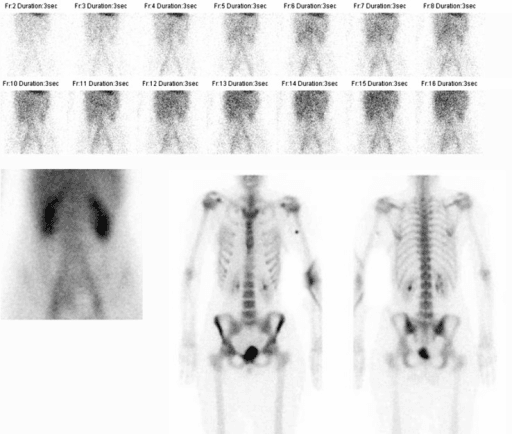
The SPECT half. SPECT acquires nuclear medicine data in 3D, as CT does for X-rays. A rotating gamma camera acquires data from multiple angles (120-360 degrees) to reconstruct a volume, and the result has better contrast resolution and sensitivity than the 2D planar scan, detecting lesions with 20-30% better contrast and revealing some that are invisible on the planar study.
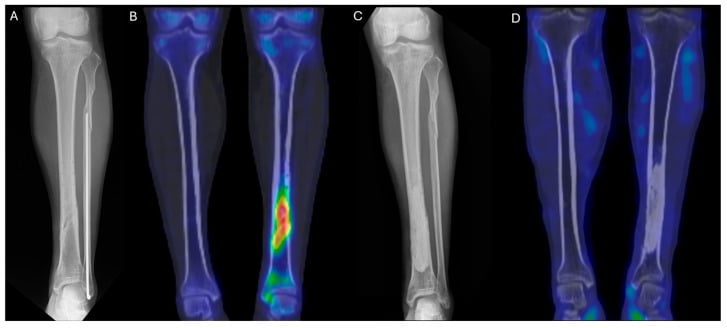
The CT half. SPECT and CT are acquired sequentially on the same gantry, which ensures precise co-registration without repositioning the patient. The CT then does two jobs: it corrects for tissue attenuation, improving the quantitative accuracy of the SPECT (particularly important around metal implants), and it supplies the anatomical framework onto which the uptake is localised.
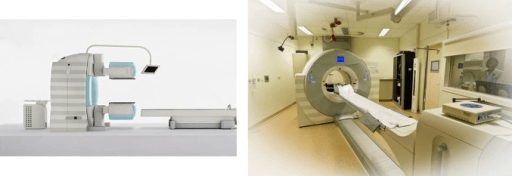
When it adds value. SPECT-CT is most useful when a planar bone scan shows uptake in a complex region and the source structure cannot be identified. It also adds most value in the painful arthroplasty, where precise compartmental localisation guides surgical planning; in deciding whether a spinal fusion is solid; in the back pain work-up, to identify the specific facet joint responsible; and in localising stress fractures in complex anatomy such as the tarsal navicular and carpal bones. Studies show it changes the diagnosis in approximately 30% of cases and changes management in approximately 25%.
Its limitations. Spatial resolution is lower than dedicated diagnostic CT or MRI, with SPECT at approximately 7-10mm. The CT component is typically low-dose and is NOT equivalent to a diagnostic CT scan; it is there primarily for localisation and attenuation correction.
The additional radiation from the CT component, typically 3-10 mSv and varying with protocol and coverage, must be justified by the clinical need. The study is regional, not whole-body like the planar scan, so the operator must select the region of interest, and availability is more limited than standard planar bone scan.
The Painful Prosthesis — Differentiating the Causes
The painful arthroplasty is the single highest-yield exam application. SPECT/CT helps separate the causes of periprosthetic pain by where the uptake sits and what the CT shows beneath it.
- Typical SPECT/CT Pattern
- Focal bone-tracer uptake at the bone-implant or bone-cement interface, often with a corresponding lucent zone on CT
- Discriminating Feature
- Interface-localised uptake plus CT lucency; normal inflammatory markers
- Typical SPECT/CT Pattern
- Diffuse or interface uptake — overlaps with aseptic loosening and cannot be reliably separated
- Discriminating Feature
- Cannot be excluded by SPECT/CT; needs aspiration, CRP/ESR, alpha-defensin, cultures
- Typical SPECT/CT Pattern
- Uptake localised to the patella or trochlea; CT shows malrotation or lateral tracking
- Discriminating Feature
- Compartment-specific uptake guiding isolated patellar intervention
- Typical SPECT/CT Pattern
- Uptake at the loaded condyle or tibial plateau matching CT-measured malrotation or varus/valgus
- Discriminating Feature
- Uptake corresponds to the mechanically overloaded zone
- Typical SPECT/CT Pattern
- Diffuse low-grade uptake, sometimes ligament insertion sites; CT may be near-normal
- Discriminating Feature
- Pattern is non-specific — diagnosis is clinical and stress-radiographic
- Typical SPECT/CT Pattern
- Little or no significant periprosthetic uptake
- Discriminating Feature
- Negative SPECT/CT redirects the search (spine, vascular, neuropathic)
A focal interface uptake on SPECT/CT does NOT differentiate aseptic loosening from periprosthetic joint infection. In any painful arthroplasty you must exclude infection first with inflammatory markers (CRP, ESR), joint aspiration for cell count, differential and culture, and adjuncts such as alpha-defensin where available. Reserve SPECT/CT for characterising the aseptic, non-infected painful joint.
The Hirschmann Localisation Scheme and Tracer-Activity Grading
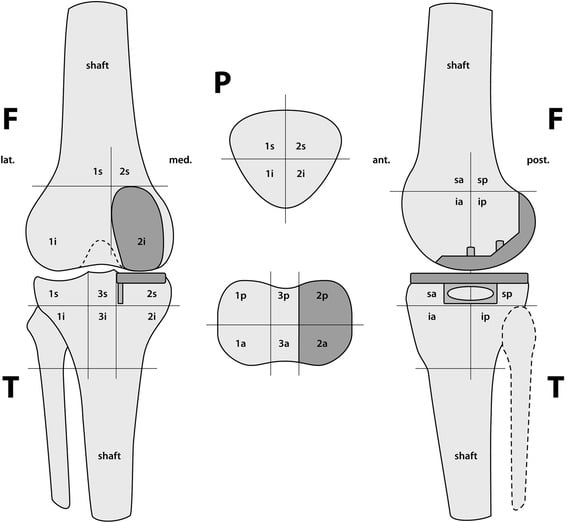
Reporting "periprosthetic uptake" in a painful total knee arthroplasty is not enough. The value of SPECT/CT comes from mapping the uptake to a defined region and grading its intensity reproducibly, and the Hirschmann scheme is the standardised system that does this, the practical reporting framework examiners expect you to know.
- How it works
- The tibia, femur and patella are each divided into defined regions on standardised axial, coronal and sagittal slices (9 tibial, 9 femoral and 4 patellar regions)
- Why it matters
- Uptake is assigned to a named region rather than a vague 'periprosthetic' label, giving reproducible localisation
- How it works
- Activity in each region is scored on a colour-coded semi-quantitative scale (0 to 10)
- Why it matters
- Allows the intensity of the metabolic abnormality to be compared between regions and over time
- How it works
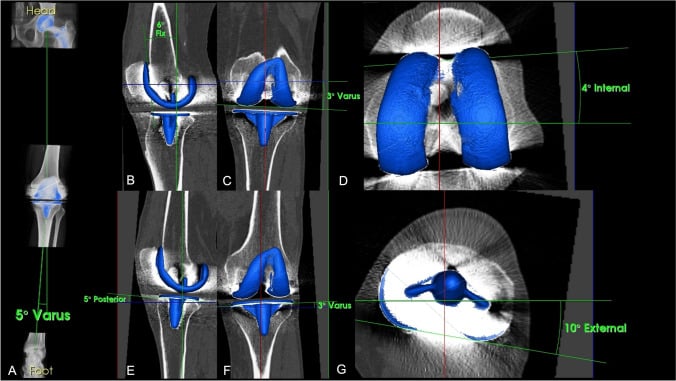
- Component position (rotation, varus/valgus, tibial slope) is measured on the co-registered CT
- Why it matters
- Links the metabolic 'hot' region to the mechanically overloaded or malaligned zone
- How it works
- The hot region is read together with the measured malalignment (e.g. posteromedial tibial uptake with tibial varus)
- Why it matters
- Turns a non-specific hot knee into a specific, mechanism-based diagnosis that guides targeted revision
The scheme has high inter- and intra-observer reliability and underpins modern compartmental reporting. An analogous regional logic is applied to the painful hip arthroplasty.
The localisation grid identifies WHERE the uptake is, but normal periprosthetic remodelling can produce uptake within the postoperative window set out under Painful Arthroplasty. A hot region within this window may be physiological; interpret the scheme together with the time since surgery and the inflammatory markers, and never read focal interface uptake as proof of loosening or infection on its own.
Systematic Approach
Read a SPECT-CT in six steps, from the whole-body picture down to the single structure and then back out to the patient.
- Assessment
- Compare SPECT-CT findings with the whole-body planar bone scan
- Key Principles
- SPECT-CT is regional — the planar study ensures no significant distant findings are missed
- Assessment
- Assess 3D uptake patterns: location, intensity, distribution
- Key Principles
- SPECT provides better contrast than planar — it may reveal additional lesions not seen on the 2D study
- Assessment
- Review the CT component for structural correlates
- Key Principles
- Look for arthritis, fracture lines, hardware position, lytic/blastic lesions, soft tissue changes
- Assessment
- Analyse the co-registered SPECT/CT fusion images
- Key Principles
- Determine which specific anatomical structure the SPECT uptake localises to — this is the key diagnostic step
- Assessment
- Integrate findings with clinical history, examination, and other imaging
- Key Principles
- Consider whether the SPECT-CT findings explain the patient's symptoms and guide management
- Assessment
- Assess whether SPECT-CT changes or confirms the diagnosis and management plan
- Key Principles
- Document how SPECT-CT adds value — this justifies the additional radiation dose
Clinical Applications
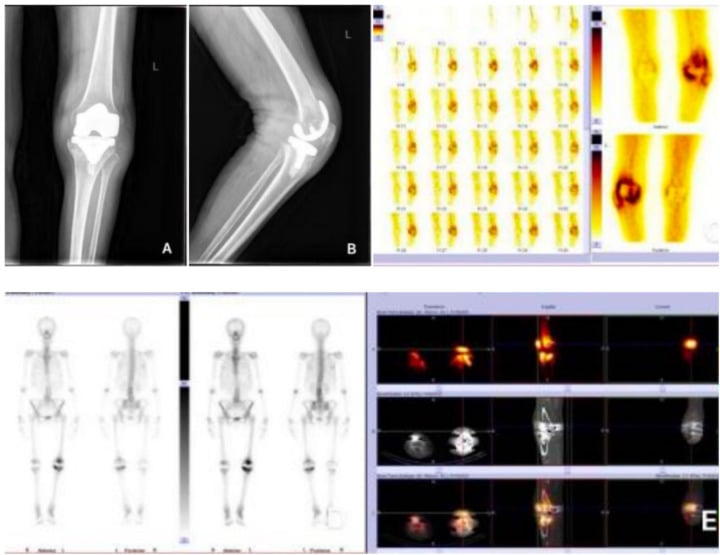
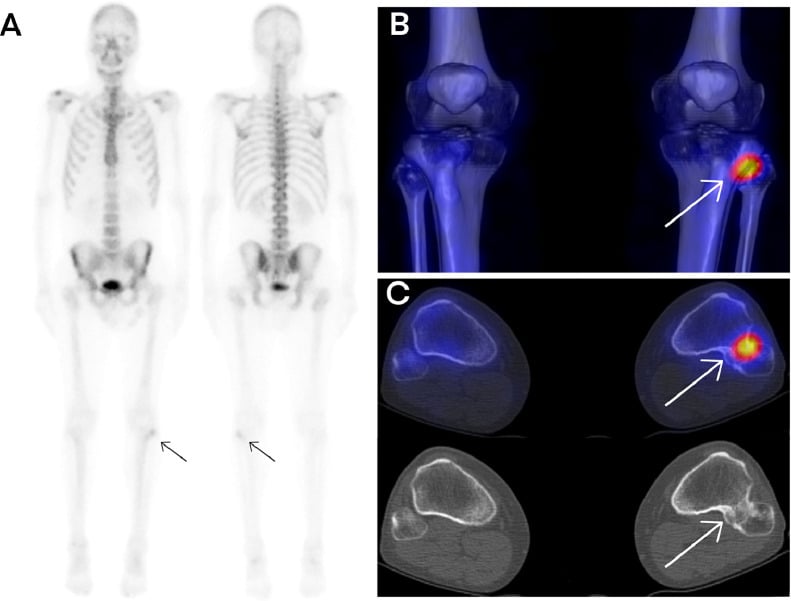
The clinical problem. Assessment of the painful total joint replacement, particularly the total knee replacement (TKR), is one of the most valuable orthopaedic applications. After TKR approximately 10-20% of patients have persistent pain, and the source may be patellofemoral maltracking, component malalignment, tibial or femoral component loosening, or soft tissue impingement. The planar bone scan often shows generalised periarticular uptake that cannot tell these apart.
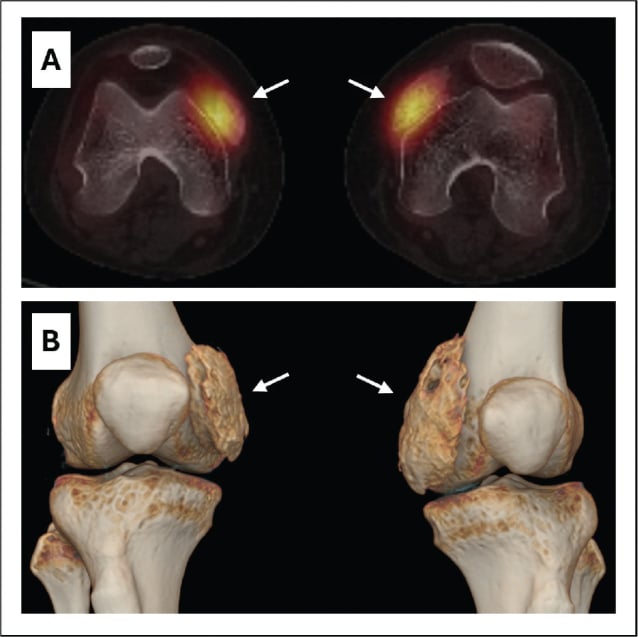
What the fusion adds. Co-registering the 3D uptake with CT anatomy localises it to a compartment or structure. Uptake in the patellofemoral compartment suggests patellar maltracking or patella button loosening; at the tibial tray, tibial loosening or tibial component malalignment; at the femoral component, femoral loosening. It can also be placed in specific soft tissue structures.
That localisation directly guides targeted revision. If SPECT-CT shows isolated patellofemoral uptake, an isolated patellar revision or lateral release may be appropriate rather than a full revision.
What the CT adds. The CT assesses component alignment (rotation, valgus/varus), implant position relative to the mechanical axis, osteolysis and cement mantle integrity. Read with the metabolic SPECT data, this gives a combined functional-anatomical assessment.
Timing. Normal periprosthetic uptake can persist for 1-2 years after surgery, so SPECT-CT at less than 2 years must be interpreted with caution.
How well it performs. A diagnostic-test-accuracy meta-analysis of 8 studies and 308 patients with painful non-infected knee arthroplasty found pooled sensitivity 0.86 (95% CI 0.75-0.93) and specificity 0.90 (95% CI 0.79-0.96), a positive likelihood ratio of 8.9, a negative likelihood ratio of 0.15 and an AUC of 0.94, with moderate GRADE certainty. SPECT-CT therefore performs well in both directions here: a positive scan meaningfully raises, and a negative scan meaningfully lowers, the probability of the suspected pain source.
The restriction to non-infected knees is load-bearing: the modality cannot reliably separate aseptic loosening from periprosthetic joint infection, and SPECT-CT does not replace an infection work-up (see the differential below).
PSFATKey Orthopaedic SPECT-CT Indications
Hook:PSFAT: the five key applications where SPECT-CT adds value beyond planar bone scan.
Guidelines, Registries & Global Practice
SPECT/CT is now a mainstream problem-solving tool in skeletal nuclear medicine worldwide, but it is not the first-line skeletal study anywhere — it is deployed selectively after a planar bone scan, radiograph or cross-sectional study leaves a specific question unanswered. There is no dedicated implant registry for an imaging test, so the evidence base is built from single-centre cohorts and the diagnostic-test-accuracy meta-analyses cited above rather than registry survivorship data.
Global Epidemiology and Demand Drivers
- Demand is driven by the rising prevalence of joint arthroplasty (the painful TKR/THR workup), an ageing degenerative spine population (facet and pseudarthrosis assessment) and youth sport (active spondylolysis).
- Approximately 10-20% of patients report persistent pain after total knee arthroplasty, generating a large referral pool in which SPECT/CT localises a source in the majority of non-infected cases.
- Tc-99m diphosphonate remains the universal bone tracer; access to SPECT/CT hardware, not tracer supply, is the main determinant of availability between regions.
Society Guidance, Side by Side
- Stance on SPECT/CT
- Procedure guidelines endorse SPECT/CT for bone imaging where anatomical localisation or attenuation correction adds value
- Practical Emphasis
- Standardised acquisition, low-dose CT protocols, attenuation correction around metalwork
- Stance on SPECT/CT
- Recognises SPECT/CT as adding localisation and specificity over planar and SPECT alone
- Practical Emphasis
- Appropriate-use framing — perform when it will change the report or management
- Stance on SPECT/CT
- Position SPECT/CT within the painful-arthroplasty and spine algorithms after infection has been excluded
- Practical Emphasis
- Aspiration and inflammatory markers first for the painful prosthesis; SPECT/CT for aseptic problem-solving
- Stance on SPECT/CT
- MRI and CT remain first-line for most musculoskeletal problems; nuclear medicine is adjunctive
- Practical Emphasis
- Reserve hybrid nuclear imaging for equivocal cases or metal-artifact-limited MRI
- Stance on SPECT/CT
- Favour low-radiation pathways (radiograph then MRI) in young athletes; SPECT/CT for activity grading when needed
- Practical Emphasis
- Minimise dose in adolescents; use SPECT only when healing potential must be established
High- vs Limited-Resource Practice Variation
- Well-resourced centres: Hybrid SPECT/CT cameras are standard; the question is appropriate use and dose optimisation, not access. Quantitative SPECT/CT and cadmium-zinc-telluride detectors are emerging to improve resolution and lower dose.
- Limited-resource settings: Many departments still run planar gamma cameras or stand-alone SPECT without an integrated CT. Here, planar bone scan plus separately acquired CT/MRI, or careful clinical-radiographic correlation, substitutes for hybrid imaging. The diagnostic question is the same; the answer is reached with less elegant co-registration and sometimes higher cumulative dose.
- Across all settings the governing principle is justification and optimisation (the ALARA principle): the additional CT dose must be offset by a genuine change in the report or management, exactly as the cited cohorts demonstrate.
Controversies & Areas of Uncertainty
Radiation dose justification. The added CT dose is a genuine concern in young athletes with spondylolysis, and several guidelines favour radiograph-then-MRI pathways first. The debate is where SPECT/CT sits in the algorithm against low-dose CT or MRI alone.
Septic versus aseptic loosening. Because SPECT/CT cannot reliably make this distinction, whether newer tracers, white-cell SPECT/CT or FDG-PET/CT should be preferred for suspected periprosthetic infection remains an active area, and practice varies with the available infrastructure.
Evidence quality. Much of the orthopaedic SPECT/CT literature is retrospective single-centre cohorts with modest specificity and no blinded outcome arm. The strongest data are diagnostic-test-accuracy meta-analyses for the painful knee; large prospective management-impact trials are still lacking.
Quantitative SPECT/CT and Emerging Technology
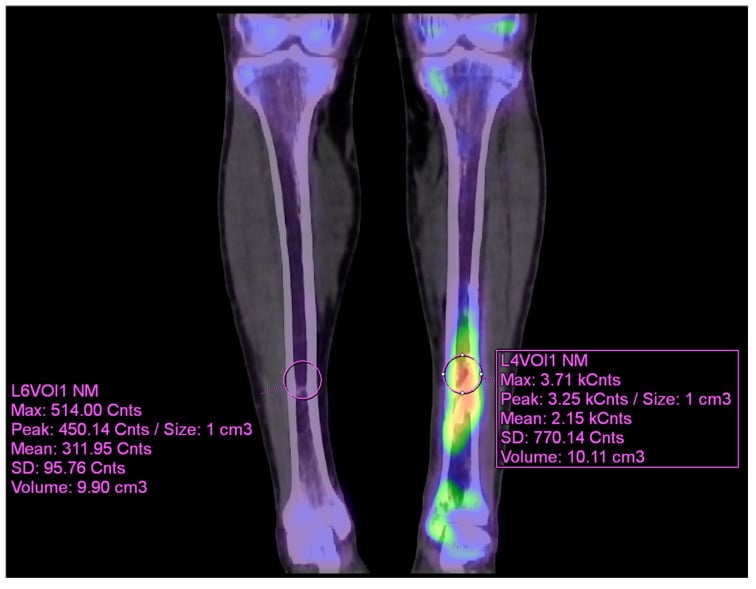
Most SPECT/CT reporting remains semi-quantitative: a visual, colour-coded grade that depends on the observer and cannot be compared reliably between scanners or centres. Two developments aim to make the metabolic signal an objective, reproducible number, and both are increasingly examinable as "where is this field going?".
- What it provides
- Visual colour-coded uptake score (e.g. the Hirschmann 0 to 10 scale)
- Limitation
- Observer-dependent and not comparable across machines or over time
- What it provides
- CT-based attenuation and scatter correction plus calibration give absolute uptake metrics (SUV-like values), enabling objective thresholds and serial comparison
- Limitation
- No cross-vendor standardisation of thresholds yet, so reproducibility between centres is limited
- What it provides
- Replace conventional sodium-iodide crystals with direct-conversion detectors, giving better energy and spatial resolution, higher count sensitivity, and the option of lower dose or faster scans
- Limitation
- Newer, more expensive hardware with less long-term skeletal validation
Together these move SPECT/CT toward the kind of objective, reproducible quantification that PET already offers. That would strengthen serial follow-up, for example tracking the activity of a fusion mass or a stress lesion, and reduce inter-observer variability.
Quantitative SPECT/CT values are promising but vendor- and protocol-dependent; there is no agreed numerical cut-off for "abnormal" bone-tracer uptake. Treat any absolute SUV-like figure as centre-specific, and continue to interpret it alongside the CT appearance, the clinical question and the postoperative timeline rather than as a stand-alone diagnostic number.
Clinical Decision Scenarios
Practise clinical reasoning and management decisions out loud
“A 55-year-old patient presents with anterior knee pain 3 years after total knee replacement. A planar bone scan shows diffuse periarticular uptake around the TKR. You are asked about the role of SPECT-CT.”
“A 16-year-old cricket fast bowler presents with persistent low back pain. MRI shows bilateral pars defects at L5 but is equivocal for marrow oedema. How would SPECT-CT help?”
“An examiner asks you to compare SPECT-CT, PET-CT, and planar bone scan for orthopaedic applications.”
SPECT-CT Basics
- SPECT: 3D nuclear medicine data (rotating gamma camera)
- CT: anatomical co-registration + attenuation correction
- Fusion: precise localisation of metabolic activity to anatomy
- Changes diagnosis in approximately 30% of cases over planar scan
Key Indications (PSFAT)
- Painful prosthesis (TKR compartmental localisation)
- Spinal fusion (solid vs pseudarthrosis)
- Facet joint disease (identifies the pain-generating level)
- Arthritis (patellofemoral vs tibiofemoral compartment)
- Tarsal/carpal pathology (specific bone localisation)
Painful TKR Workup
- Normal postoperative uptake resolves by 1-2 years
- SPECT-CT localises to patellofemoral vs tibiofemoral compartment
- CT assesses alignment, osteolysis, cement mantle
- CANNOT exclude infection — always aspirate the joint
Spondylolysis Assessment
- SPECT active = healable with bracing (sensitivity 97%)
- SPECT inactive = established non-union (bracing unlikely to heal)
- CT shows structural defect status (gap, sclerosis, callus)
- Critical for management decisions in young athletes
Comparison with Other Modalities
- Planar bone scan: 2D screening (whole-body, cheap, low dose)
- SPECT-CT: 3D problem-solver (regional, moderate dose)
- PET-CT: comprehensive stager (highest resolution, highest dose, detects lytic)
Evidence Base
SPECT/CT for the Painful Non-Infected Knee Arthroplasty (Meta-analysis)
- Pooled across 8 studies and 308 patients, SPECT/CT had a pooled sensitivity of 0.86 (95% CI 0.75-0.93) and specificity of 0.90 (95% CI 0.79-0.96) for identifying the source of pain in non-infected painful knee arthroplasty.
- Pooled positive likelihood ratio was 8.9 and negative likelihood ratio 0.15, with an area under the curve of 0.94 and diagnostic odds ratio of 57.
- SPECT/CT accurately identified loosening, patellofemoral overloading, instability, and component malalignment; GRADE certainty of evidence was moderate (level III).
Standardised SPECT/CT Algorithm for Painful TKA
- Introduced a standardised SPECT/CT localisation scheme of 9 tibial, 9 femoral and 4 patellar regions, piloted in 18 consecutive patients with pain after TKA.
- The scheme demonstrated very high inter- and intra-observer reliability for both anatomical localisation and tracer-activity grading.
- Median inter-observer difference for tibial and femoral component alignment measurement was less than 3 degrees, combining metabolic (tracer) and biomechanical (CT alignment) data.
SPECT-CT reliably localises and characterises the source of pain after arthroplasty.