3D Printing in Orthopaedics: Oncology, Trauma and Custom Implants
3D printing in orthopaedics: planning models, patient-specific guides and custom implants in tumour, trauma and revision surgery, with the evidence and rules.
By OrthoVellum Editorial TeamPublished Updated 14 min read
Educational content for clinicians, not medical advice. Editorial policy

Key points
- Orthopaedic 3D printing makes four things: anatomical models, patient-specific guides, custom implants and experimental scaffolds. Only the first three are in clinical use.
- Printed models shorten trauma operations and cut blood loss and fluoroscopy, but better reduction quality has not been shown.
- Patient-specific guides help where the unaided task is unreliable (pelvic tumour cuts, scoliotic pedicles) and add nothing measurable in routine knee replacement.
- Custom printed implants make otherwise impossible pelvic and acetabular reconstructions possible, but the evidence is case series and complication rates are high.
- Regulators separate custom-made devices (one prescription, one patient) from patient-matched devices made within a validated design envelope, and most printed guides and plates are the latter.
On this page11 sections
3D printing in orthopaedics earns its place in the cases that standard implants and instruments handle worst: a periacetabular sarcoma, a both-column acetabular fracture, a pelvis left with no host bone for a revision cup. The question for a surgeon is not whether the technology works but where it changes the result. The short answer is that it helps most where the unaided task is unreliable and the anatomy is unusual, and least where conventional instruments already do the job. The 3D printing from imaging topic page covers the technical detail; this article sets out the evidence and the regulation behind each use.
What does a printer make for an orthopaedic surgeon?
A review by Wong and colleagues sorts orthopaedic additive manufacturing into four uses, and they differ in clinical maturity and in how they are regulated.
| Use | What it is | Typical setting | Clinical maturity |
|---|---|---|---|
| Anatomical model | A 1:1 printed bone, often with fragments separated | Pelvic and acetabular fractures, deformity, tumour planning | Routine in many units |
| Patient-specific instrument (PSI) | A cutting or drill guide that fits one patient's bone | Tumour resection, corrective osteotomy, pedicle screws, knee replacement | Established; benefit depends on the task |
| Custom implant | A metal implant designed from the patient's CT | Pelvic tumour reconstruction, massive acetabular bone loss, segmental defects | Case series only |
| Scaffold or bioprinted construct | A porous or cell-laden construct meant to regenerate tissue | Bone and cartilage defects | Largely experimental |
The fourth category is covered in our piece on 3D bioprinting for cartilage repair. The rest of this article is about the first three.
From CT to part: the workflow
The printer is the last step. Most failures come earlier, in imaging and segmentation.
Imaging. Thin-slice CT, under 1 mm, is the source for bone. A metal artefact reduction protocol is needed when hardware is present, because streak artefact around old metalwork degrades segmentation and manual editing cannot fully recover it. In tumour work, contrast MRI defines the soft-tissue extent of the tumour and is fused with the CT bone model so the cut planes can be set relative to both. Scan in a position that matches the operation where it matters: a pelvis scanned supine is not the same shape relationship as the lumbosacral junction in a prone patient.
Segmentation and design. DICOM data are segmented, usually by Hounsfield thresholding with manual clean-up, then exported as a surface mesh (STL) and edited in CAD. This is the virtual planning session, where the surgeon and engineer set resection planes, mirror the uninjured side as a template for a malunion, plan screw corridors away from the sciatic notch and obturator canal, and design the bone-implant interface. Slicing software then turns the model into layers and machine instructions.
Printing and post-processing. The technology follows the job.
| Technology | Mechanism | Usual orthopaedic use |
|---|---|---|
| Fused deposition modelling (FDM) | Extruded thermoplastic filament | Low-cost planning and teaching models |
| Stereolithography (SLA) | UV-cured liquid resin | High-detail models, guides in biocompatible resin |
| Selective laser sintering (SLS) | Laser-fused polymer powder, usually nylon | Durable, sterilisable cutting guides |
| Laser powder bed fusion (DMLS/SLM) | Laser-melted metal powder | Titanium and cobalt-chrome implants |
| Electron beam melting (EBM) | Electron beam melts metal powder in a vacuum | Porous titanium implants |
Metal parts need heat treatment to relieve residual stress, removal of unmelted powder from the lattice, and machining of any bearing or taper surface. Every guide and implant should be checked against the source imaging before use; the site topic page notes that printed models typically match source CT to within 0.5 to 1 mm, but there is no universal validation standard.
Do printed models help in fracture surgery?
They make operations faster. Whether they make reductions better is not yet shown.
A 2020 meta-analysis (opens in a new tab) from Imperial College pooled 17 studies and 922 patients across orthopaedic trauma. Printed models used in pre-operative planning were associated with a 19.85% reduction in operating time, a 25.73% reduction in blood loss and 23.80% fewer fluoroscopy shots. A 2026 meta-analysis restricted to randomised trials (opens in a new tab) (16 RCTs, 881 patients; tibial plateau, ankle, calcaneus, elbow and wrist) found the same direction: operating time shorter by about 8 to 19 minutes depending on region, less blood loss and less fluoroscopy, with no difference in complications. That second analysis pooled 3D printing with on-screen virtual planning, so it does not isolate the printed model.
The acetabular fracture data are where the case is strongest and also where the limits show. In a comparative study of 22 patients (opens in a new tab), the printed-model group had shorter operations, less blood loss and fewer radiographs (all p < 0.01), and 8 of 10 reductions were good against 6 of 12 without a model, a difference not reported as statistically significant. Process outcomes such as time, blood loss and fluoroscopy are the ones most open to learning-curve and unblinded effects.
What the model gives in practice:
- Pre-contoured plates. Plates bent on a sterilised model of the fracture, or of the mirrored uninjured hemipelvis, before the patient is in theatre.
- A rehearsed reduction. The sequence of fragment manipulation, provisional wires and screw corridors planned in the hand.
- Spatial understanding of column involvement that a screen rendering does not give everyone equally.
Where do patient-specific guides help?
A guide is a pre-operative plan in plastic. It cannot be adjusted on the table and gives no feedback once seated. The evidence across specialties fits one rule: a guide helps when the unaided task has a real error rate, and when accuracy is itself the outcome rather than a surrogate.
Knee replacement: no clinical benefit. In a randomised trial of 128 patients (opens in a new tab) in Belgium, guides gave similar coronal outliers to conventional instruments (25% vs 28%), more tibial coronal (15% vs 3%) and sagittal (21% vs 3%) outliers, and were abandoned in 22% and modified in 28% of cases. A meta-analysis of 43 randomised trials (opens in a new tab) (1,816 PSI and 1,887 conventional knees) found no clinically relevant difference in efficacy or safety. Early trials favoured PSI and later ones did not, the usual pattern of an over-optimistic early literature. Guides keep a role where the canal cannot be used: retained hardware, a malunion, extra-articular deformity. For alignment in routine knees, robotic arthroplasty and navigation allow correction during the operation, which a guide does not.
Pedicle screws in scoliosis: better than freehand. A meta-analysis of seven studies (opens in a new tab) (229 children and adolescents, 2,805 screws) found printed templates more accurate than freehand placement (OR 2.96, 95% CI 2.24 to 3.91) with fewer complications (OR 0.21, 95% CI 0.06 to 0.78). The comparator was freehand, not navigation, and the templates need a pre-operative CT of the instrumented spine.
Pelvic tumour resection: accurate cuts in a hard place. Freehand osteotomies in the pelvis are difficult because of the complex geometry, poor visibility and restricted space. In a simulation with 24 surgeons (opens in a new tab) cutting a periacetabular tumour model with a planned 10 mm margin, guided cuts landed on average 1 to 1.2 mm from target in the ilium, 2 mm in the pubis and 3.7 mm in the ischium, with no intralesional cut and no difference between senior and junior surgeons. In a clinical series (opens in a new tab) of 11 pelvic tumours, every bone margin was tumour-free and the mean cut-plane error was 2.5 mm.
A 2023 systematic review (opens in a new tab) of 81 papers compared guides with intraoperative navigation in bone tumour surgery:
| Measure | Patient-specific guides | Surgical navigation |
|---|---|---|
| Positive margin rate | 0-19% (both techniques) | 0-19% (both techniques) |
| Bone-cut error | 0.3-4 mm (both) | 0.3-4 mm (both) |
| Planning and production time | 2-4 weeks | No manufacturing wait; preferred in urgent cases |
| Intraoperative time to use | 1-5 min | 15-65 min |
| Second check during the cut | No | Yes |
Both did better than freehand resection, and a planned bone margin of at least 5 mm was safe. Long osteotomies, smooth uniform bone surfaces and tight working spaces reduced the accuracy of both.
The fit test. A guide that rocks, toggles or does not sit flush has soft tissue under it or was designed from a flawed segmentation. Do not cut through it. The trade-off is biological: seating a guide needs a bare bony footprint, and every centimetre of periosteum stripped to expose it costs blood supply in a bed that may already be irradiated or injured.
Custom implants in orthopaedic oncology
The pelvis is where custom printed implants have found their main tumour role, because no catalogue implant fits a periacetabular resection well. Enneking and Dunham described the resection types in 1978 (opens in a new tab) as iliac wing, periacetabular and pubic; a sacral type IV was added later. The site's internal hemipelvectomy and limb salvage pages carry the full reconstruction ladder.
| Type | Region | Usual reconstruction | Where printing comes in |
|---|---|---|---|
| I | Ilium | Often none; iliosacral fixation if the ring is discontinuous | Guides for the supra-acetabular cut |
| II | Periacetabular | Hip transposition, ice-cream-cone prosthesis, allograft composite, arthrodesis, or a custom hemipelvis | Custom hemipelvic endoprosthesis with matching guides |
| III | Pubis and ischium | Usually no skeletal reconstruction | Guides to protect the obturator bundle and margin |
| IV | Sacral extension | Spinopelvic fixation if the posterior ring is lost | Custom sacral and hemipelvic constructs in specialist centres |
The published series are from single high-volume centres and are Level IV. From Peking University People's Hospital:
- Liang 2017 (opens in a new tab): 35 patients, mean follow-up 20.5 months. Margins were wide in 15, marginal in 14 and intralesional in 6. Seven had delayed wound healing, two dislocated, none had deep infection.
- Ji 2020 (opens in a new tab): 80 consecutive EBM-printed modular hemipelvic prostheses, median follow-up 32.5 months. No acetabular instability or aseptic loosening was seen; deep infection occurred in 6.3%, dislocation in 2.5%, local recurrence in 11.3%, and the mean MSTS score was 83.9%. Two specimens retrieved after recurrence showed bone growing into the porous metal.
Two limits matter more than the implant. The margin decides survival: an elegant reconstruction after a contaminated margin is an oncological failure. And the implant is designed weeks before the operation, so it cannot adapt if frozen sections or findings move the resection. Lead time also depends on the tumour. Osteosarcoma has a natural planning window, because neoadjuvant chemotherapy runs for 8 to 12 weeks. Chondrosarcoma is resistant to chemotherapy and radiotherapy and goes straight to surgery, so a custom build adds weeks of delay. Limb salvage does not require a custom implant: hip transposition and resection without reconstruction remain reasonable choices, especially where infection risk or resources argue against a large implant.
Printed long-bone tumour prostheses add porous collars and soft-tissue attachment features that may reproduce some advantages of an allograft-prosthetic composite without the allograft risks, but comparative data are immature.
Custom implants in revision hip surgery
The custom triflange acetabular component is the established use outside oncology: a CT-designed porous shell with iliac, ischial and pubic flanges for Paprosky IIIB loss and chronic pelvic discontinuity, when a jumbo cup, augments, a cage or a cup-cage cannot get durable fixation. A 2019 systematic review (opens in a new tab) of 17 studies and 579 components reported 82.7% all-cause revision-free survivorship and an overall complication rate of 29%, led by dislocation (11%) and infection (6.2%), with nerve injury in 3.8% and aseptic loosening in 1.7%. Fixation is rarely the problem; instability and infection are.
Trauma reconstruction and segmental defects
Acute fractures rarely get custom implants because of the lead time. Printing is used later: for malunion correction with mirrored templates and combined cutting and reduction guides, and for segmental bone loss after open fractures, ballistic injury or failed fixation. Custom porous titanium cages and total talus replacements for talar avascular necrosis appear in case series from Duke (opens in a new tab), whose authors declared stock options in implant companies. The evidence is case reports and small series; for large defects the established options remain the induced membrane technique and bone transport.
Why print metal? Porous titanium
The FDA (opens in a new tab) names the two advantages of additive manufacturing: devices matched to the patient's own imaging, and engineered porous structures and internal channels that conventional machining cannot produce. It names the matching problem too: the layer-wise process and limited clinical history make the finished device harder to characterise and validate.
Stiffness. Solid titanium alloy has an elastic modulus of about 110 GPa against roughly 15 to 20 GPa for cortical bone. A stiff implant carries load the bone would otherwise carry, and the bone resorbs (stress shielding). A printed lattice lowers the effective modulus towards bone and can vary porosity within one part.
Ingrowth. Interconnected pores of roughly 300 to 700 µm allow bone to grow in. In a rabbit study of laser-melted titanium (opens in a new tab) at 65% porosity, 600 µm pores gave the best fixation at 2 weeks, and 300 µm pores had less ingrowth at 4 weeks than 600 or 900 µm.
Both advantages rest on bench and animal data. No trial has shown that a printed lattice implant outperforms a conventional porous implant in patients, and custom printed implants are poorly captured by national joint registries, so long-term survivorship evidence is fragmented. Printed cobalt-chrome exists but has no long-term registry data. PEEK, at about 3 to 4 GPa, is radiolucent and closer to bone in stiffness, but it is bioinert: in interbody cages titanium fuses more reliably, which is why titanium-coated PEEK exists. Carbon-fibre-reinforced PEEK is also radiolucent, which matters where follow-up imaging must stay readable.
Regulation: custom-made or patient-matched?
The key regulatory distinction is between a device made to one clinician's prescription for one patient and a device designed by a manufacturer within limits it has already validated. Most printed guides and plates fall in the second group.
| Jurisdiction | Custom-made route | Patient-matched route |
|---|---|---|
| United States | Custom device exemption (opens in a new tab), section 520(b), tightened by FDASIA from July 2012: no more than five new units of a device type per year, with an annual report to FDA | The December 2017 additive manufacturing guidance (opens in a new tab) says patient-matched devices are produced within a predefined design envelope, are not custom devices unless they meet all of 520(b), and mostly follow the usual pathway for that device type |
| European Union | MDR 2017/745 (opens in a new tab) Article 2(3): made to a written prescription for the sole use of a particular patient. Article 52(8): an Annex XIII statement, and class III custom-made implants also need notified-body assessment of the quality system | MDCG 2021-3 (opens in a new tab) lists 3D-printed fracture plates built from a template and the patient's DICOM, and printed knee or pedicle cutting guides, as patient-matched: not custom-made, so the standard MDR pathway applies |
| Great Britain | UK MDR 2002 (opens in a new tab) regulation 5(1), with "joint replacement implants designed for a specific individual" given as an example. No UKCA mark or approved body; class IIa, IIb and III custom devices carry a statement the patient can request | Mass-produced devices adapted for one patient are not custom-made |
| Australia | Custom-made devices remain exempt from ARTG inclusion, subject to conditions | The TGA's personalised medical devices framework (opens in a new tab) took effect on 25 February 2021; patient-matched devices must be on the ARTG once the transition ends on 1 July 2029. TGA's own worked example is a patient-matched acetabular cage |
Hospital printing. When a hospital prints a guide and takes it into the sterile field, it is manufacturing a medical device. In the EU, Article 5(5) of the MDR exempts devices made and used within a health institution from most of the Regulation under conditions that include: they are not transferred to another legal entity, are made under an appropriate quality management system, meet the Annex I safety and performance requirements, and the institution documents why no equivalent device on the market meets the patient group's needs and publishes a declaration. In the US, the FDA's December 2021 discussion paper (opens in a new tab) on point-of-care printing set out possible oversight models for comment; FDA stated that the paper was not guidance. Whatever the jurisdiction, printing a model on a home printer and bringing it into theatre without institutional approval, a validated sterilisation process for that material, and traceability from scan to part is a medico-legal risk.
The limits
- Cost. A systematic review of 227 surgical papers (opens in a new tab) found that printing and the extra scans generally increase the cost of a procedure, and called for formal cost-effectiveness analysis that is still largely missing.
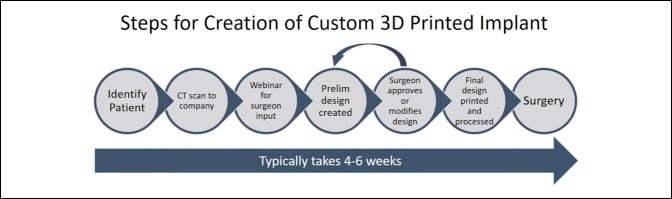
- Time. Four to six weeks for a custom implant; two to four weeks for tumour guides.
- A frozen plan. The CT is a snapshot. Tumour growth or a pathological fracture during manufacture can make a guide or implant unusable.
- Evidence quality. Trauma data are process outcomes from small, mostly unblinded studies; implant data are single-centre case series with short follow-up.
Where it is heading
Point-of-care laboratories are spreading for models and guides, while implants remain largely with certified manufacturers. Bioprinting of bone and cartilage is still pre-clinical, held back by vascularity, cell survival and load-bearing strength. The same discipline applies to printing as to artificial intelligence in orthopaedic surgery and other planning tools: ask whether the unaided task is unreliable, and whether the accuracy gained is the outcome or a surrogate for it. Where both answers are yes, printing earns its cost.
Frequently asked questions
What is the difference between a custom-made and a patient-matched implant?
A custom-made device is made to a clinician's written prescription for the sole use of one patient. A patient-matched device is designed by the manufacturer from the patient's imaging, but within a validated design envelope and a reproducible process. EU guidance lists 3D-printed fracture plates and knee or pedicle cutting guides as patient-matched, so they follow the standard conformity route rather than the custom-made exemption.
Do patient-specific cutting guides improve total knee replacement?
Not in routine primary knees. A meta-analysis of 43 randomised trials and 3,703 knees found no clinically relevant difference in efficacy or safety, and early trials favoured guides while later ones did not. In a Belgian randomised trial, guides were abandoned in 22% of cases. They remain useful where the canal cannot be used, such as retained hardware or extra-articular deformity.
How long does a custom 3D-printed implant take to make?
Allow weeks, not days. A JAAOS review gives four to six weeks from CT to surgery for a custom implant, covering design review, surgeon approval, printing and post-processing. A systematic review of bone tumour surgery puts guide planning and production at two to four weeks. That rules out acute fracture fixation and matters in tumours that are operated on first.
References
- Morgan C, Khatri C, Hanna SA, Ashrafian H, Sarraf KM. Use of three-dimensional printing in preoperative planning in orthopaedic trauma surgery: a systematic review and meta-analysis. World J Orthop 2020;11(1):57-67. DOI (opens in a new tab)
- Hinloopen JH, Puijk R, Nolte PA, et al. The efficacy and safety of patient-specific instrumentation in primary total knee replacement: a systematic review and meta-analysis. Expert Rev Med Devices 2023;20(3):245-252. DOI (opens in a new tab)
- Victor J, Dujardin J, Vandenneucker H, Arnout N, Bellemans J. Patient-specific guides do not improve accuracy in total knee arthroplasty: a prospective randomized controlled trial. Clin Orthop Relat Res 2014;472(1):263-271. DOI (opens in a new tab)
- Lu C, Ma L, Wang X, et al. Comparison of 3D-printed navigation template-assisted pedicle screws versus freehand screws for scoliosis in children and adolescents: a systematic review and meta-analysis. J Neurol Surg A Cent Eur Neurosurg 2023;84(2):188-197. DOI (opens in a new tab)
- Bruschi A, Donati DM, Di Bella C. What to choose in bone tumour resections? Patient specific instrumentation versus surgical navigation: a systematic review. J Bone Oncol 2023;42:100503. DOI (opens in a new tab)
- Gouin F, Paul L, Odri GA, Cartiaux O. Computer-assisted planning and patient-specific instruments for bone tumor resection within the pelvis: a series of 11 patients. Sarcoma 2014;2014:842709. DOI (opens in a new tab)
- Enneking WF, Dunham WK. Resection and reconstruction for primary neoplasms involving the innominate bone. J Bone Joint Surg Am 1978;60(6):731-746. PubMed (opens in a new tab)
- Liang H, Ji T, Zhang Y, Wang Y, Guo W. Reconstruction with 3D-printed pelvic endoprostheses after resection of a pelvic tumour. Bone Joint J 2017;99-B(2):267-275. DOI (opens in a new tab)
- Ji T, Yang Y, Tang X, et al. 3D-printed modular hemipelvic endoprosthetic reconstruction following periacetabular tumor resection: early results of 80 consecutive cases. J Bone Joint Surg Am 2020;102(17):1530-1541. DOI (opens in a new tab)
- De Martino I, Strigelli V, Cacciola G, et al. Survivorship and clinical outcomes of custom triflange acetabular components in revision total hip arthroplasty: a systematic review. J Arthroplasty 2019;34(10):2511-2518. DOI (opens in a new tab)
- Taniguchi N, Fujibayashi S, Takemoto M, et al. Effect of pore size on bone ingrowth into porous titanium implants fabricated by additive manufacturing: an in vivo experiment. Mater Sci Eng C Mater Biol Appl 2016;59:690-701. DOI (opens in a new tab)
- Tack P, Victor J, Gemmel P, Annemans L. 3D-printing techniques in a medical setting: a systematic literature review. Biomed Eng Online 2016;15(1):115. DOI (opens in a new tab)
Study the full topic
Share this article
Cite this article
OrthoVellum Editorial Team. 3D Printing in Orthopaedics: Oncology, Trauma and Custom Implants [Internet]. OrthoVellum; 2025 Jan 6 [updated 2026 Oct 2; cited 2026 Oct 3]. Available from: https://www.orthovellum.com/blog/3d-printing-orthopaedic-oncology-trauma
About this content
Prepared by the OrthoVellum Editorial Team from cited sources, under our editorial policy.
For education and exam preparation; not medical advice or a substitute for clinical judgement and local guidance.
Spotted an error? Tell us; every report is read.
Get new articles by email
New clinical explainers, landmark-trial summaries and exam guidance from the OrthoVellum blog. No account needed; unsubscribe from any email.