Adolescent with hip and knee pain — what's the call?
OrthoVellum Editorial · 1mo ago
The case
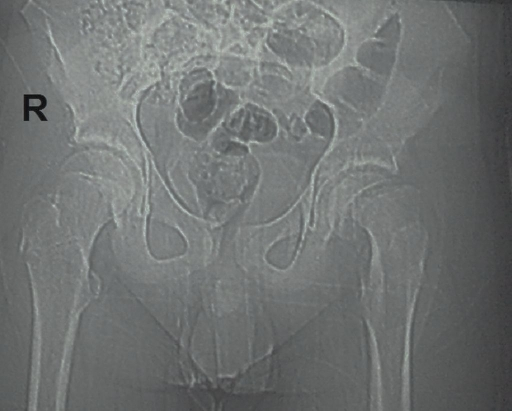
An overweight 12-year-old has a few weeks of hip and referred knee pain with a limp, and now stands with the leg slightly externally rotated. This is the AP pelvis. What is the diagnosis, which view best confirms it, and what is the immediate management?
Reveal the model answertap to expand
Slipped capital femoral epiphysis (SCFE). On the AP, draw Klein's line along the superior border of the femoral neck — it should intersect the lateral capital epiphysis; in SCFE it does not, and the physis looks widened and irregular. A frog-leg lateral best demonstrates the posterior slip. This is urgent: make the child strictly non-weight-bearing and refer for prompt in-situ percutaneous screw fixation. Do not attempt a forceful reduction (avascular necrosis risk), and consider the contralateral hip in younger or at-risk patients.
- Klein's line should cross the capital epiphysis — if it does not, suspect SCFE
- Frog-leg lateral is the most sensitive plain view
- Treat urgently with in-situ fixation; avoid forceful reduction
- Examine the hip in any child presenting with knee pain
Discussion (0)
No comments yet — be the first to weigh in.