upper limb
Post-Traumatic Elbow Stiffness
intermediate
6 min
28 marks
6 questions
Clinical Scenario
A 35-year-old right-hand dominant female presents 6 months after ORIF of a left radial head fracture (Mason II). She complains of progressive elbow stiffness affecting her work as a hair stylist. Examination reveals flexion to 100° and extension deficit of 40°. Supination is 60° and pronation 70°. There is no instability and neurovascular examination is normal.
CT scan and radiographs are provided.
CT scan and radiographs are provided.
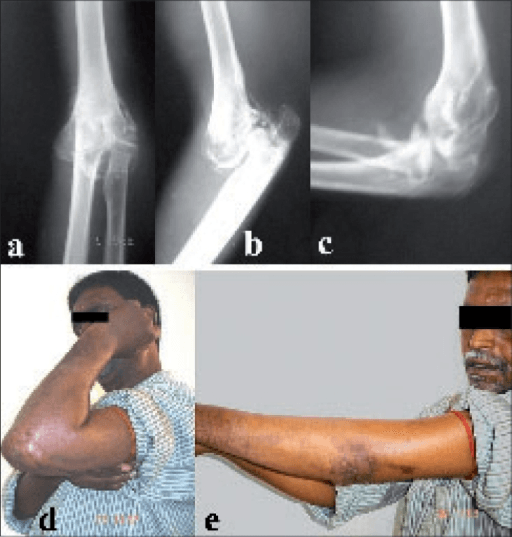
Clinical image for Post-Traumatic Elbow Stiffness
Image source: Open Access medical literature (NIH/PubMed Central) • CC-BY License
Questions
Question 1 (4 marks)
Define elbow stiffness. What are the functional range requirements and causes of post-traumatic stiffness?
Question 2 (5 marks)
Describe your clinical assessment of an elbow with post-traumatic stiffness. How do you classify the type of contracture?
Question 3 (6 marks)
What imaging is required? How do you plan surgical intervention based on imaging findings?
Question 4 (5 marks)
What are the non-operative treatment options? What are the indications for surgical release?
Question 5 (4 marks)
Describe the surgical techniques for elbow contracture release.
Question 6 (4 marks)
What are the complications and expected outcomes of surgical contracture release?