upper limb
Terrible Triad of the Elbow
advanced
6 min
28 marks
6 questions
Clinical Scenario
A 45-year-old right-hand dominant male presents after falling from a ladder onto his outstretched right hand. He has significant elbow swelling, pain, and inability to move his elbow. Examination reveals gross instability. Neurovascular examination shows intact radial, median, and ulnar nerve function with palpable pulses.
Elbow radiographs and CT scan are provided.
Elbow radiographs and CT scan are provided.
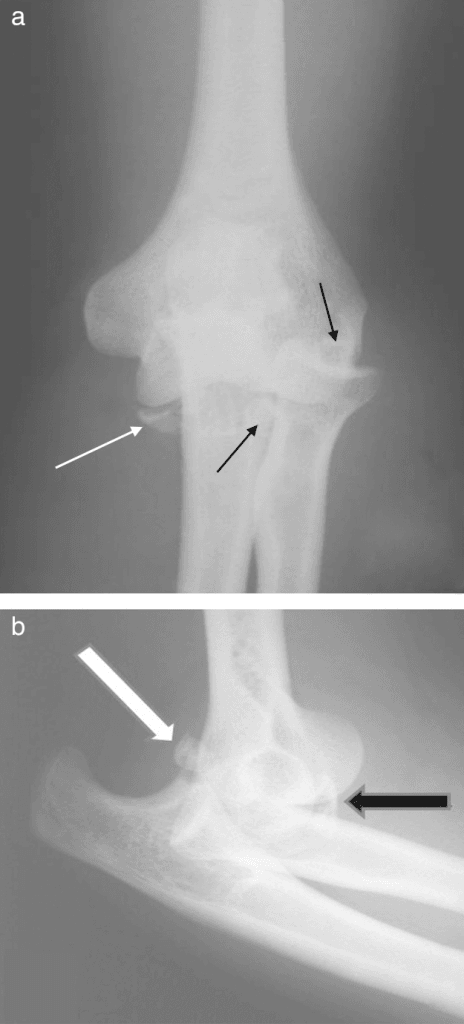
Clinical image for Terrible Triad of the Elbow
Image source: Open Access medical literature (NIH/PubMed Central) • CC-BY License
Questions
Question 1 (4 marks)
Define the terrible triad of the elbow. Describe the anatomy of elbow stability and the structures involved.
Question 2 (5 marks)
Describe the classification systems for radial head fractures and coronoid fractures. How do these guide treatment?
Question 3 (6 marks)
What is your surgical strategy for this injury? Describe the sequence of reconstruction.
Question 4 (5 marks)
Describe the surgical approaches and techniques for radial head and coronoid fixation.
Question 5 (4 marks)
When would you consider radial head replacement? What are the technical considerations?
Question 6 (4 marks)
What are the complications and expected outcomes of terrible triad injuries?