Pediatric Forearm | Ulnar Fracture + Radial Head Dislocation | Bado Classification | Missed Diagnosis Risk
- Definition: Fracture of the ulna (proximal third usually) with dislocation of the radial head
- Missed Diagnosis: High rate of missed diagnosis (up to 50%) - always check radiocapitellar line in ALL forearm fractures
- Radiocapitellar Line: draw it through the radial neck shaft — reliable on the TRUE LATERAL, but in normal children under about 4 it misses the capitellum on the AP in most cases, so never diagnose or exclude on an AP alone
- Plastic Deformation: Ulnar fracture may be subtle plastic deformation (bowing) only - requires reduction to reduce radial head
- Nerve Injury: Posterior Interosseous Nerve (PIN) most commonly injured (neurapraxia)
- “MUGR: Monteggia (Ulna # / Radial Head dislocation), Galeazzi (Radius # / DRUJ dislocation)
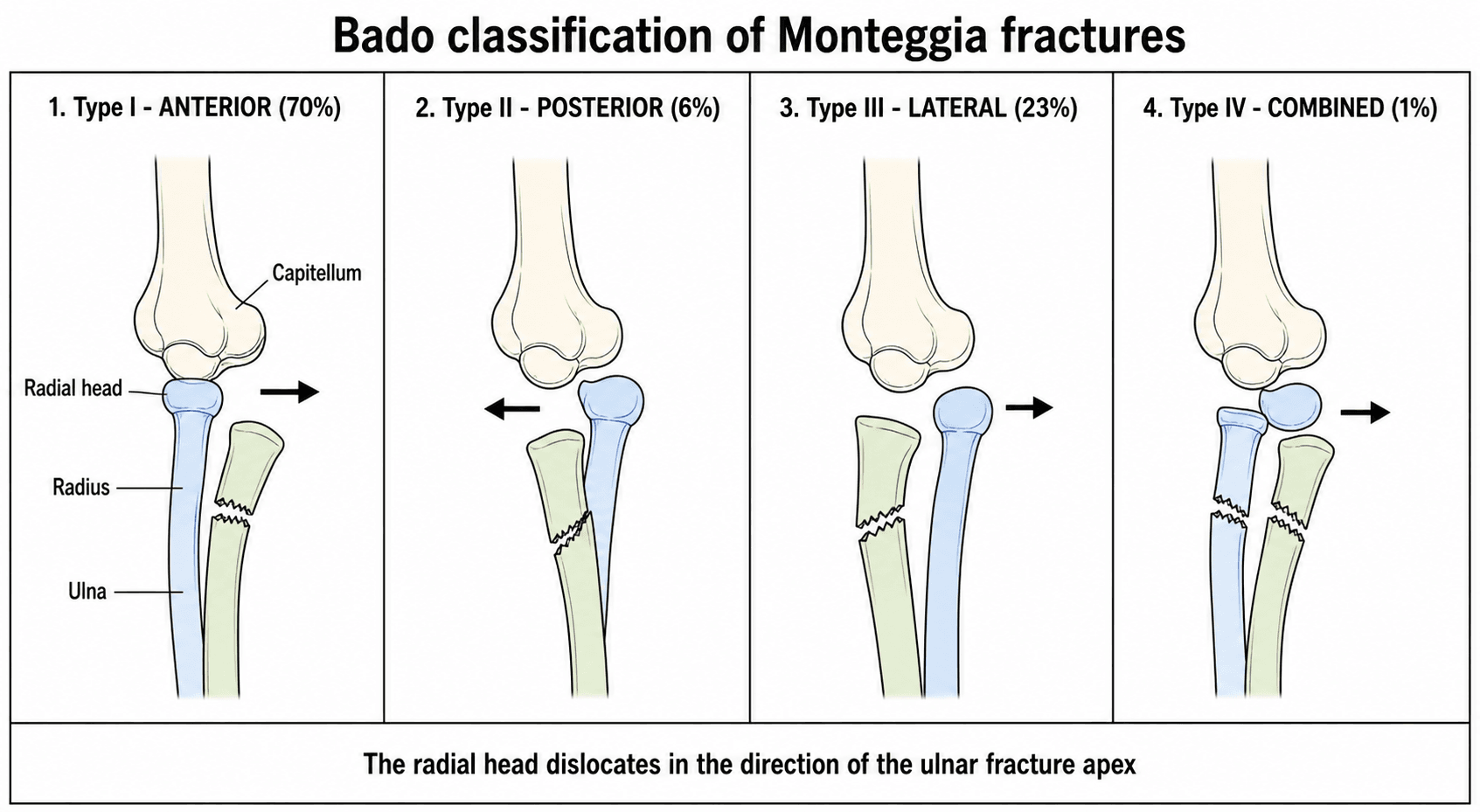
- “Radial head points to the direction of the ulnar fracture apex (and creates the Bado type)
- “If ulnar length is not restored, radial head will not reduce/stay reduced
- “In chronic missed cases, ulnar osteotomy is required to lengthen ulna and reduce head
Overview and Epidemiology
The adult injury, where open reduction and plate fixation of the ulna is the rule rather than the exception, is developed in Monteggia fractures; the mirror-image lesion in Galeazzi fractures.
The lesion. A Monteggia fracture-dislocation is a fracture of the ulnar shaft with dislocation of the radial head at the radiocapitellar joint. Giovanni Monteggia described it in 1814; Bado classified it in 1967.
Who. A rare injury, less than 2% of paediatric forearm fractures, with a peak age of 4-10 years. It is often associated with high-energy trauma but can occur from a simple fall, and Bado Type I (anterior) is by far the most common pattern in children.
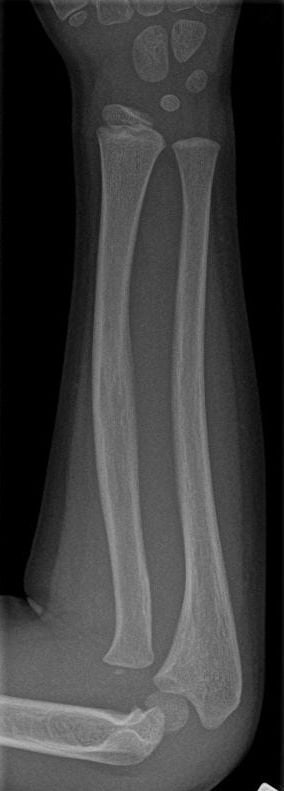
Why it is missed. In a child the ulnar injury is not always a clean break: it often presents as plastic deformation, a bow in the ulna with no fracture line. A radial head cannot dislocate without ulnar pathology or an annular ligament rupture, which is rare in isolation, so if you see a dislocated head with no obvious ulnar fracture lines, look for bowing. Up to 50% are missed at the first presentation, and the missed paediatric Monteggia is the most common malpractice case in paediatric orthopaedics, one of the most frequently missed and most litigated childhood injuries.
Any "isolated" ulnar shaft fracture must have the elbow (radiocapitellar line) and the wrist (DRUJ) checked meticulously, and where there is no frank fracture the ulna must be examined for plastic bowing.
Pathophysiology and Mechanisms
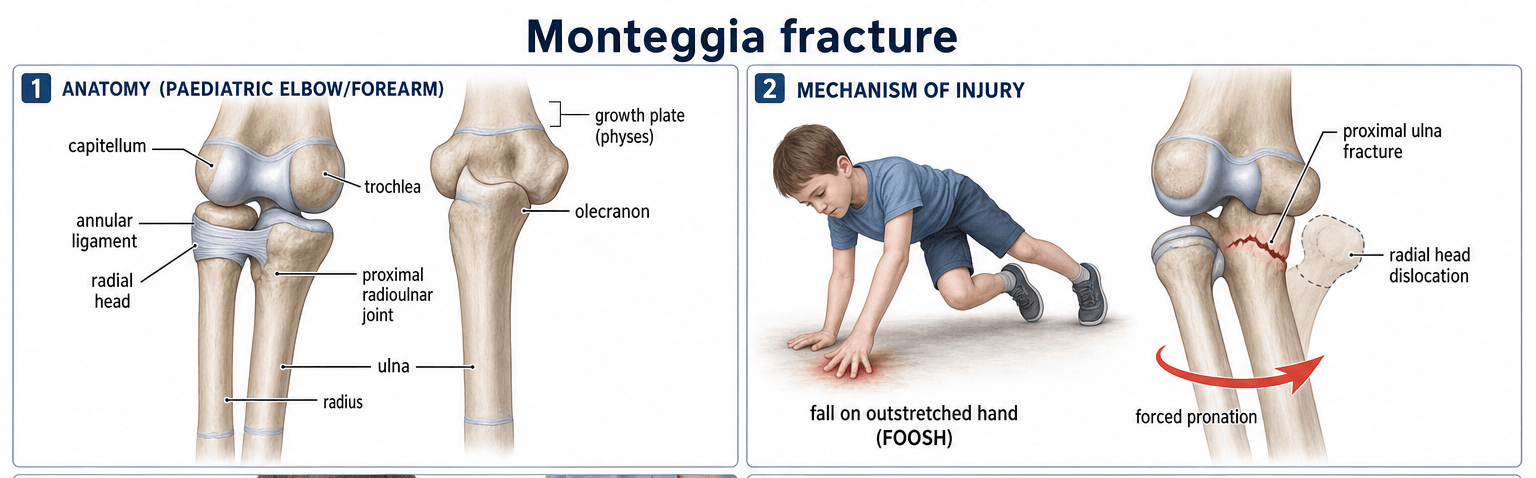
Mechanism. A fall on the outstretched hand with forced pronation transmits force through the interosseous membrane to fracture the proximal ulna and dislocate the radial head; a direct blow to the forearm is the other mechanism.
The forearm ring. The forearm and elbow work as a ring made of the radius, the ulna, the proximal radioulnar joint and the distal radioulnar joint, and the two bones are bound together by the interosseous membrane. Break the ring in one place and it often gives way in another: an ulna that shortens or angulates forces the radius it is tethered to out of its joint, which is why reducing the ulna is what reduces the radial head.
The stabilisers. The soft-tissue structures that hold the proximal radius in place:
- Annular ligament - the primary stabiliser of the proximal radioulnar joint, encircling four-fifths of the radial head. In a Monteggia lesion it usually ruptures or becomes interposed, blocking reduction
- Interosseous membrane - its central band is a stout structure that transfers load from radius to ulna and prevents excessive proximal migration of the radius
- Quadrate ligament - connects the neck of the radius to the supinator crest of the ulna
- Lateral collateral ligament complex - provides varus stability to the elbow, and is often injured in the varus Type III pattern
The radiocapitellar joint. The radial head ossifies at 3-5 years and the capitellum at 1 year, so in the youngest children the line that tests the joint is drawn through the radial neck rather than the head. What that line should show, and on which view to trust it, is covered under Investigations.
- Monteggia
- Ulna (Proximal)
- Galeazzi
- Radius (Distal/Middle)
- Monteggia
- PRUJ (Radial Head)
- Galeazzi
- DRUJ (Ulnar Styloid/Head)
- Monteggia
- PIN (Radial)
- Galeazzi
- AIN (Median) or Ulnar
- Monteggia
- Direct blow or fall (Pronation)
- Galeazzi
- Fall (Hyperextension/Pronation)
- Monteggia
- Closed Reduction usually possible
- Galeazzi
- Closed Reduction usually possible
Classification Systems
Bado (1967) classifies by the direction of the radial head dislocation, which is also the direction of the ulnar fracture apex: the radial head points where the ulna is bent. The type dictates the reduction manoeuvre and the position of immobilisation.
- Direction
- Anterior
- Frequency
- 70%
- Mechanism
- Forced pronation + extension
- Direction
- Posterior
- Frequency
- 6%
- Mechanism
- Axial load + flexion (rare in children)
- Direction
- Lateral
- Frequency
- 23%
- Mechanism
- Varus force (adduction)
- Direction
- Combined
- Frequency
- 1%
- Mechanism
- Complex force (both bones fractured)
Monteggia Equivalents (Variant Lesions)
Bado also described Monteggia equivalent lesions: injury patterns that behave like a Monteggia, with radial head instability or dislocation, but do not show the classic complete ulnar fracture plus dislocation. They matter because they fall into exactly the same missed-diagnosis trap, and they are managed on the same restore-the-ulna logic.
- What is seen
- Radial head dislocated, ulna bowed rather than frankly fractured (the Bado variant)
- Why it matters
- The single commonest reason a paediatric Monteggia is missed - the bow must be straightened to reduce the head
- What is seen
- Proximal ulnar fracture plus a radial neck fracture instead of a dislocation
- Why it matters
- Treated on the same restore-the-ulna principle; assess and reduce the radial neck
- What is seen
- Salter-Harris injury of the proximal radius in place of dislocation
- Why it matters
- Physeal injury needs gentle handling and growth follow-up
- What is seen
- Olecranon (rather than shaft) fracture driving the radial head out
- Why it matters
- Restoring olecranon/proximal ulnar geometry reduces the head
Clinical Assessment
History. Establish the mechanism and where it hurts, and ask about the elbow and the forearm separately. "Wrist" pain may be referred, or it may be the other lesion: check for a Galeazzi as well.
Look. The forearm is angulated and swollen around the elbow and the fracture site. The radial head may be palpable as a prominence in the antecubital fossa in a Type I injury or behind the elbow in a Type II.
Feel. Tenderness runs along the ulnar shaft. Palpate the radial head and place it relative to the lateral epicondyle.
The nerves. The posterior interosseous nerve is the motor branch of the radial nerve, and it is a pure motor nerve, unlike the superficial radial branch, so a PIN palsy has no sensory loss. Examine it before any manipulation and document it:
- Thumbs up - extensor pollicis longus, the hitchhiker sign
- Finger extension at the metacarpophalangeal joints, and index extension for extensor indicis
- Wrist extension weak and deviates radially
- Sensation is intact
The ulnar nerve is injured less often; assess the interossei.
Red flags. Before planning the reduction, check for:
- Open fracture (usually Gustilo I)
- Compartment syndrome (pain out of proportion)
- Skin tenting (impending open fracture)
- Polytrauma (for example, Monteggia plus femoral fracture)
Documenting it. An emergency department note that covers what matters reads something like this:
"6yo female, fall on outstretched hand. Isolated injury. O/E: Deformity L forearm. Closed neurovascularly intact. PIN function normal (thumbs up). X-ray: Midshaft ulna fracture with anterior radial head dislocation (Bado I). Plan: Ketamine procedural sedation for closed reduction. Discussed risks (PIN palsy, loss of reduction, cast issues) with parents. Consented."
Investigations
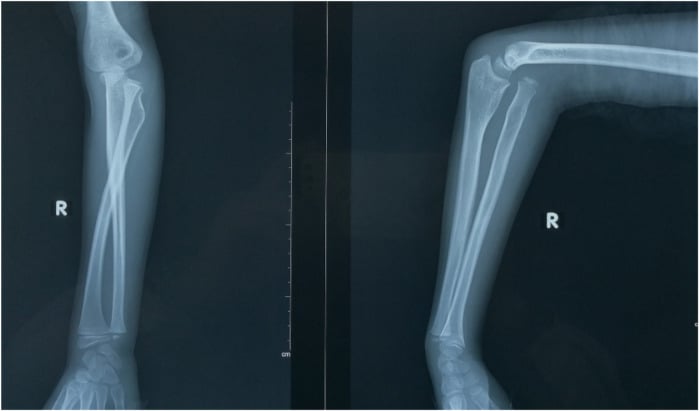
The views. Dedicated elbow and wrist views, not forearm views alone, and the elbow view must be a true lateral, because that is the only projection on which the radiocapitellar line can be trusted.
The radiocapitellar line. A line drawn along the radial neck shaft should pass through the centre of the capitellum. On the lateral view, a line that passes anterior to the capitellum means an anterior dislocation (Type I), posterior means a posterior dislocation (Type II), and centred is normal.
The line in a young child. The rule that the line must bisect the capitellum on every view is sound in a skeletally mature elbow and unreliable in a small child. In a series of 200 radiographically normal children's elbows aged 0 to 18, measured across six age bands (DOI), the line passed through the middle third of the capitellum in 93% on the lateral projection but only 74.5% on the AP. The age gradient is the striking part: on the AP it rose from 8.3% at 0 to 3 years to 94.1% at 16 to 18 (P = 0.001), and on the lateral from 50% to 100% (P = 0.023). The authors conclude that these measurements must be interpreted with great caution in younger age groups, because that is exactly where the largest proportion of normal elbows fail to follow the established principle.
Both errors are live here, and they pull in opposite directions. Over-diagnosis is calling a dislocation in a toddler because the line misses the capitellum on the AP, when roughly nine in ten normal toddlers look that way on that view. Under-diagnosis is the graver risk, because a missed lesion becomes a chronically dislocated radial head. So do not abandon the line; use it properly. Draw it on a true lateral, where it is reliable even in young children; treat an AP appearance alone as insufficient grounds to diagnose or exclude a dislocation under about four years; and compare the contralateral elbow. The strongest safeguard is not the line at all but the rule that any apparently isolated ulnar shaft fracture, or any ulnar plastic deformation, demands dedicated elbow views and a high index of suspicion.
The ulnar bow. Look for plastic deformation, comparing with the other side if unsure. The normal ulna has a slight posterior bow and is never bowed anteriorly.
- Significance
- Dislocated radial head
- Action
- Identify Direction (I, II, III)
- Significance
- Obvious pathology
- Action
- Assess angulation
- Significance
- Plastic deformation
- Action
- Requires straightening to reduce head
- Significance
- Shortening
- Action
- Must restore length to reduce head
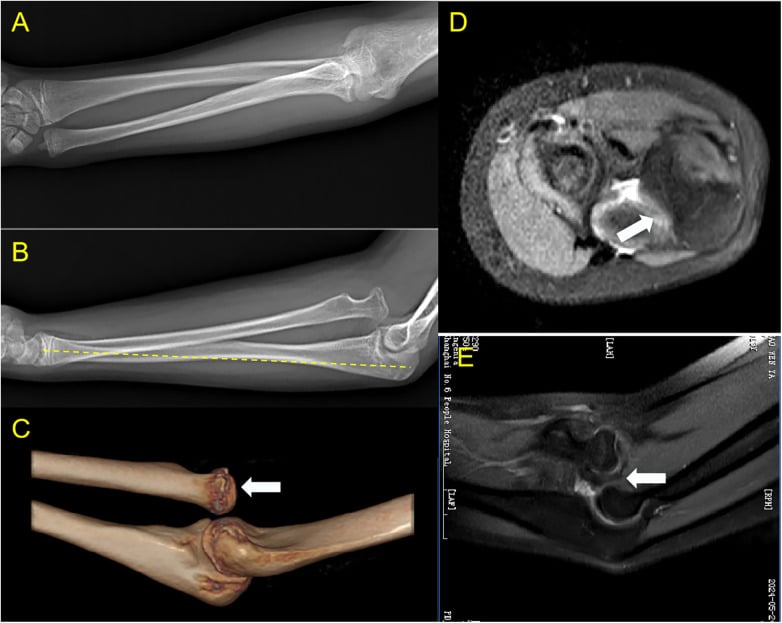
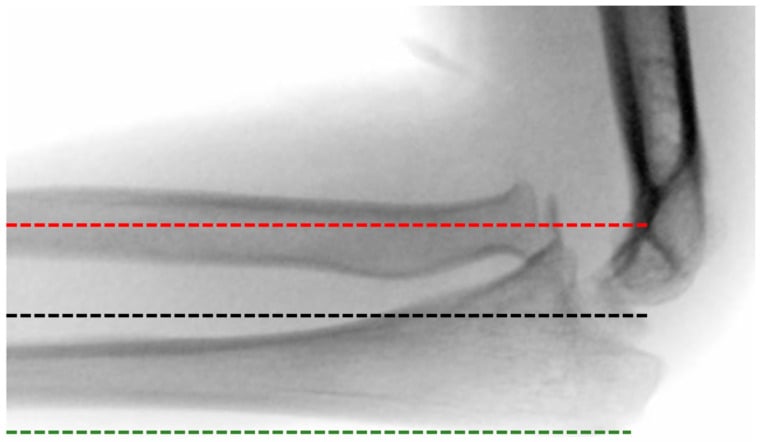
Differential Diagnosis
The differential is anything that produces radial head malalignment or a proximal forearm injury on a paediatric radiograph, and the discriminator is almost always the radiocapitellar line plus the state of the ulna. Mistaking a congenital dislocation for an acute one leads to an unnecessary attempted reduction; a traumatic Monteggia always has an ulnar abnormality, whether a fracture or plastic deformation.
- Distinguishing Feature
- Ulnar fracture OR plastic deformation + radial head dislocated (line off)
- Pitfall / Action
- Look for subtle ulnar bowing if no frank fracture
- Distinguishing Feature
- Radiocapitellar line normal in ALL views, radial head congruent
- Pitfall / Action
- Only call 'isolated' after a true lateral elbow view
- Distinguishing Feature
- Dome-shaped/hypoplastic radial head, convex capitellum, NO ulnar fracture, often bilateral
- Pitfall / Action
- Compare both elbows; do not attempt reduction
- Distinguishing Feature
- Toddler, axial-pull history, no fracture, normal radiographs
- Pitfall / Action
- Clinical diagnosis; reduces with supination/flexion or pronation
- Distinguishing Feature
- Fracture through radial neck, radiocapitellar line may still pass head
- Pitfall / Action
- Distinct from dislocation; can be a Monteggia equivalent
- Distinguishing Feature
- Ulnar fracture present but radial head congruent
- Pitfall / Action
- Still scrutinise the line - proximal ulnar fractures are high-risk for occult Monteggia
Management Algorithm
The goal. Anatomic reduction of the ulna, in length and in angulation, after which the radial head reduces indirectly. Reduce the ulna to reduce the radius; if ulnar length is not restored, the head will not reduce or will not stay reduced.
Where and how. Go to theatre: muscle relaxation is the key, and sedation in the emergency department often fails because of spasm. Get length first, and pull hard, because a short ulna will not let the head back in. Mould the interosseous space by squeezing the radius and ulna apart. Confirm the result on a true lateral and do not accept obliques, since the radiocapitellar line is only valid on a true lateral.
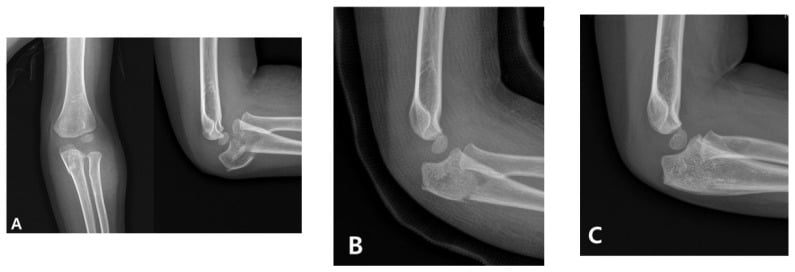
Bado I (anterior). Traction in extension restores length, then the elbow is flexed to 100-110° with the forearm fully supinated, and the ulnar angulation is moulded out with a valgus or varus mould as needed. The long arm cast holds the same position, flexion at 100-110° and supination. Supination tightens the interosseous membrane and relaxes the biceps, the main deforming force on the proximal radius; flexion relaxes the biceps as well and pushes the radial head back. Neutral rotation is not enough.
The manoeuvre itself, step by step:
- Traction - an assistant holds the humerus while the surgeon pulls traction on the forearm in extension
- Supination - fully supinate the forearm
- Correction - apply pressure over the posterior ulna to correct the anterior angulation
- Reduction - maintaining traction and pressure, flex the elbow past 90°; there is usually a "clunk" as the radial head reduces
- Check - verify the reduction on fluoroscopy, then cast in 100-110° of flexion and supination
Monitor the distal vascular status in hyperflexion.
Bado III (lateral). Traction in extension, then a valgus stress to correct the ulnar varus; cast in extension or slight flexion with a valgus mould. The varus is hard to hold in a cast, so the ulna often needs an intramedullary nail.
Bado II (posterior). Extension of the elbow reduces the posterior head, with pronation; the cast is in extension, which is uncommon and awkward, or the fracture is fixed, though it rarely needs ORIF.
Bado IV. Both bones are fractured, and open reduction and internal fixation is usually required for stability.
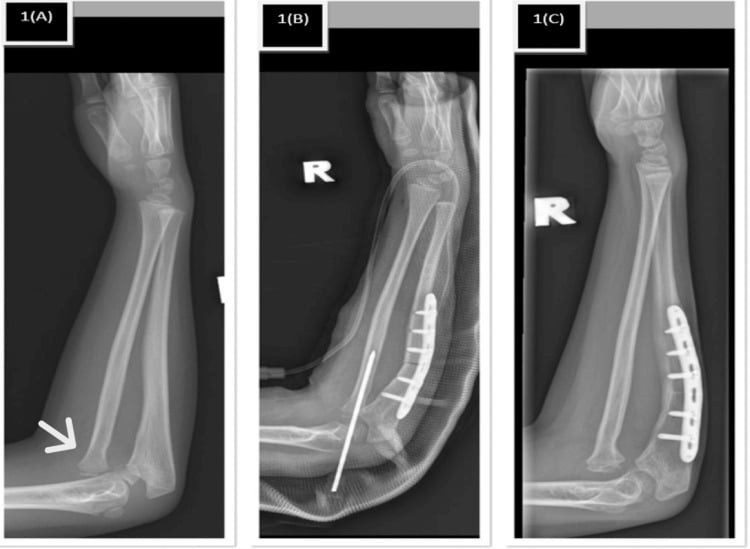
When to operate. Failure to maintain the ulnar reduction, an unstable fracture, or a Letts B or C ulna (complete or comminuted) is an indication for intramedullary nailing or open fixation. This is the relationship the evidence section documents: in the multicentre ulnar-pattern series, every treatment failure was a complete fracture managed without stabilisation, and incomplete fractures can usually be managed closed.
After the reduction. Confirm that the radiocapitellar line is restored in all views.
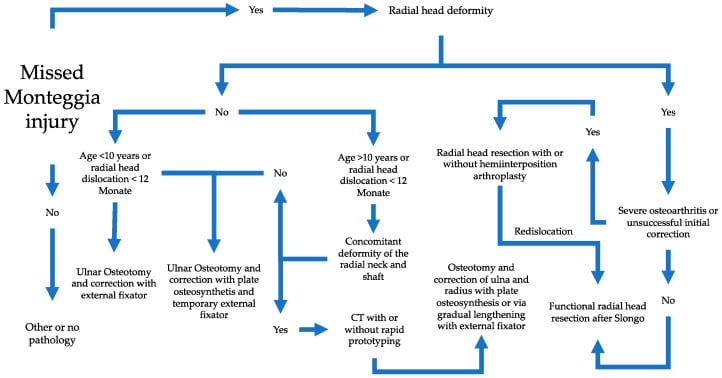
Surgical Technique
Flexible intramedullary nailing of the ulna is indicated for the unstable Type I or III fracture and for failure of closed reduction.
Preparation. Set up before the tourniquet goes up:
- Position - supine, arm on a radiolucent hand table
- Image intensifier - from the head or across from the surgeon, with the monitor at the foot of the bed
- Draping - sterile tourniquet high on the arm; drape to include the shoulder so the limb can be rotated
- Instruments - small fragment set, flexible nails (TENs), wire driver, oscillating saw if an osteotomy is needed
- Consent - infection, nerve injury (PIN), loss of reduction, removal of metalwork
Limit tourniquet time to 90 minutes. If reduction is difficult and time is expiring, deflate for 20 minutes before re-inflating. Ensure the limb is exsanguinated but avoid excessively tight Esmarch banding over the fracture site.
Steps
- Olecranon tip, proximal to distal
- Stab incision, awl
- Advance an appropriately sized TEN nail (2.0-3.0mm)
- Cross the fracture site
- Reduce the fracture manually while advancing the nail
- Length and alignment must both be restored
- Once the ulna is rigidly fixed at length, the radial head should reduce spontaneously
- Verify with the image intensifier through rotation, flexion and extension
Bell-Tawse and Annular Ligament Reconstruction
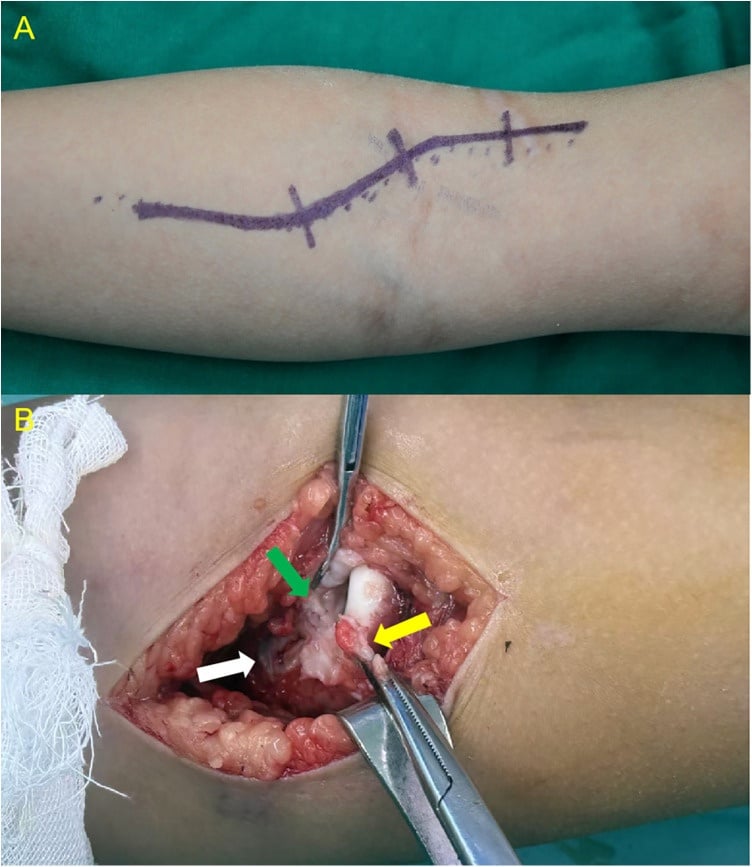
In the chronic (missed) Monteggia, once an ulnar osteotomy has restored length and angulation and the radial head has been openly reduced, the annular ligament is usually deficient and the joint must be stabilised. Knowing the options, and which the evidence actually favours, is a common viva follow-up.
- Technique
- Identify, clear and repair the patient's own annular ligament after reduction
- Evidence / role
- Associated with the best stability - native repair outperformed formal reconstruction in comparative series, so it is preferred where the ligament is usable
- Technique
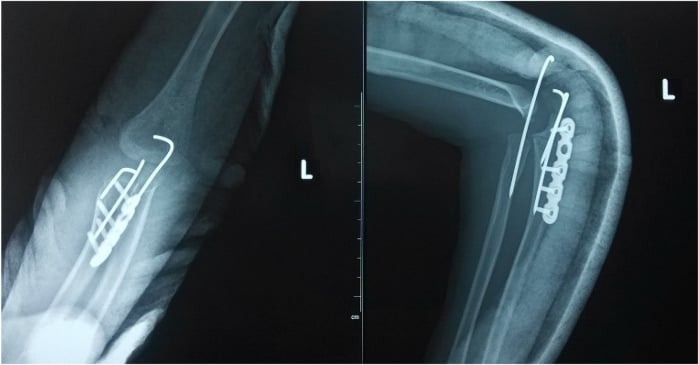
- A distally based strip of the central triceps tendon/fascia is passed through a drill hole in the proximal ulna and looped around the radial neck to recreate the annular ligament (with Lloyd-Roberts and Hirayama modifications)
- Evidence / role
- The classic named reconstruction when the native ligament is unusable; does not reliably reduce redislocation on its own
- Technique
- Temporary K-wire across the reduced radiocapitellar joint
- Evidence / role
- Adjunct only; risk of wire breakage, and it has NOT been shown to reduce redislocation - many now avoid it
- Technique
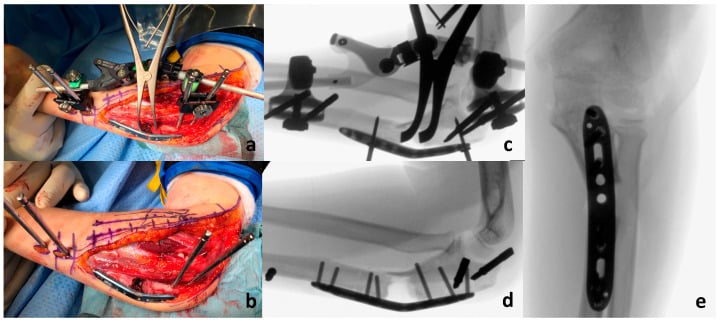
- Restore ulnar length and over-correct angulation to lever and hold the radial head reduced
- Evidence / role
- The dominant determinant of success - get this right and ligament surgery becomes secondary
The viva answer is that the accurate ulnar osteotomy does most of the work; for the ligament, repair the native annular ligament if it is usable rather than defaulting to a formal Bell-Tawse reconstruction, and treat transcapitellar pinning as an avoidable adjunct - neither routine Bell-Tawse reconstruction nor radiocapitellar pinning has reliably lowered the redislocation rate.
Complications
PIN palsy. The most common complication, in 10-20% of cases, particularly with Type III (lateral) or Type I injuries, where the nerve is stretched. It is almost always a neurapraxia that resolves spontaneously, usually within 6-12 weeks, and more than 90% recover spontaneously, so do not rush to explore; arrange electromyography if there is no recovery after 3 months. This is why the pre-reduction examination must be documented.
- Cause
- Casting error, untreated plastic deformation
- Management
- Early recognition → Redo/ORIF
- Cause
- High energy, tight cast in hyperflexion
- Management
- Fasciotomy
- Cause
- Failure to restore ulnar length
- Management
- Ulnar osteotomy
- Cause
- Trauma to interosseous space
- Management
- Excision if limiting rotation (late)
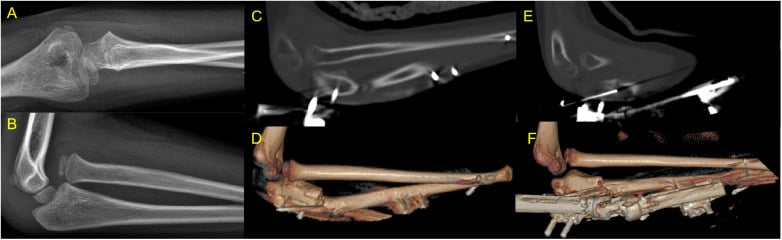
Postoperative Care and Rehabilitation
Rehab Protocol
- Long arm cast (position depends on Bado type)
- Weekly X-rays for the first 3 weeks (check ulnar alignment and radial head)
- Shoulder motion allowed
- Monitor for cast looseness as swelling subsides
- Keep dry - use a bag when showering; a wet cast causes skin sores
- No poking - nothing down the cast
- Wiggle fingers - to prevent stiffness
- Elevation - hand above heart level for the first 3 days
- Return to ED if pain is out of proportion, the fingers are blue or white, the cast feels too tight, or the cast cracks or softens
- Remove cast/splint
- Remove IM nail if used (typically 6-12 weeks when united)
- Begin active range of motion (flexion/extension, pronation/supination)
- No passive stretching, which may cause myositis
- Progressive strengthening
- Return to non-contact sports
- Monitor for heterotopic ossification (rare but possible)
- Full contact sports when radiographic union is solid and range of motion is full
- Monitor for growth disturbance (rare)
- Assess for any residual PIN deficit
Before the cast comes off. Check the radiograph first: the ulna should be healing and the radial head reduced. If the ulna has angulated, the radial head may have subluxated.
Outcomes
Treated acutely, the prognosis is excellent and most children regain a full range of motion; recurrence is rare if ulnar length is maintained. Missed and treated late, the prognosis is guarded: reconstruction by osteotomy improves pain and stability but often leaves some stiffness.
Guidelines, Registries & Global Practice
Global epidemiology:
- Monteggia fracture-dislocations account for less than 2% of paediatric forearm fractures, with a peak incidence at 4-10 years of age and a slight male predominance in most reported series.
- Common mechanisms worldwide are falls onto the outstretched hand, falls from playground equipment (monkey bars, trampolines) and direct blows to the forearm; in lower-resource settings, road traffic and fall-from-height injuries contribute a higher proportion of high-energy Bado IV patterns.
- Bado Type I (anterior) predominates in children (roughly 70%), with Type III (lateral) the second most common; Types II and IV are uncommon in the paediatric population.
Side-by-side practice and guidance:
- Key message for paediatric Monteggia
- Emphasise the radiocapitellar line on every paediatric forearm radiograph; ulnar-pattern-based treatment (closed for incomplete, fixation for complete) per multicentre data
- Key message for paediatric Monteggia
- Dedicated elbow views in all forearm injuries; urgent senior review of any radial head malalignment; manage missed cases in a paediatric specialist centre
- Key message for paediatric Monteggia
- Restore ulnar length and alignment first; the radial head reduces indirectly; ESIN is the workhorse fixation for unstable complete ulnar fractures
- Key message for paediatric Monteggia
- Early recognition is the priority; chronic reconstruction (ulnar osteotomy +/- annular ligament repair) should be performed as early as possible after diagnosis
- There is no dedicated paediatric Monteggia registry; the strongest comparative evidence comes from multicentre cohorts (e.g. the multi-institution ulnar-pattern study) rather than national arthroplasty/trauma registries, which capture implant-based adult injuries.
- Outcome data consistently show that the dominant modifiable risk factor across health systems is delay to diagnosis, not the choice of reconstruction technique.
- Well-resourced settings: Routine theatre reduction under image intensifier, ready access to elastic nails, MRI/ultrasound for occult plastic deformation, and early specialist referral pathways.
- Limited-resource settings: Higher rates of missed/late presentation; greater reliance on careful clinical examination and contralateral comparison radiographs; external fixation or open ulnar osteotomy may be used where elastic nails are unavailable.
- Splint for comfort during transfer (does not usually reduce the injury).
- Imaging - transfer dedicated elbow and wrist views (or PACS access) so the radial head can be reassessed.
- Neurovascular - document PIN function clearly before and after any manipulation.
- Fasting - keep fasted if early reduction under anaesthesia is anticipated.
Controversies & Areas of Uncertainty
Fixation of the complete ulna. A complete ulnar fracture needs stabilisation, but the choice between elastic intramedullary nailing, plating and external fixation is institution-dependent. Elastic nailing is increasingly favoured over external fixation for lower residual pain and better cosmesis.
The asymptomatic missed case. Whether to operate on an older child with a chronically dislocated but pain-free, well-functioning elbow is unsettled. Some advocate observation, given the surgical morbidity and the risk of stiffness; others reconstruct to prevent late pain, instability and tardy PIN palsy.
MCQ Practice Points
Q: A 5-year-old presents with a forearm fracture. On the lateral view, the radiocapitellar line passes posterior to the capitellum. What is the diagnosis? A: Bado Type II (Posterior) Monteggia fracture-dislocation. (Anterior line = Type I).
Q: Which nerve is most commonly injured in Monteggia fractures and what is the presentation? A: Posterior Interosseous Nerve (PIN). Presents with loss of finger extension (MCP) and thumb extension. Wrist extension is preserved (radial deviation) due to ECRL innervation (proximal to PIN). Sensation is INTACT.
Q: Why is supination used for Type I Monteggia reduction? A: Supination tightens the interosseous membrane (pulling bones together) and relaxes the biceps tendon (which is an anterior deforming force on the radial tuberosity and proximal radius).
CASTCAST - Immobilization Positions
Hook:Know the position: I = Flex/Sup. II = Extend. III = Extend/Valgus.
Q: A 7-year-old sustains a varus injury to the elbow (Bado III). What associated ligamentous injury is most likely? A: Lateral Collateral Ligament (LCL) injury or avulsion. This contributes to the instability and may require repair in chronic cases.
Q: At what age does the radial head ossification center appear, and why does this matter for diagnosis? A: It appears at 3-5 years. Before this, you must rely on the radial neck alignment with the capitellum. Don't mistake the unossified head for a "dislocation" if the neck points centrally, but be very suspicious of any misalignment.
Q: What characterizes a Bado IV fracture and how is it managed? A: Fracture of the proximal ulna AND radius shaft with radial head dislocation. It is highly unstable and almost always requires operative fixation of both bone fractures to maintain reduction.
Clinical Decision Scenarios
Practise clinical reasoning and management decisions out loud
“A 6-year-old girl falls on an outstretched hand. X-rays show a greenstick fracture of the proximal ulna. The radial head does not point to the capitellum on the lateral view.”
“You see a 12-year-old boy in clinic who injured his elbow 2 months ago. He has limited flexion and a 'bump' on the front of his elbow. X-rays show a healed ulnar fracture and a dislocated radial head.”
“A junior registrar calls you about a 5-year-old with a 'proximal ulnar fracture' and a 'swollen elbow'. They represent the X-rays describing a 'Greenstick proximal ulna fracture' but say the elbow looks 'a bit out'.”
Bado Types
- I: Anterior (70%) - Flexion/Supination cast
- II: Posterior (6%) - Extension cast
- III: Lateral (23%) - Im nail / Valgus mold
- IV: Combined (1%) - ORIF
Key Exam Steps
- Check Radiocapitellar Line (Every view)
- Check Ulnar Bow (Plastic deformation)
- Check PIN (hitchhiker thumb)
- Check Wrist (Galeazzi screen)
Reduction Mantra
- Restore Ulnar Length
- Correct Ulnar Angulation
- Radial head reduces itself
- Check the radiocapitellar line — trust the true lateral; the AP is unreliable under about age 4
Evidence Base
Ulnar-Pattern Treatment Algorithm (Landmark)
- Multicentre retrospective review of 112 acute paediatric Monteggia fractures, mean age 6.9 years
- Strategy by ulnar pattern: closed reduction for plastic/greenstick, IM pin for transverse/short-oblique, ORIF for long-oblique/comminuted
- 0 of 57 patients treated per strategy failed; 6 of 18 (33%) complete ulnar fractures treated NON-operatively failed
- All treatment failures were complete fractures managed without surgical stabilisation
Missed Monteggia Injuries (Plastic Deformation Trap)
- Retrospective series of 39 Monteggia injuries; 8 were missed at presentation (mean age 6.3 years)
- 7 of the 8 missed injuries were the variant type with ulnar plastic deformation rather than a frank fracture
- Mean interval from injury to diagnosis in missed cases was 33.5 weeks
- 2 cases diagnosed within 4 weeks were treated successfully by closed manipulation; the rest needed ulnar osteotomy plus annular ligament repair
Reconstruction of Missed Monteggia Lesions
- 52 children reconstructed for missed Monteggia, median age 6.8 years, median injury-to-surgery 12.9 weeks
- Median flexion improved from 108 to 140 degrees; congruent radiocapitellar alignment maintained in 75%
- 9 of 52 (17%) re-dislocated; 6 of these were salvaged with early revision
- Repair of the NATIVE annular ligament gave better stability than reconstruction or leaving it unaddressed (p=0.03)
Risk Factors for Redislocation After Reconstruction
- 62 children reconstructed for chronic Monteggia, mean follow-up 6 years; ulnar osteotomy in all
- 16.1% redislocated after surgery
- Time from injury to surgery was the independent predictor of redislocation on multivariate analysis - and the relationship is NONLINEAR (p = 0.023), with every additional MONTH of delay within the first year carrying a 1.37-FOLD increase in redislocation risk
- Annular ligament RECONSTRUCTION and radiocapitellar pinning did not reduce redislocation
Outcomes of Surgically Treated Missed Cases
- 22 children with chronic radial head dislocation, mean age 7.2 years, mean injury-to-surgery 15.7 months
- Radial head stayed reduced in 15 of 22; one frank redislocation
- Kim elbow score excellent/good in 18 of 22 (mean 91); all but five were pain-free
- Clinical outcome was generally better than radiographic radiocapitellar congruency
Elastic Nailing vs External Fixation (Acute)
- 26 children with acute Monteggia: closed reduction plus external fixation vs elastic stable intramedullary nailing (ESIN)
- Both achieved similar excellent healing and functional (Quick DASH) outcomes
- Residual pain / cosmetic dissatisfaction higher with external fixation (40%) than ESIN (9.1%)
- Heterotopic ossification in 2 of 26 (7.6%) overall
Bado Classification of the Monteggia Lesion (Historic)
- Defined the four-type classification still used worldwide, based on the direction of radial head dislocation
- Established the principle that the radial head dislocates in the direction of the ulnar apex - which is why correcting the ulna reduces the radial head
- Described Monteggia 'equivalents' - lesions that behave like a Monteggia without the classical pattern, including isolated radial head dislocation and radial neck fracture variants