Paediatric
Core
High Yield
Infant Hip Examination (DDH)
Complete examination of the infant hip for developmental dysplasia (DDH) including Barlow, Ortolani, Galeazzi tests, and assessment of risk factors and secondary signs.
Infant Hip Examination (DDH)
Examiner Favorite
The infant hip examination for DDH is a core clinical skill. Examiners expect you to perform Barlow and Ortolani tests correctly, recognize the difference between hip clicks and clunks, understand the limitations of clinical examination, and know when to refer for ultrasound. The examination differs by age.
Quick Reference One-Pager
Infant Hip Examination Summary
High-Yield Exam Summary
Risk Factors
- •Breech presentation
- •Family history of DDH
- •Female sex
- •Oligohydramnios
- •First-born child
- •Associated conditions (torticollis, foot deformities)
Look
- •Leg length asymmetry (Galeazzi)
- •Thigh/gluteal skin crease asymmetry
- •Limited abduction (most reliable sign)
- •Position of limb at rest
Examination by Age
- •0-3 months: Barlow + Ortolani tests
- •3-6 months: Limited abduction most important
- •Over 6 months: Galeazzi + walking/gait (late diagnosis)
Key Tests
- •Barlow (dislocatable)
- •Ortolani (relocatable)
- •Galeazzi (leg length)
- •Klisic line (late DDH)
Introduction and Setup
Before You Start
Patient Requirements:
- Warm, quiet room (baby should be calm)
- Naked from waist down, nappy removed
- Flat, firm surface
- Baby should be relaxed and not crying
Consent Script (to parent): "I'm going to examine your baby's hips to check they are developing normally. I need to move the hips gently. This doesn't hurt, but babies sometimes don't like being examined. It's best done when they're calm."
Key Concepts:
- DDH is a spectrum: Dysplasia → Subluxable → Dislocatable → Dislocated
- Clinical examination is most sensitive in first few weeks of life
- Instability may resolve spontaneously (physiological laxity) or progress
- Sensitivity of clinical exam decreases after 3 months
Risk Factors (History)
Assess Risk Before Examination
Major Risk Factors:
- Breech presentation (especially extended breech): 2-4% risk of DDH
- Family history: First-degree relative with DDH (10-fold increased risk)
- Female sex: 4-8× more common than males (ligamentous laxity from maternal hormones)
Minor Risk Factors:
- Oligohydramnios (reduced fetal movement)
- First-born child
- High birth weight
- Associated packaging disorders:
- Congenital muscular torticollis (20% association)
- Metatarsus adductus
- Calcaneovalgus foot
- Plagiocephaly
Screening Indication:
- Universal clinical screening at newborn and 6-week checks
- Ultrasound screening if any major risk factor (breech, family history) regardless of clinical findings
Look (Inspection)
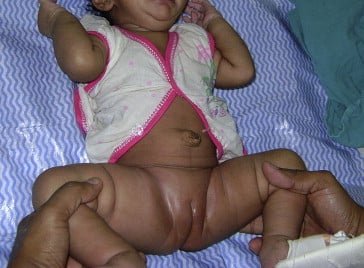
- Leg position at rest: External rotation, shortened appearance
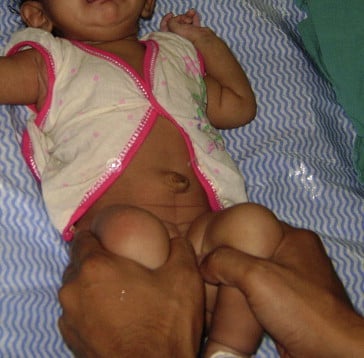
- Apparent leg length: Compare knee heights with hips and knees flexed (Galeazzi)
- Thigh skin creases: Asymmetry (not specific but should be noted)
- Abduction: Compare range visually before testing
- Movement: Spontaneous movement of both legs
Key Concept
Skin Crease Asymmetry: This is NOT a reliable sign of DDH - up to 30% of normal infants have asymmetric thigh creases. It should prompt careful examination but is NOT diagnostic.
Barlow and Ortolani Tests
Barlow Test (Provocative)
Detect a dislocatable hip (unstable but currently located)
Technique
- 1Baby supine, hips and knees flexed to 90°
- 2Hold thigh with thumb on inner thigh and middle finger over greater trochanter
- 3Stabilize pelvis with other hand (or examine one hip at a time)
- 4Adduct the hip and apply gentle posterior pressure
- 5Feel for the femoral head slipping out over the posterior acetabular rim
Positive Sign
Palpable 'clunk' as femoral head dislocates posteriorly (not a click)
Indicates
Dislocatable hip (unstable DDH) - the hip is currently in joint but can be dislocated
Diagnostic Accuracy
Sensitivity70%
Ability to detect true positives
Specificity99%
Ability to exclude false positives
Ortolani Test (Reduction)
Detect a dislocated hip that can be relocated
Technique
- 1Start from Barlow position (or with hip dislocated)
- 2Abduct the hip while lifting the greater trochanter forward (anteriorly)
- 3Feel for the femoral head sliding back into the acetabulum
Positive Sign
Palpable 'clunk' as femoral head relocates into acetabulum
Indicates
Relocatable dislocated hip - the hip was out of joint and has been reduced
Diagnostic Accuracy
Sensitivity60%
Ability to detect true positives
Specificity100%
Ability to exclude false positives
Must Know
Clunk vs Click:
-
CLUNK (significant): A palpable movement of the femoral head in or out of the acetabulum. This is what Barlow and Ortolani detect. Requires referral.
-
CLICK (usually benign): A snapping sound or sensation from soft tissues (ligamentum teres, fascia lata, tendons). Very common (up to 10% of newborns). No referral required unless other concerns.
Key distinction: A clunk is felt (movement of bone), a click is heard/snapped (soft tissue).
Click to expand
Click to expand
Additional Tests
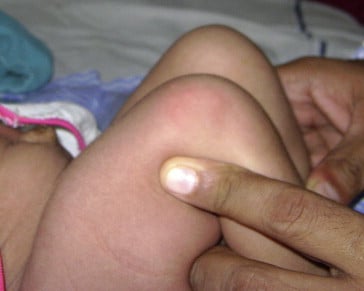
Galeazzi Sign (Allis Test)
Detect femoral shortening from dislocated hip
Technique
- 1Baby supine
- 2Hips and knees flexed, feet flat on surface
- 3Look at knee heights from side and from foot of bed
Positive Sign
Affected knee appears lower (shorter femur)
Indicates
Established DDH with proximal femoral migration (dislocated hip)
Diagnostic Accuracy
Sensitivity40%
Ability to detect true positives
Specificity90%
Ability to exclude false positives
Click to expand
Limited Abduction
Detect DDH (most reliable clinical sign after 3 months)
Technique
- 1Hips and knees flexed to 90°
- 2Gently abduct both hips simultaneously
- 3Compare range of abduction (normal greater than 60° each side)
Positive Sign
Asymmetric limitation of abduction (affected side less than 60°)
Indicates
DDH (most reliable sign after 3 months when Barlow/Ortolani become less sensitive)
Diagnostic Accuracy
Sensitivity78%
Ability to detect true positives
Specificity98%
Ability to exclude false positives
Klisic Line
Assess hip location in older infant/child
Technique
- 1Draw imaginary line from tip of greater trochanter through ASIS
Positive Sign
Line passes below umbilicus (normally passes through or above umbilicus)
Indicates
Hip dislocation (femoral head proximally migrated)
Diagnostic Accuracy
Sensitivity85%
Ability to detect true positives
Specificity90%
Ability to exclude false positives
Examination by Age
| age | primaryTest | keyFindings | limitations |
|---|---|---|---|
| 0-6 weeks | Barlow + Ortolani | Instability, clunk | Physiological laxity may cause false positives |
| 6 weeks - 3 months | Barlow + Ortolani + Abduction | Instability, limited abduction | Tests become less reliable, USS most accurate |
| 3-6 months | Limited abduction | Asymmetric abduction, Galeazzi | Barlow/Ortolani unreliable, soft tissues tighten |
| Over 6 months (walking) | Gait + Trendelenburg | Limp, waddling gait, Galeazzi | Late diagnosis, established dislocation |
Imaging
When to Image
Ultrasound (Graf Method):
- First-line investigation under 4-6 months
- Indications:
- Clinical instability (positive Barlow/Ortolani)
- Risk factors (breech, family history) even with normal exam
- Clinical concern (asymmetric creases, limited abduction)
- Timing: 6 weeks (not at birth - physiological laxity gives false positives)
Graf Classification:
| Type | Alpha Angle | Beta Angle | Interpretation |
|---|---|---|---|
| I | Greater than 60° | Less than 55° | Normal |
| IIa | 50-59° | - | Immature (normal if under 3 months) |
| IIb | 50-59° | - | Delayed ossification (over 3 months, abnormal) |
| IIc | 43-49° | Less than 77° | Critical (unstable) |
| D | 43-49° | Greater than 77° | Decentered (subluxed) |
| III | Less than 43° | Greater than 77° | Dislocated |
| IV | Less than 43° | Greater than 77° | Dislocated (labrum inverted) |
X-Ray:
- After 4-6 months when femoral head begins to ossify
- Look for: Shenton's line, acetabular index, femoral head position
Complete the Examination
Must Know
Always state to the examiner:
"To complete my examination, I would like to:
- Check for associated conditions (torticollis, foot deformities)
- Review risk factors (breech, family history)
- Arrange ultrasound if any clinical or risk factor concerns
- Document findings clearly
- Arrange follow-up at 6 weeks for repeat examination"
Summary Presentation
VIVA SCENARIOStandard
Presenting Your Findings
EXAMINER
"6-week-old female infant, first-born, with a family history of DDH (mother had hip dysplasia treated as infant)."
KEY POINTS TO SCORE
Barlow tests for dislocation (hip goes OUT)
Ortolani tests for relocation (hip goes IN)
Clunk is significant, click is usually benign
Limited abduction is most reliable sign after 3 months
COMMON TRAPS
✗Examining a crying, tense baby (will miss instability)
✗Confusing click with clunk
✗Relying on skin crease asymmetry
✗Not screening babies with risk factors despite normal exam
DDH Management Summary
| age | treatment | principle | success |
|---|---|---|---|
| 0-6 months | Pavlik harness | Maintain reduction in flexion/abduction | Greater than 95% if stable reduction |
| 6-18 months | Closed reduction + spica | Reduction under GA, immobilization | 85-90% |
| 18 months - 3 years | Open reduction +/- osteotomy | Address soft tissue obstacles | Variable |
| Over 3 years | Open reduction + pelvic/femoral osteotomy | Redirect/augment acetabulum, shorten femur | Depends on severity |
Key Points for Examiners
Scoring High in the DDH Examination
High-Yield Exam Summary
Do
- •Ensure baby is calm before examining
- •Examine one hip at a time if needed
- •Know the difference between Barlow (out) and Ortolani (in)
- •Understand clunk vs click distinction
- •Know when to refer for ultrasound (risk factors + clinical concern)
Don't
- •Force the examination if baby is crying
- •Rely on skin crease asymmetry alone
- •Expect Barlow/Ortolani to be positive after 3 months
- •Forget about risk factor screening
- •Miss associated conditions (torticollis, foot deformities)