Paediatric
Core
High Yield
Spine Scoliosis Examination
Focused examination for adolescent idiopathic scoliosis including Adams forward bend test, rib hump measurement, sagittal balance, and screening for non-idiopathic causes.
Spine Scoliosis Examination
Examiner Favorite
Scoliosis examination requires systematic assessment of the spinal deformity and exclusion of non-idiopathic causes. Examiners expect you to perform the Adams forward bend test correctly, measure trunk rotation, assess skeletal maturity (Risser sign), and recognize red flags suggesting underlying pathology.
Quick Reference One-Pager
Scoliosis Examination Summary
High-Yield Exam Summary
Key Observations
- •Shoulder height asymmetry
- •Scapular prominence
- •Waist crease asymmetry
- •Trunk shift
- •Leg length discrepancy
Adams Forward Bend
- •Most important screening test
- •Reveals rib hump (thoracic) or lumbar prominence
- •Measure with scoliometer (greater than 7° = significant)
- •Differentiates structural from postural
Red Flags (Non-Idiopathic)
- •Age under 10 years (juvenile/infantile)
- •Male sex
- •Left thoracic curve
- •Neurological signs
- •Pain (especially night pain)
- •Rapid progression
- •Cafe-au-lait spots
Maturity Assessment
- •Risser sign (0-5) on X-ray
- •Menarche status (peak growth 6-12 months before)
- •Tanner staging
- •Height velocity
Types of Scoliosis
Classification
By Etiology:
- Idiopathic (80%): Most common, diagnosis of exclusion
- Infantile: 0-3 years
- Juvenile: 4-10 years
- Adolescent (AIS): 10+ years to skeletal maturity
- Congenital: Vertebral anomalies (hemivertebra, bar)
- Neuromuscular: CP, muscular dystrophy, SMA
- Syndromic: Neurofibromatosis, Marfan, Ehlers-Danlos
Curve Classification:
- Location: Cervical, thoracic, thoracolumbar, lumbar
- Direction: Named by convexity (e.g., "right thoracic")
- Structural vs Non-structural: Structural has rib rotation
Key Concept
Adolescent Idiopathic Scoliosis (AIS):
- Most common type (80% of scoliosis)
- Female:Male = 7:1 for curves requiring treatment
- Typical pattern: Right thoracic curve
- Age of onset: 10-18 years (skeletal maturity)
- Diagnosis of EXCLUSION - must rule out other causes
Physical Examination
Observation
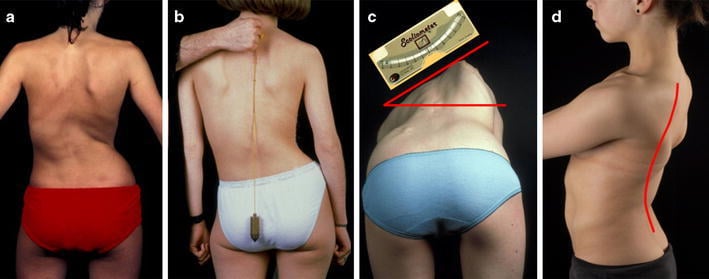
Patient Standing (From Behind)
With patient in underwear, standing relaxed:
- Head Position: Should be centered over pelvis
- Shoulder Height: Asymmetry common
- Scapulae: Prominence, winging, asymmetric position
- Trunk Shift: Trunk displaced relative to pelvis
- Waist Creases: Asymmetric (deeper on concave side)
- Pelvis: Level or oblique
- Gluteal Creases: Level or asymmetric
- Leg Length: Compare PSIS levels
Plumb Line Assessment:
- Drop line from C7 spinous process
- Should fall through gluteal cleft
- Deviation indicates coronal imbalance
Patient Standing (From Side)
Sagittal Profile:
- Cervical Lordosis: Normal
- Thoracic Kyphosis: Normal 20-40° (increased = hyperkyphosis)
- Lumbar Lordosis: Normal 40-60°
- Sagittal Balance: C7 plumb over S1
- Pelvic Tilt: Note pelvic version
Common Finding in AIS:
- Hypokyphosis (flat back) is common in thoracic curves
- May have thoracolumbar kyphosis
Adams Forward Bend Test
Adams Forward Bend Test
Screen for structural scoliosis
Technique
- 1Patient stands with feet together, knees straight
- 2Arms hanging with palms together
- 3Slowly bend forward at waist, head dropping
- 4Examiner observes from behind and from front
Positive Sign
Rib hump (thoracic) or paravertebral prominence (lumbar) on one side
Indicates
Structural scoliosis with rotational component. A rib hump results from ribs rotating with the vertebrae (convexity)
Diagnostic Accuracy
Sensitivity84%
Ability to detect true positives
Specificity93%
Ability to exclude false positives
Key Concept
Adams Test Interpretation:
- Rib Hump: Convex thoracic curve causes ribs to rotate posteriorly
- Lumbar Prominence: Convex lumbar curve causes paravertebral muscle bulge
- No Prominence on Bending: Suggests postural/non-structural scoliosis
- Measure with Scoliometer: Place across back at apex; 5-7° or more = significant
Click to expand
Scoliometer Measurement
Quantify trunk rotation
Technique
- 1Patient in Adams forward bend position
- 2Place scoliometer across back at level of maximum asymmetry
- 3Read angle of trunk rotation (ATR)
Positive Sign
ATR greater than 7° correlates with Cobb angle greater than 20° (referral threshold)
Indicates
Significant structural scoliosis - warrants radiograph and specialist referral
Diagnostic Accuracy
Sensitivity83%
Ability to detect true positives
Specificity86%
Ability to exclude false positives
Specific Assessments
Leg Length Assessment
Identify LLD contributing to scoliosis
Technique
- 1Compare ASIS heights
- 2Compare PSIS heights
- 3Block test: Place blocks under short leg until pelvis levels
Positive Sign
Asymmetric pelvis that corrects with blocks suggests LLD as contributing factor
Indicates
Leg length discrepancy can cause compensatory lumbar curve (corrects with equalization)
Diagnostic Accuracy
Sensitivity75%
Ability to detect true positives
Specificity80%
Ability to exclude false positives
Neurological Examination
Exclude non-idiopathic scoliosis
Technique
- 1Test lower limb power, sensation, reflexes
- 2Test abdominal reflexes (asymmetry suggests syrinx)
- 3Assess gait (broad-based, ataxic = cord pathology)
Positive Sign
Abnormal reflexes, asymmetric abdominal reflexes, weakness
Indicates
Neurological cause (syringomyelia, cord tumor, tethered cord) - needs MRI spine
Diagnostic Accuracy
Sensitivity85%
Ability to detect true positives
Specificity95%
Ability to exclude false positives
Red Flags for Non-Idiopathic Scoliosis
Must Know
Red Flags Requiring Investigation:
- Age less than 10 years (juvenile or infantile)
- Male patient (AIS rare in males)
- Left thoracic curve (atypical pattern)
- Rapid progression (greater than 10° in 6 months)
- Pain (especially night pain, constant)
- Neurological abnormalities
- Café-au-lait spots (neurofibromatosis)
- Foot deformity (cavovarus suggests CMT or spinal dysraphism)
- Skin stigmata over spine (dimple, hairy patch)
- Absent abdominal reflexes (syringomyelia)
If ANY red flags → MRI spine BEFORE treatment decisions
Maturity Assessment
Skeletal Maturity
Importance:
- Curve progression risk highest during growth spurt
- Immature skeleton = higher progression risk
- Maturity affects treatment decisions
Methods:
| Measure | Description |
|---|---|
| Risser Sign | Iliac apophysis ossification (0-5 on X-ray) |
| Menarche | Peak height velocity 6-12 months before menarche |
| Tanner Stage | Sexual maturity rating |
| Triradiate Cartilage | Open = significant growth remaining |
| Sanders Stage | Hand X-ray classification (1-8) |
Risser Sign:
- 0: No ossification (high risk)
- 1: Up to 25% ossification
- 2: 25-50%
- 3: 50-75%
- 4: 75-100%
- 5: Fused to ilium (skeletal maturity)
Curve Progression Risk
| curve | risser0to1 | risser2to4 |
|---|---|---|
| Less than 20° | High risk (25%) | Low risk (5%) |
| 20-30° | Very high risk (60%) | Moderate risk (20%) |
| 30-40° | Very high risk (90%) | High risk (40%) |
| Greater than 40° | Almost certain | High risk (70%) |
Associated Assessments
Complete Examination
Always Include:
-
Skin Examination:
- Café-au-lait spots (6 or more spots plus 15mm = NF1)
- Sacral dimple, hairy patch (spinal dysraphism)
- Axillary freckling (NF1)
-
Upper Limb:
- Marfan features (arachnodactyly, thumb sign, wrist sign)
- Joint hypermobility (Ehlers-Danlos)
-
Cardiac:
- Marfan syndrome = check for murmur (aortic)
-
Eyes:
- Marfan = lens subluxation
- NF1 = Lisch nodules
Summary Presentation
VIVA SCENARIOStandard
Presenting Your Findings
EXAMINER
"14-year-old girl referred by GP for asymmetric shoulders noted at school screening."
KEY POINTS TO SCORE
Adams forward bend test is the key screening test
Scoliometer greater than 7° warrants X-ray and referral
Right thoracic curve is typical pattern in AIS
Skeletal maturity (Risser) determines progression risk
COMMON TRAPS
✗Missing neurological signs (absent abdominal reflexes)
✗Not recognizing left thoracic as red flag
✗Forgetting to assess skeletal maturity
✗Missing skin stigmata of NF1
Differential Diagnosis
| type | pattern | features | mri |
|---|---|---|---|
| Adolescent Idiopathic (AIS) | Right thoracic | Female, post-menarche, normal neuro | Not routinely needed |
| Juvenile Idiopathic | Variable | Age 4-10 years, higher progression | Consider if atypical |
| Congenital | Short, angular | Visible on X-ray (hemivertebra, bar) | Yes (associated anomalies) |
| Neuromuscular | Long C-curve | Pelvic obliquity, hypotonia | If not known diagnosis |
| Syringomyelia | Left thoracic common | Abnormal neurology, absent reflexes | Essential |
| NF1-related | Variable | Cafe-au-lait spots, dystrophic curve | Yes (paravertebral tumors) |
Examiner Tips
Scoring High in Scoliosis Examination
High-Yield Exam Summary
Do
- •Perform Adams forward bend test correctly
- •Use scoliometer or describe rib hump measurement
- •Check abdominal reflexes
- •Look for café-au-lait spots
- •Assess skeletal maturity (ask about menarche)
Don't
- •Miss left thoracic as red flag
- •Forget neurological examination
- •Omit sagittal profile assessment
- •Miss leg length discrepancy
- •Forget to mention Risser sign for maturity