Systematic Pattern Recognition in Skeletal Scintigraphy
Hot spots (increased uptake): Metastases, fractures, infection, arthritis, Paget disease, healing bone
Cold spots (decreased uptake): Myeloma, AVN, aggressive tumour, radiation therapy, metal artefact
Diffuse uptake (superscan): Widespread metastases, metabolic bone disease, myelofibrosis
Linear uptake: Fracture line, stress reaction, shin splints
Periarticular uptake: Arthritis (inflammatory or degenerative), CRPS
Key: Pattern recognition combined with clinical context is the key to accurate bone scan interpretation
- Bone scan detects OSTEOBLASTIC ACTIVITY — any process increasing bone turnover produces increased uptake (hot spot).
- Systematic interpretation: (1) Technical adequacy, (2) Normal variant identification, (3) Focal abnormalities, (4) Pattern recognition, (5) Clinical correlation.
- Multiple asymmetric focal hot spots in a cancer patient = metastatic disease until proven otherwise.
- A solitary hot spot in a cancer patient has only a 50% chance of being metastatic — always correlate with anatomical imaging.
- Photopenic (cold) lesions suggest: myeloma, AVN, aggressive tumour, or prior irradiation.
- “The 'superscan' (intense diffuse skeletal uptake, absent kidney/soft tissue) = widespread metastases or metabolic bone disease.
- “Flare phenomenon: bone scan may transiently worsen 2-3 months after starting effective chemotherapy due to healing response — NOT disease progression.
- “Sternal uptake alone: consider sternotomy, metastasis, or myeloma. Focal rib uptake: consider fracture (trauma or insufficiency) first.
- “Shin splints (medial tibial stress syndrome) appear as longitudinal linear uptake along the posteromedial tibia — different from a stress fracture (focal intense uptake).
- “Paget disease produces INTENSELY increased uptake, typically in the skull, pelvis, or long bones — the most intense uptake seen on bone scan.
Bone scan questions arrive as a scan and a scenario: name the uptake pattern, then give the differential. The examinable material is the systematic approach to interpretation, the significance of a solitary against multiple hot spots, the superscan, the flare phenomenon, the causes of a cold spot, and the malignancies that produce false-negative scans (myeloma, renal cell carcinoma). The classic trap is calling a solitary hot spot a metastasis when it carries only a 50% probability of being one.
Overview
Bone scan interpretation is a fundamental skill for the orthopaedic surgery trainee, tested in both written and viva examination formats. Accurate interpretation is a combination of systematic reading technique, pattern recognition and clinical correlation, and the scan is never read in isolation: it is correlated with the clinical history, the examination findings, the laboratory results and anatomical imaging (radiographs, CT or MRI).
What the scan measures. A bone scan images osteoblastic activity and local blood flow. Anything that increases either produces increased uptake; anything that reduces blood flow or suppresses osteoblastic activity produces decreased uptake, a photopenic or cold lesion.
Sensitive, poorly specific. Because so many processes raise bone turnover — pathological and physiological alike — quite different diseases produce identical-looking hot spots. That is why the scan is described as exquisitely sensitive and poorly specific.
A good test of the skeleton, a poor test of a spot. That reflex needs one qualification, because it is a statement about a single hot spot rather than about the whole examination. Asked the right question the scan performs well: for skeletal metastases in breast cancer, pooled patient-based sensitivity is 90% and specificity 91% (area under the summary ROC curve 0.93). The poor specificity is local — a solitary focus has roughly a 50% chance of being metastatic — while the pattern across the whole skeleton is far more discriminating, which is exactly why interpretation is pattern-based.
Where PET sits. FDG PET/CT achieves similar sensitivity (92%) with markedly better specificity (99%), and Na-18F PET/CT the highest sensitivity (96%) at a lower specificity (81%), which is why PET increasingly replaces planar scanning where it is available.
Normal physiological uptake. Knowing what is meant to be hot is what prevents a false-positive report:
- Growth plates in children and adolescents — intense and symmetric
- Kidneys and bladder — tracer excretion
- Sternoclavicular joints — commonly focally increased, a normal variant
- Acromioclavicular joints — degenerative uptake in adults
- Sacroiliac joints and costochondral junctions — mild, symmetric
- Nasopharyngeal uptake — a normal variant
Systematic Approach
Read every scan in the same order: technical quality first, then the axial skeleton, the pelvis, the upper limbs and the lower limbs, and only then the pattern in its clinical context. A fixed sequence is what ensures nothing is missed.
- Assessment
- Injection site, image symmetry, artefacts, kidney visibility
- Significance
- Injection site extravasation invalidates quantitative assessment. Absent kidneys may indicate superscan
- Assessment
- Skull, mandible, spine (cervical/thoracic/lumbar/sacral), sternum, ribs
- Significance
- Most common sites for metastatic disease. Wedge compression fractures in spine
- Assessment
- Sacroiliac joints, iliac wings, acetabuli, pubic rami, ischial tuberosities
- Significance
- SI joints: sacroiliitis (bilateral) vs fracture (unilateral). Pubic rami: insufficiency fractures
- Assessment
- Shoulders, humeri, elbows, forearms, wrists, hands
- Significance
- Shoulder uptake: rotator cuff disease, OA. Hand/wrist: CRPS (diffuse periarticular uptake)
- Assessment
- Hips, femora, knees, tibiae/fibulae, ankles, feet
- Significance
- Knee uptake: OA, meniscal injury. Tibia: stress fracture (focal) vs shin splints (linear)
- Assessment
- Number, distribution, symmetry of abnormalities in context of clinical history
- Significance
- Single vs multiple, axial vs peripheral, symmetric vs asymmetric — determines differential
ABCDESystematic Interpretation
Hook:ABCDE: a systematic approach that ensures nothing is missed on bone scan interpretation.
Uptake Patterns and Differential Diagnosis
Multiple asymmetric foci. Random focal hot spots distributed through the axial skeleton, the proximal appendicular skeleton and the ribs, asymmetric and of variable intensity, predominantly axial, with the ribs and spine most commonly involved. In a patient with known malignancy this pattern has greater than 90% specificity for metastatic disease.
The solitary focus. Only approximately 50% represent metastasis in a cancer patient, so anatomical imaging decides the question. Where solitary metastases do occur, the common sites are the vertebral body (rather than the posterior elements), the ribs and the pelvis.
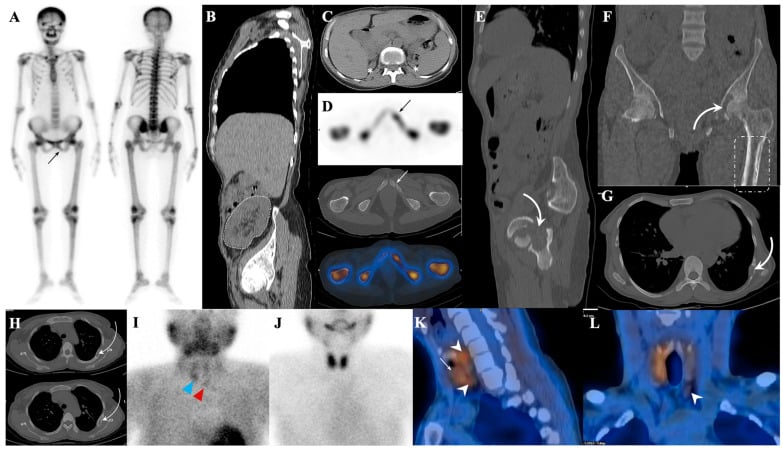
Superscan. Diffuse intense skeletal uptake with absent or faint kidney and soft-tissue activity. It is produced by widespread osteoblastic metastases (prostate, breast cancer) and by metabolic bone disease (renal osteodystrophy, hyperparathyroidism); the diagnostic clue is the absent kidneys, because the skeleton extracts nearly all the tracer.
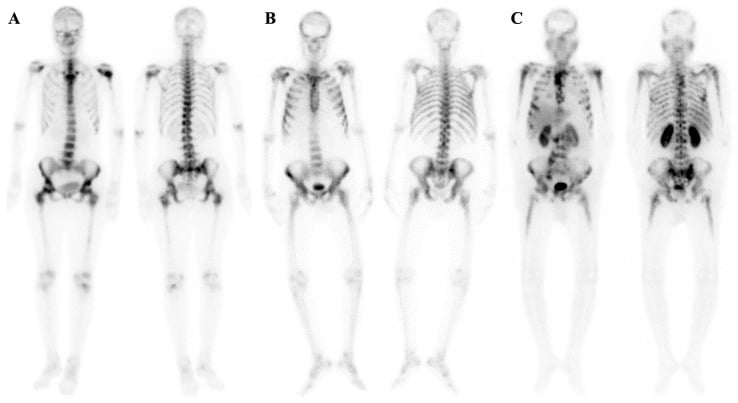
Flare phenomenon. A transient increase in bone scan uptake after starting effective chemotherapy or hormonal therapy, characteristically at 2-3 months and resolving by 6 months. The increased osteoblastic activity is healing of the metastatic lesions, a sign of repair rather than of progression, and misreading it leads to an incorrect change of treatment.
The lytic cancers. Multiple myeloma, renal cell carcinoma, follicular thyroid cancer and some lung cancers produce osteoclastic lesions without sufficient osteoblastic response to be detected, so the scan can be falsely negative in widespread disease.
The Three-Phase Bone Scan
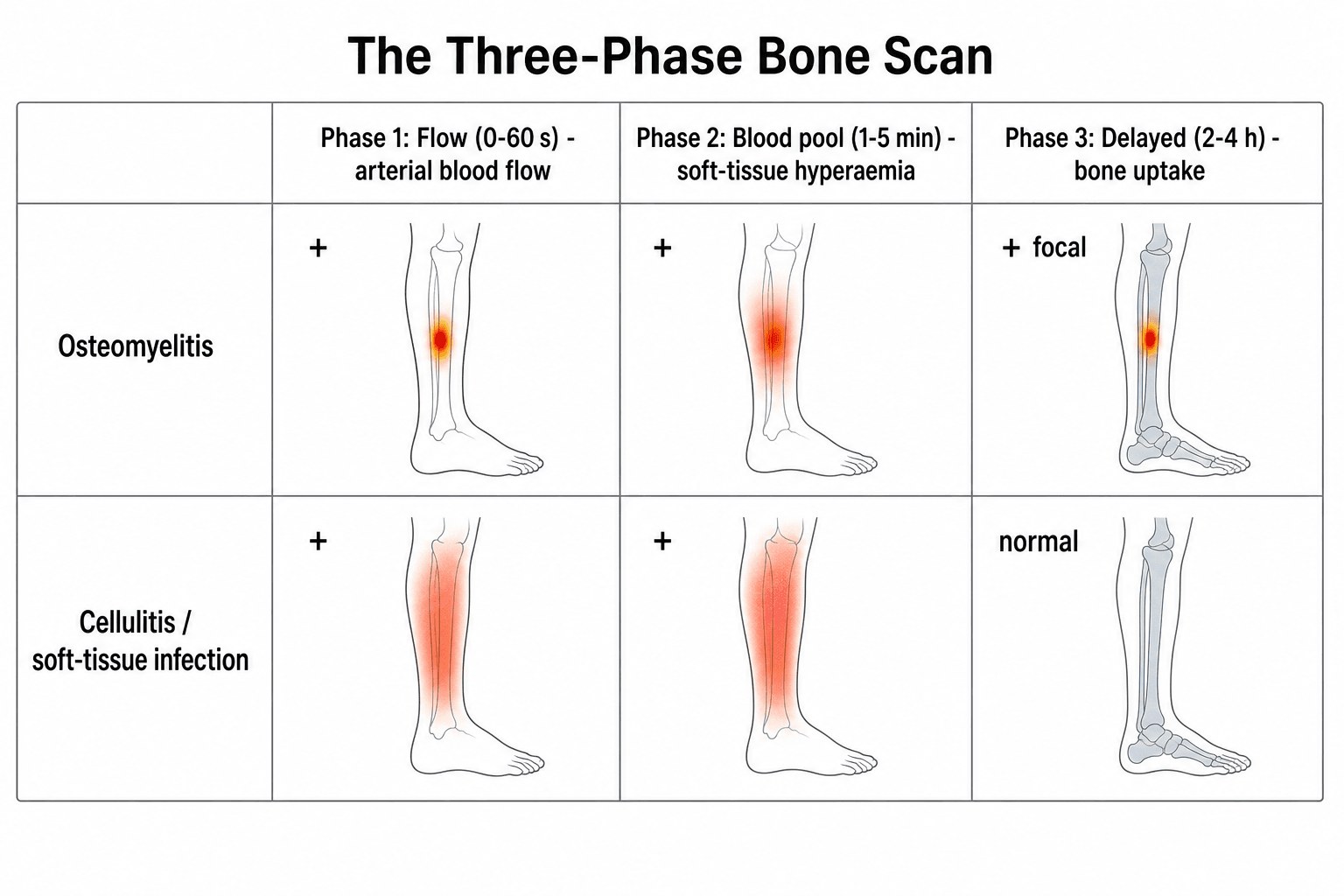
The three-phase study acquires images at three time points after a single Tc-99m diphosphonate injection, and the diagnosis is read from the pattern across the phases rather than from any one image.
- Timing and what it reflects
- Rapid images over about 60 seconds; regional arterial BLOOD FLOW
- What it shows
- Hyperaemia of an active inflammatory or neoplastic process
- Timing and what it reflects
- Static image at about 1 to 5 minutes; capillary and soft-tissue hyperaemia
- What it shows
- SOFT-TISSUE inflammation (cellulitis, synovitis)
- Timing and what it reflects
- Imaging at about 2 to 4 hours; OSTEOBLASTIC activity and bone turnover
- What it shows
- The standard bone-scan image - tracer now bound to bone
- Timing and what it reflects
- Osteomyelitis uptake keeps rising while soft-tissue activity washes out
- What it shows
- Improves specificity for bone infection
Osteomyelitis against cellulitis. Osteomyelitis is positive on all three phases, with focal bone uptake on the delayed phase. Cellulitis and other soft-tissue infection are positive on the flow and blood-pool phases, from diffuse soft-tissue hyperaemia, but the delayed bone phase is normal, and it is the absence of focal delayed bone uptake that separates them.
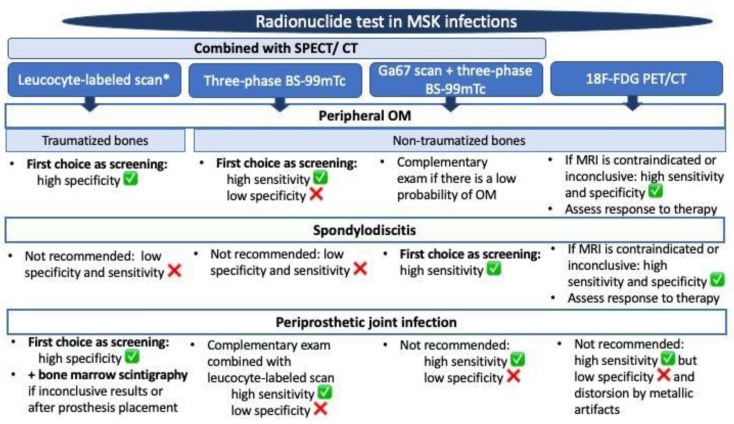
The caveat. Recent surgery, a fracture, a neuropathic (Charcot) joint or a prosthesis also light up on all three phases, so three-phase scanning is sensitive but poorly specific in those settings. Labelled-leucocyte imaging, SPECT/CT or MRI is then the next step.
Differential Diagnosis of the Solitary Hot Spot
The single most common interpretation challenge is the solitary focus of increased uptake. The pattern, intensity, anatomical site and clinical context narrow a broad differential; use the table to reason through it rather than defaulting to "metastasis".
- Typical site / pattern
- Vertebral body, pelvis, proximal long bone; round, asymmetric
- Discriminating features
- Known primary, posterior element sparing favours benign; vertebral body involvement raises concern; correlate with CT/MRI
- Typical site / pattern
- Rib (linear, aligned), pubic ramus, sacrum, tibia
- Discriminating features
- History of trauma or osteoporosis; linear or aligned uptake; ribs in a row strongly favour fracture over metastasis
- Typical site / pattern
- Facet joints, AC joint, knee, first CMC, hips
- Discriminating features
- Periarticular, often symmetric, matches radiographic OA; very common incidental cause
- Typical site / pattern
- Pelvis, skull, vertebra, long bone
- Discriminating features
- Intense uptake involving the WHOLE bone end-to-end, bone expansion; the most intense uptake seen
- Typical site / pattern
- Metaphysis (children), spine, diabetic foot
- Discriminating features
- Three-phase positivity (flow + pool + delayed); clinical sepsis, raised inflammatory markers; SPECT/CT or labelled WCC for confirmation
- Typical site / pattern
- Long bone, varies
- Discriminating features
- Osteoid osteoma: intense focal 'double-density' nidus; correlate with characteristic CT/MRI features and age
The benign possibilities. In a patient with known malignancy the differential of a solitary focus also includes a benign lesion (fibrous dysplasia, enchondroma, haemangioma), infection, degenerative change, an old fracture and Paget disease. A radiograph, CT or MRI of the region is essential before a single focus is allowed to change management.
Bone Scan in the Painful Prosthesis
Two variables govern every periprosthetic bone scan: the pattern of uptake and the time since implantation. Get the second wrong and the first cannot help you, because bone around a new implant remodels and takes up tracer whether or not anything is wrong.
- Suggests
- Often NORMAL post-operative remodelling
- Caveat
- Do NOT diagnose loosening or infection in this window - the scan is non-diagnostic
- Suggests
- Aseptic loosening (high-stress interface points)
- Caveat
- Focal rather than diffuse; delayed phase
- Suggests
- Periprosthetic infection
- Caveat
- Three-phase alone is non-specific - confirm with labelled leucocytes or SPECT/CT
- Suggests
- Useful to EXCLUDE a prosthetic cause of pain
- Caveat
- High sensitivity makes a normal scan reassuring
The nuclear reference standard. A combined labelled-leucocyte (white-cell) and sulphur-colloid marrow scan is the nuclear gold standard: infection produces leucocyte uptake without matching marrow-colloid uptake, a spatial mismatch, whereas displaced marrow shows congruent uptake on both. SPECT/CT improves anatomical localisation.
Where the plain scan sits. Because the plain three-phase bone scan cannot reliably separate aseptic loosening from infection, it is used alongside aspiration and inflammatory markers in the periprosthetic-infection pathway.
Guidelines, Registries & Global Practice
Technetium-99m diphosphonate (MDP/HDP) bone scintigraphy is one of the most frequently performed nuclear medicine studies worldwide, used across every health system for metastatic screening, evaluation of bone pain, occult and stress fracture detection, prosthetic loosening/infection assessment, and characterisation of metabolic bone disease. The whole-body planar study is inexpensive, available in virtually every nuclear medicine department, and has a high sensitivity for osteoblastic disease — properties that keep it relevant globally despite the rise of PET.
EANM (European Association of Nuclear Medicine) and SNMMI (US Society of Nuclear Medicine and Molecular Imaging) publish procedure standards for planar/SPECT bone scintigraphy and recommend SPECT or SPECT/CT to localise and characterise equivocal lesions (especially in the spine). For prostate cancer, EAU and NCCN reserve bone scan for higher-risk disease (e.g. PSA over 20, Gleason/ISUP high grade, or T3-T4), increasingly favouring PSMA PET where available. For breast cancer, ESMO and NCCN recommend bone scan or FDG PET-CT for staging when metastasis is suspected. In suspected diabetic foot osteomyelitis, IWGDF/IDSA favour MRI or labelled-leucocyte/SPECT-CT over three-phase bone scan alone because of limited specificity.
The International Myeloma Working Group (IMWG) explicitly recommends AGAINST conventional bone scan for myeloma, because lytic lesions are frequently false-negative. Whole-body low-dose CT, whole-body MRI, or FDG PET-CT are the recommended modalities — a high-yield distinction that every candidate must know.
Registry and outcome data feed back into how the scan is used: arthroplasty registries (NJR, AOANJRR, AJRR, Swedish/Norwegian) track revision for periprosthetic infection and loosening, conditions in which three-phase bone scan and SPECT/CT contribute to the diagnostic pathway alongside aspiration and inflammatory markers. The Bone Scan Index, validated in androgen-independent prostate cancer, quantifies skeletal tumour burden and prognosis and illustrates how a qualitative scan can be made quantitative for trials.
High- versus limited-resource practice variation: In well-resourced systems, PET-CT (FDG, Na-18F, or PSMA) and whole-body MRI increasingly replace planar bone scan for staging and treatment-response assessment, offering higher specificity and extra-skeletal evaluation. In limited-resource settings, planar Tc-99m bone scintigraphy remains the workhorse for metastatic screening because of low cost, wide availability of generator-produced technetium, and robust sensitivity; SPECT/CT and PET may be regionally centralised or unavailable. Sound interpretation of the planar scan therefore remains a globally essential skill rather than a historical one.
Controversies & Areas of Uncertainty
Bone scan, PET or whole-body MRI. The role of the planar bone scan is contracting as PSMA PET (prostate), FDG PET-CT (breast, lung, lymphoma) and whole-body diffusion MRI demonstrate higher specificity and detect marrow and extra-skeletal disease. There is no global consensus on when bone scan is still first-line and when it is replaced; availability and cost drive much of the variation, and guidelines lag behind the evidence.
How much does SPECT/CT add. SPECT/CT improves localisation and specificity — distinguishing facet osteoarthritis from a vertebral body metastasis, for example — but it adds radiation, cost and time. The threshold for adding SPECT/CT to a planar study, and whether it should be routine for spinal lesions, remains debated.
Flare against progression. No single imaging criterion reliably separates a 3-month healing flare from true progression. The judgement rests on serial scanning, the symptom trajectory and bone-turnover or tumour markers, so a degree of clinical uncertainty in this window is a recognised limitation rather than a solved problem.
What follows a non-specific three-phase scan. Whether to use labelled-leucocyte imaging, SPECT/CT or MRI next is institution-dependent and not fully standardised across guidelines.
Clinical Decision Scenarios
Practise clinical reasoning and management decisions out loud
“You are shown a bone scan of a 55-year-old woman with breast cancer who was recently started on chemotherapy. The scan shows more hot spots than her baseline scan 3 months ago.”
“A 70-year-old woman presents with acute low back pain after bending to pick up groceries. Her bone scan shows H-shaped uptake in the sacrum.”
“An examiner asks you to explain why a patient with known multiple myeloma has a normal bone scan despite widespread skeletal disease on CT.”
Systematic Approach (ABCDE)
- Adequacy: image quality, injection site, artefacts
- Background: overall uptake, kidney visibility (absent = superscan)
- Compare sides: asymmetry is significant
- Describe: location, intensity, pattern, number
- Explain: correlate with clinical history and anatomical imaging
Classic Patterns
- Superscan: diffuse intense uptake, absent kidneys — metastases or metabolic bone disease
- Linear uptake: fracture (stress, insufficiency, traumatic)
- Asymmetric random foci: metastatic disease (more than 90% probability if multiple)
- Periarticular uptake: arthritis (bilateral) or CRPS (unilateral)
False Negatives
- Myeloma (lytic, no osteoblastic response — DKK1 suppression)
- AVN (early, before revascularisation)
- Rapidly destructive tumour (outpaces repair)
- Previously irradiated lesions (suppressed vascularity and turnover)
Special Patterns
- Honda sign: H-shaped sacral uptake = insufficiency fractures
- Flare phenomenon: scan worsens at 2-3 months on effective treatment — NOT progression
- Train-track sign (HPOA): bilateral cortical uptake in long bones
- Doughnut sign (AVN): cold centre with ring of peripheral uptake
Hot Spot Statistics
- Solitary hot spot in cancer patient: only 50% probability of metastasis
- Multiple asymmetric hot spots: more than 90% probability of metastases
- Solitary rib hot spot: most likely fracture (not metastases)
- Always correlate with anatomical imaging for any hot spot
Evidence Base
Diagnostic Accuracy of Bone Scintigraphy for Skeletal Metastases
- Across 11 studies (753 breast cancer patients), planar/SPECT bone scintigraphy had a pooled patient-based sensitivity of 90% (95% CI 86-93) and specificity of 91% (95% CI 87-94), with an SROC area under the curve of 0.93.
- FDG PET/CT showed comparable sensitivity (92%) but markedly higher specificity (99%); Na-18F PET/CT had the highest sensitivity (96%) but lower specificity (81%).
- Bone scintigraphy retained good overall accuracy but was outperformed on specificity by FDG PET/CT, which also detects extra-skeletal disease.
Solitary Rib Hot Spots Are Usually Benign in Cancer Patients
- Review of 2,851 bone scans at a cancer centre identified 41 patients whose first abnormal finding was a solitary rib lesion.
- Only 4 of 41 (9.8%) were due to malignancy; 39% were associated with benign fractures, 27% with prior or postoperative radiotherapy, and 24% were assigned a benign aetiology with normal radiographs.
- Overall, approximately 90% of solitary rib hot spots in cancer patients were benign.
Solitary hot spots require careful anatomical correlation before making management decisions; site matters, with ribs being the least likely to be malignant.