Aspherical Femoral Head | Males | Anterosuperior
- Aspherical femoral head with loss of head-neck offset
- Alpha angle greater than 55° defines the MORPHOLOGY, not the diagnosis — cam morphology is common in asymptomatic hips, and FAI syndrome needs symptoms AND signs AND imaging
- Young athletic males predominantly affected
- Anterosuperior labral and cartilage damage from shear mechanism
- Hip arthroscopy or surgical dislocation for treatment
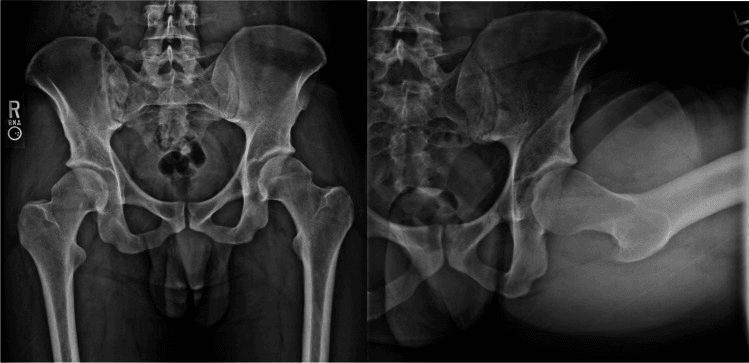
- “Pistol grip deformity on AP pelvis
- “FADIR test positive (flexion, adduction, internal rotation)
- “Outside-in cartilage damage (acetabular side first)
- “Associated with early osteoarthritis
Overview and Epidemiology
Femoroacetabular impingement (FAI) is a recognised cause of hip pain and early osteoarthritis, particularly in young adults. In the cam type the femoral head is aspherical: a bump at the head-neck junction, with loss of the normal head-neck offset, impinges on the acetabular rim as the hip flexes and internally rotates. Cam is the most common form, although combined cam and pincer morphology is the most common presentation overall, in approximately 86%.
Who. Young athletic males are predominantly affected, typically presenting between 20 and 40 years of age. Soccer, hockey, martial arts and rowing carry a high risk.
How common. Cam morphology is present in 10-15% of the asymptomatic population, and it has a strong link to early-onset hip osteoarthritis.
Pathophysiology and Pathoanatomy
The lesion. The cam lesion is an abnormal bony prominence at the anterosuperior femoral head-neck junction, with loss of the normal head-neck offset. The name comes from the bump acting like a cam in an engine, causing abnormal contact.
How it damages the joint. In flexion and internal rotation the bump is driven into the anterosuperior acetabulum. The resulting shear strips the acetabular cartilage from the labrum and delaminates it, an outside-in pattern that starts at the chondrolabral junction. The labrum itself is initially spared (Beck).
Cam versus pincer. Pincer is the acetabular form: overcoverage of a normal femoral head, commoner in middle-aged women. Its damage looks different, with the labrum crushed against the rim and the cartilage damage central.
Aetiology and Developmental Origin of the Cam Lesion
A growth-plate lesion. The cam is predominantly acquired and developmental, not present at birth. It forms during adolescent growth, chiefly in the years before capital femoral physeal closure (roughly ages 12 to 16), and it is uncommon to see one arise de novo in the fully mature skeleton.
The mechanism. The favoured explanation is lateral and anterosuperior extension of the capital physis, epiphyseal tilt, producing an aspherical prominence. This is interpreted as a growth-plate response to repetitive shear loading across the anterosuperior head-neck junction during vigorous hip flexion. The sequence runs from an early soft-tissue prominence through epiphyseal extension to the fixed osseous bump. Some authors regard mild subclinical posterior epiphyseal tilt, a spectrum resembling slipped capital femoral epiphysis, as one contributor at the severe end.
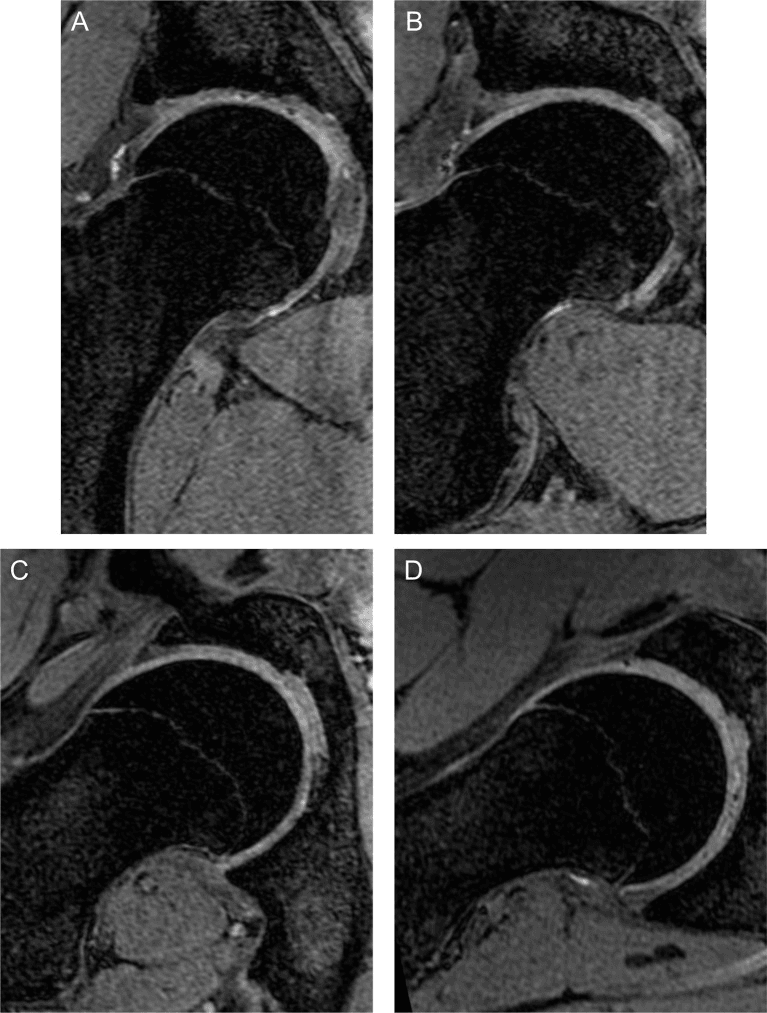
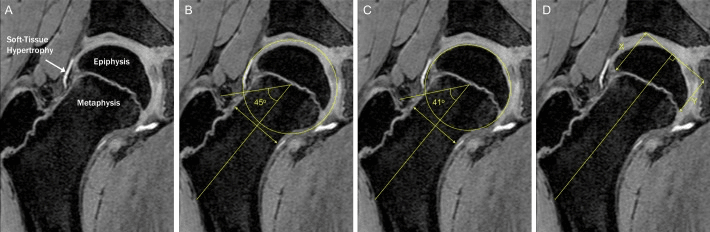
Loading during the growth spurt. High-impact, flexion-loading sports played during skeletal immaturity (football/soccer, ice hockey, basketball) are consistently associated with larger alpha angles. Cam morphology is markedly more prevalent in adolescent and young-adult athletes than in non-athletes. Prevalence and cam size increase with advancing skeletal maturity and then plateau, consistent with a window that closes at physeal fusion.
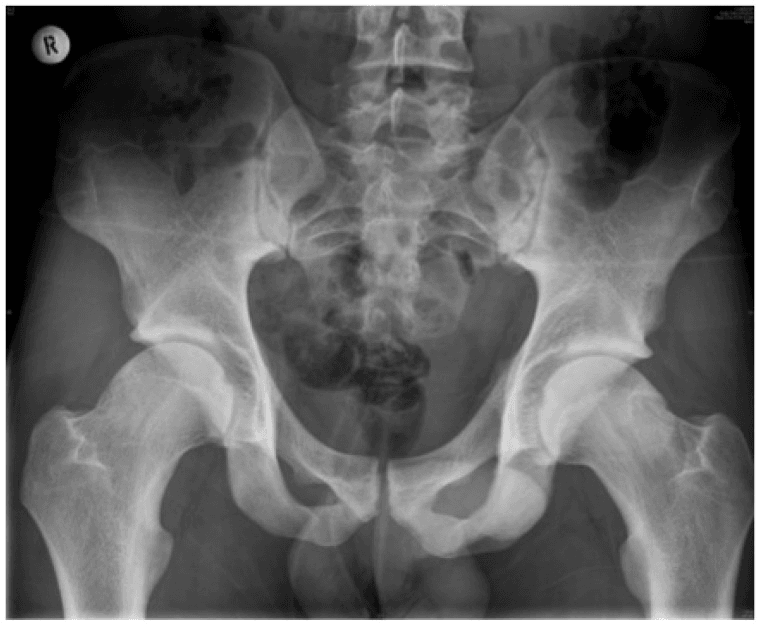
What follows clinically. Because the deformity is physeal in origin, the morphology is largely established by early adulthood, when symptomatic patients typically present. The same model is the rationale for interest in activity and load modification during growth. It also explains why the bony deformity cannot be grown out of once the physis has fused: only surgical osteochondroplasty can restore sphericity.
Clinical Presentation
History. The complaint is groin pain related to activity, particularly sport that demands hip flexion. The patient may describe mechanical symptoms such as clicking or catching, and prolonged sitting may aggravate the pain.
The FADIR test. Flexion, adduction and internal rotation, the anterior impingement test, reproduces the groin pain. It is the most sensitive test for FAI, and that is the whole of its value.
Why a positive FADIR proves little. Its specificity is poor. It is also positive in hip osteoarthritis, in labral tears of any cause, in synovitis and in a substantial proportion of hips with no symptoms at all, because the manoeuvre loads the anterosuperior joint whatever is wrong with it.
Why a negative one matters. A negative FADIR is worth much more than a positive one: it argues strongly against an intra-articular anterior hip problem, whereas a positive test says only that the anterior hip hurts when compressed. Never let a positive FADIR plus an alpha angle above threshold stand in for the diagnosis; that combination is common in people who are perfectly well.
The rest of the examination. Internal rotation in flexion is typically reduced and painful. FABER (flexion, abduction and external rotation) assesses the sacroiliac joint but also stresses the hip. Gait is usually normal unless the damage is advanced.
Diagnosis
Morphology is not the diagnosis. An alpha angle over 55° defines cam morphology, and that morphology is common in hips that never hurt. Symptomatic FAI syndrome requires concordant symptoms, examination and imaging. Once it is established, severity is graded on the cartilage and labral damage seen on MRI or at arthroscopy.
The mimics. The differential of young adult hip and groin pain, with the test that best confirms each:
- Key Distinguishing Features
- Aspherical head, alpha angle over 55 degrees, anterior groin pain, positive FADIR, reduced internal rotation in flexion
- Best Confirmatory Test
- Dunn/cross-table lateral + MRA
- Key Distinguishing Features
- Acetabular over-cover (coxa profunda, protrusio, crossover/retroversion signs), often middle-aged women, circumferential labral damage
- Best Confirmatory Test
- AP pelvis (rim signs) + MRA
- Key Distinguishing Features
- Under-coverage, lateral centre-edge angle under 20-25 degrees, instability/apprehension rather than impingement
- Best Confirmatory Test
- AP pelvis (LCEA), false-profile view
- Key Distinguishing Features
- Pain at pubic symphysis/adductor origin, resisted adduction painful, normal hip ROM, negative FADIR
- Best Confirmatory Test
- Resisted tests + MRI pubic plate
- Key Distinguishing Features
- Audible/palpable anterior snap on hip extension from flexion, tender psoas, relieved by psoas injection
- Best Confirmatory Test
- Dynamic ultrasound + diagnostic injection
- Key Distinguishing Features
- Older patient, global ROM loss, joint space narrowing, Tonnis 2-3, rest/start-up pain
- Best Confirmatory Test
- Weight-bearing AP pelvis
- Key Distinguishing Features
- Risk factors (load, RED-S), lateral trochanteric tenderness, or radicular pattern; hip joint not the source
- Best Confirmatory Test
- MRI / diagnostic injection / spine assessment
When the injection fails. A negative response to an intra-articular local anaesthetic injection, less than 50% pain relief, should prompt reconsideration of the diagnosis and of an extra-articular or referred cause before any joint-preserving surgery.
Investigations
A focused, stepwise work-up confirms the diagnosis, grades joint damage and excludes mimics.
Plain radiographs first. Weight-bearing radiographs define coverage and arthritis. The series is an AP pelvis and a dedicated lateral:
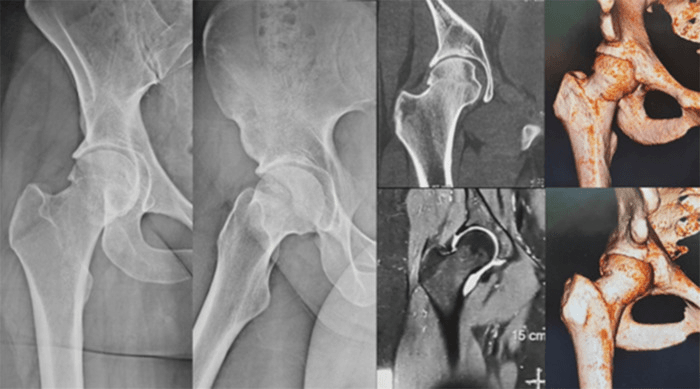
- AP pelvis: may show the pistol-grip deformity, the loss of concavity at the head-neck junction; assesses acetabular over-cover, coxa profunda or other acetabular abnormalities suggesting combined morphology; gives the Tonnis grade
- A dedicated lateral (Dunn, cross-table or frog-leg; compared below): essential for measuring the alpha angle and head-neck offset, and shows the anterosuperior bump
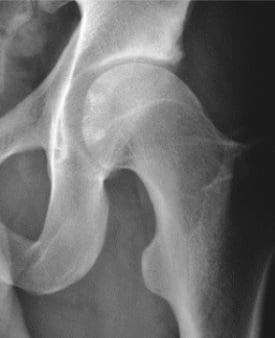
MRI and MR arthrography. These assess the labrum and the chondral surfaces (Outerbridge grade), and radial sequences show the cam lesion circumferentially. Arthrography improves sensitivity for labral tears.
CT with 3D reconstruction. Best for precise bony mapping of the cam lesion and surgical planning, and for assessing version.
Diagnostic injection. Intra-articular local anaesthetic confirms the hip joint as the pain source, with over 80% temporary relief expected, and helps exclude extra-articular causes.
Quantifying Cam Morphology: Alpha Angle Technique and Head-Neck Offset
The Nötzli method. Fit a best-fit circle around the femoral head and draw the femoral neck axis, a line through the centre of the head and the centre of the narrowest part of the neck. The alpha angle is subtended between that axis and a line from the head centre to the point where the anterior bony contour first exits the circle.
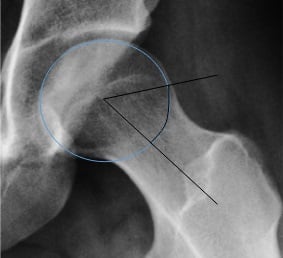
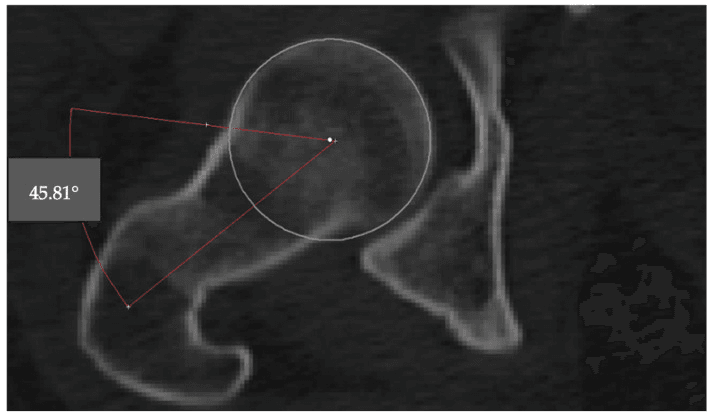
Thresholds. The alpha-angle classification:
- Normal: less than 50°
- Borderline: 50-55°
- Cam morphology: greater than 55°
Cohort data suggest around 60° for a definite deformity and around 78° for a pathological deformity that predicts end-stage osteoarthritis.
Why the view matters. The measured value is projection dependent because the cam lesion is focal, and a single lateral can under-read or miss a lesion that lies out of profile. At least one dedicated lateral is therefore combined with the AP pelvis:
- 45° Dunn (hip flexed 45°, 20° abduction): generally the most sensitive for the anterosuperior lesion
- Cross-table lateral: best profiles a purely anterior lesion
- Frog-leg and 90° Dunn: sample different points around the head-neck junction
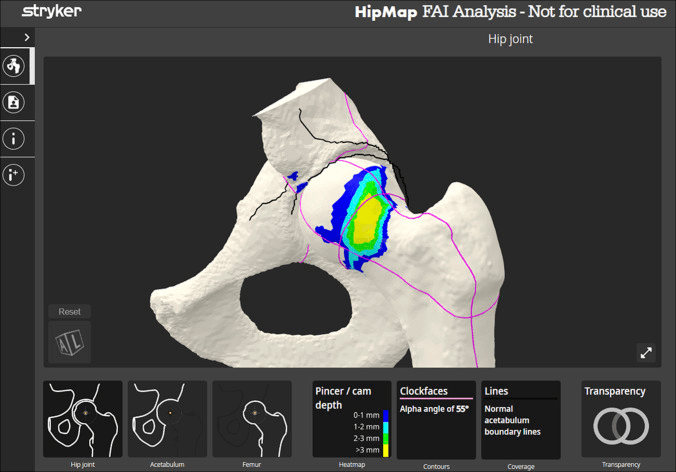
Clock-face localisation. Cam lesions are usually maximal in the anterosuperior quadrant, approximately the 1 to 3 o'clock positions on a right hip. Radial-sequence MRI reconstructs the head-neck junction all the way around the clock and is the most reliable way to localise, size and map the lesion, which is why it is preferred for planning resection and for avoiding under-resection.
Head-neck offset. Offset is the distance between the anterior femoral head and the anterior femoral neck, and reduced offset is the qualitative hallmark of the cam bump. An anterior offset ratio (offset divided by femoral head diameter) below about 0.17 is regarded as abnormal, and an absolute anterior offset under roughly 10 mm is also used as a threshold. Both complement the alpha angle, especially where it is borderline.
Management
The principle. Start with activity modification and targeted rehabilitation. Reserve joint-preserving surgery for persistent intra-articular symptoms with treatable morphology and preserved joint space.
Conservative care. Avoid provocative activities, deep hip flexion and impact sports. Physiotherapy works on core strengthening, hip stability and range of motion and addresses any muscular imbalance, while NSAIDs and analgesia give symptomatic relief. An intra-articular local anaesthetic and steroid injection can provide temporary relief.
What it cannot do. Conservative treatment may relieve symptoms, but it does not address the underlying morphology or prevent progression of cartilage damage.
Indications for surgery.
- Symptomatic cam FAI with confirmed morphology and labral or cartilage damage
- Failed conservative treatment
- Realistic expectations
The operation. Femoral osteochondroplasty resects the cam lesion to restore a spherical head-neck junction. There are two routes to it:
- Hip arthroscopy, the most common: the peripheral compartment is accessed and the cam resected with a burr
- Surgical dislocation: an open approach with a trochanteric osteotomy that protects the blood supply and allows direct visualisation
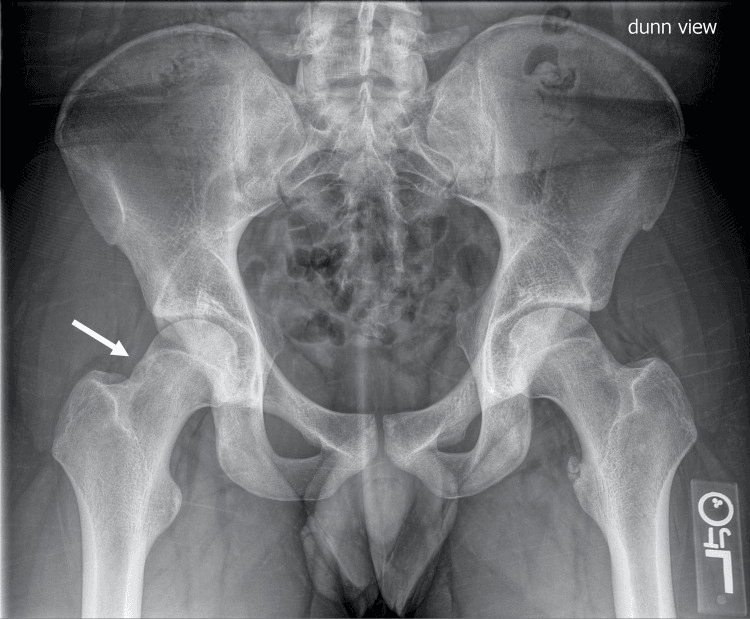
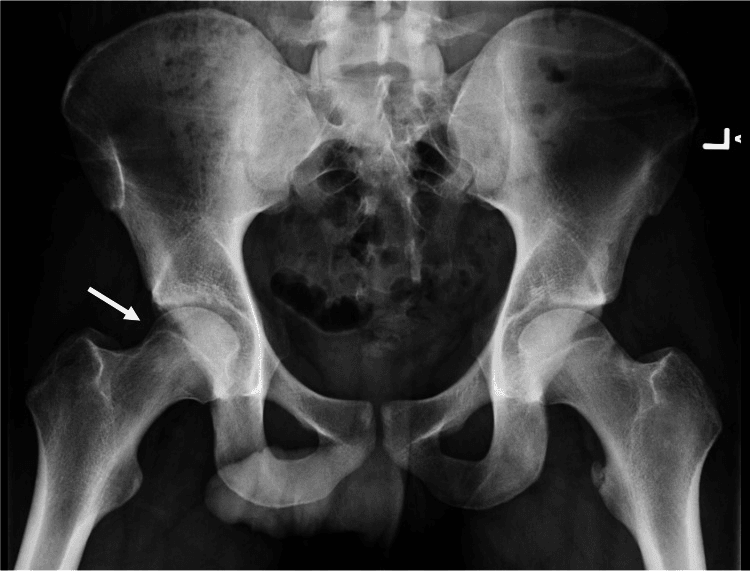
Resection. The distal resection boundary is defined first, and the prominence is then removed progressively to recreate a smooth head-neck transition and restore offset. Three-dimensional mapping localises the lesion and estimates resection depth, helping avoid both residual morphology and excessive weakening of the femoral neck.
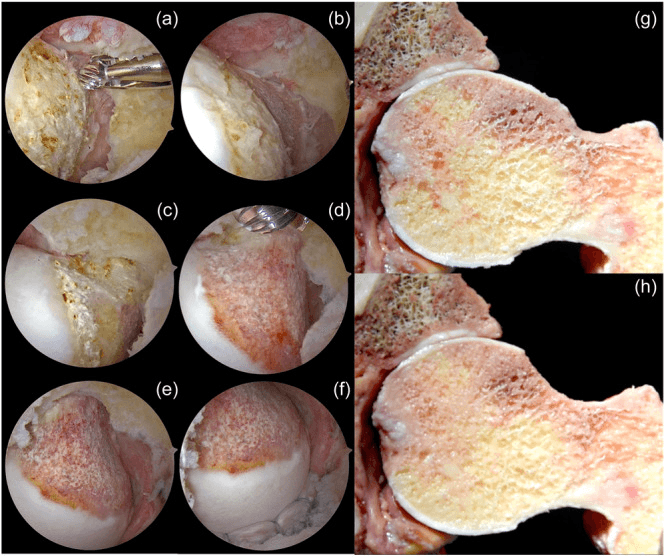
The labrum and cartilage. Osteochondroplasty is done in the peripheral compartment, and the labral tear is addressed with anchor fixation in the central compartment. Cam-related labrochondral separation is unstable to probing, and anchor repair restores the labral seal after bony correction. Labral repair is preferred over debridement, and microfracture is used for cartilage defects.
The bubble sign. At arthroscopy the bubble sign reveals fluid dissecting behind delaminated acetabular cartilage, and labral repair closes the disrupted chondrolabral junction.
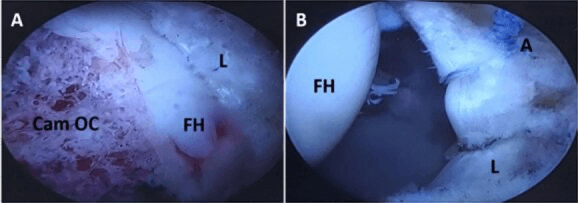
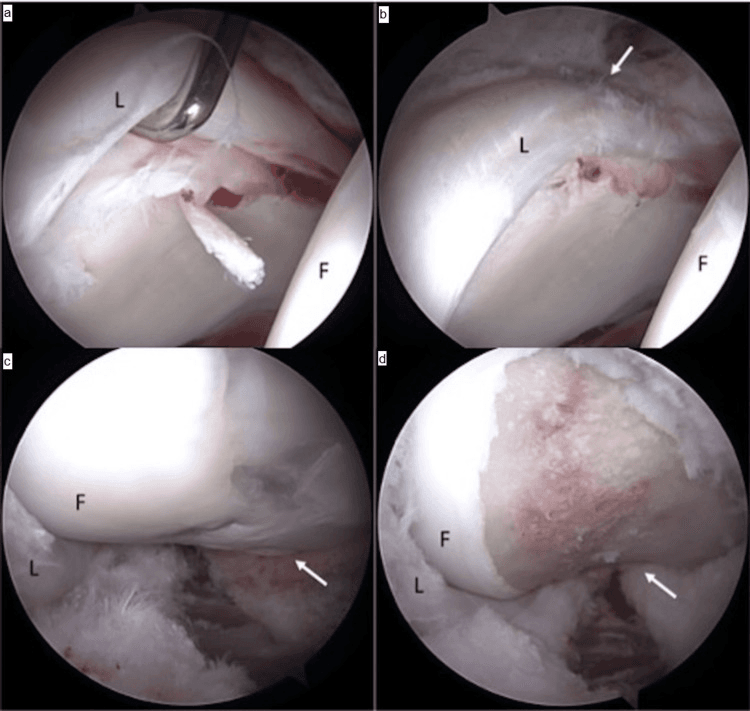
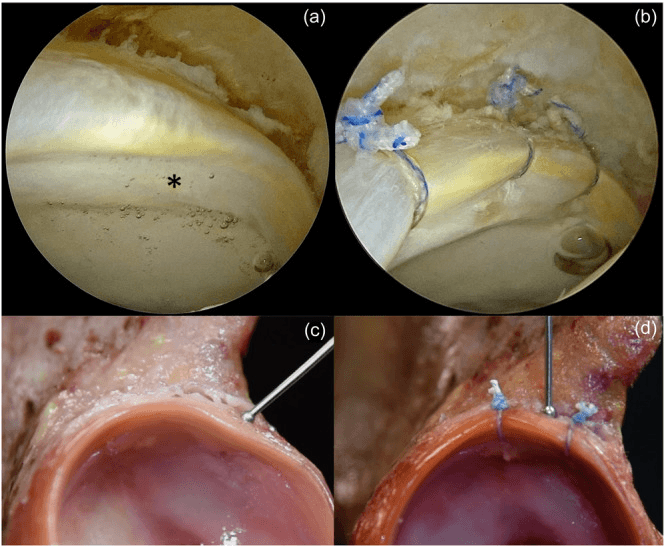
Checking the correction. Dynamic arthroscopic examination tests the corrected head-neck junction against the repaired labrum through flexion and abduction, checking for residual impingement.
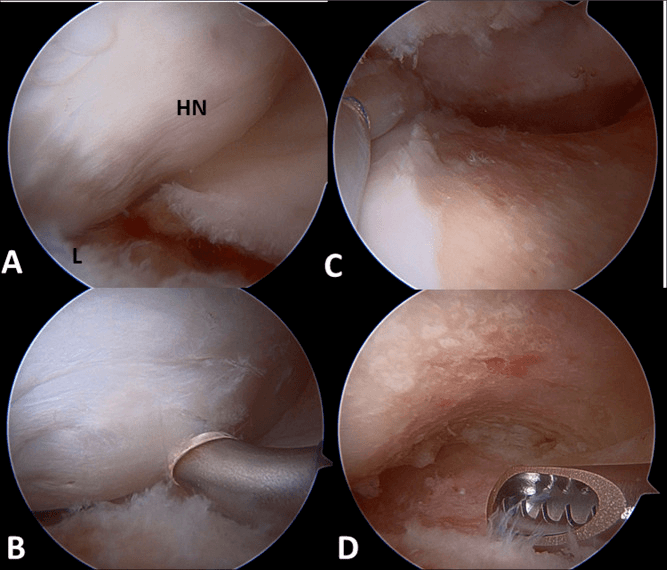
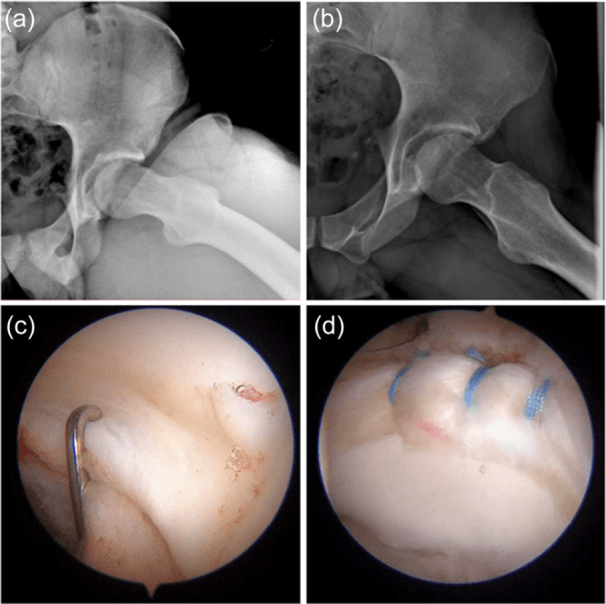
Outcomes. Results are good in patients with preserved joint space and a repairable labrum. Advanced cartilage loss, older age and high BMI are poor prognostic factors.
Complications
From the disease. The impingement itself causes progressive anterosuperior chondrolabral damage and labral tearing, and secondary osteoarthritis, particularly where the alpha angle stays elevated.
From arthroscopic osteochondroplasty. Resection can fail in both directions, and the arthroscopy carries its own risks:
- Under-resection: residual cam morphology is the commonest cause of persistent symptoms and revision arthroscopy
- Over-resection: risk of femoral neck stress fracture and iatrogenic hip instability
- Iatrogenic chondral or labral injury during portal placement or traction
- Traction-related neurapraxia (pudendal, lateral femoral cutaneous, sciatic), usually transient
- Heterotopic ossification (reduced with NSAID prophylaxis), adhesions, and rarely deep infection or venous thromboembolism
- Progression to total hip arthroplasty, markedly more likely when pre-existing OA (Tonnis 2 or more, Outerbridge III-IV) is present
From open surgical dislocation. The trochanteric osteotomy can go on to non-union or cause hardware irritation. Avascular necrosis is rare when the medial femoral circumflex artery is protected.
Guidelines, Registries & Global Practice
Global epidemiology
- Cam morphology is found in roughly 10-25% of asymptomatic adults and is markedly over-represented in adolescent and adult athletes in flexion-loading sports (football/soccer, ice hockey, basketball), where prevalence in some male cohorts approaches or exceeds 30%.
- It develops during skeletal maturation, more in males, and high-impact sport during the growth spurt is associated with larger cam morphology.
- Symptomatic FAI presents typically in active 20-40 year olds; cam morphology is a recognised risk factor for progression to hip osteoarthritis.
Side-by-side guidance
- Position on FAI syndrome
- FAI syndrome = symptoms + clinical signs + imaging findings (all three required)
- Emphasis
- Diagnosis is clinical, not radiographic alone
- Position on FAI syndrome
- Arthroscopy an option for symptomatic FAI after considering conservative care
- Emphasis
- Patient selection, supported by FASHIoN
- Position on FAI syndrome
- Joint preservation in selected younger patients without established OA
- Emphasis
- Avoid arthroscopy once significant OA present
- Position on FAI syndrome
- Correct morphology and treat intra-articular damage in symptomatic patients
- Emphasis
- Restore head-neck offset, repair labrum where possible
Registry & long-term data
- Hip-preservation procedures are not as comprehensively captured by joint registries as arthroplasty, but conversion to total hip arthroplasty (THA) is the key registry-relevant outcome: pre-existing osteoarthritis (Tonnis 2 or more, joint space under 2 mm, Outerbridge III-IV) strongly predicts early conversion to THA after arthroscopy.
- For patients who ultimately undergo THA, large national registries (NJR — UK, AJRR — USA, AOANJRR — Australia, Swedish and Norwegian registries) consistently show higher revision rates in younger, more active patients, reinforcing the value of delaying arthroplasty in this young population.
High- vs limited-resource practice variation
- In well-resourced settings, MR arthrography, dedicated hip arthroscopy and open surgical dislocation are available, and management is individualised with formal physiotherapy programmes.
- In limited-resource settings, diagnosis relies on plain radiographs (AP pelvis plus a lateral such as Dunn or cross-table for the alpha angle) and clinical examination; structured activity modification and physiotherapy are first-line, with surgery reserved for clear, refractory cases at referral centres.
Controversies & Areas of Uncertainty
- Surgery vs conservative care. UK FASHIoN (Lancet 2018) favoured arthroscopy over personalised physiotherapy at 12 months by 6.8 iHOT-33 points against an MCID of 6.1 — a point estimate just past the threshold, with a 95% CI of 1.7 to 12.0 whose lower half describes differences a patient would not perceive. The smaller US military RCT of Mansell (Am J Sports Med 2018) found no difference at 2 years with 28 of 40 physiotherapy patients crossing over to surgery — note this is not the Oxford FAIT trial, with which it is frequently confused. The two are less contradictory than they look: FASHIoN's estimate sits comfortably inside Mansell's confidence interval, so the honest reading is a small average benefit of uncertain durability, which makes patient selection and shared decision-making central rather than incidental.
- Which alpha-angle threshold? Commonly quoted cut-offs range from 50 to 60 degrees for "cam morphology," while cohort data (Agricola, CHECK/Chingford) suggest 60 degrees for presence of a deformity and around 78 degrees for a pathological deformity that predicts end-stage OA. There is no single agreed number; the morphology must be symptomatic.
- Morphology is not disease. Cam morphology is present in 10-25% of asymptomatic adults and is far higher in adolescent athletes. The Warwick Agreement defines FAI syndrome as the triad of symptoms, clinical signs and imaging findings — imaging morphology alone is never an indication for surgery.
- Does correction prevent OA? Cam morphology is a strong risk factor for hip OA, but there is no high-quality evidence that prophylactic osteochondroplasty in an asymptomatic hip prevents future OA, so prophylactic surgery is not recommended.
- Adequacy of resection. Both under-resection (residual cam, the commonest reason for revision arthroscopy) and over-resection (risk of femoral neck fracture, iatrogenic instability) are recognised failure modes; intra-operative imaging and dynamic assessment are used to titrate resection.
- Labrum: repair vs debridement vs reconstruction. Repair is generally favoured over debridement where tissue quality allows; reconstruction is reserved for irreparable or deficient labra, with evolving evidence.
MCQ Practice Points
Q: What alpha angle indicates cam morphology? A: Greater than 55°. Measured on lateral view. Angle between neck axis and point where head becomes aspherical.
Q: What is the pattern of cartilage damage in cam FAI? A: Outside-in - the cam bump shears acetabular cartilage from the labrum, starting at the labral chondral junction. This differs from pincer (labral crushing, central acetabular damage).
Q: Who typically gets cam FAI? A: Young athletic males. Pincer is more common in middle-aged females. Combined morphology is most common overall (86%).
Exam Viva Scenarios
Practise clinical reasoning and management decisions out loud
“A 25-year-old male soccer player has right groin pain worse with kicking. FADIR test is positive. How do you assess and manage him?”
“You are seeing a 26-year-old professional footballer in your sports clinic with 9 months of right groin pain. The pain is worse with running, cutting, and deep squatting. He has failed 4 months of physiotherapy and activity modification. His plain X-rays show bilateral cam morphology with alpha angles of 62° on the right and 58° on the left. He has no symptoms in his left hip whatsoever. An MRI arthrogram of his right hip shows an anterosuperior labral tear and Outerbridge grade II chondral changes to the acetabulum. He is asking about hip arthroscopy for his right hip, but is also concerned because he has 'the same bone problem' in his left hip and wants to know if he should have both hips operated on at the same time to prevent future problems. How do you counsel this patient about surgical management?”
“You are seeing a 28-year-old man in your clinic who underwent right hip arthroscopy with cam osteochondroplasty and labral repair 18 months ago. He initially improved for 6 months post-operatively but has had progressive worsening of groin pain over the past year. He now has constant pain with activities of daily living, difficulty with stairs, and uses a cane for walking. On examination, he has a positive FADIR test, marked restriction of internal rotation (5° vs 30° on the left), and an antalgic gait. His pre-operative X-rays (which you obtain from the referring surgeon) show cam morphology with an alpha angle of 68° but also Tonnis grade 1 osteoarthritis. His new X-rays show Tonnis grade 2 osteoarthritis with joint space narrowing to 2mm (previously 3mm), subchondral sclerosis, and early cyst formation. MRI shows complete loss of acetabular cartilage (Outerbridge grade IV) in the anterosuperior quadrant. The patient is devastated that the surgery 'failed' and is now reading online about revision hip arthroscopy. What is your assessment and management plan?”
Key Facts
- Aspherical femoral head (cam bump)
- Alpha angle greater than 55 degrees
- Young athletic males
- Anterosuperior location
Clinical
- Groin pain with hip flexion
- FADIR test positive
- Reduced internal rotation
- Sports with deep flexion provocative
Damage Pattern
- Outside-in mechanism
- Acetabular cartilage delamination
- Labral damage
- Leads to OA
Treatment
- Conservative first
- Arthroscopic osteochondroplasty
- Labral repair
- Good outcomes with preserved joint
Evidence Base
Ganz et al — FAI concept
- Proposed FAI as a mechanism for early (non-dysplastic) hip OA, based on more than 600 surgical dislocations
- The concept focuses on hip MOTION rather than axial loading, and is proposed for most nondysplastic hips
- Concept centres on hip motion rather than axial loading
- Argued early surgical correction may decelerate degenerative progression
Nötzli et al — alpha angle
- Defined the alpha angle on oblique-axial MRI to quantify head-neck concavity
- Mean alpha angle 74 degrees in 39 symptomatic impingement hips vs 42 degrees in 35 controls (p less than 0.001)
- Good inter-observer reproducibility across four observers
- Reduced head-neck offset distinguishes impinging from normal hips
Beck et al — damage patterns
- 302 hips analysed; cam impingement damages anterosuperior acetabular cartilage with labrum-cartilage separation (outside-in)
- Cam: aspherical head shears cartilage off bone while the labrum is initially spared
- Pincer: circumferential narrow strip of damage with the labrum crushed against the rim
- Labral damage signifies ongoing impingement and rarely occurs in isolation