Paediatric Toe Deformity | Flexor Tenotomy | Age 4-12 Years | High Success Rate
- Flexor tenotomy: Divide both FDB and FDL through small plantar incision at PIPJ
- Age 4-12 years: Optimal age for simple tenotomy - flexible deformity, high success
- Digital nerves: Run on sides, not midline - incision must be exactly midline
- Both tendons essential: FDB (superficial) and FDL (deeper) must both be divided
- Post-op care: Gauze between toes, heel weight-bearing initially
- “Viva question: Walk me through flexor tenotomy for curly toe
- “Key point: TWO tendons (FDB and FDL) must be divided, not just one
- “Incision: 2-3mm transverse at PIPJ flexion crease, exactly midline
- “Complications: Digital nerve injury, recurrence, overcorrection
Overview and Epidemiology
Curly toe is a flexion-and-rotation deformity of a lesser toe that makes it curl under its neighbour. It is a common paediatric condition, most often affects the 3rd, 4th or 5th toes, and is caused by tightness of the flexor digitorum brevis (FDB) and flexor digitorum longus (FDL) tendons.
Who. It usually presents in early childhood, is bilateral in many cases and often runs in families. It is more common than the other lesser toe deformities in children, and it is developmental rather than acquired, which sets it apart from the lesser toe deformities of adults.
Why it matters. Some of these toes are painless and only a cosmetic concern; others hurt, catch on socks and make shoes difficult. For the flexible symptomatic toe in a child aged 4-12 years a simple flexor tenotomy succeeds in over 90%, so the examiner's interest is in whether you can pick the right toe, the right age and the right operation.
Cause. The FDB and FDL are relatively tight, so the flexors overpower the extensors. A familial tendency (a genetic component) is recognised, and the deformity is present from early childhood. Tight shoes may worsen it but do not cause it, it may become more apparent with growth, flexible deformities respond better to tenotomy, and older children may develop fixed contractures.
Natural history. Under 4 years some toes improve spontaneously with growth, but published rates run from about 25% to over 90%, so do not commit to a figure; the toes that persist are usually asymptomatic. Between 4 and 12 years the deformity is usually stable or slowly progressive if untreated, and beyond 12 it may become rigid and less responsive to simple tenotomy. Functional impact is variable: some children have no symptoms and others have significant problems.
Pathophysiology of Curly Toe Deformity
Curly toe is one of the lesser toe deformities, and its defining feature is that the deformity is driven by a tight flexor tendon in a toe with otherwise normal joints. That separates it from hammer toe (PIPJ flexion with MTPJ extension) and claw toe (MTPJ extension with both interphalangeal joints flexed), and it is why a flexor procedure alone corrects it.
What the tight flexor does. The toe flexes at the PIPJ and DIPJ, rotates medially or laterally, and curls under the adjacent toe. The result is pain, difficulty with shoes and catching.
Flexor Tendon Anatomy
Flexor digitorum brevis. FDB arises from the calcaneal tuberosity and inserts on the middle phalanges, splitting into two slips before it does so; it flexes the PIPJ and MTPJ. It lies superficial to FDL, so it is the first tendon met and the first divided at tenotomy.
Flexor digitorum longus. FDL arises from the posterior tibia and inserts on the distal phalanges as a single tendon; it flexes the DIPJ, PIPJ and MTPJ. It lies deep to FDB and is divided second.
Digital neurovascular anatomy. The digital nerves run along the medial and lateral sides of each toe, with the digital arteries beside them, and the midline holds only the flexor sheath and its tendons. That is why the tenotomy incision is a 2-3mm transverse cut placed exactly in the midline at the PIPJ flexion crease: the sheath is safe to open there, both tendons are reached, and neither neurovascular bundle is met.
Classification Systems
Curly toes are grouped by flexibility, which decides whether a soft-tissue operation can work, and by severity, which decides whether anything needs doing at all. The age-based grouping is the treatment decision itself and sits under Management.
Flexibility is tested by passive correction and must be assessed before any surgery is planned.
- Clinical Finding
- Passively correctable to neutral
- Treatment
- Flexor tenotomy
- Outcome
- Excellent (90%+)
- Clinical Finding
- Some correction possible
- Treatment
- Tenotomy + soft tissue release
- Outcome
- Good (70-80%)
- Clinical Finding
- Fixed contracture, no passive correction
- Treatment
- Bony procedure (fusion, osteotomy)
- Outcome
- Good with appropriate procedure
Clinical Assessment
History. Age comes first, because it frames everything that follows. Then ask what the toe actually does to the child: pain, difficulty with shoes or with particular shoes, catching on socks, any limit on activities, and whether the deformity is getting worse or has stayed the same. Ask whether other family members have curly toes.
Examination. The examination has one question at its centre, which is whether the toe can be straightened by hand.
Systematic Examination
Look for the flexed, rotated toe curling under its neighbour, usually the 3rd, 4th or 5th, and check both feet. Note corns, calluses and nail problems, and any pressure marks or deformities from shoes.
Try to correct the toe passively.
- Fully correctable: flexible, and tenotomy is appropriate
- Some correction only: partially rigid, and additional release may be needed
- Fixed contracture: rigid, and a bony procedure is needed
Feel the flexor tendons for tightness, assess the PIPJ and DIPJ for contracture, and localise any tender areas.
Watch the gait, ask about shoe fit, and establish whether any activity is limited.
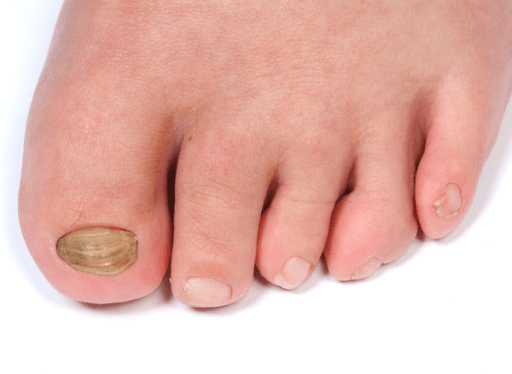
Differential Diagnosis of the Deformed Lesser Toe
The single most common examiner trap is to label every malpositioned lesser toe a "curly toe". Each deformity has a distinct plane, mechanism and operation. Curly toe is a flexion-and-rotation deformity driven by tight long flexors; it must be separated from the coronal-plane overlapping toe, the hyperextension-based hammer/claw/mallet toes, the crossover toe of the adult second ray, and the dorsally subluxed congenital overriding fifth toe.
- Toe(s) / Plane
- 3rd-5th; flexion + rotation (varus)
- Key Mechanism
- Tight FDL ± FDB; toe curls plantar/medial under neighbour
- Distinguishing Feature
- Toe tip points down and under, nail rotated; usually flexible
- Typical Treatment
- Observation or open flexor tenotomy
- Toe(s) / Plane
- 5th; dorsal + adduction
- Key Mechanism
- Tight extensor (EDL) and dorsomedial MTPJ capsule
- Distinguishing Feature
- 5th toe rides OVER 4th dorsally, opposite plane to curly toe
- Typical Treatment
- Butler / extensor release with capsulotomy
- Toe(s) / Plane
- Flexion at PIPJ, extension at MTPJ
- Key Mechanism
- Flexor/extensor imbalance at PIPJ
- Distinguishing Feature
- Acquired in adults; PIPJ buckles, DIPJ neutral
- Typical Treatment
- Flexor tenotomy/transfer or PIPJ fusion
- Toe(s) / Plane
- Extension MTPJ + flexion PIPJ and DIPJ
- Key Mechanism
- Intrinsic minus, often neurological
- Distinguishing Feature
- Multiple toes, look for cavus/neuromuscular cause
- Typical Treatment
- Treat cause; transfers, fusions
- Toe(s) / Plane
- Isolated flexion at DIPJ
- Key Mechanism
- Tight FDL at distal phalanx
- Distinguishing Feature
- Tip callus only; PIPJ normal
- Typical Treatment
- Distal flexor tenotomy
- Toe(s) / Plane
- Coronal-plane varus, may overlap with curly
- Key Mechanism
- Skin/soft-tissue contracture
- Distinguishing Feature
- May tuck under without true flexion-rotation
- Typical Treatment
- Taping in neonate; release if persistent
The classic discriminator: a curly fifth toe curls plantarward and UNDER the fourth toe (flexion-rotation, FDL-driven), whereas a congenital overriding fifth toe rides dorsally OVER the fourth toe (extension-adduction, EDL/capsule-driven). They are opposite-plane deformities needing opposite operations - flexor surgery versus the Butler extensor-release procedure. Do not confuse them.
Most curly toes are idiopathic and often familial, but a lesser-toe flexion deformity can be the first sign of a neuromuscular disorder, and missing this is a classic trap. Be suspicious when the picture is atypical:
- Progressive worsening rather than a stable congenital deformity.
- Multiple toes or a claw-toe pattern (extension at MTPJ with flexion at PIP and DIP) rather than the isolated 3rd-5th flexion-rotation of true curly toe.
- Associated pes cavus, a high arch, or hindfoot varus.
- Asymmetry, sensory changes, weakness, or an abnormal gait.
- A family history of neuropathy or a known neurological condition.
These features should prompt a focused neurological examination and consideration of Charcot-Marie-Tooth disease (hereditary motor-sensory neuropathy), spinal dysraphism / tethered cord, or cerebral palsy. The cavus-clawtoe combination in particular is Charcot-Marie-Tooth until proven otherwise. Treating the toe in isolation without recognising the underlying disease leads to recurrence and misses the real diagnosis.
Investigations
A clinical diagnosis. A flexed and rotated toe curling under its neighbours is diagnostic, and a simple case may not need imaging at all. AP and lateral radiographs of the foot are usually normal; when they are taken their job is to rule out a skeletal abnormality and to assess joint alignment, and they confirm that there is no bony deformity rather than make the diagnosis.
When to image. Reserve radiographs for:
- An atypical presentation with an unusual deformity pattern
- A rigid deformity, to look for joint contracture or a bony abnormality
- Multiple deformities, to rule out an underlying condition
- Pre-operative planning in a complex case
Management Algorithm
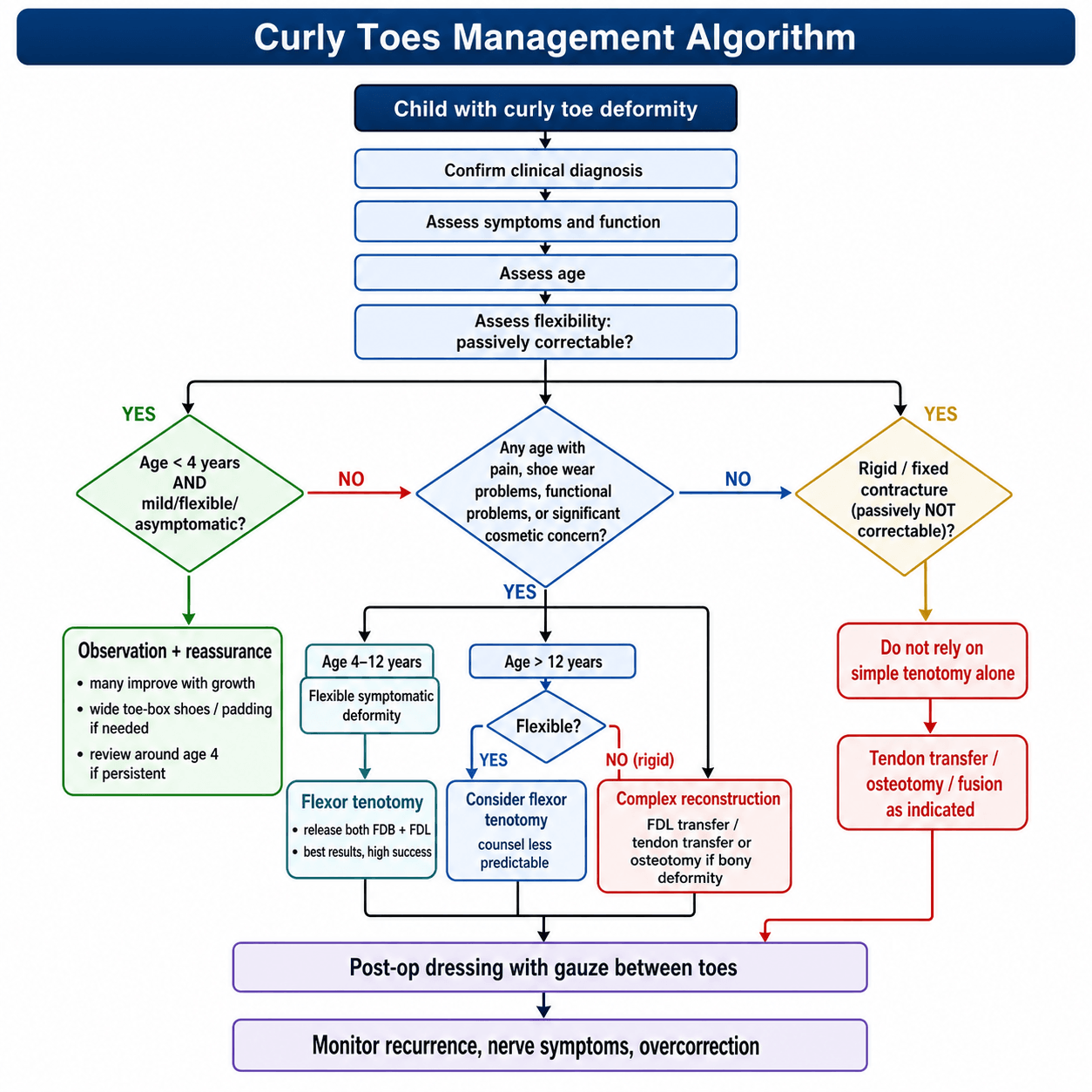
The decision. Age is the primary factor in choosing treatment, and flexibility is assessed alongside it: a rigid deformity needs a bony procedure regardless of age.
- Deformity Type
- Flexible, may be asymptomatic
- Treatment
- Observation - may resolve spontaneously
- Key Point
- Observe because persistence is usually painless, not because resolution is predictable
- Deformity Type
- Flexible, symptomatic
- Treatment
- Flexor tenotomy (FDB + FDL)
- Key Point
- Optimal age, 90%+ success
- Deformity Type
- May be rigid
- Treatment
- Tendon transfer or osteotomy
- Key Point
- Simple tenotomy often insufficient; result depends on flexibility
- Deformity Type
- Rigid, fixed contracture
- Treatment
- Bony procedure (fusion, osteotomy)
- Key Point
- Soft tissue release insufficient; good if the flexible component is addressed
Under 4 years: observe, for the right reason. The spontaneous-resolution figures cannot be reduced to one number (see the pearl under Controversies), so observation is justified because the deformity is usually painless and surgery can wait, not because correction is predictable. Tell parents honestly that some toes straighten, many do not, and that the literature does not allow a confident percentage, but that persistence is usually painless; promising resolution sets a family up to feel misled at age 5. Avoid surgery in very young children and reassess at age 4 if the toe is still there.
4-12 years: flexor tenotomy. This is the optimal age. For the symptomatic flexible toe, division of FDB and FDL succeeds in over 90% with appropriate technique, and it can be done at any point in this age range.
Over 12 years: assess flexibility before choosing. If the toe is still flexible, tenotomy may still work. If it is rigid, it needs a tendon transfer, FDL to the extensor hood (Girdlestone-Taylor), or an osteotomy if there is bony deformity.
Why the transfer is reserved for the rigid toe. A double-blind randomised trial (Hamer, PMID 8331129) is conventionally cited as showing that simple tenotomy matches flexor-to-extensor transfer in the childhood curly toe. In a flexible deformity, then, the transfer's extra dissection, scar and stiffness risk buy nothing. The transfer earns its place only where a tenotomy cannot work because the deformity is no longer flexor-driven.
Conservative measures. For mild cases or children under 4, the options are observation and reassurance. Explain the natural history accurately: persistence is the commoner outcome, and it is persistence without symptoms that makes observation reasonable. A wider toe box may help and padding between the toes may provide some relief.
Strapping and taping. In the older child strapping is ineffective: Turner found 68% of toes improved while the strapping was on, but the correction was lost once it stopped. The exception is the neonate. Taping begun within about 10 days of birth improved or cured 94% of 84 toes in Smith's prospective series. So the honest statement is not "taping does not work" but "taping works only in a window that closes in the first weeks of life", which is also why it is worth recognising these toes on the newborn check.
Indications for surgery. Most symptomatic cases in the 4-12 year age group benefit from surgical release. Operate for:
- Pain, from nail weight-bearing or dorsal rubbing
- Corns or calluses from shoe pressure
- Functional problems: catching on socks, difficulty with shoes
- Under-riding that puts pressure on the adjacent toe
- Significant cosmetic concern causing distress
- Failed observation (if under 4, reassess at 4)
- Age 4-12 years, the optimal window for tenotomy
Surgical Technique
Principle. Divide both FDB and FDL through a small plantar incision to release the flexor pull and let the toe straighten.
The precondition, and it is a real one. Ross and Menelaus set an explicit selection rule that is easy to skip and that decides whether the operation can work at all: pre-operative assessment must show that the resting length of the flexor tendons is unduly short, and that this shortening is the only cause of the deformity. A tenotomy releases a tight tendon; it does nothing to a fixed rotational or bony deformity, an interphalangeal joint contracture, or a toe deformed by a trapezoidal phalanx. So before consenting, confirm that the deformity corrects passively and that the flexor is the structure holding it. If the toe does not straighten fully on passive correction, dividing the flexors will not straighten it either; reconsider the diagnosis rather than the incision.
Flexor Tenotomy Steps
- Supine on the operating table
- Frog-leg position, hip flexed and externally rotated, for access to the plantar foot
- Ankle or thigh tourniquet for haemostasis
- Plantar surface of the affected toe or toes clearly visible
A 2-3mm transverse incision on the plantar surface, lying in the PIPJ flexion crease and never crossing it, placed exactly in the midline and taken through skin and subcutaneous tissue to the flexor sheath. The transverse orientation matters: in the landmark series the one identifiable cause of failure was a scar crossing one or more flexor creases, which tethers the toe back into flexion. A short transverse incision sitting along the line of the crease does not cross it; a longitudinal incision does. This is a technical error, not an age-related or biological one, so it is entirely within your control.
Open the flexor sheath and identify the tendons. FDB is superficial and splits into two slips; divide both. FDL lies deeper as a single tendon; divide it completely. The toe should straighten immediately once both are divided, and that is the confirmation of a complete release. Incomplete division of either tendon leads to recurrence, so check for residual tightness before closing.
Close with a single stitch or Steristrips and put gauze between the toes to hold the correction. Use a non-constrictive dressing that allows for swelling. A splint is usually not needed after a simple tenotomy.
Digital nerves run on the lateral and medial sides of each toe, NOT in the midline. The incision must be exactly midline at the PIPJ flexion crease. A 2-3mm transverse incision is sufficient and safe if placed correctly; deviation from the midline risks nerve injury.
Open flexor tenotomy is the classic, reliable operation, but a percutaneous (needle) flexor tenotomy is a recognised, lower-morbidity alternative for the flexible toe and is the standard technique in some settings:
- Percutaneous: under local or general anaesthesia, the flexor tendon(s) are divided through a stab or needle (e.g. a hypodermic needle or a small blade) introduced at the flexion crease, sweeping across the tendon until the toe straightens - no formal incision or suture.
- Advantages: minimal scar (so it cannot cross and tether a flexion crease - the documented cause of failure in open tenotomy), quick, day-case, often under local anaesthetic in a cooperative child.
- Caveats: it is a "blind" division, so completeness is judged by the toe straightening on the table; the same digital-nerve-on-the-sides rule applies and a guarded midline entry is essential.
- Percutaneous distal flexor tenotomy is also the workhorse for the diabetic/neuropathic toe with an apical (tip) ulcer or a mallet toe, where it offloads the tip with negligible morbidity.
The examiner is testing that you know both exist and that the principle - complete release confirmed by on-table correction, with the scar kept away from a flexion crease - matters more than the specific approach.
Complications
Recurrence is the complication to know, and it is usually from incomplete division of FDB or FDL. The others are listed for completeness; the nerve injury is the one the midline incision is designed to avoid.
- Incidence
- 5-10%
- Cause
- Incomplete division of FDB or FDL
- Management
- Revision tenotomy
- Incidence
- Rare (less than 1%)
- Cause
- Incision not midline, poor technique
- Management
- Usually resolves, may need exploration
- Incidence
- Rare
- Cause
- Excessive release
- Management
- Usually mild, observation
- Incidence
- Less than 5%
- Cause
- Contamination, poor healing
- Management
- Antibiotics, local care
- Incidence
- Rare
- Cause
- Nerve injury or irritation
- Management
- May need excision if symptomatic
Postoperative Care and Rehabilitation
The aftercare is simple. The gauze between the toes is what holds the correction and prevents recurrence.
Postoperative Protocol
Gauze between the toes to maintain the correction, heel weight-bearing at first to protect the repair, and elevation to reduce swelling. Pain is usually minimal.
Change the dressing, check the wound and replace the gauze between the toes. Remove sutures at 10-14 days if any were used, and progress to full weight-bearing.
Remove the gauze after 2-4 weeks once the correction is maintained. Normal activities and normal shoes resume as comfort allows, which for most children means within 2-4 weeks, and the toe is reviewed for recurrence.
Check for recurrence at follow-up visits, confirm normal toe function and assess the final appearance. Additional procedures are rarely needed if the initial procedure succeeded.
Outcomes
Results. Ross and Menelaus reported success in roughly 95% of 188 toes, and results above 90% are the expectation when the operation is done correctly; the keys are complete division of the offending flexor tendon(s) and an incision that does not cross a flexor crease. Recurrence runs at 5-10%, usually from incomplete division. It is a day-case procedure with a quick recovery, most children are back to normal activities within 2-4 weeks, and the cosmetic and functional improvements are usually excellent. It is one of the most successful and lowest-morbidity paediatric foot procedures.
What predicts a good result.
- Age 4-12 years
- A flexible rather than rigid deformity
- Complete division of both FDB and FDL
- Gauze between the toes afterwards, to prevent recurrence
Guidelines, Registries & Global Practice
Global epidemiology
- Congenital curly/varus/underlapping and overlapping toes were found in 2.8% of newborns screened in a prospective study (Smith et al).
- The deformity is frequently bilateral and often familial (autosomal dominant tendency reported in some families), affecting the 3rd, 4th and 5th toes most often.
- Spontaneous improvement is quoted from about 25% (Smith et al, citing world literature) to over 90% in other series - the spread reflects different ages at review, different definitions of "resolved", and screened versus clinic-presenting cohorts. Quote the range, not a point estimate; toes that persist are commonly asymptomatic.
- There is no implant or arthroplasty registry relevant to curly toe - it is a soft-tissue paediatric procedure - so the evidence base is case-series driven rather than registry driven, unlike adult forefoot reconstruction.
Side-by-side guidance from major bodies
- Conservative
- Observe asymptomatic flexible toes
- Surgical threshold
- Persistent symptomatic deformity
- Procedure of choice
- Open flexor tenotomy
- Conservative
- Reassure; taping of limited value beyond infancy
- Surgical threshold
- Symptoms (pain, footwear, skin breakdown)
- Procedure of choice
- Open flexor tenotomy; transfer/osteotomy if rigid
- Conservative
- Observation; flexor lengthening considered to preserve flexion
- Surgical threshold
- Symptomatic or severe overlapping
- Procedure of choice
- Tenotomy or FDL Z-lengthening (+/- FDB)
- Conservative
- Limited role
- Surgical threshold
- Severe overlapping by age 2-3 years
- Procedure of choice
- FDB slip tenotomy +/- capsular release / skin flap
The points of genuine divergence are timing (earlier in severe overlapping per the Tokioka school versus a symptom-led approach elsewhere) and division versus lengthening of the flexor. All converge on observation for the asymptomatic flexible toe and on a flexor-based soft-tissue operation as the workhorse.
High- versus limited-resource practice variation
- Day-case procedure under general or regional anaesthesia
- Routine paediatric orthopaedic or paediatric surgical follow-up
- Easy access to early review and revision if recurrence occurs
- Low threshold to image atypical or rigid toes before surgery
- Often performed under local anaesthesia in older cooperative children, minimising theatre and anaesthetic burden
- Clinical diagnosis without routine radiographs is entirely appropriate (cost-saving and accurate)
- Neonatal taping is an attractive low-cost first-line option where the deformity is recognised at birth
- Strong emphasis on reserving surgery for genuinely symptomatic toes given limited operative capacity
Regardless of health system, document the flexibility assessment, which flexor tendon(s) were divided, and confirmation that the toe straightened on the table. Consent should cover recurrence (around 5%), digital nerve injury (rare) and the principle that some minor toes are better observed than operated.
Controversies and Areas of Uncertainty
The "facts" most candidates recite about curly toes are softer than they sound. Being able to articulate the genuine areas of debate marks out a strong answer.
Timing of surgery. There is no consensus age. A symptom- and flexibility-led pathway is widely taught, but Tokioka and colleagues argue that severe overlapping toes should be corrected by 2-3 years because spontaneous correction is unlikely and later surgery risks skeletal deformity. Others defer until school age to avoid operating on toes that may settle. The honest answer is that timing is individualised, not fixed.
Tenotomy versus lengthening. Simple division sacrifices active toe flexion, which is usually clinically irrelevant, whereas Z-lengthening (Jacobs and Vandeputte) aims to preserve flexion power and strength. Whether retaining active flexion of a lesser toe matters functionally is unproven, and lengthening is technically more demanding.
Which tendon to divide. Teaching ranges from FDB slip only (Tokioka) to both FDB and FDL, the common exam answer. Ross and Menelaus emphasised dividing whatever short flexor is the sole cause of deformity. The pragmatic rule is to divide enough that the toe straightens fully on the table, then confirm.
The role of conservative treatment. Strapping fails to hold correction once stopped in older children (Turner), yet neonatal taping cured or improved 94% of toes (Smith). The window in which non-operative treatment works may be confined to the first weeks of life, a genuine and underappreciated nuance.
The often-quoted "most curly toes resolve" is stated far more confidently than the evidence allows - but so is any single replacement figure. Published series disagree sharply, with spontaneous resolution quoted anywhere from about a quarter to over 90%, and they differ in the age at which they look, in whether "resolution" means a straight toe or merely a painless one, and in whether the toes were screened at birth or presented to a clinic. Note too that the widely repeated 25% comes from Smith et al citing world literature - it is a second-hand summary, not a measurement they made.
So the defensible position is that the true rate is genuinely uncertain, and the wide range is the finding. Counsel families on that basis: the deformity is usually painless and often needs nothing, some toes straighten and many do not, and no one can promise which. That is a stronger viva answer than quoting either "most resolve" or a falsely precise percentage.
MCQ Practice Points
Q: What is the optimal age for flexor tenotomy for curly toes? A: 4-12 years is the optimal age range. Under 4 years the standard advice is observation - but be careful how you justify it: published spontaneous-resolution rates run from about 25% to over 90%, so you observe because the deformity is usually asymptomatic and there is time, not because correction is predictable. Over 12 years, simple tenotomy may be insufficient and more complex procedures may be needed. Age 4-12 years has the best outcomes with tenotomy (90%+ success rate).
Q: Which tendons must be divided for curly toe tenotomy? A: Both FDB (flexor digitorum brevis) and FDL (flexor digitorum longus) must be divided. FDB is superficial and splits into 2 slips (both must be divided). FDL is deeper and is a single tendon (must be completely divided). Incomplete division of either leads to recurrence.
Q: Where should the incision be made for flexor tenotomy? A: Exactly midline at the PIPJ flexion crease on the plantar surface. Digital nerves run on the lateral and medial sides of the toe, not midline. A 2-3mm transverse incision in the midline is safe and protects the nerves. Deviation from midline risks nerve injury.
Q: What is the key post-operative measure to prevent recurrence? A: Gauze between toes for 2-4 weeks maintains correction and prevents recurrence. The toe should be kept straight with gauze padding. Heel weight-bearing initially protects the repair. This simple measure significantly reduces recurrence risk.
Q: What is the recurrence rate after flexor tenotomy for curly toes? A: 5-10% recurrence rate, usually from incomplete division of FDB or FDL. If both tendons are completely divided and post-operative care is appropriate (gauze between toes), recurrence is uncommon. Revision tenotomy is usually successful if the initial release was incomplete.
Q: What is the success rate of flexor tenotomy for curly toes? A: 90%+ success rate when performed correctly in children aged 4-12 years. The key factors are: complete division of both FDB and FDL, appropriate age (4-12 years), flexible deformity, and proper post-operative care with gauze between toes.
Exam Viva Scenarios
Practise clinical reasoning and management decisions out loud
“Walk me through flexor tenotomy for a curly toe in a 6-year-old child.”
“A 3-year-old has curly toes affecting both 4th toes. The parents want surgery. What is your approach?”
“A 10-year-old had flexor tenotomy for curly toe 6 months ago, but the deformity has recurred. How do you manage this?”
Age-Based Treatment
- Under 4 years: Observe - spontaneous improvement quoted from ~25% to over 90%; persistence usually painless
- 4-12 years: Flexor tenotomy (FDB + FDL) - 90%+ success
- Over 12 years: May need tendon transfer or osteotomy
- Rigid deformity: Needs bony procedure regardless of age
Surgical Technique
- Incision: 2-3mm transverse, exactly midline at PIPJ crease
- Divide FDB: Superficial, splits into 2 slips (divide both)
- Divide FDL: Deeper, single tendon (divide completely)
- Confirm: Toe should straighten immediately when both divided
Key Anatomy
- Digital nerves: Run on lateral and medial sides, NOT midline
- FDB: Superficial, splits into 2 slips
- FDL: Deeper, single tendon
- Midline approach: Safe for both tendons, protects nerves
Post-operative Care
- Gauze between toes: 2-4 weeks to maintain correction
- Heel weight-bearing: Initially, progress to full
- Minimal pain: Usually well-tolerated
- Quick recovery: 2-4 weeks to normal activities
Complications
- Recurrence: 5-10% if incomplete division
- Digital nerve injury: Less than 1% if midline approach
- Overcorrection: Rare
- Wound infection: Less than 5%
Evidence Base
The evidence for curly toes is dominated by retrospective case series, with one important exception: Hamer, Stanley and Smith published a double-blind, randomised, prospective trial of surgery for curly toe deformity in 1993, and it is the paper behind the teaching that a simple flexor tenotomy is enough. The studies below are the most frequently cited and are presented with their sample sizes and outcomes. A recurring theme is that open flexor tenotomy reliably corrects flexible deformity, that failure correlates with surgical technique (scar crossing a flexion crease) rather than with age, and that conservative strapping/taping does not produce durable correction beyond the neonatal period.
Surgery for Curly Toe Deformity - a Double-Blind, Randomised, Prospective Trial
- A double-blind, randomised, prospective trial of surgery for curly toe deformity - an unusually high level of evidence for a paediatric forefoot procedure
- Conventionally cited as showing that simple FLEXOR TENOTOMY is as effective as the more extensive FLEXOR-TO-EXTENSOR TRANSFER (Girdlestone-Taylor)
- It is the reason the smaller operation became the default for a flexible childhood curly toe
Open Flexor Tenotomy for Curly and Hammer Toes (Landmark Series)
- 62 children (188 toes) reviewed at mean 9.8 years after open flexor tenotomy
- Operation unsuccessful in only 5% of toes (95% success)
- Identifiable cause of failure was the scar crossing one or more flexor creases - a technical, not age-related, error
- No patient was aware of loss of flexor power; only one toe was stiff (from scar tethering)
Flexor Tenotomy in the Treatment of Curly Toes (Original Description)
- Early case series establishing flexor tenotomy as treatment for symptomatic curly toes
- Demonstrated preserved toe movement after tendon division
- Helped define curly toe as a flexor-driven deformity of the toe joints
Open Tenotomy of Flexor Digitorum Brevis for Curly Toe
- 8 toes in 7 children treated by open tenotomy of the medial slip of FDB (with capsular release for severe cases)
- Median age 2 years 6 months; overlapping corrected in every case at median 2 years 9 months follow-up
- Residual flexion/varus persisted in the most severe toes
- Authors argue severe overlapping toes should be corrected by 2-3 years because spontaneous correction is unlikely and later surgery risks skeletal deformity
Flexor Tendon Lengthening for Hammer and Curly Toes
- Retrospective series of flexor tendon lengthening (rather than simple tenotomy) at mean 31 months follow-up
- Deformity improved in all patients, with less improvement in the 4th and 5th toes
- Active toe flexion and strength recovered in all patients
- Recommended Z-lengthening of FDL for hammer toes plus FDB tenotomy for curly toes
Strapping of Curly Toes - Conservative Treatment Has No Durable Effect
- Retrospective review of 49 children treated by strapping (24 children, 44 toes reviewed)
- Strapping improved 68% of toes while maintained, but correction was lost significantly once strapping stopped
- Sustained improvement was not sufficient to justify strapping for this minor deformity
- Author recommends open flexor tenotomy and reserves treatment for the more severely deformed toe
Neonatal Taping for Congenital Curly/Underlapping and Overlapping Toes
- Prospective study of 84 toes taped within 10 days of birth and reviewed by an independent assessor
- 94% of toes improved or cured with no complications
- Quoted world literature suggests only about 25% spontaneous improvement without treatment
- Toe abnormalities occurred in 2.8% of newborns screened
Spread of Practice - AAOS/POSNA and BSCOS Educational Guidance
- Curly toe is described as a common, usually benign, often familial flexible deformity of the lesser toes
- Observation is recommended for the asymptomatic toe; many improve or stabilise with growth
- Open flexor tenotomy is the standard operation for the persistently symptomatic flexible toe
- Rigid or fixed deformity, and recurrence, may require tendon transfer or bony correction