Pes Planus | Physiological | Jack's Test
- Natural History: Most infants have flat feet. The arch develops spontaneously within the first decade of life. 90% resolve by age 10.
- Physiological vs Pathological: Flexible, painless flatfoot is physiological. Painful or rigid flatfoot is pathological.
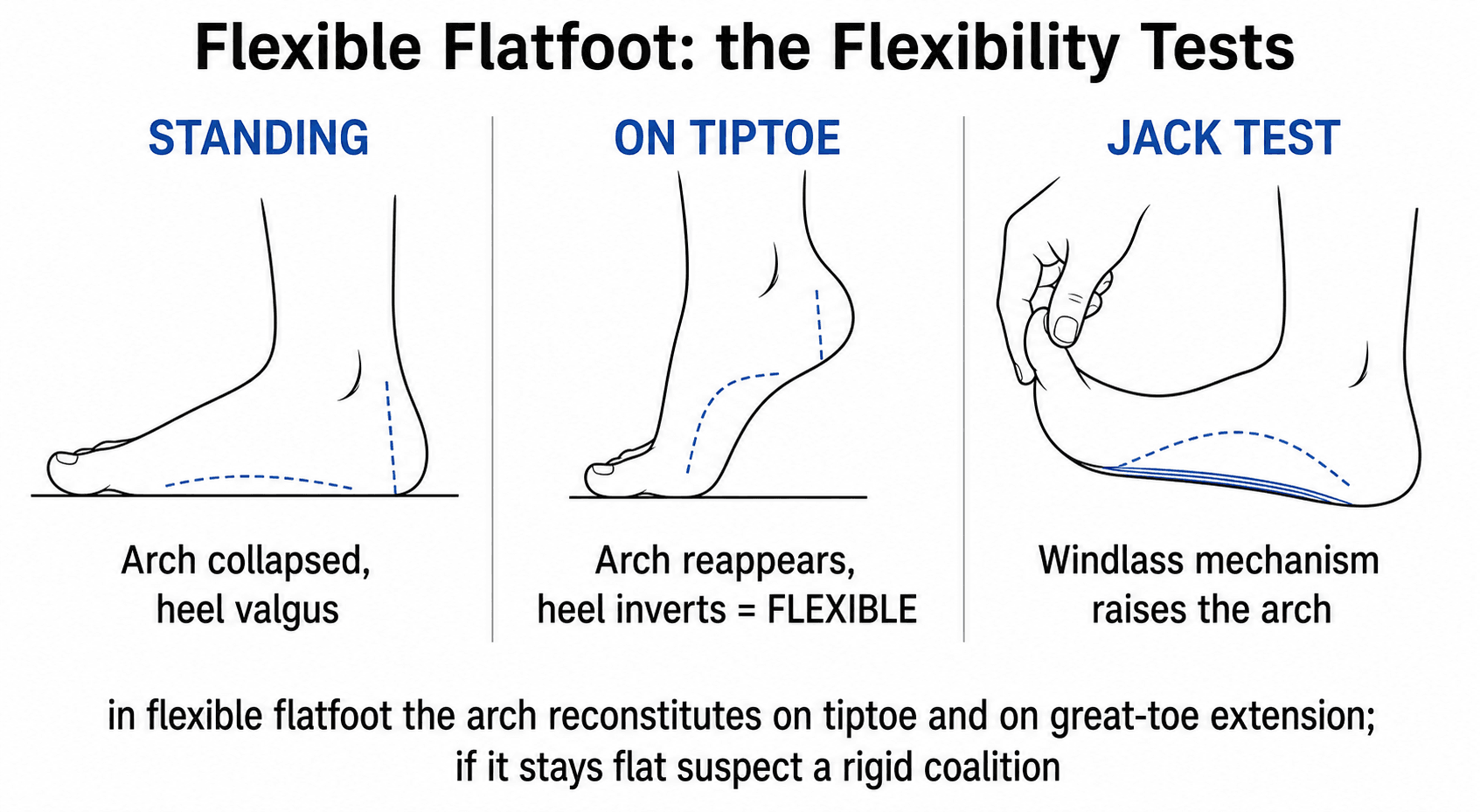
- Jack's Test: Passive extension of the big toe engages the Windlass mechanism. If the arch reconstitutes, it is flexible.
- Treatment: Asymptomatic flexible flatfoot requires NO treatment (no orthotics). Symptomatic cases start with calf stretching.
- “Look at the parents' feet. It is often familial.
- “Always check the shoes for wear patterns. Uneven medial wear suggests significant pronation.
- “Don't forget to assess generalised ligamentous laxity (Beighton Score).
Overview and Epidemiology
Flexible flatfoot is the most common reason for referral to a paediatric orthopaedic clinic. The medial longitudinal arch is lost only during weight bearing and returns when the foot is unloaded or the Windlass mechanism is engaged; that reducibility is what "flexible" means, and it is the finding the whole consultation turns on.
Terms. Pes planus is the flat foot: valgus of the hindfoot, abduction of the forefoot and depression of the medial longitudinal arch. Pes planovalgus is the same deformity named for its heel component. A flexible flatfoot is reducible, with mobile subtalar, talonavicular and calcaneocuboid joints.
Natural history. The neonatal foot is flat because of a plantar fat pad and ligamentous laxity, and the arch appears as the neuromuscular system matures. Morley (1964) found 97% of 2-year-olds flat-footed but only 4% of 10-year-olds, so spontaneous resolution is the rule and the first decade is the timescale.
Aetiology. Ligamentous laxity is the usual substrate, whether generalised (Ehlers-Danlos, Marfan, Down syndrome) or isolated and familial, which is why the parents' feet are worth a glance. Obesity adds load to the arch. W-sitting is associated with femoral anteversion and external tibial torsion, the "miserable malalignment" pattern.
Pathophysiology and Mechanisms
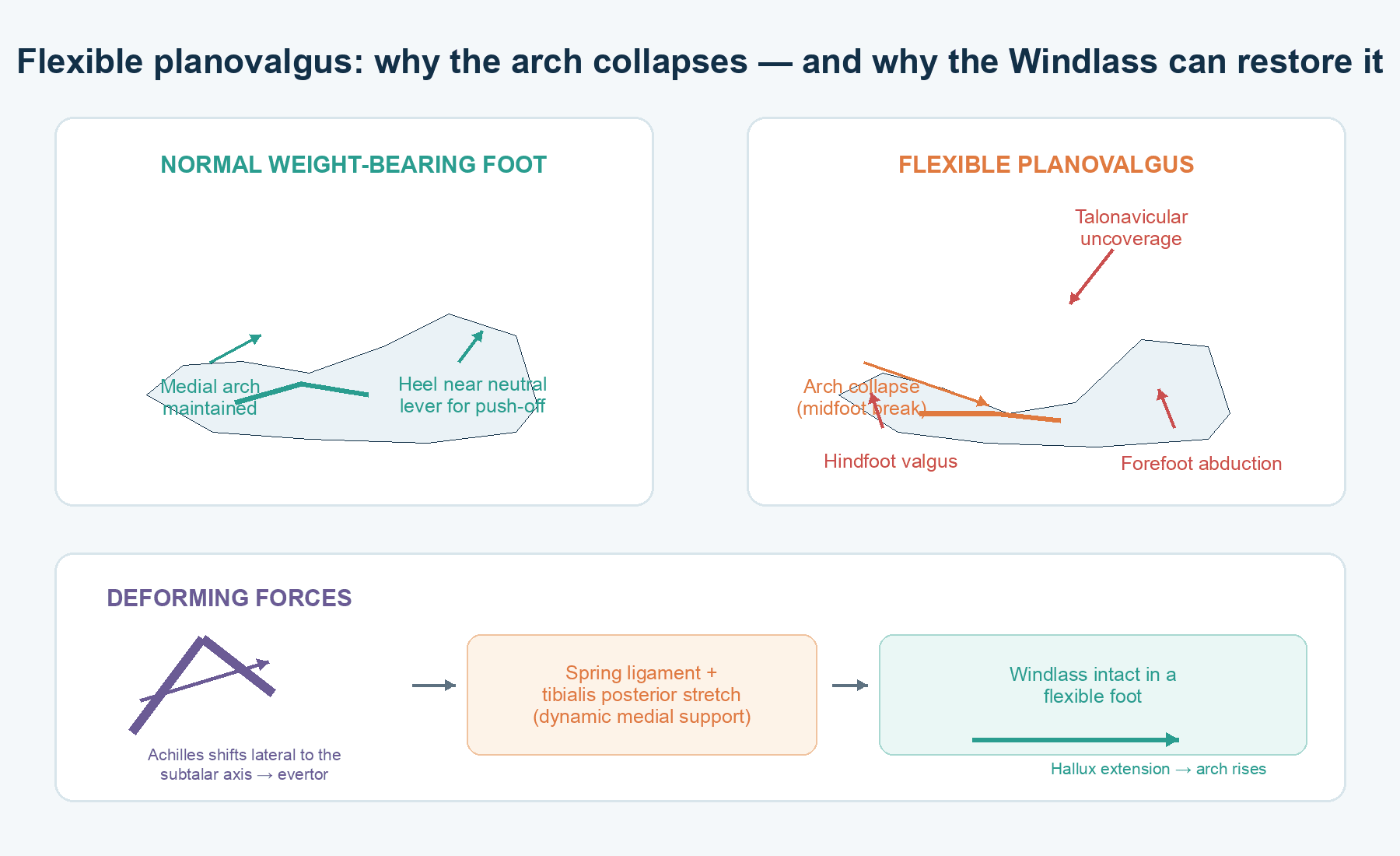
The keystone. The talonavicular joint is the keystone of the arch. In flatfoot the talar head uncovers medially and plantarward, a peritalar subluxation, and the rest of the deformity follows: the calcaneus falls into valgus, the midfoot breaks, and the forefoot abducts relative to the hindfoot.
The Achilles becomes a deforming force. With the hindfoot in valgus the tendo Achillis lies lateral to the axis of the subtalar joint, so it now acts as an evertor and drives the deformity rather than resisting it.
The medial column stretches. The spring (calcaneonavicular) ligament and tibialis posterior are the medial restraints, and in flatfoot both stretch out. The spring ligament's superomedial band is the most important stabiliser and its inferoplantar band supports the head of the talus. Tibialis posterior is the primary dynamic stabiliser of the arch, inserting on the navicular tuberosity with slips to the cuneiforms, cuboid and the second to fourth metatarsals; its failure produces the adult acquired flatfoot, whereas in children the problem is usually laxity, not rupture.
The lateral column. In flatfoot the lateral column is, in theory, short relative to the medial column, which is the rationale for lengthening it.
Gait. At heel strike the calcaneus everts, unlocking the subtalar joint so the foot can absorb shock. In mid-stance the subtalar joint inverts, locking the midtarsal joint and turning the foot into a rigid lever for push-off. The flat foot stays everted and unlocked throughout stance, so gait is inefficient.
The Windlass mechanism. Extending the hallux pulls on the plantar aponeurosis and shortens the distance between the calcaneus and the metatarsal heads, so the arch rises and the hindfoot inverts. In a flexible flatfoot the mechanism is intact; in a rigid one it is blocked, which is what Jack's test exploits.
Classification
Both systems grade the weight-bearing footprint rather than the foot.
Harris and Beath (1947)
Graded by talocalcaneal overlap on the weight-bearing footprint (Harris mat). Most flexible feet are Type II.
- Type I: arch present
- Type II: arch absent with heel valgus, the flexible foot
- Type III: rigid flatfoot (coalition)
Clinical Assessment
History. Ask where it hurts, because the site sorts the pain generators: the sinus tarsi points to impingement, the medial arch to medial strain. The activity complaints to listen for are "tired legs" and a child who refuses to walk any distance. Record prematurity, developmental delay and the family history.
Standing. Examine barefoot and compare both sides. Record arch height, hindfoot valgus, forefoot abduction, heel-cord orientation, callosity and shoe wear: from behind, seeing more than 1.5 toes lateral to the heel is the too-many-toes sign and suggests forefoot abduction, a callus under the medial talar head marks a severe deformity, and uneven medial shoe wear suggests significant pronation. Then watch the child walk, run and rise on tiptoe, looking for an antalgic gait or internal rotation.
Test correction, not appearance. With the child standing, ask for a double- then a single-leg heel raise. A flexible foot recreates the arch and swings the heel into varus; pain, inability or persistent valgus suggests a symptomatic tendon problem, a coalition or neuromuscular weakness.
Jack's test. Stabilise the hindfoot, passively extend the hallux at the metatarsophalangeal joint with the child standing, and watch the medial arch and the calcaneus. A rising arch is a positive flexibility response. Pain at the plantar fascia or no correction is not a positive result and should prompt a search for rigidity or another pain generator.
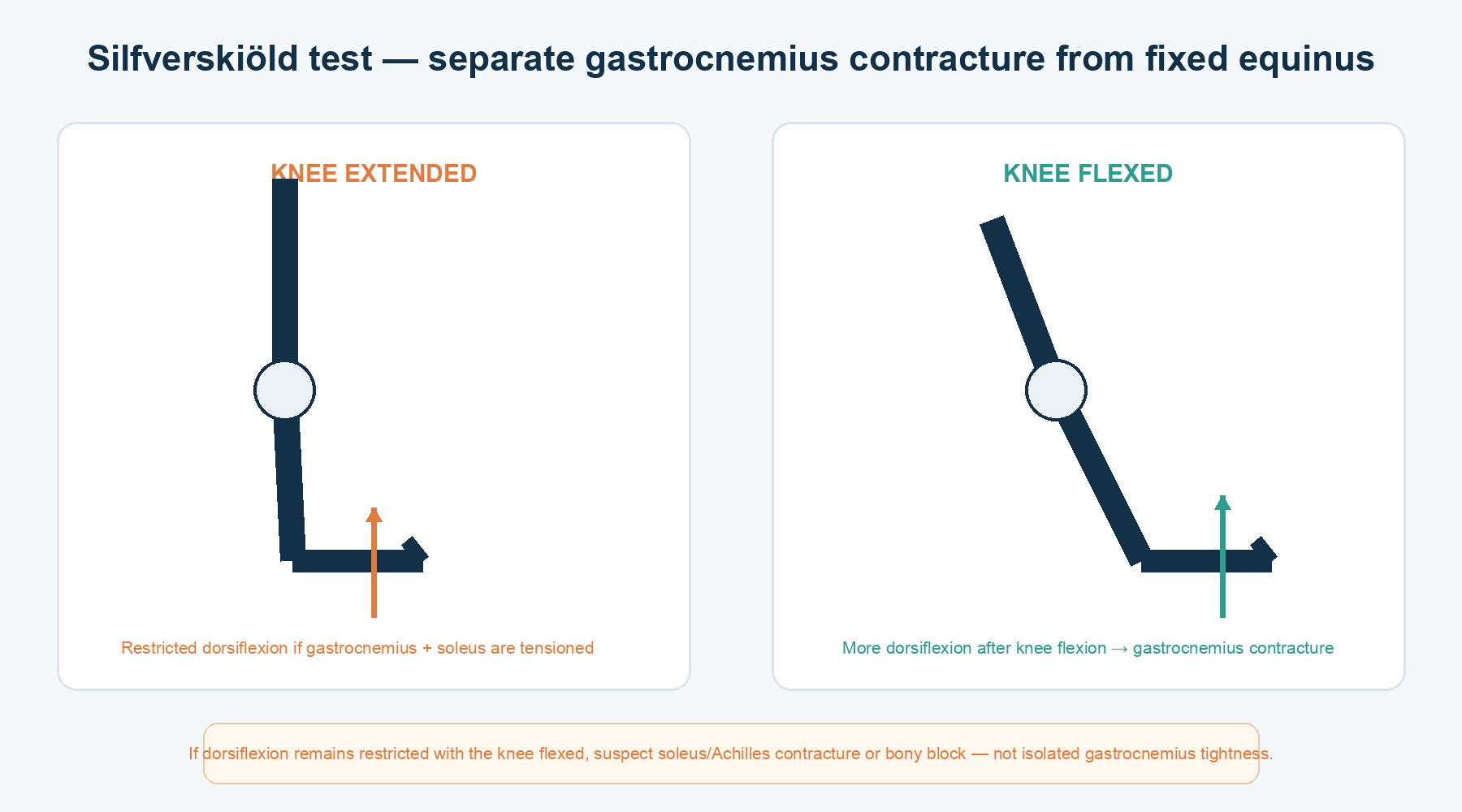
Equinus. Measure ankle dorsiflexion with the knee extended and then flexed, holding the hindfoot in neutral so the midtarsal joint cannot substitute for ankle motion; this is the Silfverskiöld test. A meaningful increase after knee flexion indicates gastrocnemius tightness; persistent equinus in both positions indicates soleus/Achilles tightness or a structural block.
Subtalar and midtarsal motion. Move the calcaneus through inversion and eversion while palpating the talar head, and check whether the foot can be passively corrected to neutral. Subtalar motion in a flexible foot is normal or hypermobile; marked restriction, pain or peroneal spasm is abnormal for an idiopathic flexible foot and warrants coalition imaging.
Palpation. Localise tenderness to the navicular prominence, the tibialis posterior insertion, the plantar fascia, the sinus tarsi or the calcaneocuboid joint. Test resisted inversion and plantarflexion, and document skin pressure from footwear.
The whole child. Record limb-length asymmetry, tibial torsion, femoral version, genu valgum, Beighton laxity and neuromuscular signs.
A deformity with any of these is not presumed physiological:
- Progressive deformity
- Asymmetrical or unilateral flatfoot
- Inflammation: swelling or warmth
- Neurological signs (cavovarus is the commoner neurological foot shape, but flatfoot occurs in cerebral palsy)
Traps. Allowing the child to pronate the forefoot during dorsiflexion measurement; calling a painful forced manoeuvre "rigid" without checking subtalar motion; and diagnosing a coalition from a flat arch alone.
Investigations
When to image. Radiographs are usually not needed for a physiological flatfoot. Request standing AP and lateral foot radiographs when pain, rigidity, asymmetry, atypical age or operative planning makes imaging useful, and add the view the question needs:
- Harris (Saltzman) axial hindfoot view when coronal hindfoot alignment matters
- 45-degree oblique view for a suspected calcaneonavicular coalition
- Forced-plantarflexion lateral in a rigid rocker-bottom foot, to separate a reducible oblique talus from congenital vertical talus; persistent dorsal navicular dislocation and a vertical talus support congenital vertical talus
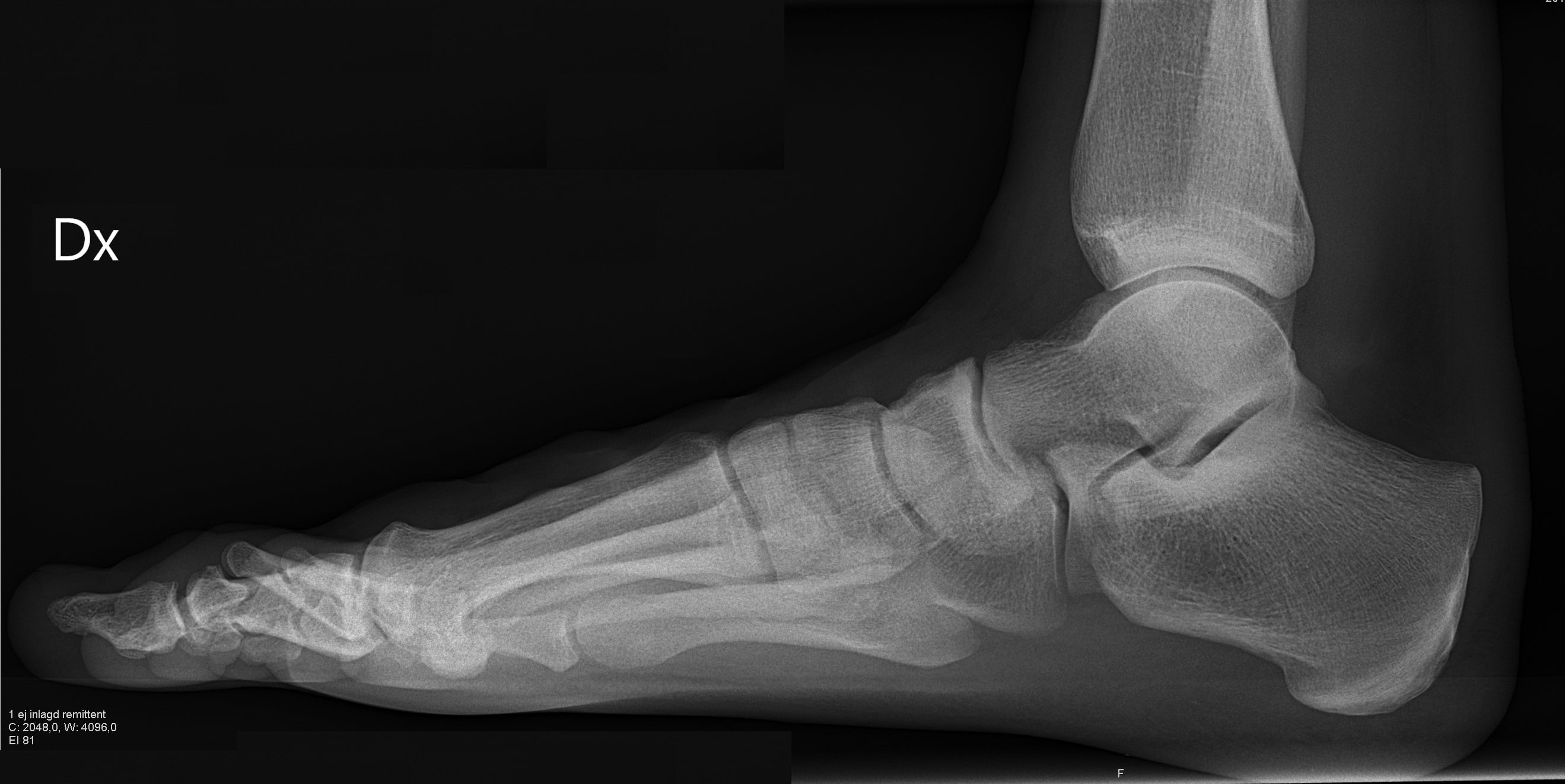
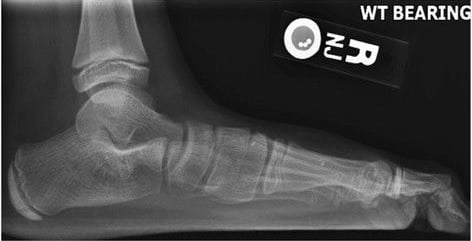
The lateral view. Draw the long axes of the talus and first metatarsal for Meary's angle, record the calcaneal pitch from the inferior calcaneal surface to the floor, and assess talar beaking, talocalcaneal overlap and the height of the medial column.
The AP view. Assess talonavicular coverage, talo-first-metatarsal alignment and forefoot abduction. Describe direction and severity rather than treating one angle as an isolated surgical threshold.
- Normal
- 0 degrees (Straight line)
- Flatfoot
- Convex downwards (Sag)
- Normal
- 20-30 degrees
- Flatfoot
- Decreased (less than 15 even negative)
- Normal
- Aligned
- Flatfoot
- Lateral subluxation of Navicular
CT and MRI. Neither is routine. CT is the best study to define a suspected osseous coalition, its location and extent, subtalar joint degeneration and the bony anatomy needed to plan resection or fusion; a thin-slice hindfoot CT is not routine for a painless flexible foot. MRI is useful for a fibrous or cartilaginous coalition, tibialis posterior or spring-ligament pathology, marrow oedema and an unexplained pain generator, but it is not a substitute for weight-bearing alignment films when deformity correction is being planned.
Reading the numbers. Measurements support the examination; they do not overrule symptoms, flexibility, skeletal maturity, neuromuscular status or the distribution of deformity.
Differential Diagnosis
The clinical task is to separate benign physiological flexible flatfoot from the pathological mimics that share a flat appearance. Flexibility (the arch restores on tiptoe and on Jack's test) and painlessness are the great discriminators: a flexible foot is usually painless, a rigid one often painful.
- Flexibility
- Flexible, painless
- Key Discriminator
- Arch restores on tiptoe; normal subtalar motion; often familial
- Action
- Reassurance, no imaging
- Flexibility
- Flexible but symptomatic
- Key Discriminator
- Positive Silfverskiold; midfoot break on dorsiflexion
- Action
- Calf stretching first line
- Flexibility
- Rigid
- Key Discriminator
- Loss of subtalar motion, peroneal spasm, C-sign on lateral X-ray, age 8-16
- Action
- CT to characterise bar
- Flexibility
- Rigid (neonatal)
- Key Discriminator
- Rocker-bottom sole, vertical talus on forced-plantarflexion lateral film, dorsal navicular dislocation
- Action
- Reverse-Ponseti +/- surgery
- Flexibility
- Often flexible early
- Key Discriminator
- Medial prominence and tenderness over navicular; single-heel-raise weakness in adolescents
- Action
- Imaging, immobilisation, selective surgery
- Flexibility
- Variable
- Key Discriminator
- Spasticity, equinus, asymmetry, global motor signs
- Action
- Treat underlying condition; bony correction if disabling
- Flexibility
- Flexible
- Key Discriminator
- Forefoot adduction with hindfoot valgus (S-shaped lateral border)
- Action
- Distinguish before any lengthening
Congenital vertical talus is the neonatal rigid flatfoot: the sole is convex, the rocker bottom, and the foot does not reduce. It is not a flexible flatfoot.
Tarsal Coalition: the Rigid-Flatfoot Mimic
The most important pathological cause of a rigid flatfoot is a tarsal coalition, an abnormal fibrous, cartilaginous or bony bridge between two tarsal bones that restricts subtalar and midtarsal motion. It is the classic cause of the peroneal spastic flatfoot, in which the peroneal muscles spasm to splint a painful, stiff hindfoot. Two types make up about 90% of coalitions, and they differ in the age at which they declare themselves and the film that shows them.
- Calcaneonavicular (CN)
- 8-12 years (ossifies earlier)
- Talocalcaneal (TC)
- 12-16 years (ossifies later)
- Calcaneonavicular (CN)
- 45-degree oblique foot
- Talocalcaneal (TC)
- Lateral and Harris axial
- Calcaneonavicular (CN)
- 'Anteater nose' (elongated anterior calcaneal process)
- Talocalcaneal (TC)
- 'C-sign' and talar beaking on lateral; middle-facet obliquity
- Calcaneonavicular (CN)
- CT (MRI for a fibrous bar)
- Talocalcaneal (TC)
- CT (defines the middle-facet bar)
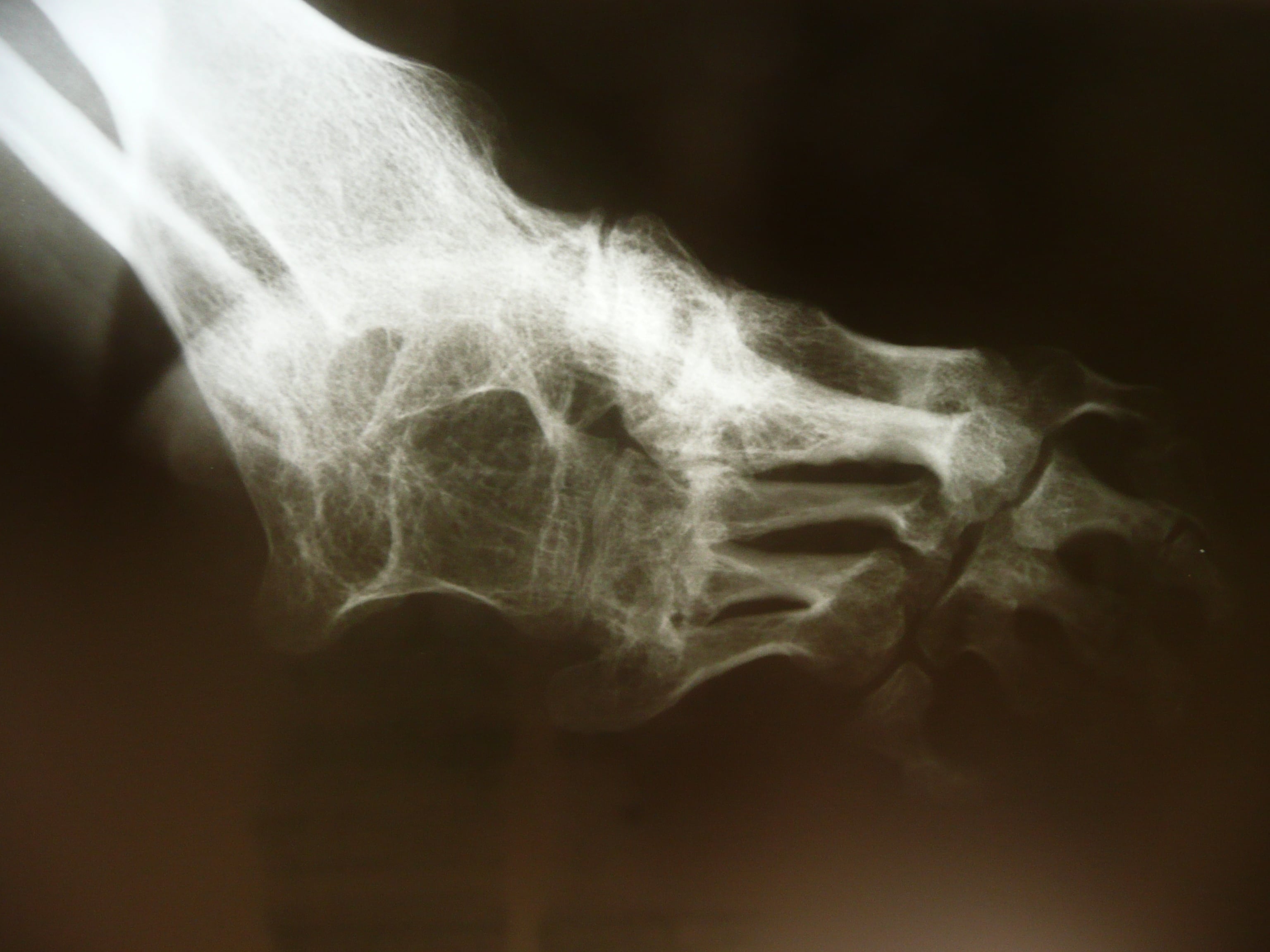
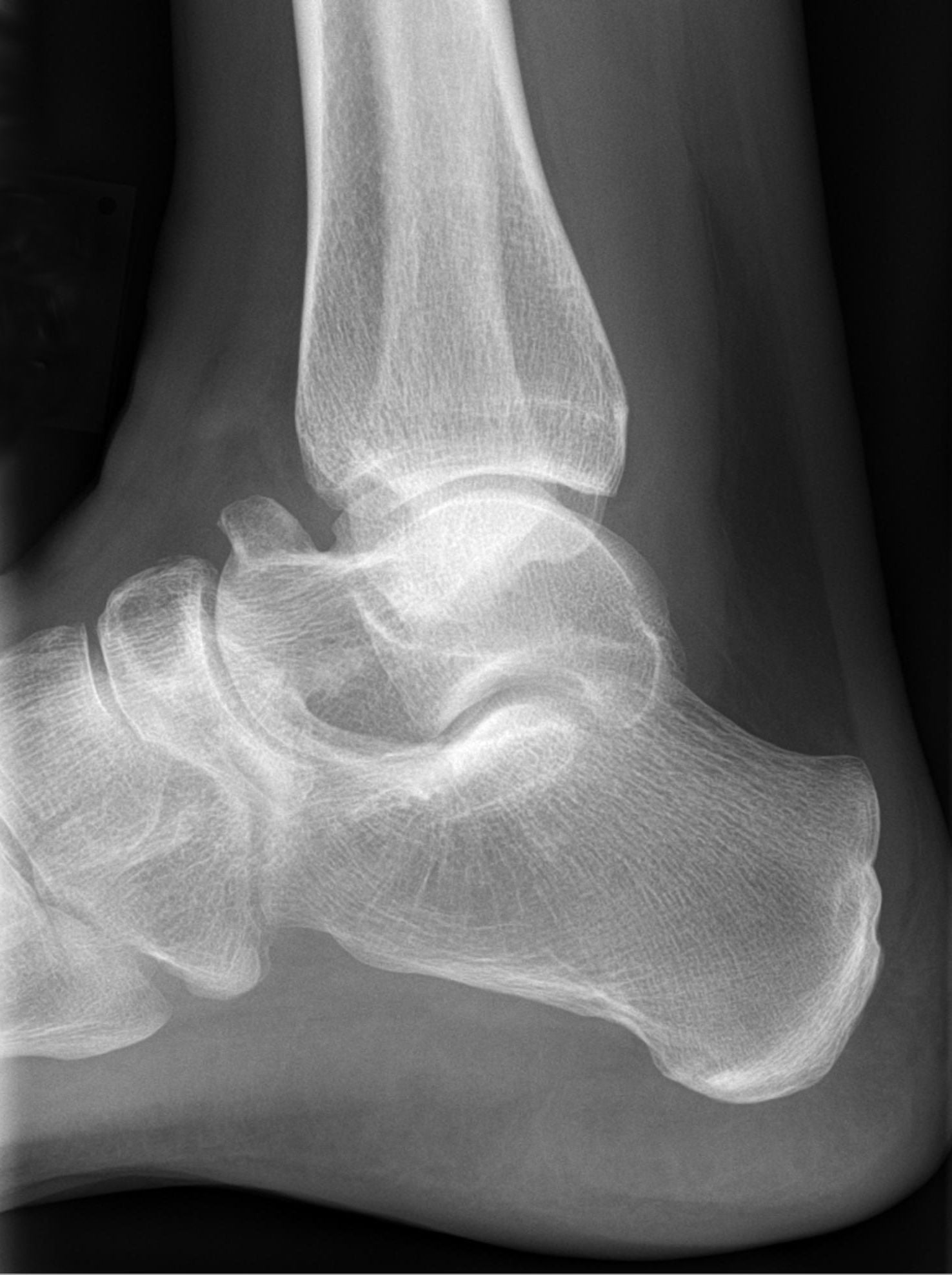
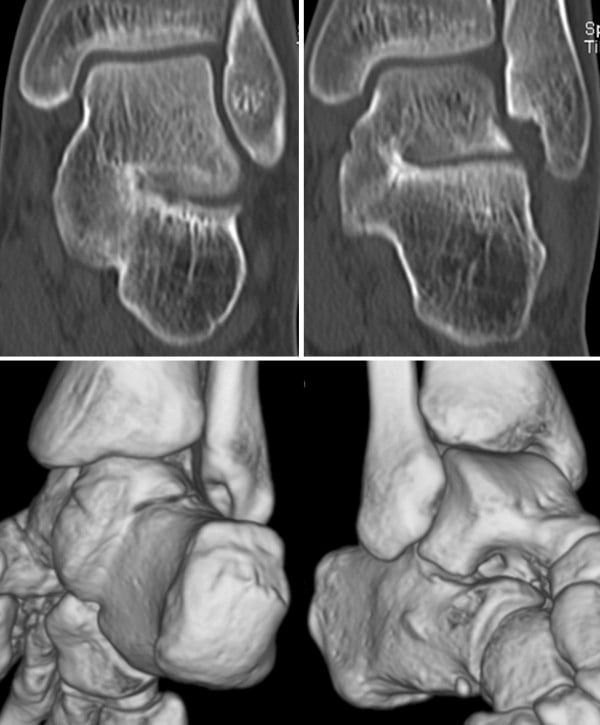
Management. First-line is non-operative: activity modification, a period of cast or boot immobilisation for a painful flare, and orthoses. For refractory symptoms, resection of the bar with interposition (extensor digitorum brevis or fat for a calcaneonavicular bar) preserves motion and is favoured in the young foot with little subtalar arthrosis. A large talocalcaneal coalition, involving more than about half of the joint, or established subtalar arthrosis is better treated by arthrodesis than by resection.
A rigid, painful flatfoot with restricted subtalar motion and peroneal spasm in a child of 8-16 is a tarsal coalition until proven otherwise.
Accessory Navicular and the Painful Medial Prominence
An accessory navicular, a secondary ossicle at the medial navicular present in up to about 10-12% of feet, is a common cause of a painful flexible flatfoot in adolescents, because it lies within the insertion of tibialis posterior and disturbs its arch-supporting pull.
Geist classification. The three types differ in how the ossicle relates to the navicular, and that relationship decides which one hurts:
- Type I, os tibiale externum: a small (2-3 mm) sesamoid within the tibialis posterior tendon, separate from the navicular; usually asymptomatic
- Type II: a larger ossicle joined to the navicular by a fibrocartilaginous synchondrosis; the symptomatic type, because repetitive traction and shear across the synchondrosis causes medial pain, often after minor trauma or with sport
- Type III, the cornuate navicular: the ossicle is fused to the navicular as a prominent horn, and symptoms come mainly from the prominence rubbing in footwear
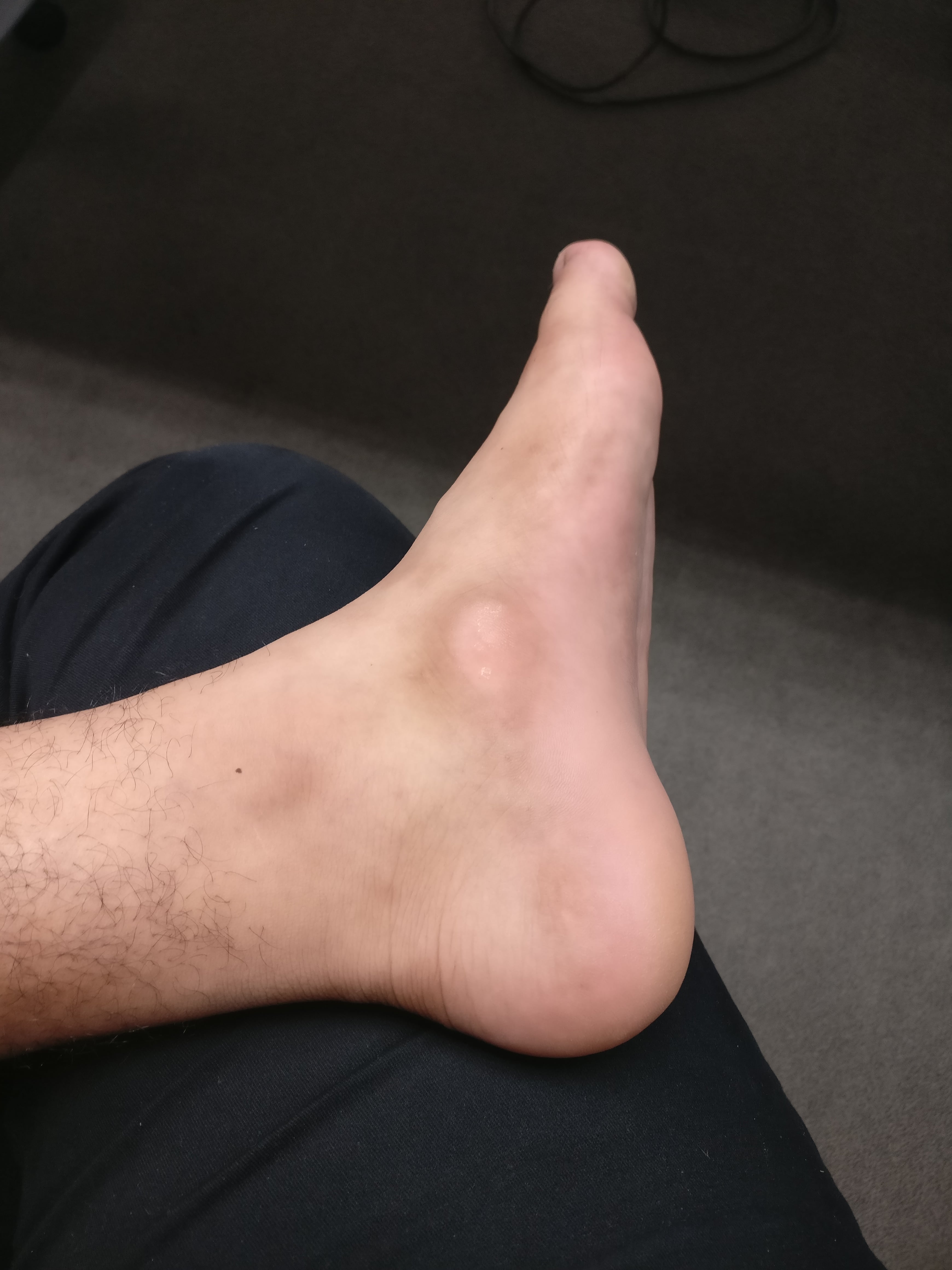
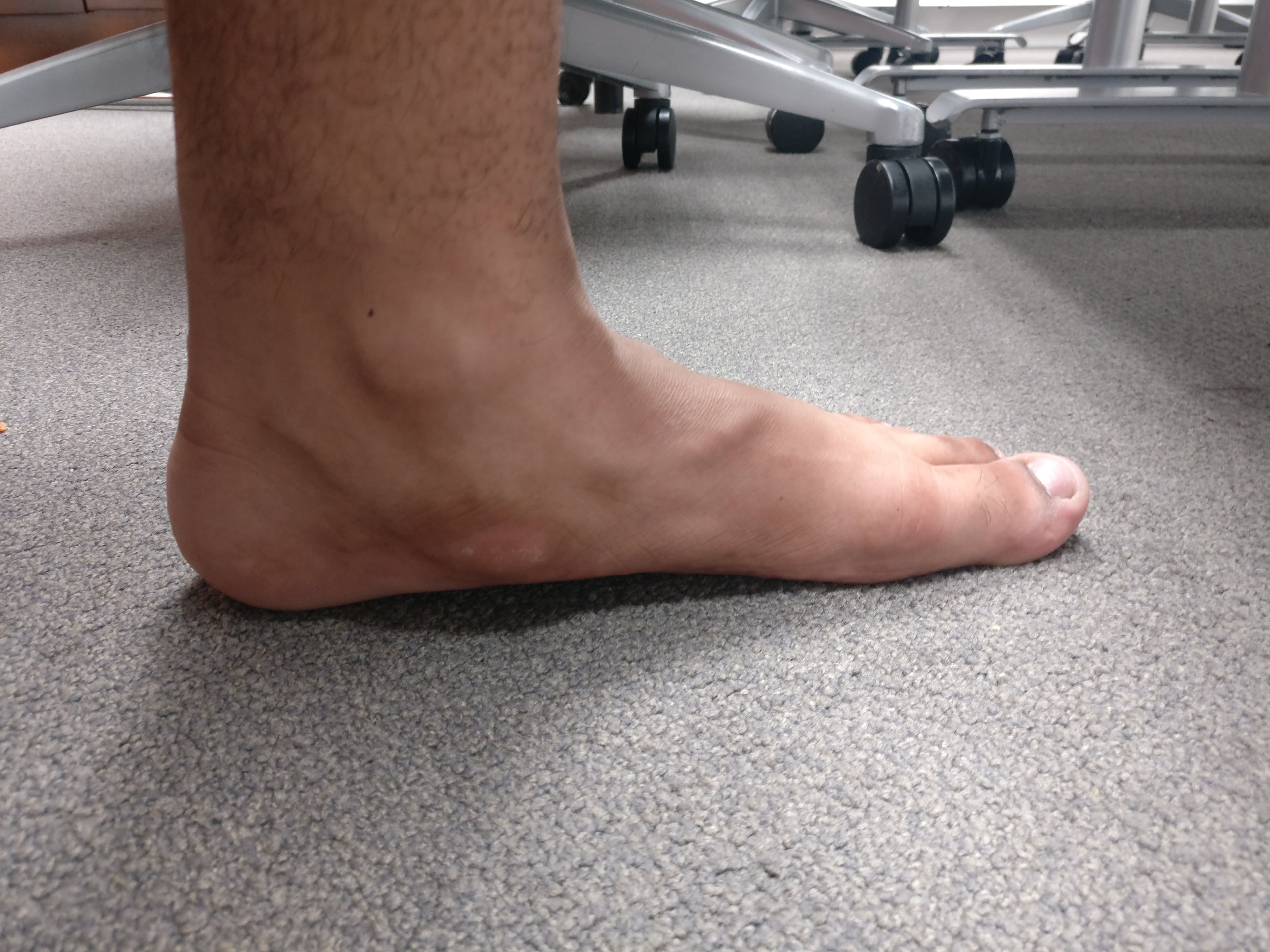
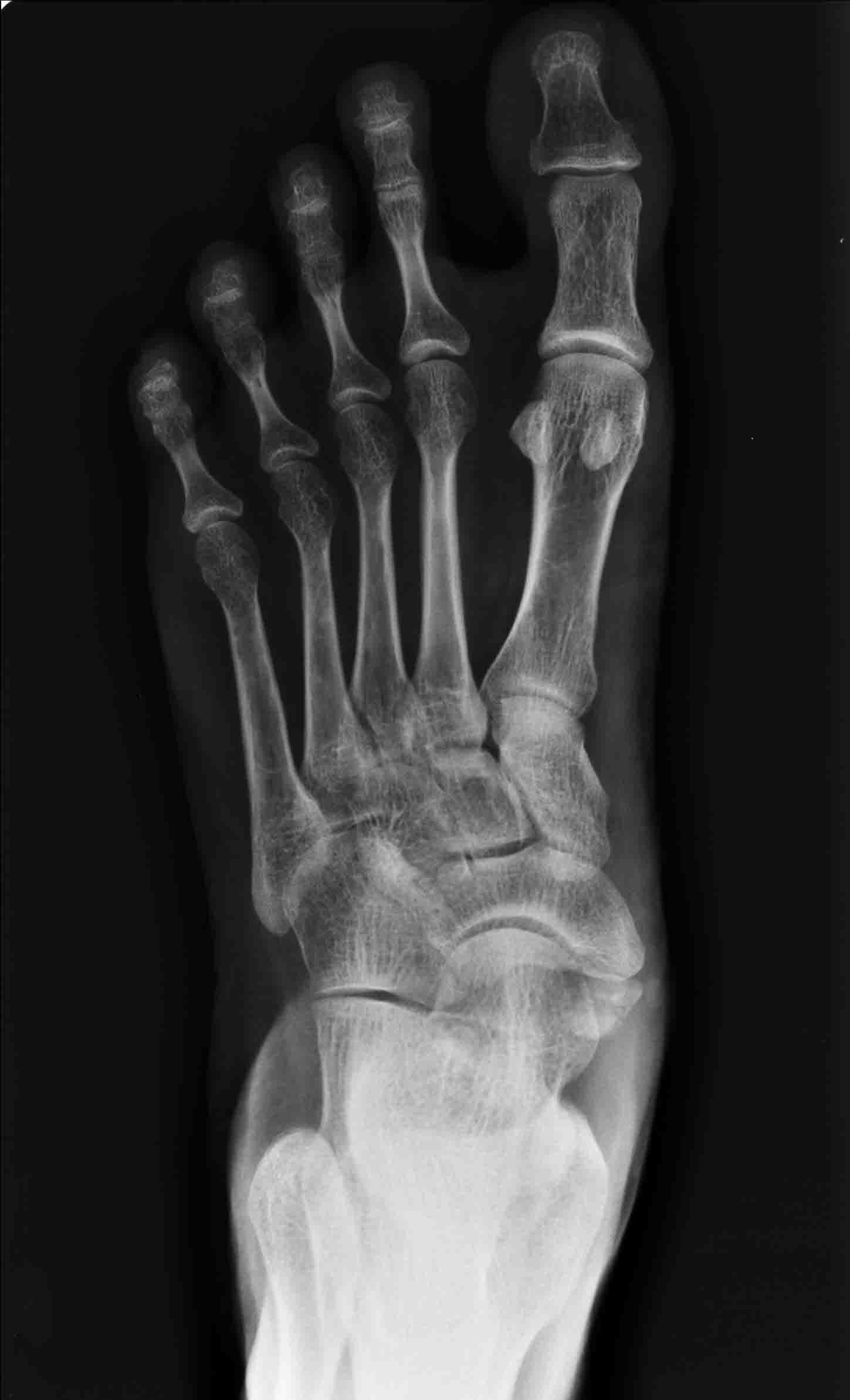
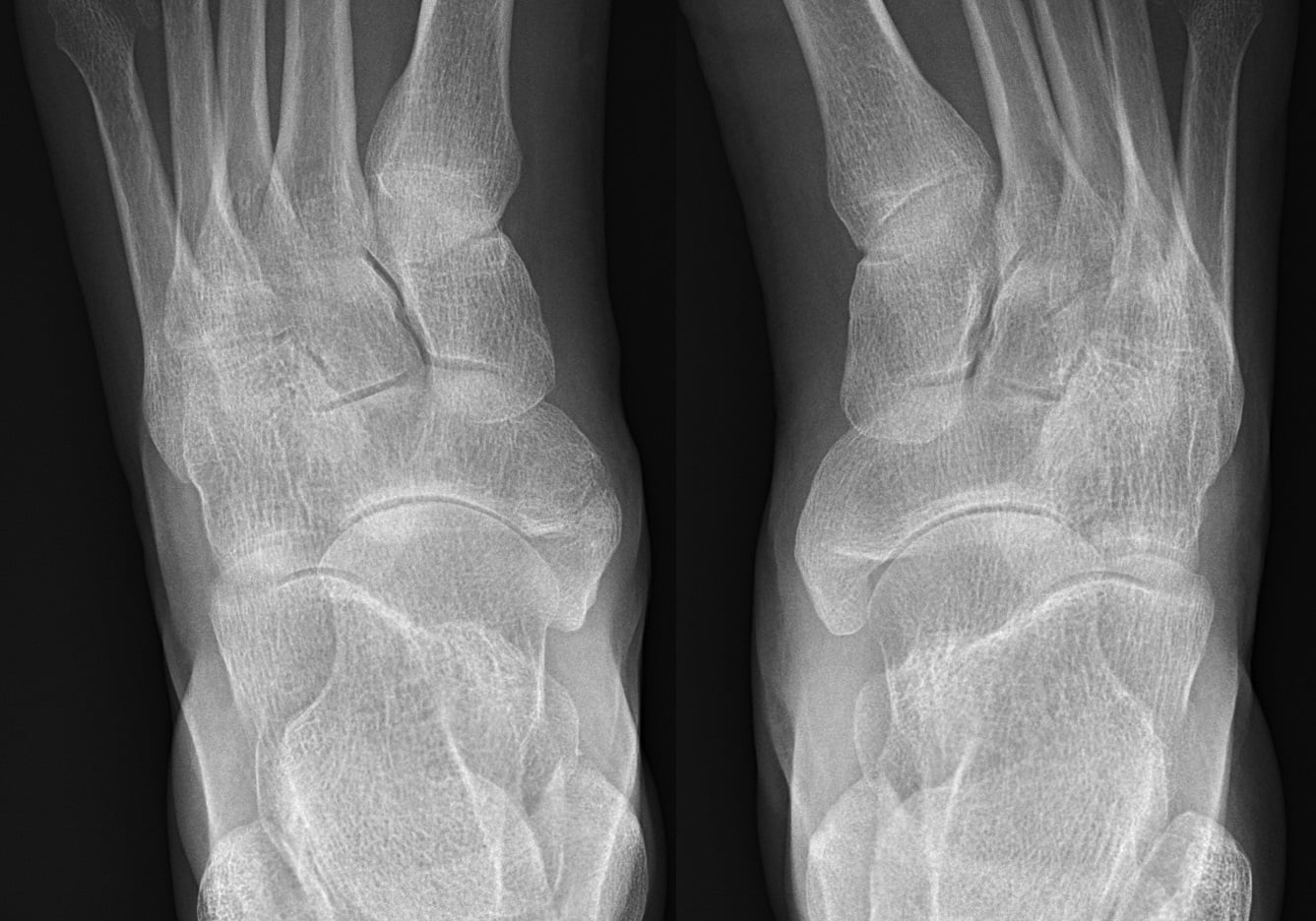
Clinical picture. A tender bony medial prominence over the navicular, pain on resisted inversion, and sometimes a weak or painful single-heel raise, because the tibialis posterior insertion is disturbed.
Management. First-line is non-operative: rest, immobilisation of a painful synchondrosis, orthoses and activity modification. For refractory cases the Kidner procedure, excision of the accessory navicular with advancement and re-anchoring of tibialis posterior onto the navicular, is the classic operation; simple excision is an alternative.
Type II is the one that hurts: shear across the synchondrosis within the tibialis posterior insertion. Refractory cases get a Kidner procedure.
Management Algorithm
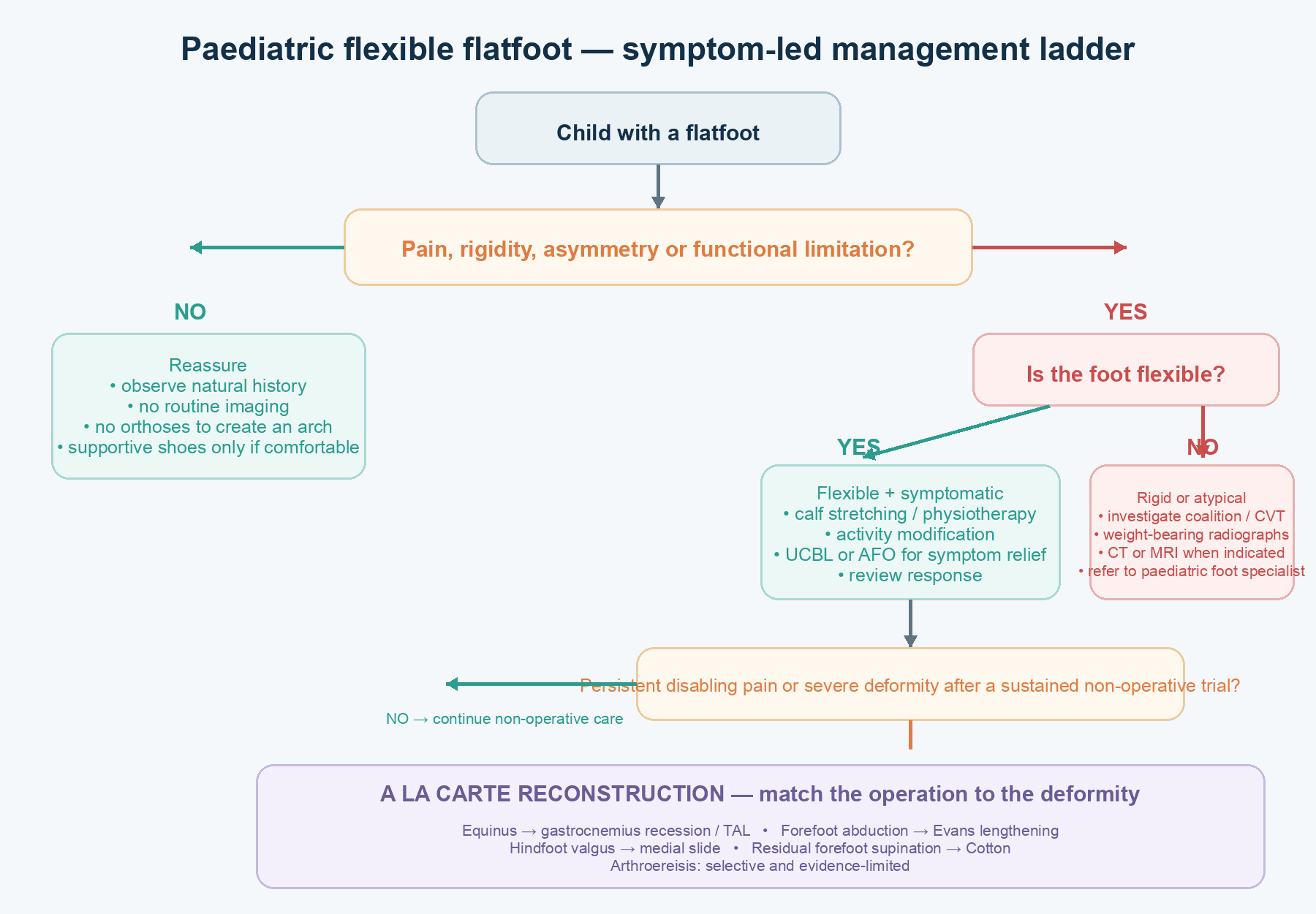
The Painless Flatfoot
Reassure and explain. The natural history does the treating. A useful line for parents is that the arch is like height, some are tall and some are short, and flat is a variant, not a disease.
No orthotics. Orthoses do not change the shape of the foot or the development of the arch (Wenger and colleagues, 1989), and they are expensive and uncomfortable. Supportive heel-counter shoes are fine, and barefoot walking is also healthy.
Do not treat X-rays.
Surgical Technique
Surgery aims to realign the foot, and it is often an à la carte menu chosen by the deformity. Calcaneal lengthening (Evans) is a lateral column lengthening and the workhorse for severe correction; arthroereisis ("to prop up") is the surgical limitation of joint motion with an implant, without fusion.
Joint-Sparing Osteotomies (Preferred)
These realign the anatomy without fusing joints.
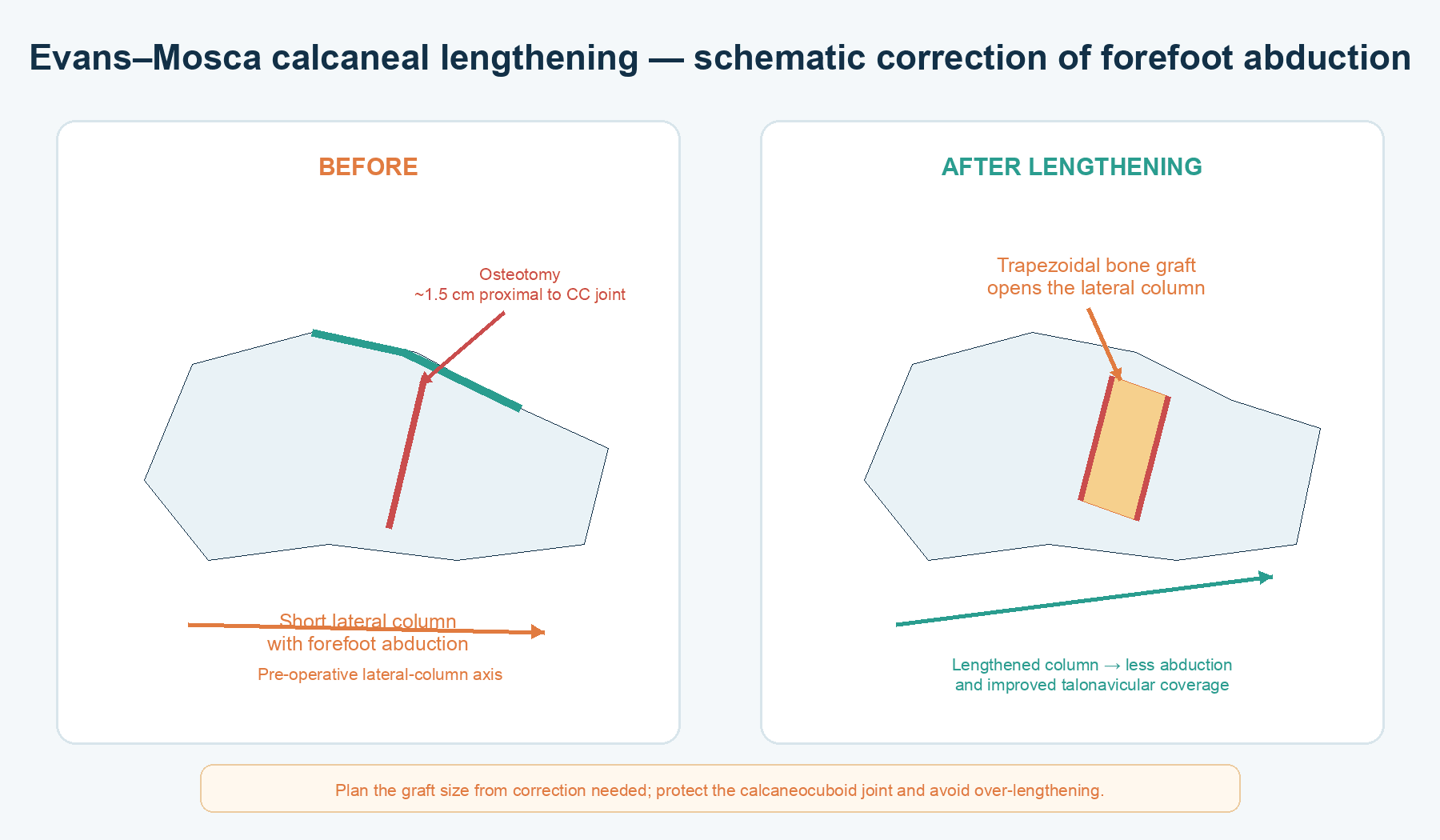
Calcaneal lengthening (Evans-Mosca). The indication is a symptomatic, flexible planovalgus with forefoot abduction and adequate subtalar mobility. Correct equinus and assess residual forefoot supination rather than using Evans as an automatic bundle. Position supine or lateral on a radiolucent table with a bump under the ipsilateral hip, prepare the entire limb, and use fluoroscopy to confirm the osteotomy, graft size, talonavicular coverage and the calcaneocuboid joint.
Medialising calcaneal osteotomy (Koutsogiannis). The indication is hindfoot valgus with little forefoot abduction; it changes the Achilles moment arm but does not reliably restore medial-column height. Position lateral decubitus or supine with a bump, make a posterolateral incision, identify and protect the sural nerve and keep the peroneal tendons safe. Make the oblique osteotomy through the calcaneal tuberosity, translate the posterior fragment medially while preserving purchase for fixation, confirm the posterior facet and heel alignment fluoroscopically, then secure with two screws or a plate according to fragment size. Avoid excessive translation and screw prominence; persistent forefoot supination after heel correction is treated separately.
Cotton osteotomy. The indication is residual forefoot varus or supination after the hindfoot has been corrected, where a plantarflexed medial column is needed to restore a plantigrade tripod. Through a medial dorsal incision, protect the dorsomedial cutaneous nerves and extensor tendons, create a medial-cuneiform opening wedge while maintaining a stable hinge, insert a structural wedge graft and secure it with a staple or plate. The first ray should contact the floor without overcorrecting into a plantarflexed or varus position.
Selected combination (Mosca-type reconstruction). Combine lateral-column lengthening, medial soft-tissue tightening, a medial slide, a Cotton osteotomy and gastrocnemius recession or Achilles lengthening only when each component is indicated by the corrected examination. Correct the heel and lateral column first, reassess forefoot supination and medial-column height, then add Cotton or soft-tissue work. A combined reconstruction is not a licence to perform every component.
Complications
Calcaneocuboid overload after Evans. Lateral column pain, dorsal subluxation of the calcaneocuboid joint or later arthritis of that joint follow when the graft is too large or the alignment is not checked. Do not over-stuff the graft.
Sural nerve injury after a medial slide. The posterolateral approach puts the sural nerve at risk; careful lateral dissection is the prevention.
Sinus tarsi pain after arthroereisis. The treatment is removal of the implant.
Non-union and hardware irritation. Assess graft incorporation, and remove prominent hardware only after union.
Under-correction and recurrence. Prevention is addressing both the equinus and the valgus. When a foot recurs, reassess residual equinus, hindfoot valgus, forefoot supination, skeletal maturity and neuromuscular progression rather than simply repeating the same osteotomy.
Postoperative Care and Rehabilitation
Protocol (Osteotomy)
- Non-weight bearing in a cast
- Elevation for swelling control
- X-ray at 6 weeks to check graft healing
- Aircast boot, weight bearing as tolerated and guided by the X-ray
- Start ankle and subtalar range of motion
- Transition into supportive runners
- Physiotherapy: gait training and calf stretching to prevent recurrence of equinus
- Return to play when osteotomy consolidation is demonstrated, strength and balance have returned and gait is pain-free; fusion criteria apply only if an arthrodesis was performed
- Plyometrics: hopping and skipping are reintroduced progressively once strength and landing control are restored
- Orthotics are generally not needed after a stable correction, although an arch support may be used temporarily for comfort
- Exercise
- Wall Stretch / Night Splint
- Rationale
- Corrects Equinus driver
- Exercise
- Heel Raises with Ball squeeze
- Rationale
- Dynamic arch support
- Exercise
- Towel gather / Marble pick-up
- Rationale
- Core strength of foot
- Exercise
- Balance Board
- Rationale
- Ankle stability
Outcomes
What Mosca actually reported. Quote the source accurately, because the headline is softer than it sounds. In 31 severe symptomatic valgus feet, calcaneal lengthening gave satisfactory clinical and radiographic correction in all but the two most severely deformed, with pain and plantar callus eliminated in the rest and subtalar motion preserved, avoiding arthrodesis.
Two qualifiers that change how far the result travels. Follow-up was 2 years to 3 years 7 months, short to medium rather than long term. And 26 of the 31 deformities were secondary to an underlying neuromuscular disorder, so this is not a series of idiopathic paediatric flexible flatfoot; a spastic planovalgus foot has a different natural history and a different recurrence risk.
Deformity correction. Joint-sparing reconstruction can restore arch and hindfoot alignment when the operation matches the deformity and equinus is addressed when present.
Natural history without surgery. Asymptomatic flexible flatfoot is a variant of normal and does not lead to disability in adulthood.
Guidelines, Registries & Global Practice
Global Epidemiology:
- One of the commonest reasons for paediatric orthopaedic referral worldwide; the great majority are physiological.
- Prevalence is strongly age-dependent: ~44% at ages 3-6 falling to ~24% by age 6 (Pfeiffer, Pediatrics 2006), and only a few percent of 10-year-olds retain a flat arch as the medial arch matures through the first decade.
- Higher prevalence with male sex, overweight/obesity, and generalised ligamentous laxity; pathological (rigid) flatfoot accounts for under 1%.
- Often presents as "grandmother concern" — a normal-looking variant raised by an anxious family member rather than a symptomatic child.
Side-by-Side Society Guidance:
- Imaging stance
- No imaging for painless flexible foot
- Orthotics / shoes
- Not to alter arch; symptom relief only
- Surgery threshold
- Reserved for pain refractory to non-op care
- Imaging stance
- Weight-bearing films only if pain or rigidity
- Orthotics / shoes
- Reassurance first; insoles for symptoms
- Surgery threshold
- Symptomatic, flexible, failed conservative Rx
- Imaging stance
- Do NOT X-ray painless flexible feet
- Orthotics / shoes
- Do NOT prescribe to asymptomatic children
- Surgery threshold
- Refer only if rigid, painful or atypical
- Imaging stance
- Selective imaging
- Orthotics / shoes
- More liberal use of arthroereisis in some centres
- Surgery threshold
- Earlier surgical interest in selected cases
The major point of genuine international divergence is subtalar arthroereisis: relatively popular in parts of continental Europe, but viewed with caution in the UK, North America and Australasia given low-level evidence and removal rates of roughly 7-19% (Metcalfe, Foot Ankle Int 2011).
- There is no dedicated implant registry for paediatric flatfoot. Arthroereisis "spacers" are device implants, so where national implant or device registries exist (e.g. orthopaedic device tracking schemes), outcomes and removal events should be captured the same way as any implant; the absence of long-term registry data is itself a reason for caution.
- High-resource settings: Risk is over-investigation and over-treatment (unnecessary X-rays, custom orthoses, premature surgery) for what is usually a normal variant; ethical counselling — "we treat the child, not the radiograph" — is the priority.
- Limited-resource settings: Custom orthoses and elective reconstruction may be unaffordable; emphasis falls on examination-based diagnosis, reassurance, simple calf-stretching programmes, and reserving theatre time for genuinely disabling or rigid deformity.
- Rigid foot or absent subtalar motion (suspect tarsal coalition or congenital vertical talus).
- Unilateral or asymmetric deformity.
- Pain or callosity limiting walking/sport.
- Failure of a supervised calf-stretching programme over roughly 6 months.
Controversies & Areas of Uncertainty
Does flexible flatfoot cause adult problems? There is no robust evidence that an asymptomatic flexible flatfoot in childhood causes pain, osteoarthritis or disability in adulthood. Anchoring treatment to a feared future is not supported.
Arthroereisis: genuine option or fad? The international divide persists. Proponents cite minimally invasive correction during growth; critics cite low-level evidence and removal rates of about 7-19% (Metcalfe 2011). No controlled trial shows benefit over natural history.
Custom versus prefabricated orthoses. For the uncommon symptomatic child, expensive custom devices have not been shown to outperform simple supportive footwear or off-the-shelf insoles for symptom relief, and neither alters the arch.
Threshold and timing of surgery. No agreed radiographic cut-off triggers surgery. Decisions are symptom-led, with debate over how long to persist with stretching and whether to operate before or after skeletal maturity.
Unresolved questions.
- There is no validated, disease-specific paediatric patient-reported outcome measure, which hampers comparison across procedures
- The relative contribution of each à la carte component (lengthening, medial column, soft tissue, gastrocnemius recession) is poorly isolated because procedures are usually combined
- Optimal management of the borderline symptomatic adolescent, with mild pain and a very flexible foot, remains opinion-based
MCQ Practice Points
Q: What is the most common potential complication of a lateral column lengthening (Evans)? A: Calcaneocuboid joint arthritis (due to increased joint pressure) or Dorsal subluxation of the CC joint.
Q: At what age do most flexible flat feet resolve? A: By age 10 years. The arch development curve plateaus at this age. If it hasn't formed by 10, it likely won't.
Q: What mechanism is tested by passive extension of the hallux? A: The Windlass Mechanism (Shortening of plantar fascia elevates the arch).
Q: If the arch does NOT reconstitute on toe standing, what is the likely diagnosis? A: Rigid Flatfoot (Tarsal Coalition or Vertical Talus).
Q: What soft tissue contracture is most strongly associated with symptomatic flatfoot? A: Gastrocnemius-Soleus complex (Achilles) tightness. Always test with the knee straight (Gastroc) and bent (Soleus) - Silfverskiold Test.
Q: How do you clinically differentiate Oblique Talus (Severe Flatfoot) from Vertical Talus (CVT)? A: In CVT, the foot is rigid and the hindfoot is in valgus but the forefoot is dorsiflexed (Rocker Bottom). You can palpate the head of the talus in the sole. In flexible/oblique talus, the deformity reduces.
Q: Which nerve is at risk during the lateral approach for a Medial Slide calcaneal osteotomy? A: The Sural Nerve. It runs with the small saphenous vein posterior to the lateral malleolus.
Q: What is the 'C-Sign' on a lateral foot X-ray indicative of? A: Talocalcaneal coalition. It represents a bony bridge between the talus and calcaneus.
Q: What happens to the calcaneal pitch angle in flatfoot? A: It decreases (flattens), often becoming less than 15 degrees or even negative (rocker bottom).
Clinical Decision Scenarios
Practise clinical reasoning and management decisions out loud
“A worried mother brings her 2-year-old son. He has flat feet. 'His dad has flat feet too'. He runs and plays without pain.”
“A 12-year-old boy has painful flat feet. Medial arch pain. Short calf muscles. Flexible on exam.”
“Discuss the role of Arthroereisis (Subtalar screw).”
Diagnosis
- Flexible: Arch restores on tiptoe
- Rigid: Arch stays flat (Coalition)
- Physiological: Painless
- Pathological: Painful / Rigid
- Vertical Talus: Rocker Bottom
Assessment
- Jack's Test (Windlass)
- Toe Raise Test
- Silfverskiold (Equinus)
- General Laxity (Beighton)
- Too Many Toes Sign
Management
- Asymptomatic: Reassurance
- Symptomatic: stretching; orthoses for symptom relief
- Evans: lateral-column lengthening for forefoot abduction
- Lengthen gastroc/Achilles only when equinus is demonstrated
- Arthroereisis: evidence-limited; counsel removal risk
Evidence Base
DOIs link to the primary record where one exists.
Corrective Shoes/Inserts Do Not Change Natural History (Landmark RCT)
- Prospective RCT of 129 children with radiographic flatfoot randomised to controls, corrective orthopaedic shoes, Helfet heel-cup, or custom-molded insert; 98 completed minimum 3 years of treatment.
- Radiographs improved significantly in ALL groups including untreated controls (p less than 0.01).
- NO significant difference between controls and any treated group (p greater than 0.4).
- Wearing corrective shoes or inserts for 3 years does not influence the course of flexible flatfoot.
Calcaneal Lengthening for Symptomatic Hindfoot Valgus
- 31 severe symptomatic valgus feet (flatfoot/skewfoot) in 20 children corrected with a modified Evans calcaneal lengthening osteotomy.
- Satisfactory clinical and radiographic correction of all components in all but the two most severely deformed feet.
- Pain and plantar callus resolved; subtalar motion preserved (avoiding arthrodesis).
- Medial cuneiform opening-wedge osteotomy added for forefoot supination in skewfeet.
Subtalar Arthroereisis - Critical Review
- Critical review of 76 studies of arthroereisis for paediatric flexible flatfoot.
- Most radiographic parameters improved; calcaneal inclination changed least.
- Complication rates 4.8% to 18.6%; unplanned implant removal rates 7.1% to 19.3% across device types.
- All evidence is consecutive case series or case reports - no controlled comparison with natural history.
Flatfoot Prevalence, Age, Sex and Weight
- 835 children aged 3-6 assessed by laser surface scanning.
- Flexible flatfoot prevalence 44% overall, falling from 54% at age 3 to 24% at age 6; pathological flatfoot under 1%.
- Boys affected more than girls (52% vs 36%); significant association with overweight/obesity.
- Over 90% of treatments given (10% wore arch supports) were judged unnecessary.
Original Lateral Column Lengthening (Calcaneo-valgus)
- Original description: in calcaneo-valgus the lateral column is short relative to the medial column.
- Cortical tibial bone graft inserted to elongate the anterior calcaneus, equalising column lengths.
- Elongating the lateral column swings the forefoot medially, correcting valgus, abduction and sag.
- Conceptual basis for the modern Evans/Mosca lengthening.
Addressing Equinus Improves Flatfoot Surgery Outcomes
- 34 symptomatic flexible flatfeet in 20 children treated with gastrocnemius recession plus subtalar arthroereisis.
- Mean AOFAS Ankle-Hindfoot score improved 21.3 points (67.7 to 89, p less than 0.0001).
- Authors emphasise correcting the underlying equinus deformity as key to optimising outcomes.
- Subjective pain, function, cosmesis and shoe wear all improved.