Charcot-Marie-Tooth Disease | CMT
- Definition: Group of inherited peripheral neuropathies. Most common inherited neuropathy.
- Genetics: CMT1A (PMP22 duplication) is most common (50%). Autosomal dominant.
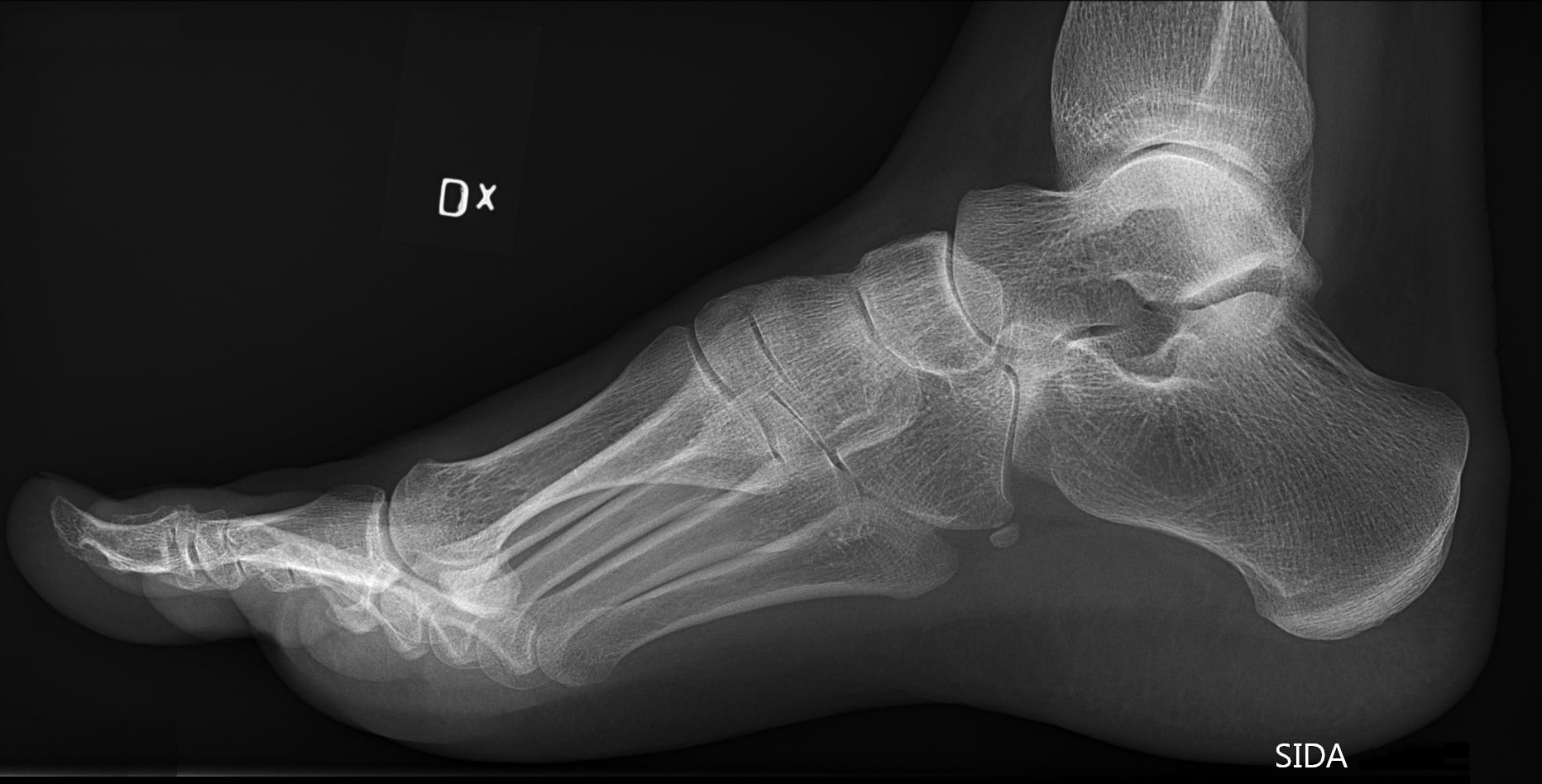
- Foot Deformity: Cavovarus foot - High arch, Hindfoot varus, Claw toes.
- Coleman Block Test: Differentiates FIXED from FLEXIBLE hindfoot varus.
- Management: Non-op (Orthotics, PT) then Osteotomies if progressive/fixed.
- “CMT is the most common inherited neuropathy.
- “Cavovarus foot = Weak Peroneus Brevis (Tibialis Posterior unopposed).
- “Coleman Block Test: If hindfoot corrects when 1st ray offloaded, varus is forefoot-driven.
- “Surgery: Soft tissue balancing + Osteotomies (Calcaneal, Midfoot, 1st MT).
Overview and Epidemiology
What it is. Hereditary motor sensory neuropathy (HMSN), better known as Charcot-Marie-Tooth (CMT) disease, is a group of inherited peripheral neuropathies characterised by progressive distal muscle weakness and sensory loss. It is the most common inherited neuropathy, with a prevalence of about 1 in 2,500, and inheritance is mostly autosomal dominant. The orthopaedic surgeon meets it as the cavovarus foot.
The name. Jean-Martin Charcot and Pierre Marie in France, and Howard Henry Tooth in the UK, described the condition independently in 1886.
Genetics
The genes. CMT1 is demyelinating, CMT2 is axonal and CMTX is X-linked. One table holds what is examined.
- Chromosome
- 17p11.2
- Type
- CMT1A (50% of all CMT)
- Inheritance
- Autosomal dominant
- Pathology
- Demyelinating
- Nerve conduction
- Slow velocity
- Chromosome
- 1q22
- Type
- CMT1B
- Inheritance
- Autosomal dominant
- Pathology
- Demyelinating
- Nerve conduction
- Slow velocity
- Chromosome
- 1p36
- Type
- CMT2A
- Inheritance
- Autosomal dominant
- Pathology
- Axonal (axonal transport defect)
- Nerve conduction
- Normal velocity, low amplitude
- Chromosome
- Xq13
- Type
- CMTX
- Inheritance
- X-linked
- Pathology
- Mixed
- Nerve conduction
- Intermediate
HNPP, the same gene at the opposite dose. The PMP22 gene that is duplicated in CMT1A is deleted in hereditary neuropathy with liability to pressure palsies (HNPP): an autosomal dominant deletion of one PMP22 allele on 17p11.2, produced by the same nonallelic homologous recombination event running in the opposite direction. Examiners like to pair the two.
How HNPP presents. Recurrent, painless, often transient focal palsies precipitated by minor compression or stretch at the common entrapment sites: the peroneal nerve at the fibular neck (a foot drop), the ulnar nerve at the elbow, the median nerve at the wrist and the brachial plexus. That is quite different from the slowly progressive, symmetric cavovarus of CMT. Nerve biopsy shows focal sausage-shaped myelin thickenings called tomacula, hence "tomaculous neuropathy".
Anatomy and Biomechanics
Selective weakness builds the foot. The cavovarus deformity is the product of the order in which muscles fail. Peroneus brevis, the primary evertor of the hindfoot, weakens first and the intrinsics go early; tibialis anterior follows later. Tibialis posterior and peroneus longus are relatively preserved, and each pulls unopposed.
- Status in CMT
- Weak (early)
- Antagonist
- Tibialis posterior
- Deforming effect
- Loss of hindfoot eversion, so the hindfoot drifts into varus
- Status in CMT
- Weak (early)
- Antagonist
- Long extensors and flexors
- Deforming effect
- Claw toes, loss of arch support
- Status in CMT
- Weak (later)
- Antagonist
- Peroneus longus
- Deforming effect
- Foot drop, forefoot equinus
- Status in CMT
- Relatively strong
- Antagonist
- Peroneus brevis
- Deforming effect
- Unopposed inversion pulls the hindfoot into varus
- Status in CMT
- Relatively strong
- Antagonist
- Tibialis anterior
- Deforming effect
- Plantarflexes the first metatarsal: forefoot equinus and cavus
The plantar fascia contracts secondarily and adds to the arch. The net result is the cavovarus foot: high arch, hindfoot varus, claw toes and forefoot adduction.
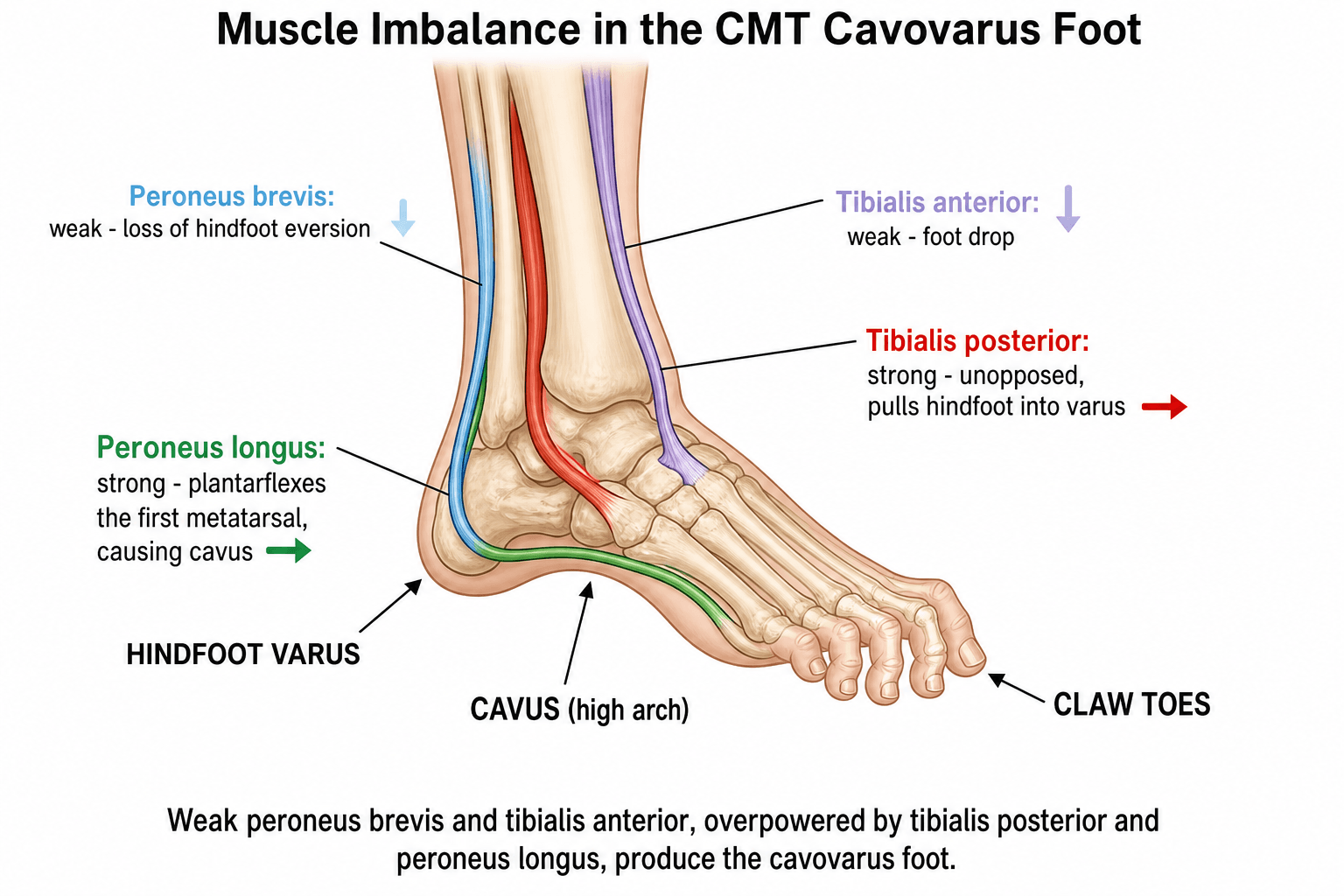
The tripod. The forefoot rests on three points: the first metatarsal head, the fifth metatarsal head and the heel. The strong peroneus longus plantarflexes the first ray and drives the medial leg of the tripod down; to keep all three points on the ground, the hindfoot rolls into varus. This is the mechanical basis of the "forefoot-driven" hindfoot varus that the Coleman block test unmasks.
The cascade. The plantarflexed first ray produces forefoot pronation and cavus, and the tripod compensation produces hindfoot varus. With time the varus becomes fixed through subtalar contracture and a calcaneal varus tilt. A varus heel then overloads the lateral border of the foot: recurrent ankle sprains, peroneal tendinopathy, fifth metatarsal stress fractures, and a varus ankle that can progress to medial ankle arthritis.
Why this orders the operation. Correction runs from the distal deforming force outward: release the tight static structure (plantar fascia), neutralise the deforming dynamic force (peroneus longus to brevis transfer), correct the bony apex (first metatarsal dorsiflexion osteotomy), and add a calcaneal osteotomy only if the hindfoot is still in varus once the forefoot is balanced.
Pathophysiology
The cellular lesion depends on the gene, and it decides what the nerve conduction study shows.
CMT1, demyelinating, about 60% of cases. PMP22 or MPZ mutations disrupt myelin formation by the Schwann cell. Repeated cycles of demyelination and remyelination build the onion bulbs seen on nerve biopsy, and conduction velocity falls. The clinical result is progressive distal weakness and sensory loss.
CMT2, axonal, about 20% of cases. MFN2 mutations affect mitochondrial function and axonal transport, and the distal axon breaks down by Wallerian degeneration without primary demyelination. Conduction velocity is normal but amplitude is reduced. The weakness pattern is similar, often with later onset.
Progression. Weakness runs distal to proximal, a "dying back" neuropathy, with the lower limbs affected before the upper and sensory loss following the same pattern. The deformity progresses throughout growth and into adulthood.
Classification Systems
Dyck and Lambert classification (electrophysiological)
The original HMSN classification is based on motor nerve conduction velocity (NCV), measured in the upper limb (median or ulnar motor):
- CMT1 / HMSN I (demyelinating): motor NCV under 38 m/s. PMP22 duplication most common; onion bulbs on biopsy. The most common form.
- CMT2 / HMSN II (axonal): motor NCV over 38 m/s but reduced amplitude (axonal loss). Often later onset, more purely motor.
- Intermediate CMT: NCV 25 to 45 m/s (for example CMTX in males, DI-CMT).
- CMTX: X-linked, GJB1/connexin 32. Males more severely affected than females; intermediate NCV.
- CMT4 / HMSN III (Dejerine-Sottas): autosomal recessive, severe, infantile onset, very slow NCV. Scoliosis is a hallmark (for example CMT4C / SH3TC2).
Clinical Assessment
History. Onset is usually in childhood or adolescence, and the family history often includes an affected parent, as autosomal dominant inheritance predicts. The complaints are difficulty walking, frequent ankle sprains, foot drop and clumsiness.
Inspection. Distal wasting with normal proximal bulk gives the "stork legs". The foot is cavovarus, with a high arch and hindfoot varus, the toes are clawed, and calluses form under the metatarsal heads and along the lateral border.
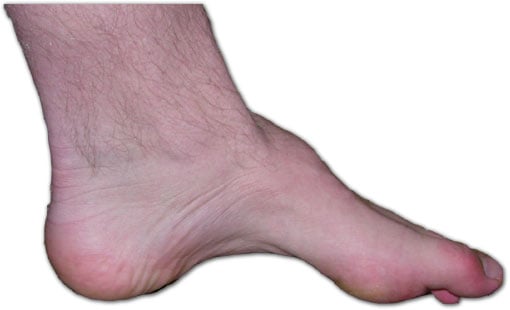
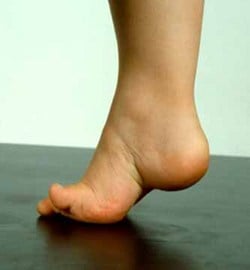
Motor, sensory and reflexes. Ankle dorsiflexion is weak (foot drop), eversion is weak (peroneus brevis) and toe extension and flexion are weak (intrinsics). Sensory loss is glove-and-stocking, and the ankle jerks are reduced or absent.
Gait. A steppage gait, high-stepping to clear the dropped foot. Toe walking is also seen, from weakness and deformity.
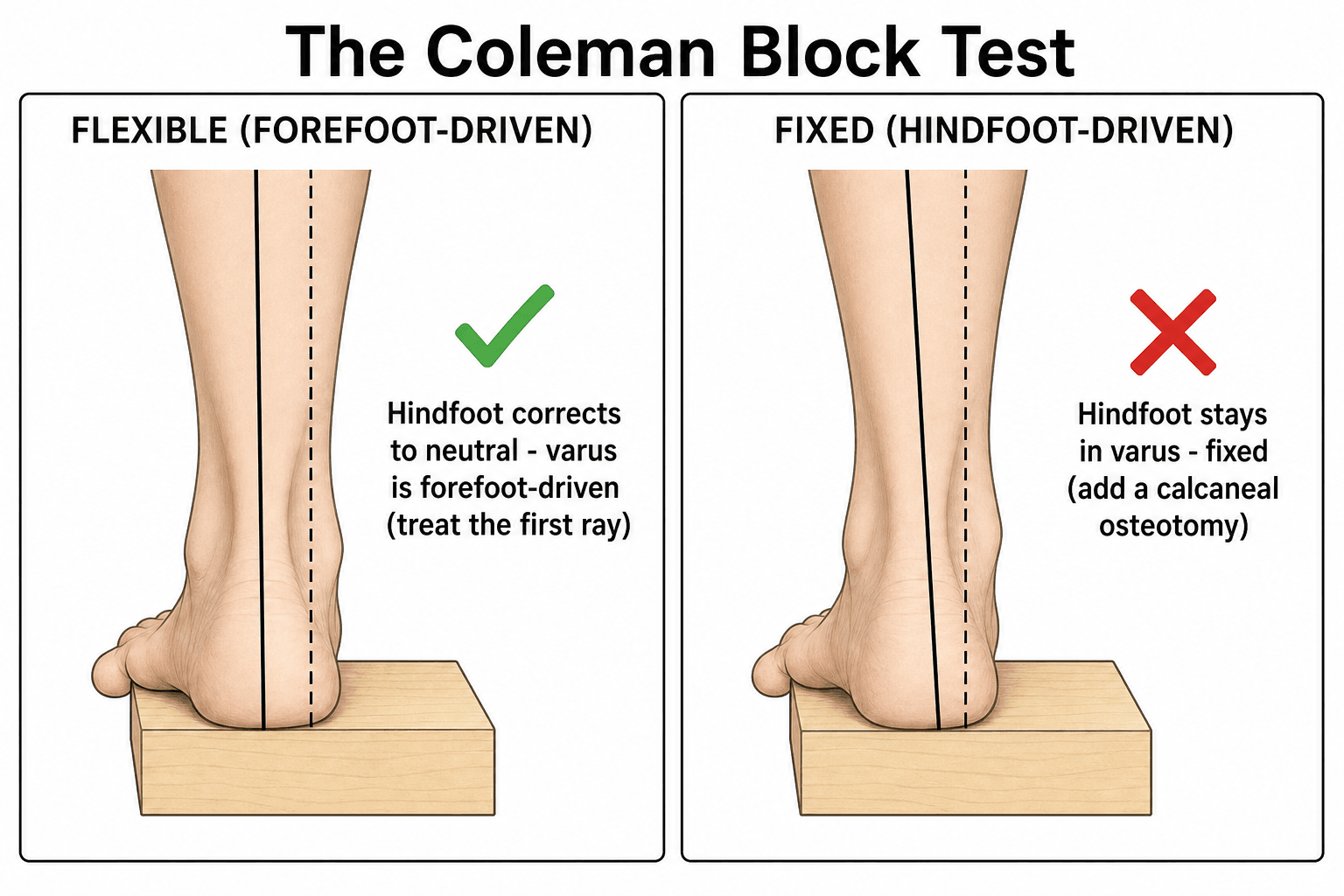
The Coleman block test. It tells you whether a hindfoot varus is forefoot-driven or fixed, and that decides the operation:
- The patient stands on a 2-3 cm block.
- The heel and lateral border of the foot rest on the block; the first metatarsal head hangs off the medial edge, off-loading the plantarflexed first ray.
- Watch the hindfoot from behind: does the varus correct?
- Corrects: the varus is forefoot-driven by the plantarflexed first ray and the hindfoot is flexible. Surgery addresses the first ray.
- Does not correct: the varus is fixed in the hindfoot. Surgery needs a calcaneal osteotomy.
Investigations
Making the diagnosis. Clinical examination is often sufficient. Nerve conduction studies and EMG place the patient on the demyelinating or axonal axis of the classification above. Nerve biopsy is rarely needed; it shows the onion bulbs of CMT1.
Genetic testing. First-line is PMP22 duplication/deletion analysis, which detects 70% of CMT1; a duplication confirms CMT1A. Second-line is a targeted gene panel or whole exome sequencing. Prenatal testing is available for known familial mutations.
Orthopaedic assessment. Weight-bearing AP and lateral foot radiographs quantify the bony deformity, the arch height, the calcaneal pitch and Meary's talo-first-metatarsal angle, and guide whether correction is soft-tissue only or requires osteotomy. The Coleman block test (above) completes the foot assessment, and a spine radiograph screens for scoliosis.
Beyond the Foot: Hip, Hand and Spine
CMT is a generalised neuropathy, so the foot is not the whole story. The hip and the hand are the two examinable sites most easily overlooked.
The hip. Acetabular dysplasia is a recognised association of CMT, reported in roughly the high single figures of patients, and is frequently missed because it is often painless. The threshold for a screening pelvis radiograph should be low, particularly in the growing child: untreated dysplasia progresses to subluxation and early arthritis, and it is far easier to address early, with a peri-acetabular or femoral osteotomy, than late.
The hand. As the neuropathy ascends the hand develops intrinsic wasting of the first dorsal interosseous and thenar muscles, a claw posture and weak pinch and grip, which impair fine tasks such as buttons and keys. Management is largely supportive, with therapy and splints; selective tendon transfers, for example to restore thumb opposition or correct clawing, are reserved for carefully chosen patients.
The spine. Scoliosis is more common in early-onset and autosomal recessive forms and warrants surveillance.
Differential Diagnosis
The cavovarus foot is the orthopaedic presentation, but a cavus foot is a red flag for an underlying neurological diagnosis until proven otherwise, and any patient with a cavovarus foot and weakness should be evaluated for CMT. Bilateral, symmetric, slowly progressive cavovarus with a positive family history points strongly to CMT; the following must be considered and excluded.
- Distinguishing features
- Bilateral, symmetric, family history, distal wasting, areflexia, glove-stocking sensory loss
- Key investigation
- NCS/EMG + genetic testing (PMP22)
- Distinguishing features
- Ataxia, dysarthria, cardiomyopathy, diabetes, upgoing plantars (UMN signs)
- Key investigation
- FXN gene (GAA triplet repeat)
- Distinguishing features
- UNILATERAL cavus, back/midline skin signs, bladder symptoms, rapid progression
- Key investigation
- Whole-spine MRI
- Distinguishing features
- Spasticity, UMN signs, perinatal history, brisk reflexes
- Key investigation
- Clinical + brain MRI
- Distinguishing features
- Asymmetric, flail segments, no sensory loss, static (non-progressive)
- Key investigation
- History + EMG
- Distinguishing features
- Mild, non-progressive, normal neuro exam
- Key investigation
- Diagnosis of exclusion
A unilateral or rapidly progressive cavovarus foot is not typical CMT. It mandates whole-spine MRI to exclude tethered cord, diastematomyelia, syrinx or an intraspinal tumour before any foot surgery.
Management
The decision. A mild, flexible deformity is managed non-operatively. A progressive or fixed deformity is corrected surgically, and the Coleman block test chooses between a forefoot correction and one that must include the hindfoot.
Physiotherapy stretches the plantar fascia and the Achilles, with strengthening exercises. Orthotics are matched to the problem:
- An AFO for foot drop
- A lateral wedge for mild varus
- Custom-moulded insoles
Footwear and follow-up. Supportive footwear, and no high heels. Progression is expected, so review is regular.
Surgical Technique
Lateral calcaneal osteotomy (Dwyer)
For the fixed hindfoot varus that the block test did not correct. It is often combined with a lateralising component, shifting the calcaneus laterally.
- Incision: lateral oblique, over the calcaneus.
- Protect the sural nerve and the peroneal tendons.
- Osteotomy: lateral closing wedge, the base lateral.
- Fixation: staple or screw.
- Result: the hindfoot is shifted into neutral or slight valgus.
Complications
- Risk Factor
- Progressive disease
- Management
- Revision surgery
- Risk Factor
- Excessive osteotomy
- Management
- Revision / Accept
- Risk Factor
- Poor technique
- Management
- Revision fixation
- Risk Factor
- Fusion procedures
- Management
- Expected tradeoff
- Risk Factor
- Calcaneal osteotomy
- Management
- Careful dissection
Postoperative Care
After osteotomies. A non-weight-bearing cast for 6-8 weeks, then a transition to an AFO or supportive footwear, with physiotherapy for range of motion and strengthening.
After tendon transfers. A splint in the corrected position for 4-6 weeks, then gradual retraining of the transferred muscles.
Outcomes
Short term. Reliable deformity correction is achievable with the combined soft-tissue and osteotomy, "joint-sparing", approach.
Long term. In the longest published series, a mean 26-year follow-up of joint-sparing reconstruction, the cavus correction was well maintained but most feet showed some radiographic recurrence of hindfoot varus, reflecting the progressive nature of CMT. No patient required salvage triple arthrodesis, and rates of degenerative change and reoperation were lower than historically reported after triple arthrodesis; as the evidence card below sets out, that is a comparison with other units' historical fusion series rather than a concurrent control, and moderate-to-severe arthritis was still present in more than a quarter of the feet.
Function. Surgery improves plantigrade stance, reduces lateral-border overload and recurrent sprains, and improves gait efficiency. Patient-reported physical function (SF-36) remains below age-matched norms because of the underlying neuropathy.
Smoking. Smoking is an independent predictor of worse pain and disability scores after CMT cavovarus reconstruction; counsel cessation.
Counselling. Patients, and parents, must understand that surgery corrects the deformity but does not cure the neuropathy. Progression, long-term follow-up and possible revision should be anticipated.
Guidelines, Registries & Global Practice
Global epidemiology:
- CMT/HMSN is the most common inherited neuropathy, with a widely cited population prevalence of approximately 1 in 2,500 (around 1 in 1,200 to 1 in 3,300 across studies).
- CMT1A (PMP22 duplication) is the single most common subtype; in population-based genetic series the PMP22 duplication accounts for roughly 10 to 60% of genetically defined cases.
- Cavovarus foot deformity is the dominant orthopaedic manifestation; scoliosis is more frequent in early-onset and autosomal-recessive forms (e.g. CMT4C).
Side-by-side practice guidance (no single national framework governs CMT foot surgery):
- Emphasis
- Genetic confirmation, multidisciplinary care, CMTNS for monitoring; PMP22 duplication tested first
- Emphasis
- Joint-sparing osteotomy + tendon transfer for flexible deformity; arthrodesis reserved for rigid/arthritic feet
- Emphasis
- Stable internal fixation of osteotomies, plantigrade balanced foot, address all deformity components in one stage
- Emphasis
- Early soft-tissue balancing to prevent fixed bony deformity; spine surveillance for scoliosis
- No dedicated arthroplasty-style registry exists for CMT foot surgery; evidence is from specialist case series (e.g. the 26-year joint-sparing cohort).
- International CMT patient registries and natural-history consortia (e.g. the Inherited Neuropathies Consortium) underpin genotype-phenotype data and trial recruitment.
- High-resource settings: broad NGS gene panels, gait analysis, custom orthotics/AFOs, staged joint-sparing reconstruction, MDT neuromuscular clinics.
- Limited-resource settings: diagnosis often clinical plus basic nerve conduction studies; management weighted toward bracing and a single definitive corrective procedure; emerging genetic and disease-modifying therapies are largely inaccessible.
Controversies and Areas of Uncertainty
Joint-sparing versus arthrodesis. The pendulum has swung decisively toward joint-sparing osteotomies and tendon transfers in flexible, correctable feet, reserving triple arthrodesis for rigid, arthritic or salvage feet. Long-term data favour the joint-sparing approach, but the optimal threshold for fusion remains debated.
Timing of surgery. Whether to operate early, while the deformity is flexible and soft-tissue balancing is simpler, or to wait until skeletal maturity, when the deformity is stable and revisions fewer, is unresolved. Many advocate early balancing to prevent fixed bony deformity.
Prophylactic transfers. The value of a "prophylactic" tibialis posterior or anterior transfer in a still-flexible foot, to slow the deformity, is not established by high-level evidence.
Disease-modifying therapy. No drug is yet licensed to alter CMT progression. Gene-targeted and small-molecule therapies, for example PMP22-lowering approaches, are in trials; this is a moving field and may change the orthopaedic picture in coming years.
MCQ Practice Points
Q: What is the most common type of CMT? A: CMT1A (50% of cases). Caused by PMP22 gene duplication. Autosomal dominant.
Q: If the hindfoot varus corrects on Coleman Block Test, what does this indicate? A: The varus is FOREFOOT-DRIVEN (plantarflexed 1st ray). Surgical correction should address the 1st ray (Dorsiflexion 1st MT Osteotomy).
Q: What muscle imbalance causes cavovarus in CMT? A: Weak Peroneus Brevis (first to go) with relatively strong Tibialis Posterior (pulls into varus) and Peroneus Longus (plantarflexes 1st ray).
Q: What NCS finding is seen in CMT1 (demyelinating)? A: Slow nerve conduction velocity (less than 38 m/s motor).
Q: What is the purpose of Peroneus Longus to Brevis transfer in CMT? A: 1) Removes the deforming force on the 1st ray (reduces plantarflexion). 2) Augments the weak Peroneus Brevis (improves eversion).
Exam Viva Scenarios
Practise clinical reasoning and management decisions out loud
“What is your diagnosis and approach?”
“Demonstrate and explain the test.”
“Outline your surgical plan.”
Key Features
- Most common inherited neuropathy
- CMT1A = PMP22 duplication
- Cavovarus foot
- Weak PB, Strong PT/PL
Coleman Block
- Block under lateral foot
- 1st ray offloaded
- If corrects = Forefoot-driven
- If not = Hindfoot-driven
Surgery
- PF Release
- PL to PB Transfer
- 1st MT Osteotomy (if Coleman+)
- Calcaneal Osteotomy (if Coleman-)
- Jones Procedure (claw toes)
Pitfalls
- Progressive disease
- Recurrence common
- Check spine for scoliosis
Evidence Base
Joint-Sparing Reconstruction — 26-Year Follow-up
- 25 patients (41 feet) with CMT cavovarus treated with 1st metatarsal dorsiflexion osteotomy, peroneus longus to brevis transfer, plantar fascia release and EHL transfer; mean follow-up 26.1 years.
- Cavus correction was well maintained but most feet had radiographic recurrence of hindfoot varus.
- No patient required triple arthrodesis, and 7 patients (8 feet) had 11 further foot or ankle operations.
- But give the absolute number alongside the comparison: moderate-to-severe osteoarthritis was present in 11 of the 41 feet at final review. 'Lower degenerative change than triple arthrodesis' is a relative claim, and more than a quarter of these feet were still arthritic at 26 years.
- Smoking was associated with significantly worse Foot Function Index pain and disability scores (p less than 0.0001).
Molecular Basis of CMT1A — PMP22 Duplication
- Identified a large DNA duplication on chromosome 17p completely linked to CMT1A.
- Demonstrated three alleles at a polymorphic locus and a novel 500 kb SacII fragment in affected individuals.
- Established CMT1A as a gene-dosage disorder from inherited DNA rearrangement (later localised to PMP22).
Molecular Genetics & Neuropathology of CMT1A
- Reviewed the chromosome 17 CMT1A locus and the PMP22 gene-dosage mechanism.
- Correlated the CMT1A duplication with sural nerve onion-bulb pathology.
- Linked the Trembler mouse PMP22 point mutations to the human phenotype.
Population Genetic Diagnosis of CMT (Next-Generation Sequencing)
- Population-based sample of 81 CMT families analysed with a 32-gene NGS panel.
- PMP22 duplication was the single most common mutation (11 of 81 families, 14%); a pathogenic mutation was found in 46% overall.
- Mutations were also found in non-classical CMT genes, supporting broad panels over single-gene testing.
Spine Deformity as a Hallmark of CMT4C
- SH3TC2 mutations cause autosomal-recessive demyelinating CMT4C.
- Scoliosis or kyphoscoliosis and foot deformities were present in almost all patients and were often the presenting feature.
- Recommended neurological evaluation when scoliosis is found in this context.
Prevalence of the PMP22 Genomic Disorder
- Methodology study estimating the population prevalence of recurrent CNV genomic disorders mediated by low-copy-repeat nonallelic homologous recombination.
- Includes the PMP22 (17p11.2) duplication/deletion - the molecular basis of CMT1A and HNPP - among the calibration disorders with previously established prevalence.
- Newly estimated prevalences for the 1q21.1, 15q13.3 and 16p11.2 CNV syndromes using a linear-regression model.
Coleman Block Test (Classic Description)
- Described the lateral block test to assess hindfoot flexibility in the cavovarus foot - the patient stands with the lateral border of the foot and the heel on a block, allowing the first ray to drop free.
- If hindfoot varus CORRECTS once the plantarflexed first ray is off-loaded, the varus is forefoot-driven and the hindfoot is FLEXIBLE.
- If the hindfoot stays in varus, the deformity is fixed and the hindfoot itself must be addressed.
- That single observation determines whether correction targets the forefoot alone or must include a calcaneal osteotomy.