Paediatric Elbow | Avulsion Fracture | Elbow Dislocation | Fragment Entrapment | ORIF Indications
- Ossification order CRITOL: Capitellum, Radial head, Internal (medial) epicondyle, Trochlea, Olecranon, Lateral (external) epicondyle
- Association with elbow dislocation: 50% of medial epicondyle fractures occur with elbow dislocation - fragment may become entrapped in joint
- Ulnar nerve at risk: Runs posterior to medial epicondyle - 10-16% ulnar nerve symptoms
- Surgery indications: Intra-articular fragment, greater than 5mm displacement (relative, absolute controversial), high-level throwing athlete, ulnar nerve dysfunction
- “Compare to contralateral elbow - medial epicondyle appears at age 5-7, fuses at 15-17
- “If trochlea visible but NO medial epicondyle seen, it is entrapped in joint
- “Stress X-rays may show valgus instability from avulsed UCL origin
- “Always assess ulnar nerve function pre-operatively
Overview and Epidemiology
Medial epicondyle fractures are avulsion injuries through the apophysis of the medial epicondyle. The flexor-pronator mass and the ulnar collateral ligament (UCL) originate there, and traction through them pulls the apophysis off during a fall or a throw.
Who. The child is at the apophyseal stage, before the epicondyle fuses:
- Peak incidence 9-14 years
- More common in boys (75%)
- Roughly 11-20% of paediatric elbow fractures across sources; Pathy's review gives 12%
- 50% occur with an elbow dislocation
- Common in throwing sports (baseball, cricket, javelin)
Mechanism. There are two. In the first, a direct valgus stress on the extended elbow coincides with a sudden muscle contraction, the throwing injury. In the second the elbow dislocates: the posterolateral force avulses the epicondyle through the UCL and the flexor-pronator mass, and as the dislocation is reduced the fragment may become trapped in the joint.
Provenance of the association figures. The three numbers quoted on this page, 50% with elbow dislocation, 15-18% fragment incarceration and 10-16% ulnar nerve symptoms at presentation, are conventional textbook ranges, not figures from the studies carded below. Pathy's review gives 12% as the share of paediatric elbow fractures and describes the associations qualitatively as "frequent" without rates; Fowles's series consists entirely of dislocations, so it cannot supply a denominator for how often the two coexist. The ranges are stable across sources and safe to quote, but say "conventionally around half" rather than attributing a precise rate to a named paper. What matters clinically is not the exact percentage but the conditional structure behind it: incarceration is essentially a complication of the dislocated elbow, and ulnar nerve injury clusters with incarceration. In Fowles, five of nine operated children had ulnar nerve contusion or compression and four needed anterior transposition. So the fracture that worries you is the one whose elbow dislocated.
Pathophysiology and Mechanisms
The apophysis and what hangs from it. The medial epicondyle is a separate ossification centre that appears at about 5-7 years and fuses at 15-17. Two structures take origin from it: the flexor-pronator mass, whose traction causes the avulsion, and the anterior bundle of the UCL, which is the reason the thrower's elbow is treated differently. The ulnar nerve runs immediately posterior to the epicondyle in the cubital tunnel, at risk from the fracture and from the surgeon.
The ossification sequence. The six centres of the elbow appear in a fixed order, CRITOL, at odd-numbered years from one to eleven. The ages are approximate, and girls are earlier.
CRITOLCRITOL - Elbow Ossification Order
Hook:CRITOL: Capitellum 1, Radial head 3, Internal epicondyle 5, Trochlea 7, Olecranon 9, Lateral epi 11 (odd years 1-3-5-7-9-11).
If the trochlea has ossified but you cannot identify the medial epicondyle, it must be incarcerated in the joint. Per CRITOL, the medial epicondyle (I) appears before the trochlea (T). This is a common exam question and a common missed diagnosis.
The reason a medial epicondyle fracture is treated more aggressively in a thrower is its role in valgus stability. The restraint hierarchy at the elbow is:
- The anterior bundle of the ulnar (medial) collateral ligament is the PRIMARY static restraint to valgus stress - and it originates from the medial epicondyle, so a displaced or un-united avulsion effectively detaches the thrower's main valgus stabiliser.
- The radial head (radiocapitellar joint) is the most important SECONDARY valgus restraint - which is why radial head excision worsens valgus instability.
- The bony ulnohumeral articulation contributes mainly in full extension and full flexion, and the flexor-pronator mass (also originating from the medial epicondyle) is the principal DYNAMIC stabiliser.
Overhead throwing generates enormous valgus load in the late-cocking / early-acceleration phase, repeatedly stressing exactly this medial column. That is why restoring the medial epicondyle (UCL plus flexor-pronator origin) anatomically is argued to matter most in the elite thrower, and why persistent medial pain after the fracture has healed should raise suspicion of UCL insufficiency.
Classification Systems
There is no universally accepted classification. Fractures are commonly described by displacement, and the description should always add the clinical context: isolated, with an elbow dislocation, or with another elbow fracture (olecranon, coronoid, radial head or neck).
- Displacement
- Minimally displaced (less than 5mm)
- Management Tendency
- Conservative
- Displacement
- Moderately displaced (5-10mm)
- Management Tendency
- Controversial - varies by patient factors
- Displacement
- Severely displaced (greater than 10mm)
- Management Tendency
- Often surgical, but some advocate conservative
- Displacement
- Incarcerated in joint
- Management Tendency
- Mandatory ORIF
The 5mm threshold. It has been used historically for the operative decision but is increasingly controversial: many centres report good outcomes with conservative treatment up to 10-15mm.
Why the context matters. An associated dislocation carries the risk of fragment incarceration and affects both outcome and treatment. Ulnar nerve symptoms prompt consideration of nerve exploration. A coronoid fracture is less common and contributes to instability.
Clinical Assessment
History. Ask for the mechanism: a fall on the outstretched hand, a dislocation event or a throwing injury. Pain and swelling are immediate, and the child may be unable to flex the wrist or fingers. The level of throwing activity (baseball, cricket) and hand dominance both bear on the treatment decision.
Examination. Swelling and ecchymosis sit over the medial elbow, with deformity if the elbow is still dislocated; check the skin for an open wound. There is point tenderness over the avulsed fragment, and a gap or defect may be palpable if it is displaced. Crepitus may be present; avoid excessive manipulation.
The ulnar nerve. It lies immediately posterior to the medial epicondyle, and 10-16% have ulnar nerve symptoms at presentation. Test motor function in the first dorsal interosseous (finger abduction) and the hypothenar muscles, and sensation over the little finger and the ulnar half of the ring finger; examine the median and radial nerves and the vascular status (pulse, capillary refill, colour) as well. In throwing athletes the nerve commonly subluxates over the epicondyle.
Document ulnar nerve function before any intervention. A post-operative neuropraxia may be iatrogenic or from the injury, and only a baseline can tell the two apart, which is why the record is medicolegally important.
Differential Diagnosis
The medial-sided paediatric elbow injury that most often catches candidates out is the incarcerated fragment masquerading as a "reduced" dislocation. Systematically exclude the look-alikes below.
- Discriminating Features
- Apophyseal age 9-14, valgus or dislocation mechanism, medial point tenderness
- Key Pitfall / Distinguisher
- Apply CRITOL - confirm the epicondyle is in its normal position, not the joint
- Discriminating Features
- Block to motion, widened ulnohumeral space, 'missing' epicondyle with trochlea visible
- Key Pitfall / Distinguisher
- Easily missed on the post-reduction film - mandatory ORIF if present
- Discriminating Features
- Lateral tenderness, Salter-Harris IV pattern, high nonunion if missed
- Key Pitfall / Distinguisher
- Intra-articular and often needs fixation - different limb side, different risk profile
- Discriminating Features
- Under 3 years, whole epiphysis displaced, often non-accidental
- Key Pitfall / Distinguisher
- Capitellum/radius maintain alignment with each other but not the humerus; consider safeguarding
- Discriminating Features
- Asymptomatic, smooth corticated margin, symmetrical with other side
- Key Pitfall / Distinguisher
- Compare to the contralateral elbow before calling a fracture
- Discriminating Features
- Chronic throwing pain, widened/fragmented apophysis without acute avulsion
- Key Pitfall / Distinguisher
- Overuse, not acute trauma - managed with rest and activity modification
The acute avulsion sits at one end of a spectrum; the chronic end is "Little League elbow" - medial epicondyle apophysitis, a traction (overuse) injury of the same apophysis in the skeletally immature thrower. Instead of a single avulsing event, repetitive valgus tension produces apophysitis with widening, sclerosis or fragmentation of the medial epicondyle apophysis (compare with the asymptomatic contralateral side), gradual-onset medial elbow pain, and reduced throwing velocity/distance - without an acute fracture line. It can progress to a frank avulsion if throwing continues.
Management is overwhelmingly non-operative: relative rest from throwing, correction of pitching mechanics, and a graduated interval throwing programme - with the key preventive lever being pitch-count and rest-day limits (USA Baseball / Little League guidelines cap pitches per game and mandate rest days by age). Surgery is reserved for an associated displaced avulsion or a symptomatic non-union. The examinable contrast: chronic apophysitis = rest and prevention; acute displaced/incarcerated avulsion = (often) fixation.
Investigations
Radiographs. Elbow films in two planes are usually sufficient. Compare with the contralateral side, especially when the ossification status is uncertain, and if the medial epicondyle is not in its normal position, look for it in the joint. Oblique views characterise the fragment position and articular involvement further.
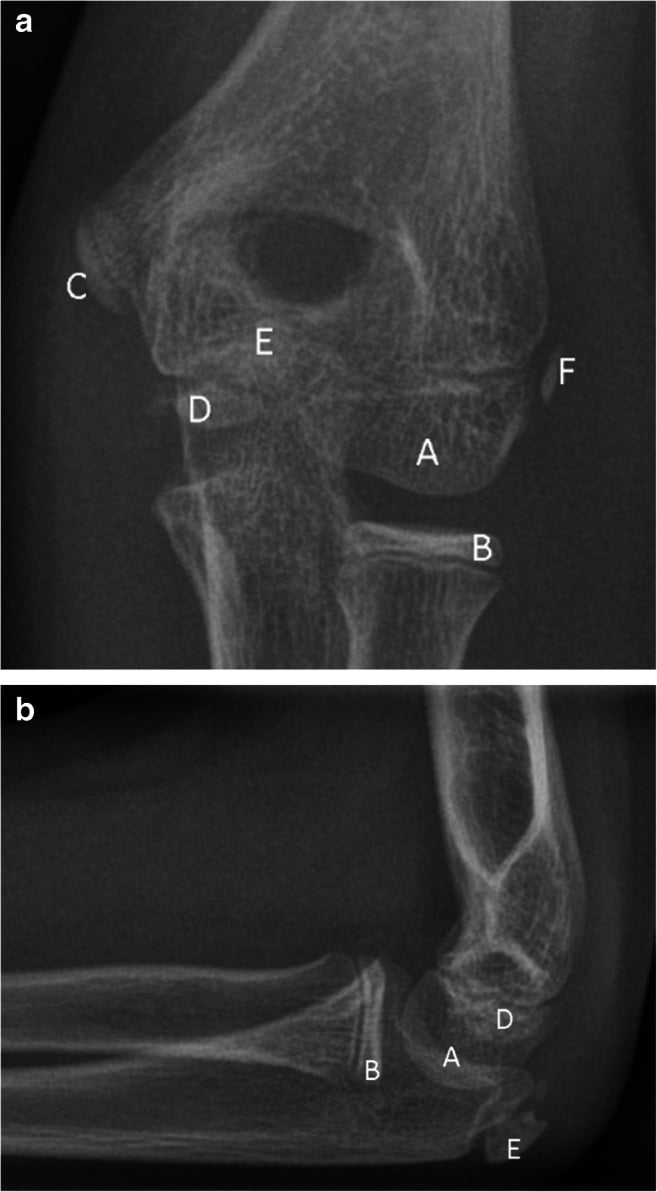
Signs of incarceration. The post-reduction film of a dislocated elbow is read for these:
- Trochlea ossified but the medial epicondyle not in its normal position (CRITOL)
- Widening of the ulnohumeral joint space medially on the AP view
- An ossific density in the joint space, often posteromedial; look carefully
- Medial soft-tissue swelling
- Pain or a mechanical block to motion after the "reduction"
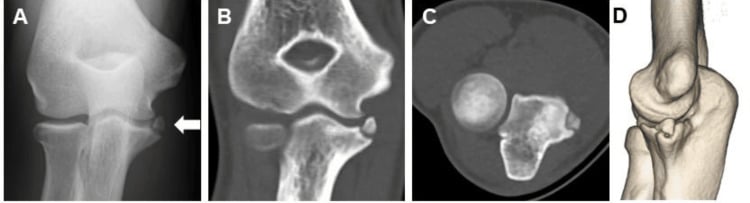
Beyond plain films. Valgus stress views show widening of the medial joint space from UCL laxity, and are used for the chronic or old injury and to assess instability. CT gives the precise position of the fragment when the radiograph leaves doubt and in complex injuries. MRI is for chronic valgus instability and UCL injury, where the ligament and the soft tissues are the question.
Management Algorithm
The decision. Three questions: is the fragment in the joint, how far has it displaced, and who is the patient. An incarcerated fragment or an open fracture is operated on whatever else is true. Everything else is a weighing of displacement against the demands on the elbow, and the displacement figure is less reliable than it looks, which is the subject of the Controversies section.
Non-operative treatment. The indications:
- Minimally displaced fracture (less than 5mm)
- No fragment incarceration and a congruent joint
- Non-throwing athlete or low-demand patient
- Intact ulnar nerve function
The protocol:
- Above-elbow splint or cast with the elbow at 90° and the forearm neutral
- Immobilise for 1-2 weeks
- Then begin progressive range-of-motion exercises
- Avoid valgus stress for 6 weeks
- Return to throwing at 8-12 weeks, progressed gradually
Operative treatment. Two indications are absolute:
- Incarcerated fragment in the joint (mandatory)
- Open fracture
The rest are relative, and are weighed:
- Displacement greater than 5mm (controversial; some use 10mm)
- High-level throwing athlete
- Ulnar nerve dysfunction
- Valgus instability
- Associated elbow instability
- Description
- Cannulated screw fixation (4.0-4.5mm)
- When Used
- Older children with adequate fragment size
- Description
- Smooth K-wire fixation
- When Used
- Younger children, small fragment
- Description
- Trans-osseous suture or suture anchor
- When Used
- Small or comminuted fragment
- Description
- Excision with muscle/ligament repair
- When Used
- Chronic non-union, small fragment (rarely primary)
Surgical Technique
Screw fixation. The standard technique for the paediatric medial epicondyle fracture with an adequate fragment. The patient is supine with the arm on an arm board, the shoulder externally rotated and the elbow flexed; an upper-arm tourniquet is optional.
Approach. A medial incision centred over the epicondyle. Dissect carefully to identify and protect the ulnar nerve, which is usually left in situ unless it subluxates. Transposition is rarely needed, but may be done if the nerve is subluxating or injured.
Reduction. If the fragment is incarcerated, extract it from the joint before anything else (below). Reduce it anatomically to the epicondylar bed and hold it with a reduction clamp or a K-wire.
Fixation. Place the guide wire for a 4.0 or 4.5mm cannulated screw, measure, and insert a partially threaded screw for compression, without over-compressing. The screw should be parallel or slightly posterior to avoid the articular surface, and a washer is optional if the bone is soft. Two divergent K-wires are the alternative, and may be preferred in younger children or with a small fragment.
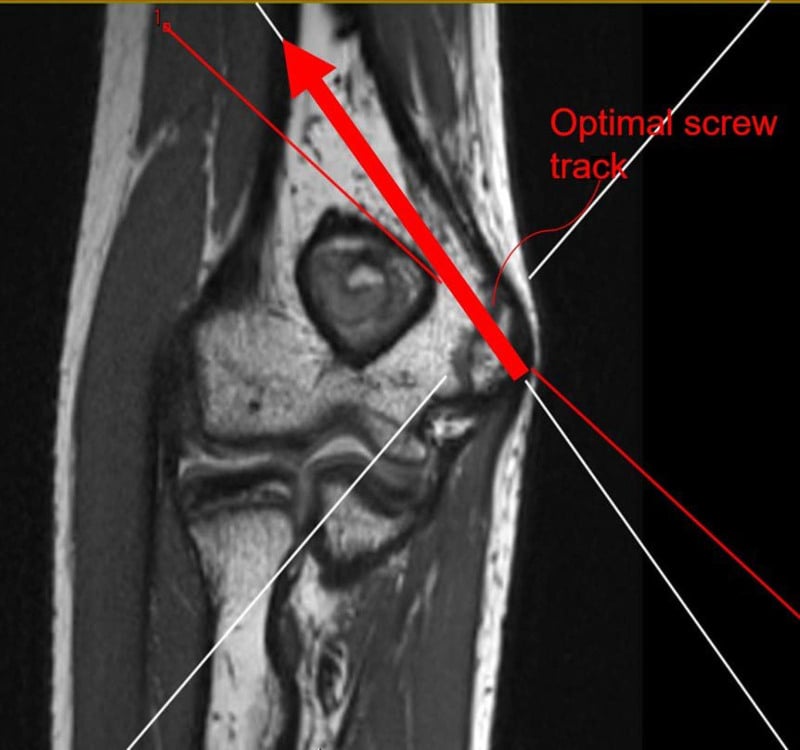
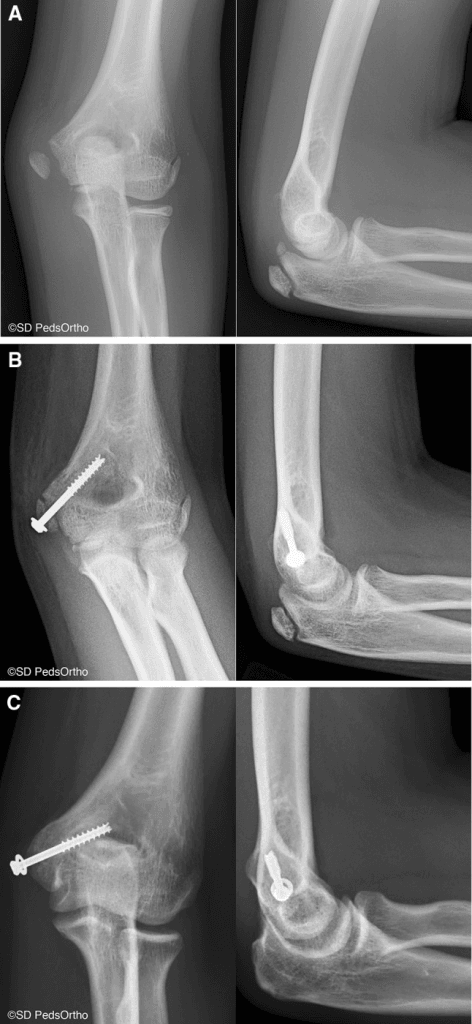
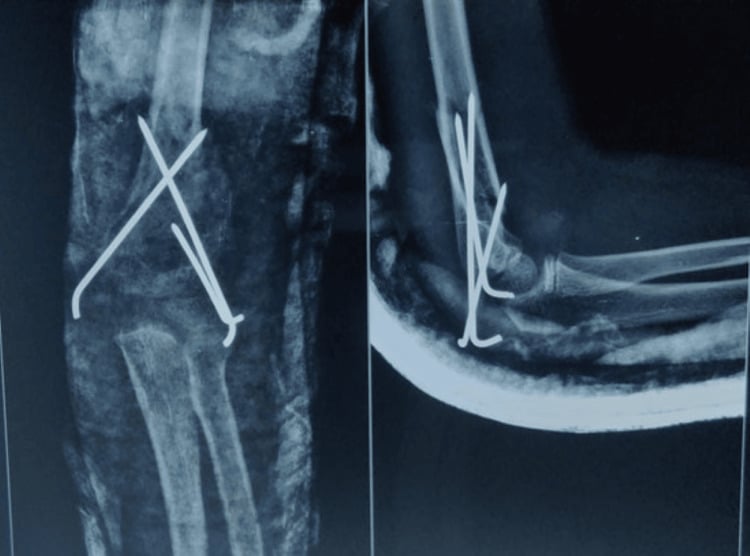
Assessment. Check the reduction and fixation on imaging, take the elbow through its range to confirm there is no mechanical block, and verify ulnar nerve function if able.
Extracting an incarcerated fragment. This is the mandatory step before fixation when the fragment is trapped in the joint. Through the medial approach, distract the joint gently and find the fragment in the ulnohumeral joint, usually posteromedially. Extract it with its soft-tissue attachments (flexor-pronator mass, UCL) intact; it may also have periosteal attachments to the bone bed. Irrigate the joint thoroughly, reduce the fragment to its bed and fix it with a screw or K-wires as above.
Do not go through the joint from a lateral approach, which risks iatrogenic injury. If the fragment is comminuted or very small, excision with soft-tissue repair may be needed, rarely.
Complications
Ulnar nerve injury. Comes from the injury or from the operation. Careful identification at surgery protects the nerve; consider transposition if it is at risk.
Non-union and fibrous union. The rate is variable and the result is often asymptomatic; fibrous union is usually functional, and ORIF is for the patient with symptoms.
Fibrous union is common (up to 50%) and usually asymptomatic. The flexor-pronator mass and UCL origin function well despite lack of bony union. Symptomatic non-union causing pain or instability is rare and may require late ORIF or excision with soft tissue repair.
Stiffness. Common and usually mild; early motion and physiotherapy are the treatment.
Valgus instability. Rare if the fracture has healed. Restoring the UCL origin is the argument for ORIF in the throwing athlete.
Missed incarceration. Potentially serious, and prevented by reading the post-reduction film with the signs listed under Investigations, comparison views and a high index of suspicion.
Hardware prominence. A problem of screws; the implant may need removal after healing.
Postoperative Care and Rehabilitation
Post-ORIF Protocol
- Posterior splint with elbow at 90°
- Gentle finger and wrist ROM
- Wound care
- Sling for comfort
- Remove splint, begin elbow ROM
- Active-assisted flexion/extension
- Avoid valgus stress
- Progress as tolerated
- Aim for full ROM
- Begin light strengthening
- Continue avoiding valgus stress
- May remove K-wires at 4-6 weeks if used
- Progressive resistance exercises
- Sport-specific conditioning
- Gradual return to non-throwing activities
- Begin graduated throwing programme
- Interval throwing protocol
- Full return when painless and full strength
The shape of it. The splint comes off at 2-4 weeks, valgus stress is avoided for 6-8 weeks, and throwing resumes at 3-4 months. The non-operative patient runs the same course faster: a shorter immobilisation, an earlier start to motion, and progression as tolerated.
Outcomes
After conservative treatment. Functional outcomes are excellent in most cases. Fibrous union is common but usually asymptomatic, and there may be a slight loss of extension, usually not clinically significant. Return to sport is at 6-12 weeks.
After surgery. Anatomic union is achieved, and it may be preferred for the high-level throwing athlete, but in many studies the long-term outcome is similar to conservative treatment. Hardware removal is occasionally needed.
In the long term. Most patients return to full activity; late valgus instability is rare and osteoarthritic change uncommon.
Guidelines, Registries & Global Practice
Global Epidemiology:
- Medial epicondyle fractures account for approximately 11-20% of paediatric elbow fractures (about 12% in contemporary series), making them the third most common after supracondylar and lateral condyle fractures
- Peak incidence 9-14 years; male predominance (roughly 3:1); rare after physeal fusion (15-17 years)
- Up to 50% occur with elbow dislocation; intra-articular incarceration in roughly 15-18% of fractures
- Sport-related avulsions cluster in overhead/valgus-loading activities - baseball pitching, cricket bowling, javelin, gymnastics, and wrestling - while trampoline and fall mechanisms predominate in younger children
- Position on Displaced Isolated Fractures
- Incarceration and open injury are absolute operative indications; fixation increasingly favoured in adolescent throwing athletes
- Notes
- Driven by return-to-sport literature (Lawrence 2013)
- Position on Displaced Isolated Fractures
- Non-operative care for most minimally and moderately displaced isolated fractures; surgery for incarceration, instability or open injury
- Notes
- Emphasis on shared decision-making and accepting fibrous union
- Position on Displaced Isolated Fractures
- Anatomic reduction and stable fixation when surgery is indicated; cannulated screw in older children, smooth K-wires in younger/small fragments
- Notes
- Technique-focused rather than threshold-focused
- Position on Displaced Isolated Fractures
- Recognises the unreliability of the historical 5mm threshold; individualised decision weighting instability and demand
- Notes
- Supports CT for borderline displacement
- Medial epicondyle fractures are not implant-survivorship procedures, so they do not feature in arthroplasty registries (NJR, AJRR, AOANJRR, SHAR). Evidence therefore comes from institutional cohorts and reviews rather than national registries
- Across these cohorts the consistent signal is functional equivalence of operative and non-operative care for most fractures, with surgery reserved for incarceration, instability, open injury and selected athletes
- High-resource settings: ready CT for borderline displacement, cannulated-screw fixation, intra-operative fluoroscopy, and structured throwing-return programmes
- Limited-resource settings: greater reliance on plain radiographs and closed/cast management; K-wire fixation favoured over screws on cost grounds; the strong evidence that casting yields good long-term function (even with nonunion) makes non-operative care a defensible default where imaging and theatre access are constrained
- Universal non-negotiables regardless of setting: never miss an incarcerated fragment, always document ulnar nerve function before intervention, and reduce-and-fix open injuries urgently
Controversies & Areas of Uncertainty
This is one of the most contested fractures in paediatric orthopaedics. A strong viva answer names the controversy, states what the evidence does and does not show, and lands on a defensible, individualised position.
The 5mm threshold. Surgeons cannot measure displacement reproducibly on plain films (Pappas 2010: greater than 2mm disagreement 54% of the time on AP, 87% on lateral). A fixed millimetre rule is therefore built on an unreliable number. Standardised methods and CT improve reliability, but radiograph-CT discrepancy can still reach 5-6mm (Guzek 2022).
Surgery versus casting for the displaced fracture. Long-term and propensity-matched data (Farsetti 2001; Axibal 2020) show equivalent function for most isolated fractures despite frequent radiographic nonunion after casting. Surgery buys bony union and stability, not necessarily a better functional result.
The throwing athlete. The historical argument for fixing the UCL origin in throwers is biomechanically intuitive, but athletes return to sport at high rates with either treatment (Lawrence 2013; Axibal 2020). Reasonable surgeons fix the elite thrower with instability or marked displacement; reflex surgery for every athlete is not evidence-based.
Nonunion: failure or not? Fibrous nonunion is the rule after casting (Farsetti 2001), yet rarely causes symptoms or valgus instability. Radiographic nonunion should not be equated with treatment failure; the relevant endpoints are pain, stability and function.
MCQ Practice Points
Q: In what order do the elbow ossification centers appear? A: CRITOL - Capitellum (1yr), Radial head (3yr), Internal (medial) epicondyle (5yr), Trochlea (7yr), Olecranon (9yr), Lateral epicondyle (11yr).
Q: How can you identify an incarcerated medial epicondyle fragment on X-ray? A: If the trochlea is visible but the medial epicondyle is NOT seen in its normal position (per CRITOL, medial epicondyle ossifies before trochlea), the fragment is incarcerated in the joint.
Q: Which nerve is at risk in medial epicondyle fractures? A: The ulnar nerve. It runs posterior to the medial epicondyle in the cubital tunnel. 10-16% have ulnar nerve symptoms at presentation.
Q: What is an absolute indication for surgery in medial epicondyle fractures? A: Incarcerated fragment in the joint. Also, open fracture.
Medicolegal Considerations
- Pre-operative ulnar nerve examination (critical)
- Radiographic assessment including comparison views
- Discussion of treatment options and shared decision-making
- For athletes: discussion of risks/benefits for throwing
- Risk of ulnar nerve injury (pre-existing vs iatrogenic)
- Non-union (rare with fixation)
- Stiffness
- Hardware removal
- For athletes: timeline for return, no guarantee of return to prior level
The most important medicolegal point is documenting ulnar nerve function BEFORE any intervention. If the patient has post-operative ulnar symptoms and there is no baseline documentation, it is difficult to establish whether the injury was pre-existing or iatrogenic.
Clinical Decision Scenarios
Practise clinical reasoning and management decisions out loud
“A 12-year-old boy fell from a trampoline onto his outstretched left arm. X-rays show a 3mm displaced medial epicondyle fracture. The elbow is congruent and ulnar nerve function is intact.”
“An 11-year-old girl had an elbow dislocation reduced in the emergency department. Post-reduction X-ray shows a congruent elbow but the 'medial epicondyle' appears smaller than expected and there is a bony density in the ulnohumeral joint space.”
“A 14-year-old elite baseball pitcher presents with medial elbow pain after a throwing injury. X-rays show an 8mm displaced medial epicondyle fracture. The joint is congruent and ulnar nerve is intact.”
CRITOL Sequence
- Capitellum 1yr
- Radial head 3yr
- Internal (medial) epicondyle 5yr
- Trochlea 7yr
- Olecranon 9yr
- Lateral epicondyle 11yr
Key Associations
- 50% with elbow dislocation
- 15-18% fragment incarceration
- 10-16% ulnar nerve symptoms
- Flexor-pronator and UCL origin
Incarceration Detection
- Trochlea visible, epicondyle missing = in joint
- Bony density in ulnohumeral joint space
- Post-dislocation reduction - check carefully
- Mandates ORIF
Treatment Thresholds
- Less than 5mm: Conservative
- 5-10mm: Controversial, consider patient factors
- Incarcerated: Mandatory surgery
- Elite thrower: Lower threshold for ORIF
Critical Actions
- Document ulnar nerve function pre-op
- Compare to contralateral elbow
- Look for fragment in joint on post-reduction films
- Protect ulnar nerve during surgery
Evidence Base
The evidence base is dominated by retrospective series and a small number of comparative cohorts; no randomised trial has yet REPORTED, though one is finally underway - the multicentre SCIENCE trial (Surgery or Cast of the EpicoNdyle in Children's Elbows; protocol Bone Jt Open 2024, PMID 38269598) is randomising displaced fractures without absolute operative indications to fixation versus cast, with a patient-reported upper-limb score at 12 months as the primary outcome. Until it reports, two themes recur across the literature: (1) measurement of displacement on plain radiographs is unreliable, undermining the historical "5 mm rule", and (2) functional outcomes after operative and non-operative treatment are broadly similar for most fractures, with surgery reserved for intra-articular incarceration, gross instability, and selected high-demand athletes.
Farsetti 2001 - Landmark Long-Term Comparison (Cast vs ORIF vs Excision)
- 42 isolated fractures displaced greater than 5mm, reviewed at a mean of 45 years (range 30-61) after injury
- Cast without reduction (n=19): 16 good, 3 fair - nonunion in all but 2, yet all had a stable elbow on valgus stress
- ORIF with K-wire or T-nail (n=17): 15 good, 2 fair - bony union but similar function to casting
- Fragment excision (n=6): 4 poor, 2 fair - chronic pain, ulnar paraesthesiae, instability
Fowles 1990 - Elbow Dislocation with Epicondyle Avulsion / Incarceration
- 28 children with elbow dislocation plus medial epicondyle avulsion followed after closed reduction
- 19 with satisfactory closed reduction treated in plaster: 11 normal elbows, 8 lost a mean 15 degrees flexion
- 6 of the 9 operated children had intra-articular entrapment; 5 had ulnar nerve contusion/compression
- Operated group lost a mean 37 degrees flexion - reflecting selection of the most severe injuries