Traumatic and Stress-Related Injuries
- Zone 2 (Jones) is a vascular watershed area prone to nonunion
- Zone 1 (Pseudo-Jones) heals well with protected weight-bearing
- Lisfranc injury must be excluded with weight-bearing views if subtle
- 1st Metatarsal requires zero displacement tolerance due to load bearing
- Smoking significantly increases the risk of Jones fracture nonunion
- “Jones fracture entry point: 'High and Inside' (High-Dorsal, Inside-Medial)
- “Fleck sign: Pathognomonic for Lisfranc avulsion (Base of 2nd MT)
- “Stress fractures: 2nd MT (Good) vs 5th MT (Poor) prognosis
- “Early fixation in athletes improves time to union and return to play
Metatarsal Fractures
Overview and Epidemiology
Metatarsal fractures are common foot injuries, approximately 35% of all foot fractures, and the fifth metatarsal accounts for nearly 70% of them. They range from simple avulsions through stress reactions to traumatic Lisfranc disruptions.
Which metatarsal. Each ray has its own pattern:
- Fifth - the most common, across Zones 1-3, and the Zone 1 avulsion is the most frequent of all
- Central (second to fourth) - often fractured together; an isolated central fracture is rare and should raise suspicion of Lisfranc involvement
- First - the least common, but the most critical for weight-bearing
Stress fractures. The "march fracture" classically involves the second or third metatarsal shaft. Fifth metatarsal stress fractures (Zone 3) are high-risk.
Anatomy and Biomechanics
The columns. The foot's structural integrity depends on the metatarsals' role in the longitudinal and transverse arches. For Lisfranc stability the metatarsals and the bones they articulate with are grouped into three columns:
- Medial - first metatarsal and medial cuneiform; flexible
- Middle - second and third metatarsals with the middle and lateral cuneiforms; rigid, the "keystone"
- Lateral - fourth and fifth metatarsals with the cuboid; mobile
The Lisfranc ligament. It runs obliquely from the medial cuneiform to the base of the second metatarsal. There is no ligamentous connection between the first and second metatarsal bases.
Blood supply of the fifth metatarsal base. The base has a dual supply. Metaphyseal arteries feed the tuberosity (Zone 1), and the nutrient artery enters the mid-diaphysis and travels proximally. The junction between the two, the Zone 2 Jones fracture site, is a vascular watershed, and that is what leads to its high nonunion rate. [1]
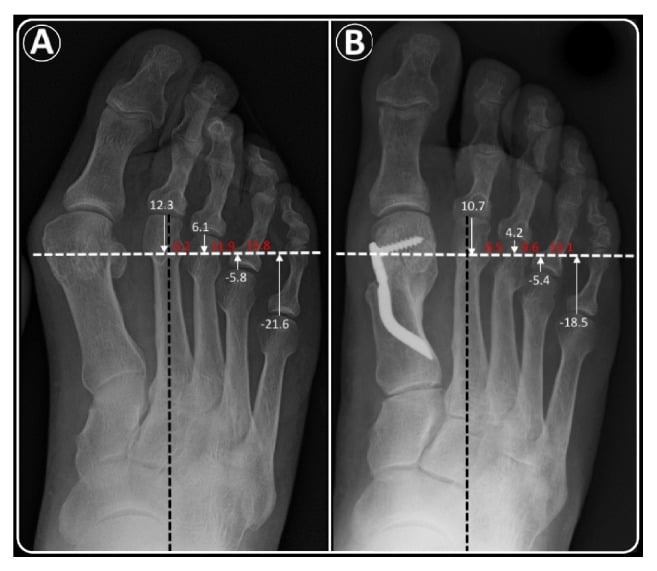
Load sharing. During gait the first metatarsal takes double the load of the lesser metatarsals and carries roughly a third of forefoot load. The heads sit on a parabola: the second metatarsal is usually the longest, the first and third are slightly shorter and roughly similar, and the fourth and fifth are progressively shorter. That smooth arc distributes forefoot load evenly across the heads.
What malreduction does. Shortening unloads a metatarsal's own head and transfers load to the adjacent heads. Plantar (dorsiflexion-apex) angulation drives the head plantarward so that it bears excess pressure. Either produces a transfer lesion: a painful plantar callosity, metatarsalgia, and sometimes a secondary stress fracture under the overloaded neighbour.
Why the first metatarsal is unforgiving. With that share of the load it has zero tolerance for shortening or malalignment, and a dorsal malunion causes chronic metatarsalgia and can accelerate hallux rigidus. So when fixing any metatarsal, restore length and the plantar plane, not just the coronal alignment. Residual shortening of more than a few millimetres, or plantar angulation, is the mechanism behind late transfer metatarsalgia.
Classification Systems
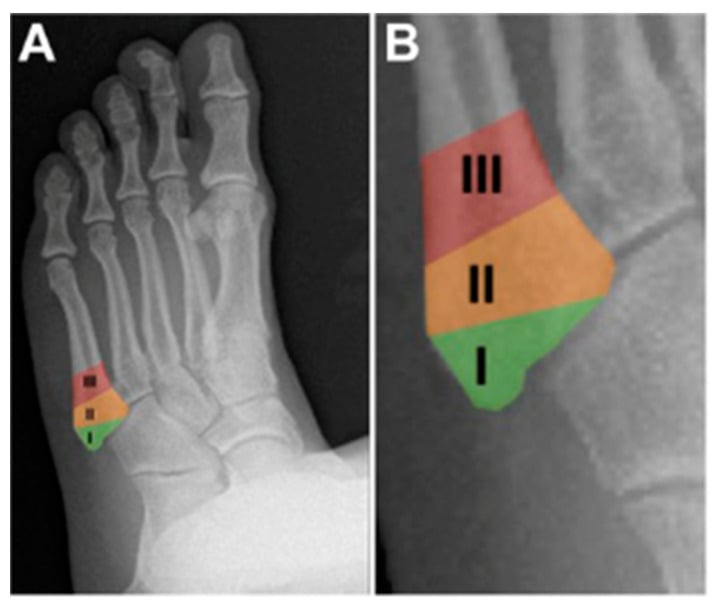
Lawrence and Botte zones. The fifth metatarsal base is divided into three zones by anatomy and healing potential, and the further distal the zone, the worse the fracture heals: Zone 3 has the highest nonunion rate. The exam favourite is the Zone 2 (Jones) fracture at the watershed. Do not confuse it with the Zone 1 tuberosity avulsion, the pseudo-Jones.
| Grade/Type | Description | Management |
|---|---|---|
| Pseudo-Jones | Tuberosity avulsion. Involves the cancellous bone. Heals universally. | Boot and weight-bear as tolerated. Excellent prognosis. |
| Jones Fracture | Metaphyseal-diaphyseal junction. Extends into the 4th-5th intermetatarsal joint. Watershed area. | NWB cast 6-8 weeks OR intramedullary screw fixation (athletes). |
| Stress Fracture | Proximal diaphyseal fracture. Distal to the 4th-5th intermetatarsal joint. Very poor biology. | Intramedullary screw fixation strongly recommended. High nonunion risk. |
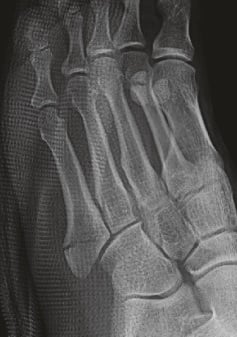
Hardcastle (Lisfranc). Useful for the associated tarsometatarsal injuries:
- Type A, total - all five metatarsals displaced in one direction
- Type B, partial - the first (B1) or the lesser metatarsals (B2) displaced in isolation
- Type C, divergent - the first and the lesser metatarsals displaced in opposite directions
Torg: chronicity. Lawrence and Botte describe where a proximal fifth metatarsal fracture sits; the Torg classification describes its chronicity and healing potential on the radiograph. The two are complementary, and both are examinable.
- Type I, acute - a sharp, narrow fracture line with no intramedullary sclerosis and no periosteal reaction. Best healing potential; many unite in a non-weight-bearing cast.
- Type II, delayed union - a widened fracture line with some intramedullary sclerosis and evidence of prior periosteal reaction, a fracture that has struggled to heal. Often needs fixation.
- Type III, established nonunion - complete obliteration of the medullary canal by sclerotic bone. Needs operative treatment: curettage or drilling of the sclerotic canal with bone grafting and/or a larger intramedullary screw.
Why chronicity matters. Radiographic chronicity, not the millimetre of location, drives prognosis. Sclerosis or canal obliteration predicts poorer healing and pushes toward surgery, whether the fracture is labelled a "Jones" or a proximal diaphyseal fracture (Chuckpaiwong).
Detailed management is developed in Jones Fractures, with Pseudo-Jones Fractures for the zone 1 tuberosity avulsion that behaves completely differently, Fifth Metatarsal Stress Fractures for the chronic presentation, Metatarsal Stress Fractures for the lesser rays, and Lisfranc Injuries for the midfoot injury that must be excluded alongside any base fracture.
Clinical Assessment
A high degree of clinical suspicion for Lisfranc injury is required in all midfoot trauma.
History. The mechanism separates a direct blow (crush) from indirect twisting, the Lisfranc pattern. Inability to weight-bear is a significant indicator of instability. When a stress fracture is possible, ask about a recent increase in load, as in military recruits and marathon runners.
Examination. Plantar ecchymosis is pathognomonic for Lisfranc injury. Palpate for point tenderness over the metatarsal bases and the intermetatarsal spaces, then stress the forefoot:
- Midfoot stress test - passive abduction and pronation of the forefoot; pain indicates a Lisfranc injury
- Piano key test - moving the metatarsal head up and down; pain at the base suggests a fracture
Finish with the neurovascular examination: the dorsalis pedis pulse and deep peroneal nerve sensation.
Investigations
Radiographs are the gold standard, but subtle injuries may require advanced imaging.
Radiographs. AP, lateral and 30° oblique views. The Lisfranc signs are:
- A gap of more than 2mm between the first and second metatarsal bases
- The fleck sign, a bony avulsion in the first intermetatarsal space, which is pathognomonic
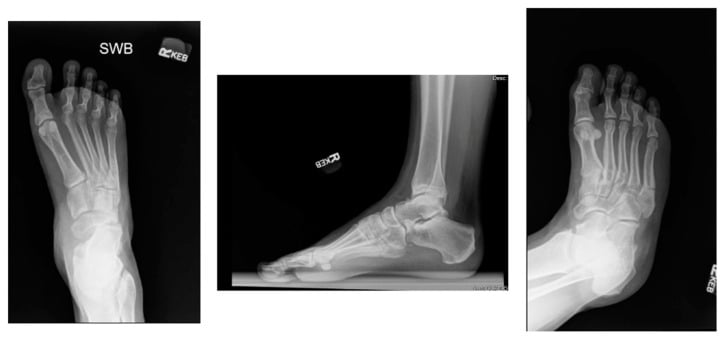
Weight-bearing views. Essential for the subtle Lisfranc injury, because a ligamentous injury can look stable on non-weight-bearing films. If weight-bearing is too painful, consider stress radiographs under anaesthesia.
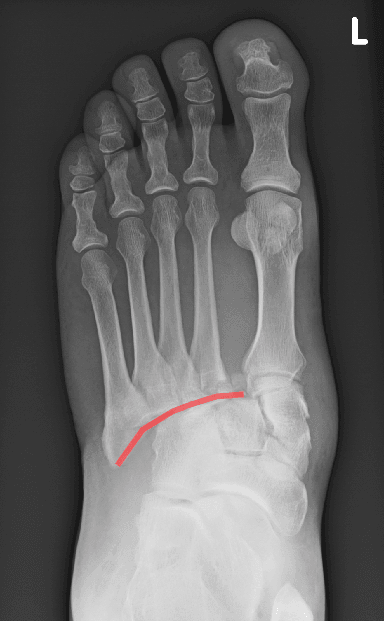
CT. Superior for identifying small avulsion fractures such as the fleck sign and for assessing articular involvement, and the study for pre-operative planning.
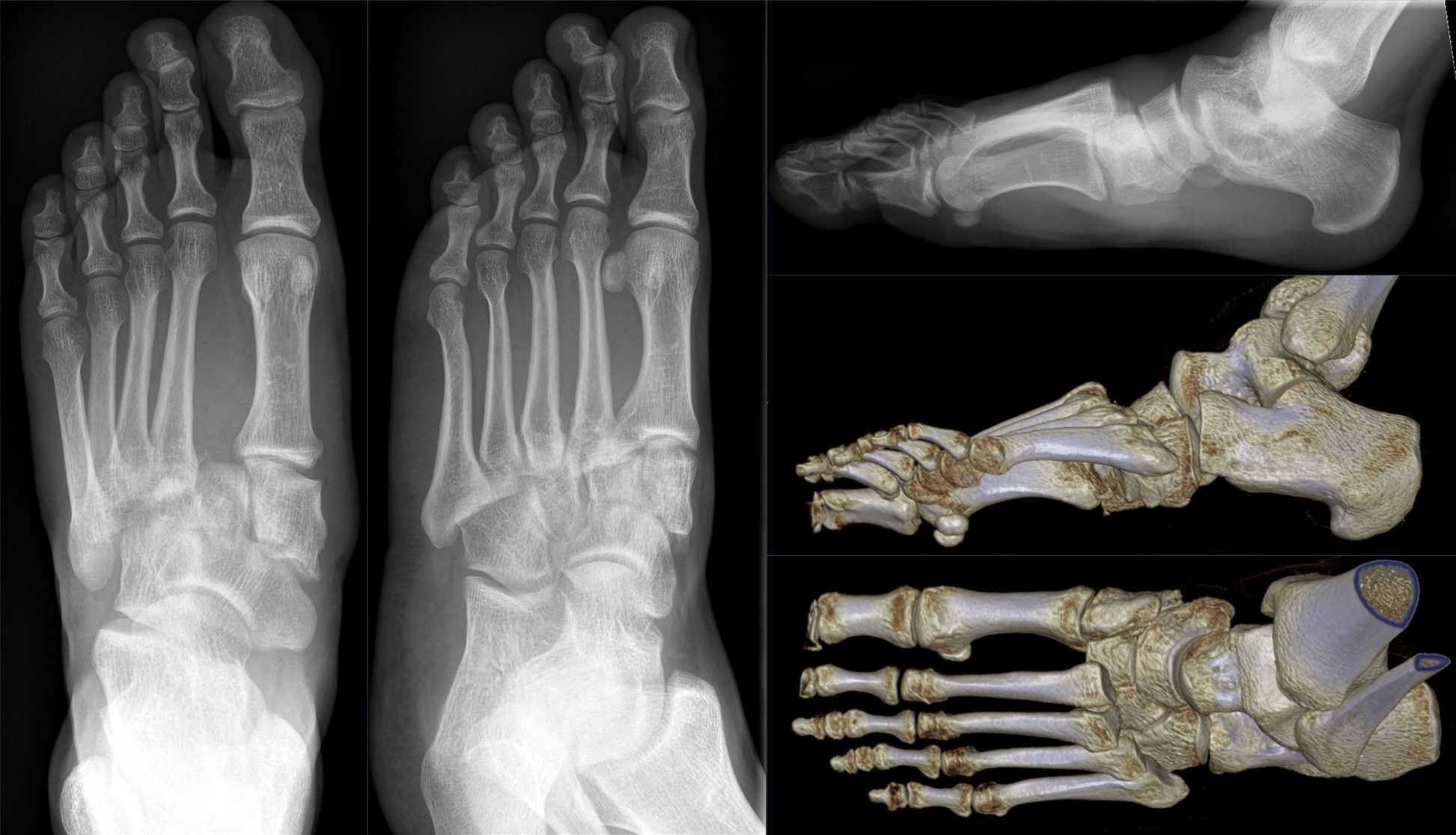
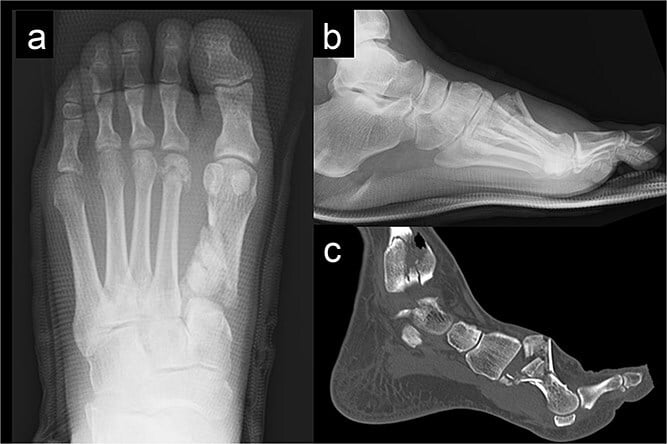
MRI. The most sensitive test for an early stress reaction, showing bone marrow oedema before cortical changes appear on the radiograph.
Differential Diagnosis
Forefoot and midfoot pain has several mimics; the table sets out what discriminates them.
- Discriminating Features
- Trauma history, focal bony tenderness, deformity
- Best Test
- Plain radiographs (AP/oblique/lateral)
- Discriminating Features
- Insidious overuse pain, normal early X-ray, training spike
- Best Test
- MRI (marrow oedema) or delayed callus on X-ray
- Discriminating Features
- Plantar ecchymosis, midfoot instability, gap over 2mm
- Best Test
- Weight-bearing/stress radiographs, CT
- Discriminating Features
- 2nd MT head, adolescent/young female, AVN flattening
- Best Test
- Radiograph/MRI of MT head
- Discriminating Features
- Burning interdigital pain, Mulder click, no bony tenderness
- Best Test
- Clinical, ultrasound/MRI
- Discriminating Features
- Dorsal MTP pain, positive drawer, no fracture line
- Best Test
- Clinical exam, MRI/ultrasound
- Discriminating Features
- Smooth corticated bone lateral to cuboid, asymptomatic
- Best Test
- Compare with contralateral foot
Management
Fifth metatarsal. The zone sets the default, as the Lawrence and Botte table shows: Zone 1 is treated with symptomatic weight-bearing in a boot, and Zone 3 warrants aggressive surgical fixation. Zone 2 is where the judgement lies.
The Zone 2 decision. A non-weight-bearing cast or an intramedullary screw. In athletes, early intramedullary screw fixation gives faster union and return to sport than casting (Mologne), and pooled data support the screw for all Jones fractures in athletes (Attia); both are in the Evidence Base. Outside that group the best strategy is debated (see Controversies). The non-weight-bearing rule for the cast comes from Torg's series; the UK position summarised under Guidelines manages most acute Jones fractures in a boot.
First metatarsal. Because it tolerates no shortening or malalignment, ORIF is indicated for any displacement, angulation, instability or articular step-off.
Central metatarsals (second to fourth). Conservative treatment when angulation is less than 10° and displacement less than 3mm. Surgery is indicated for:
- Multiple (displaced) central metatarsal fractures
- A "floating midfoot" configuration
- Clinical instability
- Significant shortening or plantovalar deformity
- An irreducible closed injury
Surgical Technique
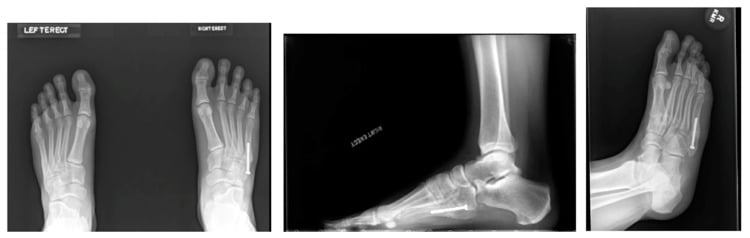
Set-up. The patient lies supine with a bolster under the ipsilateral hip to rotate the foot medially, which gives the optimal lateral view of the foot on the C-arm.
Entry point. High and inside: dorsomedial on the tuberosity. This avoids splitting the lateral cortex and aligns the screw with the intramedullary canal.
- Pass a 1.6mm or 2.0mm guidewire down the intramedullary canal
- Confirm central placement on AP and lateral views
- Drill cautiously over the wire
- Insert a 4.5-5.5mm partially threaded screw, using the largest-diameter solid screw
- Confirm compression across the watershed zone on the C-arm
Getting the screw right. Every thread must cross the fracture, and the screw tip should reach within 5mm of the distal metatarsal head. An undersized screw leads to persistent nonunion and risks refracture, while an excessively long straight screw may distract the fracture or penetrate the cortex. An eccentric wire leads to distal cortical perforation. Avoid excessive lateral dissection, which endangers the sural nerve, and consider bone graft for a delayed union of more than 6 months.
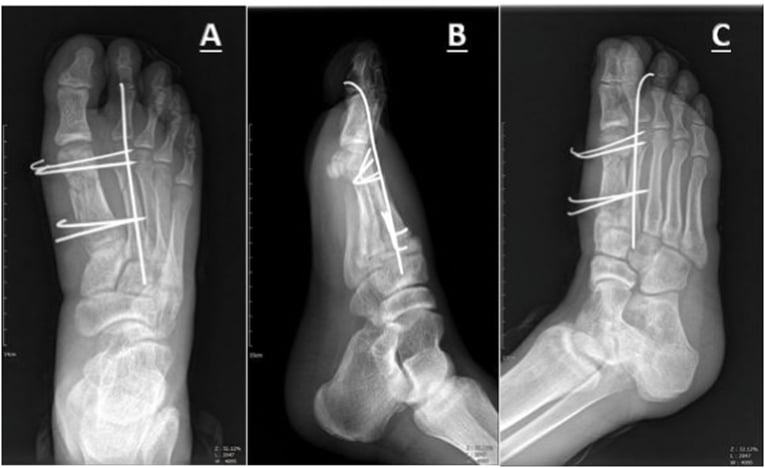
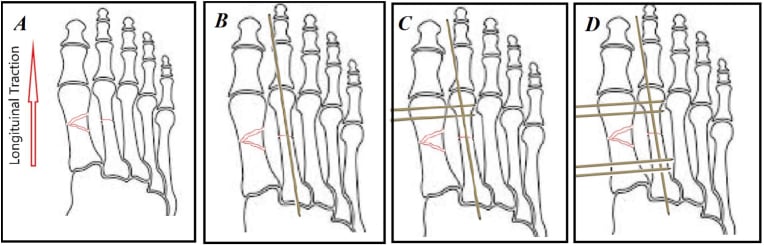
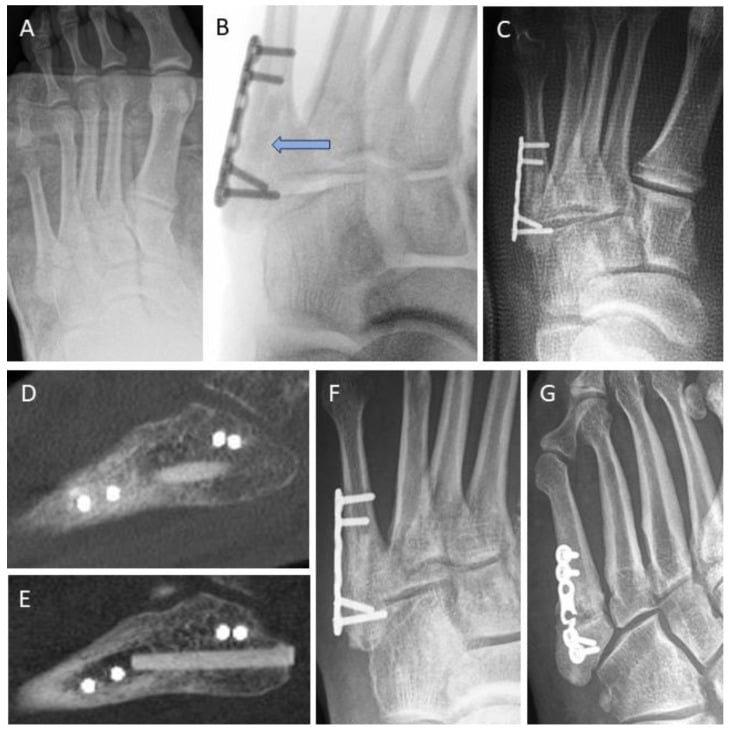
Complications
Nonunion. The Zone 2 and 3 fifth metatarsal fracture is the one that fails to unite: 30-50% of Jones fractures without surgery. Smoking is the most significant risk factor; the others are delayed presentation (more than 6 weeks), premature weight-bearing and an undersized screw (under 4.5mm). Revision is described under Surgical Technique.
Refracture. Follows premature return to sport and occurs in 10-15% of athletes.
Transfer metatarsalgia. The consequence of malunion with plantar angulation or shortening of more than 3mm, the malreduction described under Anatomy and Biomechanics, and prevented by anatomical reduction, above all of the first metatarsal. Treatment starts with metatarsal pads and orthotics; the surgical option is a distal (Weil) shortening osteotomy of the overloaded ray.
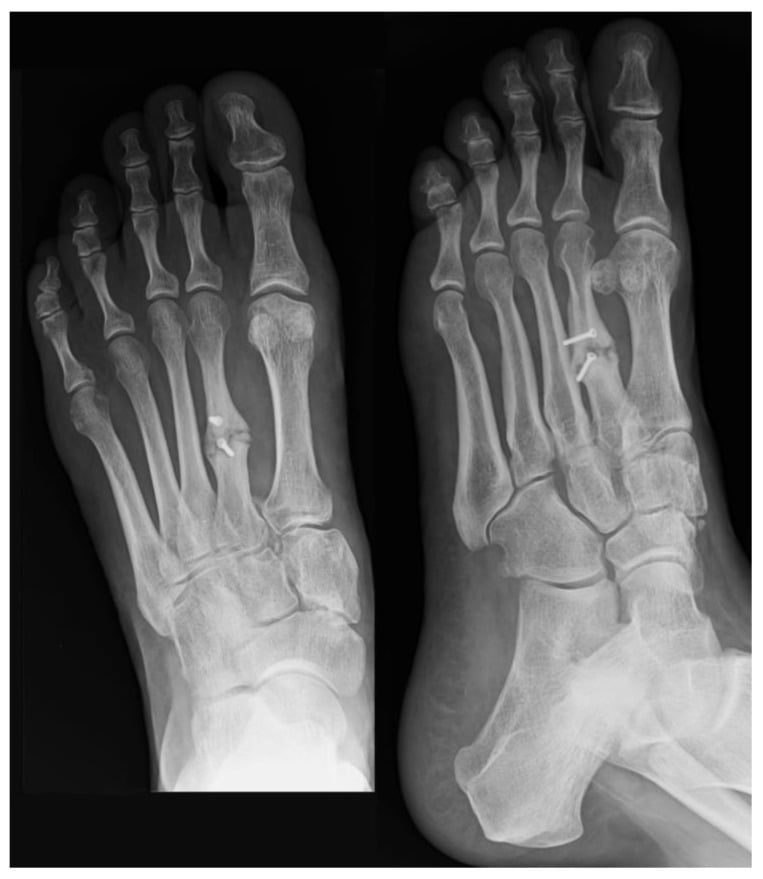
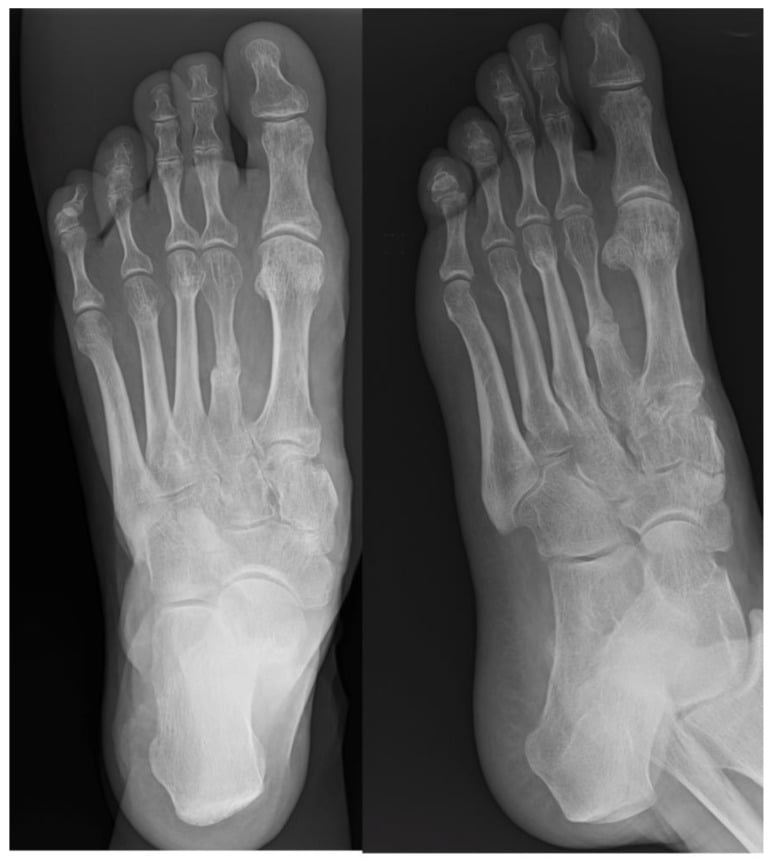
Post-traumatic arthritis. Follows over 50% of Lisfranc injuries and is common even after anatomical reduction. It presents as midfoot stiffness and pain at push-off. Activity modification and stiff-soled shoes come first; arthrodesis of the first, second and third TMT joints is the gold standard and may be required at 2-5 years.
Compartment syndrome. Rare, but an emergency: it follows a high-energy crush (a run-over foot) or multiple metatarsal fractures. Pain out of proportion and a delta pressure under 30mmHg make the diagnosis, and fasciotomy releases all nine compartments:
- Medial, lateral and superficial
- Four interosseous
- Adductor
- Calcaneal
Sequelae are claw toes, sensory loss and stiffness.
Sural neuropathy. A risk of the lateral approach to the fifth metatarsal base, felt as numbness along the lateral border of the foot.
Hardware prominence. Pain over the screw head, treated by removing the hardware after union.
Complex regional pain syndrome. Associated with prolonged immobilisation, and managed with early mobilisation, physiotherapy and the pain clinic.
Postoperative Care
Recovery depends on the stability of the construct and the biology of the fracture. The general framework:
- 0-2 weeks, protection - splint or backslab, strictly non-weight-bearing, elevation to manage oedema
- 2-6 weeks, mobilisation - transition to a CAM walking boot and gentle toe range of motion, weight-bearing status per the surgeon's protocol for the procedure
- 6-12 weeks, rehabilitation - gradual weight-bearing as tolerated, physiotherapy to strengthen the intrinsic foot muscles
After Lisfranc ORIF. Non-weight-bearing in a cast or boot for 6 weeks, then progressive weight-bearing from 6 to 12 weeks. Screws are removed at 3-4 months, while plates can stay, and return to sport takes 4-6 months at minimum.
After first metatarsal ORIF. Non-weight-bearing for 6 weeks, then a boot with weight-bearing to 12 weeks, progression guided by radiographic union.
Outcomes and Prognosis
Overall prognosis for metatarsal fractures is good, provided structural alignment is maintained.
Zone 1 and central fractures. Excellent. Healing is predictable within 6-10 weeks, and functional return to baseline is standard.
Zones 2 and 3 of the fifth metatarsal. Guarded, with the highest rate of secondary intervention (up to 30%). Return to high-impact sport may take 4-6 months if nonunion develops.
Long term. Post-traumatic arthritis after Lisfranc injury and chronic metatarsalgia after plantar-angulated malunion are the lasting problems.
Guidelines, Registries & Global Practice
Global epidemiology:
- Metatarsal fractures account for roughly 5-6% of all fractures and about 35% of foot fractures worldwide; the fifth metatarsal is involved in the majority (commonly quoted ~70% of metatarsal fractures).
- Stress (fatigue) fractures cluster in military recruits, distance runners, dancers and footballers. The 2nd/3rd metatarsal shaft ("march fracture") is the classic fatigue site; proximal 5th metatarsal stress fractures are the high-risk subset.
- Bone stress injuries frequently signal an underlying metabolic problem — screen for the Relative Energy Deficiency in Sport (RED-S) / female athlete triad, low vitamin D, and (in recurrent or atypical cases) coeliac disease.
Side-by-side guidance:
- Position on 5th MT base / Jones fractures
- Nonoperative for Zone 1 avulsions; intramedullary screw favoured for Zone 2/3 and for athletes seeking faster return.
- Position on 5th MT base / Jones fractures
- Early IM screw for competitive athletes; solid, largest-diameter screw to reduce refracture.
- Position on 5th MT base / Jones fractures
- Tuberosity (Zone 1) and most acute Jones fractures managed nonoperatively (boot, weight-bear as tolerated); surgery for displacement, nonunion or high-demand athletes.
- Position on 5th MT base / Jones fractures
- Lag-screw or plate ORIF for displaced 1st and central shaft fractures; IM screw for proximal 5th MT; anatomic restoration of length/alignment to prevent transfer metatarsalgia.
Across societies, anatomic reduction is mandatory; primary arthrodesis is favoured for purely ligamentous injuries (Ly & Coetzee Level I evidence), while ORIF remains standard for bony / combined patterns.
- Well-resourced settings: MRI for occult stress fractures, weight-bearing and stress radiographs (or weight-bearing CT) for subtle Lisfranc injuries, and early IM screw fixation for athletes to compress return-to-play timelines.
- Limited-resource settings: Plain radiographs and clinical examination drive decisions; NWB casting is a wholly acceptable primary treatment for acute Jones and tuberosity fractures, reserving surgery for nonunion, displacement or unequivocal instability. Smoking cessation and nutritional optimisation are universally available, high-yield interventions.
Controversies & Areas of Uncertainty
Surgery for the non-elite Jones fracture. Level I evidence supports early screw fixation in athletes, but the optimal strategy for sedentary or low-demand patients is debated. Many heal with non-weight-bearing casting, avoiding hardware and refracture risk.
Screw type and diameter. Larger, solid screws are widely recommended to reduce refracture. High-quality comparative data on the ideal diameter, headed versus headless designs and the added value of bone graft or biologics remain limited.
Primary fusion or ORIF for Lisfranc. Primary arthrodesis is favoured for purely ligamentous injuries. For combined bony-ligamentous patterns the choice between fusion and ORIF, and the timing of routine hardware removal, is still individualised.
Weight-bearing protocols. Early protected weight-bearing after fixation may speed recovery without compromising union, but cautious surgeons still use prolonged non-weight-bearing in watershed-zone fractures. Consensus thresholds are lacking.
MCQ Practice Points
Q: What are the three zones of 5th metatarsal base fractures and their significance?
A: Zone 1 (tuberosity avulsion): Peroneus brevis insertion, excellent healing, weight-bear as tolerated. Zone 2 (Jones fracture): Metaphyseal-diaphyseal junction, poor blood supply, high nonunion risk - consider early fixation in athletes. Zone 3 (diaphyseal stress): Chronic, requires intramedullary screw fixation.
Q: What associated injury must be excluded with any metatarsal fracture?
A: Lisfranc injury - tarsometatarsal joint complex disruption. Check for: 2nd MT base alignment with middle cuneiform on AP, medial border of 4th MT aligns with medial cuboid on oblique. Fleck sign (avulsion between 1st/2nd MT bases) pathognomonic. Weight-bearing radiographs if subtle. Missed injury leads to painful flatfoot.
Q: What are the indications for surgical fixation of metatarsal shaft fractures?
A: Surgical indications: greater than 10° sagittal angulation, greater than 3-4mm shortening, displacement greater than 3-4mm in transverse plane, multiple metatarsal fractures (disrupts transverse arch), open fractures, compartment syndrome. Central metatarsals (2-4) tolerate less displacement than 1st or 5th due to load distribution.
Q: What is the mechanism and treatment of first metatarsal stress fractures?
A: First MT stress fractures occur in runners with forefoot varus or hypermobility. Located at proximal metaphysis or diaphysis. Treatment: Activity modification, rigid-soled shoe/boot for 6-8 weeks. Surgical fixation for nonunion or elite athletes. Risk factors include vitamin D deficiency, female athlete triad, training errors.
Q: What is the "March fracture" and its typical location?
A: March fracture = stress fracture of metatarsal shaft, classically 2nd or 3rd metatarsal neck/shaft. Named for military recruits. Caused by repetitive stress exceeding bone remodeling capacity. X-ray may be negative initially; periosteal reaction or callus appears 2-3 weeks later. MRI/bone scan for early diagnosis if needed.
Exam Cheat Sheet
5th MT Base Zones
- Zone 1: Avulsion → Boot and weight-bear as tolerated
- Zone 2: Jones → Watershed, NWB Cast or Screw (Athlete)
- Zone 3: Stress → Diaphyseal, High risk of nonunion
Lisfranc Pearls
- Plantar ecchymosis (Pathognomonic sign)
- Gap greater than 2mm between 1st/2nd MT bases
- Fleck sign is a pathognomonic avulsion fragment
Management Limits
- 1st MT: Zero displacement tolerance
- 2-4 MT: less than 10° angulation, less than 3mm shortening
- 5th MT: Zone 2 always requires non-operative protection or ORIF
Clinical Decision Scenarios
Practise clinical reasoning and management decisions out loud
“A 19-year-old elite basketball player presents with sudden lateral foot pain after a pivot. X-ray shows a transverse fracture at the 5th MT base, 2cm distal to the tuberosity tip. How would you proceed?”
Evidence Base
Early Screw Fixation vs Casting (RCT)
- RCT, 37 acute Jones fractures (19 screw vs 18 cast)
- Cast group: 44% treatment failure (5 nonunions, 1 delayed, 2 refractures)
- Screw: median union 7.5 wks and return to sport 8.0 wks vs 14.5 and 15.0 wks for cast
Surgery vs Nonop in Athletes (Meta-analysis)
- 22 studies, 646 Jones fractures in athletes
- Return to play: 98.8% with IM screw vs 71.6% nonoperative; union 97.3% vs 71.4%
- Overall refracture rate 10.2%; time to RTP 9.6 wks (screw) vs 13.1 wks (nonop)
Torg Classification (Landmark)
- 46 fractures distal to tuberosity stratified into acute, delayed union and nonunion
- Acute fractures: 14/15 united in ~7 wks with NWB toe-to-knee cast vs 4/10 with weight-bearing methods
- Sclerosis / canal obliteration defines chronic disease needing surgery