Congenital Muscular Torticollis | Head Tilt | Sternocleidomastoid | Stretching vs Surgery
- Classic triad: Head tilt to AFFECTED side, chin rotation to OPPOSITE side, palpable SCM mass (pseudotumor)
- Screen for DDH: real association is most likely under 10% (older reports quoted up to 20%) - always perform a clinical hip examination
- Early stretching is key: Greater than 90% resolve with physiotherapy started before 1 year
- Plagiocephaly: Positional head flattening from persistent tilt - contributes to cosmetic concerns
- Surgical release: Consider if no improvement by 12-18 months, releases SCM at clavicular origin
- “Tilt is toward the TIGHT SCM (affected side), chin points AWAY
- “Pseudotumor (SCM mass) present in first weeks, usually resolves by 4-6 months
- “Facial asymmetry and plagiocephaly develop if untreated
- “Differential: congenital cervical spine anomaly, ocular torticollis, Sandifer syndrome
Overview and Epidemiology
Congenital muscular torticollis (CMT) is unilateral shortening or fibrosis of the sternocleidomastoid (SCM). The head tilts toward the affected side and the chin rotates to the opposite side. It is the most common cause of torticollis in infants and young children.
Who. CMT affects 0.4-2% of live births and is the third most common congenital musculoskeletal condition, after DDH and clubfoot. The right side is affected more often (75%), and males slightly more often than females. It is associated with difficult delivery, breech presentation and first-born infants.
Why. The most accepted theory is an intrauterine compartment syndrome of the SCM. Others propose birth trauma with ischaemia of the muscle, or venous occlusion and oedema leading to fibrosis. Oligohydramnios and multiple pregnancy are also associated.
Not every tilt is muscular. CMT accounts for 80% of paediatric torticollis. The remaining 20% includes osseous abnormalities (Klippel-Feil, atlantoaxial rotatory subluxation), tumours (posterior fossa, spinal cord), ocular causes and Sandifer syndrome, and the features that should send you looking for them are listed under Investigations.
Pathophysiology and Mechanisms
The muscle. The sternal head of the SCM arises from the manubrium and the clavicular head from the medial clavicle; both insert on the mastoid process and the lateral superior nuchal line. Surgical release is usually at the clavicular end and rarely proximally. The muscle is supplied by the spinal accessory nerve (CN XI), which is at risk in surgery.
The deformity. The SCM tilts the head to its own side and rotates it to the opposite side, which explains the clinical pattern of CMT. A unilaterally shortened muscle holds the head in its own action: tilted toward the tight side, chin turned away.
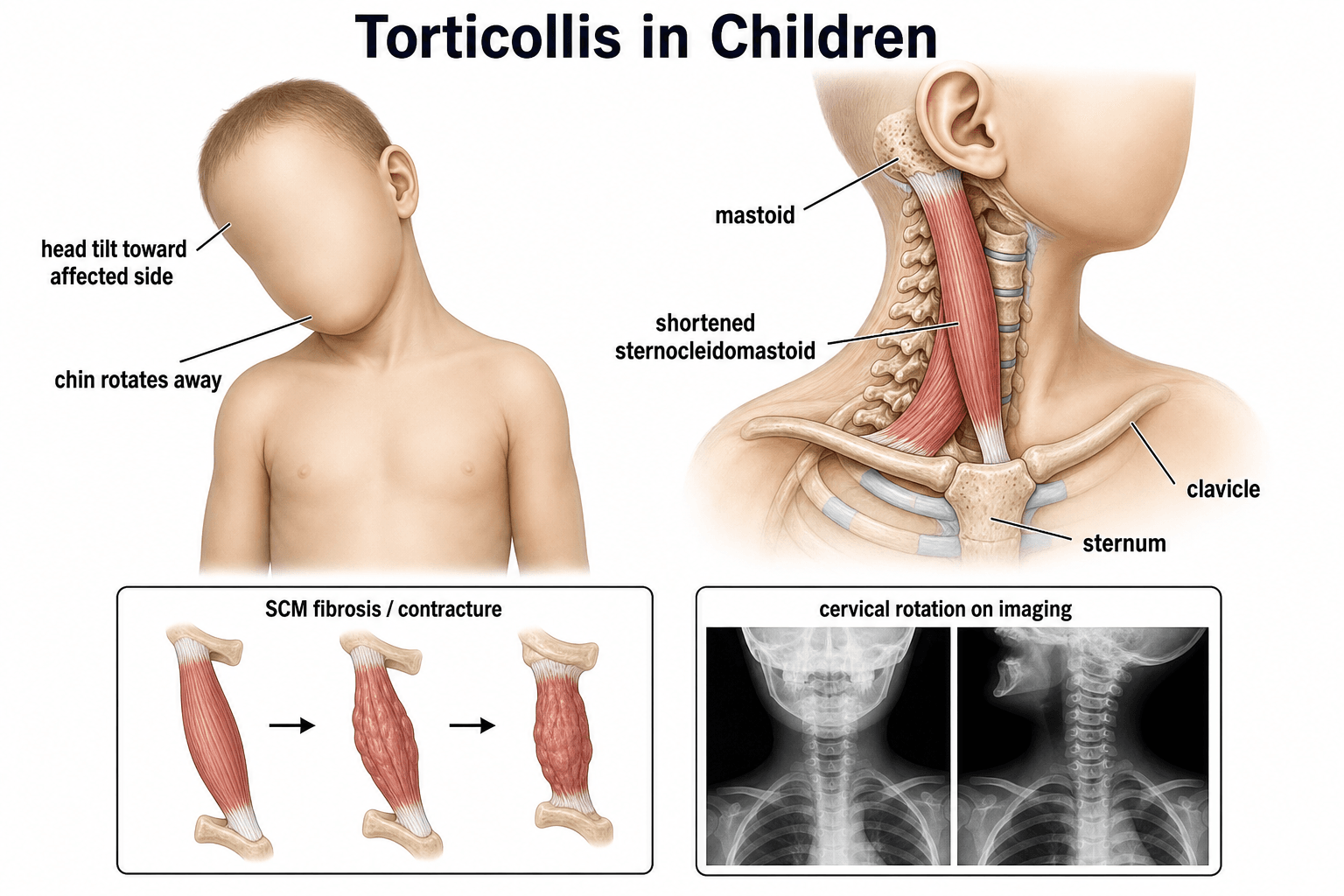
Secondary deformities. Left untreated, the tilt remodels the skull and face, and these changes are what drive the urgency of early treatment:
- Plagiocephaly - flattening of the ipsilateral occiput, the side the infant lies on
- Facial asymmetry - the ipsilateral face appears smaller
- Frontal bossing - in positional plagiocephaly the forehead on the side of the flat occiput comes forward (see the pearl below)
Timing. Positional plagiocephaly develops within months if torticollis is untreated. Mild cases improve with treatment, but severe plagiocephaly may require helmet therapy, which is why early stretching matters: it prevents the secondary skull deformity.
The plagiocephaly that accompanies CMT is positional (deformational) and must be distinguished from true unilateral lambdoid synostosis, which is rare but needs surgery. Look at the skull from above (vertex view): positional plagiocephaly produces a parallelogram — the flattened occiput pushes the ipsilateral ear forward with ipsilateral frontal bossing, so the ear and forehead shift toward the flat side. Lambdoid synostosis produces a trapezoid — the ear is displaced posteriorly and inferiorly on the fused side, with an ipsilateral mastoid bulge and contralateral frontal bossing, giving a tilted, windswept skull base. Positional plagiocephaly responds to repositioning and physiotherapy (helmet if severe); suspected synostosis warrants CT with 3D reconstruction and craniofacial referral.
Classification Systems
CMT is described by what is felt in the SCM and graded by how much rotation is lost. All three clinical subtypes generally respond well to conservative treatment if it is started early.
- Clinical Finding
- Palpable mass in SCM
- Characteristics
- Most common, present in first weeks, usually resolves by 4-6 months
- Prognosis
- Excellent with stretching
- Clinical Finding
- Tight SCM without mass
- Characteristics
- No palpable mass, just tight muscle
- Prognosis
- Good with stretching
- Clinical Finding
- Positional preference, no tightness
- Characteristics
- Mildest form, normal ROM
- Prognosis
- Resolves with positioning
Clinical Assessment
The pattern. The head tilts toward the tight SCM and the chin points away from it: a tight right SCM gives a right tilt and a chin pointing left. Passive rotation of the chin toward the affected side is limited, and in early infancy there may be a palpable pseudotumour (fibromatosis colli) in the muscle.
History. Ask about the birth (breech, prolonged labour, forceps or vacuum), when the tilt was first noticed and whether it is worsening, stable or improving, and any stretching or physiotherapy already tried. Feeding difficulty may point to Sandifer syndrome and visual concerns to an ocular torticollis.
Examination. Work from the head down to the hips and feet:
- Inspection - tilt direction and chin position, plagiocephaly (flattening of the occiput), facial asymmetry (ipsilateral face smaller), and neck webbing, which may indicate Klippel-Feil
- SCM palpation - a mass (pseudotumour) or tightness
- Range of motion - passive rotation should be symmetrical, so measure the deficit; passive lateral flexion to each side; active range observed as the child looks around. Asymmetry between sides is diagnostic
- Associated conditions - hips (Barlow, Ortolani, asymmetry); feet (metatarsus adductus, clubfoot); spine (scoliosis, congenital anomalies); dysmorphic features if the picture is atypical
Developmental dysplasia of the hip coexists with CMT in a clinically important minority. Older reports quoted 20%, but verified series report around 8% (Walsh) and about 4.5% requiring treatment (Minihane), within a literature range of 2-29%; the real association is most likely under 10%. Both conditions share the aetiology of intrauterine crowding and malpositioning. A documented clinical hip examination is mandatory in every CMT patient. A normal examination makes significant DDH unlikely, so targeted ultrasound or radiograph follows an abnormal examination or DDH risk factors.
TILTTILT - Torticollis Features
Hook:The head TILTs toward the tight SCM - same side as the problem.
Investigations
Most CMT needs no imaging. Routine CMT with classic features is diagnosed clinically; imaging is for the child who does not fit the pattern.
When to X-ray the cervical spine. Atypical features, no palpable SCM mass, failure to respond to stretching, restricted range of motion in multiple planes, or concern for a bony anomaly.
When to consider a non-CMT cause.
- No palpable SCM mass or tightness
- Restriction in more than one plane
- Onset after the first weeks of life
- Neurological signs
- Failure to improve with proper stretching
- When Used
- Atypical presentation, no improvement, bony abnormality suspected
- What to Look For
- Klippel-Feil, hemivertebra, atlantoaxial anomaly
- When Used
- Early, if diagnosis uncertain
- What to Look For
- Muscle thickening, echogenicity changes
- When Used
- CMT infant under 6 months with abnormal hip exam or DDH risk factors
- What to Look For
- DDH screening
- When Used
- Neurological signs, severe or atypical
- What to Look For
- Cord abnormality, tumour
- When Used
- Suspected atlantoaxial rotatory fixation
- What to Look For
- AARF diagnosis
Differential Diagnosis
The single most important exam skill is separating benign CMT from sinister or non-muscular causes. The atypical features listed under Investigations mandate further work-up; this table sorts the causes they point to.
- Distinguishing features
- Present at or shortly after birth, SCM mass or tight band, isolated rotation deficit
- Key investigation
- Clinical (radiograph normal); SCM ultrasound if unsure
- Implication
- Conservative stretching first-line
- Distinguishing features
- Short neck, low posterior hairline, limited multi-plane ROM, no SCM mass
- Key investigation
- Cervical radiograph (fused vertebrae)
- Implication
- Screen hearing, renal, cardiac, Sprengel; stretching ineffective
- Distinguishing features
- Present from birth, no SCM mass, ROM variable and may be fixed
- Key investigation
- Cervical radiograph (abnormal)
- Implication
- Treatment depends on the anomaly
- Distinguishing features
- Acute onset, often after URTI (Grisel) or trauma, cock-robin posture, painful
- Key investigation
- Dynamic CT C-spine
- Implication
- Reduction; avoid forceful manipulation
- Distinguishing features
- Often noted later, intermittent, no SCM mass, full passive ROM, resolves when eyes covered
- Key investigation
- Ophthalmology (cranial nerve IV palsy, strabismus); radiograph normal
- Implication
- Treat the eye, not the neck
- Distinguishing features
- Paroxysmal posturing with feeds/reflux (GERD), normal between episodes
- Key investigation
- Clinical; pH study/upper GI if needed
- Implication
- Treat reflux
- Distinguishing features
- Progressive, neurological signs, head tilt to relieve pressure, vomiting
- Key investigation
- MRI brain and whole spine
- Implication
- Urgent neurosurgical referral
A head tilt that is new, progressive, painful, accompanied by neurological signs, or unresponsive to stretching is NOT congenital muscular torticollis until imaging proves otherwise. The dangerous misses are a posterior fossa tumour and atlantoaxial rotatory fixation.
Benign paroxysmal torticollis of infancy (BPTI). A torticollis that is episodic and recurrent rather than fixed points away from CMT toward BPTI. Recurrent, self-limiting attacks of head tilt (lasting hours to days) begin in the first year, often with pallor, irritability, vomiting or ataxia, and the child is entirely normal between episodes, with full passive range of motion and no SCM mass.
What it is. BPTI is regarded as a migraine variant or channelopathy (associated with CACNA1A, the gene of familial hemiplegic migraine and episodic ataxia type 2), usually with a family history of migraine. It is a clinical diagnosis of exclusion that resolves spontaneously by age 2-3 years; the priority is to exclude posterior fossa pathology and atlantoaxial rotatory fixation before reassuring.
Management Algorithm
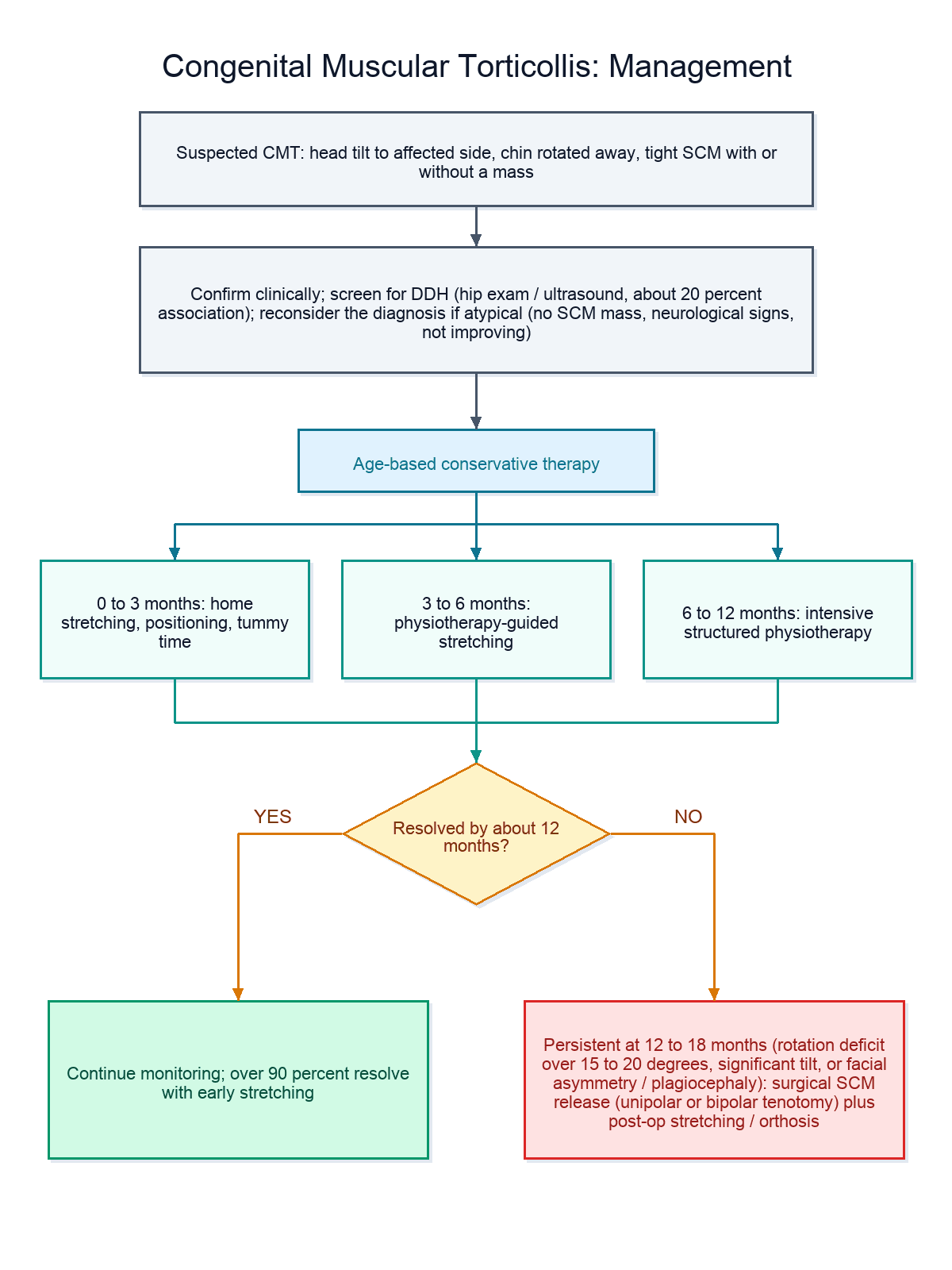
Stretching first. Passive stretching is first-line treatment, and early, consistent stretching succeeds in over 90% when started before the first birthday. The intensity steps up with age and with failure to progress.
- Approach
- Home programme
- Key Elements
- Parent stretching, positioning, tummy time
- Expected Outcome
- Most resolve
- Approach
- PT-guided
- Key Elements
- Formal physiotherapy if not resolving
- Expected Outcome
- High success
- Approach
- Intensive PT
- Key Elements
- More structured programme, monitor progress
- Expected Outcome
- Most still resolve
- Approach
- Re-evaluate
- Key Elements
- Consider surgery if significant residual deficit
- Expected Outcome
- Some need surgery
When to involve a physiotherapist. The table reserves formal physiotherapy for the infant who is not resolving on a home programme. The APTA guideline (see Evidence Base) goes further, referring to physiotherapy as soon as the asymmetry is identified.
The stretch is the reverse of the deformity: tilt the head away from the tight side and rotate the chin toward it. Frequent repetition is key.
- Hold the baby's shoulder down on the affected side
- Tilt the head toward the opposite side (stretches the tight SCM)
- Rotate the chin toward the affected side
- Hold 10-30 seconds, repeat 10-15 times
- Do it at every nappy change (easily 4-6 times daily)
Positioning encourages the infant to look toward the affected side:
- Toys, lights and the parent's position on the affected side
- Supervised tummy time (prone) when awake
- Avoid prolonged time on the back in the same position
Surgical Technique
Open unipolar (clavicular) release is the standard procedure for CMT that has not responded to conservative treatment. The small skin-crease incision gives excellent cosmesis.
Surgical Steps
- General anaesthesia, supine with a shoulder roll
- Head turned toward the affected side (exposes the clavicular SCM)
- Transverse, 1-2cm above the clavicle, in a skin crease
- Approximately 2-3cm long
- Divide platysma
- Identify the sternal and clavicular heads of the SCM
- Protect the external jugular vein laterally
- Identify and protect the spinal accessory nerve, which crosses the SCM
- Divide the SCM at its clavicular and sternal origins
- Any tight bands felt can be divided
- Move the head passively to test the release; full correction should be achieved on the table
- Haemostasis
- Close platysma, subcuticular skin closure
- Dressing; a soft collar may be used for comfort
Complications
- Incidence
- 5-10% (usually minor)
- Prevention/Management
- Compliance with post-op PT, stretching
- Incidence
- Rare (less than 1%)
- Prevention/Management
- Careful dissection, know anatomy
- Incidence
- Minimal with skin crease incision
- Prevention/Management
- Transverse incision placement
- Incidence
- Rare
- Prevention/Management
- Avoid excessive release, PT guided
- Incidence
- Variable
- Prevention/Management
- May need helmet if severe, usually improves with time
- Incidence
- Improves but may not fully correct
- Prevention/Management
- Earlier treatment = better outcome
Counselling. Families should be counselled that some residual facial asymmetry may remain even after successful treatment.
Postoperative Care and Rehabilitation
After release. Post-operative physiotherapy is essential for maintaining correction, and post-operative stretching and bracing are crucial, with close physiotherapy follow-up for 3-6 months.
Post-Surgery Protocol
- Wound check, remove dressing
- Soft collar for comfort (optional)
- Gentle ROM encouraged
- Discharge day 1 usually
- Begin formal stretching exercises
- PT referral
- Wound care
- Maintain correction with positioning
- Active physiotherapy programme
- Stretching continued by parents at home
- Gentle strengthening as tolerated
- May use headband/brace overnight if needed
- Ongoing stretching maintenance
- Monitor for recurrence
- Assess facial/skull symmetry
- Discharge from active PT when stable
After conservative treatment. Stretching continues until full, symmetrical range of motion is achieved, then its frequency is weaned gradually. Positioning strategies continue through infancy, and the child is watched for recurrence.
Outcomes
Conservative. The best outcomes follow early diagnosis and treatment, and range of motion normalises within months in most cases.
Surgical. Series report high rates of good to excellent results, with full or near-full range of motion typically achieved; good outcomes are reported in greater than 90% when surgery is needed and done appropriately. Facial asymmetry and plagiocephaly improve but may not fully resolve, and earlier correction gives greater remodelling potential.
Guidelines, Registries & Global Practice
Global epidemiology:
- Reported birth incidence ranges from about 0.4% to as high as 16% depending on definition and screening intensity; a commonly cited clinical figure is 1-2% of newborns
- Third most common congenital musculoskeletal condition after DDH and clubfoot
- Right-sided predominance (roughly 75%); modest male predominance in several series
- Risk factors converge on intrauterine crowding/positioning: breech presentation, primiparity, oligohydramnios, multiple gestation and difficult/instrumented delivery
- The CMT-DDH association is real but smaller than the textbook 20%: verified series report around 8% (Walsh) and about 4.5% requiring treatment (Minihane), within a literature range of 2-29%
Side-by-side guidance (where emphasis differs):
- Region
- US/International
- Key emphasis
- Refer to physiotherapy as soon as asymmetry is found; severity classification; first-line passive and active ROM plus positioning; defined escalation criteria
- Region
- US
- Key emphasis
- Supine sleeping for SIDS prevention drove a rise in positional plagiocephaly and torticollis - counsel supervised tummy time and repositioning
- Region
- UK
- Key emphasis
- Plagiocephaly and CMT largely managed conservatively; helmet (cranial orthosis) therapy not routinely recommended on NHS for positional plagiocephaly given limited evidence and cost
- Region
- Global
- Key emphasis
- Conservative stretching before age 1; surgical release reserved for failure of an adequate stretching programme with persistent deficit/tight band
- CMT is not tracked in arthroplasty/implant registries; the evidence base is cohort and case-series level, anchored by the Cheng 821-patient prospective cohort
- Cranial orthosis (helmet) policy diverges internationally: more readily used in parts of North America, more restricted in several European public systems where high-quality comparative evidence is felt to be lacking
- High-resource settings: early physiotherapy referral, ultrasound for SCM/hip when indicated, access to cranial orthoses and craniofacial multidisciplinary teams
- Limited-resource settings: diagnosis is clinical; parent-delivered stretching is the mainstay; later presentation is more common, increasing the proportion needing surgical release and the burden of established facial asymmetry; emphasis falls on caregiver education and low-cost positioning strategies
Controversies and Areas of Uncertainty
How strong is the DDH association? Textbooks quote 20%, but the best primary series (Walsh approximately 8%; Minihane 4.5% requiring treatment) suggest the figure is considerably lower and that a normal clinical hip examination reliably excludes significant DDH. Whether universal hip ultrasound is justified in every CMT infant, or only in those with an abnormal examination or risk factors, remains debated.
When to operate. Conventional teaching favours release by 12-18 months, yet Shim's older children did at least as well for movement and scar (see Management). There is no high-level trial defining the ideal age.
Helmets. Evidence on whether a cranial orthosis outperforms repositioning for positional plagiocephaly is mixed. Lam reported greater measured head-shape correction with orthoses, but a randomised trial (the Dutch HEADS study, not cited here) found no clinically meaningful difference for mild-to-moderate cases. Practice varies widely by region and payer.
Open versus endoscopic release. Endoscopic or arthroscopic release (Wang) and open unipolar and bipolar techniques all report good outcomes, but no adequately powered head-to-head trial establishes superiority. The choice remains surgeon- and resource-dependent.
MCQ Practice Points
Q: In CMT affecting the right SCM, which direction does the head tilt? A: The head tilts to the RIGHT (toward the tight muscle). The chin rotates to the LEFT (away from the tight side).
Q: What musculoskeletal condition should you screen for in all CMT patients? A: Developmental dysplasia of the hip (DDH). The classic teaching is a 20% association, but verified series show nearer 8% (and about 4.5% requiring treatment) - so the imperative is a documented clinical hip examination in every CMT infant, with imaging reserved for abnormal findings or risk factors.
Q: How do you stretch a tight right SCM? A: Tilt the head to the LEFT (opposite to tight side) and rotate the chin to the RIGHT (toward the tight side).
Q: When should surgery be considered for CMT? A: After 12-18 months if no improvement with proper physiotherapy, or if significant rotation deficit (greater than 15-20°) persists.
Medicolegal Considerations
- Document head position, SCM mass, ROM measurements
- Record hip examination findings
- Document stretching instructions given to parents
- Note compliance with stretching at follow-up
- Record imaging results if obtained
- Scarring (usually minimal in skin crease)
- Recurrence risk (5-10%)
- Spinal accessory nerve injury (rare)
- Need for post-operative physiotherapy
- Residual facial asymmetry possible
Failure to examine the hips in CMT is a medicolegal risk. Even at the verified association rate (around 8%, with roughly 4.5% needing treatment), a documented clinical hip examination - and targeted imaging when the exam is abnormal or risk factors are present - should be recorded in all CMT patients.
Clinical Decision Scenarios
Practise clinical reasoning and management decisions out loud
“A 6-week-old infant is brought in with a persistent head tilt to the right. The mother noticed it shortly after birth and is concerned about the position.”
“A 14-month-old child with CMT has been receiving physiotherapy since 4 months of age. Despite reported compliance, there remains 25 degrees of rotation deficit and significant facial asymmetry.”
“A 3-month-old presents with a head tilt but you cannot feel an SCM mass. The passive ROM seems restricted in multiple planes. The parents report the tilt was not present at birth but appeared at around 6 weeks of age.”
Clinical Pattern
- Head tilts TOWARD tight SCM
- Chin rotates AWAY from tight side
- Limited rotation TO affected side
- Pseudotumor in first weeks (resolves by 4-6 months)
Associated Conditions
- DDH co-exists (around 8%, under 10%) - examine hips in every case
- Plagiocephaly - develops with persistent tilt
- Facial asymmetry - ipsilateral face smaller
- Metatarsus adductus (packaging)
Conservative Treatment
- Tilt head OPPOSITE to tight side
- Rotate chin TOWARD tight side
- Do at every diaper change
- Positioning: toys on affected side
Surgical Indications
- No improvement by 12-18 months
- Rotation deficit greater than 15-20 degrees
- Significant residual tilt/asymmetry
- Unipolar clavicular release standard
Differentials
- Klippel-Feil (fused vertebrae)
- AARF (atlantoaxial rotatory fixation)
- Ocular torticollis
- Sandifer syndrome (GERD)
Evidence Base
Landmark prospective cohort: manual stretching and surgery threshold
- Prospective study of 821 consecutive infants seen under 1 year, standardised manual stretching, mean follow-up 4.5 years
- Three clinical groups: sternomastoid tumour 55% (452), muscular torticollis 34% (276), postural torticollis 11% (93)
- Subsequent surgery required in 8% of the tumour group, 3% of the muscular group, 0% of the postural group
- Outcome predicted by clinical group, initial passive rotation deficit, and age at presentation
Operative timing: outcomes by age at surgery
- 47 children undergoing operative release, mean follow-up 74 months
- Group 1 aged 1-4 years versus Group 2 aged 5-16 years
- Craniofacial asymmetry and overall scores were similar between groups
- Older children (Group 2) had SUPERIOR movement, scar and head-tilt outcomes
CMT-DDH association: lower than the quoted 20%
- Retrospective review of 70 children with congenital muscular torticollis
- 6 had hip subluxation or dislocation, all detectable at presentation
- Calculated hip-disease rate of approximately 8%, lower than the 20% often quoted
- Reported literature range for the association spans 2-29%
Hip imaging strategy in CMT
- 292 infants with CMT reviewed; 16 had developmental dysplasia of the hip
- Every infant with DDH had an ABNORMAL clinical hip examination
- Coexistence rate for CMT and DDH requiring treatment was 4.5%
- Routine hip imaging not required when the clinical hip examination is normal
Minimally invasive (arthroscopic/endoscopic) release
- 69 teenagers (mean age 16.1 years) with arthroscopic radiofrequency release under local anaesthesia
- Mean rotation deficit improved from 22.5 to 4.1 degrees; lateral-bend deficit 14.6 to 3.3 degrees
- Good or excellent result (Cheng score) in 65 of 69 patients (94.2%)
- No intra-operative or post-operative complications reported
Positional plagiocephaly: factors influencing correction
- 991 infants under 1 year evaluated for positional skull deformity; 552 followed to completion
- Cranial orthosis produced the largest correction in oblique diagonal difference; repositioning/PT the least
- Earlier age at presentation correlated with greater head-shape correction
- Torticollis history was NOT significantly associated with magnitude of correction on multivariate analysis
APTA Evidence-Based Clinical Practice Guideline (CMT)
- 17 action statements linking graded evidence to practice, updating the 2013 guideline
- Infants with CMT should be referred to physical therapy as soon as asymmetry is identified
- Structured severity classification and referral flow sheets for monitoring, treating and onward referral
- First-choice intervention is neck passive range of motion, active range of motion and positioning/environmental adaptation