Tillaux (SH-III) | Triplane (SH-IV) | Adolescent Ankle | CT Essential
- Occur during physeal closure - Central, Medial, then Lateral (CML)
- Tillaux = SH-III - anterolateral epiphysis only
- Triplane = SH-IV - epiphysis + metaphysis (2 or 3 part)
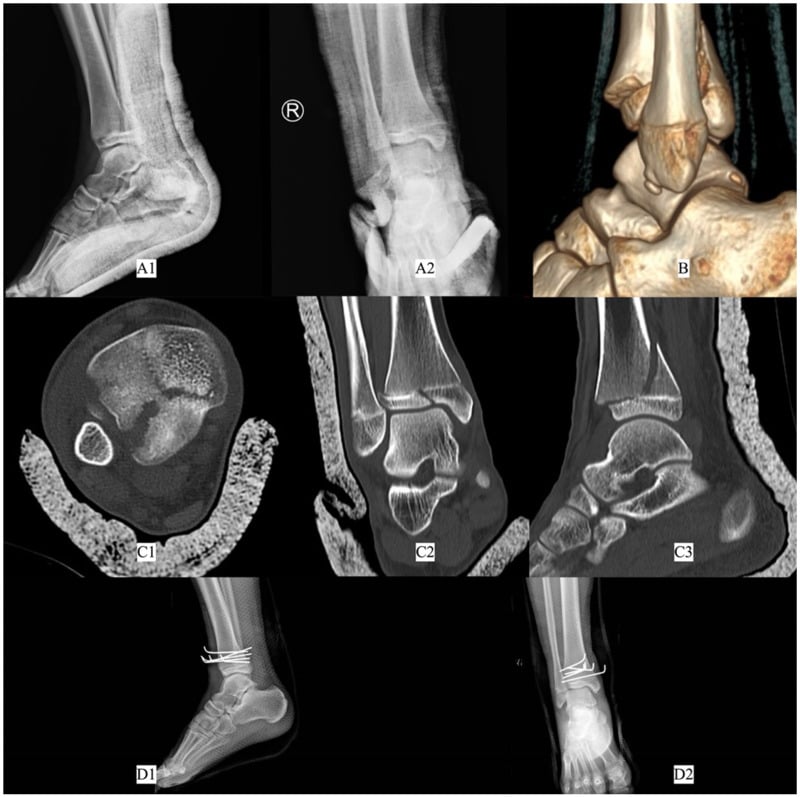
- CT is essential to determine fracture configuration and step-off
- Greater than 2mm articular step-off requires ORIF
- “Tillaux and Triplane are NOT adult ankle fractures
- “CT defines 2-part vs 3-part triplane pattern
- “Anterolateral fragment in Tillaux is attached to AITFL
- “Near skeletal maturity means low growth arrest risk
Overview and Epidemiology
Transitional fractures are paediatric ankle injuries unique to the roughly 18-month period during which the distal tibial physis closes asymmetrically. They occur in adolescents aged 12-15, and the age is crucial: the physis must be closing for the pattern to exist.
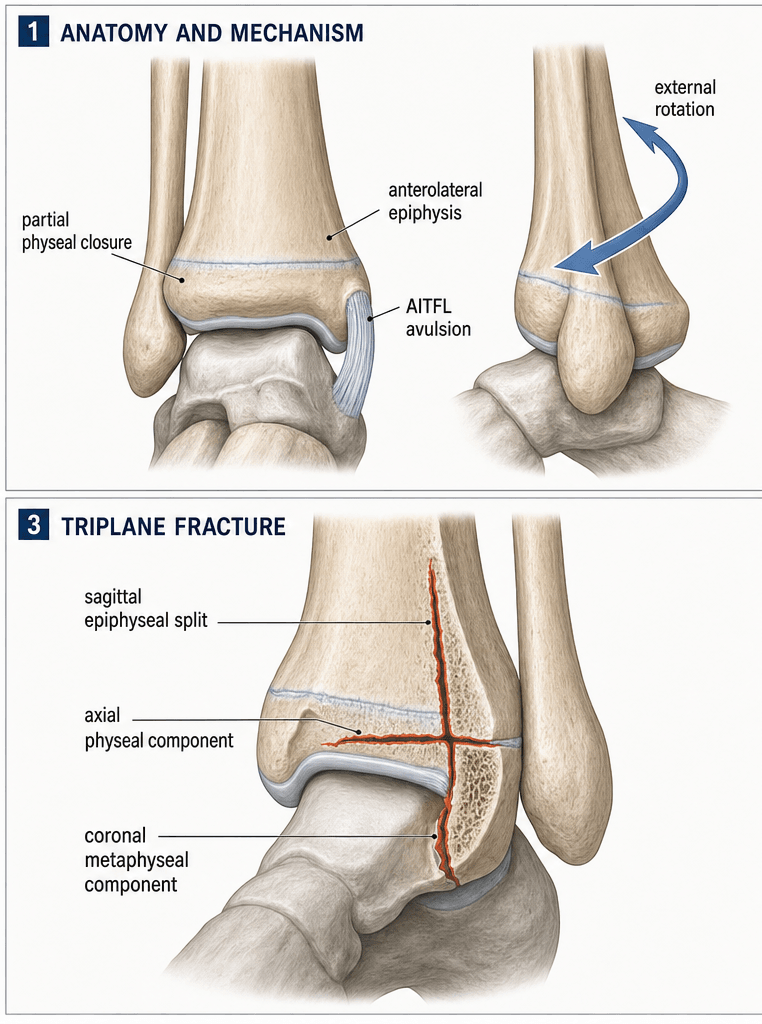
Mechanism. The foot is externally rotated on a fixed leg, much as in an adult ankle fracture, and the anterolateral fragment is avulsed through the anterior inferior tibiofibular ligament (AITFL). Which pattern results depends on which portions of the physis remain open.
Why they matter. These are intra-articular injuries that need anatomic reduction. Unlike more proximal physeal injuries, growth arrest here is rarely clinically significant because the patient is near skeletal maturity, and the focus is articular congruity rather than physeal preservation.
Anatomy and Pathomechanics
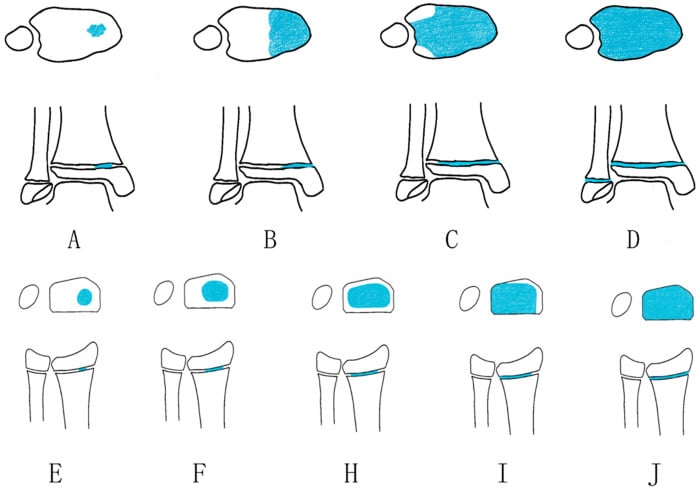
Asymmetric closure. The distal tibial physis does not close all at once. The central portion closes first, the medial portion next and the lateral (anterolateral) portion last. The fibular physis closes at approximately the same time as the tibial physis.
Why the anterolateral corner breaks. The AITFL attaches to the anterolateral tibia, the site of the Tillaux fragment. Once the medial physis has fused while the lateral remains open, external rotation lets the AITFL avulse the anterolateral epiphyseal fragment, creating a Tillaux fracture; if the force propagates into the metaphysis, a triplane results. The lateral malleolus is usually intact in pure transitional fractures.
Three planes. The triplane fracture takes its name from its three planes of fracture:
- Sagittal through the epiphysis, splitting it into medial and lateral fragments
- Transverse (axial) through the physis
- Coronal through the metaphysis
CMLPhyseal Closure Pattern
Hook:Central, then Medial, then Lateral: the lateral physis closes last, which leaves the anterolateral fragment vulnerable.
Classification Systems
Transitional fractures form a spectrum set by how much physis is left open, and the classification that drives treatment is the number of parts, which CT defines.
Juvenile Tillaux. A Salter-Harris III injury of the physis and epiphysis only, producing a single anterolateral epiphyseal fragment. It occurs when only the lateral physis remains open and represents the final stage of the transitional fracture spectrum. Age, the physis and the metaphysis separate it from the adult Chaput tubercle fracture:
- Tillaux
- 12-15 years
- Adult Chaput Tubercle
- Adult
- Tillaux
- Partially open
- Adult Chaput Tubercle
- Closed
- Tillaux
- Intact
- Adult Chaput Tubercle
- May be involved
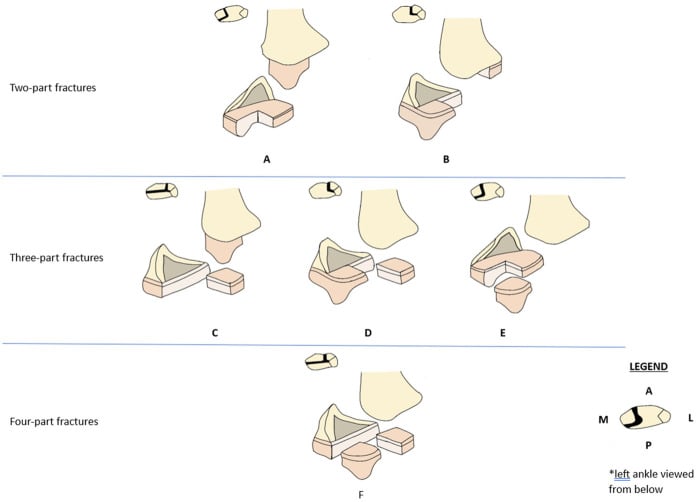
Two-part triplane. A Salter-Harris IV injury: a lateral epiphyseal fragment, as in a Tillaux, plus a posterolateral metaphyseal spike, while the medial epiphysis stays attached to the metaphysis as one fragment. It is the most common triplane configuration, although in Ertl's series 11 of 15 anatomically confirmed cases were three-fragment patterns (see the evidence below). On CT:
- Axial: the anterolateral epiphyseal fragment
- Sagittal: the posterior metaphyseal fragment
- Coronal: a single medial fragment, epiphysis and metaphysis together
Three-part triplane. Also Salter-Harris IV, with an anterolateral epiphyseal fragment, a posterolateral metaphyseal fragment and a medial epiphyseal fragment separate from the metaphysis. The axial CT shows two separate epiphyseal fragments, and the pattern requires more complex surgical planning.
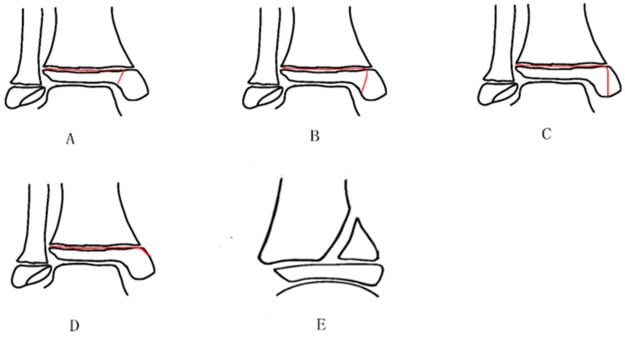
Medial and Intramalleolar Triplane Variants
Most triplane fractures are lateral, with the anterolateral epiphyseal fragment described above. Two less common variants are examinable because they behave differently and are easy to miss if you assume every triplane exits laterally.
- Where the fracture exits
- Anterolateral epiphysis (AITFL-bearing), as in Tillaux
- Why it matters
- Commonest pattern; intra-articular at the lateral plafond
- Management note
- ORIF if step over 2 mm; lateral approach
- Where the fracture exits
- Through the medial malleolus / medial plafond
- Why it matters
- Tends to occur in slightly younger children with more open physis; can be intra-articular medially and carries a relatively higher growth-disturbance risk
- Management note
- CT to map fragments; anatomic reduction of the medial plafond; watch the physis
- Where the fracture exits
- Vertical epiphyseal limb running within the medial malleolus
- Why it matters
- Rare; the key question is whether the articular exit lies within the WEIGHT-BEARING plafond
- Management note
- Intra-articular weight-bearing variant needs anatomic ORIF; a purely extra-articular exit behaves benignly
The unifying principle is unchanged: define the fragments and the articular exit on CT, and reduce any step within the weight-bearing plafond to under 2 mm. Cummings classified the intramalleolar variant by exactly that question, whether the articular exit lies in the weight-bearing plafond.
Why the medial variant matters. It appears in a slightly younger patient with more growth remaining, so the standard reassurance about growth arrest is less absolute than for the classic late-adolescent lateral Tillaux or triplane. Articular reduction of the medial plafond matters, so map it on CT exactly as you would a lateral triplane.
Clinical Assessment
History. A rotational injury, the foot externally rotated, in a patient whose physis is closing. The pain is anterolateral and the patient is usually unable to bear weight.
Examination. Swelling and ecchymosis sit anterolaterally, with point tenderness over the anterolateral physis. Movement is painful, especially external rotation. Document the neurovascular status, which is usually intact.
Investigations
Radiographs. AP, lateral and mortise views come first. Look for widening of the lateral physis and for an epiphyseal fragment on the mortise view.
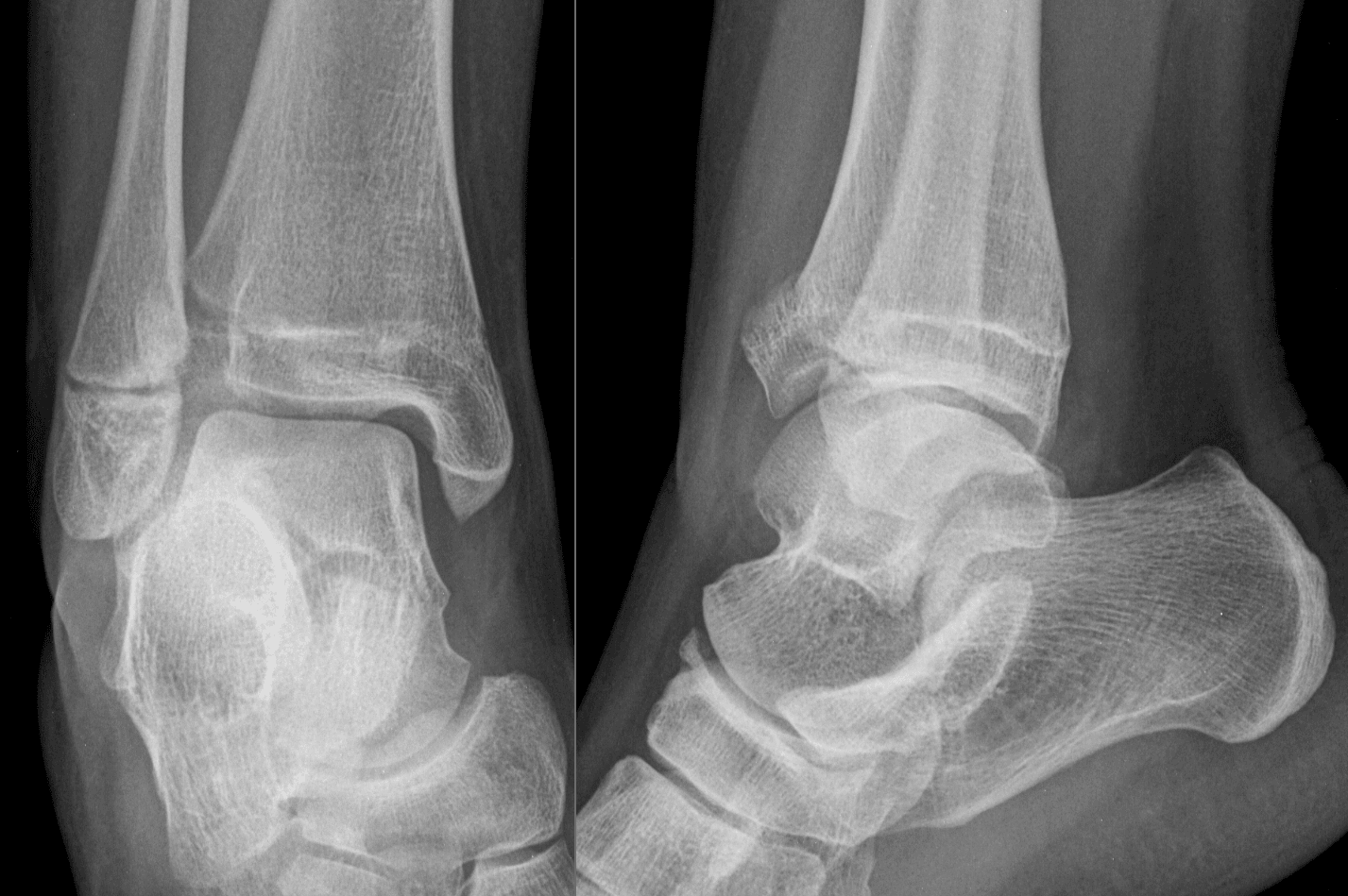
CT. CT is mandatory for all transitional fractures. It determines the 2-part or 3-part pattern, measures articular step-off accurately and guides the surgical approach. Whether a truly non-displaced extra-articular pattern can be followed on radiographs instead is one of the controversies discussed below.
Plain radiographs consistently underestimate displacement. A fracture that appears 1-2mm on X-ray may be more than 2mm on CT. Always get a CT before deciding on non-operative treatment.
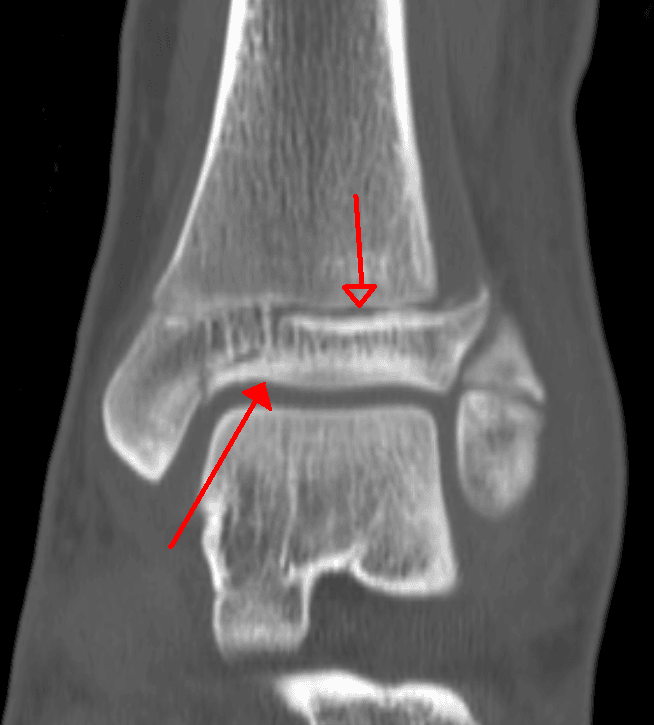
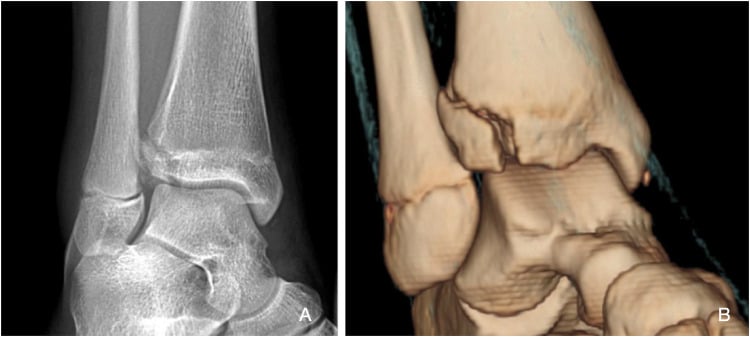
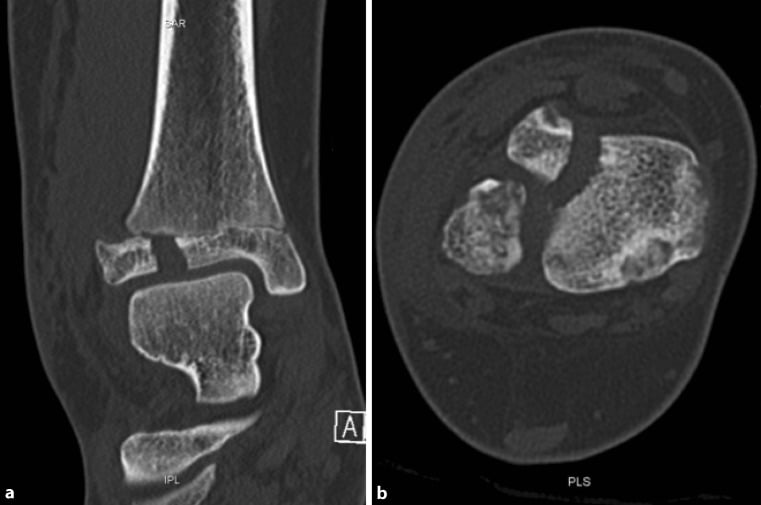
MRI is rarely needed. It may help if the diagnosis is unclear or to assess soft-tissue or ligament injury.
Differential Diagnosis
The painful anterolateral adolescent ankle after a twisting injury has a tight differential, and the pivotal discriminator is patient age and physeal status. In the adolescent the open physis is weaker than the AITFL and the other ligaments, so the external-rotation force that produces a ligament sprain in an adult produces a physeal fracture instead.
- Typical Age
- 12-15 (lateral physis open)
- Salter-Harris / Pattern
- SH-III
- Key Discriminator
- Isolated anterolateral epiphyseal fragment, metaphysis intact
- Imaging Clue
- Mortise view + axial CT: single epiphyseal fragment
- Typical Age
- 10-14 (more physis open than Tillaux)
- Salter-Harris / Pattern
- SH-IV (multiplanar)
- Key Discriminator
- Epiphyseal + metaphyseal involvement, 2 or 3 fragments
- Imaging Clue
- Lateral X-ray looks SH-II, AP looks SH-III; CT resolves
- Typical Age
- Skeletally mature
- Salter-Harris / Pattern
- Intra-articular avulsion
- Key Discriminator
- Physis closed, often with syndesmotic injury
- Imaging Clue
- No physeal lucency; assess syndesmosis
- Typical Age
- Adult
- Salter-Harris / Pattern
- Fibular fracture +/- medial
- Key Discriminator
- Fibula fractured; physes closed
- Imaging Clue
- Talar shift, fibular fracture line
- Typical Age
- Under 12 (whole physis open)
- Salter-Harris / Pattern
- SH-I / SH-II
- Key Discriminator
- Whole physis open, metaphyseal Thurston-Holland fragment
- Imaging Clue
- No isolated anterolateral fragment
- Typical Age
- Any (but rare to be pure in adolescent)
- Salter-Harris / Pattern
- Soft-tissue
- Key Discriminator
- No bony tenderness over physis, normal films
- Imaging Clue
- Normal radiographs; MRI shows ligament only
A 13-year-old who has "just sprained an ankle" with point tenderness over the anterolateral distal tibia has a Tillaux fracture until proven otherwise. Dedicated radiographs (and CT if a fragment is seen) are mandatory before labelling it a sprain.
Management Algorithm
The 2 mm rule. An articular step-off greater than 2 mm, measured on CT axial and sagittal reformats, is the threshold for operative treatment. Say where the step is, not just how big it is: the original series attached the threshold to the primary weight-bearing area, finding that 2 mm or more worsened the result unless the fragment lay outside that zone. That is why the extra-articular and non-weight-bearing triplane variants are managed on their own terms rather than by the number alone.
Non-operative treatment. A CT step-off of less than 2 mm with acceptable alignment on X-ray can be treated closed:
- Long leg cast or CAM boot for 4-6 weeks
- Non-weight bearing initially, then progressive weight bearing
- Weekly X-rays for 2-3 weeks to ensure the fracture does not displace
Early displacement is possible. If step-off increases beyond 2mm on follow-up X-ray, convert to operative treatment.
Tillaux. A Tillaux with a step over 2 mm is fixed by ORIF through an anterolateral approach over the anterolateral tibial physis. A single epiphyseal screw parallel to the joint is usually sufficient, and it should avoid crossing the intact (medial) physis if possible. It is a straightforward procedure with excellent outcomes.
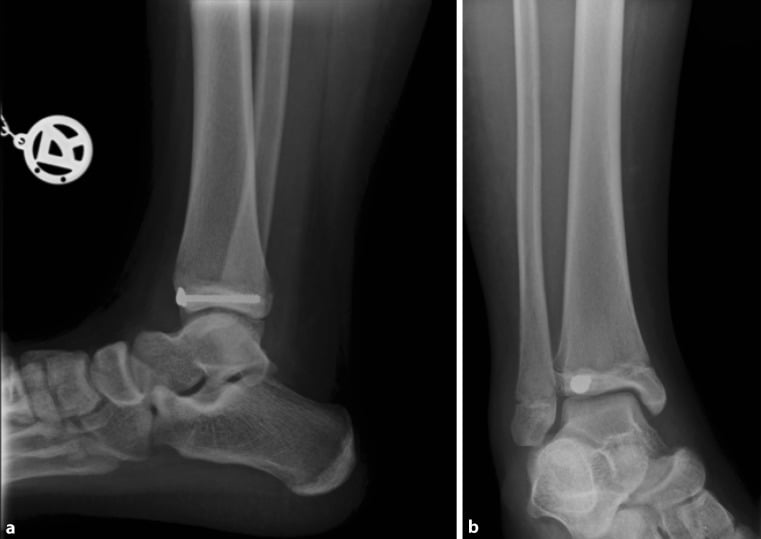
Two-part triplane. Often reducible through a lateral approach alone. Fix the epiphyseal fragment first with an epiphyseal screw, then the metaphyseal fragment with a separate metaphyseal screw, which can cross the closed central physis.
Three-part triplane. May require a medial approach for the separate medial epiphyseal fragment, in addition to the lateral one, and the reduction is more complex. The sequence is to reduce and fix the medial epiphysis first, then the lateral epiphysis, then the metaphysis.
Implants and planning. Cannulated screws of 4.0-4.5 mm, with epiphyseal screws parallel to the joint. Triplane fractures require careful pre-operative CT planning.
- Fracture Type
- Tillaux or Triplane
- Treatment
- Long leg cast 4-6 weeks
- Key Pearl
- Weekly X-rays to check displacement
- Fracture Type
- Tillaux
- Treatment
- ORIF via anterolateral approach
- Key Pearl
- Single epiphyseal screw
- Fracture Type
- 2-Part Triplane
- Treatment
- ORIF - one approach may suffice
- Key Pearl
- Lateral approach, epiphyseal + metaphyseal screws
- Fracture Type
- 3-Part Triplane
- Treatment
- ORIF - may need medial approach
- Key Pearl
- Fix medial epiphyseal fragment separately
Surgical Techniques
Positioning. Supine on a radiolucent table, with a small bump under the ipsilateral hip. The bump internally rotates the leg slightly, which makes the anterolateral approach more accessible. Free-drape the lower limb for manipulation and bring the C-arm in from the contralateral side for AP, mortise and lateral views.
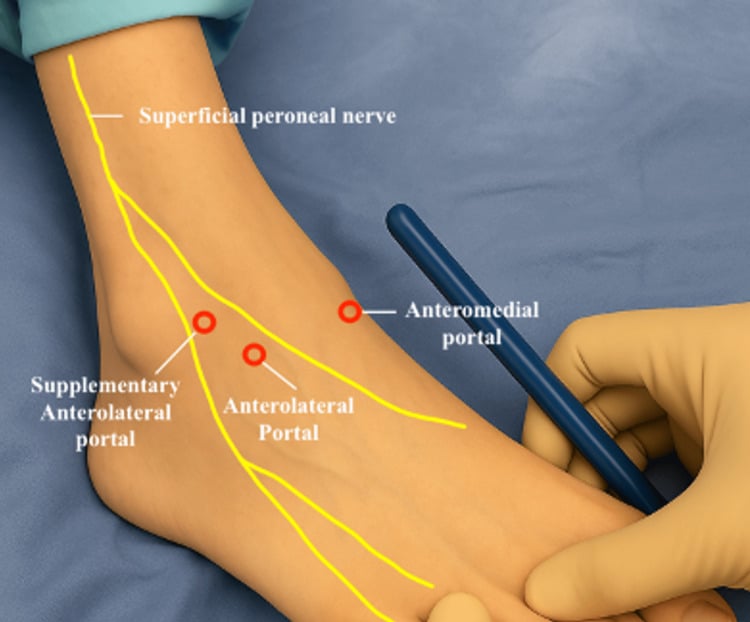
Anterolateral approach. Used for the Tillaux and the two-part triplane, through a curved incision over the anterolateral tibia centred on the fracture, and it gives excellent visualisation. The superficial peroneal nerve crosses the field; the anterior tibial artery lies deeper and is less at risk.
- Identify and protect the superficial peroneal nerve branches
- Incise the ankle capsule and periosteum
- Expose the fracture and the articular surface
- Irrigate the joint to remove haematoma
Reduction. Internal rotation of the foot reduces the Tillaux or lateral fragment, helped by direct manipulation with a periosteal elevator or pointed reduction clamp. Visualise the articular surface directly to make the reduction anatomic, then hold it with a 1.6 mm K-wire across the fragment and confirm it on fluoroscopy (AP, mortise, lateral) and by direct inspection.
Fixation. Definitive fixation is a 4.0 mm cannulated screw over the guidewire, the epiphyseal screw parallel to the joint and within the epiphysis, aiming for a lag effect if possible. In a triplane the metaphyseal screw can be a standard partially threaded screw. Use fluoroscopy liberally: the articular surface should be anatomic, less than 1-2 mm of step, and no screw should penetrate the joint.
Closure. Close the capsule and periosteum, then the subcutaneous layer, with absorbable suture, and the skin with subcuticular or interrupted nylon. A sterile dressing and a below-knee backslab follow, with suture removal at 2 weeks.
Complications
- Incidence
- Variable
- Risk Factors
- Non-anatomic reduction
- Management
- Accept less than 2mm, revise if more
- Incidence
- Rare short-term
- Risk Factors
- Articular incongruity
- Management
- Anatomic reduction prevents
- Incidence
- Rare clinically
- Risk Factors
- Near maturity
- Management
- Usually not significant
- Incidence
- Uncommon
- Risk Factors
- Prolonged immobilisation
- Management
- Early mobilisation
- Incidence
- Rare
- Risk Factors
- Lateral approach
- Management
- Careful dissection
Detecting and Managing Growth Disturbance
Growth arrest is usually inconsequential in the late-adolescent Tillaux or lateral triplane, but the risk is not zero. In younger patients, and in the medial variants above, a partial physeal bar can produce angular deformity or leg-length discrepancy, and examiners expect you to know how you would detect and manage it rather than simply assert that it rarely matters.
Detection. The younger or higher-risk patient is followed to skeletal maturity, with comparison radiographs of the contralateral limb. A Harris (growth-arrest) line is a transverse sclerotic line laid down after the injury: one that stays parallel to the physis indicates symmetric resumed growth, and one that is asymmetric or converges toward the physis points to a tethering bar at the point of convergence. CT or MRI then locates and sizes a suspected bar, expressed as a percentage of the physeal area, which guides treatment.
- Option
- Bar resection with interposition (e.g. fat graft or bone wax / PMMA)
- Rationale
- Can restore growth if enough healthy physis remains
- Option
- Complete the arrest, plus contralateral epiphysiodesis if leg-length discrepancy is projected
- Rationale
- Prevents progressive angular deformity and balances limb length
- Option
- Corrective osteotomy and/or limb-length equalisation
- Rationale
- Addresses the established deformity rather than the physis itself
The practical rule. The closer to skeletal maturity, the less you need to do, and the classic late-adolescent Tillaux essentially needs nothing. A younger patient deserves follow-up, because a partial bar is treatable if it is caught early.
Postoperative Care
Rehabilitation Protocol
Backslab initially, convert to short leg cast. Non-weight bearing. Elevation, ice.
Short leg cast or CAM boot. Non-weight bearing continues. Check X-rays at 2-4 weeks.
If healing confirmed, transition to weight-bearing as tolerated in boot. Begin gentle ankle ROM.
Wean from boot. Physiotherapy for ROM and strength. Return to sport at 3 months if healed and strong.
Hardware. Screws are usually left in situ unless symptomatic; routine removal is not needed.
Outcomes and Prognosis
Articular reduction. The quality of the articular reduction is the main determinant of outcome, and a step greater than 2 mm is associated with an increased risk of arthritis. Growth arrest, if it occurs, is usually not clinically significant.
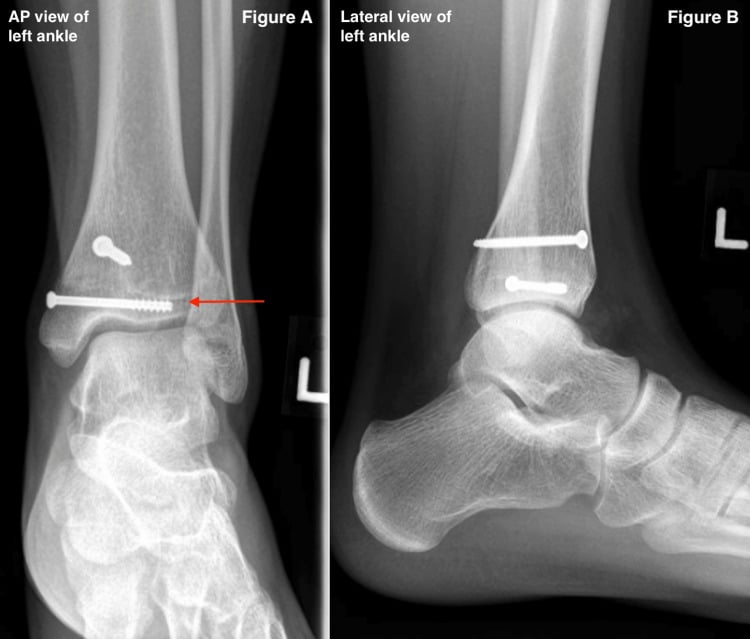
Return to activity. Most patients return to full sport by 3-4 months, and outcomes are generally excellent with appropriate treatment. Read "excellent" against the length of follow-up: in Ertl's series, symptoms emerged later even in a broadly successful cohort (Ertl, below).
Guidelines, Registries & Global Practice
Global epidemiology:
- Triplane fractures account for approximately 5-10% of paediatric intra-articular ankle injuries (Schnetzler & Hoernschemeyer 2007); juvenile Tillaux is rarer.
- Peak age 12-15 years, with triplane tending to occur slightly younger than Tillaux because more of the physis remains open.
- Slight male predominance; mechanism is external rotation across a narrow window of asymmetric physeal closure, so true incidence is similar worldwide where physeal maturation is comparable.
Side-by-side guidance (no formal RCT-based guideline exists - recommendations are consensus/textbook-derived):
- Imaging stance
- CT for displaced or intra-articular patterns
- Operative threshold
- ORIF if step over 2 mm
- Emphasis
- Anterolateral or anteromedial approach, screw fixation
- Imaging stance
- Cross-sectional imaging when surgery contemplated; senior decision-maker
- Operative threshold
- Restore articular congruity
- Emphasis
- Definitive care in unit with paediatric expertise
- Imaging stance
- CT for fragment mapping and pre-op planning
- Operative threshold
- Anatomic joint reduction; lag screw fixation
- Emphasis
- Respect closing physis; avoid hardware across open lateral physis
- Imaging stance
- CT to define 2- vs 3-part configuration
- Operative threshold
- Reduce to under 2 mm; closed/percutaneous if achievable
- Emphasis
- Minimise soft-tissue insult, early mobilisation
- Paediatric physeal ankle fractures are not implant-survival registry topics (these are not arthroplasty), so NJR/AOANJRR/AJRR data do not apply.
- Evidence is therefore single-centre Level III-IV series and reviews, not registry datasets - candidates should know the evidence base is comparatively thin.
- High-resource: routine CT, image-intensifier-guided or arthroscopic-assisted percutaneous screws, day-case ORIF.
- Limited-resource: reliance on good mortise radiographs and closed reduction; CT reserved for clearly displaced cases; cast immobilisation more often accepted when CT is unavailable.
Counselling points (globally applicable):
- Explain that growth arrest is unlikely to be clinically significant because the patient is near skeletal maturity.
- Emphasise that the goal is articular congruity, and that displacement may be greater on CT than on plain films.
- Consent should cover the small risks of stiffness, superficial peroneal nerve irritation, and the possibility of converting a closed plan to open reduction.
Controversies and Areas of Uncertainty
In the viva, state the mainstream position first (CT for displaced or intra-articular patterns, ORIF for a step over 2 mm), then the nuance below. Examiners reward candidates who know where the evidence is soft.
Is the 2 mm threshold absolute? The rule derives from small Level IV series (Ertl 1988, Rapariz 1996). Some authors argue the location of the gap matters more than the absolute number: a step outside the principal weight-bearing zone may tolerate more displacement, whereas central plafond incongruity warrants reduction even near 2 mm. No randomised data exist to define a precise cut-off.
CT for every fracture? CT undeniably changes management (Eismann 2015), but it adds radiation and cost. A reasonable compromise is selective CT for any fracture that looks displaced, intra-articular or triplane on plain films, while truly non-displaced extra-articular patterns may be followed radiographically. Practice varies by centre.
Closed or open reduction? Several series report success with closed or percutaneous fixation under fluoroscopic and even arthroscopic control, avoiding open arthrotomy. Critics counter that the articular surface cannot be verified to within 2 mm without direct or CT-confirmed visualisation. The decision hinges on surgeon experience and intra-operative imaging quality.
Arthroscopic assistance. Arthroscopy directly demonstrates the distal tibial articular step and fracture widening that fluoroscopy can underestimate. Mark the superficial peroneal nerve and establish the anteromedial portal under direct control before placing the lateral portals.
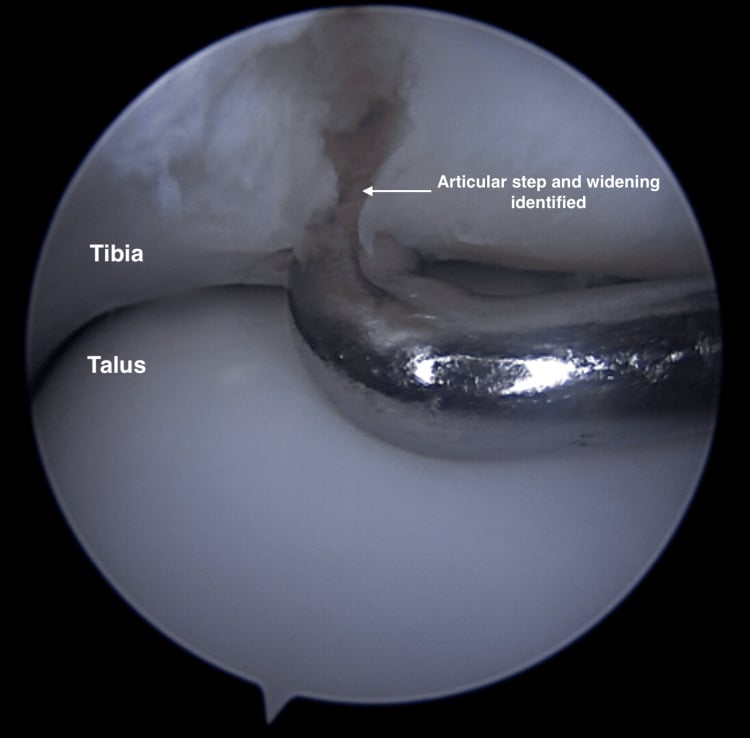
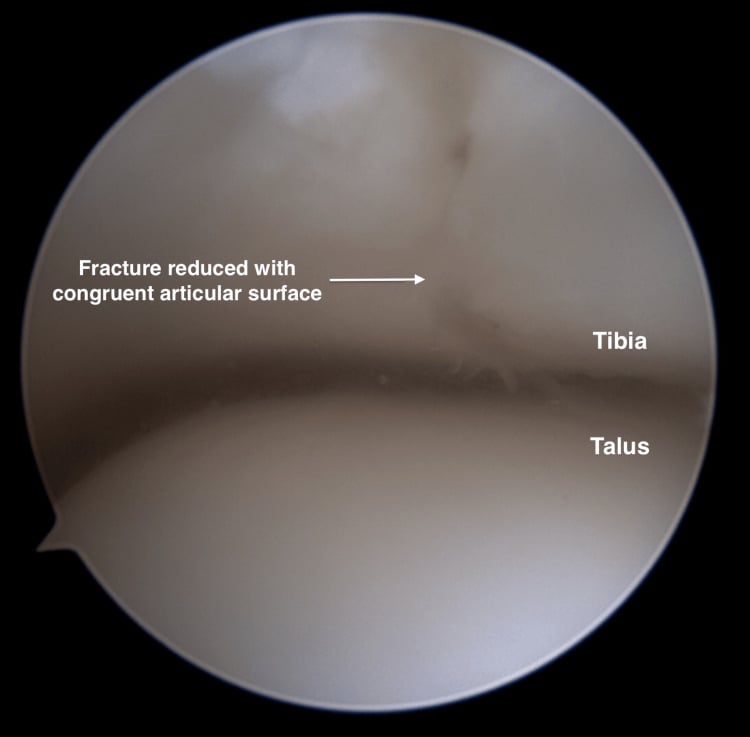
MRI or CT? MRI avoids radiation and shows the physeal cartilage and ligaments, and some paediatric centres prefer it. CT remains faster, more available, and better for bony step-off measurement and screw planning. The radiation-versus-availability trade-off is unsettled, particularly in younger patients.
MCQ Practice Points
Q: In what order does the distal tibial physis close? A: Central, Medial, Lateral (CML) - this asymmetric closure creates transitional fractures.
Q: A Tillaux fracture is which Salter-Harris type? A: Type III - involves the physis and epiphysis only.
Q: A Triplane fracture is which Salter-Harris type? A: Type IV - involves metaphysis, physis, and epiphysis.
Q: What imaging modality is essential for transitional fractures? A: CT scan - determines 2-part vs 3-part pattern and measures articular step-off.
Q: What is the threshold for operative treatment in transitional fractures? A: Greater than 2mm of articular step-off on CT.
Q: Why is growth arrest less concerning in transitional fractures? A: They occur near skeletal maturity - any growth arrest is rarely clinically significant.
Self-Assessment Quiz
Exam Viva Scenarios
Practise clinical reasoning and management decisions out loud
“14-year-old girl twisted her ankle playing netball. X-ray shows an anterolateral epiphyseal fragment at the distal tibia. What is your assessment and management?”
“Same patient - CT shows an anterolateral epiphyseal fragment, a posterolateral metaphyseal spike, and the medial epiphysis is attached to the metaphysis. What is this pattern and how would you treat it?”
“CT shows an anterolateral epiphyseal fragment, a SEPARATE medial epiphyseal fragment, and a posterolateral metaphyseal fragment. How does this change your approach?”
KEY FACTS
- CML physeal closure pattern
- Tillaux = SH-III
- Triplane = SH-IV
- Age 12-15 years
IMAGING
- CT is mandatory
- X-rays underestimate displacement
- Determine 2-part vs 3-part
- Measure articular step-off
TREATMENT THRESHOLD
- Greater than 2mm step = surgery
- Less than 2mm = cast with monitoring
- Weekly X-rays for first 2-3 weeks
- CT measurement is the gold standard
SURGICAL APPROACH
- Tillaux: anterolateral
- 2-part triplane: lateral
- 3-part triplane: may need medial too
- Epiphyseal screws parallel to joint
PROGNOSIS
- Excellent with anatomic reduction
- Growth arrest rarely significant
- Low arthritis risk if reduced
- Return to sport 3-4 months
KEY EVIDENCE
- 2mm threshold (Ertl 1988)
- CT changes management in 27% (Eismann 2015)
- Triplane described by Cooperman/Spiegel 1978
- Focus on articular reduction
Evidence Base
Cooperman, Spiegel & Laros - Triplane epiphyseal fracture
- 15 children (mean age 13 years); triplane represented 6% of 237 consecutive physeal ankle fractures
- Tomography redefined the anatomy - a medial epiphyseal/malleolar fragment plus a lateral fragment carrying posterior metaphysis
- 13 of 15 treated closed; 3 of 14 showed premature symmetrical physeal closure with under 0.5 cm shortening and no angular deformity
Ertl, Barrack & Alexander - Triplane long-term follow-up
- 23 patients reviewed; 11 of 15 anatomically confirmed cases were 3-fragment patterns
- Plain radiographs alone did not accurately demonstrate fracture configuration
- Residual displacement of 2 mm or more after reduction was associated with a less than optimum result unless the fragment lay outside the weight-bearing zone
- The finding that should change how you counsel: results DETERIORATED with longer follow-up. Twenty of 23 patients were asymptomatic at 18-36 months, but only 8 of 15 remained asymptomatic when reviewed at 38 months to 13 years
Rapariz et al - Distal tibial triplane fractures, long-term follow-up
- 35 patients reviewed; CT required because plain films did not accurately show configuration
- Closed reduction attempted first; failure to obtain or maintain reduction was the indication for surgery
- Degenerative change at over 5 years was seen only when reduction left more than 2 mm of displacement
Eismann, Mehlman et al - Impact of CT on classification & treatment
- 5 raters assessed 25 triplane fractures with radiographs alone then with CT
- Adding CT moved displacement across the 2 mm threshold in 39% of ratings and changed the treatment decision (non-operative to operative) in 27%
- Rapariz classification reliability improved from poor (kappa 0.17) to moderate (kappa 0.41) with CT
Schnetzler & Hoernschemeyer - The pediatric triplane ankle fracture
- Narrative review: triplane fractures are 5-10% of paediatric intra-articular ankle injuries, typically age 12-15, slightly more common in boys
- Result of asymmetric distal tibial physeal closure over ~18 months
- Non-displaced fractures cast; displaced fractures need ORIF to within 2 mm via anterolateral or anteromedial approach
Yung, Kuong & Chow - Atypical/extra-articular triplane variants
- Retrospective series identifying 10 atypical triplane patterns, including an extra-articular variant with an anteromedial epiphyseal sleeve fragment
- Closed reduction and percutaneous screw fixation gave no long-term complications
- Average return to sport 5.2 months; full range of motion regained by ~13 weeks