Gustilo-Anderson and Open Fracture Antibiotics: What BOAST and EAST Actually Recommend
The Gustilo-Anderson classification explained, and what BOAST (2017) and EAST (2011) really say on open fracture antibiotic timing, choice and duration.
By OrthoVellum Editorial TeamPublished 12 min read
Educational content for clinicians, not medical advice. Editorial policy

Key points
- BOAST (December 2017) asks for intravenous antibiotics as soon as possible, ideally within 1 hour of injury, and leaves the drug and the duration to a published network guideline.
- EAST (2011 update of the 1998 guideline) recommends gram-positive cover for every open fracture, added gram-negative cover for Type III, and high-dose penicillin for faecal or clostridial contamination.
- EAST duration: Types I and II stop 24 hours after wound closure; Type III runs for 72 hours from injury or no more than 24 hours after soft-tissue cover, whichever comes first.
- Neither guideline says to stop 24 hours after the first debridement. Short courses are supported by a randomised trial and a meta-analysis, but that is evidence, not a consensus rule.
- The Gustilo grade is confirmed after debridement and has only moderate interobserver agreement, so the first dose is given before the grade is final.
On this page9 sections
The Gustilo-Anderson classification is the language every trauma team uses for an open fracture, and in most protocols it decides which antibiotics the patient gets and for how long. The trouble is that the two guidelines most often quoted on antibiotics, the UK's BOAST Open Fractures standard and the US Eastern Association for the Surgery of Trauma (EAST) guideline, say different things, and some teaching material blurs them. The short answer: BOAST asks for antibiotics as soon as possible, ideally within 1 hour of injury, and leaves the regimen to your network; EAST specifies the cover and stops Type III prophylaxis at 72 hours from injury or 24 hours after soft-tissue cover, whichever comes first.
What does the Gustilo-Anderson classification grade?
Gustilo and Anderson published the original three types in 1976, from 1,025 open fractures of long bones treated at Hennepin County Medical Center. Type III infection was 44% in their retrospective series and 9% under their prospective protocol of debridement, irrigation, delayed closure for Type III wounds and antibiotics started before surgery. The classification came out of a study of infection prevention, and it still anchors antibiotic choice.
In 1984, Gustilo, Mendoza and Williams split Type III after reviewing 87 Type III fractures, because the single group mixed injuries with very different outcomes. Wound sepsis was 4% in IIIA, 52% in IIIB and 42% in IIIC, and amputation 0%, 16% and 42%. Those rates come from care between 1976 and 1979, before free-tissue transfer and combined orthoplastic care became routine, and are likely higher than contemporary rates.
| Type | Definition | What decides it | EAST antibiotic implication |
|---|---|---|---|
| I | Skin wound under 1 cm, clean | Low energy, minimal soft-tissue damage | Gram-positive cover |
| II | Laceration over 1 cm without extensive soft-tissue damage, flaps or avulsions | Moderate soft-tissue injury | Gram-positive cover |
| IIIA | Severe injury, but soft tissue can still cover bone; includes high-energy injuries whatever the wound size | Cover is possible after debridement | Add gram-negative cover |
| IIIB | Extensive soft-tissue loss with periosteal stripping and bone exposure | Bone needs a flap or tissue transfer to be covered | Add gram-negative cover |
| IIIC | Open fracture with an arterial injury that requires repair | The vascular repair, not the wound size | Add gram-negative cover |
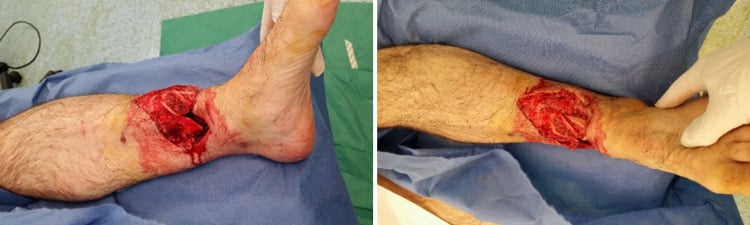
Type III also covers segmental fractures and traumatic amputations, and EAST lists gunshot fractures and farm injuries as special categories within it. High-dose penicillin is added at any grade when there is faecal or clostridial contamination.
Why is the grade less precise than it looks?
The final grade belongs after debridement, because muscle viability, periosteal stripping and the need for a flap are only clear in theatre. The 1998 EAST guideline made the same point and noted that the A/B/C subtypes allow a wound to be graded upwards as necrosis declares itself. A small puncture over the subcutaneous tibia can hide extensive stripping underneath.
Agreement between surgeons is modest. Horn and Rettig (1993) found only moderate interobserver agreement when surgeons graded photographic slides of 10 patients' wounds. Brumback and Jones (1994) showed 245 orthopaedic surgeons twelve videotaped cases with history, examination, radiographs and debridement footage: average agreement was 60%, ranging from 42% to 94% per case. Yim and Hardwicke (2018) traced how the descriptors themselves changed subtly in the 1990s, so papers reporting results "by Gustilo grade" decades apart may not be grading identical injuries.
The 1984 paper defined IIIB as extensive soft-tissue loss with periosteal stripping and bone exposure, "usually associated with massive contamination". Current usage, including the EAST table, turns on whether exposed bone needs tissue transfer to be covered. That drift is one reason some units also record the OTA Open Fracture Classification, which scores skin, muscle, arterial injury, contamination and bone loss separately; the open tibial fracture page compares the two.
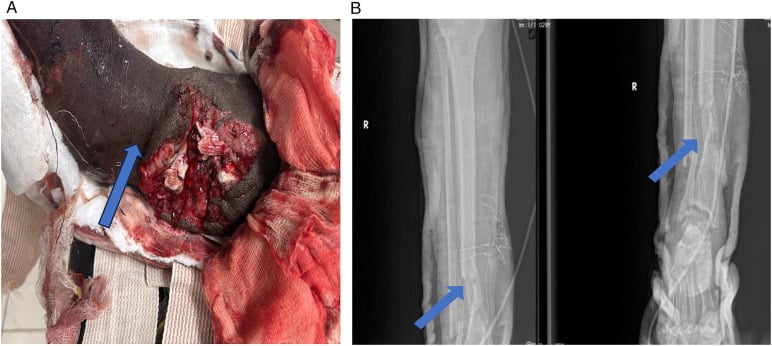
The practical consequence is that the first antibiotic dose is given before the grade is final. Features that should make you treat the injury as severe until theatre proves otherwise include exposed bone, segmental bone loss, ischaemia, crush or avulsion, heavy contamination and tissue loss that will need a flap.
What does BOAST say about antibiotics?
The BOAST Open Fractures standard, published by the British Orthopaedic Association in December 2017 and still listed as last updated December 2017, covers open fractures of long bones, the hindfoot and the midfoot. On antibiotics it makes exactly two statements:
- Standard 2: "Intravenous prophylactic antibiotics should be administered as soon as possible, ideally within 1 hour of injury."
- Standard 3: "There should be a readily accessible published network guideline for the use of antibiotics in open fractures."
That is all. BOAST names no drug, no dose and no duration, and it does not tie the regimen to the Gustilo grade. Anyone quoting a BOAST antibiotic course is quoting a network guideline or the older BOA/BAPRAS standards, not BOAST.
The rest of the standard sets the clock around those doses. Debridement is immediate for highly contaminated wounds (agricultural, aquatic, sewage) or vascular compromise, within 12 hours for other solitary high-energy open fractures and within 24 hours for low-energy ones. Definitive soft-tissue closure or cover should be achieved within 72 hours of injury if it cannot be done at the debridement, and definitive internal fixation only when it can be followed immediately by definitive cover. BOAST cites NICE NG37 (2016) as its evidence base, and NG37 matches it: pre-hospital teams should consider intravenous antibiotics as soon as possible and preferably within 1 hour without delaying transport, and the emergency department gives them immediately if they have not been given.
Where UK regimens come from. The 2009 BOA/BAPRAS Standards for the management of open fractures of the lower limb did specify drugs: co-amoxiclav 1.2 g or a cephalosporin such as cefuroxime 1.5 g, 8-hourly, until the first debridement; gentamicin 1.5 mg/kg added at that debridement, with the co-amoxiclav or cephalosporin continued until soft-tissue closure or for a maximum of 72 hours, whichever is sooner; and gentamicin with vancomycin or teicoplanin at induction for definitive fixation and closure, not continued afterwards. Clindamycin replaced the beta-lactam for penicillin anaphylaxis. A new BOA/BAPRAS edition was published in 2020, and BOAST makes the network guideline the operative document.
What does EAST recommend?
The EAST guideline was first presented in 1998 (posted on the EAST website in 2000) and updated in the Journal of Trauma in March 2011 (Hoff et al.). The update reviewed the literature published since the original and concluded that the original recommendations "remain valid". Its recommendations are graded:
Level I
- Systemic antibiotic cover directed at gram-positive organisms should start as soon as possible after injury.
- Gram-negative cover should be added for Type III fractures.
- High-dose penicillin should be added for faecal or potential clostridial contamination, such as farm injuries.
- Fluoroquinolones offer no advantage over cephalosporin and aminoglycoside regimens, may impair fracture healing and may give higher infection rates in Type III fractures.
Level II
- In Type III fractures, antibiotics should continue for 72 hours after injury or not more than 24 hours after soft-tissue coverage. The 1998 wording adds "whichever occurs first".
- Once-daily aminoglycoside dosing is safe and effective for Type II and III fractures.
For Types I and II, the 1998 guideline recommends stopping antibiotics 24 hours after wound closure; the 2011 update restates this as part of the original recommendations it reaffirms. Neither EAST document makes a graded recommendation on debridement or cover timing; the 1998 background text advised avoiding delays of more than six hours where possible, a position later evidence has not supported (see below).
The fluoroquinolone recommendation rests partly on a randomised trial by Patzakis and colleagues that EAST summarises: in Type III fractures, infection was 31% with ciprofloxacin alone versus 7.7% with ceftazidime plus gentamicin. Note the age of the evidence base: the update was submitted for publication in 2009 and built its recommendations on 27 articles.
BOAST and EAST side by side
| BOAST Open Fractures | EAST guideline | |
|---|---|---|
| Date | December 2017 | 2011 update of the 1998 guideline |
| Scope | Long bones, hindfoot, midfoot | Open extremity fractures |
| First dose | As soon as possible, ideally within 1 hour of injury | As soon as possible after injury |
| Agent | Not specified; published network guideline required | Gram-positive cover for all |
| Type III | Not specified | Add gram-negative cover |
| Contamination | Immediate debridement for agricultural, aquatic or sewage wounds | Add high-dose penicillin for faecal or clostridial contamination |
| Duration, Types I–II | Not specified | Stop 24 hours after wound closure |
| Duration, Type III | Not specified | 72 hours from injury or 24 hours after cover, whichever first |
| Debridement timing | Immediate, 12 hours or 24 hours by injury | No graded recommendation |
| Definitive cover | Within 72 hours of injury | No graded recommendation |
Is "24 hours after debridement" the rule?
No. An earlier OrthoVellum post on this subject stated that stopping antibiotics strictly 24 hours after the initial debridement was the definitive consensus. That was wrong, and this article replaces it. Neither guideline says that. BOAST is silent on duration, and EAST ties the stop to wound closure for Types I and II and to injury time or soft-tissue cover for Type III.
Short courses have trial and meta-analysis support. Dellinger and colleagues (1988) randomised 248 patients to 1 day or 5 days of cefonicid, or 5 days of cefamandole: infection rates were 13%, 12% and 13%, and the brief course was not inferior. Messner and colleagues (2017) pooled 5 comparative studies (1,284 fractures) and 27 observational studies (5,408 fractures) and found no protection from courses longer than 72 hours (odds ratio 0.85, 95% CI 0.60 to 1.21), with 24–48-hour regimens equivalent to longer ones in a subgroup analysis. Most of the pooled studies are observational.
The shortest position in a major document comes from the American Association for the Surgery of Trauma's 2024 clinical consensus: start within 1 hour of injury, continue for 24 hours, and do not continue more than 24 hours after soft-tissue cover. That is a consensus statement from one society, not a replacement for EAST or for your network guideline. The honest summary is that short courses are defensible, 72 hours is the common ceiling, and the stop rule you follow is your network's. Long empirical courses carry their own harms, discussed in our post on antibiotic resistance in orthopaedic surgery.
Does timing matter more than the drug list?
Probably, and both guidelines put timing first. The Cochrane review by Gosselin and colleagues (2004) pooled 913 participants in seven trials: antibiotics reduced early infection compared with none or placebo (relative risk 0.41, number needed to treat 13). Patzakis and Wilkins (1989) analysed 77 infections in 1,104 open fracture wounds and found the single most important factor in reducing infection was early antibiotics active against both gram-positive and gram-negative organisms.
Lack and colleagues (2015) studied 137 Type III open tibial fractures. Antibiotics given beyond 66 minutes (odds ratio 3.78, 95% CI 1.16 to 12.31) and wound cover beyond 5 days (odds ratio 7.39) independently predicted deep infection, while time to debridement did not. Infection was 2.8% when both were early and 40.5% when both were delayed. It is a retrospective single-centre study and the 66-minute cut-point came from its own data, so read it as "as early as possible", not as a precise threshold.
Debridement timing behaves differently. Schenker and colleagues (2012) pooled 16 cohort studies with 3,539 open fractures and found no infection difference between early and later debridement at any threshold studied; the six-hour rule had little support, though the authors did not recommend elective delay. BOAST and NICE use immediate, 12-hour and 24-hour tiers instead of a six-hour rule. In the physiologically unstable patient, damage control orthopaedics decides when definitive surgery can safely happen.
Contamination, local antibiotics and tetanus
Contamination changes the cover. EAST adds high-dose penicillin for faecal or clostridial contamination, and BOAST makes agricultural, aquatic and sewage wounds an immediate trip to theatre. The perioperative antibiotics page covers elective prophylaxis, where a single dose or a 24-hour maximum is the norm, and why open fractures are the exception.
Local antibiotics supplement, never replace, systemic prophylaxis and debridement. Antibiotic-loaded cement beads and bioabsorbable carriers are used for dead-space management in Type III wounds, but high-level comparative evidence for routine use is still maturing; see local antibiotic delivery. Tetanus status is checked at the same time as the first dose, because an open fracture is usually a tetanus-prone wound; the tetanus prophylaxis page gives the immunisation rules.
None of this compensates for an inadequate operation. The open fracture debridement operative guide walks through excision, saline irrigation, skeletal stability and early cover step by step.
In the exam
Frequently asked questions
What is the Gustilo-Anderson classification?
It grades open fractures by wound size, soft-tissue damage, contamination and vascular injury. Type I is a clean wound under 1 cm, Type II a wound over 1 cm without extensive soft-tissue damage, and Type III a severe injury, subdivided in 1984 into IIIA (soft tissue can cover bone), IIIB (periosteal stripping and exposed bone) and IIIC (arterial injury needing repair). The final grade is assigned after debridement.
How long should antibiotics be given for an open fracture?
EAST recommends stopping 24 hours after wound closure for Types I and II, and for Type III continuing for 72 hours after injury or no more than 24 hours after soft-tissue cover, whichever comes first. BOAST leaves duration to the network guideline. A 2024 AAST consensus document advises 24 hours. Follow your local network protocol.
Which antibiotics are used for a Gustilo Type III open fracture?
EAST recommends gram-positive cover plus added gram-negative cover for Type III, with high-dose penicillin if there is faecal or clostridial contamination such as a farm injury. A cephalosporin with an aminoglycoside is the combination EAST discusses. BOAST names no drug; UK units use their trauma network's published antibiotic guideline.
Does BOAST require antibiotics within one hour?
BOAST Open Fractures (December 2017) states that intravenous prophylactic antibiotics should be given as soon as possible, ideally within 1 hour of injury. NICE NG37 asks pre-hospital teams to consider antibiotics preferably within 1 hour, without delaying transport, and emergency departments to give them immediately if not already given.
Is the six-hour rule for open fracture debridement still used?
Neither BOAST nor NICE uses it. BOAST asks for immediate debridement of highly contaminated wounds or those with vascular compromise, within 12 hours for other solitary high-energy open fractures and within 24 hours for low-energy ones. A 2012 meta-analysis of 3,539 fractures found no infection difference between early and later debridement.
References
- British Orthopaedic Association. BOAST: Open Fractures. Published December 2017. Source (opens in a new tab)
- Hoff WS, Bonadies JA, Cachecho R, Dorlac WC. East Practice Management Guidelines Work Group: update to practice management guidelines for prophylactic antibiotic use in open fractures. J Trauma. 2011;70(3):751-4. DOI (opens in a new tab)
- Luchette FA, Bone LB, Born CT, et al. EAST Practice Management Guidelines Work Group: practice management guidelines for prophylactic antibiotic use in open fractures (1998, archived). Source (opens in a new tab)
- National Institute for Health and Care Excellence. Fractures (complex): assessment and management. NICE guideline NG37. 2016. Source (opens in a new tab)
- Nanchahal J, Nayagam S, Khan U, et al. Standards for the management of open fractures of the lower limb. BOA/BAPRAS. London: Royal Society of Medicine Press; 2009. Source (opens in a new tab)
- Gustilo RB, Anderson JT. Prevention of infection in the treatment of one thousand and twenty-five open fractures of long bones: retrospective and prospective analyses. J Bone Joint Surg Am. 1976;58(4):453-8. PubMed (opens in a new tab)
- Gustilo RB, Mendoza RM, Williams DN. Problems in the management of type III (severe) open fractures: a new classification of type III open fractures. J Trauma. 1984;24(8):742-6. DOI (opens in a new tab)
- Brumback RJ, Jones AL. Interobserver agreement in the classification of open fractures of the tibia. J Bone Joint Surg Am. 1994;76(8):1162-6. DOI (opens in a new tab)
- Lack WD, Karunakar MA, Angerame MR, et al. Type III open tibia fractures: immediate antibiotic prophylaxis minimizes infection. J Orthop Trauma. 2015;29(1):1-6. DOI (opens in a new tab)
- Dellinger EP, Caplan ES, Weaver LD, et al. Duration of preventive antibiotic administration for open extremity fractures. Arch Surg. 1988;123(3):333-9. DOI (opens in a new tab)
- Messner J, Papakostidis C, Giannoudis PV, Kanakaris NK. Duration of administration of antibiotic agents for open fractures: meta-analysis of the existing evidence. Surg Infect (Larchmt). 2017;18(8):854-67. DOI (opens in a new tab)
- Appelbaum RD, Farrell MS, Gelbard RB, et al. Antibiotic prophylaxis in injury: an American Association for the Surgery of Trauma Critical Care Committee clinical consensus document. Trauma Surg Acute Care Open. 2024;9(1):e001304. DOI (opens in a new tab)
Study the full topic
Included in Pro
Go deeper with Pro
- Operative guide: open fracture debridement and reconstruction
- Operative guide: local muscle flaps for the open tibia
Share this article
Cite this article
OrthoVellum Editorial Team. Gustilo-Anderson and Open Fracture Antibiotics: What BOAST and EAST Actually Recommend [Internet]. OrthoVellum; 2026 Oct 2 [cited 2026 Oct 2]. Available from: https://www.orthovellum.com/blog/gustilo-anderson-classification-open-fracture-antibiotics
About this content
Prepared by the OrthoVellum Editorial Team from cited sources, under our editorial policy.
For education and exam preparation; not medical advice or a substitute for clinical judgement and local guidance.
Spotted an error? Tell us; every report is read.
Get new articles by email
New clinical explainers, landmark-trial summaries and exam guidance from the OrthoVellum blog. No account needed; unsubscribe from any email.