Vertebral Body Tethering for Adolescent Idiopathic Scoliosis: Promise, Limits, and Counselling
Vertebral body tethering for adolescent idiopathic scoliosis: candidate selection, motion preservation, tether breakage, overcorrection and family counselling.
By OrthoVellum Editorial TeamPublished 4 min read
Educational content for clinicians, not medical advice. Editorial policy
On this page14 sections
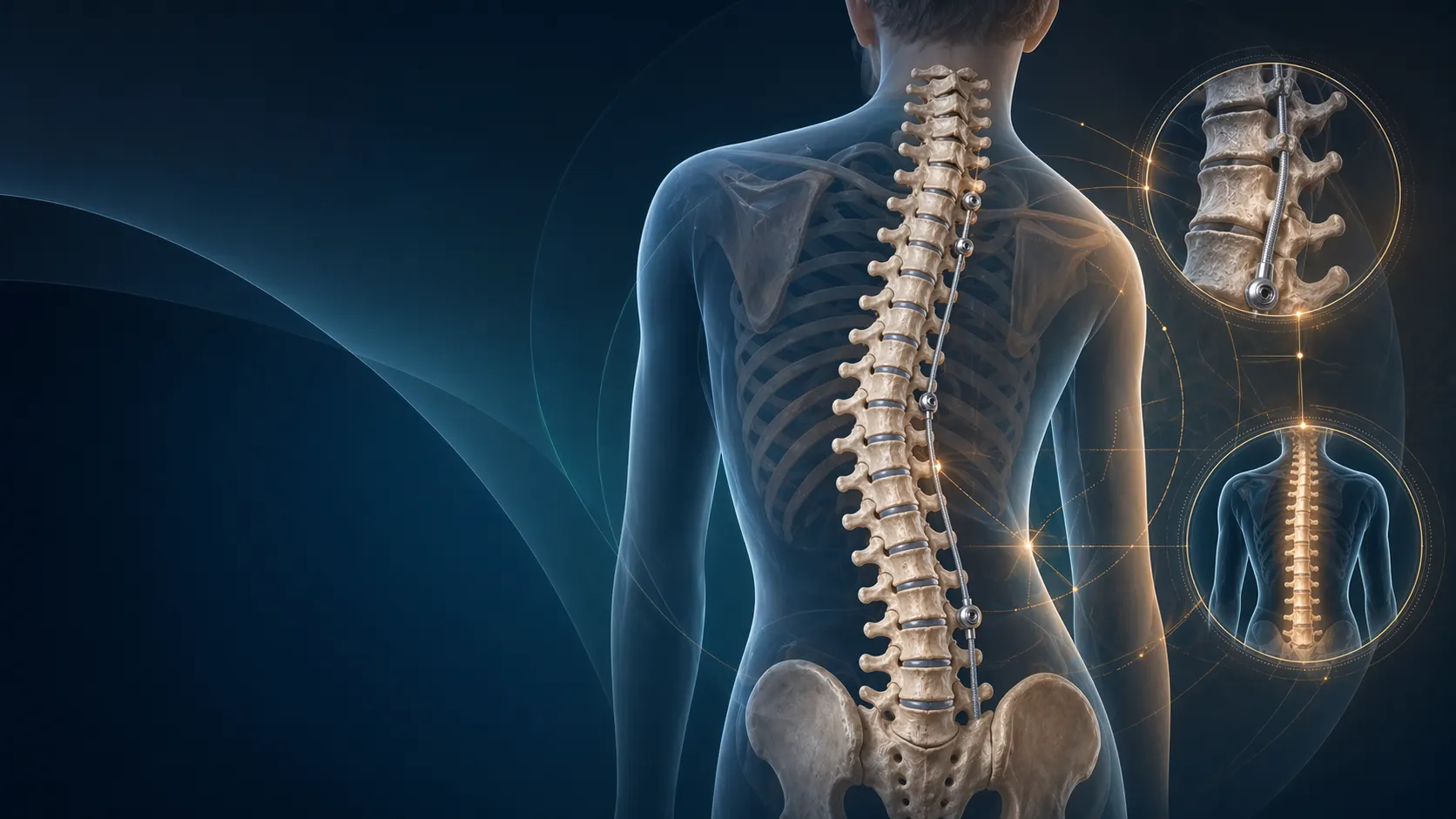
Vertebral body tethering has captured attention because it promises something spinal fusion cannot: correction with retained motion. That is a powerful idea for adolescents and families. It is also exactly the sort of idea that can be oversold when enthusiasm outruns long-term evidence. In 2026, the right stance is neither dismissal nor hype. It is disciplined honesty.
Fast Takeaways
- Vertebral body tethering is a real option for a narrow subset of growing patients with adolescent idiopathic scoliosis.
- Motion preservation is the attraction, but it does not automatically outweigh the known predictability of fusion.
- Candidate selection is everything: flexibility, curve pattern, and remaining growth all matter.
- Overcorrection, tether breakage, and reoperation remain central counselling points.
- Posterior spinal fusion is still the benchmark operation against which VBT should be judged.
Why This Matters
The Scoliosis Research Society material remains a useful anchor because it explains both the appeal and the caution in plain language. Standard fusion has decades of predictable correction and relatively low reoperation risk in experienced hands. VBT is attractive because it preserves more motion and may allow faster early recovery, but its evidence base is younger and its complication profile is different.
That framing still holds. The modern discussion is not whether VBT is real. It is whether the patient in front of you is the right patient for it.
The Core Decision Points
1. The patient must still have meaningful growth remaining
The biological logic of tethering is growth modulation. That means the procedure depends on remaining growth to help the curve continue correcting over time. Too little growth and the correction may be inadequate. Too much growth and overcorrection becomes a bigger concern.
That is why maturity assessment is not a side note. It is central to indication.
2. Flexibility matters
Not every scoliotic curve is tether-friendly. The procedure is most compelling in flexible curves within the selection windows described by current guidance and major published series. Rigid curves and more complex deformity patterns challenge the promise of controlled modulation.
3. Motion preservation must be weighed against predictability
This is the heart of the shared decision-making conversation. Fusion is less motion-preserving, but more predictable. Tethering preserves more motion, but the family must accept a less mature evidence base plus the possibility of tether breakage, overcorrection, or further surgery.
If the counselling sounds like “same correction, less stiffness, why not do VBT?” it is incomplete.
4. Reoperation risk must be discussed explicitly
The SRS patient information summary cites meaningful rates of second surgery, including for overcorrection and broken tethers. More recent reviews and multicentre outcome studies continue to position reoperation as one of the defining trade-offs of VBT.
That does not make the procedure wrong. It makes the consent discussion honest.
VBT is best understood as a selective motion-preserving growth-modulation strategy, not as a universal replacement for posterior spinal fusion.
Common Pitfalls
Treating VBT as the default modern option
Fusion remains the standard against which VBT must be compared. A new technology article should not erase that.
Ignoring growth timing
In VBT, growth is not background information. It is the mechanism.
Under-counselling about breakage and overcorrection
Families may accept reoperation risk if it is explained clearly. Problems arise when those risks are minimised or presented as rare technical footnotes.
Assuming motion preservation means better long-term outcomes
That remains a hypothesis in many respects, not a universally proven long-term fact.
Exam and Practice Pearls
- In a viva, say that VBT is for selected growing patients with flexible AIS, not for every adolescent with scoliosis.
- Contrast VBT with adolescent idiopathic scoliosis fusion by discussing predictability, motion preservation, and reoperation risk.
- If asked about the main complications, mention overcorrection, tether breakage, and revision surgery.
- If the question becomes patient counselling, explain both the attraction and the uncertainty in the same answer.
References
- SRS Patient Information PDF on Vertebral Body Tethering (opens in a new tab).
- SRS Informational Statement: Vertebral Body Tethering in Pediatric and Adult Spinal Deformity (opens in a new tab).
- Current Status of Vertebral Body Tethering for Adolescent Idiopathic Scoliosis: An Umbrella Review (opens in a new tab). 2024.
- Outcomes of Vertebral Body Tethering in Adolescent Idiopathic Scoliosis: A Prospective, Multicenter Study (opens in a new tab). 2025.
- Vertebral body tethering for adolescent idiopathic scoliosis: a review (opens in a new tab). 2024.
Share this article
Cite this article
OrthoVellum Editorial Team. Vertebral Body Tethering for Adolescent Idiopathic Scoliosis: Promise, Limits, and Counselling [Internet]. OrthoVellum; 2026 Apr 14 [cited 2026 Oct 24]. Available from: https://www.orthovellum.com/blog/vertebral-body-tethering-ais-2026
About this content
Prepared by the OrthoVellum Editorial Team from cited sources, under our editorial policy.
For education and exam preparation; not medical advice or a substitute for clinical judgement and local guidance.
Spotted an error? Tell us; every report is read.
Get new articles by email
New clinical explainers, landmark-trial summaries and exam guidance from the OrthoVellum blog. No account needed; unsubscribe from any email.