Avascular | Aneural | 4 Zones | Type II Collagen | Aggrecan Proteoglycans
- Articular cartilage is avascular, aneural, and alymphatic - limited healing capacity
- Type II collagen (90-95% of collagen) provides tensile strength and framework
- Aggrecan proteoglycans attract water, providing compressive stiffness
- Four zones with different collagen orientation and proteoglycan content
- Tide mark separates deep zone from calcified cartilage
- “Superficial zone has highest collagen, lowest proteoglycan content
- “Deep zone has lowest collagen, highest proteoglycan content
- “Collagen orientation changes from tangential to perpendicular across zones
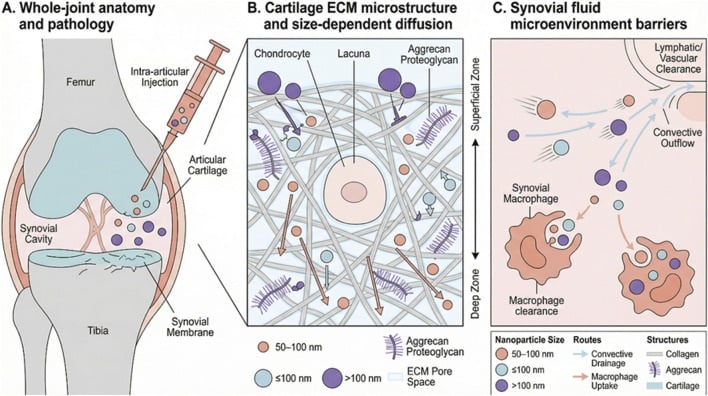
- “Cartilage nutrition depends on diffusion from synovial fluid and subchondral bone
Overview
What it is. Articular cartilage is a specialised connective tissue covering the ends of bones in synovial joints. It provides a smooth, low-friction surface for joint motion and distributes load to the underlying subchondral bone.
Why its structure matters. The tissue is avascular, aneural and alymphatic, which is why cartilage injuries have limited healing potential and why its nutrition has to arrive by diffusion. Osteoarthritis is the same structure failing: loss of proteoglycans, disruption of the collagen network and changes in water content all contribute to cartilage degeneration, so the normal tissue has to be understood before the diseased one can be.
How to think about it. Mechanically, cartilage is a composite in which a collagen network constrains the swelling pressure of the proteoglycans, and a biphasic material in which a mobile fluid phase and a solid matrix interact under load. Four zones, differing in collagen orientation and composition, give the tissue different properties at the surface and at the bone. Each of these ideas has its own section below.
Composition
Water, collagen and proteoglycans make up 95-98% of cartilage. Each has a mechanical job: water is the fluid phase that carries load and nutrients, collagen resists tension, and proteoglycans resist compression, with the collagen network constraining the proteoglycan swelling to form the composite.
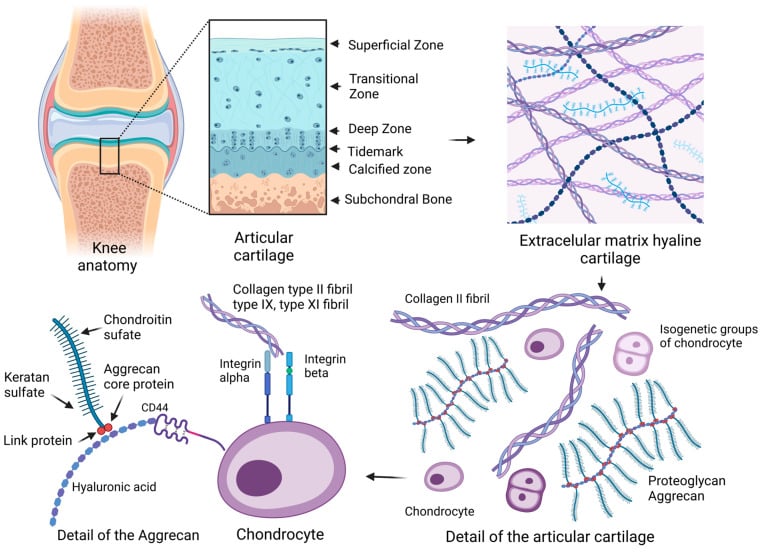
Water is 70-80% of wet weight, and it is not evenly distributed: 75-80% in the superficial zone, 70-75% in the middle zone and 65-70% in the deep zone, falling with depth. It is held in the tissue by the osmotic pressure of the proteoglycans and constrained by the collagen network.
What the water does. It is the diffusion pathway for nutrition, it carries metabolites and waste products, and its hydrodynamic effect lubricates the surface. Under load it is the fluid phase of the biphasic material, moving through the porous matrix to distribute the load; the time course of that flow is set out under Mechanical Properties.
Zonal Organisation
Cartilage is built in four zones that differ in collagen orientation, composition and mechanical role, from a surface that has to slide to a base that has to hold on to bone.
- Depth
- 5-10%
- Collagen
- Parallel to surface; over 80% dry weight
- Proteoglycan Content
- Lowest (15-20 mg/mL)
- Water Content
- Highest (75-80%)
- Function
- Shear resistance, low friction
- Depth
- 40-60%
- Collagen
- Oblique/random; 60-70% dry weight
- Proteoglycan Content
- Moderate (30-40 mg/mL)
- Water Content
- Moderate (70-75%)
- Function
- Transition zone
- Depth
- 30%
- Collagen
- Perpendicular to surface; 50-60% dry weight
- Proteoglycan Content
- Highest (50-60 mg/mL)
- Water Content
- Lowest (65-70%)
- Function
- Compression resistance
- Depth
- 5-10%
- Collagen
- Anchored in bone
- Proteoglycan Content
- Intermediate
- Water Content
- Low
- Function
- Attachment to bone
Structure. The tangential zone, the outer 5-10%, has the most collagen as small-diameter fibrils densely packed parallel to the surface, the least proteoglycan and the most water. Its chondrocytes are flattened, lie parallel to the surface and are the densest in the tissue at 15,000-20,000 cells/mm³.
Function. The zone has the highest tensile strength in the tissue, resists shear and provides the low-friction surface: it is the first line of defence against mechanical wear.
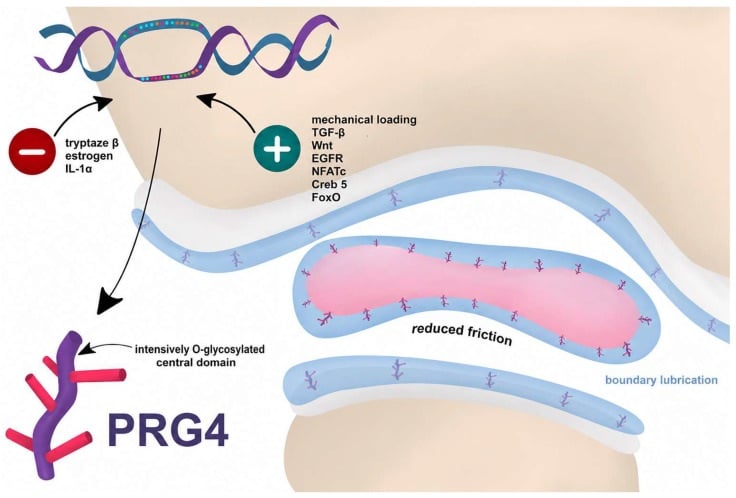
Superficial zone chondrocytes uniquely express lubricin (proteoglycan 4, PRG4, superficial zone protein), secreted onto the articular surface and into the synovial fluid to provide boundary lubrication. Loss of lubricin increases cartilage wear.
Two Boundaries, Not One
The tide mark is the boundary examiners ask about first, but it is the second boundary that explains how the tissue fails. The two are not interchangeable.
The tide mark separates the uncalcified deep (radial) zone from the calcified zone. It is a thin basophilic line on histology and it is the mineralisation front, not a mechanical join. The literature writes it as one word, tidemark, and both forms appear in textbooks.
The cement line separates the calcified cartilage from the subchondral bone plate beneath it. This is the true osteochondral junction.
The crossing rule. Collagen fibrils from the radial zone pass through the tide mark and anchor into the calcified layer, which is why the uncalcified cartilage is firmly continuous with the calcified layer. Those fibrils do not cross the cement line: the calcified cartilage is joined to bone by interdigitation of the two mineralised surfaces rather than by a continuous fibrillar network.
Two consequences follow, and both are worth being able to state:
- The cement line is the mechanical weak point in shear, which is why osteochondral fragments and flaps characteristically separate at or just above the subchondral plate rather than peeling off within the cartilage itself
- The interface is a gradient, not a step. Stiffness rises steeply from uncalcified cartilage through calcified cartilage to subchondral bone, and the calcified layer exists precisely to spread that mismatch over a few hundred micrometres. Anything that stiffens the subchondral plate, sclerosis or the bone reaction after marrow stimulation, steepens the gradient and concentrates shear at the junction
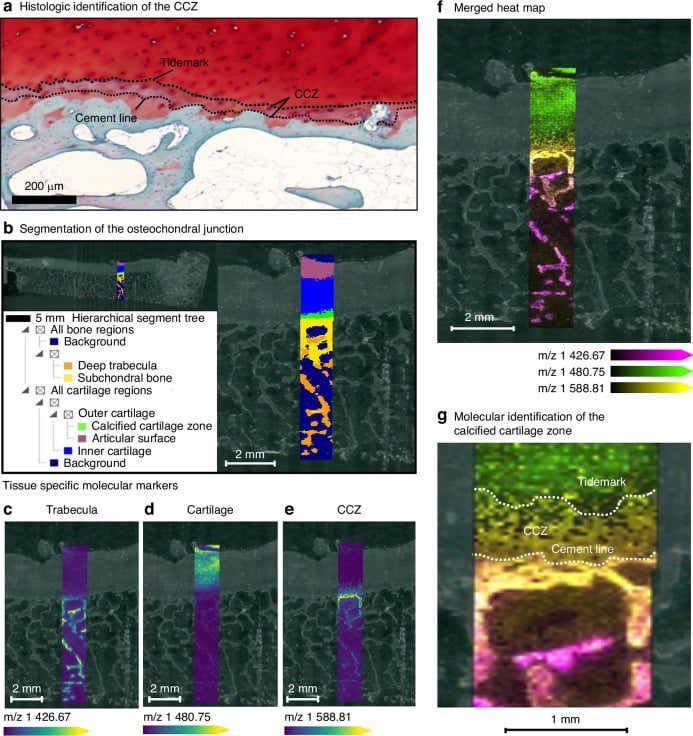
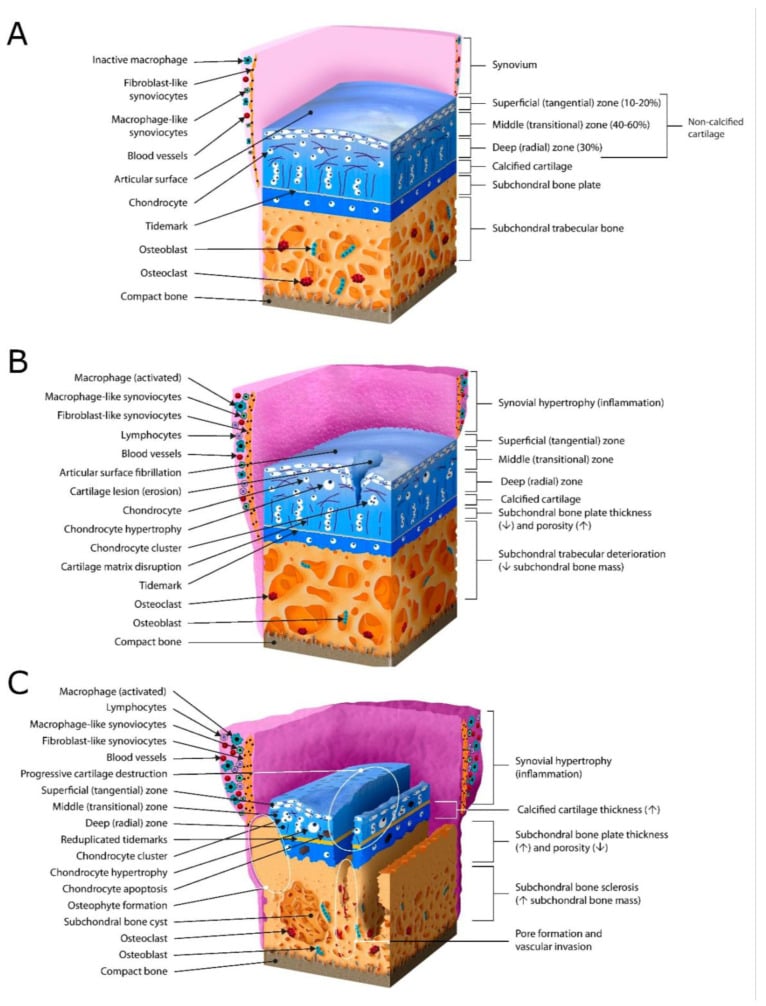
The tide mark advances with age and in osteoarthritis: the calcified zone thickens and the uncalcified cartilage above it thins, which may impair nutrition from subchondral bone. Duplicated or reduplicated tide marks are a recognised marker of that advance and record repeated cycles of cartilage damage and repair.
Mechanical Properties and Biomechanics
Articular cartilage owes its mechanical properties to its biphasic composition and its zonal organisation.
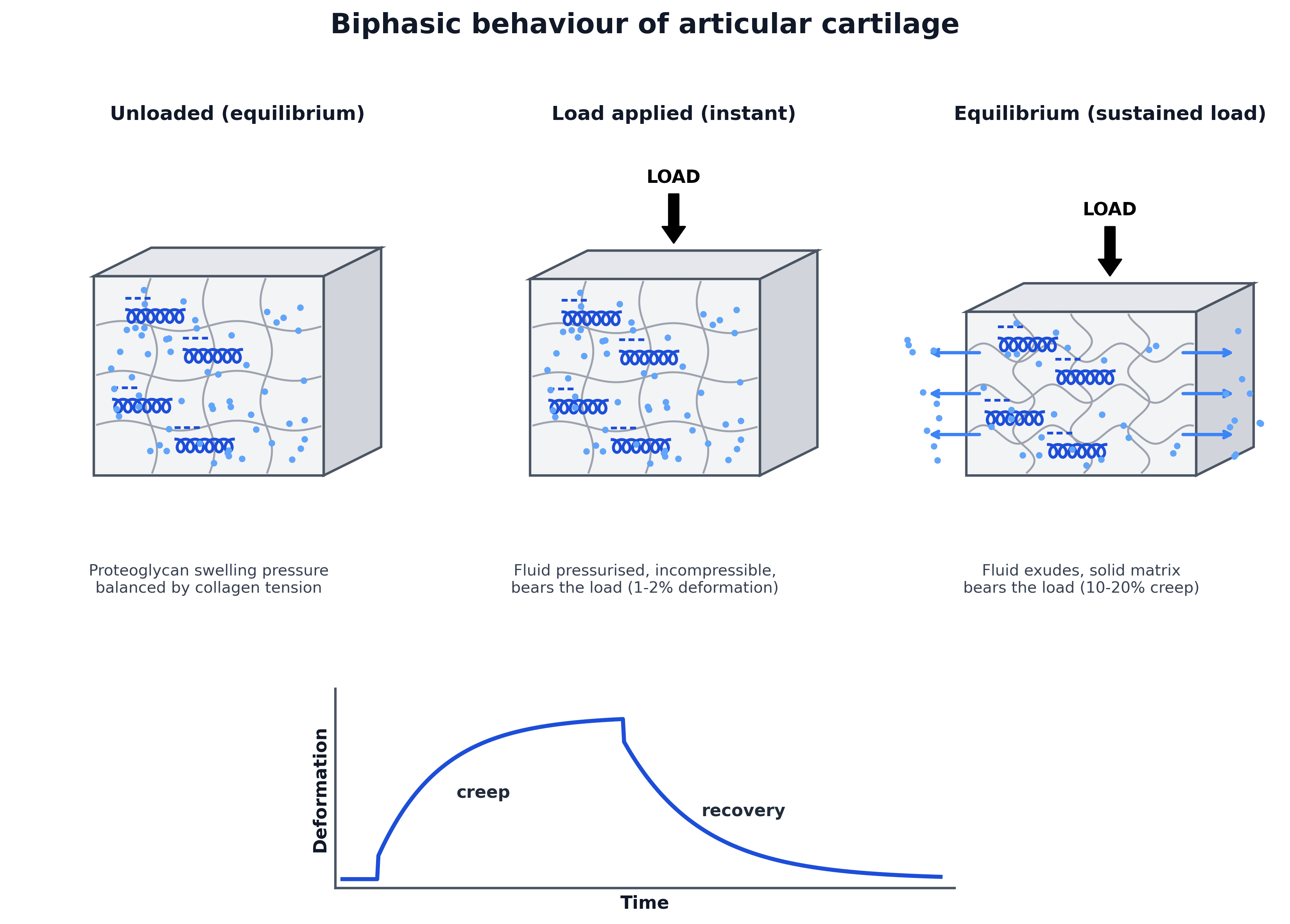
Two phases. The solid phase is the collagen-proteoglycan matrix, 20-30% of the tissue; the fluid phase is the interstitial water, 70-80%. Under load the incompressible fluid carries the load first, then exudes through the matrix, and only at equilibrium is the load carried by the compressed solid. Unloading reverses the sequence as fluid is re-imbibed. This is what gives the joint its shock absorption and load distribution.
Cartilage Response to Load
Instantaneous deformation of 1-2%. The load is supported by the fluid phase and there is no fluid flow yet, so the cartilage behaves as an incompressible material.
Water flows from the compressed region through the porous matrix. Deformation progresses (creep) as the load is gradually transferred to the solid matrix and the interstitial fluid pressure falls.
Fluid flow ceases at an equilibrium deformation of 10-20%. The load is fully supported by the compressed and stressed solid matrix of collagen and proteoglycans.
Osmotic pressure from the proteoglycans draws fluid back into the matrix and the cartilage swells to its original thickness. Recovery takes hours to days depending on the duration of loading.
Normal daily activities compress cartilage by 10-20%, which recovers overnight during sleep.
Clinical Relevance and Applications
Structure explains three clinical problems, each developed in its own right elsewhere: why the tissue cannot regenerate itself once damaged (cartilage healing and repair), how chondral defects are graded and treated (articular cartilage injuries), and how the zonal architecture is read on MRI (MRI cartilage assessment).
Osteoarthritis
Early change. Proteoglycan depletion is one of the earliest changes in osteoarthritis. Loss of aggrecan reduces the fixed negative charge and with it the compressive stiffness; paradoxically the water content rises early, as the constraining collagen network fails, and the matrix softens. Surface fibrillation follows as the protective superficial zone fails.
Progression. Collagen network disruption follows proteoglycan loss, and once the collagen arcade is damaged the cartilage cannot maintain its integrity. Full-thickness defects expose subchondral bone and the joint articulates bone on bone.
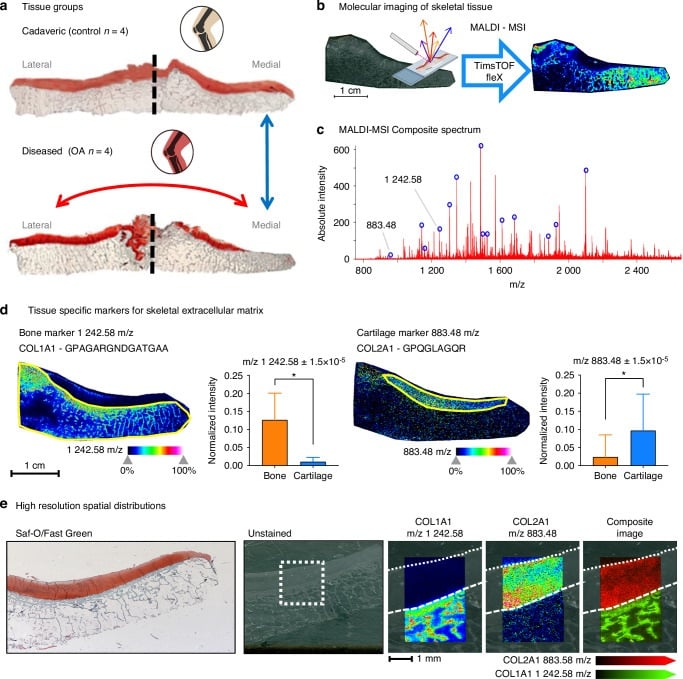
The enzymatic cascade. Cartilage breakdown is an active, enzyme-mediated process in which chondrocytes, driven by inflammatory cytokines and mechanical overload, shift from matrix maintenance to net catabolism. A basic-science viva commonly moves from what is lost to how it is degraded.
- Class
- Matrix metalloproteinase
- Principal substrate / action
- Cleaves Type II collagen triple helix - the dominant collagenase of cartilage; rate-limiting in irreversible collagen loss
- Class
- Matrix metalloproteinases
- Principal substrate / action
- Collagen and proteoglycan breakdown; MMP-3 also activates other pro-MMPs
- Class
- A disintegrin and metalloproteinase with thrombospondin motifs
- Principal substrate / action
- Cleave aggrecan core protein - earliest and main driver of proteoglycan loss (ADAMTS-5 dominant in animal models)
- Class
- Pro-inflammatory cytokines
- Principal substrate / action
- Master upstream drivers: upregulate MMPs/aggrecanases, suppress matrix synthesis, induce nitric oxide and PGE2
- Class
- Endogenous inhibitors
- Principal substrate / action
- Counterbalance MMPs; OA reflects an imbalance of MMP activity over TIMP inhibition
Aggrecan loss comes first and is initially reversible. Type II collagen loss, driven mainly by MMP-13, is the irreversible step: once the collagen arcade is cleaved, the architecture cannot be rebuilt. This is why early disease-modifying strategies have targeted aggrecanases (ADAMTS-5) and IL-1, to intervene before collagen is lost.
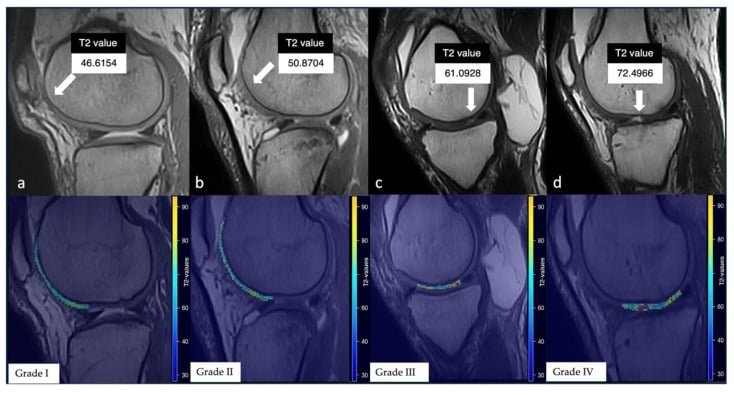
Grading the Chondral Lesion
Before any repair decision the lesion is graded. Two systems dominate: the classic Outerbridge classification, originally for chondromalacia patellae and now applied generally, and the ICRS (International Cartilage Regeneration & Joint Preservation Society) arthroscopic grade, which the ICRS algorithm uses to drive repair choice. Both run from intact surface to full-thickness loss exposing bone.
- Outerbridge
- Normal cartilage
- ICRS
- Normal
- Depth
- Intact
- Outerbridge
- Softening and swelling
- ICRS
- Intact surface - softening / superficial fissures or indentation
- Depth
- Superficial
- Outerbridge
- Fragmentation/fissuring under 1.5 cm diameter
- ICRS
- Lesion extending less than 50% of cartilage depth
- Depth
- Less than half thickness
- Outerbridge
- Fragmentation/fissuring over 1.5 cm diameter
- ICRS
- Defect greater than 50% depth, down to but not through the calcified layer / subchondral bone
- Depth
- More than half thickness, bone not exposed
- Outerbridge
- Erosion to subchondral bone
- ICRS
- Full-thickness loss through subchondral bone plate (IVa to bone, IVb into deeper bone)
- Depth
- Full thickness, bone exposed
Why grading drives management. Grade and defect size together select the technique. Low-grade (Outerbridge/ICRS I-II) lesions are usually managed non-operatively or with debridement; symptomatic full-thickness (grade III-IV) focal defects are the ones considered for marrow stimulation, ACI/MACI or osteochondral grafting. The examinable threshold is depth past the subchondral plate: marrow stimulation relies on breaching the plate, which only a grade IV lesion, or a grade III lesion converted at surgery, provides. ICRS grade, lesion size, depth and location are exactly the variables the ICRS treatment algorithm uses.
Repair
Healing capacity. Partial-thickness defects do not heal spontaneously, because the tissue is avascular. Full-thickness defects that extend to subchondral bone may heal with fibrocartilage (Type I collagen) laid down by marrow-derived mesenchymal stem cells.
The treatments in use are each built on that biology:
- Microfracture and drilling penetrate subchondral bone to recruit MSCs for fibrocartilage repair
- ACI and MACI implant cultured chondrocytes to regenerate hyaline-like cartilage
- Osteochondral grafts transplant intact hyaline cartilage from non-weight-bearing areas
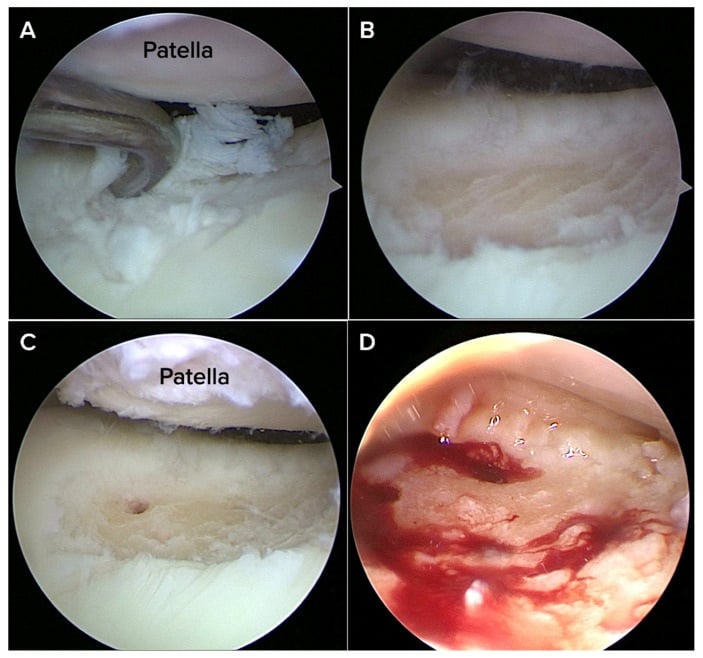
The three cartilages. A common viva trap is to confuse hyaline articular cartilage with fibrocartilage and elastic cartilage; they are distinguished by collagen type, location and mechanical behaviour.
- Hyaline (articular)
- Type II
- Fibrocartilage
- Type I (plus some Type II)
- Elastic cartilage
- Type II + elastin fibres
- Hyaline (articular)
- Articular surfaces, growth plate, costal, tracheal rings
- Fibrocartilage
- Menisci, annulus fibrosus, pubic symphysis, repair tissue
- Elastic cartilage
- External ear, epiglottis, Eustachian tube
- Hyaline (articular)
- Absent over articular surface
- Fibrocartilage
- Absent
- Elastic cartilage
- Present
- Hyaline (articular)
- High (aggrecan-rich)
- Fibrocartilage
- Lower
- Elastic cartilage
- Moderate
- Hyaline (articular)
- Low-friction, compression and shear
- Fibrocartilage
- Tensile load, energy absorption
- Elastic cartilage
- Flexible support, recoil
- Hyaline (articular)
- Goal tissue (ACI/MACI/osteochondral graft)
- Fibrocartilage
- Default repair tissue after microfracture (inferior, wears)
- Elastic cartilage
- Not a repair tissue
Marrow-stimulation techniques (microfracture, drilling) fill defects with fibrocartilage dominated by Type I collagen. Fibrocartilage lacks the zonal collagen arcade and the aggrecan density of native hyaline cartilage, so it has lower compressive and shear resistance and tends to deteriorate over time. That is the biological rationale for cell-based and osteochondral techniques that aim to restore hyaline (Type II) cartilage.
Controversies and Areas of Uncertainty
Best repair technique. There is no consensus single best technique for focal chondral defects. Microfracture is cheaper and single-stage but yields fibrocartilage with deterioration after 2 to 5 years; ACI/MACI and osteochondral techniques may give more durable hyaline-like tissue but are costlier and may be two-stage. Defect size, location, depth and patient age all modify the choice.
Tide mark and subchondral bone. The role of the subchondral bone plate and calcified zone in osteoarthritis, initiation or consequence, is debated. Whether tide-mark advancement and subchondral change drive cartilage loss, or merely follow it, remains an active research question that influences whether therapies should target bone, cartilage or both.
Regeneration versus repair. True regeneration of zonally organised hyaline cartilage with a restored collagen arcade has not been reliably achieved in humans; current techniques produce repair tissue of variable quality. Whether scaffolds, growth factors, or gene and cell therapy can recreate the depth-dependent architecture is unresolved.
Lubrication. The relative contribution of boundary lubrication (lubricin, hyaluronan), fluid-film and interstitial-fluid-pressurisation mechanisms to the very low friction of cartilage is still actively studied, with implications for viscosupplementation and lubricin-based therapies.
Guidelines, Registries & Global Practice
Articular cartilage structure underpins the global burden of osteoarthritis and the choice of cartilage-repair strategies. Recommendations vary by society and by resource setting.
Osteoarthritis is among the leading causes of disability worldwide, with the knee the most commonly affected large joint. Prevalence rises sharply with age and obesity and is increasing globally as populations age, making cartilage biology and preservation a worldwide priority rather than a regional one.
Focal chondral and osteochondral lesions are found in a substantial proportion of knee arthroscopies and are an important cause of pain and progression to osteoarthritis in younger, active patients - the group in whom cartilage-restoration procedures are most often considered.
- Region
- Global
- Emphasis
- Standardised arthroscopic grading of chondral lesions and algorithm for defect size, depth and location guiding repair choice
- Region
- US
- Emphasis
- Evidence-based OA guidance; emphasis on non-operative measures (exercise, weight loss) first; cautious recommendations on intra-articular agents
- Region
- UK
- Emphasis
- Core OA management of education, exercise and weight loss; ACI considered for selected knee defects within defined criteria
- Region
- Europe
- Emphasis
- Consensus on cartilage-defect management favouring restorative techniques in younger patients with isolated defects
Access to MRI for defect characterisation, arthroscopic grading, and the full range of restorative options (microfracture variants, ACI/MACI, osteochondral autograft/allograft). Cell-based therapies require licensed cell-culture facilities and are concentrated in specialist centres.
Imaging and cell-based therapy access may be constrained, so single-stage marrow-stimulation and conservative management (activity modification, physiotherapy, weight management, analgesia) predominate. Joint-preserving surgery and timely arthroplasty for end-stage disease may also be limited by capacity.
Basic Science Viva Scenarios
Practise clinical reasoning and management decisions out loud
“Describe the composition of articular cartilage and explain how each component contributes to its mechanical function.”
“Describe the zonal organization of articular cartilage. How does structure relate to function in each zone?”
“Explain the biphasic nature of articular cartilage. How does this contribute to load-bearing and nutrition?”
Composition by Weight
- 70-80% water (fluid phase in biphasic model)
- 15-22% collagen (90-95% Type II, provides tensile strength)
- 4-7% proteoglycans (aggrecan with GAG chains, compression resistance)
- 1-2% cells and other proteins (chondrocytes, COMP, fibronectin)
Zonal Organization (4 Zones)
- Superficial (5-10%): tangential collagen, high collagen, low proteoglycan, shear resistance
- Middle (40-60%): oblique collagen, intermediate composition, transitional
- Deep (30%): perpendicular collagen, low collagen, high proteoglycan, compression resistance
- Calcified (5-10%): mineralized, tide mark boundary, anchors to subchondral bone
Type II Collagen Network
- Type II collagen is 90-95% of total collagen (Type IX, XI minor collagens)
- Fibril diameter 20-40 nm (smaller than Type I)
- Orientation: tangential (superficial) to perpendicular (deep) - arcade structure
- Provides tensile strength and constrains proteoglycan swelling
Aggrecan Proteoglycan
- Major proteoglycan (90% of total), molecular weight 2-3 million Da
- GAG side chains: chondroitin sulfate and keratan sulfate
- Aggregates: 50-100 aggrecans bind to hyaluronan via link protein
- Negative charges (SO4-, COO-) attract water via Donnan osmotic pressure
Biphasic Mechanics
- Fluid phase (water) and solid phase (collagen-proteoglycan matrix)
- Immediate load on fluid (incompressible), then water flows out (creep)
- Equilibrium at hours: load on solid matrix, 10-20% deformation
- Recovery after unloading: osmotic pressure draws water back in
Key Mechanical Properties
- Aggregate modulus: 0.5-0.9 MPa (equilibrium compression)
- Tensile modulus: 5-25 MPa (zone and direction dependent)
- Hydraulic permeability: 0.5-5 × 10⁻¹⁵ m⁴/N·s
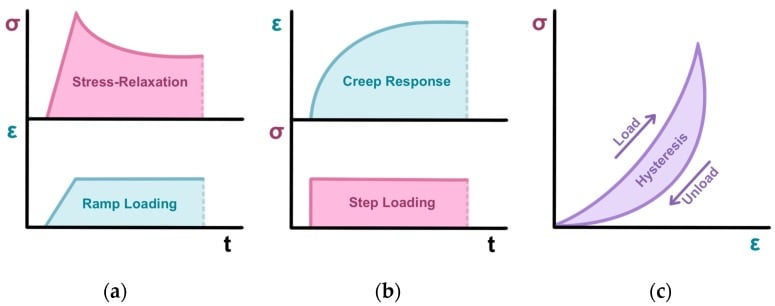
- Viscoelastic: creep, stress relaxation, hysteresis
Clinical Pearls
- Avascular, aneural, alymphatic: limited healing capacity
- Nutrition by diffusion from synovial fluid and subchondral bone
- Cyclic loading pumps nutrients in/out (immobilization impairs nutrition)
- Lubricin from superficial zone provides boundary lubrication
- OA: proteoglycan loss → reduced stiffness, collagen damage → fissures
Evidence Base
Biphasic Theory of Articular Cartilage
- Articular cartilage is a biphasic material (solid matrix + interstitial fluid)
- Under load, fluid flows through porous matrix creating time-dependent behavior
- Aggregate modulus describes equilibrium compressive properties
- Permeability determines rate of fluid flow and creep response
Zonal Organization and Collagen Architecture
- Described arcade-like collagen architecture from deep to superficial zones
- Collagen orientation changes from perpendicular (deep) to tangential (superficial)
- Zonal organization provides different mechanical functions
- This architecture has been confirmed by modern imaging techniques
Proteoglycan Swelling Pressure in Cartilage
- Directly measured cartilage swelling pressure and compared it with the osmotic pressure of constituent proteoglycans
- Fixed negative charge density on proteoglycan GAG chains generates Donnan osmotic (swelling) pressure
- Swelling pressure provides the compressive resistance of cartilage
- Collagen network constrains proteoglycan swelling, creating matrix prestress
The Biology of Lubricin: Near Frictionless Joint Motion
- Lubricin (PRG4) is a surface-active mucinous glycoprotein that coats the cartilage surface and provides boundary lubrication
- Prevents cell and protein adhesion and preserves superficial-zone chondrocytes
- Lubricin-null joints show damage to the superficial zone, implicating lubricin deficiency in arthropathy after trauma or inflammatory arthritis
- Recombinant rhPRG4 is a candidate therapeutic for transient lubricin deficiency
The Basic Science of Articular Cartilage: Structure, Composition, and Function
- Comprehensive review of articular cartilage as an avascular, aneural, alymphatic hyaline tissue with low cellularity
- Defines the four zones (superficial, middle, deep, calcified) and the gradient of collagen orientation and proteoglycan content
- Explains the collagen-proteoglycan composite and biphasic mechanical behaviour underlying load-bearing
- Limited intrinsic repair capacity follows directly from avascularity and low chondrocyte turnover
Autologous Chondrocyte Transplantation for Deep Cartilage Defects
- First-in-human series of autologous chondrocyte implantation (ACI) in 23 patients with full-thickness defects of 1.6 to 6.5 cm squared
- 14 of 16 femoral condylar transplants achieved good-to-excellent results at 2 years; patellar transplants performed less well
- Biopsy showed hyaline-like cartilage in 11 of 15 femoral transplants, in contrast to fibrocartilage from marrow-stimulation techniques
- Established that cultured autologous chondrocytes can resurface femorotibial cartilage defects