Mankin Principles | Approach Planning | Avoid Contamination | Tumor Center Collaboration
- ALL BIOPSIES SHOULD BE PERFORMED BY THE SURGEON WHO WILL DO THE DEFINITIVE RESECTION, or in consultation with a tumour centre
- LONGITUDINAL INCISIONS ONLY - transverse incisions contaminate multiple compartments and may preclude limb salvage
- THE BIOPSY TRACT MUST LIE WITHIN THE PLANNED RESECTION FIELD - the entire tract, including the skin incision, will be excised
- MINIMISE HAEMATOMA - meticulous haemostasis, minimal tourniquet time, a compression dressing, and avoid drains where possible
- NEVER PERFORM AN EXCISIONAL BIOPSY FOR SUSPECTED SARCOMA - it violates oncological principles and contaminates the surrounding tissue
- “Mankin 1982: 18% needed a more complex operation and 8.5% a changed outcome after biopsy error; 1996 revisited: 2-12x more errors at referring institutions
- “The four recurring error categories: wrong biopsy type, wrong approach, poor haemostasis, inadequate tissue
- “Image-guided core needle biopsy is about 92% accurate for the benign-versus-malignant call, but only 71-84% for the exact diagnosis (Hau 71% overall; Skrzynski 84%)
- “Always discuss suspected bone or soft tissue tumor with tumor center BEFORE biopsy
Overview and Epidemiology
Biopsy is the definitive diagnostic procedure for a suspected bone or soft tissue tumour, and its technique and timing are critical. An improperly performed biopsy compromises subsequent treatment, increases morbidity, and can force an amputation in a limb that would otherwise have been salvageable. An inappropriate biopsy is the most common referral error.
Two multi-institutional studies by Mankin, fourteen years apart, put numbers to that and established the principle the rest of this page follows.
Mankin's work is two papers, and the figures belong to different ones. The 1982 study (329 biopsies, 16 Musculoskeletal Tumor Society centres) found that a biopsy-related problem forced a different or more complex operation, or adjunctive treatment, in 18%, changed the outcome (disability, loss of function, local recurrence or death) in 8.5%, and led to 15 unnecessary amputations (about 4.5%). The 1996 revisited study (597 patients, 21 institutions) found the problem essentially unchanged: diagnostic error 17.8%, a forced different/more complex operation in 19.3%, an outcome change in 10.1%, and 18 unnecessary amputations - and it is the 1996 paper that quantifies that errors were 2-12 times more frequent when the biopsy was done at the referring institution (p less than 0.001). The recurring error categories were wrong biopsy type, an inappropriate approach, poor haemostasis causing haematoma, and inadequate or non-representative tissue. Together they established that biopsies should be performed by or in consultation with the surgeon who will perform the definitive resection.
Planning Before Any Tissue Is Taken
Finish the imaging first. Plain films, MRI and a CT chest come before the biopsy, and the case is reviewed by radiology, pathology and oncology together. The images are what the tract is planned from, so they are read with the anatomy of the eventual resection in mind.
Involve the definitive surgeon. Ideally the surgeon who will perform the resection performs the biopsy; at the very least the plan is discussed with a tumour centre and the approach agreed with them before anyone books the list.
Then execute it properly. Core needle biopsy for most lesions, a longitudinal approach parallel to the neurovascular structures, a single compartment, a tract lying entirely within the planned resection field, and meticulous haemostasis so that no haematoma forms.
If you are not going to perform the definitive resection, do not perform the biopsy. Contact a tumour centre first. An inappropriately placed biopsy can convert a limb salvage procedure to an amputation, increase surgical morbidity, or compromise the oncological outcome.
Why the Tract Matters
The biopsy tract is contaminated with tumour cells from the moment it is made, and it is excised en bloc with the tumour at the definitive resection. Every rule below follows from that single fact. Poor technique does specific damage:
- Seeds tumour cells into the surrounding tissue through the haematoma
- Violates tissue planes, so the resection margins become unclear
- Contaminates additional compartments, forcing a wider resection
- Compromises neurovascular structures, precluding limb salvage
- Creates a skin bridge between the biopsy and the tumour that then needs grafting
Clinical Presentation and Indications
Fine Needle Aspiration
Technique. A 22-25 gauge needle by palpation or under image guidance, with multiple passes, typically four to six; the material is smeared and either air-dried or alcohol-fixed. It yields cells, not tissue.
What that costs. Cytology cannot assess architecture, and architecture is what the grading and subtyping of a bone or soft tissue sarcoma depend on. Sensitivity for sarcoma is 60-80%, the inadequate specimen rate 10-20%, there is little tissue left for immunohistochemistry or molecular studies, and the reading is reader-dependent, requiring an expert cytopathologist.
Where it still earns its place. FNA is minimally invasive and office-based, can sample several sites, carries minimal contamination risk and turns around quickly. Use it to confirm metastatic disease when the primary cancer is known, to diagnose lymphoma alongside flow cytometry, and for initial triage in resource-limited settings. For a primary sarcoma diagnosis, core needle biopsy is superior.
Core Needle Biopsy
Core needle biopsy is the first-line biopsy technique for most suspected bone and soft tissue tumours. It preserves the tissue architecture, so the tumour can be graded histologically; several cores give enough material for immunohistochemistry; the tract is small and easily excised; image guidance puts the needle in viable tumour rather than necrosis; and it is done as an outpatient with lower morbidity than an open biopsy.
- Soft Tissue
- 14-16 gauge
- Bone Lesion
- 11-13 gauge (larger for bone)
- Soft Tissue
- Ultrasound or CT
- Bone Lesion
- CT preferred (bone cortex visualization)
- Soft Tissue
- 3-5 cores minimum
- Bone Lesion
- 4-6 cores (bone harder to sample)
- Soft Tissue
- Local infiltration
- Bone Lesion
- Local plus conscious sedation often
- Soft Tissue
- Longitudinal trajectory
- Bone Lesion
- Through planned resection field
Its limits. The tissue volume is small, so sampling error is real and a heterogeneous tumour may be under-represented. The slides need an expert musculoskeletal pathologist, frozen section cannot be performed reliably on cores, and a non-diagnostic result means repeating the biopsy. The radiologist taking the cores must also know the planned approach and the resection field, which means a conversation with the surgeon before the needle goes in.
A single core is not enough to diagnose a sarcoma. Enough cores must come back to guarantee representative sampling, to provide tissue for permanent sections, to allow immunohistochemistry if the differential demands it, and to leave fresh tissue for culture or molecular studies. Inadequate sampling is a common cause of a non-diagnostic biopsy.
Incisional Biopsy
An open incisional biopsy takes a block of tissue through a limited surgical incision without removing the lesion. It is second-line, and its indications are specific:
- A non-diagnostic needle biopsy, whether inadequate or inconclusive
- A heterogeneous tumour with large areas of necrosis, where a larger sample is needed
- A bone lesion requiring instrumentation, where hard cortex prevents needle access
- Suspected lymphoma, which needs tissue architecture and fresh tissue for flow cytometry
- Surgeon preference, when the definitive surgeon prefers to place the tract themselves
Drains should be avoided if at all possible in tumour biopsies. A drain creates its own tract, which can disseminate tumour cells and must be excised en bloc with the tumour. If a drain is unavoidable, for example a large cavity in bone after biopsy, it must exit through the biopsy incision rather than a separate stab incision, so that the entire tract can still be resected.
Excisional Biopsy
Excisional biopsy removes the whole lesion with a margin of normal tissue, and in musculoskeletal oncology its place is very limited: a small superficial lesion under 3cm with low suspicion of sarcoma, a subcutaneous lipoma of typical appearance that is mobile and soft, a pedunculated lesion such as a presumed skin tag or neurofibroma, or a patient who prefers complete removal when a benign diagnosis is likely.
Do not excise a mass that is deep to fascia (an unacceptable contamination risk), greater than 5cm (this violates oncological principles), firm or fixed (which suggests malignancy), one with imaging features of sarcoma (excision here is an inappropriate marginal excision), or a bone lesion with aggressive features (which needs staging and planning first).
Excisional biopsy of a suspected sarcoma is a major error. It causes tumour spillage into the surrounding tissue, loses the anatomic planes needed for the definitive resection, contaminates adjacent compartments, forces a much wider re-excision, and can convert a limb salvage into an amputation. Wrong choice of biopsy type was one of the leading error categories in Mankin's series.
Pathophysiology and Rationale
Which Lesions Need Tissue
Not every bone or soft tissue lesion needs a biopsy. Many benign lesions are diagnosed with certainty from the imaging and the clinical picture, and biopsying them adds risk without adding information.
- Biopsy Needed?
- No
- Rationale
- Pathognomonic imaging, age-appropriate, asymptomatic
- Biopsy Needed?
- No (unless atypical)
- Rationale
- Classic imaging and location, can treat empirically
- Biopsy Needed?
- No
- Rationale
- Classic appearance, no aggressive features
- Biopsy Needed?
- Yes
- Rationale
- High risk of malignancy, requires tissue diagnosis
- Biopsy Needed?
- Yes
- Rationale
- Permeative pattern, cortical destruction, soft tissue mass
- Biopsy Needed?
- Yes (after stabilization)
- Rationale
- Need diagnosis to guide adjuvant treatment
- Biopsy Needed?
- Maybe
- Rationale
- Biopsy if changes treatment or confirms diagnosis
The features that force tissue. Beyond those scenarios, the findings that convert an observed lesion into a biopsied one are:
- A moth-eaten or permeative pattern of bone destruction, or a soft tissue mass arising alongside the bone lesion
- A lesion inappropriate for the patient's age, such as a lytic femoral lesion at 40
- Rapid growth or progression of symptoms, or atypical features that do not fit a benign diagnosis
- A firm, fixed or irregular soft tissue mass, or one that has recurred after a previous excision
- Pain or paraesthesia arising from the mass, or pain disproportionate to the imaging findings
- Tissue needed to direct treatment: establishing the diagnosis in a metastatic workup, planning neoadjuvant chemotherapy or radiotherapy, re-biopsy to monitor treatment response, uncertain imaging despite a full workup, or separating infection from tumour
Any soft tissue mass that is deep to fascia, larger than 5cm, or growing on serial imaging should be considered malignant until proven otherwise and requires biopsy. Superficial subcutaneous lipomas less than 5cm can usually be observed or excised without pre-operative biopsy. However, atypical features (firmness, fixation, rapid growth) mandate biopsy regardless of size.
When to Defer or Avoid Biopsy
Biopsy should be deferred or avoided in a small number of specific situations:
- Classic benign imaging, such as a pathognomonic fibrous cortical defect
- Vascular lesions, where the haemorrhage risk is real - consider embolisation first
- Inadequate imaging - complete the MRI and the staging studies first
- Suspected infection - aspirate for culture rather than biopsy
- Uncorrected coagulopathy, where the bleeding risk is too high
- A patient unfit for treatment, in whom the diagnosis will not change management
Lesions That Mimic Sarcoma
A defining biopsy error is treating a benign or non-neoplastic mimic as a sarcoma, or the reverse. Recognising the differential before the biopsy decides whether to biopsy at all, by what route, and where it should be done.
- Clue Favouring the Mimic
- Fever, raised inflammatory markers, sinus, adjacent septic focus
- Why It Matters for Biopsy
- Always send fresh tissue for culture; infection can both mimic and contaminate
- Clue Favouring the Mimic
- Trauma history, peripheral zonal ossification maturing over weeks
- Why It Matters for Biopsy
- Biopsy of immature myositis ossificans can be misread as osteosarcoma
- Clue Favouring the Mimic
- Soft, mobile, subcutaneous, fat signal on all MRI sequences
- Why It Matters for Biopsy
- Deep or septated fatty lesions may be atypical lipomatous tumour - needs proper biopsy
- Clue Favouring the Mimic
- Fluid-fluid levels, classic age and location
- Why It Matters for Biopsy
- Highly vascular - bleeding risk; primary aggressive lesion may underlie ABC
- Clue Favouring the Mimic
- Age over 40, known primary, multiple lesions
- Why It Matters for Biopsy
- May only need confirmatory biopsy; changes whole workup (look for primary first)
- Clue Favouring the Mimic
- Permeative bone with large soft-tissue mass, B symptoms
- Why It Matters for Biopsy
- Needs fresh tissue for flow cytometry; chemo/RT not surgery
- Clue Favouring the Mimic
- Epiphyseal lytic lesion, skeletally mature
- Why It Matters for Biopsy
- Locally aggressive but benign - biopsy still in resection field
Classification
The Four Biopsy Types
The four techniques differ in what they yield, and the yield decides what the pathologist can tell you. Cells alone answer a narrow question; tissue with its architecture intact answers the question that matters in sarcoma.
- Technique
- 22-25 gauge needle, multiple passes
- Tissue Yield
- Cells only (cytology)
- Primary Indication
- Confirmatory role, metastatic disease
- Technique
- 11-16 gauge, image-guided
- Tissue Yield
- Tissue cores (histology)
- Primary Indication
- First-line for most lesions
- Technique
- Open surgical, partial removal
- Tissue Yield
- Tissue block (1-2cm cube)
- Primary Indication
- When needle inadequate
- Technique
- Complete lesion removal
- Tissue Yield
- Entire lesion with margin
- Primary Indication
- Only small superficial lesions under 3cm
Investigations and Imaging Guidance
The Longitudinal Incision Rule
A biopsy incision runs along the limb, never across it. A longitudinal tract lies parallel to the neurovascular bundle, stays in one compartment, can be extended proximally or distally when the definitive resection is done, and is taken out en bloc with the tumour. A transverse incision crosses compartments, cannot be extended without raising skin flaps, and lets a haematoma spread across every plane it has opened.
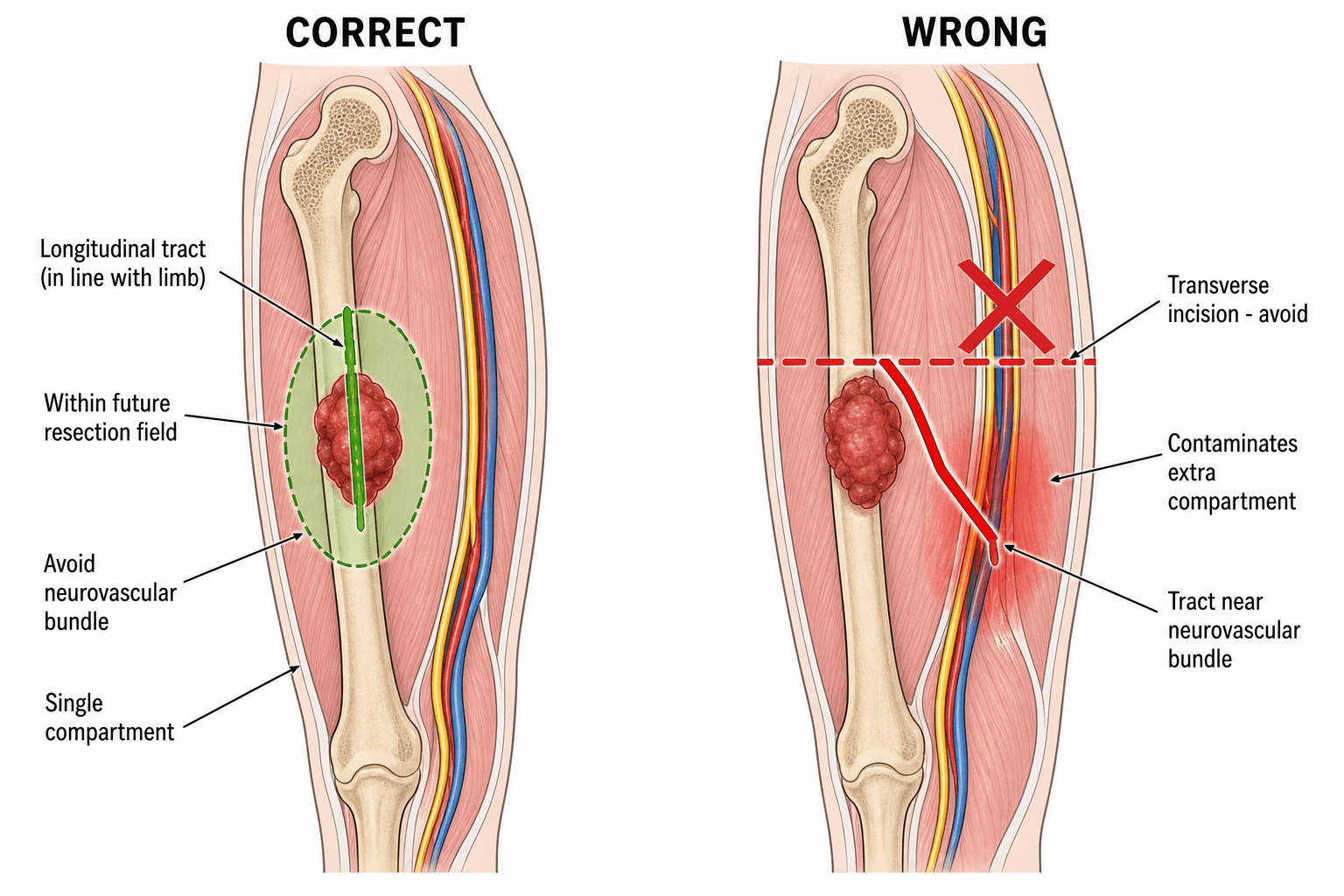
- Longitudinal (Correct)
- Parallel to neurovascular bundle and long axis of limb
- Transverse (WRONG)
- Perpendicular to long axis, crosses compartments
- Longitudinal (Correct)
- Can extend proximally/distally for definitive resection
- Transverse (WRONG)
- Cannot be extended without creating skin flaps
- Longitudinal (Correct)
- Single compartment
- Transverse (WRONG)
- Multiple compartments contaminated
- Longitudinal (Correct)
- Entire tract excised en bloc with tumor
- Transverse (WRONG)
- May necessitate amputation or massive skin grafting
- Longitudinal (Correct)
- Confined to single compartment
- Transverse (WRONG)
- Spreads across multiple compartments
At the definitive resection the entire contaminated area has to come out, which after a transverse incision means every compartment the incision crossed. That may demand sacrifice of critical neurovascular structures, or an amputation. Examiners will fail candidates who suggest a transverse biopsy incision.
Planning the Approach by Site
Extremity biopsy approaches are planned with the definitive resection in mind.
- Shoulder and proximal humerus: deltopectoral for anterior access, direct lateral, or a posterior approach through deltoid for posterior tumours
- Arm and forearm: longitudinal over the tumour, in line with the definitive incision; do not cross the antecubital fossa
- Hand: longitudinal dorsal or volar, midaxial for digital lesions
- Thigh: anterolateral through the vastus lateralis interval, medial directly onto the adductors, or posterior longitudinal through the hamstring interval
- Distal femur: anteromedial longitudinal, through the vastus medialis interval
- Leg: anteromedial, medial to the tibial crest; or posterolateral between the peronei and gastrocnemius
- Proximal tibia: anteromedial, medial to tibialis anterior
- Foot: dorsal longitudinal
- Pelvis: CT-guided in preference to open, given the complex anatomy
- Spine: transpedicular CT-guided, or posterior open
Does the Needle Tract Need to Be Excised?
The principle that the entire biopsy tract is excised en bloc with the tumour was defined for open biopsy. Core needle biopsy, the first-line technique, raises a distinct and examinable nuance, because a percutaneous needle leaves a far smaller tract.
Tract seeding is real but rare. Tumour cells can implant along any biopsy tract, but with modern percutaneous core needle biopsy the seeding rate is very low.
Open and needle tracts are handled differently. The open-biopsy tract is always excised, skin, subcutaneous tissue and deep tract together. For a percutaneous core-needle tract, routine excision is debated: many sarcoma centres do not formally resect every needle tract, particularly for deep lesions where the tract cannot be reliably identified, while others excise it when it is superficial and easily incorporated into the resection.
The practical compromise. Keep the needle tract within the future resection field, use a single coaxial tract with multiple cores through one cannula rather than several separate punctures, and mark or tattoo the skin entry so the resecting surgeon can identify it. That preserves the option to remove the tract without mandating it for every percutaneous biopsy. A carelessly placed needle tract outside the resection field is the same error as a badly placed open-biopsy incision.
Management - Biopsy Technique
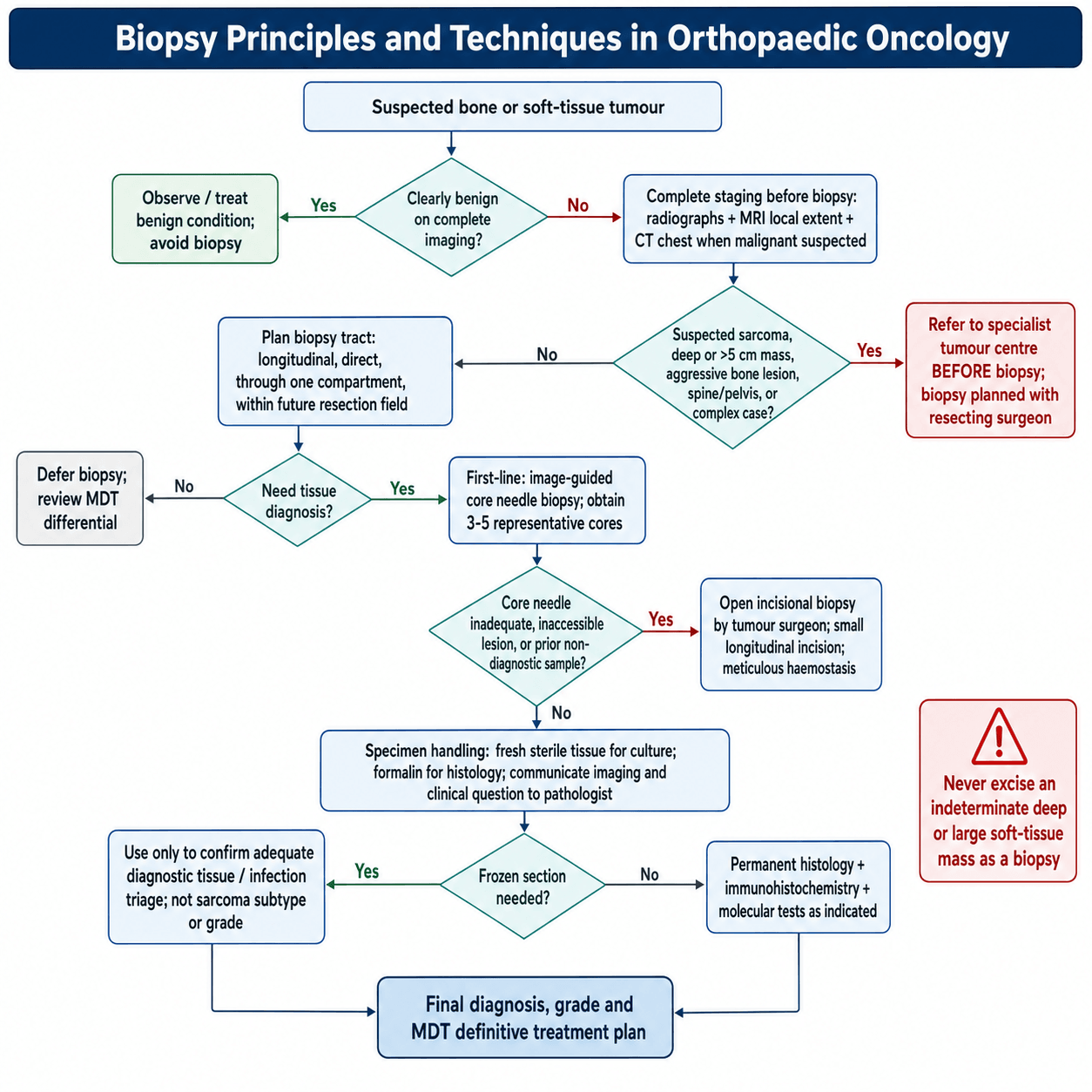
Talking to the Pathologist
Call before the biopsy, not after it. The pathologist needs the patient's age and relevant history, the location and size of the lesion and the anatomic compartment it occupies, the imaging findings and the differential, and the clinical question being asked: primary tumour, metastasis or infection. Say whether fresh tissue is coming separately for culture, and whether a frozen section will be requested.
Why the phone call changes the result. Given the case in advance, the pathologist can prepare the appropriate fixatives and stains, plan ancillary studies such as immunohistochemistry and molecular work, arrange frozen section capability, and optimise specimen handling. Poor communication with pathology is a common cause of a non-diagnostic biopsy.
From Specimen to Diagnosis
From Biopsy to Diagnosis
- Send portion in sterile container (not formalin) for culture
- Touch prep cytology can be done on fresh tissue
- Frozen section if requested (limited role in sarcoma)
- Photograph specimen if desired
- Minimize time to pathology (tissue degradation)
- Majority of tissue in 10% formalin for permanent sections
- Fixation time 24-48 hours before processing
- Decalcification if bone (EDTA preferred over acid)
- Embedding in paraffin blocks
- Sectioning at 4-5 microns thickness
- H&E staining: standard haematoxylin and eosin
- Immunohistochemistry: panel based on the differential
- Special stains: as needed (trichrome, reticulin)
- Molecular studies: FISH, PCR, NGS if indicated
- Expert musculoskeletal pathologist review
- Diagnosis with grading if malignant
- Immunohistochemistry results
- Molecular findings if performed
- Comment on adequacy and differential
- Recommendations for further testing if needed
What Frozen Section Can and Cannot Do
It cannot make the diagnosis. Freezing disrupts the architecture and loses the cellular detail, so a frozen section cannot reliably identify the sarcoma subtype and cannot grade it. It also consumes tissue a small biopsy may not be able to spare, and the answer it gives is preliminary. Permanent sections with immunohistochemistry are what deliver the diagnosis.
What it is genuinely for. Frozen section has four appropriate uses:
- Confirming that diagnostic tissue has been obtained, rather than adipose, muscle or necrosis
- Ruling out infection, with a gram stain on the frozen material
- Confirming diagnostic material in a lesion that is difficult to reach again, such as spine or pelvis
- Triaging tissue for ancillary studies, such as flow cytometry for lymphoma
Ancillary Studies
Modern sarcoma diagnosis often requires studies beyond standard H&E microscopy.
- Indications
- Subtype sarcoma, confirm diagnosis
- Examples
- Desmin (muscle), S100 (nerve), CD34 (vascular), keratin (epithelial)
- Indications
- Diagnostic translocations
- Examples
- EWSR1 (Ewing), SYT-SSX (synovial), MDM2 (liposarcoma)
- Indications
- Lymphoma diagnosis
- Examples
- B-cell vs T-cell markers, clonality assessment
- Indications
- Rule out infection
- Examples
- Bacterial, fungal, mycobacterial cultures from fresh tissue
- Indications
- Poorly differentiated tumors
- Examples
- Rare, for ultrastructural features (seldom needed now)
Surgical Technique
Core Needle Biopsy, Step by Step
Step-by-Step Core Needle Biopsy
- Review all imaging with the radiologist
- Plan the trajectory through the resection field
- Mark the skin entry point
- Confirm pathology availability
- Obtain informed consent
- Position for optimal access (prone, supine or lateral)
- Ensure patient comfort, with sedation if needed
- Sterile prep and drape
- Local anaesthesia to skin and tract
- Small skin nick with a scalpel
- Insert the coaxial guiding cannula
- Advance under image guidance
- Confirm position within the lesion
- Avoid the necrotic centre
- Insert the biopsy needle through the coaxial cannula
- Fire the needle to obtain a core
- Remove and inspect each core
- Repeat to 3-5 cores in soft tissue, 4-6 in bone
- Confirm adequate tissue obtained
- Remove the coaxial cannula
- Apply pressure for haemostasis
- Post-procedure imaging to assess complications
- Compression dressing
- Steri-strips to skin (sutures rarely needed)
Equipment. An 11-16 gauge core needle system with a coaxial guiding cannula, specimen containers for both formalin and fresh sterile tissue, and a CT scanner or ultrasound with sterile probe covers.
Getting a diagnostic core. Target the periphery of the lesion, where the tissue is viable, and avoid the cystic and necrotic areas. Take every core through the one coaxial cannula, rotating the needle between passes. Keep haemostasis meticulous and stay away from the major neurovascular structures.
Complications and Biopsy Errors
The Four Error Categories
Mankin's series sorted biopsy failures into four recurring categories. Each has its own specific prevention.
- Mechanism
- Excisional biopsy of a suspected sarcoma
- Consequence
- Tumour spillage, loss of planes, wider re-excision
- Prevention
- Use core needle or incisional biopsy for suspected sarcoma
- Mechanism
- Transverse incision crossing compartments
- Consequence
- Multi-compartment contamination, salvage compromised
- Prevention
- Longitudinal incision, single compartment, resection field
- Mechanism
- Haematoma seeds tumour cells along tissue planes
- Consequence
- Field contamination beyond the tract
- Prevention
- Meticulous technique, avoid tourniquet release bleed, no drain
- Mechanism
- Insufficient or non-representative sample
- Consequence
- Non-diagnostic specimen, repeat biopsy, delay
- Prevention
- Adequate sample size, avoid necrosis, frozen confirmation
What the errors cost. Beyond the wider resection or the amputation, a biopsy error buys re-operation, skin grafting and flap coverage, definitive treatment waits while the wound heals, and the tumour progresses during the delay. That is the argument for these biopsies being performed at specialised centres, by surgeons with oncological training.
Complications of the Biopsy Itself
Early. Haematoma is the most common, and here it is more than a wound problem: it carries tumour cells out into the surrounding tissue, which is why haemostasis is meticulous and a compression dressing goes on. Infection mimics tumour progression and delays definitive treatment, so sterile technique and prophylactic antibiotics matter. Fracture through a cortical window is prevented by keeping the window small, avoiding stress risers, and considering prophylactic fixation.
Late. Tumour seeding along the tract is why the tract is excised, and seeding into an adjacent compartment may preclude salvage altogether. A non-diagnostic result, from inadequate tissue or sampling error, means a repeat biopsy: image guidance, an adequate sample and a briefed pathologist are what prevent it.
A 25-year-old presents with an 8cm firm thigh mass. A general surgeon performs an excisional biopsy through a transverse incision, thinking it a benign cyst. Pathology returns high-grade undifferentiated pleomorphic sarcoma.
The transverse incision has violated the anterior and posterior compartments. The tumour was shelled out rather than excised with a margin, and the haematoma has tracked into both compartments, so the femoral vessels and the sciatic nerve now sit in a contaminated field. A wide re-excision would require sacrifice of those structures, and the patient is counselled for an above-knee amputation.
What should have happened: pre-operative MRI staging, a core needle or incisional biopsy through a longitudinal incision in the planned resection field, then a wide resection with negative margins and limb salvage.
The Unplanned ("Whoops") Excision
A specific and common referral disaster is the unplanned excision: inadvertent marginal or intralesional removal of an unsuspected sarcoma by a non-specialist who assumed the mass was benign. It is the surgical analogue of the biopsy errors.
Why it matters. The tumour has been shelled out without a margin, the whole surgical bed - including any drain sites and the haematoma - is contaminated, and the tissue planes are destroyed. It is exactly the situation Mankin warned against.
Residual disease is common and unpredictable. After an unplanned excision with apparently negative margins and no gross residual on examination or imaging, planned re-excision still finds residual sarcoma in roughly a third of cases (Noria), and this cannot be predicted by tumour size, grade or the interval since surgery.
Management. Restage with MRI of the operative bed plus a CT chest, discuss at the sarcoma multidisciplinary team meeting, and perform a planned wide re-excision of the entire previous surgical field, taking scar, drain tracts and contaminated tissue en bloc. Adjuvant or neoadjuvant radiotherapy is frequently added given the contaminated field. Re-excision is often still margin-positive, and local recurrence is higher than for tumours resected correctly the first time.
Do NOT simply observe a patient because the post-excision imaging looks clean. Restage, refer to the sarcoma multidisciplinary team, and plan a wide re-excision of the entire previous surgical bed.
Postoperative Care
Post-Biopsy Care Protocol
Post-Biopsy Care Timeline
- Compression dressing maintained
- Monitor for bleeding or haematoma
- Ice for comfort if needed
- Analgesia (simple analgesics usually sufficient)
- Keep the wound clean and dry
- Remove the compression dressing at 48 hours
- Inspect the wound for complications
- Light dressing over the puncture site
- Resume normal activities as tolerated
- No heavy lifting or impact activities
- Review the wound at 7-10 days
- Remove sutures if open biopsy (10-14 days)
- Multidisciplinary team review when results are available
- Plan definitive treatment
What the patient is told. Keep the dressing clean and dry for 48 hours, shower after that and pat dry, and avoid soaking - bath or swimming - for two weeks. Watch for redness, swelling or discharge, and contact the clinic with any concern.
Activity. After a core needle biopsy normal activities resume the next day, with no strenuous exercise for 48-72 hours and no weight-bearing restriction. After an open biopsy, limit activity for a week, consider protected weight-bearing if bone was sampled, and avoid impact activities until the wound has healed.
Outcomes
What the Techniques Deliver
Core needle biopsy. Overall diagnostic accuracy is 85-95% for sarcomas, with sensitivity 89-96%, specificity 97-100% and negative predictive value 85-92%. Complications occur in 3-5%: haematoma in 2-3% and mostly minor, infection in under 1%, major complications in under 0.5%.
Read those accuracy figures carefully, because the studies do not all measure the same thing. About 92% is the benign-versus-malignant call; the exact histological diagnosis is reached in only 71-84% (Hau 71% overall; Skrzynski 84%). A non-diagnostic or equivocal core therefore mandates rebiopsy rather than an assumption.
Open biopsy. The higher tissue yield improves the diagnosis, approaching 100% when adequate tissue is obtained, and open biopsy may be required after a non-diagnostic needle. It costs more in complications: haematoma in 5-10%, wound complications in 2-5%, a higher risk of tumour seeding, and a longer recovery.
Mankin: The Hazards of Biopsy (Landmark Study)
- 329 biopsies of primary bone or soft tissue sarcoma, reviewed at 16 Musculoskeletal Tumor Society centres
- A biopsy-related problem forced a different or more complex operation, or adjunctive treatment, in 18% of patients
- A change in OUTCOME (disability, loss of function, local recurrence or death) attributable to the biopsy occurred in 8.5% - note this is the outcome figure, not the treatment-change figure
- 15 patients underwent an unnecessary amputation because of the biopsy (about 4.5%)
- Errors and complications were clearly more frequent when the biopsy was done at a referring institution than at a treatment centre - the precise '2-12 times greater' figure comes from the 1996 revisited study (below)
- Established the principle that biopsy should be performed by, or in consultation with, the surgeon who will undertake the definitive resection
The Hazards of the Biopsy, Revisited (MSTS)
- Repeat multi-institutional Musculoskeletal Tumor Society study of 597 patients (25 surgeons, 21 institutions)
- Diagnostic error rate for the whole series was 17.8% - essentially unchanged from the 1982 study
- A biopsy-related problem forced a different or more complex operation, or adjuvant radiation/chemotherapy, in 19.3% (versus 18% in 1982)
- A change in outcome (disability, loss of function, local recurrence or death) attributable to the biopsy occurred in 10.1% (versus 8.5% in 1982)
- 18 patients underwent an unnecessary amputation because of the biopsy
- Errors, complications and outcome changes were 2-12 times greater when biopsy was done at a referring institution rather than a treatment centre (p less than 0.001)
CT-Guided Biopsy Accuracy in Musculoskeletal Lesions
- 359 CT-guided biopsies of musculoskeletal lesions analysed against final diagnosis
- Overall diagnostic accuracy was 71% across all techniques and sites
- Core biopsy outperformed fine needle aspiration (74% versus 63%)
- Pelvic lesions had higher accuracy (81%) than non-pelvic sites (68%); spine lesions were lowest (61%)
- Infectious lesions had the lowest yield (50%)
- Concluded CT-guided biopsy remains a safe, logical first diagnostic step despite site-dependent yield
Percutaneous Needle Biopsy is Safe and Recommended
- 185 biopsy procedures on 161 musculoskeletal masses suspected of being sarcoma in 155 patients
- Only 7.4% of masses required open biopsy; a single percutaneous biopsy was adequate in 88.2%
- Complication rate 1.1% and major diagnostic-error rate 1.1%; no unnecessary amputations
- Positive predictive value 100%, sensitivity 81.8%, specificity 100%
- Accuracy for benign versus malignant 92.4%, for exact grade 88.6%, for exact pathology 72.7%
- Open biopsy added little when preceded by an adequate needle biopsy
Core Needle versus Open Biopsy: Accuracy and Cost
- Prospective study of 62 outpatient core needle biopsies for soft tissue mass or bone tumour with soft-tissue extension
- Core needle biopsy diagnostic accuracy was 84% (52/62); all errors involved soft-tissue tumours
- Contemporary open biopsy by the same surgeon achieved 96% accuracy
- Hospital charges were markedly lower for needle biopsy ($1106) than open biopsy ($7234)
- 13% of needle biopsies yielded no neoplastic tissue (non-diagnostic)
- Recommended treating equivocal/non-diagnostic needle results as if no biopsy had been done
Core Needle versus Open Biopsy for Bone and Soft Tissue Sarcoma
- Retrospective comparison of percutaneous core needle versus open biopsy in 77 patients with suspected primary sarcoma
- Overall diagnostic accuracy 92.9% for core needle biopsy versus 98.0% for open biopsy (no significant difference)
- For bone tumours core needle biopsy reached 100% accuracy, comparable to open biopsy
- For soft tissue tumours core needle biopsy was moderately inferior to open biopsy (84.6% versus 100%, not significant)
- A specific diagnosis was obtained in 84.2% (core) versus 93.9% (open)
- Concluded core needle biopsy is safe and cost-effective for bone, but should be selected carefully for soft-tissue masses
Guidelines, Registries & Global Practice
Global Epidemiology and Centralisation
Soft tissue sarcomas account for roughly 1% of adult malignancies and primary bone sarcomas for around 0.2%, with combined incidences in the region of 4-5 and 0.8-1 per 100,000 per year respectively across high-income registries - both are rare cancers for which centralised, multidisciplinary care is the international standard (ESMO-EURACAN-GENTURIS soft tissue/visceral sarcoma and bone sarcoma guidelines, Ann Oncol 2021). Across all major frameworks the consistent message is identical to Mankin's: biopsy should be planned and ideally performed at, or in agreement with, the sarcoma reference centre that will deliver definitive treatment.
Side-by-Side Guideline Positions on Biopsy
- Biopsy recommendation
- Image-guided core needle biopsy is the standard; excisional biopsy of a suspected sarcoma is discouraged
- Referral position
- Diagnosis and biopsy planning at a sarcoma reference centre / network
- Evidence basis
- Expert consensus guideline (Ann Oncol 2021)
- Biopsy recommendation
- Core needle biopsy at the specialist centre after MRI; planned by the surgeon who will resect
- Referral position
- Refer any suspected sarcoma to a diagnostic clinic before biopsy
- Evidence basis
- NICE improving-outcomes guidance + BSG/BOA standards
- Biopsy recommendation
- Core needle (or image-guided) biopsy preferred; incisional if inadequate; avoid excisional for deep/large lesions
- Referral position
- Evaluation/biopsy at a sarcoma centre with experienced MDT
- Evidence basis
- NCCN category 2A consensus guideline
- Biopsy recommendation
- Percutaneous core needle first-line, open biopsy by treating surgeon if needed
- Referral position
- Early referral to a sarcoma service, ideally before biopsy
- Evidence basis
- Optimal care pathway / national consensus
ESMO, NICE/BOA, NCCN and Cancer Australia differ in formatting but agree on the substance: complete cross-sectional imaging first, image-guided core needle biopsy as first-line, no excisional biopsy of a suspected deep/large lesion, and biopsy planned by (or with) the resecting surgeon at a specialist centre. This convergence is itself an examinable point.
Practice Variation and Registries
Real-world practice still diverges from guideline ideals. Population and centre-based series consistently show that a substantial minority of sarcomas are still subjected to an unplanned ("whoops") excision before referral, and that biopsy performed outside a sarcoma centre carries 2-12 times the error/complication rate (Mankin, J Bone Joint Surg Am 1982 and 1996). National sarcoma registries and reference-centre networks (for example UK and European networks, and the Australian sarcoma services) are used to audit unplanned-excision rates, time-to-specialist-review and diagnostic accuracy as quality indicators.
Regional Access Notes
Reference-centre models operate worldwide, each providing multidisciplinary sarcoma clinics, limb-salvage expertise and trial access, with telehealth review for regional and rural patients. Examples include specialist sarcoma units in the UK (BSG/NICE designated centres), EURACAN reference networks in Europe, NCCN-aligned sarcoma centres in North America, and Australian sarcoma services (e.g. Peter MacCallum Cancer Centre, Chris O'Brien Lifehouse, Princess Alexandra Hospital and Royal Adelaide Hospital). Across systems, the rate-limiting step for good outcomes is the same: getting the patient to an expert MDT before the first biopsy.
MCQ Practice Points
Q: What did Mankin's studies show about biopsy errors?
A: Two papers. 1982 (329 biopsies, 16 centres): a biopsy problem forced a different or more complex operation in 18%, changed the outcome (disability, recurrence, death) in 8.5%, and caused 15 unnecessary amputations (~4.5%). 1996 revisited (597 patients, 21 institutions): diagnostic error 17.8%, more complex operation 19.3%, outcome change 10.1%, 18 amputations - essentially unchanged, and errors were 2-12 times more frequent at referring institutions (p less than 0.001). Error categories: wrong biopsy type, wrong approach, poor haemostasis, and inadequate tissue. The conclusion: biopsies should be performed by the definitive surgeon.
Q: What is the diagnostic accuracy of image-guided core needle biopsy for musculoskeletal tumors?
A: 85-95% diagnostic accuracy with under 5% complication rate. This is higher than FNA (60-80%). Requires minimum 3-5 cores. Image guidance (CT or ultrasound) is preferred. It is the first-line technique for most musculoskeletal tumors.
Q: A general surgeon performs a biopsy for a suspected thigh sarcoma. Which represents a major error?
A: A transverse incision (NEVER acceptable). Must use longitudinal incision parallel to neurovascular bundle, in planned resection field, so entire tract can be excised en bloc. Transverse incisions contaminate multiple compartments and may necessitate amputation.
Q: A 60-year-old presents with a 7cm deep soft tissue mass. What is the most appropriate initial biopsy?
A: Core needle biopsy (image-guided). This is first-line for most lesions with 85-95% accuracy. Excisional biopsy would be a major error for a large deep mass (suspected sarcoma). Incisional biopsy is reserved for cases where needle is inadequate.
This section provides exam-focused practice points.
Exam Viva Scenarios
Practise clinical reasoning and management decisions out loud
“What are the indications for open incisional biopsy over core needle biopsy?”
“You are performing an open biopsy of a proximal tibia lesion suspected to be osteosarcoma. Walk me through your surgical approach.”
“What is the reported diagnostic accuracy of core needle biopsy for musculoskeletal tumors, and what factors influence this?”
Mankin's Biopsy Errors (MUST KNOW)
- 1982 (329 biopsies): 18% needed a more complex operation, 8.5% changed outcome, 15 unnecessary amputations (~4.5%)
- 1996 revisited (597 patients): diagnostic error 17.8%, complex operation 19.3%, outcome change 10.1%, 18 amputations
- Errors 2-12 times more frequent at referring institutions (1996, p less than 0.001)
- Error types: wrong biopsy type, wrong approach, poor haemostasis, inadequate tissue
- Conclusion: biopsy should be performed by the definitive surgeon or at a tumour centre
Cardinal Biopsy Principles
- Longitudinal incision ONLY - a transverse incision is never acceptable
- Single-compartment approach - do not violate multiple planes
- Follow the resection-field trajectory - the entire tract is excised en bloc
- Meticulous haemostasis - haematoma spreads tumour cells
- No drains, or bring the drain out through the incision
- Tumour centre consultation before biopsy
Biopsy Type Selection
- Core needle: first-line, 85-95% accuracy, with a minimum of 4-6 cores
- Open incisional: if the needle sample is inadequate, using a longitudinal approach
- Excisional: ONLY for small superficial lesions under 3 cm with low suspicion
- Fine-needle aspiration: a limited, confirmatory role only (60-80% accuracy)
- NEVER excise a suspected sarcoma - this is a major error
Image Guidance
- CT-guided: bone lesions, deep masses, and three-dimensional planning
- Ultrasound-guided: superficial soft tissue, real-time, with Doppler
- Fluoroscopy: a limited role, mainly the transpedicular spinal approach
- Communicate with radiologist about resection field
Specimen Handling
- Fresh tissue in a sterile container for culture, not in formalin
- A minimum of a 1 cm cube, or 3-5 cores, for diagnosis
- Frozen section: confirms adequacy only, and cannot diagnose sarcoma
- Permanent H&E: the standard diagnostic technique
- Immunohistochemistry: to subtype the sarcoma
- Molecular studies: FISH and PCR where indicated
Indications for Biopsy
- Deep soft tissue mass (below fascia)
- Superficial mass over 5cm or growing
- Bone lesion with aggressive features
- Age-inappropriate lesion
- Pathological fracture through lesion
- Atypical imaging not fitting benign diagnosis
Specific Approaches
- Distal femur: anteromedial longitudinal, through vastus medialis
- Posterior thigh: posterior longitudinal, through the hamstring interval
- Proximal tibia: anteromedial, at the pes anserinus
- Pelvis: CT-guided is safer than open, given the complex anatomy
- Spine: transpedicular CT-guided, or posterior open
Common Exam Scenarios
- Referral after an inappropriate biopsy: assess the contamination and plan salvage
- Planning biopsy for a suspected osteosarcoma: stage first, discuss with a tumour centre, use a longitudinal approach
- Deep soft-tissue mass: image-guided core needle is first-line
- Consequence of a transverse incision: multi-compartment contamination and amputation risk
Evidence Base and Literature
CT-Guided Core Biopsy
- Bone visualization: See cortex, plan trajectory
- Avoidance of critical structures: 3D planning
- Confirmation of placement: Real-time imaging
- Deep lesions accessible: Pelvis, spine, retroperitoneum
- Reproducible approach: Coordinates documented
- Patient positioning (prone, supine, lateral based on approach)
- Scout CT to plan trajectory
- Skin prep and local anesthesia
- Small nick incision with scalpel
- Coaxial needle placement under CT guidance
- Confirm position on CT
- Multiple cores through coaxial needle (4-6 cores)
- Post-biopsy CT to assess for complications
- Compression dressing
A coaxial needle system uses an outer guiding cannula through which the biopsy needle passes. This allows multiple cores through a single tract, reducing contamination and improving patient comfort. The guiding cannula is positioned under CT, then multiple cores are obtained without removing the guide. This is the standard technique for percutaneous bone biopsy.
Ultrasound-Guided Core Biopsy
- Real-time visualization: See needle advancing in real-time
- No radiation: Safe for multiple passes
- Vascular avoidance: Doppler identifies vessels
- Soft tissue detail: Excellent for superficial masses
- Portable: Can be done in clinic or OR
- Identify lesion and vasculature on Doppler ultrasound
- Plan trajectory avoiding vessels
- Mark entry site
- Sterile prep and local anesthesia
- Visualize needle entry and advancement in real-time
- Multiple cores (3-5 minimum)
- Confirm hemostasis on ultrasound
- Compression dressing
- Superficial soft tissue masses
- Vascular lesions (can avoid vessels)
- Pediatric patients (no radiation)
- Lesions near neurovascular bundles (real-time avoidance)
Fluoroscopy-Guided Biopsy
Limited role in musculoskeletal oncology:
- Primarily for spine lesions (transpedicular approach)
- Real-time guidance for needle placement
- Lower radiation than CT
- 2D imaging only (less accurate than CT 3D)
Collaboration with Tumor Centers
All suspected sarcomas should be discussed with a tumor center before biopsy. Referral is indicated for suspected bone sarcoma, soft tissue mass greater than 5cm or deep to fascia, imaging features of malignancy, failed primary treatment, complex anatomy (spine, pelvis), and metastatic disease staging.
The optimal referral is BEFORE biopsy. Many tumor centers prefer to perform the biopsy themselves. Referral after an inappropriate biopsy results in delayed treatment, increased morbidity, and potentially worse outcomes.
Tumor centers provide access to multidisciplinary tumor boards including orthopaedic oncologist, musculoskeletal radiologist and pathologist, medical oncologist, radiation oncologist, and plastic surgeon. Benefits include expert consensus, coordinated treatment planning, protocol-based therapy, access to clinical trials, and improved outcomes.
References
-
Mankin HJ, Lange TA, Spanier SS. The hazards of biopsy in patients with malignant primary bone and soft-tissue tumors. J Bone Joint Surg Am. 1982;64(8):1121-1127.
-
Hau A, Kim I, Kattapuram S, et al. Accuracy of CT-guided biopsies in 359 patients with musculoskeletal lesions. Skeletal Radiol. 2002;31(6):349-353.
-
Welker JA, Henshaw RM, Jelinek J, et al. The percutaneous needle biopsy is safe and recommended in the diagnosis of musculoskeletal masses. Cancer. 2000;89(12):2677-2686.
-
Noria S, Davis A, Kandel R, et al. Residual disease following unplanned excision of soft-tissue sarcoma of an extremity. J Bone Joint Surg Am. 1996;78(5):650-655.
-
Skrzynski MC, Biermann JS, Montag A, Simon MA. Diagnostic accuracy and charge-savings of outpatient core needle biopsy compared with open biopsy of musculoskeletal tumors. J Bone Joint Surg Am. 1996;78(5):644-649.
-
Dupuy DE, Rosenberg AE, Punyaratabandhu T, et al. Accuracy of CT-guided needle biopsy of musculoskeletal neoplasms. AJR Am J Roentgenol. 1998;171(3):759-762.
-
Fraser-Hill MA, Renfrew DL, Hilsenrath PE. Percutaneous needle biopsy of musculoskeletal lesions. 2. Cost-effectiveness. AJR Am J Roentgenol. 1992;158(4):813-818.
-
Heslin MJ, Lewis JJ, Woodruff JM, Brennan MF. Core needle biopsy for diagnosis of extremity soft tissue sarcoma. Ann Surg Oncol. 1997;4(5):425-431.
-
Pohlig F, Kirchhoff C, Lenze U, et al. Percutaneous core needle biopsy versus open biopsy in diagnostics of bone and soft tissue sarcoma: a retrospective study. Eur J Med Res. 2012;17:29.
-
Ray-Coquard I, Montesco MC, Coindre JM, et al. Sarcoma: concordance between initial diagnosis and centralized expert review in a population-based study within three European regions. Ann Oncol. 2012;23(9):2442-2449.
-
Mitsuyoshi G, Naito N, Kawai A, et al. Accurate diagnosis of musculoskeletal lesions by core needle biopsy. J Surg Oncol. 2006;94(1):21-27.
-
Strauss DC, Qureshi YA, Hayes AJ, et al. The role of core needle biopsy in the diagnosis of suspected soft tissue tumours. J Surg Oncol. 2010;102(5):523-529.
-
Domanski HA, Akerman M, Carlén B, et al. Core-needle biopsy performed by the cytopathologist: a technique to complement fine-needle aspiration of soft tissue and bone lesions. Cancer. 2005;105(4):229-239.
-
Adams SC, Potter BK, Pitcher DJ, Temple HT. Office-based core needle biopsy of bone and soft tissue malignancies: an accurate alternative to open biopsy with infrequent complications. Clin Orthop Relat Res. 2010;468(10):2774-2780.
-
Åkerman M, Domanski HA. The cytology of soft tissue tumours. Monogr Clin Cytol. 2003;16:1-116.
-
Mankin HJ, Mankin CJ, Simon MA. The hazards of the biopsy, revisited. Members of the Musculoskeletal Tumor Society. J Bone Joint Surg Am. 1996;78(5):656-663. PMID: 8642021.
-
Gronchi A, Miah AB, Dei Tos AP, et al. Soft tissue and visceral sarcomas: ESMO-EURACAN-GENTURIS Clinical Practice Guidelines for diagnosis, treatment and follow-up. Ann Oncol. 2021;32(11):1348-1365. PMID: 34303806.
-
Strauss SJ, Frezza AM, Abecassis N, et al. Bone sarcomas: ESMO-EURACAN-GENTURIS-ERN PaedCan Clinical Practice Guideline for diagnosis, treatment and follow-up. Ann Oncol. 2021;32(12):1520-1536. PMID: 34500044.
Key Regional References
-
Australia and New Zealand Sarcoma Association (ANZSA). Guidelines for the management of soft tissue sarcoma. Available at: www.anzsa.org.au
-
Cancer Australia. Optimal care pathway for people with sarcoma. Canberra: Cancer Australia, 2016.
-
Victorian Comprehensive Cancer Centre. Sarcoma service referral guidelines. Melbourne: Peter MacCallum Cancer Centre, 2020.
Suggested Reading
- Enneking WF. Musculoskeletal Tumor Surgery, Volume 1. Churchill Livingstone; 1983. [Classic text on biopsy principles]
- Simon MA, Springfield D. Surgery for Bone and Soft-Tissue Tumors. Lippincott-Raven; 1998. [Comprehensive operative techniques]
- Grimer RJ, Carter SR, Pynsent PB. The cost-effectiveness of limb salvage for bone tumours. J Bone Joint Surg Br. 1997;79(4):558-561.