Second Most Common Entrapment Neuropathy | Ulnar Nerve | Elbow
- Ulnar Nerve Territory: Small finger and ulnar half of ring finger (palmar and dorsal)
- Froment's Sign: Thumb IP flexion when pinching - indicates adductor pollicis weakness
- Wartenberg's Sign: Small finger abduction at rest - indicates weak 3rd palmar interosseous
- Claw Hand: Ring and small finger hyperextension at MCP with IP flexion (ulnar paradox)
- Surgery Options: In-situ decompression vs anterior transposition - similar outcomes
- “Froment's positive = motor involvement = Grade II+
- “Intrinsic atrophy = urgent surgery, incomplete recovery
- “Elbow flexion test reproduces symptoms
- “Ulnar claw is WORSE with LOW lesion (ulnar paradox)
Overview and Epidemiology
Cubital tunnel syndrome is compression of the ulnar nerve at the elbow, where it passes between the medial epicondyle and the olecranon. It is the second most common peripheral nerve compression, after carpal tunnel syndrome. Paraesthesia in the small and ulnar ring finger comes first; intrinsic weakness follows as it progresses.
Who. Men predominate 2:1, the peak age is 30-50 years and 30% of cases are bilateral. Repetitive elbow flexion and leaning on the elbows are the occupational risks. The largest population study (Osei, US claims data) is more modest, finding incidence only slightly higher in men overall and rising with age in both sexes, so quote the 2:1 ratio and the mid-life peak with that in mind.
Causes. Most cases are idiopathic. Screen every patient for an underlying cause:
- Repetitive flexion, occupational or from sleeping with the elbow bent
- Direct pressure from leaning on the elbows
- Cubitus valgus, producing tardy ulnar palsy after a fracture
- Osteophytes from elbow arthritis
Anatomy and Pathophysiology
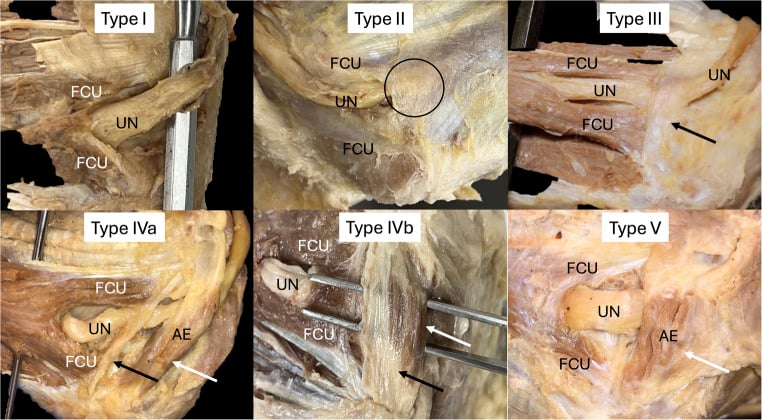
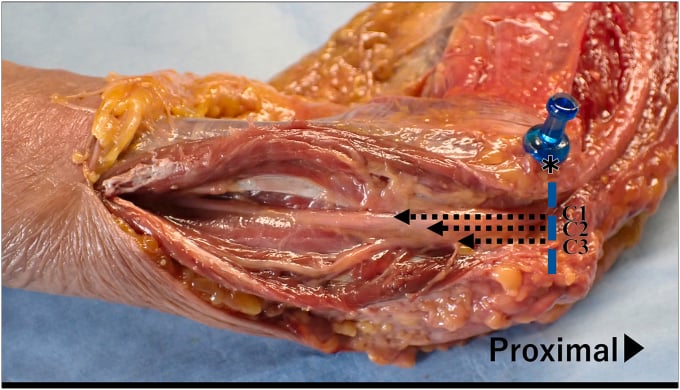
The tunnel. A fibro-osseous tunnel between the medial epicondyle and the olecranon. Its floor is the MCL and elbow capsule; its roof is Osborne's ligament, the arcuate ligament joining the two heads of FCU. Here the ulnar nerve becomes superficial and vulnerable.
The course. Proximally the nerve passes the medial intermuscular septum in the medial arm and the arcade of Struthers, 5-10cm above the epicondyle. It then runs through the retrocondylar groove between the medial epicondyle and olecranon, and leaves between the two heads of FCU under Osborne's ligament. Each of these is a potential compression site.
FOAMCubital Tunnel Compression Sites
Hook:FOAM - Four sites of potential compression from distal to proximal!
The roof varies. It ranges from absent or thin fascial bands to thick tendinous or muscular structures. The variation changes flexion-related compression and explains why operative findings do not always match a single textbook form.
Flexion narrows the tunnel. Elbow flexion stretches the nerve 4-8mm and narrows the tunnel by 55%, and the pressure within it increases sixfold from extension to flexion. The nerve's excursion with full flexion is 10mm.
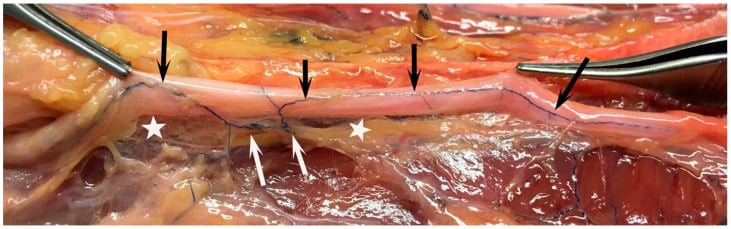
Blood supply. Multiple coiled vessels enter the nerve segmentally along its length. Excessive circumferential dissection during transposition can devascularise it, so preserve the feeding vessels and a vascularised tissue bed whenever possible.
What the nerve supplies in the hand. Sensation to the small finger and the ulnar half of the ring finger, palmar and dorsal. The motor supply:
- Hypothenar muscles: ADM, ODM and FDM
- Adductor pollicis, thumb adduction
- Third and fourth lumbricals
- Palmar interossei, finger adduction
- All the dorsal interossei, finger abduction, including the first dorsal interosseous, which abducts the index
- The deep head of FPB
Tardy Ulnar Nerve Palsy (Cubitus Valgus)
This is the one cubital tunnel presentation in which simple in-situ decompression is not the default answer, and the classic exception to decompression first.
What "tardy" means. A delayed ulnar neuropathy that appears months, years or even decades after an elbow injury in childhood. The classic cause, and the commonest, is a lateral condyle fracture nonunion or malunion, or else a physeal injury. Both arrest lateral-column growth and produce a progressive cubitus valgus.
How the nerve fails. As the carrying angle increases, the nerve is chronically stretched and angulated as it courses behind the medial epicondyle. Repeated traction over years, often compounded by friction and subluxation, eventually produces the neuropathy long after the original fracture has been forgotten.
- Idiopathic cubital tunnel
- Compression in the retrocondylar groove / under Osborne's
- Tardy ulnar palsy
- Chronic traction over a valgus elbow
- Idiopathic cubital tunnel
- Often occupational, leaning, repetitive flexion
- Tardy ulnar palsy
- Childhood elbow fracture (lateral condyle), often remote
- Idiopathic cubital tunnel
- Tinel's/flexion test positive, normal carrying angle
- Tardy ulnar palsy
- Increased carrying angle (cubitus valgus), often visible deformity
- Idiopathic cubital tunnel
- Often normal radiographs
- Tardy ulnar palsy
- Lateral condyle nonunion, valgus deformity, sometimes osteophytes
- Idiopathic cubital tunnel
- In-situ decompression first-line
- Tardy ulnar palsy
- Anterior transposition to de-tension the stretched nerve; correct deformity if appropriate
Why transposition, not in-situ release. The problem is length and tension, not just a tight roof. In-situ decompression leaves the nerve on the stretch behind a valgus elbow. Anterior transposition moves it in front of the axis of elbow flexion, which shortens its path and relieves the traction.
The deformity. Correcting a correctable bony deformity (e.g. a supracondylar/varus-producing osteotomy for the valgus, or addressing a lateral condyle nonunion) is considered alongside the nerve procedure, particularly in younger patients. Deformity correction alone does not reliably reverse an established neuropathy.
If a viva stem gives an ulnar neuropathy with an increased carrying angle or a childhood lateral condyle fracture, name tardy ulnar nerve palsy explicitly and say you would favour anterior transposition over in-situ decompression.
Classification Systems
McGowan Classification (Modified)
- Symptoms
- Intermittent paraesthesias
- Examination
- Normal strength and sensation
- Treatment
- Conservative
- Symptoms
- Intermittent paraesthesias
- Examination
- Weakness without atrophy
- Treatment
- Surgery if fails conservative
- Symptoms
- Persistent paraesthesias
- Examination
- Weakness without atrophy
- Treatment
- Surgery recommended
- Symptoms
- Persistent symptoms
- Examination
- Intrinsic atrophy
- Treatment
- Urgent surgery
Reading the McGowan grade. The grade guides treatment. Grade I is intermittent numbness with a normal examination, and gets a conservative trial of 3 months before surgery. Weakness on examination or a positive Froment's sign is Grade II: motor involvement is a surgical indication. Intrinsic atrophy and a claw hand are Grade III, which calls for urgent decompression and a warning that motor recovery may be incomplete.
Clinical Assessment
History. Numbness in the small and ulnar ring finger, worse at night and with elbow flexion. Weak grip shows as dropping objects, and numbness while holding a phone to the ear is the phone sign. Ask about occupation and sleeping position; rapid progression and severe weakness are red flags.
Examination. Always compare with the other side. Tinel's sign over the cubital tunnel and two-point discrimination, abnormal at over 6mm, sit alongside the provocative and motor signs below.
- Technique
- Pinch paper between thumb and index
- Positive Finding
- IP flexion of thumb
- Indicates
- Adductor pollicis weakness
- Technique
- Observe hand at rest
- Positive Finding
- Small finger abducted
- Indicates
- 3rd palmar interosseous weakness
- Technique
- Sustained elbow flexion 60 seconds
- Positive Finding
- Paraesthesias reproduced
- Indicates
- Ulnar nerve compression
- Technique
- Resist shoulder external rotation while scratching nerve
- Positive Finding
- Momentary weakness
- Indicates
- Nerve irritability
The motor signs. Froment's sign, Wartenberg's sign and clawing are the three motor signs of ulnar palsy, in order of severity. In Froment's sign the weak adductor pollicis is replaced by FPL, supplied by the median nerve, so the thumb IP joint flexes as the patient pinches. In Wartenberg's sign a weak third palmar interosseous cannot adduct the small finger, which rests abducted and catches on the pocket.
Clawing and the ulnar paradox. The ring and small fingers hyperextend at the MCP joints and flex at the IP joints. The claw is worse with a low lesion. In a high lesion FDP is paralysed as well, so there is less IP flexion; in a low lesion FDP works and the clawing is more marked.
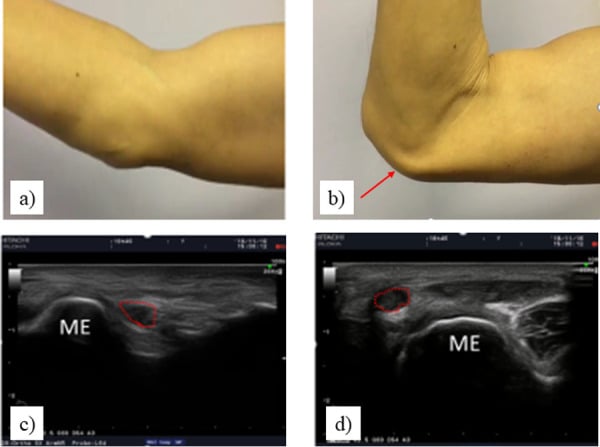
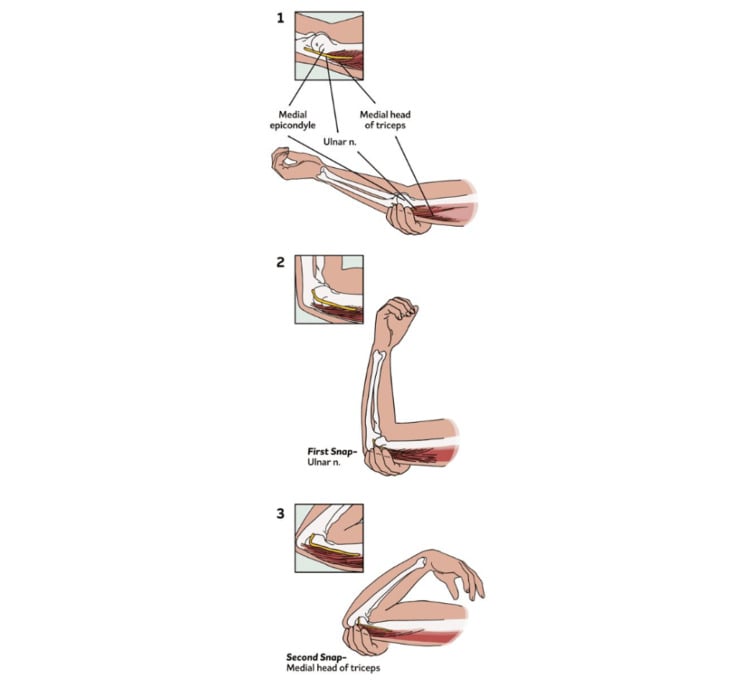
The unstable nerve. With elbow flexion the nerve can move from the retrocondylar groove to the front of the epicondyle. Dynamic palpation and ultrasound distinguish symptomatic instability from a static enlarged nerve.
A second snap may follow the first. The first is the ulnar nerve crossing the epicondyle; deeper flexion brings the medial head of triceps over it as well, and missing the triceps component can leave persistent snapping after an isolated nerve transposition.
Consider C8/T1 radiculopathy, thoracic outlet syndrome, Guyon's canal (ulnar tunnel) compression and Pancoast tumour, and check for double crush syndrome.
Investigations
A clinical diagnosis. A typical presentation with a positive Tinel's sign, elbow flexion test and motor signs is diagnosed clinically.
Nerve conduction studies are the gold standard. They show slowing of motor conduction velocity across the elbow, under 50 m/s, compared with the segments above and below.
EMG grades severity. It shows denervation potentials in the intrinsics (FDI, ADM), and fibrillations indicate axonal loss.
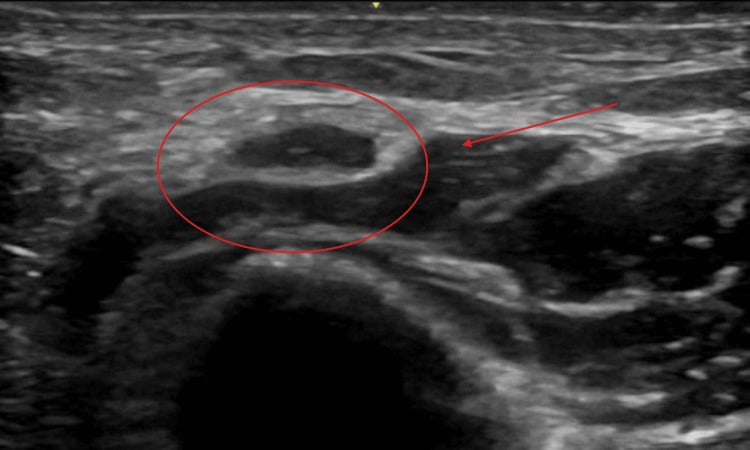
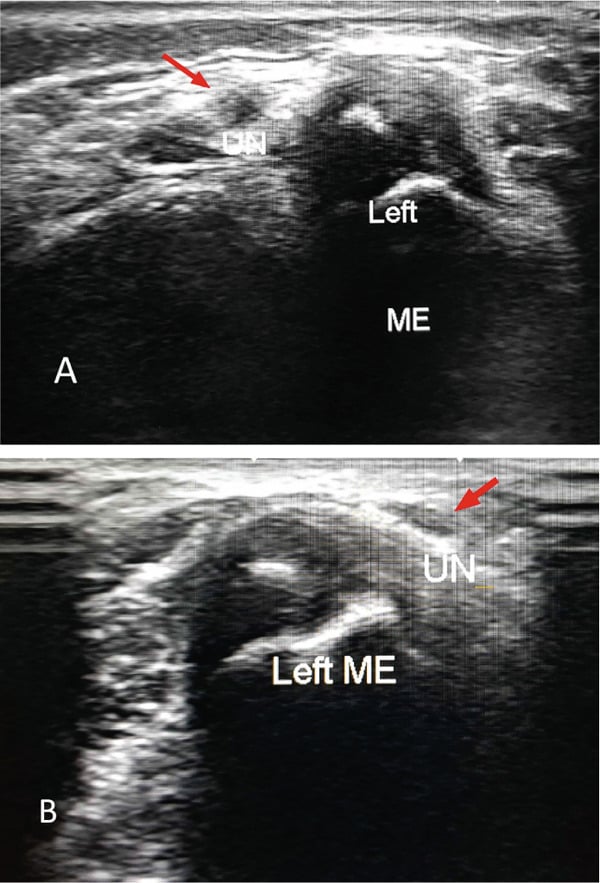
Imaging. Radiographs show cubitus valgus, osteophytes or a prior fracture; MRI shows subluxation, a mass lesion or nerve changes. On short-axis ultrasound the compressed nerve is enlarged and hypoechoic, with an increased cross-sectional area and loss of its normal fascicular pattern at the compression site. Compare the proximal and distal segments and interpret the scan alongside the examination and electrodiagnostic findings.
Management Algorithm
Conservative treatment is appropriate for McGowan Grade I with intermittent symptoms only.
- Activity modification: avoid prolonged elbow flexion and leaning on the elbows, with an ergonomic workplace assessment
- A night extension splint, towel wrap or commercial, to keep the elbow extended and prevent nocturnal flexion
- An elbow pad to protect the nerve from direct pressure, worn during the day if there is occupational exposure
When to operate. The absolute indications are intrinsic muscle atrophy (McGowan III), failure of an adequate conservative trial of 3 months, and progressive weakness. McGowan Grade II with motor involvement, recurrent subluxation of the nerve and occupational requirements are relative indications. Do not delay surgery if motor involvement is present.
Surgical Technique
In-situ decompression is technically simpler, with a lower complication rate.
- Position supine with the arm on a table, the elbow flexed 20-30 degrees; a tourniquet is optional.
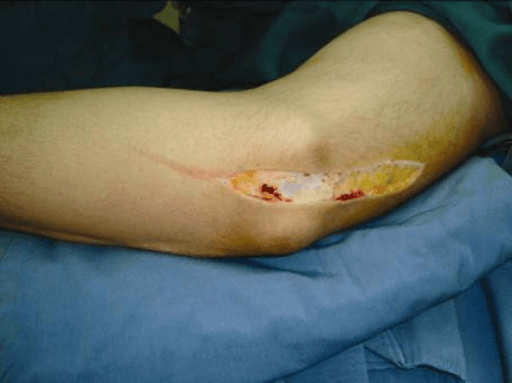
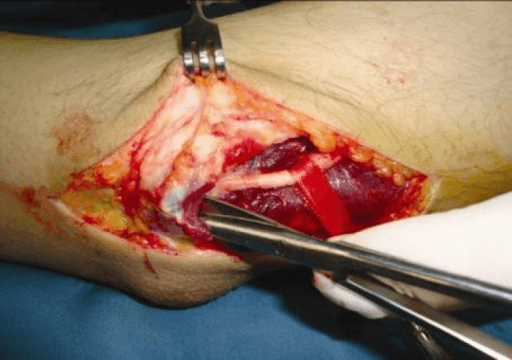
- Make a curved 6-8cm incision between the medial epicondyle and olecranon, over the retrocondylar groove, protecting the medial antebrachial cutaneous nerve.
- Identify and protect the ulnar nerve. Release Osborne's ligament (the FCU aponeurosis) and continue distally between the FCU heads, leaving no distal fascial edge to kink the nerve.
- Release the arcade of Struthers if tight, and the medial intermuscular septum.
- Check nerve excursion and stability through flexion, then close in layers; no drain is required.
Preserve the epineurium and the vascular supply throughout.
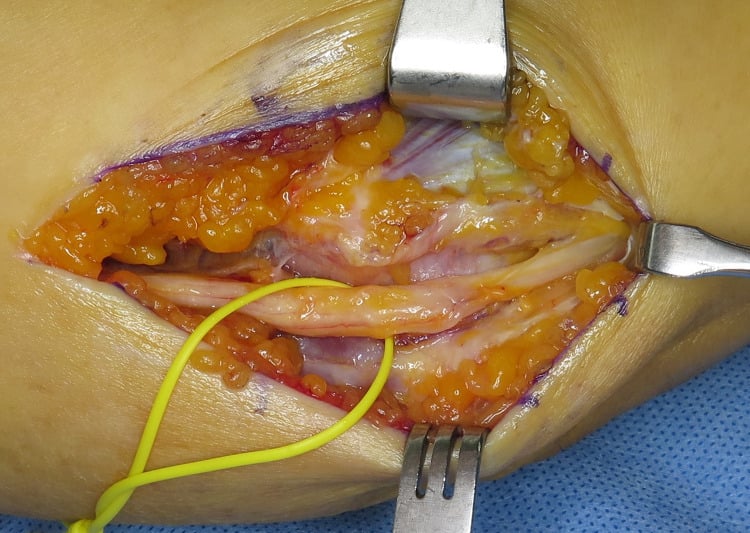
Anterior transposition adds complexity but addresses subluxation. The nerve can be placed in one of three beds:
- Subcutaneous, superficial to the flexor-pronator mass
- Intramuscular, within the flexor-pronator mass
- Submuscular, deep to the elevated flexor-pronator origin
It is selected for instability, deformity, a scarred tunnel or revision rather than used routinely in every case:
- A subluxating nerve
- Failed in-situ decompression
- Cubitus valgus (tardy ulnar palsy)
- A scarred tunnel
- Revision surgery
Subluxation as an indication is contested by the trial evidence; see Controversies.
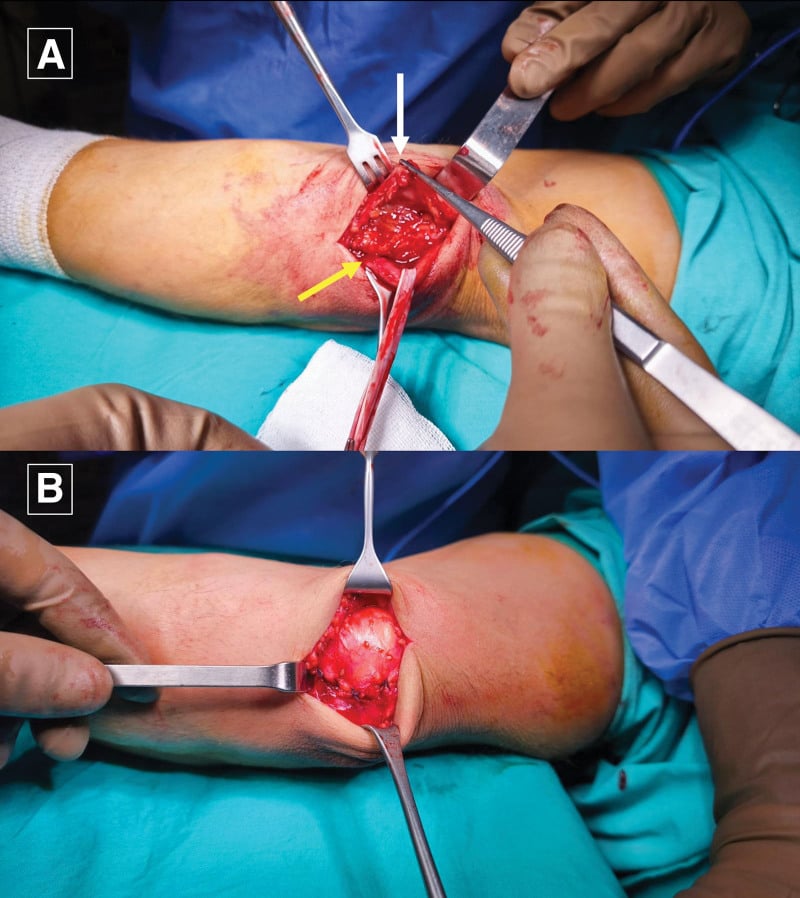
Pivot points. The nerve is mobilised from the retrocondylar groove while the branch points and the median nerve are identified. Moving it anteriorly creates new bends at the limits of release. Sufficient proximal and distal neurolysis is required to prevent traction and compression at these pivot points.
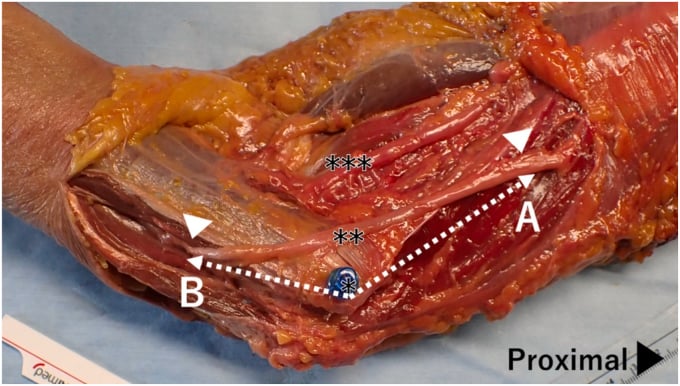
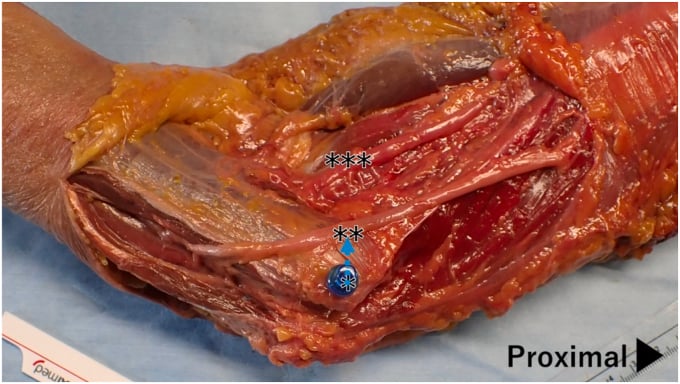
Submuscular transposition with Z-lengthening. Planned Z flaps lengthen the flexor-pronator fascia rather than closing it tightly over the transposed nerve, which creates a broad, nonconstricting muscular bed. A proximal fascial flap and a distal FCU musculofascial flap are mobilised while the nerve is protected, then reapproximated without tension over the anterior nerve bed. Flex and extend the elbow before closure to exclude kinking, tethering or excessive fascial pressure.
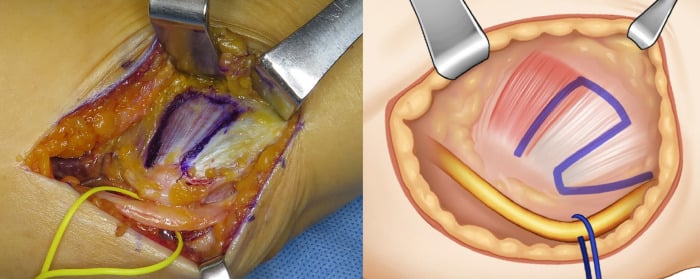
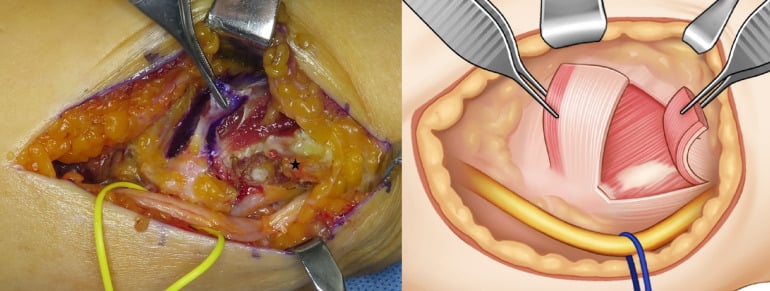
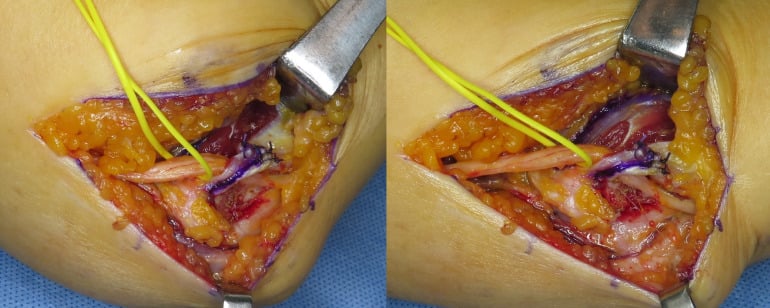
Structures at risk. The anterior and posterior branches of the medial antebrachial cutaneous (MABC) nerve cross near the operative field beside the ulnar nerve, and identifying their course reduces painful neuroma and persistent medial-elbow dysaesthesia after decompression.
- Location
- Crosses field superficially
- Consequence if Injured
- Painful neuroma, numbness forearm
- Location
- Motor to FCU at/below tunnel
- Consequence if Injured
- Weakness of wrist flexion
- Location
- Deep to nerve
- Consequence if Injured
- Elbow instability if damaged
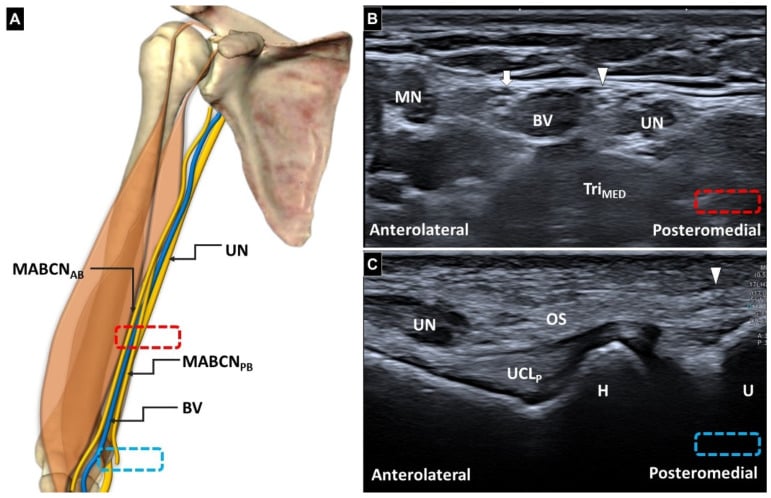
Motor branches. Sequential branches leave the nerve soon distal to the epicondyle. Over-long release, aggressive traction or deep dissection risks denervating FCU and intrinsic pathways during transposition or epicondylectomy.
Medial Epicondylectomy: The Third Operation
Medial epicondylectomy occupies the middle ground between in-situ decompression and transposition, and it is a recurring viva option.
The principle. Rather than moving the nerve, remove the bony prominence it is tethered against. After the tunnel is decompressed, the medial epicondyle is osteotomised, partially or completely, so the nerve can glide anteriorly on its own during flexion without the formal mobilisation, dissection and potential devascularisation of a transposition. It preserves the nerve's intrinsic blood supply better than transposition while still removing the retrocondylar tether. It avoids a new anterior bed, but shares the same need to preserve the branches and the blood supply.
- Detail
- Resect the epicondyle so the nerve self-translates anteriorly; no formal transposition
- Detail
- Less nerve mobilisation/devascularisation than transposition; addresses subluxation by removing the point it catches on
- Detail
- Medial elbow pain/tenderness over the resection, and VALGUS INSTABILITY if the MCL origin (inferior epicondyle) is over-resected
- Detail
- Flexor-pronator origin disruption/weakness, heterotopic bone, persistent symptoms
What the evidence shows. Outcomes are broadly equivalent to the other operations but stage-dependent. A randomised trial within the Cochrane review found no difference between medial epicondylectomy and anterior transposition in clinical or neurophysiological outcome (Cochrane, PMID 27845501). The staged meta-analysis (Mowlavi, PMID 10946931) found that in minimal or mild disease total symptom relief was achieved most often after medial epicondylectomy, but in severe disease it produced the poorest operative result. Those rankings compare separate case series rather than randomised arms, so hold them loosely.
The practical message. Epicondylectomy is a reasonable alternative in milder disease and for the subluxating nerve. It is not a rescue for the atrophic hand, and the MCL must be respected to avoid trading neuropathy for instability.
The anterior bundle of the medial collateral (ulnar collateral) ligament, the primary restraint to valgus, originates from the inferior aspect of the medial epicondyle. A complete epicondylectomy risks detaching it and producing valgus instability, so a partial (minimal) epicondylectomy is the modern preference: enough bone to let the nerve translate, not so much that you destabilise the elbow.
Complications
- Incidence
- 5-10%
- Management
- Careful dissection, neurolysis if symptomatic
- Incidence
- 5-15%
- Management
- Revision with transposition
- Incidence
- Rare
- Management
- Avoid MCL injury, repair if damaged
- Incidence
- 2-5%
- Management
- Standard wound care
- Incidence
- 10-20%
- Management
- Counsel pre-operatively especially if atrophy
MABC nerve injury causing a painful neuroma is the most common complication, and careful handling and protection during dissection are essential.
Postoperative Care
Postoperative Protocol
Soft dressing, sling optional. Elevate the arm and start finger movement immediately; wound check at 1 week.
Remove sutures and begin gentle elbow movement, avoiding resisted flexion.
Progressive strengthening, with full range of motion by 4 weeks and grip strengthening from week 6.
Assess nerve recovery. Sensation improves first; motor recovery may take 6-12 months.
Return to work. Desk work at 1-2 weeks and manual work at 6-8 weeks.
Outcomes and Prognosis
Success rates. In-situ decompression and anterior transposition both give 80-90% good or excellent results, with no significant difference between them.
Prognosis. Motor recovery is often incomplete if intrinsic atrophy is present pre-operatively. Intrinsic recovery depends on the duration of symptoms, and sensation recovers better than motor function.
- Better Outcome
- I-II
- Worse Outcome
- III with atrophy
- Better Outcome
- Short (under 6 months)
- Worse Outcome
- Long (over 1 year)
- Better Outcome
- Younger
- Worse Outcome
- Elderly
- Better Outcome
- Absent
- Worse Outcome
- Present
Guidelines, Registries & Global Practice
Global Epidemiology
- Second most common upper-limb entrapment neuropathy after carpal tunnel syndrome (Cochrane, PMID 27845501).
- Population incidence approximately 30 per 100,000 person-years (US claims database, PMID 28362959); rises with age, slightly higher in men.
- Around 40% of diagnosed patients eventually undergo surgery; surgical conversion increases with age.
Side-by-Side Guidance
- Diagnosis
- Clinical plus NCS/EMG to grade severity; ultrasound increasingly used
- First-line
- Activity modification, night extension splinting
- Surgical default
- In-situ decompression; transposition for subluxation/revision
- Diagnosis
- Clinical diagnosis; NCS to confirm and grade
- First-line
- Conservative 3-6 months for mild disease
- Surgical default
- Simple decompression first-line (NICE-aligned)
- Diagnosis
- NCS plus high-resolution ultrasound (nerve CSA)
- First-line
- Conservative for McGowan I
- Surgical default
- Decompression; submuscular transposition in selected severe/revision cases
- Diagnosis
- Address structural causes (osteophytes, cubitus valgus)
- First-line
- Treat underlying deformity
- Surgical default
- Decompression plus deformity correction where relevant
Across societies the convergent position—supported by Level I trials (PMID 15730578) and meta-analyses (PMID 18056489, 27845501)—is that simple in-situ decompression is the default operation, with transposition reserved for documented subluxation, revision, or specific deformity (e.g. cubitus valgus tardy ulnar palsy).
Registry & Outcome Notes
- No dedicated international cubital tunnel registry exists; evidence rests on RCTs and administrative databases (e.g. PMID 28362959).
- Reported good/excellent outcomes are 80-90% across techniques, with revision rates of roughly 4-5% (PMID 29481399).
High- vs Limited-Resource Practice
- High-resource: routine NCS/EMG, ultrasound nerve cross-sectional area, day-case surgery, endoscopic options.
- Limited-resource: clinical diagnosis and the elbow flexion/Tinel tests guide management; open in-situ decompression under local or regional anaesthesia is effective, low-cost, and avoids the need for advanced neurophysiology.
Documentation & Consent (universal)
- Record motor examination (Froment's, Wartenberg's) and any intrinsic wasting at each visit.
- Consent must include risk of incomplete motor recovery when atrophy is present, MABC nerve injury, wound complications, and recurrence.
- Capture occupational exposure where work-related causation is plausible.
Controversies and Areas of Uncertainty
Decompression or transposition in severe disease. Older dogma reserved transposition for severe (McGowan III) cases. Gervasio's RCT (PMID 15617592) found equivalence even in Dellon Grade 3 disease and the Cochrane review (PMID 27845501) reaches the same conclusion, but the two are not independent, because Gervasio is one of the trials Cochrane pools. The severe-disease evidence is therefore 35 patients per arm, which excludes only a large difference, and the optimal operation for the atrophic hand remains genuinely debated.
The subluxating nerve. Subluxation is the classic indication for transposition, yet Bartels Part 1 (PMID 15730578) found outcomes unaffected by subluxation after simple decompression. Whether subluxation alone justifies transposition is unsettled.
Endoscopic or open release. Endoscopic in-situ release gives equivalent clinical outcomes (Buchanan, PMID 29481399) with less scar pain but more haematoma. Cost, the learning curve and limited long-term data keep its role contested.
Ultrasound and nerve CSA. High-resolution ultrasound, measuring an enlarged nerve cross-sectional area, is increasingly used, but diagnostic thresholds are not standardised and NCS/EMG remains the reference standard. The place of imaging in equivocal cases is evolving.
Other open questions. When, if ever, to operate in purely sensory McGowan I disease that fails conservative care. The value of supplementary nerve-gliding exercises, which added no benefit over advice in the one RCT analysed by Cochrane. And the lack of a unified outcome metric across trials, which complicates pooling.
MCQ Practice Points
Q: Which fingers are affected in ulnar nerve compression? A: Small finger and ulnar half of ring finger - both palmar AND dorsal surfaces (unlike CTS which is palmar only).
Q: Which muscle is tested by Froment's sign? A: Adductor pollicis - the only muscle that adducts the thumb (except for first interosseous to lesser extent). Innervated by ulnar nerve.
Q: Why is clawing worse in a LOW ulnar nerve lesion? A: FDP function preserved. In high lesion, FDP to ring/small is paralyzed so IP flexion is weak. In low lesion, FDP works normally, causing pronounced IP flexion with MCP hyperextension.
Q: What does the evidence show regarding in-situ decompression vs anterior transposition? A: Similar outcomes. Cochrane review (Caliandro 2016) shows no significant difference. Simple decompression has lower complication rate. Reserve transposition for subluxation or revision.
Q: What is the Arcade of Struthers and why is it important? A: Musculofascial band 5-10cm proximal to medial epicondyle. Potential compression site that must be released during decompression to prevent recurrence.
Q: What is Osborne's ligament? A: The arcuate ligament connecting the two heads of FCU. Forms the roof of the cubital tunnel. Release is essential during decompression.
Exam Viva Scenarios
Practise clinical reasoning and management decisions out loud
“A 35-year-old office worker presents with 6 months of numbness in the small finger. He leans on his elbows at his desk. Tinel's is positive over the elbow. Froment's is negative.”
“A 45-year-old man has 12 months of small finger numbness and now notices weakness holding a key. On examination, Froment's sign is positive and there is early wasting of the first dorsal interosseous.”
“A patient returns 6 months after in-situ decompression with persistent symptoms and now has subluxation of the ulnar nerve with elbow flexion. What is your approach?”
Key Anatomy
- Ulnar nerve between medial epicondyle and olecranon
- Osborne's ligament = FCU aponeurosis (roof)
- Arcade of Struthers 5-10cm proximal
- MABC nerve at risk superficially
Clinical Signs
- Froment's = thumb IP flexion when pinching
- Wartenberg's = small finger abducted
- Claw hand = MCP hyperextension + IP flexion
- Ulnar paradox = worse claw in LOW lesion
Classification
- McGowan I = sensory only = conservative
- McGowan II = weakness = consider surgery
- McGowan III = atrophy = urgent surgery
- Modified IIA/IIB distinguishes intermittent vs persistent
Surgery Options
- In-situ decompression = first line
- Anterior transposition = subluxation/revision
- Submuscular = high demand/revision
- All have 80-90% success
Complications
- MABC neuroma = most common
- Recurrence 5-15%
- Incomplete motor recovery if atrophy
- Elbow instability if MCL injured
Evidence Base
Count the evidence, not the citations. The first four cards below look like four demonstrations that simple decompression equals transposition. They are one. Both meta-analyses pool the same three randomised trials and the same 261 participants for the clinical comparison, differing only in whether they report a risk ratio or a standardised mean difference - and Bartels and Gervasio, shown separately for their detail, are two of the trials being pooled. The randomised evidence that the operations are equivalent is roughly 261 patients, which is a real answer to a narrow question and a much smaller body of work than four Level I citations imply.
And the question it does not answer is the one asked in clinic. The Cochrane authors' own conclusion is that "we do not know when to treat a person with this condition conservatively or surgically" - only two of the nine trials used conservative treatment as a comparator at all. Everything below compares operations with each other. The threshold for offering any operation, and the point at which delay costs recovery, rests on the natural-history and staging literature rather than on trials.
Caliandro et al (Cochrane)
- 9 RCTs, 587 participants; UNE is 2nd commonest entrapment neuropathy
- Simple decompression vs transposition: no difference in clinical improvement (RR 0.93, 95% CI 0.80-1.08, moderate-quality evidence)
- Transposition associated with more wound infections (RR 0.32, 95% CI 0.12-0.85)
- Equally effective even when nerve impairment is severe
Zlowodzki et al
- 4 RCTs pooled (2 submuscular, 2 subcutaneous transposition)
- No difference in clinical scores (3 trials, 261 patients; SMD -0.04, 95% CI -0.36 to 0.28)
- No difference in postoperative motor conduction velocity (2 trials, 100 patients)
- Narrow confidence intervals exclude clinically meaningful difference
Bartels et al (Part 1)
- 152 patients randomized: 75 simple decompression vs 77 anterior subcutaneous transposition
- Good/excellent: 49/75 (decompression) vs 54/77 (transposition) — not significant
- Complication rate lower with decompression (9.6% vs 31.1%; RR 0.32, 95% CI 0.14-0.69)
- Outcome unaffected by nerve subluxation or symptom severity
Gervasio et al
- 70 patients with SEVERE (Dellon grade 3) cubital tunnel syndrome
- Simple decompression vs deep submuscular transposition with flexor-pronator Z-lengthening
- Good/excellent: 80% (decompression) vs 82.9% (transposition) — no significant difference
- No severe complications or recurrences in either group
Buchanan et al
- 5 studies, 655 patients (226 endoscopic, 429 open in-situ release)
- Equivalent good/excellent Bishop scores (OR 1.27, 95% CI 0.59-2.75) and VAS reduction
- Endoscopic: less scar tenderness/elbow pain (OR 0.19) but more haematoma (OR 5.70)
- Reoperation rates similar (4.9% endoscopic vs 4.1% open)
Mowlavi et al
- Meta-analysis of 30 studies with staged pre- and post-operative outcomes
- Mild disease: all modalities similar; nonoperative care had highest recurrence
- Moderate disease: submuscular transposition most efficacious
- Severe disease: no modality consistently effective; medial epicondylectomy poorest
Osei et al
- Largest population study: US claims database, 53,401 new cases (2006-2012)
- Adjusted incidence 30.0 per 100,000 person-years
- 41.3% of diagnosed patients underwent surgery; rate rises with age
- Slightly higher incidence in men overall; incidence increases with age in both sexes