Hook Test | Supination Loss | Radial Tuberosity | Acute vs Chronic
- Hook test (O'Driscoll): Flex elbow 90°, supinate - hook finger from lateral under biceps tendon. No cord = rupture (100% sensitivity)
- Supination is the primary deficit (40% loss) - more than flexion (30%) because brachialis compensates for flexion
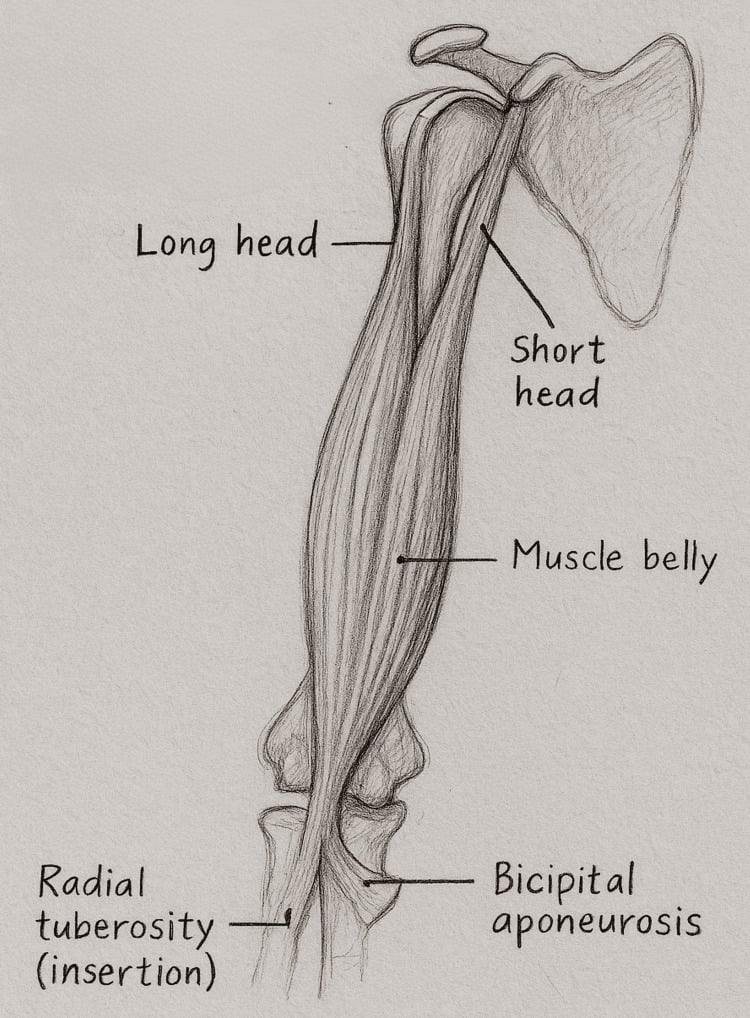
- Tendon inserts on posterior aspect of radial tuberosity - this posterior footprint provides cam effect for supination
- Lacertus fibrosus if intact can mask Popeye sign but hook test still positive
- Chronic (beyond about 4 weeks) is harder, but 'chronic therefore graft' is too strong - a systematic review of 124 chronic tears repaired DIRECTLY at a mean of 122 days reported good satisfaction and function without any graft. What decides is tendon excursion and quality at operation, not the date on the referral; reserve reconstruction for a tendon that will not reach
- “Timing matters but is not the whole answer: acute repair is easier, and in a chronic tear the intraoperative finding - can the tendon be brought to the tuberosity without undue tension - decides between direct repair and graft
- “LABCN (lateral antebrachial cutaneous nerve) is most commonly injured nerve (5-30%), usually transient
- “Single-incision vs two-incision (Boyd-Anderson): Two-incision has synostosis risk but better anatomic placement
- “Cortical button is the strongest single device; adding an interference screw is optional, a biomechanical preference rather than a clinical requirement
Distal Biceps Rupture
Anatomy & Pathophysiology
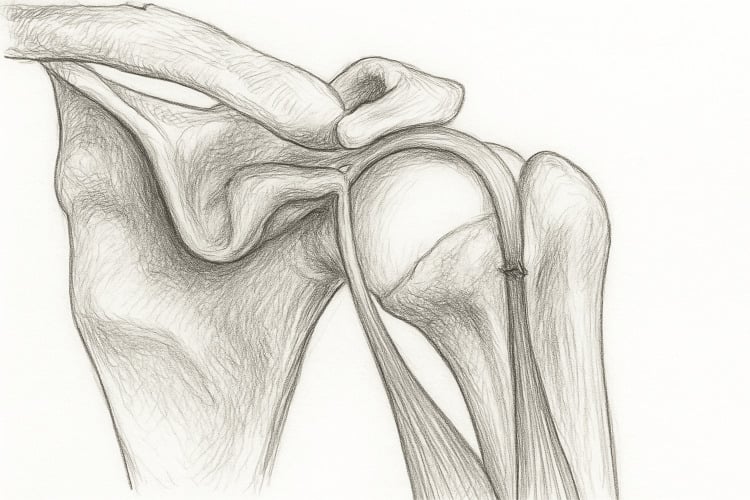
The tendon and its footprint. The two muscle heads coalesce into a single distal tendon, which often rotates 90° before inserting on the posterior aspect of the radial (bicipital) tuberosity. That footprint sits furthest from the forearm's rotational axis, giving the biceps its cam effect, its supination moment arm, and it is the anatomical reason supination is the dominant deficit. A repair must restore the tendon to the posterior footprint; an anterior or non-anatomic re-attachment loses supination torque.
The lacertus fibrosus. The bicipital aponeurosis is a fascial expansion from the tendon to the flexor-pronator fascia. If it is intact it tethers the muscle belly and can mask the Popeye deformity, but it never masks the hook test.
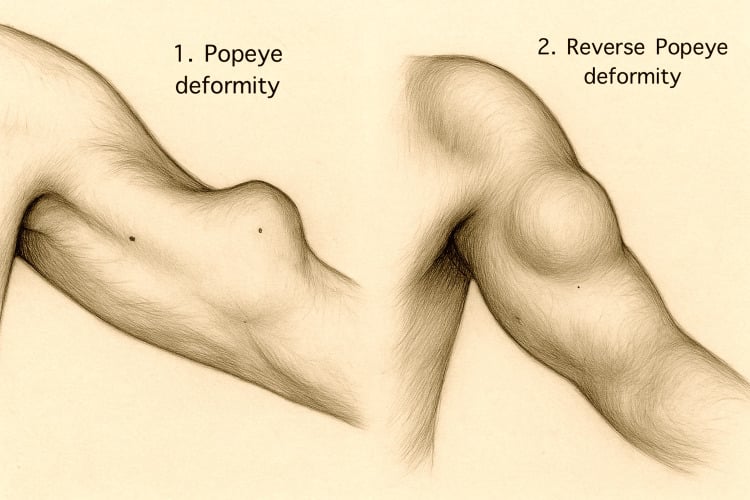
Mechanism. Eccentric overload of a flexed, supinated elbow, such as lifting or catching a falling load. Pre-existing tendinosis predisposes to it, and smoking and anabolic steroid use are debated factors. It is almost exclusively an injury of middle-aged men, in the dominant arm.
Nerves at risk. Each is threatened by a particular part of the exposure or fixation:
- Lateral antebrachial cutaneous nerve (LABCN) - runs between biceps and brachialis; the most commonly injured nerve and the most frequent neurological complication, from skin-flap or retractor traction
- Posterior interosseous nerve (PIN) - rare but devastating; threatened by far-cortex over-drilling for a cortical button, or by anterior dissection past the tuberosity. Pronating the forearm (which wraps the PIN posteriorly) and limiting over-penetration mitigate the risk
- Radial / superficial radial nerve - at risk laterally in the two-incision exposure
Clinical Assessment
History. A sudden extension force against a flexed elbow, a "pop", and pain in the antecubital fossa.
Examination. Look for ecchymosis and a Popeye sign, the muscle belly retracted proximally. The tuberosity is tender, and supination is weaker than flexion.
The hook test (O'Driscoll). Flex the elbow to 90°, supinate the forearm, and try to hook a finger under the tendon from the lateral side. An intact tendon is a cord the finger hooks; after a rupture there is no tendon to feel. O'Driscoll reported a sensitivity and specificity of 100%.
What the 100% does not cover. O'Driscoll's cohort contained 33 complete avulsions and 12 partial tears, and the hook test was intact in all twelve. The test was validated to detect complete avulsion, so a normal hook test excludes a complete tear, not a partial one. What the partial tears did do was hurt: the test was painful in 9 of the 12. Read a hook test as three results, not two:
- Absent tendon - complete tear
- Hookable and comfortable - intact
- Hookable but painful - should send you to imaging rather than to reassurance
MRI errs the other way. In the same series MRI called a complete tear in 11 of the 12 partial tears. Where the hook test under-calls partial injury, MRI over-calls it; neither substitutes for the other, and the combination is what separates the three groups.
Investigations
Clinical first. The hook test is the primary investigation and outperforms MRI (O'Driscoll 2007). A confident clinical diagnosis needs no imaging.
Radiographs are usually normal. They exclude a radial tuberosity avulsion fracture and confirm there is no bony pathology.
Ultrasound is operator-dependent but useful, cheap and dynamic, and good first-line imaging in limited-resource settings.
MRI is reserved for equivocal cases, suspected partial tears and chronic ruptures. For surgical planning it quantifies:
- The percentage of the tendon torn
- The gap and the retraction
- Muscle atrophy and the Goutallier fatty-infiltration grade
The FABS view. FABS stands for flexed elbow, abducted shoulder, supinated forearm. The patient lies prone with the arm brought overhead (shoulder abducted or flexed), the elbow flexed to about 90 degrees and the forearm supinated, the "flying superman" position, and the MRI is acquired in that position.
Why it helps. On a standard extended-elbow scan the distal tendon curves obliquely to the radial tuberosity, so it is cut across several axial slices and is hard to follow along its length. The FABS position straightens and profiles the tendon and its footprint in a single oblique plane, so the tendon is seen continuously from the muscle belly to the tuberosity. That improves assessment of partial tears, the tear gap and retraction, and the footprint before surgery.
The price. It needs a cooperative patient who can hold the awkward overhead position, and it adds sequence time. It is used selectively, when the standard MRI is equivocal for a partial or footprint tear.
FABS View — Exam Points
- FABS = Flexed elbow (about 90 degrees), ABducted shoulder (arm overhead), Supinated forearm
- Profiles the WHOLE distal biceps tendon to the radial tuberosity in one plane
- Better than the standard extended-elbow scan for partial tears and footprint/gap assessment
- Used selectively when the standard MRI is equivocal; needs a cooperative patient
Differential Diagnosis
- Hook test
- Positive (hollow, no cord)
- Popeye sign
- Low (near elbow); absent if lacertus intact
- Key deficit
- Supination strength and endurance
- Hook test
- Negative but painful (cord present, thinner)
- Popeye sign
- Absent
- Key deficit
- Pain plus mild-moderate weakness; MRI grades severity
- Hook test
- Negative (distal tendon intact)
- Popeye sign
- High (near shoulder)
- Key deficit
- Minimal/cosmetic; usually non-operative
- Hook test
- Negative (intact tendon)
- Popeye sign
- Absent
- Key deficit
- Insidious pain, no structural gap on MRI
- Hook test
- Negative
- Popeye sign
- Absent
- Key deficit
- Flexion pain, supination preserved
Management
Who is repaired. Repair is offered to the active, medically fit patient, because supination is the deficit non-operative treatment cannot recover. Morrey's biomechanical study found a mean 40% loss of supination strength and about 30% loss of flexion strength with conservative treatment; the brachialis compensates for flexion, which is why supination suffers more.
Non-operative management is acceptable for low-demand or elderly patients, but the magnitude of the supination loss (meta-analysis puts the deficit at about 27-37%) drives the decision more than age alone. Counsel non-operative and delayed cases about permanent loss of supination strength and endurance, and about the cosmetic deformity.
Timing. An acute tear, within about 3-4 weeks, usually has a mobile tendon with a preserved sheath that reaches the tuberosity without tension, and it is repaired primarily and anatomically to the radial tuberosity. A subacute tear needs urgent surgical assessment, with primary repair if tendon excursion and quality permit. Beyond 4 weeks the tendon retracts and scars, the sheath is scarred and the biceps may be adherent proximally, and it often needs an allograft (Achilles or hamstring).
Chronic is a spectrum. The 4-week threshold is a convention; it marks no biological switch. A systematic review of 124 chronic tears repaired directly at a mean of 122 days reported good satisfaction and function without a graft (Tzeuton 2023). What decides is whether the tendon can be brought to the tuberosity without undue tension at operation, its excursion and quality rather than the date on the referral. Reserve graft reconstruction for a tendon that will not reach, or choose non-operative adaptation by shared decision. Counsel that dissection is more extensive and transient LABCN symptoms more likely, and that delayed cases recover more slowly and regain less strength.
Partial tears. There is no randomised evidence, and the threshold, like the decision to debride or preserve intact fibres, remains expert opinion. Low-grade partial tears are managed non-operatively, and most partial tears get a non-operative trial first; consider debridement and completion of the tear with repair for persistent pain or a high-grade tear that fails it. High-grade tears (over 50%) in active patients are usually completed and repaired.
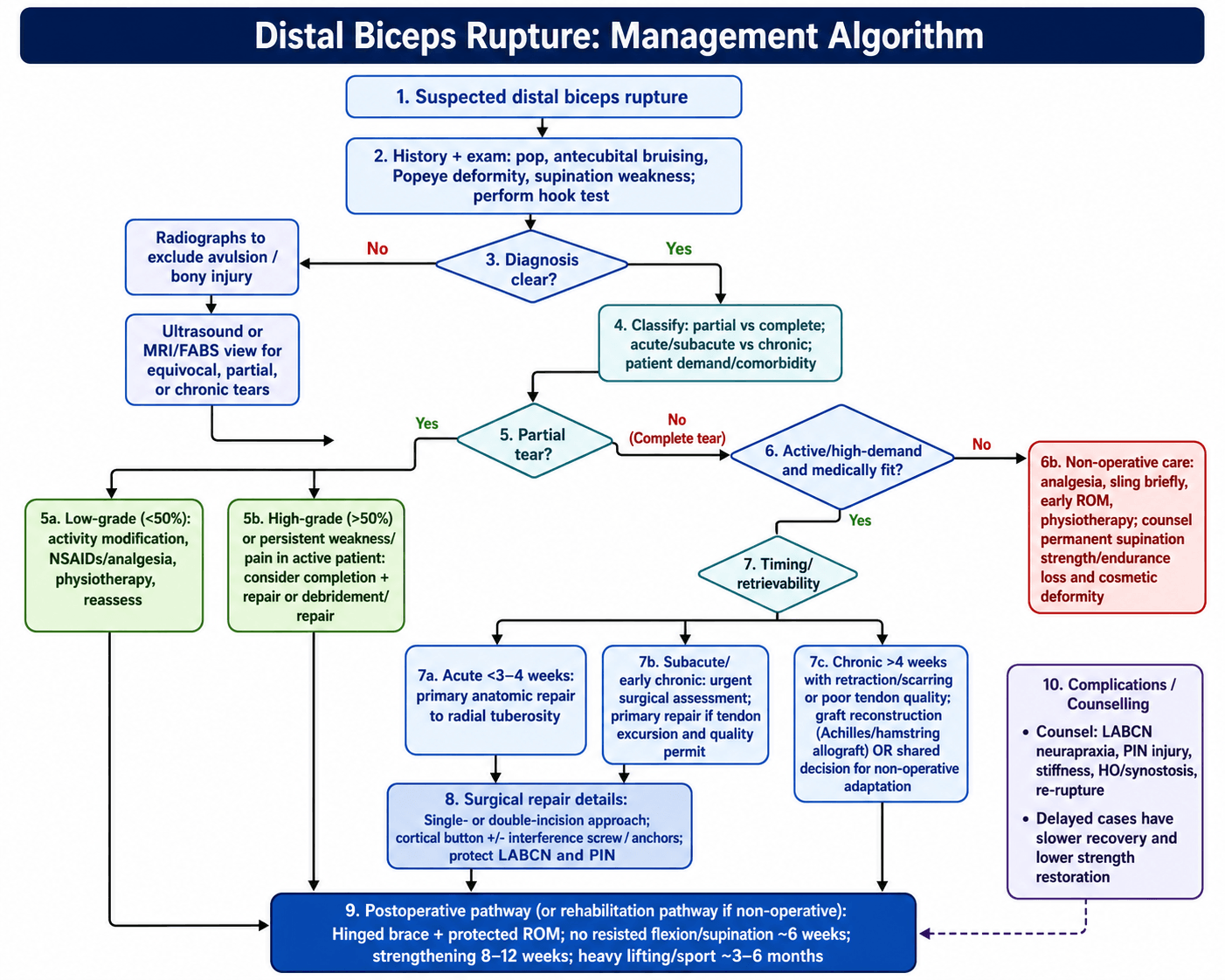
Rehabilitation. After repair the pathway is:
- Hinged brace and protected range of motion
- No resisted flexion or supination for about 6 weeks
- Strengthening at 8-12 weeks
- Heavy lifting and sport at 3-6 months
Surgical Technique
Choosing the approach. Level-I and meta-analysis data show equivalent function from single and double incisions. The choice is surgeon-dependent rather than evidence-mandated.
Single incision (anterior). Simple, through one incision, and it risks synostosis less. The costs are a higher risk of LABCN injury and a harder route to the anatomical posterior footprint, which may lose supination torque. Fixation is with a cortical button (Endobutton) and an interference screw.
Double incision (Boyd-Anderson). An anterior incision retrieves the tendon, and a posterior incision (splitting the common extensor/ulna) fixes it to the tuberosity. It gives anatomical posterior fixation, retains a small flexion-strength edge and causes less LABCN irritation, at the risk of radio-ulnar synostosis and heterotopic ossification.
Fixation devices.
- Cortical button (suspensory) - the strongest
- Suture anchors - easier, with less risk to the PIN
- Interference screw - compresses the tendon into the bone tunnel
Does the device matter? The cortical button is biomechanically strongest, but clinical meta-analysis shows all constructs (button, anchors, transosseous, interference screw) yield equivalent outcomes. The "button + screw" mantra is biomechanical, not a clinical requirement.
The tension-slide technique. The tension-slide technique (TST, Mazzocca) deploys a suspensory cortical button so that the tendon is drawn (slid) into the bone tunnel and tensioned after the button has flipped on the far cortex, rather than hanging off the button at the mouth of the tunnel. The steps:
- A tunnel is drilled at the tuberosity footprint
- The whipstitched tendon is attached to the button through a sliding pulley-suture loop
- The button is passed through the tunnel and flips on the far (posterior) cortex
- Pulling the free suture limbs slides the tendon down into the tunnel and seats it against bleeding bone under tension
- The sutures are tied over the button
Why it matters. The plain suspensory button gives the strongest published repair but permits gap formation and tendon "pistoning" at the tunnel mouth. Seating the tendon within the tunnel significantly reduces gap formation without lowering load-to-failure (Sethi 2010). Adding an interference screw to a tension-slide construct adds little further strength, which is why the supplemental screw is optional rather than essential.
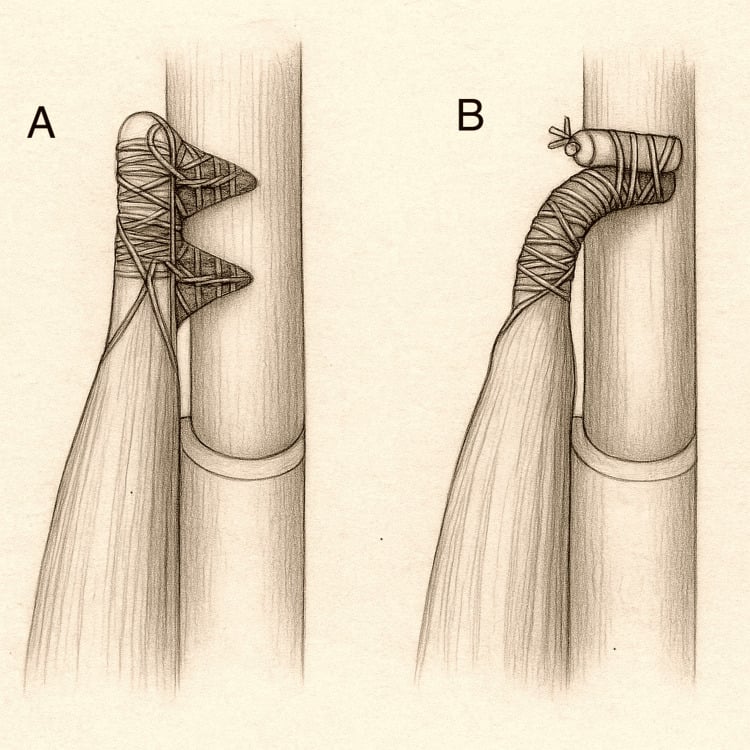
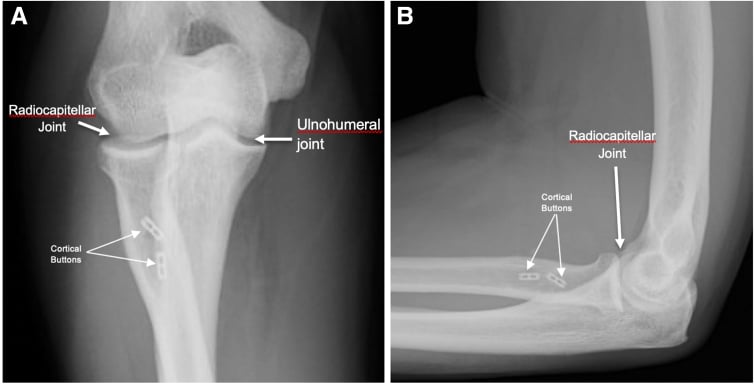
Tension-Slide Technique — Exam Points
- A modification of suspensory cortical-button fixation (Mazzocca)
- Slides the whipstitched tendon DOWN into the bone tunnel after the button flips on the far cortex
- Seats the tendon against bone under tension - reduces gap formation and pistoning
- Maintains load-to-failure of the standard button (Sethi 2010); supplemental interference screw is optional, not essential
Complications
- Rate
- 5-30%
- Cause / Mechanism
- Retraction of skin flaps/nerve
- Notes
- Numbness lateral forearm; usually transient
- Rate
- 3-5% (higher in 2-incision)
- Cause / Mechanism
- Loss of rotation (synostosis) if severe
- Notes
- Consider indomethacin prophylaxis in high-risk cases
- Rate
- 1-2%
- Cause / Mechanism
- Premature loading, fixation failure
- Notes
- Management: revision with graft
- Rate
- Rare (less than 1%)
- Cause / Mechanism
- Drilling through far cortex (button)
- Notes
- Protect by pronating the forearm during drilling
Heterotopic ossification. Pooled series put the rate nearer 10% (Cuzzolin 2021). Neither indomethacin nor single-dose radiotherapy after two-incision repair is supported by high-quality trials.
Operative vs Non-operative — Meta-analysis
- Systematic review and meta-analysis, 62 studies, 2481 cases (2402 operative, 79 non-operative); mean age 47 years, 98.5% male
- Operative repair gave a mean +27.6% supination strength and +33.9% supination endurance versus non-operative (both p less than 0.0001)
- Operative repair also superior for flexion strength (+25.7%) and flexion endurance (+11.1%)
- DASH and Mayo Elbow Performance Score significantly better after surgery
Operative vs Non-operative — Strength Ratios
- Systematic review and meta-analysis, 53 studies, 1380 patients
- Supination strength (injured/uninjured ratio) 89.2% operative vs 62.6% non-operative (p less than 0.001)
- Flexion strength 94.7% operative vs 83.0% non-operative (p less than 0.001)
- Surgical complications: ~10% heterotopic ossification, ~10% transient sensory nerve injury, 1.6% transient motor injury, 0.1% persistent motor deficit; all fixation methods equivalent, single-incision gave slightly better pronation ROM
Hook Test — Original Description
- Diagnostic cohort of 45 patients undergoing surgical exploration (33 complete avulsions, 12 partial tears)
- Hook test abnormal in 33/33 complete avulsions and intact in 12/12 partial tears — sensitivity and specificity both 100%
- Partial tears: hook test was intact but painful in 9 of 12 (pain-positive hook flags a partial tear)
- Hook test outperformed MRI (sensitivity 92%, specificity 85%)
Single vs Double-Incision Repair — RCT
- Randomized trial: single-incision (suture anchors, n=47) vs double-incision (transosseous tunnels, n=44), all male, acute ruptures
- No difference in ASES, DASH, PREE or supination strength at 2 years
- Double-incision had a 10% advantage in final isometric flexion strength (104% vs 94%, p=0.01)
- Single-incision had far more transient LABCN neurapraxia (19/47 vs 3/43, p less than 0.001); 4 reruptures overall, all from early non-compliance/reinjury
Fixation Biomechanics — Cortical Button
- Cadaveric study, 20 matched specimens, cyclically loaded 3600 cycles
- Standard cortical button load-to-failure 389 N vs tension-slide technique 432 N (no significant difference, p=0.28)
- Tension-slide significantly reduced gap formation (1.26 mm vs 2.79 mm, p=0.03)
- Adding an interference screw to the tension-slide construct did not significantly change load-to-failure or gap formation
Direct Repair of Chronic Ruptures
- Systematic review, 8 studies, 124 chronic tears (mean delay 122 days) repaired directly without graft
- Chronic direct repair had a slightly higher but mostly transient LABCN palsy rate (12.1% vs 7.9% acute, p=0.75)
- Only 3 reruptures (3.2%) across studies reporting this complication
- Good patient satisfaction, ROM and functional scores when residual tendon excursion and quality permit direct repair
Guidelines, Registries & Global Practice
Global epidemiology
- Incidence approximately 1.2-2.5 per 100,000 person-years; rising with increasing recreational weightlifting.
- Demographics are remarkably consistent worldwide: men in the 4th-6th decade, dominant arm, eccentric loading mechanism. Meta-analyses report 98-100% male cohorts (Looney 2022; Cuzzolin 2021).
- Distal tears account for only ~3-10% of all biceps ruptures (the long-head proximal rupture is far commoner).
Society guidance — side by side
- Position
- No dedicated CPG; surgical repair endorsed for active patients via expert consensus and AJRR-adjacent literature
- Position
- Early repair (within ~3-4 weeks) for functional demand; shared decision-making for low-demand patients
- Position
- Anatomic re-attachment to posterior footprint; cortical button or transosseous fixation; protect LABCN/PIN
- Position
- Surgery superior for strength/endurance; fixation choice surgeon-dependent (meta-analytic equivalence)
Registry & outcome notes
- There is no dedicated tendon-rupture registry equivalent to the arthroplasty registries (NJR, AJRR, AOANJRR, SHAR); evidence is driven by RCTs (Grewal 2012) and meta-analyses (Looney 2022; Cuzzolin 2021).
- Across these datasets, surgery restores supination strength to ~89% of the contralateral side versus ~63% non-operatively, with fixation device having no measurable effect on outcome.
High- vs limited-resource practice variation
- Well-resourced centres: MRI confirmation when clinically ambiguous, cortical-button/interference-screw constructs, hinged-brace rehabilitation, early semi-urgent listing to stay within the repairable window.
- Limited-resource settings: diagnosis is clinical (hook test, which outperforms MRI anyway); transosseous suture fixation through bone tunnels is a low-cost, effective alternative; chronic presentation is commoner because of referral delay, raising the proportion needing graft or accepting non-operative deficit.
- Universal medicolegal point: a complete rupture mislabelled a "strain" can miss the acute repair window — document the hook test, the timing discussion, and informed consent regarding the natural-history supination deficit.
Exam Viva Scenarios
Practise clinical reasoning and management decisions out loud
“A 45-year-old bodybuilder presents to your clinic 3 days after feeling a sudden pop in his right elbow whilst deadlifting a heavy weight. He describes an immediate sharp pain in the antecubital fossa followed by swelling and bruising. He has continued to train with modifications but notices significant weakness when doing pulling exercises and when turning his wrist (such as using a screwdriver). On examination, there is ecchymosis in the antecubital fossa and a visible high-riding biceps muscle belly in the upper arm (Popeye sign). His elbow range of motion is full (0-145°) but painful at terminal flexion. When you perform the hook test - asking him to flex his elbow to 90° and actively supinate while you attempt to hook your index finger from the lateral side under the biceps tendon in the cubital fossa - you cannot palpate any cord-like structure beneath the skin. There is just a hollow space. His flexion strength is moderately reduced (4/5) but his supination strength against resistance is markedly reduced compared to the contralateral side. He is right-hand dominant and this is his dominant arm. He asks whether he really 'needs' surgery or if he can just continue training and let it heal naturally. How do you counsel him regarding diagnosis, natural history without surgery, surgical options, and your recommendation?”
“A 38-year-old carpenter presents to your clinic 10 days after injuring his right (dominant) elbow whilst catching a falling ladder at work. He felt immediate pain in the front of his elbow but was able to continue working that day with some difficulty. Over the past week, he has had persistent anterior elbow pain and weakness, particularly when using power tools that require forearm rotation (screwdrivers, drills). He can perform most daily activities but notices definite weakness compared to his normal strength. On examination, there is mild swelling and tenderness in the antecubital fossa. There is NO obvious Popeye sign - the muscle belly contour appears symmetric to the contralateral side. When you perform the hook test (elbow 90° flexion, active supination), you CAN palpate a cord-like structure under your finger when hooking from lateral to medial, but it feels somewhat thinner than the contralateral side and he has significant pain when you do this maneuver. His active elbow flexion is full range (0-145°) with 4+/5 strength (mild weakness). His supination strength is noticeably reduced compared to the contralateral side - approximately 60-70% of normal strength by your estimation. Plain radiographs of the elbow are normal with no fracture or dislocation. You order an MRI which reports: 'High-grade partial tear of the distal biceps tendon involving approximately 60-70% of the tendon substance. The tear is located 2cm proximal to the radial tuberosity insertion. There is retraction of the torn fibers with a 1cm gap. The remaining intact fibers (30-40%) are attenuated and show high T2 signal indicating degeneration. No complete discontinuity. Mild surrounding soft tissue edema. Radial tuberosity shows normal marrow signal.' He asks whether he needs surgery or if this can heal with rest. He is highly motivated to return to full carpentry work which requires significant upper extremity strength. How do you counsel him and what is your management plan?”
“You are seeing a 48-year-old mechanic in your reconstructive elbow clinic, referred from another state. He sustained a distal biceps tendon rupture 8 months ago when he was pulling on a seized engine part. He was initially seen at a rural emergency department where X-rays showed no fracture and he was told he had a 'biceps strain' and given analgesia and a sling. Over the following weeks, his pain settled but he noticed significant weakness in his right (dominant) arm, particularly when using wrenches and turning bolts. He saw his GP at 6 weeks who ordered an MRI confirming complete distal biceps rupture, and he was referred to a local orthopaedic surgeon. The surgeon offered him surgery, but he was hesitant due to fear of complications and decided to 'live with it.' Over the past 6 months, he has struggled significantly at work - he can no longer perform many mechanical tasks requiring forearm rotation, has had to modify his work duties, and is facing potential job loss. He has relocated to your area and presents requesting surgery. On examination, there is a prominent Popeye sign with the biceps muscle belly high in the arm. When you perform the hook test, there is a completely hollow antecubital fossa with no palpable structure. His elbow range of motion is full (0-140°) but his flexion strength is 3+/5 and supination strength is markedly reduced (2/5, approximately 40% of the contralateral side). There is visible quadriceps atrophy with his right upper arm measuring 4cm less circumference than the left. You review his MRI from 6 months ago which showed complete rupture with 4cm retraction, and you order a new MRI which now shows: 'Complete distal biceps tendon rupture with 7cm retraction of the tendon stump to the mid-arm level. The retracted tendon is scarred and adherent to the brachialis muscle. Marked atrophy of the biceps muscle belly with moderate fatty infiltration (Goutallier grade 2-3). The muscle belly measures 15mm in diameter compared to 28mm on the contralateral side. Dense scar tissue fills the anterior elbow. Radial tuberosity is intact but shows cortical irregularity and bone resorption. No acute abnormality.' He is desperate for surgery as his livelihood depends on returning to mechanic work. He asks: 'Can you fix this? I know I should have had surgery earlier, but can you still repair it now?' How do you counsel him and what is your surgical plan?”
Deficits (Non-op)
- Supination Strength: -40%
- Supination Endurance: -50%
- Flexion Strength: -30%
Hook Test
- Index finger hooks lateral edge
- Most sensitive test (100%)
- Abnormal even if Lacertus intact
Nerves at Risk
- LABCN (Sensory) - Commonest
- PIN (Motor) - Worst
References
- O'Driscoll SW, Goncalves LBJ, Dietz P. The hook test for distal biceps tendon avulsion. Am J Sports Med. 2007;35(11):1865-9. PMID 17687121.
- Grewal R, Athwal GS, MacDermid JC, et al. Single versus double-incision technique for repair of acute distal biceps tendon ruptures: a randomized clinical trial. J Bone Joint Surg Am. 2012;94(13):1166-74. PMID 22760383.
- Looney AM, Day J, Bodendorfer BM, et al. Operative vs. nonoperative treatment of distal biceps ruptures: a systematic review and meta-analysis. J Shoulder Elbow Surg. 2022;31(4):e169-e189. PMID 34999236.
- Cuzzolin M, Secco D, Guerra E, et al. Operative versus nonoperative management for distal biceps brachii tendon lesions: a systematic review and meta-analysis. Orthop J Sports Med. 2021;9(10):23259671211037311. PMID 34734095.
- Sethi P, Obopilwe E, Rincon L, Miller S, Mazzocca A. Biomechanical evaluation of distal biceps reconstruction with cortical button and interference screw fixation. J Shoulder Elbow Surg. 2010;19(1):53-7. PMID 19574061.
- Tzeuton S, Johns W, Campbell B, et al. Outcomes and patient satisfaction of delayed distal biceps repairs without graft augmentation: a systematic review. JBJS Rev. 2023;11(5). PMID 37141425.
- Chavan PR, Duquin TR, Bisson LJ. Repair of the ruptured distal biceps tendon: a systematic review. Am J Sports Med. 2008;36(8):1618-24. PMID 18658024. (Cited for the approach and fixation comparison - EndoButton best biomechanically, unsatisfactory results 31% with two-incision versus 6% with single-incision - not for natural-history figures.)
- Morrey BF, Askew LJ, An KN, Dobyns JH. Rupture of the distal tendon of the biceps brachii. A biomechanical study. J Bone Joint Surg Am. 1985;67(3):418-21. PMID 3972866. (The source of the non-operative strength deficits: mean 40% supination and about 30% flexion strength loss with conservative treatment.)