Ulnar-Sided Wrist Pain | Post-Traumatic | Salvage Procedures
- Articulation between ulnar head and sigmoid notch critical for forearm rotation
- Post-traumatic most common cause (distal radius malunion)
- Clinical triad: ulnar-sided pain, restricted rotation, DRUJ crepitus/instability
- Conservative first: activity modification, NSAIDs, splinting, injection
- Surgical: Darrach (elderly), Sauve-Kapandji (younger), hemiresection, arthroplasty
- “Piano key sign - dorsal displacement of ulnar head
- “CT best for sigmoid notch assessment
- “Always assess for TFCC tears, Essex-Lopresti injury
- “Know indications and complications for each salvage procedure
DRUJ Arthritis (Distal Radioulnar Joint Arthritis)
Overview and Epidemiology
DRUJ arthritis is degenerative or post-traumatic arthritis of the distal radioulnar joint, the articulation between the ulnar head and the sigmoid notch of the radius on which forearm rotation depends. It presents with ulnar-sided wrist pain, crepitus and restricted pronation and supination.
Causes. Post-traumatic arthritis is the most common, and distal radius malunion is its usual source; intra-articular fracture, chronic DRUJ instability and the Essex-Lopresti injury make up the rest of the group. Inflammatory arthritis includes rheumatoid arthritis, often bilateral with synovitis and bone erosion, psoriatic arthritis and crystalline arthropathy. Primary osteoarthritis occurs without clear antecedent trauma and is less common, and neuromuscular causes, cerebral palsy and other spasticity disorders, act through chronic abnormal forces.
- Frequency
- 60-70%
- Characteristics
- Most common, assess for malunion correction
- Frequency
- 10-15%
- Characteristics
- Chronic instability leads to arthritis
- Frequency
- 10-15%
- Characteristics
- RA, psoriatic arthritis, bilateral
- Frequency
- 5-10%
- Characteristics
- No clear antecedent trauma
Who. Adults of all ages are affected, most commonly in the fifth to seventh decades. Post-traumatic cases show a male predominance, reflecting the higher incidence of trauma, and inflammatory cases a female one. Occupational risk comes from repetitive forceful gripping with forearm rotation (mechanics, carpenters, assembly workers) and from prior wrist trauma (athletes, manual labourers).
Anatomy and Biomechanics
The joint. The DRUJ is a diarthrodial joint in which the convex ulnar head articulates with the concave sigmoid notch of the radius. The notch covers only 60-80 degrees of the ulnar head's circumference, and the ulnar head sits slightly palmar and ulnar to the radius. Normal forearm rotation needs congruent articular surfaces, intact ligamentous support and balanced muscle forces.
Rotation. The radius rotates around the ulna, not the ulna around the radius: the ulnar head stays relatively stationary while the contact area changes throughout the arc. In pronation the dorsal sigmoid notch contacts the dorsal ulnar head; in supination the palmar notch contacts the palmar ulnar head.
The stabilisers. The soft tissues hold the joint together, led by the TFCC:
- TFCC - the primary stabiliser; injury leads to instability, then arthritis
- Dorsal radioulnar ligament - resists palmar translation in supination
- Palmar radioulnar ligament - resists dorsal translation in pronation, and is key for surgical reconstruction
- Interosseous membrane - the central band is the most important part
- Joint capsule
- Dynamic stabilisers - ECU and pronator quadratus
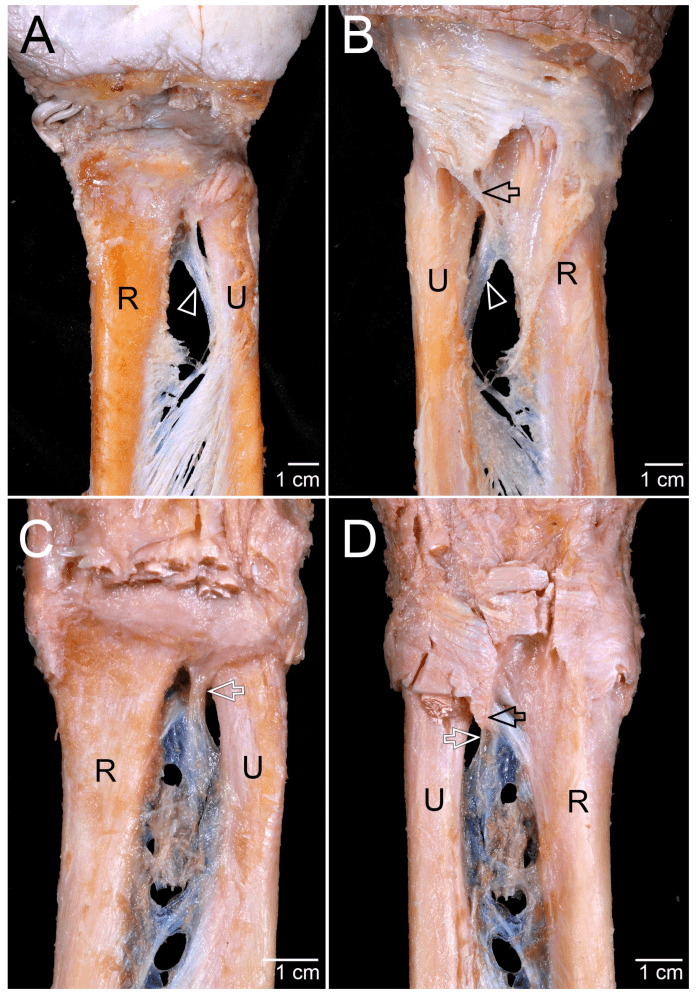
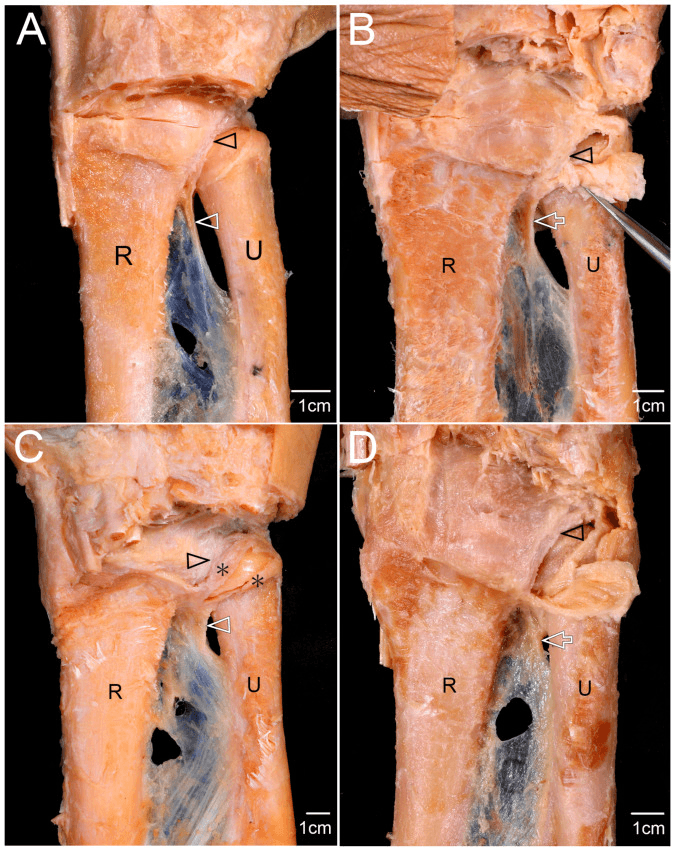
The shape of the sigmoid notch. Tolat classified the notch into four types. Morphology affects load distribution, the ski-slope type may predispose to instability, and the shape matters for prosthetic design and sizing.
- Type I, flat face - 42%
- Type II, ski slope - 14%
- Type III, C-type - 30%
- Type IV, S-type - 14%
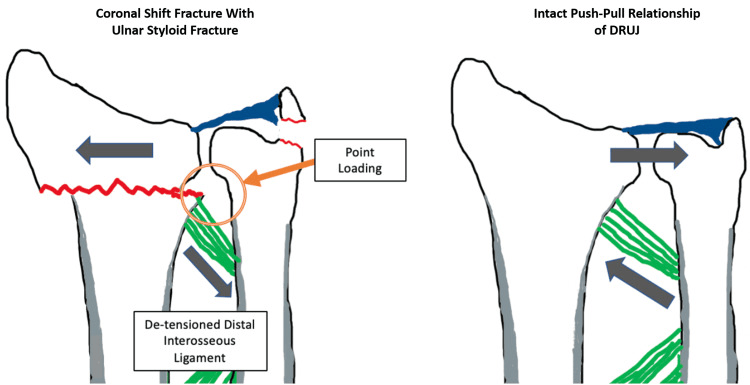
How a malunion damages the joint. Each component of a distal radius malunion alters DRUJ mechanics:
- Dorsal angulation increases load on the dorsal sigmoid notch
- Radial shortening creates positive ulnar variance and raises DRUJ pressure
- Articular step-off point-loads the joint and accelerates cartilage wear
Chronic instability from TFCC insufficiency reaches the same end by another route. The abnormal kinematics bring repetitive subluxation, synovitis and progressive cartilage degeneration.
Grading and Associated Pathology
Severity. Arthritis is graded on the radiograph and the symptoms together, and each grade points towards a treatment.
- Radiographic Findings
- Minimal joint space narrowing, minimal sclerosis, preserved sigmoid notch
- Clinical Features
- Intermittent or mild pain with activity, minimal rotation loss
- Treatment Options
- Conservative management, activity modification; consider malunion correction
- Radiographic Findings
- Obvious joint space loss, sclerosis, early osteophytes, ulnar head changes
- Clinical Features
- Regular pain with activities, 20-40% rotation loss
- Treatment Options
- Conservative trial, surgical if failed; address aetiology, consider hemiresection or Sauvé-Kapandji
- Radiographic Findings
- Severe space loss or bone-on-bone, cysts, sigmoid notch erosion, ulnar head deformity, instability
- Clinical Features
- Constant severe pain, greater than 50% rotation loss, instability
- Treatment Options
- Surgical reconstruction typically required: Darrach, Sauvé-Kapandji, or prosthesis
- Radiographic Findings
- Bone-on-bone, subluxation, ulnar head destruction
- Clinical Features
- Severe pain and instability, minimal function
- Treatment Options
- Salvage procedure essential
The sigmoid notch on CT. The notch is described in three states:
- Normal - smooth, concave, good cartilage coverage
- Eroded - irregular surface, loss of concavity
- Destroyed - flat or convex, no cartilage remaining
Associated pathology. Look for what else is wrong before choosing an operation. TFCC integrity affects procedure selection; the ECU tendon, ulnocarpal impaction, carpal arthritis in rheumatoid patients and the parameters of any radius malunion all change the plan.
Clinical Presentation
History. The pain is ulnar-sided, activity-related and worse with forearm rotation, gripping and loading: turning doorknobs, using screwdrivers, wringing towels, push-ups and keyboard use. It may radiate proximally into the forearm or distally into the ulnar digits. Clicking, catching or popping with rotation suggests instability or loose bodies.
The questions that matter. Ask about antecedent trauma, particularly a distal radius fracture: the mechanism, the treatment received (operative or non-operative) and any healing complications. Patients may report progressive worsening over the months or years since the injury. In inflammatory arthropathy, document systemic symptoms and the other joints involved.
Function. Deficits vary with severity. Rotation tasks such as turning keys, opening jars and using screwdrivers are difficult, grip strength falls through pain inhibition (a 20-40% reduction is typical), bearing weight on the extended wrist (push-ups, yoga) becomes impossible, and keyboard and mouse use suffer. Patients may compensate by rotating the whole arm from the shoulder.
Examination. Work through it in order:
- Inspection - ulnar head prominence (dorsal subluxation), swelling over the ulnar wrist (usually mild), deformity; muscle atrophy is rare unless the pain is chronic and severe
- Palpation - DRUJ tenderness over the ulnar head, dorsally, volarly and ulnarly; the ulnar styloid (tenderness implies TFCC involvement), the fovea and the ECU tendon
- Range of motion - active and passive pronation and supination with the elbow flexed 90 degrees, compared with the other side; normal is 80/80, and a loss of 30-50% in each direction is typical
- Stability - piano key and ballottement, dorsal-volar translation compared with the contralateral wrist in neutral, pronation and supination
- Crepitus - rotation under load
- Grip strength - compared with the contralateral side
- Associated pathology - TFCC, ECU, ulnocarpal
Finish with the neurovascular examination: ulnar nerve function, the ulnar artery at Guyon's canal and the dorsal sensory branches of the ulnar nerve.
- Technique
- Stabilise the radius and push the ulnar head dorsally and volarly
- Positive Finding
- Increased dorsal prominence, reducible; excessive translation that reproduces symptoms
- Significance
- DRUJ instability (incompetence)
- Technique
- Stabilise the distal radius, grasp the ulnar head, compress axially and rotate through pronation and supination
- Positive Finding
- Pain and crepitus
- Significance
- DRUJ arthritis
- Technique
- Stabilise radius, translate ulna
- Positive Finding
- Increased translation vs contralateral
- Significance
- DRUJ instability
- Technique
- Tenderness at ulnar fovea (between FCU and ulnar styloid)
- Positive Finding
- Point tenderness
- Significance
- TFCC foveal tear
Differential diagnosis. An isolated TFCC tear, ECU tendinopathy or subluxation, ulnocarpal impaction syndrome, ulnar styloid impingement and lunotriquetral instability all produce ulnar-sided pain, and several may coexist with DRUJ arthritis. Three further provocative tests complete the examination:
- Ulnocarpal stress test - ulnar deviation with axial load
- ECU synergy test - resisted supination and extension
- Press test - pushing up from a chair
Investigations
Radiographs. Plain films are first-line in every patient. Standard wrist views form the initial assessment:
- PA in neutral rotation - ulnar variance; pronation increases positive variance, so the rotation must be neutral
- True lateral - DRUJ alignment and subluxation
- Oblique - if needed
The PA shows DRUJ joint space narrowing, subchondral sclerosis, ulnar head deformity or flattening, and cysts in advanced cases; osteophytes and subluxation are the other plain-film findings. Positive ulnar variance, the ulnar head extending beyond the radial articular surface, increases DRUJ loading and accelerates arthritis. Comparison with the uninjured wrist is valuable.
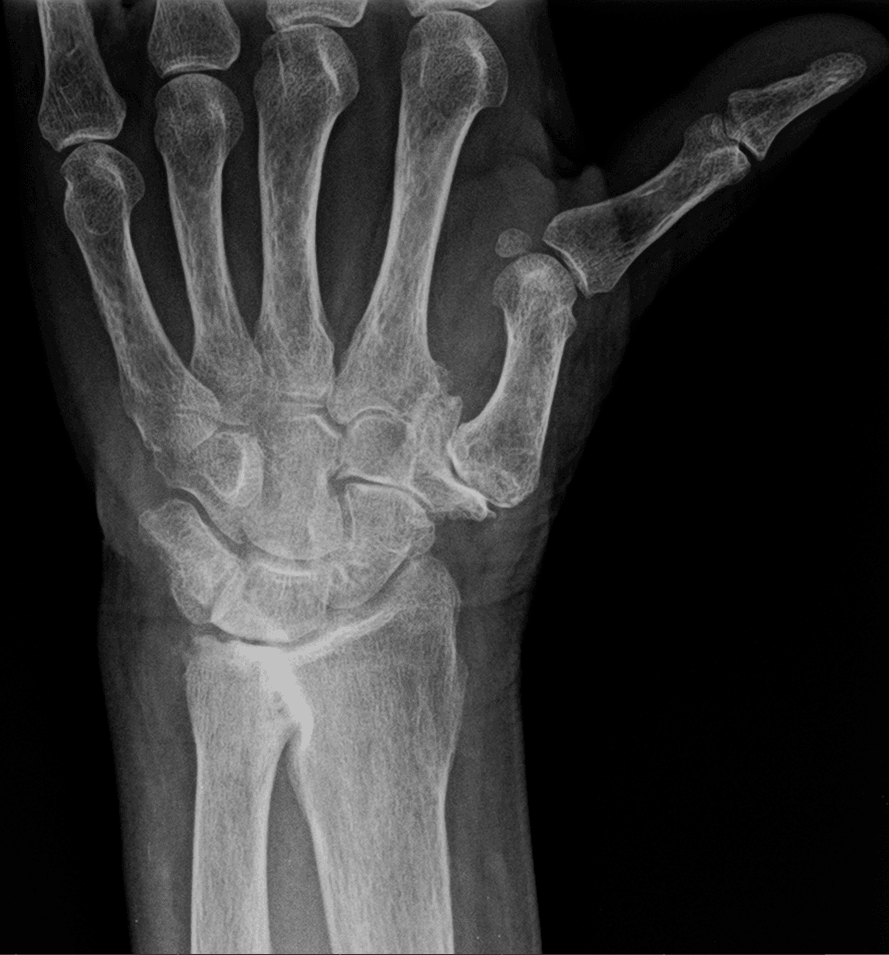
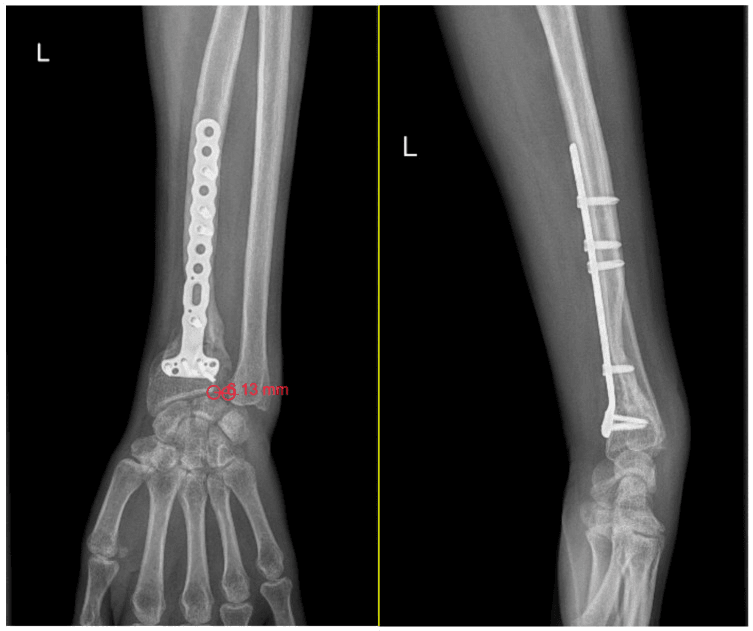
CT. The gold standard for detailed assessment, ordered for preoperative planning or when the diagnosis is unclear. It shows sigmoid notch morphology and articular irregularity, ulnar head shape and arthrosis, the degree of subluxation or dislocation, loose bodies and osteophytes, and the bone stock available for surgery. Scanning both wrists in pronation, neutral and supination shows dynamic stability and the pattern of subluxation.
- Bilateral comparison, essential for subtle subluxation
- Axial cuts through the DRUJ, 3 mm slices
- Positions - neutral, pronation, supination
- Assess sigmoid notch cartilage, ulnar head morphology and the degree of subluxation
- Measure the radioulnar ratio
The radioulnar ratio (Mino method). Draw a line along the dorsal surface of the radius and measure the position of the ulnar head relative to it. Normally the ulnar head lies within 10% of the dorsal line; displacement greater than 10% is subluxation.
MRI. It evaluates the soft tissues: TFCC integrity (central perforation, peripheral detachment), which affects the choice of procedure; ECU tendon pathology; interosseous membrane injury; cartilage in early arthritis; and bone marrow oedema, which indicates an active arthritic process. It also stages inflammatory arthritis. MRI is particularly valuable when concomitant soft-tissue pathology is suspected, and in younger patients in whom TFCC repair might be considered.
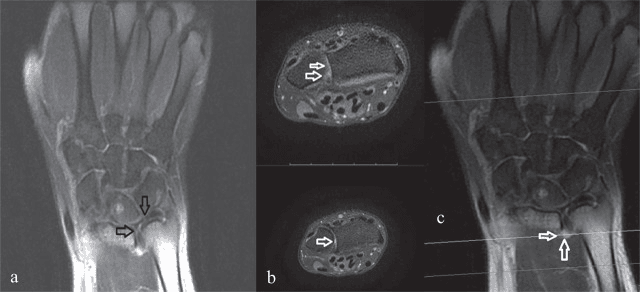
Diagnostic injection. A fluoroscopically guided DRUJ injection of corticosteroid (triamcinolone 40 mg) with local anaesthetic (lidocaine or bupivacaine) is both diagnostic and therapeutic. Temporary complete pain relief confirms the DRUJ as the primary pain generator, which is valuable when several sources coexist: ulnar impaction syndrome, TFCC tears, ECU tendinopathy.
Differential Diagnosis
Ulnar-sided wrist pain is one of the most difficult diagnostic regions in the hand. A diagnostic DRUJ injection that abolishes pain helps confirm the DRUJ as the true pain generator when several causes coexist.
- distinguishing
- Pain and crepitus on loaded rotation, positive grind test
- keyTest
- DRUJ grind, CT of sigmoid notch, diagnostic DRUJ injection
- pitfall
- Coexisting TFCC tear or ulnar impaction muddies the picture
- distinguishing
- Positive fovea sign, click on ulnocarpal stress, often stable DRUJ
- keyTest
- MR arthrogram, wrist arthroscopy
- pitfall
- Chronic foveal tears cause secondary instability then arthritis
- distinguishing
- Positive ulnar variance, lunate/triquetral cysts, pain on ulnar deviation
- keyTest
- PA in neutral rotation for variance, MRI marrow oedema
- pitfall
- Treat with ulnar shortening, not a DRUJ salvage procedure
- distinguishing
- Tenderness over ECU groove, painful snapping on supination
- keyTest
- ECU synergy test, dynamic ultrasound
- pitfall
- Mistaken for DRUJ instability; ECU sits dorsal to ulnar head
- distinguishing
- Pain on LT ballottement and shear, focal LT tenderness
- keyTest
- LT ballottement, fluoroscopy, arthroscopy
- pitfall
- Often coexists with TFCC and ulnar impaction (ulnocarpal abutment)
- distinguishing
- Volar-ulnar pain, tenderness over pisiform, pisotriquetral grind
- keyTest
- 30-degree supinated oblique radiograph, injection
- pitfall
- Pain is volar, not dorsal as in DRUJ disease
Management
Non-operative treatment first. Conservative measures come before any operation:
- Activity modification - avoid rotation under load
- NSAIDs for symptomatic relief; topical NSAIDs may be preferred in patients with GI concerns
- Splinting in neutral forearm rotation - a long arm splint or Muenster-type orthosis limits rotation and is worn during aggravating activities or at night; hand therapists can fabricate custom thermoplastic splints. Wrist splinting, ulnar gutter or forearm-based, is also used
- Corticosteroid injection - temporary relief in 60-70%, lasting weeks to months; repeat injections may be performed but are generally limited to 2-3 per year
- Physical therapy - maintains range of motion and strengthens the forearm and wrist muscles to provide dynamic stability
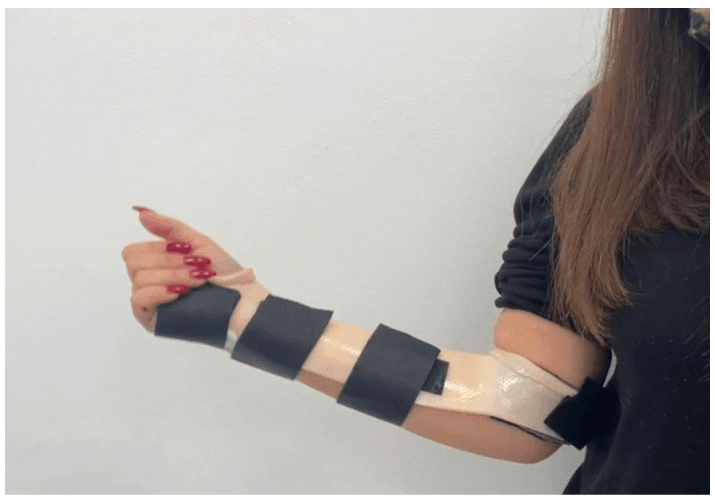
When to operate. Surgery is considered when conservative management fails to control symptoms after 3-6 months, when pain significantly limits function or quality of life, when instability or deformity progresses, or when the patient's functional demands are incompatible with conservative restrictions. Relative contraindications are active infection, severe osteoporosis (which compromises fixation for a Sauvé-Kapandji), unrealistic expectations and medical comorbidities that preclude surgery.
Choosing the operation. Three assessments, in order, select the procedure:
- The aetiology. Post-traumatic arthritis with a malunion: consider corrective osteotomy while the arthritis is early (Grade I), when it may halt progression. Inflammatory arthritis: Darrach is preferred, because the bone is often too poor for fusion. Primary osteoarthritis: go to step 2.
- The patient. Over 60 and low-demand: Darrach. Under 60 and high-demand: Sauvé-Kapandji or a prosthesis.
- The sigmoid notch. Intact: consider ulnar head replacement, or hemiresection-interposition or matched resection for moderate (Grade II) disease. Damaged: Sauvé-Kapandji or Darrach.
The preference for Darrach in inflammatory disease rests on bone stock, not on the diagnosis alone: Vincent's Sauvé-Kapandji series was entirely rheumatoid.
The soft tissues and the rest of the wrist. An intact TFCC leaves more options; with a torn TFCC, consider procedures that do not rely on it, and address ECU instability at the same operation. The DRUJ procedure can be combined with ulnar shortening for positive variance, with TFCC repair, or with radius osteotomy to correct a malunion.
Surgical Technique
Corrective Osteotomy
For a malunion with early arthritis, a radius osteotomy corrects the underlying cause and may halt progression. Ulnar shortening is added for positive variance.
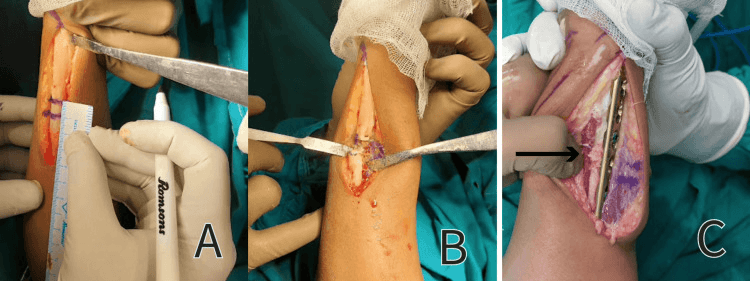
Darrach Procedure
The operation. Excision of the distal ulna, 1.5-2.5 cm of ulnar head and neck, preserving enough ulna for forearm function. It is technically simple, gives reliable pain relief and carries no implant-related complications.
Anterior dislocation of the head of the ulna
- Original description of resection of the distal ulna for a symptomatic, dislocated ulnar head - the historical basis for the Darrach excision arthroplasty still used in low-demand and rheumatoid wrists.
Who. Elderly, low-demand patients (age greater than 60 years), severe arthritis with destruction of the ulnar head, rheumatoid arthritis with bone erosion, and revision of other failed procedures. Avoid it in the young or high-demand patient, in whom ulnar stump instability is the risk; use a Sauvé-Kapandji instead.
Technique.
- Dorsal approach between the 5th and 6th extensor compartments (an ulnar approach is an alternative)
- Subperiosteal exposure of the distal ulna, protecting the TFCC remnant and the ECU tendon and preserving its sheath
- An oblique cut at 45 degrees reduces impingement; smooth the bone edges with a rasp
- Stabilise the stump with soft tissue: an ECU sling, the TFCC remnant over the stump, or capsular interposition. This is critical, because it reduces instability
- Close the capsule and retinaculum
The price. Ulnar stump instability (a painful prominence of the ulna on gripping), grip strength reduced by 10-20% with variable recovery, and a visible depression at the DRUJ.
Sauvé-Kapandji Procedure
The operation. The DRUJ is fused and a pseudarthrosis is made in the ulna just proximal to the fusion, so the forearm rotates through the pseudarthrosis. The ulnar head is preserved and with it ulnocarpal support. It is chosen for younger, active patients with good bone stock who need ulnar-sided stability.
The Kapandji-Sauvé operation
- Description of the technique and indications of the Sauvé-Kapandji operation in non-rheumatoid disease - DRUJ arthrodesis combined with a proximal ulnar pseudarthrosis to stabilise the ulnar carpus while preserving forearm rotation in younger, higher-demand patients.
Technique.
- Approach - dorsal, between the 5th and 6th compartments
- Expose the DRUJ - preserve the TFCC and dorsal capsule
- Prepare the fusion - decorticate the ulnar head and sigmoid notch
- Fuse in neutral rotation - K-wires or a compression screw; the technique described here uses two lag screws (3.5 or 4.0 mm) placed 90 degrees apart
- Create the pseudarthrosis - excise a 1-1.5 cm segment of ulna proximal to the fusion
- Stabilise the stump - ECU sling or pronator quadratus interposition
- Close - repair capsule and retinaculum
Technical errors. Each has a predictable consequence:
- Resecting less than 10 mm - impingement
- Poor soft-tissue stabilisation - stump instability
- Eccentric screw placement - nonunion
- Damage to the TFCC - ulnocarpal instability
Hemiresection-Interposition Arthroplasty (Bowers)
The operation. The arthritic dome of the ulnar head is resected, approximately 50% of the head (2-4 mm of articular surface), while the ulnar styloid and TFCC attachments are preserved. Soft tissue, typically palmaris longus autograft or allograft, is secured between the remaining ulna and the radius to prevent bone-on-bone contact and provide cushioning.
Distal radioulnar joint arthroplasty: the hemiresection-interposition technique
- In 38 patients followed a mean of 2.5 years, hemiresection-interposition arthroplasty preserved the ulnocarpal ligament complex and gave stable, painless forearm rotation (pronation ~84 degrees, supination ~77 degrees) in 85% of rheumatoid wrists and 100% of degenerative/post-traumatic wrists.
Who. Intermediate-age patients (45-65 years) with moderate arthritis, a preserved ulnar styloid, TFCC and sigmoid notch, who want stability without fusion. It sits between conservative management and the more extensive salvage operations.
The trade-off. The preserved TFCC attachment provides stability, the resection is less extensive than a Darrach and preserves more ulna, and forearm rotation is maintained. Against that, it is technically demanding, an inadequate resection leaves recurrent pain, and the interposition attenuates over time, bringing the symptoms back.
DRUJ Prosthetic Arthroplasty
The implants. A metal stem and articular component reconstruct the ulnar head. Constrained designs link radius and ulna components; unconstrained designs replace the ulnar head only. The ulnar head is excised, the ulnar canal prepared and the prosthesis implanted with secure fixation; size matching is critical and the soft tissues must be preserved.
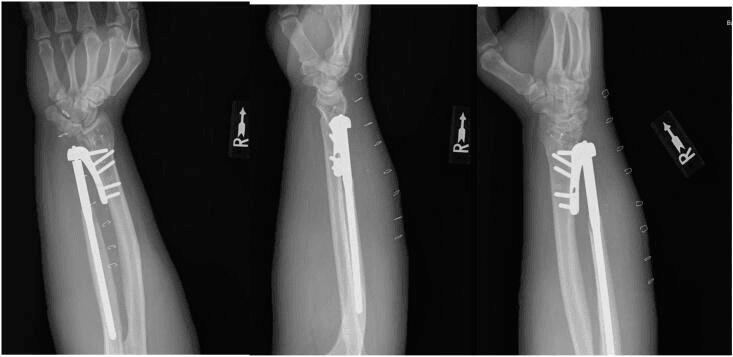
Who. Younger patients with isolated DRUJ arthritis, an intact TFCC, a good sigmoid notch and good bone stock; failed prior DRUJ procedures needing revision; and high functional demands that call for maximal preservation of function. It is reserved for carefully selected patients in centres with expertise in DRUJ arthroplasty.
The trade-off. It maintains DRUJ anatomy and stability, gives good forearm rotation and may improve on the results of ulnar head excision. Against that are implant cost, loosening or failure (10-15% at 5-10 years), polyethylene wear and a difficult revision. Long-term data are limited compared with the Darrach and Sauvé-Kapandji.
Salvage of failed resection arthroplasties of the distal radioulnar joint using an ulnar head prosthesis: long-term results
- In this prospective multicentre series, 16 patients reviewed at a mean of 11 years after a Herbert ulnar head prosthesis (placed for painful instability after ulnar head resection) all had a clinically stable DRUJ, grip strength recovered to 81% of the opposite side, satisfaction rose to 8.9/10, and no stem loosening or further DRUJ surgery occurred - early gains did not deteriorate long-term.
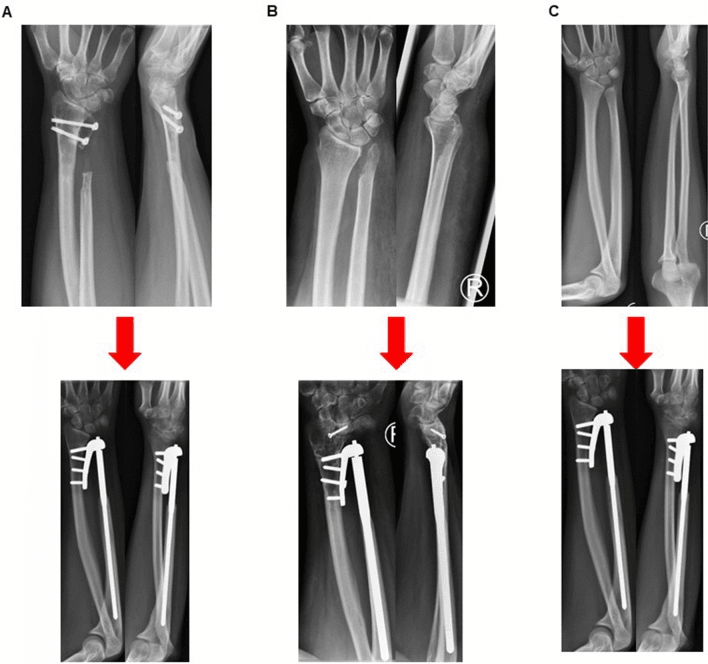
Outcomes following distal radioulnar joint arthroplasty in the setting of total or partial wrist fusion
- In 33 primary DRUJ implants with a mean 67-month follow-up, pain and Mayo Wrist Scores improved, but 30% of implants were explanted and 61% required a second surgery for an implant-related complication - failure was concentrated in total wrist fusions, underscoring strict patient selection for DRUJ arthroplasty.
Complications
Early. Wound healing problems (infection, dehiscence, haematoma), nerve injury and early instability. The dorsal sensory branch of the ulnar nerve is the nerve most often injured and is at risk with every approach; protect it during dissection, and a painful neuroma may need excision and burial.
Ulnar stump instability. The most common complication of the Darrach, quoted at 20-40%, and higher in younger, active patients. A Sauvé-Kapandji can develop the same proximal stump instability. The problem is managed in stages:
- Prevention - soft-tissue stabilisation at the index procedure
- Conservative - splinting, therapy, activity modification
- Surgical - ECU tenodesis, pronator quadratus wrap, tendon interposition (palmaris, FCR strip)
- Salvage - an ulnar head prosthesis if bone stock is adequate; a one-bone forearm as the last resort
The Darrach also brings radioulnar impingement, ECU subluxation, weak grip and persistent pain.
Nonunion after Sauvé-Kapandji. It occurs in 5-10%, usually at the fusion site. Smoking, poor technique and inadequate fixation are the risk factors, and a symptomatic nonunion is revised with bone graft and rigid plate fixation. ECU irritation and prominent hardware are the procedure's other problems.
Failed arthroplasty. Loosening, wear, breakage, instability and erosion of the sigmoid notch call for surveillance, and revision if symptomatic: revision arthroplasty or conversion to a salvage procedure, with a one-bone forearm as the last resort.
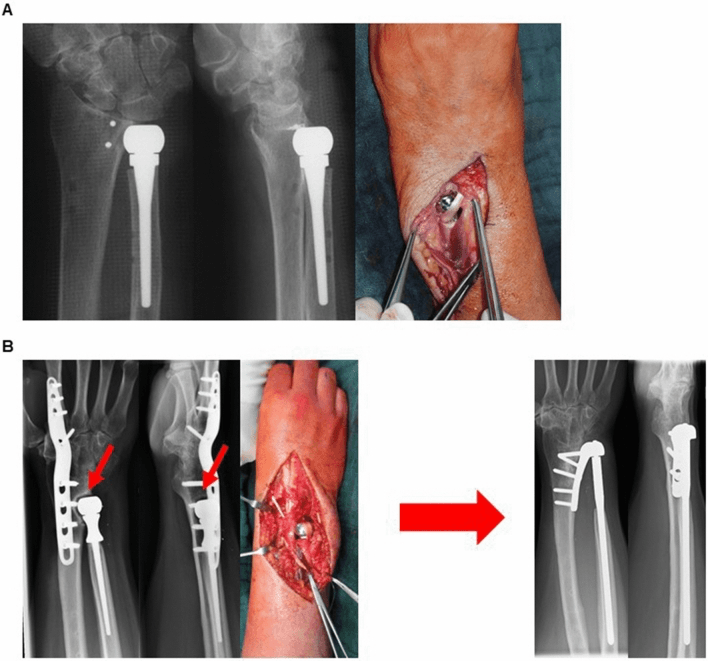
Across all procedures. Stiffness may follow any operation; early motion protocols prevent it, and aggressive therapy treats it if excessive. Persistent or recurrent pain affects 10-20%, and complex regional pain syndrome is rare (less than 5%).
The rates below are quoted ranges from heterogeneous series, not measured comparisons: no study on this page compares these operations against each other.
- Darrach
- 20-40%
- Sauvé-Kapandji
- 10-15%
- Ulnar Head Replacement
- 5-10%
- Darrach
- 10-20%
- Sauvé-Kapandji
- 10-15%
- Ulnar Head Replacement
- 10-15%
- Darrach
- N/A
- Sauvé-Kapandji
- 5-10%
- Ulnar Head Replacement
- N/A
- Darrach
- 15-20%
- Sauvé-Kapandji
- 10-15%
- Ulnar Head Replacement
- 10-15%
Postoperative Care
The principles. Protect the Sauvé-Kapandji fusion and do not load it until radiographic union. Move a Darrach early to prevent stump adhesions. Grip strengthening is critical to functional recovery, and training is tailored to the patient's occupation and hobbies.
The protocols. After a Darrach, a short arm splint for 2 weeks is followed by progressive range of motion. After a Sauvé-Kapandji, an above-elbow splint in supination for 2 weeks is followed by a short arm splint to 6 weeks, and active motion starts once fusion is confirmed; full recovery takes 3-4 months.
- Darrach
- 2 weeks
- Sauvé-Kapandji
- 6 weeks
- Darrach
- 2-4 weeks
- Sauvé-Kapandji
- 6-8 weeks
- Darrach
- 6 weeks
- Sauvé-Kapandji
- 8-10 weeks
- Darrach
- 8-12 weeks
- Sauvé-Kapandji
- 12-16 weeks
Follow-up radiographs. A Sauvé-Kapandji is imaged at 6 and 12 weeks to confirm fusion, a Darrach at 6 weeks to assess soft-tissue healing, and both annually or as symptoms require thereafter.
Return to work. Procedure-dependent:
- Sedentary - 2-4 weeks
- Light manual - 6-8 weeks
- Heavy manual - 12-16 weeks
Outcomes and Prognosis
What the evidence supports. The cited series are single-procedure case series, and none of the comparisons a surgeon actually needs has been made in a controlled study. Percentages quoted in textbooks for these operations are pooled impressions from heterogeneous series and are deliberately not reproduced here.
- Darrach - reliable pain relief in the low-demand and rheumatoid wrist, at the cost of an unstable, convergent proximal ulnar stump in younger or higher-demand patients. Avoid quoting a success percentage: none is supported by the sources here, and the 1912 original reported no outcome at all
- Sauvé-Kapandji - Kapandji's own technique paper is seven patients. Vincent's rheumatoid series of 21 wrists reported, at a mean of 39 months, pronation 78 and supination 86 degrees with radiographic prevention of carpal translocation: inflammatory wrists, not the post-traumatic young. Neither reports a validated outcome score, so counsel on rotation preserved and ulnar support gained rather than on a satisfaction percentage
- Hemiresection-interposition - Bowers reported stable, painless rotation in 85% of rheumatoid wrists and in all of his smaller degenerative and post-traumatic group, at a mean of 2.5 years in 38 patients: a single surgeon, no comparison group, no validated score. No larger or comparative series has superseded it, so quote the denominator with the figure, and expect that results may deteriorate as the interposition attenuates
- Prosthetic arthroplasty - no registry data and no comparative series. In van Schoonhoven's specialist salvage cohort, the 16 of 22 eligible patients reviewed at a mean of 11 years all had a stable joint and 81% grip, with no stem loosening; in Amundsen's fusion cohort 30% of implants were explanted and 61% of patients needed a second operation
- Failed salvage - poorly solved. After failed distal ulna resection, Archual's Achilles allograft interposition left 7 of 10 patients with persistent pain and instability, and 5 needed revision
The two implant figures describe two different populations, not two estimates of the same thing. An implant placed for a failed resection in an otherwise mobile wrist behaves differently from one placed beneath a total wrist fusion, so selection governs everything.
Prognostic factors. Better outcomes follow a procedure matched to the patient's age and demand, good bone stock, absence of inflammatory arthropathy, non-smoking, adequate soft-tissue stabilisation and realistic expectations. Workers' compensation or litigation, unrealistic expectations, severe osteoporosis and active smoking (which affects healing) predict worse results, and the effect of inflammatory arthritis is variable.
Over time. Stump instability after a Darrach may develop over time. The Sauvé-Kapandji is generally durable and its pseudarthrosis rarely causes problems. Long-term prosthetic data are limited, with the potential for wear and loosening.
Guidelines, Registries & Global Practice
DRUJ arthritis is a clinical and radiographic diagnosis with no single society "guideline" governing it; practice is shaped by hand-surgery society teaching (ASSH, BSSH, FESSH, IFSSH) and by the absence of high-level comparative evidence. The principles below apply wherever the operation is performed.
Global Epidemiology
- Post-traumatic disease (distal radius malunion, chronic DRUJ instability, Essex-Lopresti injury) is the dominant cause worldwide; inflammatory arthropathy is the next largest group and primary osteoarthritis is uncommon.
- Distal radius fractures are among the most common upper-limb fractures globally and are rising with population ageing, so the at-risk pool for secondary DRUJ arthritis is large and growing.
- Inflammatory (rheumatoid) DRUJ disease is declining in high-income settings as early biologic disease-modifying therapy reduces joint destruction, but remains a frequent indication where access to such therapy is limited.
Side-by-Side Practice Comparison
- approach
- Darrach excision favoured (poor bone precludes reliable fusion or implant)
- rationale
- Reliable pain relief, simple, tolerant of poor bone stock
- approach
- Sauvé-Kapandji or ulnar head replacement
- rationale
- Preserve ulnocarpal support, grip and rotation; avoid stump convergence
- approach
- Corrective distal radius osteotomy ± ulnar shortening
- rationale
- Address the cause before sacrificing the joint
- approach
- Ulnar head / total DRUJ arthroplasty in specialist centres
- rationale
- Restores stability that excision cannot; needs expertise and bone stock
Registry and Evidence Notes
- There is no dedicated international DRUJ implant registry; survivorship data come from single-centre and multicentre series rather than national joint registries (which capture hip, knee and increasingly shoulder arthroplasty).
- The best long-term implant data are prospective multicentre series of the Herbert ulnar head prosthesis showing durable stability at over 10 years, contrasted with high complication rates when DRUJ implants are combined with total wrist fusion.
High- vs Limited-Resource Practice Variation
- Well-resourced settings: ready access to CT, MR arthrography and arthroscopy for diagnosis; ulnar head and total DRUJ implants and hand therapy available; corrective osteotomy offered for malunion.
- Limited-resource settings: diagnosis rests on plain radiographs and clinical tests; the Darrach and Sauvé-Kapandji procedures dominate because they need no implants and tolerate poor bone; prosthetic arthroplasty and specialised hand therapy may be unavailable, raising the threshold for surgery and favouring durable, low-cost salvage.
Controversies & Areas of Uncertainty
DRUJ salvage surgery rests almost entirely on Level IV case series; no randomised trial has compared the main procedures, so several questions remain genuinely unresolved.
- Darrach versus Sauvé-Kapandji in the active patient. Both rely on the same soft-tissue stabilisation and both can develop a painful, convergent proximal ulnar stump. Sauvé-Kapandji preserves the ulnar head and ulnocarpal support and is generally preferred in younger, higher-demand patients, but high-quality comparative data are lacking and stump instability is not reliably abolished by either.
- Failed distal ulna resection is hard to salvage. Symptomatic radioulnar convergence after Darrach is a recognised, poorly solved problem.
Distal radioulnar Achilles allograft interposition arthroplasty: does it solve the problem of persistent pain?
- In 10 patients salvaged with Achilles allograft interposition after failed distal ulna resection (mean follow-up 76 months), motion and grip improved only marginally, 7 of 10 had persistent pain and instability from allograft subluxation or radioulnar convergence, and 5 required revision - the authors advise considering alternative salvage strategies.
- Ulnar head and total DRUJ implants restore stability that excision arthroplasties cannot, with durable long-term results in well-selected wrists, but registry-level survivorship data are scarce and complication/explantation rates rise sharply when combined with total wrist fusion.
- Role of corrective radius osteotomy. When DRUJ arthritis is early and driven by a correctable distal radius malunion, osteotomy may halt progression and defer salvage; the threshold of arthrosis beyond which osteotomy fails is not well defined.
MCQ Practice Points
Q: What are the causes of DRUJ arthritis and how do they affect treatment selection?
A: Causes: (1) Post-traumatic (most common) - distal radius malunion, Essex-Lopresti injury, TFCC tears; (2) Inflammatory - RA (often bilateral, involves carpal joints); (3) Degenerative - primary OA (rare, usually with positive ulnar variance). Treatment selection: Low-demand elderly: Darrach resection. High-demand/young: Matched ulnar head prosthesis, Sauvé-Kapandji, or one-bone forearm. RA with concurrent carpal disease: Consider combined procedures.
Q: What is the Darrach procedure and what are its indications and complications?
A: Darrach procedure: Excision of distal ulna (2-3 cm). Indications: Low-demand elderly patients, rheumatoid arthritis, failed previous DRUJ procedures. Contraindications: Young, active patients; heavy laborers; need for forearm stability. Complications: Ulnar stump instability (painful clicking, snapping - most common); Radioulnar impingement; Weakness of grip; ECU subluxation. Modifications (soft tissue stabilization, capsular interposition) reduce instability risk.
Q: What is the Sauvé-Kapandji procedure and when is it preferred over Darrach?
A: Sauvé-Kapandji: DRUJ fusion with proximal ulnar pseudarthrosis (segment excision creates "floating" proximal ulna). Advantages over Darrach: Preserves ulnar head for ulnocarpal support; Better cosmesis (no ulnar stump); Maintains TFCC insertion. Indications: Younger, active patients; Need for ulnar-sided wrist stability. Complications: Proximal stump instability (similar to Darrach - requires soft tissue stabilization); Pseudarthrosis of fusion; ECU irritation.
Q: What are the options for ulnar head replacement in DRUJ arthritis?
A: Matched ulnar head arthroplasty (e.g., First Choice, Herbert): Replaces arthritic ulnar head while preserving DRUJ articulation. Advantages: Maintains forearm stability, grip strength, and ulnocarpal support. Indications: Young/active patients with isolated DRUJ arthritis and intact sigmoid notch. Requirements: Adequate sigmoid notch cartilage, stable soft tissues. Complications: Loosening, instability (requires adequate soft tissue tension), sigmoid notch erosion.
Q: How does ulnar variance affect DRUJ arthritis and treatment planning?
A: Positive ulnar variance: Ulnar impaction syndrome, increases ulnocarpal loading. May require ulnar shortening osteotomy if DRUJ preserved, or consider shortening with arthroplasty. Negative ulnar variance: Often post-traumatic (radius malunion with shortening). May require radius osteotomy to correct alignment before DRUJ procedure. Neutral variance: Isolated DRUJ procedure usually sufficient. Variance assessment on neutral rotation PA radiograph essential for surgical planning.
Why Radioulnar Convergence Happens After Distal Ulna Resection
The whole of the "painful clicking stump" viva turns on radioulnar convergence, and a followUp asks why it happens - but the pathomechanics are never set out.
- The ulna is a load-bearing strut. The intact distal ulna and its DRUJ articulation act as a lateral buttress that keeps the radius and ulna apart and shares axial and rotational load across the forearm. Removing the distal ulna (Darrach) - or leaving only a short, poorly-supported stump - removes that spacer.
- Dynamic muscle forces then pull the bones together. The interosseous membrane, pronator quadratus and the wrist/finger muscles bridging the radius and ulna generate a convergent (radius-toward-ulna) force, especially under grip and forearm rotation. With the distal buttress gone, the residual ulna is drawn toward the radius and the two bones abut and impinge - the painful clicking "rubbing" the patient describes, seen as convergence on grip/stress radiographs.
- Why it is worse in the young and high-demand. Greater muscle power and higher loading generate larger convergent forces, so a Darrach in a young manual worker is far more likely to become symptomatic - which is exactly why Sauvé-Kapandji (preserving the ulnar head and ulnocarpal support) or an implant is preferred in this group.
- Static resection alone does not fix it. Simply shortening the ulna further worsens convergence; the problem is the lost articulation and dynamic imbalance, not bone length.
Q: Why does radioulnar convergence develop after distal ulna resection? A: The distal ulna and its DRUJ articulation normally act as a lateral strut keeping the radius and ulna apart and sharing load. Once it is resected, the interosseous membrane, pronator quadratus and bridging muscles pull the residual ulna toward the radius under grip and rotation, so the two bones abut and impinge (painful clicking; convergence on grip radiographs). It is worse in young, high-demand patients (greater convergent force) and is NOT solved by further ulnar shortening - hence Sauvé-Kapandji or an implant is preferred in this group.
Stabilising the Unstable Ulnar Stump
The complications list and the failed-Darrach viva name several soft-tissue stabilisations for a painful convergent stump - ECU/FCU tenodesis, pronator quadratus interposition, distal radioulnar ligament reconstruction - but a followUp asks you to describe one, and none is developed.
- ECU (or FCU) tenodesis sling (dynamic). A distally-based slip of extensor carpi ulnaris (or flexor carpi ulnaris) is passed through a drill hole in the residual ulna and looped around it (a Breen-Jupiter type ECU/FCU tenodesis), tethering the stump and adding a dynamic checkrein that resists convergence during grip. It is the workhorse both as a primary adjunct at the Darrach and for a symptomatic stump.
- Pronator quadratus interposition. The pronator quadratus is mobilised and wrapped or interposed between the radius and the ulnar stump, providing a vascularised soft-tissue cushion that resists bony abutment - simple, and often combined with a tenodesis.
- Distal radioulnar ligament reconstruction (Adams-Berger). A free tendon graft (palmaris longus) is passed through bone tunnels in the radius and ulna to recreate the dorsal and palmar radioulnar ligaments and restore a stable articulation; this is used where the ulnar head is retained (instability without full excision) rather than for a bare stump.
- When soft tissue is not enough. In a well-selected wrist with adequate bone stock and an intact/reconstructable sigmoid notch, converting to an ulnar head or total DRUJ prosthesis restores a true stable articulation more reliably than any tenodesis; a one-bone forearm (see the radioulnar-synostosis topic) is the last-resort salvage that trades all forearm rotation for a stable, painless forearm.
Q: Describe a soft-tissue stabilisation for a painful unstable ulnar stump after Darrach. A: The most useful is an ECU (or FCU) tenodesis sling - a distally-based tendon slip passed through a drill hole in the residual ulna and looped around it (Breen-Jupiter type) to tether the stump and dynamically resist convergence. Alternatives are a pronator quadratus interposition/wrap (a vascularised cushion between radius and stump) and, where the ulnar head is retained, an Adams-Berger distal radioulnar ligament reconstruction with a palmaris graft. If soft tissue fails and bone stock/sigmoid notch allow, convert to an ulnar head/total DRUJ implant; a one-bone forearm is the last resort.
Clinical Decision Scenarios
Practise clinical reasoning and management decisions out loud
“A 55-year-old carpenter presents with ulnar wrist pain 3 years after a distal radius fracture treated non-operatively. Examination reveals DRUJ tenderness, crepitus, and 50% loss of forearm rotation. Radiographs show DRUJ arthritis with dorsal malunion of the radius. Conservative management has failed. What are your surgical options and which would you recommend?”
“A 72-year-old retired woman with rheumatoid arthritis presents with painful DRUJ arthritis affecting her dominant hand. She has tried NSAIDs and corticosteroid injection with temporary relief only. Radiographs show severe DRUJ arthritis with ulnar head erosion. She has low functional demands. What is your management approach?”
“A 48-year-old manual worker had a Darrach resection of the distal ulna 18 months ago for post-traumatic DRUJ arthritis. He now has ulnar-sided pain, a painful click on gripping and rotation, and feels the forearm bones 'rub together'. Radiographs show convergence of the proximal ulnar stump towards the radius on grip views. How do you assess and manage this?”
Definition and Anatomy
- Arthritis of distal radioulnar joint (ulnar head articulates with sigmoid notch of radius)
- Critical for forearm rotation (pronation/supination)
- Etiology: Post-traumatic 60-70% (distal radius malunion most common), inflammatory arthritis 10-15%, primary OA 5-10%
- Often associated with TFCC pathology, ECU tendinopathy
Clinical Presentation
- Ulnar-sided wrist pain worse with forearm rotation, gripping, loading
- Painful restricted pronation/supination (30-50% loss typical)
- DRUJ tenderness, crepitus with rotation
- Piano key sign (dorsal-volar instability of ulnar head)
- DRUJ grind test positive (axial load with rotation)
- Difficulty with doorknobs, screwdrivers, wringing towels
Investigation Protocol
- PA and lateral wrist radiographs: Joint space narrowing, subchondral sclerosis, ulnar head deformity, assess ulnar variance
- GOLD STANDARD: CT scan (sigmoid notch morphology, articular surface detail, degree of subluxation, bone stock assessment)
- MRI: TFCC integrity, soft tissue pathology
- Diagnostic injection: Confirms DRUJ as pain source
- Bilateral comparison views valuable
Conservative Management
- First-line for early-moderate arthritis
- Activity modification (avoid forceful rotation, push-ups)
- NSAIDs for symptom relief
- Splinting in neutral rotation (Muenster-type orthosis) during activities
- Corticosteroid injection (60-70% temporary relief)
- No published success rate - counsel on relief of a specific painful arc rather than a percentage
- Surgery if 3-6 months conservative treatment fails
Surgical Options - By Patient
- DARRACH (ulnar head excision): Age greater than 60, low-demand, rheumatoid arthritis, severe bone erosion - Simple, reliable pain relief but ulnar stump instability and reduced grip
- SAUVÉ-KAPANDJI (radioulnar fusion + pseudarthrosis): Age less than 60, high-demand, good bone stock - Stable DRUJ, maintained rotation, best outcomes but technical with nonunion risk 5-10%
- HEMIRESECTION-INTERPOSITION (Bowers): Age 45-65, intermediate demands - Preserves TFCC, less extensive but variable long-term results
Sauvé-Kapandji Technique
- Create radioulnar fusion at DRUJ level (prepare articular surfaces, fix with screw/K-wires in neutral rotation)
- Create 1-1.5cm ulnar pseudarthrosis proximal to fusion (allows forearm rotation through this site)
- Advantages: Stable DRUJ, maintained rotation via pseudarthrosis, excellent pain relief, good grip strength
- Recovery: 3-4 months to full activity
- Preserves rotation through the pseudarthrosis; small-series results favourable in selected patients (no comparative rates exist)
Key Complications
- Darrach: Ulnar stump instability (30-40%, especially younger patients), reduced grip strength (10-20%)
- Sauvé-Kapandji: Nonunion at fusion site (5-10%), ulnar stump instability if excessive proximal resection
- General: Nerve injury (dorsal sensory ulnar nerve), persistent pain (10-20%), wound complications, CRPS (less than 5%)
Viva Talking Points
- Emphasize post-traumatic etiology (distal radius malunion most common)
- CT scan gold standard imaging
- Conservative first-line (3-6 months)
- Surgical selection by patient age and demand: Darrach for elderly/low-demand, Sauvé-Kapandji for younger/high-demand
- Know Sauvé-Kapandji technique (fusion + pseudarthrosis)
- Ulnar stump instability main concern with Darrach
- Assess for associated TFCC, ECU pathology
Evidence Base
Key Evidence
- Darrach WE (1913): Original description
- High complication rates in young, active patients
- Remains reliable for elderly, low-demand patients
- Sauvé and Kapandji (1936): Original description
- Preferred over Darrach in younger, higher-demand patients (preserves ulnocarpal support)
- No cited series reports a comparative fusion rate; Vincent's rheumatoid series reports rotation preserved (78/86 degrees) and prevention of carpal translocation
- Procedure
- Ulnar head excision
- Key Finding
- Original description of procedure
- Procedure
- DRUJ fusion + pseudarthrosis
- Key Finding
- Preserves ulnocarpal support
- Procedure
- Hemiresection-interposition
- Key Finding
- Alternative for moderate arthritis
- Procedure
- Sauvé-Kapandji vs Darrach
- Key Finding
- S-K superior in younger patients
Additional Resources and Further Reading
The Sauvé-Kapandji procedure for reconstruction of the rheumatoid distal radioulnar joint
- In 21 rheumatoid wrists (17 patients) followed a mean of 39 months, the Sauvé-Kapandji procedure preserved forearm rotation (pronation 78 degrees, supination 86 degrees) and prevented ulnar and palmar carpal translocation, providing a stable ulnar-sided support for the rheumatoid wrist with DRUJ degeneration.
Practical Notes
Hand therapy is critical for both conservative and postoperative management. Customised splinting in neutral rotation, grip and forearm strengthening, and functional retraining optimise outcomes regardless of healthcare setting. In work-related cases, detailed causation assessment, graduated return-to-work planning, and ergonomic modification of forearm-rotation-heavy tasks support recovery.
This topic provides comprehensive, globally applicable coverage of DRUJ arthritis for international fellowship examinations, emphasising aetiology recognition, patient-specific surgical selection, and evidence-based management of this common yet challenging wrist condition.