Gene Expression Without Sequence Change
- EPIGENETICS refers to HERITABLE and potentially REVERSIBLE changes in GENE EXPRESSION that occur WITHOUT any change to the underlying DNA SEQUENCE; it is the molecular interface through which the environment, ageing and mechanical loading influence how musculoskeletal cells (chondrocytes, osteoblasts, osteoclasts, mesenchymal stem cells) behave - and, because the changes are reversible, it is an attractive therapeutic target.
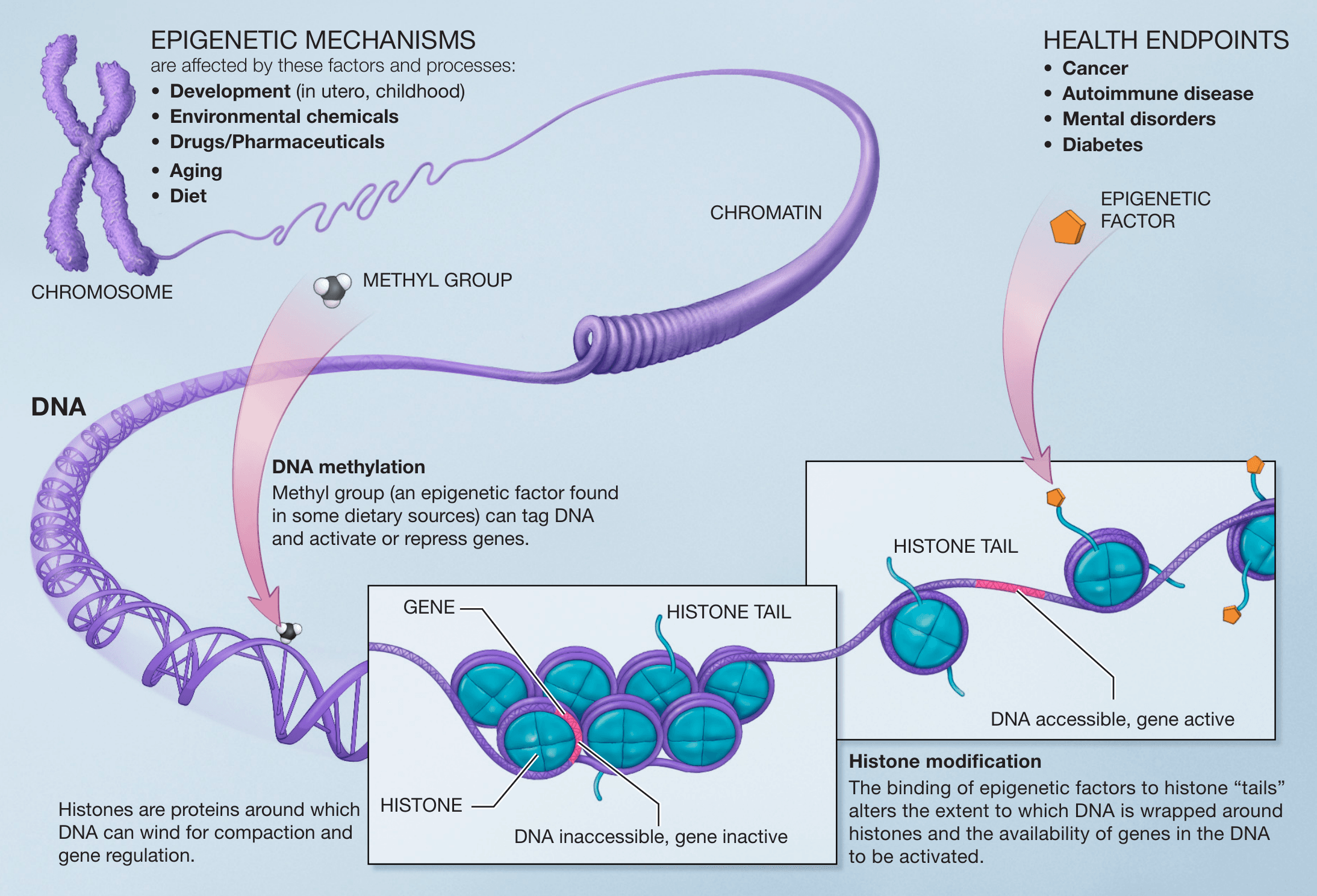
- There are THREE principal mechanisms: DNA METHYLATION (methyl groups, typically at promoter CpG islands, generally SILENCING a gene), HISTONE MODIFICATION (acetylation/methylation of histone tails that OPEN or CLOSE chromatin and thus permit or block transcription), and NON-CODING RNAs (notably MICRORNAS and long non-coding RNAs that regulate gene expression post-transcriptionally).
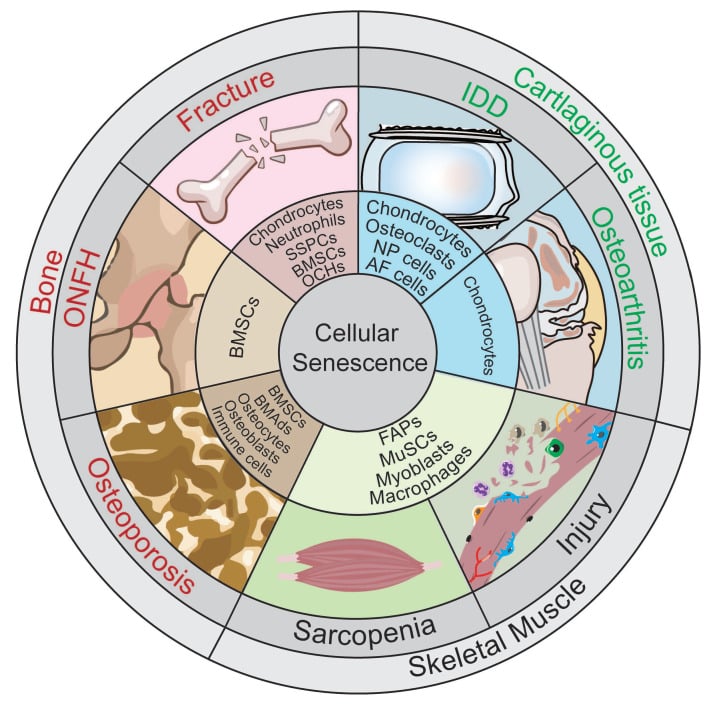
- In OSTEOARTHRITIS, epigenetic regulation (DNA methylation, histone modification and non-coding RNA) contributes to the abnormal chondrocyte phenotype and to mesenchymal stem cell (MSC) SENESCENCE - aged MSCs differentiate poorly and release pro-inflammatory cytokines - and MSC-derived EXOSOMES (carrying DNA, RNA, proteins and lipids, including regulatory microRNAs) are being explored as a therapy to promote cartilage repair.
- Epigenetic dysregulation also contributes to OSTEOPOROSIS (osteoblast/osteoclast balance), to BONE and soft-tissue TUMOURS (epigenetic silencing of tumour-suppressors, characteristic methylation/chromatin changes), and to other degenerative musculoskeletal conditions - making epigenetics a unifying theme across MSK disease.
- EPIGENETIC CLOCKS - estimates of biological age from DNA-METHYLATION patterns (e.g. Horvath's clock, GrimAge, DunedinPACE) - have emerged as biomarkers of biological ageing; they show significant associations with degenerative musculoskeletal disease (for example chronic low-back-pain severity and functional impairment, and tissue-specific epigenetic ageing in OA cartilage), highlighting their potential as biomarkers although disease-specific algorithms and longitudinal validation are still needed.
- The CLINICAL IMPLICATIONS are emerging rather than established: epigenetic marks offer potential DIAGNOSTIC/PROGNOSTIC BIOMARKERS (including epigenetic age acceleration), and because epigenetic changes are REVERSIBLE they are candidate DRUG TARGETS (e.g. agents acting on methylation/HDACs) and underpin REGENERATIVE strategies (MSC/exosome therapy) - the orthopaedic relevance is conceptual understanding of how environment and ageing translate into MSK disease, rather than current routine practice.
- “Epigenetics = heritable, REVERSIBLE change in gene EXPRESSION WITHOUT a change in DNA SEQUENCE. Three mechanisms: DNA methylation (usually silences), histone modification (opens/closes chromatin), non-coding RNA (microRNA/lncRNA).
- “Roles in MSK: osteoarthritis (chondrocyte phenotype, MSC senescence; exosome therapy), osteoporosis, bone tumours (tumour-suppressor silencing). The interface of environment/ageing/load with gene expression.
- “Epigenetic clocks (DNA-methylation age - Horvath/GrimAge/DunedinPACE) = biomarkers of biological ageing, associated with degenerative MSK disease (OA cartilage runs 3.7 years old on Horvath's clock). Reversibility means drug-target/regenerative potential - and one epi-drug, the EZH2 inhibitor tazemetostat, is already licensed for INI1-deficient epithelioid sarcoma.
Epigenetics = heritable, reversible change in gene expression without any change in the DNA sequence - the bridge from environment/ageing/load to cell behaviour.
DNA methylation (usually silences), histone modification (opens/closes chromatin), non-coding RNA (microRNA/lncRNA). All implicated in OA, osteoporosis and tumours.
Mechanisms & Roles in MSK Disease
Epigenetics is heritable, reversible regulation of gene expression without DNA-sequence change, through DNA methylation (promoter CpG methylation generally silencing genes), histone modification (acetylation/ methylation opening or closing chromatin) and non-coding RNAs (microRNAs and lncRNAs). In osteoarthritis these drive an abnormal chondrocyte phenotype and MSC senescence (poorly differentiating, pro-inflammatory cells), and MSC-derived exosomes carrying regulatory microRNAs are being explored to promote cartilage repair. Epigenetic dysregulation also contributes to osteoporosis (osteoblast/osteoclast balance) and to bone/soft- tissue tumours (tumour-suppressor silencing). Epigenetics is the environment-ageing-load interface of MSK disease.
- What it does
- Methyl at promoter CpG generally silences the gene
- MSK example
- Altered chondrocyte/osteoblast gene programs; epigenetic clocks
- What it does
- Acetylation/methylation open or close chromatin
- MSK example
- HDAC activity in cartilage/bone regulating transcription
- What it does
- microRNA/lncRNA regulate expression post-transcriptionally
- MSK example
- OA, bone remodelling, tumours; deliverable via exosomes
Epigenetic Clocks & Clinical Implications
- Epigenetic clocks: estimates of biological age from DNA-methylation patterns (Horvath's clock, GrimAge, DunedinPACE) - biomarkers of ageing associated with degenerative MSK disease. The concrete figures from the systematic review: OA cartilage is 3.7 years older than chronological age on Horvath's clock; DunedinPACE tracks chronic low-back-pain severity and impairment at r = 0.39-0.45; GrimAge correlates most strongly with chronic pain (rho = 0.47).
- Read the direction with care. All fourteen underlying studies are observational, so none of this shows that epigenetic ageing causes degenerative disease rather than tracking its consequences - and GrimAge was found to mediate a socioeconomic effect on pain, so part of what these clocks measure is the biology of disadvantage. An r of 0.4 explains about a sixth of the variance: real, reproducible, and nowhere near a test.
- Biomarkers: epigenetic marks and epigenetic age acceleration as potential diagnostic/prognostic tools (disease-specific algorithms and longitudinal validation still needed).
- Therapeutic potential: because epigenetic changes are reversible, they are candidate drug targets (methylation/HDAC-acting agents) and underpin regenerative strategies (MSC/exosome therapy).
- Orthopaedic relevance: conceptual understanding of how environment/ageing translate into MSK disease - emerging, not yet routine practice.
The honest framing of epigenetics in musculoskeletal disease is that it is a rapidly advancing but still emerging field, with one important exception. The core concepts are secure - heritable, reversible changes in gene expression without alteration of the DNA sequence, mediated by DNA methylation, histone modification and non-coding RNAs, and clearly implicated in osteoarthritis, osteoporosis and bone tumours - and epigenetic clocks are a genuine, reproducible biomarker of biological ageing that correlates with degenerative musculoskeletal disease. The diagnostic applications are not ready: every clock study is observational, none has longitudinal validation, and the correlations are moderate. MSC and exosome regenerative therapies are preclinical, and no randomised trial has shown they change human osteoarthritis - which matters, because patients are being sold them. The exception is oncological and it is real: EZH2 inhibition with tazemetostat is licensed for INI1/SMARCB1-deficient epithelioid sarcoma, a soft-tissue sarcoma seen in orthopaedic oncology, so the claim that epigenetic therapy has not yet reached musculoskeletal practice is no longer true. State it precisely - one licensed indication with a 15% response rate, and everything else investigational.
Histone Modification, Specified
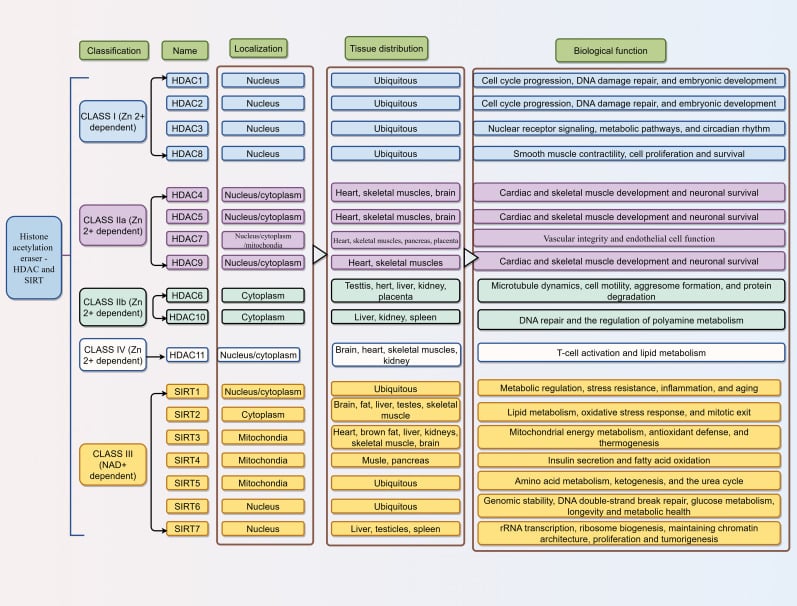
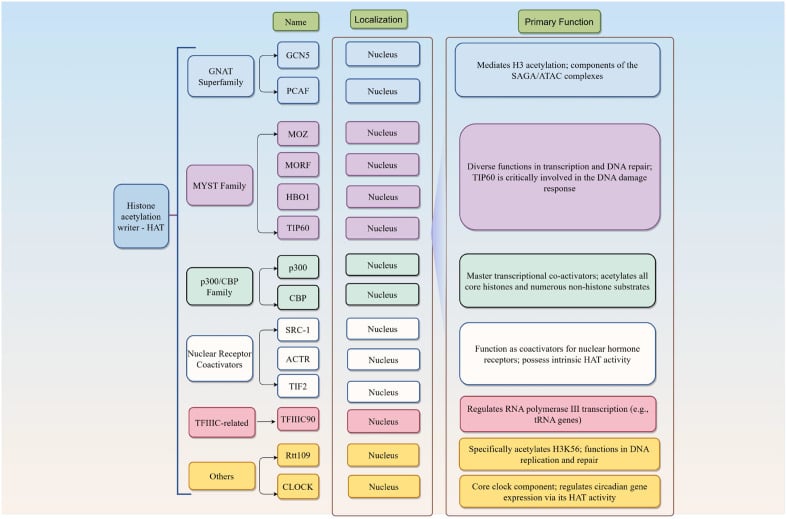
- Acetylation opens, deacetylation closes. Histone acetyltransferases (HATs) add acetyl groups to lysine tails, neutralising their positive charge and loosening the histone-DNA grip → open chromatin (euchromatin) → activates transcription; histone deacetylases (HDACs) remove them → condensed chromatin → represses/silences (which is why HDAC inhibitors can re-express silenced genes).
- Histone methylation is context-dependent. Unlike acetylation, methylation activates OR represses by position: H3K4me3 (at active promoters) is activating, whereas H3K9me3 and H3K27me3 (heterochromatin/Polycomb) are repressive.
- Writers, erasers, readers. Marks are added by writers (HATs, methyltransferases, DNMTs), removed by erasers (HDACs, demethylases, TET enzymes) and interpreted by readers (bromodomain proteins read acetyl, chromodomain proteins read methyl) - the machinery that makes the code reversible and druggable.
Q: Which histone modification activates and which represses?
A: Acetylation (by HATs) neutralises the lysine charge → opens chromatin → activates; deacetylation (by HDACs) → condenses → represses (so HDAC inhibitors re-express silenced genes). Histone methylation is context-dependent: H3K4me3 activating, H3K9me3/H3K27me3 repressive. Marks are added by writers (HATs/HMTs/DNMTs), removed by erasers (HDACs/demethylases/TETs), read by readers (bromodomains read acetyl, chromodomains read methyl).
The Methylation Machinery and the Real Epigenetic Drugs
- The methylation machinery. DNMTs add a methyl group to the 5-carbon of cytosine (5-methylcytosine) in CpG dinucleotides: DNMT1 is the maintenance enzyme (copying the pattern to the daughter strand at replication), DNMT3A/3B the de novo enzymes; TET enzymes oxidise 5-methylcytosine towards demethylation.
- How methylation silences. Methyl-CpG directly blocks transcription-factor binding and recruits methyl-CpG-binding proteins (MeCP2/MBD) that pull in HDACs/co-repressors to condense the chromatin - linking the two mechanisms.
- The epigenetic drugs (real, licensed). Because the marks are reversible, epi-drugs exist: DNMT inhibitors / hypomethylating agents (azacitidine, decitabine - myelodysplastic syndrome/AML) and HDAC inhibitors (vorinostat, romidepsin - cutaneous T-cell lymphoma). One of them is already an orthopaedic drug. Over 90% of epithelioid sarcomas lose INI1/SMARCB1, a subunit of the SWI/SNF chromatin-remodelling complex, and that loss creates an oncogenic dependence on EZH2, the histone methyltransferase that writes the repressive H3K27me3 mark. The EZH2 inhibitor tazemetostat exploits exactly that dependence and is licensed for advanced INI1-deficient epithelioid sarcoma. Keep the result honest: the pivotal phase 2 cohort of 62 patients had an objective response rate of 15%, median progression-free survival 5.5 months and median overall survival 19.0 months, with little toxicity. So the correct statement is not that epigenetic therapy has yet to reach orthopaedics - it has, in a soft-tissue sarcoma - but that outside that one indication it remains investigational.
Q: What is the DNA-methylation machinery, and are there real epigenetic drugs?
A: DNMTs add methyl to cytosine C5 (5-methylcytosine) at CpG: DNMT1 = maintenance (at replication), DNMT3A/3B = de novo; TET enzymes drive demethylation. Methylation silences by directly blocking transcription factors + recruiting MeCP2/MBD and then HDACs, condensing chromatin. Real licensed epi-drugs: DNMT inhibitors (azacitidine, decitabine - MDS/AML), HDAC inhibitors (vorinostat, romidepsin - CTCL), and the one that is orthopaedic: the EZH2 inhibitor tazemetostat for INI1/SMARCB1-deficient epithelioid sarcoma - loss of a SWI/SNF subunit creates dependence on EZH2, which is then blocked. Response rate 15%, but it is proof the principle reaches musculoskeletal disease.
Mnemonics & Memory Aids
MARK
Hook:MARK (epigenetic marks): Methylation, Acetylation/histones, RNA (non-coding), Klocks/reversibility.
WER
Hook:WER: Writers add, Erasers remove, Readers interpret - and every licensed epigenetic drug works by blocking a writer or an eraser. The one that is orthopaedic blocks a writer: tazemetostat on EZH2.
Related pages: Cell and Molecular Biology in Orthopaedics and Genetics and Inheritance in Orthopaedics hold the layer beneath this one - the distinction that defines the topic is that epigenetics changes expression without changing the sequence, so read them together. Epithelioid Sarcoma is the single place where this science is licensed treatment: INI1/SMARCB1 loss creating EZH2 dependence, drugged by tazemetostat; Synovial Sarcoma is the neighbouring translocation sarcoma in which SS18-SSX also acts by hijacking chromatin remodelling, and Osteosarcoma with Chondrosarcoma are where tumour-suppressor silencing by promoter methylation is best described. On the degenerative side, Osteoarthritis Pathophysiology, Chondrocyte Metabolism and Articular Cartilage Structure are where the methylation and non-coding-RNA changes described here are expressed as a phenotype, and Intervertebral Disc Biology is the tissue in which the senescence data are strongest. Osteoporosis and Bone Remodeling carry the RANKL-OPG axis that epigenetic regulation acts on. Stem Cells and MSCs in Orthopaedics and Gene Therapy and Tissue Engineering cover the exosome and regenerative strategies discussed here - and the reason they remain investigational.
Clinical Decision Scenarios
Practise clinical reasoning and management decisions out loud
“What is epigenetics, and why does it matter in musculoskeletal disease?”
Definition
- Heritable, reversible change in gene EXPRESSION
- WITHOUT change to the DNA sequence
- Interface of environment/ageing/load with cell behaviour
Three mechanisms
- DNA methylation (promoter CpG, usually silences)
- Histone modification (acetylation/methylation, chromatin open/close)
- Non-coding RNA (microRNA/lncRNA, post-transcriptional)
MSK roles
- Osteoarthritis: chondrocyte phenotype, MSC senescence; exosome therapy
- Osteoporosis: osteoblast/osteoclast balance
- Bone/soft-tissue tumours: tumour-suppressor silencing
Implications
- Epigenetic clocks (DNA-methylation age) = ageing biomarkers in degenerative MSK disease
- Reversibility means drug targets (methylation/HDAC/EZH2) + regenerative (MSC/exosome) therapy
- Emerging/investigational - not yet routine practice
Evidence & Key Studies
Single-cell sequencing, genetics and epigenetics reveal mesenchymal stem cell senescence in osteoarthritis
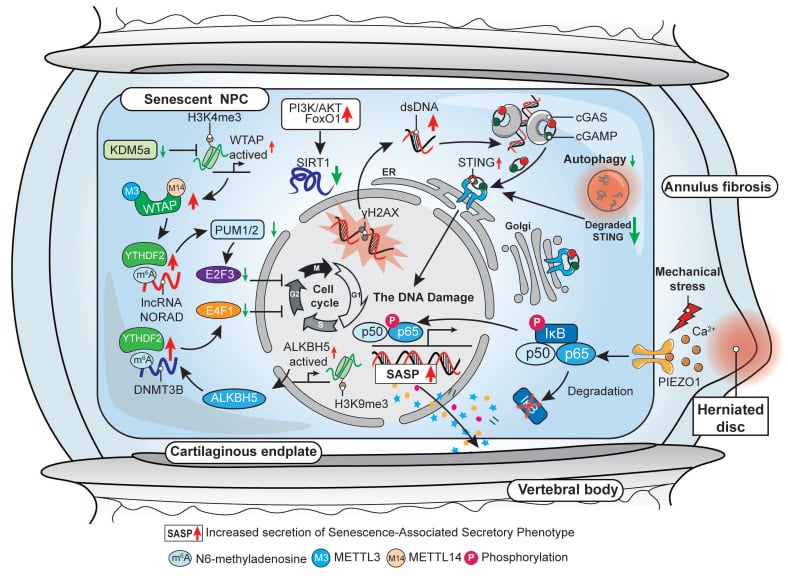
- Epigenetic regulation - DNA methylation, histone modification and regulation of non-coding RNA - is a key mechanism contributing to osteoarthritis, alongside mesenchymal stem cell (MSC) senescence (aged MSCs differentiate poorly and release pro-inflammatory cytokines).
- MSC-derived exosomes can deliver DNA, RNA, proteins and lipids, facilitating MSC migration and cartilage repair, making them a promising therapy for osteoarthritis.
- The review links MSC ageing and osteoarthritis at the genetic and epigenetic level and characterises the reparative potential of MSC-derived exosomes.
Epigenetic clocks in degenerative musculoskeletal diseases - a systematic review
- Fourteen observational studies (case-control, cross-sectional, cohort) and eight distinct epigenetic clocks derived from cartilage, bone and blood
- DunedinPACE correlated with chronic low-back-pain severity and functional impairment, r = 0.39 to 0.45
- Horvath's clock showed tissue-specific epigenetic ageing in OA cartilage: delta-age = 3.7 years older than chronological age
- GrimAge showed the strongest correlation with chronic pain (rho = 0.47) and mediated socioeconomic influences (beta = 0.81)
- No longitudinal validation exists; the authors call for disease-specific algorithms before clinical use
Gounder et al - tazemetostat in epithelioid sarcoma: an epigenetic drug licensed for a musculoskeletal tumour
- Over 90% of epithelioid sarcomas LOSE INI1/SMARCB1, a subunit of the SWI/SNF chromatin-remodelling complex, creating an oncogenic dependence on the histone methyltransferase EZH2
- Open-label phase 2 basket study, 62 patients with locally advanced or metastatic epithelioid sarcoma given oral tazemetostat, a selective EZH2 inhibitor
- Objective response rate 15% (9 of 62, 95% CI 7-26); disease control at 32 weeks 26%; median time to response 3.9 months
- Median progression-free survival 5.5 months, median overall survival 19.0 months
- Well tolerated: grade 3 or worse treatment-related events were anaemia (6%) and weight loss (3%); no treatment-related deaths
The role of epigenetic regulation (DNA methylation, histone modification, non-coding RNA) and MSC senescence in osteoarthritis, and the reparative potential of MSC-derived exosomes, come from the cited Tan review. The epigenetic-clock figures - Horvath delta-age of 3.7 years in OA cartilage, DunedinPACE r = 0.39-0.45 with low-back-pain severity, GrimAge rho = 0.47 with chronic pain and its mediation of socioeconomic effect - come from the Bao systematic review, as does the caution that all fourteen underlying studies are observational. The epithelioid sarcoma material - over 90% INI1/SMARCB1 loss, the resulting EZH2 dependence, and the 15% objective response rate to tazemetostat with median overall survival of 19.0 months - comes from the Gounder phase 2 basket study. The definition of epigenetics, the three mechanisms, the writer/eraser/reader machinery and the non-orthopaedic licensed epi-drugs are standard, well-established teaching.