Biology of Bone Repair
- Primary Healing: Requires absolute stability (less than 2% strain) + gap less than 0.01mm for contact healing (less than 1mm for gap healing). Mechanism: Cutting Cones.
- Secondary Healing: Occurs with relative stability (2-10% strain). Mechanism: Enchondral Ossification (Callus).
- Phases: Inflammation → Soft → Hard → Remodelling
- Diamond Concept: The holy grail of union = Cells + Scaffold + Signals + Mechanical Stability.
- Perren's Strain Theory: Tissues can only exist if they can withstand the mechanical strain of the environment.
- “Soft Callus = Type II Collagen (Cartilage). Hard Callus = Type I Collagen (Bone).
- “Primary Healing has NO callus.
- “BMP-2 = Open Tibia (INFUSE). BMP-7 = Non-union (OP-1).
- “Nicotine is a potent vasoconstrictor and inhibitor of healing.
Overview and Epidemiology
Fracture healing is the regeneration of bone. Other tissues heal by scar formation; bone regenerates its normal structure, through a complex cascade of cellular and biochemical events that restores its integrity.
Stability chooses the pathway. The strain at the fracture decides between primary and secondary healing. Under absolute stability (strain less than 2%), as when a compression plate eliminates micromotion, the bone behaves as if it were intact and remodels across the fracture with cutting cones. Under relative stability (strain 2-10%), as when an intramedullary nail allows micromotion, the body lays down cartilage callus to stiffen the gap.
- Primary (Direct)
- Absolute (No motion)
- Secondary (Indirect)
- Relative (Micromotion)
- Primary (Direct)
- Less than 2%
- Secondary (Indirect)
- 2% - 10%
- Primary (Direct)
- Haversian Remodelling
- Secondary (Indirect)
- Enchondral Ossification
- Primary (Direct)
- NO Callus
- Secondary (Indirect)
- YES Callus (Bridging)
- Primary (Direct)
- Lag Screw + Neutralisation Plate
- Secondary (Indirect)
- Intramedullary Nail
Primary (direct) healing is healing without callus. It needs absolute stability and an anatomical reduction, and it takes one of two forms depending on the gap:
- Contact healing, gap less than 0.01mm: cutting cones cross the fracture directly, osteoclasts boring tunnels that osteoblasts fill with osteoid, healing by Haversian remodelling
- Gap healing, gap less than 1mm: woven bone fills the gap first as a scaffold, and cutting cones then remodel it
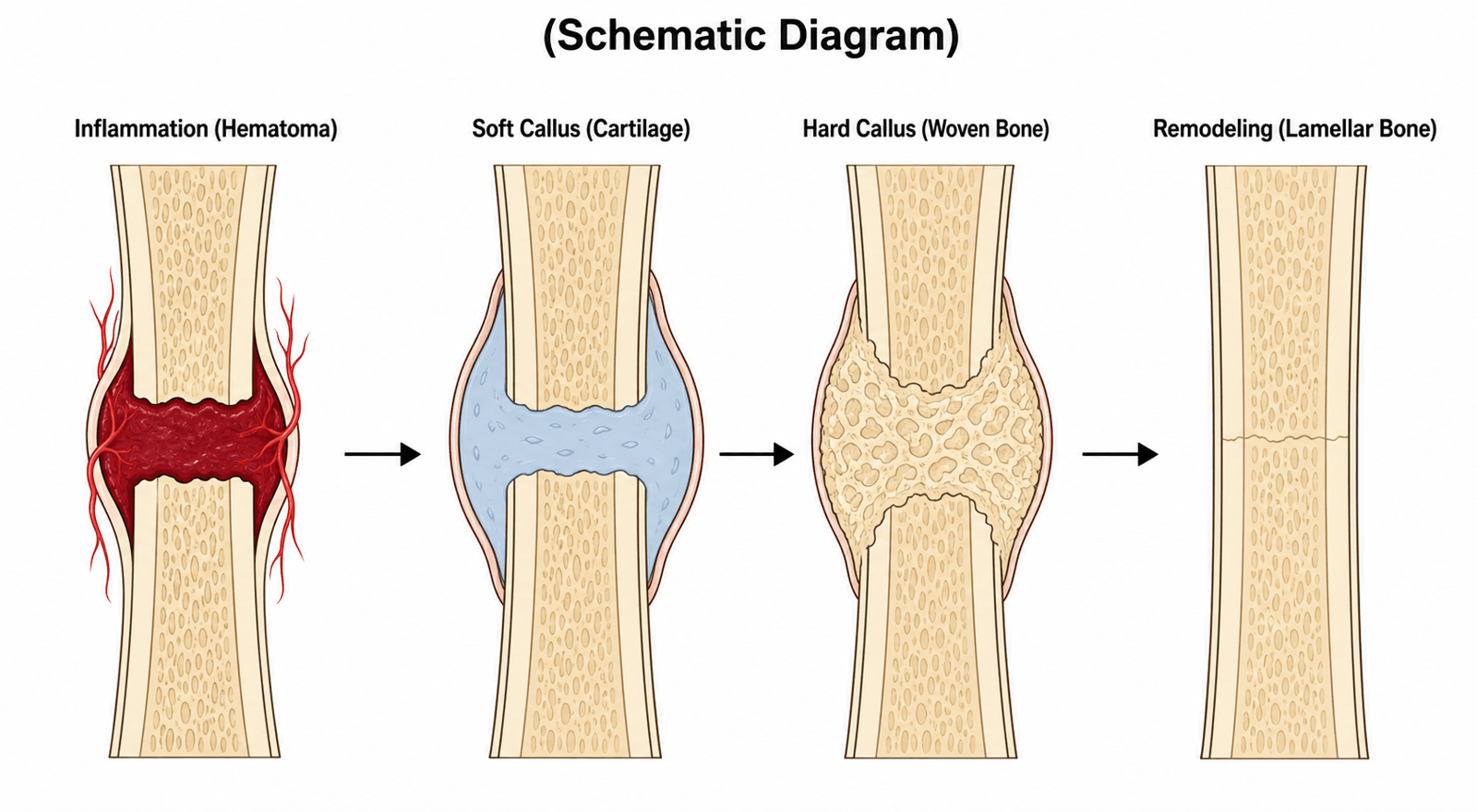
Secondary (indirect) healing is the natural form, healing by callus. It needs relative stability and vitality, and it requires micromotion. It runs through four phases:
- Inflammation (days): haematoma forms and mesenchymal stem cells are recruited
- Soft callus (weeks): cartilage, rich in type II collagen, bridges the gap by enchondral ossification
- Hard callus (months): the callus mineralises into woven bone, type I collagen
- Remodelling (years): woven bone is replaced by lamellar bone according to Wolff's law
Distraction osteogenesis is a third pathway: intramembranous ossification under tension stress (Ilizarov). It depends on four conditions:
- Stability
- Latency of 7 days
- Rate of 1mm/day
- Rhythm of 4 x 0.25mm
These pathways exist on a spectrum.
Biology and Core Concepts
The cells. Three cells build, sense and remove bone.
- Osteoblasts ("build") derive from mesenchymal stem cells. They secrete osteoid (type I collagen), regulate its mineralisation and express RANK-L, through which they control osteoclasts.
- Osteocytes ("sense") are mechanosensors trapped in lacunae deep within the mineralised matrix, communicating through canaliculi. They secrete sclerostin, which inhibits bone formation; mechanical loading inhibits sclerostin and so allows bone to form.
- Osteoclasts ("chew") are multinucleated giant cells of the monocyte/macrophage (haematopoietic) lineage. They resorb bone with acid (HCl) and proteases (cathepsin K), are activated by RANK-L and are inhibited by OPG.
The matrix. The inorganic 65% is hydroxyapatite, calcium phosphate crystals that give compressive strength. The organic 35% is mostly type I collagen (90%), a triple helix that gives tensile strength, with non-collagenous proteins: osteocalcin (a marker of turnover), osteopontin (cell attachment) and the BMPs (growth factors).
The blood supply reverses after fracture. Normal flow is centrifugal, from marrow to cortex to periosteum, inside to outside. After fracture it becomes centripetal, periosteum to cortex to marrow, and the periosteal supply becomes dominant once the medullary supply is disrupted, for example by reaming. That is why the soft-tissue envelope and periosteum are preserved at surgery.
Biophysics. Stress on collagen generates electric potentials, the piezoelectric effect. The compression side becomes electronegative and stimulates osteoblasts to form bone; the tension side becomes electropositive and stimulates osteoclasts to resorb it. Fluid flow in the canaliculi generates streaming potentials that stimulate osteocytes.
Perren's strain theory. A tissue can only exist in a gap if it can withstand the strain there. Strain is the change in gap divided by the original gap. Bone ruptures at 2% strain, while cartilage and granulation tissue tolerate more than 10%. To form bone directly, as in primary healing, strain must be kept below 2%. Callus healing works in steps: granulation tissue first stiffens the gap, reducing strain enough for cartilage, and the cartilage then allows bone.
The Fracture Haematoma and the Inflammatory Phase
The haematoma is not inert debris. It is the first regenerative signal, and preserving it is a surgical goal rather than an afterthought.
Why the haematoma matters. It forms within minutes and provides both a fibrin scaffold and a reservoir of platelet-derived signalling molecules (PDGF, TGF-beta). Experimentally, excising or preventing the early haematoma impairs union, whereas a transplanted haematoma can itself induce bone. That is the biological reason to preserve it with closed or indirect reduction and to avoid over-stripping the fracture ends.
The acute pro-inflammatory burst (first 24-72 hours). Neutrophils and then macrophages infiltrate and release a coordinated cytokine wave: TNF-alpha, IL-1, IL-6, IL-11 and IL-18. These cytokines are chemotactic for mesenchymal stem cells, promote angiogenesis and prime the periosteal and marrow progenitors that will build callus.
Macrophages are obligatory. Depleting them in models markedly impairs callus formation. The switch from pro-inflammatory (M1) to reparative (M2) macrophages marks the transition out of the inflammatory phase.
Angiogenesis precedes osteogenesis. The injured, hypoxic fracture site stabilises HIF-1-alpha, which drives VEGF and new-vessel ingrowth. No vessels, no bone: revascularisation must precede mineralisation, which is why the periosteal blood supply and gentle soft-tissue handling dominate the outcome.
The COX-2 link. Prostaglandins generated by COX-2 during this phase are required for progenitor differentiation and for the conversion of soft to hard callus. That is the mechanistic basis for caution with NSAIDs: blunting the inflammatory signal can blunt healing. The clinical NSAID evidence is under Factors Affecting Healing and Controversies; the dedicated nsaids-in-orthopaedics topic holds the full drug discussion.
Classification Systems
The AO Foundation classification is universally accepted.
- Type A: simple, two fragments
- Type B: wedge, three fragments, but cortex intact
- Type C: complex, comminuted, no contact
Clinical Assessment
History. Resolution of pain is the first sign of union. Ask about function, whether the patient can weight bear and has returned to the activities of daily living, and about the risk factors: smoking, diabetes, steroid use and NSAIDs.
Examination. Clinical union means no tenderness at the fracture site and no abnormal mobility, with painless stressing of the fracture. Assess the soft-tissue envelope as well: healed wounds and skin grafts.
Investigations
Radiographs and the RUST score. The Radiographic Union Scale for Tibial fractures (RUST) scores the four cortices seen on the AP and lateral films: anterior, posterior, medial and lateral. Each cortex scores:
- 1 point: fracture line visible, no callus (unhealed)
- 2 points: fracture line visible, callus present (healing)
- 3 points: fracture line invisible, bridging callus (healed)
The total runs from 4 (unhealed) to 12 (fully united). A score greater than 10 usually correlates with mechanical stability and the ability to weight bear without pain. The general radiographic signs of union are bridging bone on 3 of 4 cortices and blurring of the fracture line, but radiographs lag behind the clinical signs.
Investigating a suspected non-union. Each test answers a different question:
- CT: the gold standard for assessing bridging, and able to distinguish bony union from fibrous non-union
- MRI: infection (osteomyelitis) versus sterile non-union
- Laboratory tests: vitamin D, calcium, phosphate, PTH, and ESR/CRP for infection
Management Algorithm
- 1Assess fracture healing at 3-6 months
Review clinical signs (resolution of pain, painless stressing) and radiographs for clinical and radiographic union.
Clinical + radiographic union present?
- 2If united: clinical + radiographic union
No tenderness, no abnormal mobility, bridging callus on imaging.
good outcome
- 3If not united: pain or no bridging
Persistent pain or absent bridging callus at the expected time point.
proceed to next step
- 4Determine biologic vs mechanical failure
Assess callus formation on serial imaging to separate a stability problem from a biology problem.
Is callus present (hypertrophic) or absent (atrophic)?
- 5Hypertrophic (callus present)
Good biology (the body is trying to heal) but poor stability - the 'elephant foot' appearance.
warning
- 6Atrophic (no callus)
Poor biology - sclerotic, 'pencil-tip' bone ends with vascular failure.
critical
Management: Conservative
Casting. A cast holds a reduction by three-point moulding: pressure at the apex of the curve, with counter-pressure at the proximal and distal ends.
Functional bracing (Sarmiento). The brace leaves the joints free to move, and hydrostatic containment of the soft tissues stabilises the fracture. The micromotion it allows stimulates callus, so it heals by secondary healing. It is commonly used for humeral and tibial shaft fractures.
Biologic Adjuvants
The Diamond Concept. Union needs four things, remembered as CSSM:
- Cells: osteogenic cells (osteoblasts, MSCs)
- Scaffold: an osteoconductive matrix (bone graft, collagen)
- Signals: osteoinductive factors (BMPs, VEGF)
- Mechanical stability: fixation
When the biology is poor, as in an atrophic non-union, it is augmented with graft or growth factors.
Autograft is the patient's own bone, from the iliac crest (the gold standard) or harvested from the femur with the reamer irrigator aspirator (RIA). It is osteogenic, osteoinductive and osteoconductive, providing cells, signals and scaffold. The price is donor-site morbidity: pain, infection and nerve injury.
Allograft is cadaveric bone from a bone bank, as structural struts or morcellised chips. It is strictly osteoconductive, with no cells and minimal signals. Its drawbacks are disease transmission (rare, 1 in 1 million), slower incorporation and a minor immune reaction.
Synthetics (ceramics, TCP) are osteoconductive scaffolds. They are brittle and expensive and can cause seroma.
Growth factors supply the signals:
- BMP-2 (Infuse): a potent osteoinductor that recruits MSCs to differentiate into osteoblasts, indicated for acute open tibial fractures. The risks are swelling (airway compromise in the cervical spine), heterotopic ossification and cost.
- BMP-7 (OP-1): historically used for non-unions
- PRP/BMAC: bone marrow aspirate concentrate, rich in MSCs and growth factors (PDGF, TGF-beta)
Systemic Anabolic Pharmacology to Augment Healing
The osteocyte's sclerostin brake, which loading switches off, and the PTH/Wnt axis make a druggable target for accelerating healing. This is systemic treatment, distinct from the local osteoinductive BMP grafts under Biologic Adjuvants (and in the dedicated growth-factors-bone-healing topic).
Teriparatide (recombinant PTH 1-34). Intermittent, once-daily PTH is anabolic: it favours osteoblast survival and enhances callus formation, the opposite of the catabolic effect of the continuously elevated PTH of hyperparathyroidism. It is used off-label to support healing in selected fragility fractures and established non-unions, for example pelvic and vertebral insufficiency fractures and atypical femoral fractures related to bisphosphonates.
Not licensed for fracture healing. Supportive evidence exists but is limited and heterogeneous, so teriparatide stays an adjunct in high-risk hosts rather than routine care. It is avoided where a bone tumour, skeletal metastasis, Paget disease or prior skeletal irradiation is a concern.
Romosozumab (anti-sclerostin antibody). A monoclonal antibody that neutralises sclerostin, giving a dual effect of increased formation and reduced resorption, licensed for osteoporosis. It is mechanistically attractive for healing, but dedicated fracture-healing acceleration trials (tibial and hip) have not met their primary endpoints, so it is not established for speeding union.
Do not confuse these with anti-resorptives. Bisphosphonates and denosumab are anti-resorptive, not pro-healing, and do not accelerate union. The link between bisphosphonates and atypical femoral fractures is a separate problem from augmenting repair.
Factors Affecting Healing
Optimising the host is as important as the surgery, and the fracture environment dictates the biology.
Smoking. Nicotine is a vasoconstrictor of the microvasculature, and carbon monoxide binds haemoglobin, leaving the fracture hypoxic. Smoking increases the risk of non-union significantly, for example in the tibia, in fusions and at the ankle.
Diabetes. Microvascular disease makes the fracture ischaemic, advanced glycation end-products (AGEs) inhibit collagen cross-linking, and cellular proliferation is decreased.
Medications
- NSAIDs: they inhibit COX-2 (see the inflammatory phase). Their effect is controversial, but they are generally avoided in high-risk fractures.
- Steroids: inhibit osteoblasts and calcium absorption
- Bisphosphonates: inhibit osteoclasts and so remodelling; long half-life; can cause atypical fractures
- Quinolones: possibly toxic to chondrocytes, a minor factor
Nutrition and endocrine. Albumin less than 3.5 indicates malnutrition, and vitamin D and calcium are essential for mineralisation. Thyroid disease, like diabetes, is an endocrine risk factor for non-union.
Preoperative Planning
Planning for union covers the patient, the implant and the biology. Stop smoking, optimise diabetes and correct nutrition. Choose a load-sharing implant (nail) or a load-bearing one (plate) according to the fracture pattern and the soft tissues. Preserve the soft tissues to preserve the biology, which bears on the choice between open and closed reduction.
History of Fracture Treatment
Ancient splinting. Splinting and casting go back to the Egyptians.
The AO era (1950s). The AO Foundation, founded by Mueller, Allgower and colleagues, emphasised anatomical reduction and rigid fixation. The result was primary healing, but a high non-union rate from biological stripping.
Biological fixation (1990s). Practice shifted to minimally invasive plate osteosynthesis (MIPO) and IM nails, putting biology (the blood supply) before anatomy and accepting secondary healing by callus.
The future.
- Gene therapy: viral vectors delivering BMP-2 genes to local cells
- 3D printing: custom scaffolds matching the defect, seeded with MSCs
- LIPUS (low-intensity pulsed ultrasound): mechanical vibration stimulates integrins
- PEMF (pulsed electromagnetic fields): induces electrical currents (streaming potentials) to stimulate calcification; contraindicated in patients with pacemakers
Surgical Technique
Compression plating gives absolute stability and heals by primary healing. Anatomical reduction is essential for articular surfaces, and compression comes from a lag screw (interfragmentary) or a DCP plate (axial).
Indications
- Articular fractures, where the reduction must be perfect
- Forearm fractures, to restore length and rotation
- Osteotomy sites
The cost. The wide exposure strips the blood supply, and if a gap remains the strain is high. Primary healing is intolerant of gaps.
Implant stiffness sets the strain. The stiffness of the implant dictates the strain at the fracture site. An implant that is too stiff, such as a thick steel plate, takes all the load, and the bone beneath it senses no load (strain less than 2%) and no need for strength. The result is stress shielding: bone resorption and porosis under the plate, Wolff's law in reverse. Titanium, being less stiff and closer to bone, allows some load transfer and reduces stress shielding. Carbon fibre has a modulus closer still to bone and, being radiolucent, is used in oncology.
- Modulus (GPa)
- 200 GPa
- Biological Effect
- Very Rigid. Good for absolute stability.
- Modulus (GPa)
- 110 GPa
- Biological Effect
- Less Rigid (closer to bone). Better for load sharing.
- Modulus (GPa)
- 15-20 GPa
- Biological Effect
- Target stiffness.
- Modulus (GPa)
- 0.1-1 GPa
- Biological Effect
- Spongy.
Complications of Healing
Delayed union is healing that takes longer than expected for the specific fracture and host (typically 3-6 months) but is still progressing. Conservative options are functional bracing, low-intensity pulsed ultrasound (LIPUS, whose evidence is set out under Controversies) and nutrition. The surgical option is dynamisation, removing locking screws to increase load and strain.
Non-union is failure to heal by 6-9 months, or no progression on radiographs for 3 consecutive months (FDA definition). The type decides the treatment:
- Septic: infection until proven otherwise; check CRP/ESR and obtain an MRI
- Hypertrophic: good biology, poor stability, the "elephant foot"; it needs stability
- Atrophic: poor biology, the "pencil tip"; it needs biology and stability
- Oligotrophic: intermediate
Work-up asks about smoking, diabetes and NSAIDs, examines for mobility at the fracture site and a sinus, and uses the imaging and laboratory tests under Investigations.
Malunion is union in a non-anatomical position, measured as shortening, rotation and angulation. Tolerance depends on the bone:
- Humeral shaft: tolerates a large deformity (20° angulation, 3cm shortening)
- Forearm: zero tolerance, because pronation and supination are lost
- Tibia: tolerates minimal varus or valgus (less than 5°)
Synostosis is fusion between two adjacent bones, radius to ulna or tibia to fibula. It follows disruption of the interosseous membrane with high energy and a single-incision approach, and in the forearm it costs rotation.
- Timing / Definition
- Slower than expected but still progressing
- Imaging Clue
- Some callus, fracture line persists
- Action
- Optimise host, protected loading, observe
- Timing / Definition
- No progression 3 months; good biology
- Imaging Clue
- Abundant callus, 'elephant foot'
- Action
- Add STABILITY (revise fixation)
- Timing / Definition
- No progression; poor biology
- Imaging Clue
- No callus, sclerotic 'pencil-tip' ends
- Action
- Add BIOLOGY (debride + graft) + stability
- Timing / Definition
- Stalled healing + sepsis markers
- Imaging Clue
- Lysis, sequestrum, periosteal reaction; MRI/labs
- Action
- Treat infection first, then reconstruct
- Timing / Definition
- Healed in non-anatomic position
- Imaging Clue
- Bridged but deformed (angulation/rotation/short)
- Action
- Assess function; osteotomy if symptomatic
Postoperative Care
Early phase (0-2 weeks). Elevate to reduce oedema, start early range of motion if the fixation allows, to prevent stiffness and stimulate blood flow, and check the wound.
Middle phase (2-6 weeks). Proprioceptive weight bearing begins, a Wolff's law stimulus, and radiographs check alignment and maintenance of the reduction.
Late phase (6-12 weeks). Strengthening restores muscle mass. Full weight bearing follows once hard callus is visible on 3 of 4 cortices.
- Goal
- Protect Soft Tissue
- Restrictions
- NWB / Elevation
- Biology
- Haematoma Formation
- Goal
- Prevent Stiffness
- Restrictions
- Touch WB / ROM
- Biology
- Soft Callus (Cartilage)
- Goal
- Load the Bone
- Restrictions
- Progressive WB
- Biology
- Hard Callus (Bone)
- Goal
- Return to Sport
- Restrictions
- Full Activity
- Biology
- Haversian Remodelling
Outcomes and Prognosis
Time to union. On average, upper-limb fractures unite in 6-8 weeks and lower-limb fractures in 12-16 weeks. The tibia is the slowest bone to heal because of its poor blood supply, and 16-20 weeks is common for open fractures.
Non-union rates
- Tibia: 10-15%, especially when open; the most common long-bone non-union
- Femur: 1-2% with an IM nail, a success story of modern orthopaedics
- Clavicle: 5-10% with conservative treatment
- Scaphoid: high, because of its retrograde blood supply
Predictors of a poor outcome
- Smoking, consistently associated with non-union, though the size of the effect is not well established
- Open fracture (Gustilo III)
- Infection
- Prolonged NSAID use
Paediatric Healing
Children are not just small adults. Their thick, vascular periosteum has high osteogenic potential, and their fractures heal twice as fast.
Remodelling. A child's fracture can correct angulation in the plane of motion but cannot correct rotation. Femoral fractures also stimulate growth through hyperaemia, and a 1-2cm leg-length discrepancy from overgrowth is common.
Physeal injury. Injuries to the physis are described by the Salter-Harris classification, and a growth arrest (physeal bar) leads to deformity.
Guidelines, Registries & Global Practice
Global Epidemiology
- Tibial shaft fracture is the most common long-bone fracture; nonunion affects roughly 5-15% (highest with open injuries and segmental bone loss).
- Smoking, diabetes, NSAID exposure, and high-energy/open injury are consistent risk factors for impaired union worldwide.
Side-by-Side Society Guidance
- Stance on BMP / Stimulators
- BMP-2 an option for selected open tibial fractures; bone stimulators not routinely recommended
- Key Healing Principle
- Early debridement and soft-tissue cover for open fractures
- Stance on BMP / Stimulators
- Stimulators not endorsed; emphasis on biology and stability
- Key Healing Principle
- Combined ortho-plastic fixation and flap within 72h
- Stance on BMP / Stimulators
- Adjuncts reserved for compromised biology
- Key Healing Principle
- Diamond concept: cells + scaffold + signals + stability
- Stance on BMP / Stimulators
- Cautious; reserve BMP for non-union/high-risk
- Key Healing Principle
- Preserve periosteal blood supply; relative stability for diaphysis
Registry & Trial Signals
- Large RCTs (SPRINT, TRUST, BESTT) anchor practice: ream closed tibial nails, LIPUS adds no benefit for fresh fractures, BMP-2 reduces reoperation in open tibiae.
- National trauma/arthroplasty registries (NJR, AOANJRR, Swedish/Norwegian) track reoperation and nonunion as quality metrics rather than implant survival for diaphyseal fixation.
High- vs Limited-Resource Practice
- High-resource: routine IM nailing, CT for suspected nonunion, ortho-plastic flap cover, selective BMP/autograft.
- Limited-resource: external fixation and functional bracing (Sarmiento) remain mainstays; autograft (iliac crest) preferred over costly BMP/synthetics; clinical and plain-radiograph union assessment.
Smoking Cessation (Universal Principle)
- Offer behavioural support plus pharmacotherapy (nicotine replacement, varenicline, or bupropion where available).
- For elective osteotomy/fusion, aim for cessation before surgery; cotinine testing can confirm abstinence.
Controversies and Areas of Uncertainty
NSAIDs. Animal data and a meta-analysis (OR ~2.1 overall) suggest impaired union, but the effect is dose- and duration-dependent and absent in children. Short low-dose courses for simple fractures are likely safe, and prolonged use is best avoided in high-risk cases. True equipoise persists.
Bone stimulators (LIPUS, PEMF). The TRUST RCT showed no benefit for fresh tibial fractures. Their role, if any, is debated for established non-union, where high-level evidence is lacking.
BMP. It reduces reoperation in open tibiae, but cost, swelling, heterotopic ossification and off-label spinal complications have narrowed enthusiasm, and it is reserved for selected high-risk or non-union cases.
Reaming in open fractures. SPRINT showed benefit only in closed tibial fractures, and whether to ream open fractures remains debated, especially in contaminated wounds.
Defining union. No universally accepted radiographic threshold exists. RUST improves reliability but CT is often needed, and clinical and radiographic union frequently disagree.
Biologic adjuncts (PRP/BMAC, synthetics). Widely marketed but supported mainly by low-level evidence; routine use is not established.
MCQ Practice Points
Q: What type of collagen is found in soft callus? A: Type II Collagen. (Think "Two" for "Tissue" / Cartilage). Hard callus replaces it with Type I (Bone).
Q: How do Osteoclasts attach to bone? A: Via the Sealing Zone (Integrins, specifically alpha-v beta-3). They create a "Howship's Lacuna" and secrete H+ ions (acid) to dissolve mineral.
Q: A simple fracture is plated with a bridging plate (long span). Why might it fail? A: Strain Concentration. In a simple gap, all motion is concentrated. Strain = Motion / Gap. Small gap = High Strain. Bridging plates work best in comminuted fractures (Strain = Motion / Long Gap).
Q: How strong is the association between smoking and non-union? A: Consistent in direction, weaker in the numbers than the teaching suggests. The meta-analysis cited on this page (Mahajan, 12 observational studies in tibial shaft fractures) reports no pooled odds ratio, and the association with non-union was statistically significant in only three of the twelve studies - one for delayed union and two for time to union. Every study was observational, so smokers differ from non-smokers in nutrition, comorbidity, injury mechanism and adherence as well as in tobacco. Resist quoting a single odds ratio: say that smoking is consistently associated with delayed union, non-union and longer time to union, that the effect size is not well established, and that cessation is worth advising for reasons that do not depend on this evidence at all.
Q: What are the 4 pillars of the Diamond Concept for fracture healing? A: C-S-S-M: Cells (osteogenic), Scaffold (osteoconductive), Signals (osteoinductive BMPs), and Mechanical stability.
Specific Fracture Scenarios
The Tibial Shaft (The "Unforgiving Bone")
- Anatomy: One third is subcutaneous (anteromedial surface). Poor blood supply.
- Healing: Slow (16-20 weeks).
- Management: IM Nail (standard) vs Plate (distal/proximal).
- Pearl: Reamed nailing creates a "bonfire" of growth factors and autograft.
The Scaphoid (Retrograde Flow)
- Anatomy: Blood enters distal pole. Proximal pole depends on intraosseous flow.
- Risk: Proximal pole fracture → Avascular Necrosis (AVN).
- Healing: Compression screw (Herbert screw) buried in bone.
The Clavicle (S-Shaped Strut)
- Anatomy: Membranous bone formation (unique).
- Malunion: Shortening greater than 2cm affects shoulder biomechanics (scapular dyskinesis).
- Non-Union: Atrophic common in smokers.
The Femoral Neck (Intracapsular)
- Anatomy: Synovial fluid washes away hematoma (no clot = no callus).
- Result: Must heal by Primary Healing (Compression).
- Risk: AVN due to medial circumflex artery damage.
The Humeral Shaft
- Healing: Typically 8-12 weeks.
- Acceptance: Accepts up to 20 degrees anterior angulation and 30 degrees varus/valgus due to shoulder range of motion compensation.
- Nerve: Radial nerve palsy (Holstein-Lewis fracture in distal third). 90% resolve spontaneously. Watch and wait for 3 months if closed injury.
The Distal Radius (Colles)
- Healing: 6 weeks for bony union.
- Remodeling: Limited in adults. Malunion (shortening) leads to ulnar impaction syndrome.
- Management: Volar locking plate allows early motion.
The Ankle (Weber B)
- Mortise: 1mm shift = 42% decrease in contact area.
- Healing: 6 weeks NWB (Syndesmosis) or 2 weeks NWB then boot (stable).
- Risk: Post-traumatic arthritis if articular step greater than 2mm.
The Pelvis (Ring)
- Healing: Cancellous bone heals fast (6-8 weeks).
- Weight Bearing: Depends on posterior ring stability (Sacrum/SIJ).
- Complication: Venous Thromboembolism (highest risk in orthopaedics).
The Fifth Metatarsal (Jones Fracture)
- Zone 2: Metaphyseal-Diaphyseal junction.
- Physics: Adductor longus traction creates tension side failure.
- Healing: Poor blood supply. High non-union rate.
- Management: Screw fixation often required for athletes.
Exam Day Cheat Sheet
Primary (Direct)
- Absolute Stability
- less than 2% Strain
- Cutting Cones
- No Callus
Secondary (Indirect)
- Relative Stability
- 2-10% Strain
- Callus (Enchondral)
- IM Nail
PHASES
- Inflammation 0-1wk
- Soft callus 1-3wk
- Hard callus 3-12wk
- Remodeling months-years
Diamond Concept
- Cells
- Scaffold
- Signals
- Stability
Future Directions
The Next Frontier The future of fracture healing lies in targeted biological intervention.
- Personalized Medicine: Genetic profiling for non-union risk.
- Smart Implants: Sensors embedded in plates to measure strain and notify patients when to weight bear.
- Bio-printing: 3D printed vascularized bone grafts.
Clinical Decision Scenarios
Practise clinical reasoning and management decisions out loud
“Patient with a tibial shaft fracture asks why they need to stop smoking. Convince them.”
“Show me an X-ray of a non-union. How do you classify it and treat it?”
“A simple transverse mid-shaft femoral fracture is fixed with a bridging locked plate and fails to form callus, then breaks the plate. What went wrong, biomechanically?”
Evidence Base
BMP-2 for Open Tibial Fractures (BESTT)
- Prospective, randomized, single-blind RCT of 450 patients with open tibial shaft fractures treated with IM nailing.
- 1.50 mg/mL rhBMP-2 on a collagen sponge gave a 44% reduction in risk of secondary intervention (RR 0.56, 95% CI 0.40-0.78).
- Significantly faster fracture and wound healing, fewer hardware failures, and fewer infections in Gustilo type-III injuries.
- Basis for FDA approval in acute open tibial shaft fractures stabilized with an IM nail.
NSAIDs and Bone Healing (Meta-analysis)
- Random-effects meta-analysis of NSAID exposure and bone healing across adult and pediatric studies.
- NSAID exposure increased delayed union/nonunion (OR 2.07, 95% CI 1.19-3.61).
- No significant effect in children (OR 0.58, 95% CI 0.27-1.21).
- No significant effect with low-dose/short-duration exposure (OR 1.68, 95% CI 0.63-4.46) - effect is dose- and time-dependent.
SPRINT Trial (Reamed vs Unreamed Nailing)
- Multicenter blinded RCT of 1319 adults with a tibial shaft fracture (reamed vs unreamed IM nailing).
- In CLOSED fractures, reamed nailing reduced the primary composite outcome (RR 0.67, 95% CI 0.47-0.96; p=0.03), largely driven by less dynamization.
- In OPEN fractures, no significant difference (RR 1.27, 95% CI 0.91-1.78; p=0.16).
- Delaying reoperation for nonunion until at least 6 months substantially reduced the need for reoperation.
The Diamond Concept
- Reframed bone regeneration around four equally weighted pillars rather than the older triangular tissue-engineering model.
- Pillars: osteogenic cells, osteoconductive scaffold, osteoinductive signals, and mechanical stability.
- Argued the mechanical environment is consistently underweighted in non-union strategy.
- Provides the framework for systematically assessing and treating non-unions.
TRUST Trial (LIPUS)
- Concealed, blinded, sham-controlled RCT of 501 operatively managed tibial fractures.
- No difference in time to radiographic healing (HR 1.07, 95% CI 0.86-1.34; p=0.55).
- No difference in SF-36 physical component score or other functional measures.
- Postoperative LIPUS did not accelerate healing or improve functional recovery.
Smoking and Tibial Fracture Healing (Global Meta-analysis)
- Systematic review and meta-analysis of 12 observational studies conducted worldwide.
- Smoking associated with increased non-union, delayed union, and longer time to union of tibial shaft fractures.
- 8 of 12 studies reported increased non-union rates with smoking.
- Reinforces smoking cessation counselling as a core part of fracture care globally.